If you’ve ever typed “emaculate” and stopped to wonder wait, is that actually a word? You’re in good company. This is one of those quiet spelling traps that catches even careful writers off guard. The two words look similar, they almost sound the same, and that’s exactly where the confusion starts.
Here’s the clear answer upfront: immaculate is the correct, standard English word. It means perfectly clean, flawless, or free from any blemish or fault. “Emaculate,” on the other hand, is not a recognized word in major English dictionaries like Merriam-Webster or Oxford. In most cases, it’s simply a misspelling of immaculate.
But there’s a bit more nuance worth exploring including what “emaculate” actually refers to in rare or technical contexts, why so many people confuse the two, and how to make sure you always choose the right word. Let’s break it all down.
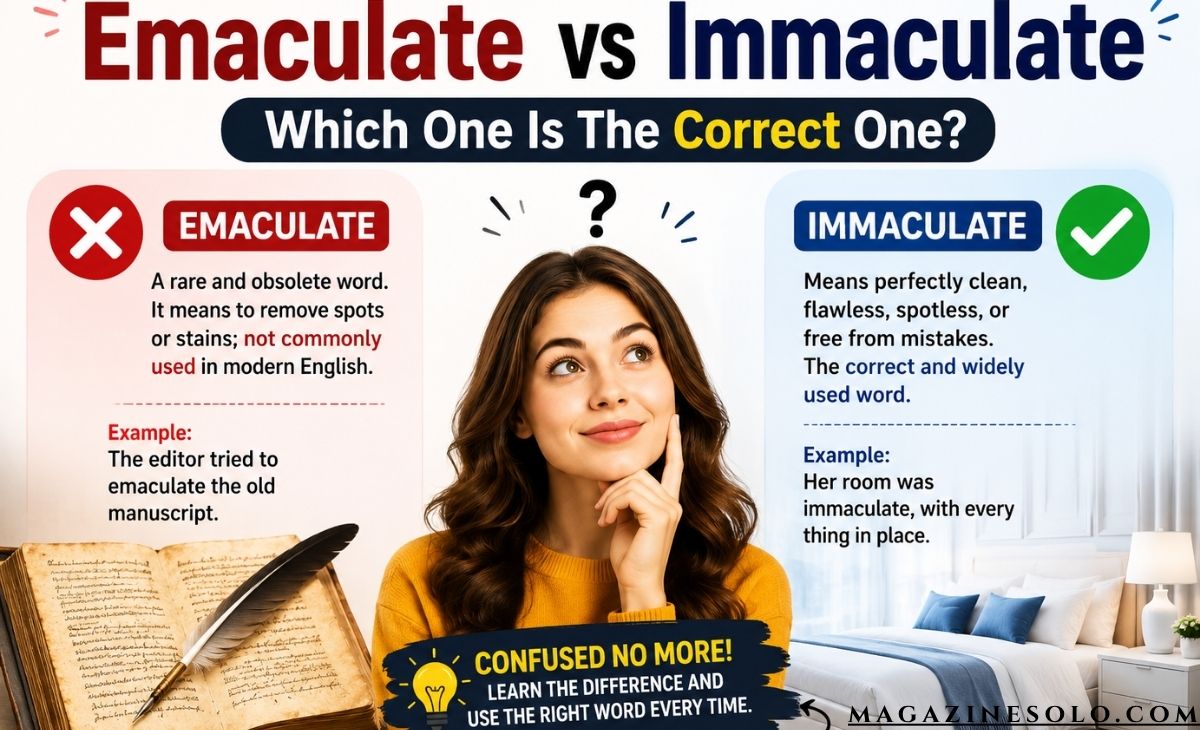
Emaculate vs Immaculate: Quick Difference

| Word | Meaning | Correct Modern Usage | Example |
| Emaculate | Rare obsolete word meaning “to remove stains or spots” | Rarely used today | “The editor tried to emaculate the text.” |
| Immaculate | Perfectly clean, flawless, pure, or without mistakes | Correct and commonly used | “Her kitchen was immaculate.” |
In modern English, immaculate is almost always the correct choice.
What Does Immaculate Mean?
The word immaculate is an adjective that comes from the Latin immaculatus, which literally means “unstained” or “spotless.” It’s built from the prefix im- (meaning “not”) and macula (meaning “spot” or “stain”). So at its core, immaculate means free from any spot, stain, or flaw.
In everyday use, immaculate describes:
- Physical cleanliness — a spotless kitchen, a gleaming car, a tidy bedroom
- Flawless performance — an athlete’s technique, a musician’s timing, a chef’s presentation
- Moral or spiritual purity — most famously in “the Immaculate Conception,” a Catholic doctrine referring to the Virgin Mary being free from original sin
- Professional or personal excellence — an immaculate record, immaculate credentials, an immaculate reputation
The word carries a strong positive connotation. When something is immaculate, it suggests care, precision, and an absence of any defect whatsoever.
What Does Emaculate Mean?
The word emaculate is an old and obsolete English term derived from Latin. Historically, it meant:
“To remove spots, stains, or imperfections.”
Unlike what many websites incorrectly claim, emaculate does not mean thin, weak, or frail. That definition is inaccurate and not supported by standard dictionaries. The confusion likely comes from misunderstanding similar-sounding words.
Today, emaculate is rarely used in modern English. Most people encounter it only in historical texts, old dictionaries, or spelling mistakes.
Example of Emaculate
- “The scholar worked hard to emaculate the manuscript.”
This usage sounds outdated in modern writing.
Important Note
If you are writing modern English content, emails, blogs, or academic work, you should usually avoid using emaculate because readers may think it is simply a spelling mistake.
How To Properly Use The Words In A Sentence
Getting immaculate right is mostly about context. Ask yourself: am I describing something spotless, flawless, or pure? If yes, immaculate is the right choice. Below are the most common situations where immaculate fits naturally:
Describing cleanliness:
- “The hotel suite was immaculate — every surface polished and every pillow perfectly positioned.”
- “She keeps her kitchen immaculate, wiping down counters after every single meal.”
Describing flawless performance or skill:
- “His footwork during the match was immaculate, drawing applause from everyone watching.”
- “The surgeon’s technique was immaculate, leaving no room for error.”
Describing appearance:
- “He arrived at the interview in an immaculate navy suit, shoes polished to a shine.”
- “Despite the long journey, she looked immaculate when she stepped off the plane.”
Describing reputation or record:
- “The company has maintained an immaculate safety record for over two decades.”
- “Her academic record was immaculate — straight A’s from the very first semester.”
Using emaculate (rare/technical):
- “The rescued stray appeared emaculate, its ribs showing through patchy fur.” (informal, better replaced with emaciated)
- “The specimen was classified as an emaculate variety due to its unmarked wing surfaces.” (biological context)
More Examples Of Emaculate & Immaculate Used In Sentences
Seeing both words used clearly in context helps reinforce the difference. Below are 10 examples for each:
Immaculate — 10 Example Sentences
- The operating theatre was kept immaculate to reduce the risk of infection.
- Her garden was immaculate, with not a single weed between the flower beds.
- The vintage sports car was in immaculate condition, looking as if it had never left the showroom.
- His handwriting was immaculate — neat, even, and easy to read.
- The conference room was immaculate before the board of directors arrived.
- Every dish the chef plated had an immaculate presentation.
- She delivered an immaculate speech, not once stumbling over her words.
- The museum’s exhibition space was immaculate, with each artifact carefully lit and preserved.
- His service record was immaculate — no complaints, no disciplinary action, not once.
- The wedding venue looked immaculate, every table adorned with fresh white flowers.
Emaculate — 10 Example Sentences
- The rescued dog looked emaculate, its bones visible beneath loose, patchy skin.
- After months of illness, the patient’s emaculate frame shocked even his doctors.
- The abandoned farmhouse had an emaculate, hollow quality — stripped bare by years of neglect.
- The wildlife researcher noted that the moth was an emaculate specimen, entirely lacking the usual wing markings.
- Her emaculate figure after the long expedition concerned the expedition’s medical officer.
- The emaculate appearance of the horse suggested it had gone without proper feed for weeks.
- The biologist classified the butterfly as emaculate due to the complete absence of its characteristic spots.
- The famine had left many of the villagers in an emaculate condition, barely able to walk.
- Even the oak tree in the corner looked emaculate — its bark peeling, its branches bare.
- The stray cat’s emaculate body prompted the rescue team to act immediately.
Common Mistakes To Avoid
Mistake 1: Writing “Emaculate” When You Mean “Immaculate”
This is by far the most common error. It happens because the words sound similar in natural speech, especially when spoken quickly. Many people have never seen “emaculate” challenged by autocorrect, so they assume it must be correct.
How to avoid it: Remember that immaculate starts with a double-M — imm. Think of words like impossible or immense to anchor that opening sound. A fun memory trick: “I Must Make A Clean Uniform, Look Amazing, Then Exit” — the first letters spell I-M-M-A-C-U-L-A-T-E.
Mistake 2: Confusing “Emaculate” with “Emaciated”
These two are completely different words with no overlap in meaning. Emaciated is the correct medical and descriptive term for someone or something dangerously thin due to illness, starvation, or deprivation. “Emaculate” should not be used as a substitute.
Correct usage:
- “The famine survivors looked emaculate.”
- “The famine survivors looked emaciated.”
Mistake 3: Assuming “Immaculate” Always Means “Perfect”
Immaculate is specifically about being free from stains, flaws, or blemishes. Something can be immaculate in condition but still quite ordinary in quality. A basic apartment can be immaculate. A cheap car can be in immaculate condition. The word describes the absence of fault, not the presence of grandeur.
Mistake 4: Writing “Emmaculate” (Double M, Double M)
Some people overcorrect and write emmaculate with two M’s at the start and another in the middle. This is also incorrect. The correct spelling is simply immaculate , one prefix, one double-M at the start, no extras.
Context Matters
Choosing between these two words is mostly a non-issue in practical writing because immaculate is what you almost always want. Here’s a simple context guide:One helpful rule of thumb: if immaculate makes sense in your sentence, use it. If you’re describing physical frailty or thinness, reach for emaciated instead.
| Situation | Correct Word | Why |
| Spotless kitchen | Immaculate | Means perfectly clean |
| Flawless presentation | Immaculate | Means without errors |
| Historical editing | Emaculate | Obsolete meaning |
| Clean hotel room | Immaculate | Modern usage |
| Ancient manuscript correction | Emaculate | Rare historical context |
Exceptions To The Rules
When “Emaculate” Might Appear in Text
There are a handful of situations where you might legitimately encounter the word emaculate:
Scientific writing: In entomology (the study of insects), emaculate is occasionally used to describe specimens that lack the typical spots or markings of their species. If you’re writing or reading scientific literature in this field, the term may be technically valid.
Historical or literary texts: Older texts , particularly those written before the 20th century , sometimes use emaculate in ways that modern English no longer recognises. Reading older literature, you may encounter it without it being an error in its original context.
Informal writing: In very casual or colloquial writing, emaculate sometimes appears as a substitute for emaciated. While not grammatically recommended, it’s occasionally understood in context.
When “Immaculate” Might Seem Like an Overstatement
In everyday conversation, immaculate can occasionally feel like an exaggeration. If someone’s desk is fairly tidy rather than perfectly organised, calling it immaculate might come across as hyperbole. In these cases, alternatives like tidy, neat, spotless, or pristine might better match the actual degree of cleanliness. That said, immaculate itself is not wrong — it’s just a strong word.
Practice Exercises
Put your understanding to the test with these quick exercises.
Exercise 1: Choose the Correct Word
Fill in each blank with either immaculate or emaculate (or emaciated where appropriate):
- The ballroom was __________, with gleaming floors and freshly polished chandeliers.
- After three weeks lost in the wilderness, the hiker returned looking thin and __________.
- The scientist noted that the moth specimen was __________, entirely lacking its usual wing spots.
- Her essay was __________, free from grammatical errors and beautifully structured.
- The neglected horse had an __________ appearance, its ribs clearly visible.
Answer Key:
- immaculate
- emaciated
- emaculate (technical biological context)
- immaculate
- emaciated (or emaculate in informal use)
Exercise 2: Correct the Sentences
Each sentence below contains an error. Rewrite it correctly:
- “The chef’s plating was emaculate — every element perfectly placed.”
- “The patient appeared immaculate after months without proper nutrition.”
- “She always keeps her office emmaculate and well-organised.”
Corrections:
- “The chef’s plating was immaculate — every element perfectly placed.”
- “The patient appeared emaciated after months without proper nutrition.”
- “She always keeps her office immaculate and well-organised.”
FAQ’s
What is the correct spelling: emaculate or immaculate?
The correct modern English spelling is immaculate. The word “emaculate” is outdated, rarely used, and often considered a spelling mistake today.
What does immaculate mean?
Immaculate means perfectly clean, flawless, spotless, or free from mistakes. It can describe appearance, performance, writing, or reputation.
Is emaculate a real word?
Yes, emaculate exists historically, but it is obsolete in modern English. Most people use it accidentally instead of the correct word “immaculate.”
Is “emmaculate” correct?
No, emmaculate is incorrect. The proper spelling is immaculate, starting with “imm” and containing only one “m” in the middle.
Is “emaculate” a real word in English?
Not in standard modern English usage. It appears in rare historical or scientific contexts, but most dictionaries treat it as obsolete or outdated.
What is the correct spelling — immaculate or emaculate?
The correct spelling is immaculate with a double “m” at the beginning. It comes from the Latin word immaculatus, meaning spotless.
What is the difference between emaculate and emaciated?
Emaciated means extremely thin or weak due to illness or starvation. Emaculate is obsolete and should not replace emaciated in writing.
Can immaculate be used to describe a person?
Yes, immaculate can describe a person’s appearance, clothing, behavior, reputation, or performance as flawless, neat, or perfectly maintained.
How do I remember the spelling of immaculate?
Remember that immaculate starts with “imm,” like impossible or immense. A simple trick is: “Immaculate means impressively clean.”
Is “emmaculate” correct?
No, emmaculate is a spelling error. The only correct modern English spelling is immaculate, commonly used for spotless or flawless things.
Conclusion
Understanding the difference between emaculate vs immaculate is essential for accurate English writing. While both words may sound similar, their meanings and usage are completely different.
The word immaculate is the correct and widely accepted modern English term. It describes something perfectly clean, flawless, spotless, or free from mistakes. It is commonly used in everyday conversation, professional writing, academic work, and SEO content.
On the other hand, emaculate is an obsolete and extremely rare word that historically meant removing stains or imperfections. Most modern dictionaries and writers no longer use it in regular communication.
To avoid confusion:
- Use immaculate for modern English
- Avoid using emaculate unless discussing historical language
By understanding the proper meanings, practicing sentence examples, and avoiding common spelling mistakes like emmaculate, you can improve your grammar, write more professionally, and communicate with confidence.
Whether you are a student, blogger, content writer, or English learner, mastering this small distinction helps make your writing clearer, more polished, and more trustworthy for readers and search engines alike.