Emersion Vs. Immersion: Meaning And Differences
Understanding the difference between emersion vs immersion can help you communicate more clearly in writing, science, education, and everyday conversations. Although these two words look similar, they have completely different meanings and are used in different contexts. Many people also search for immersion vs emersion or mistakenly type emmersion vs immersion, which adds to the confusion.
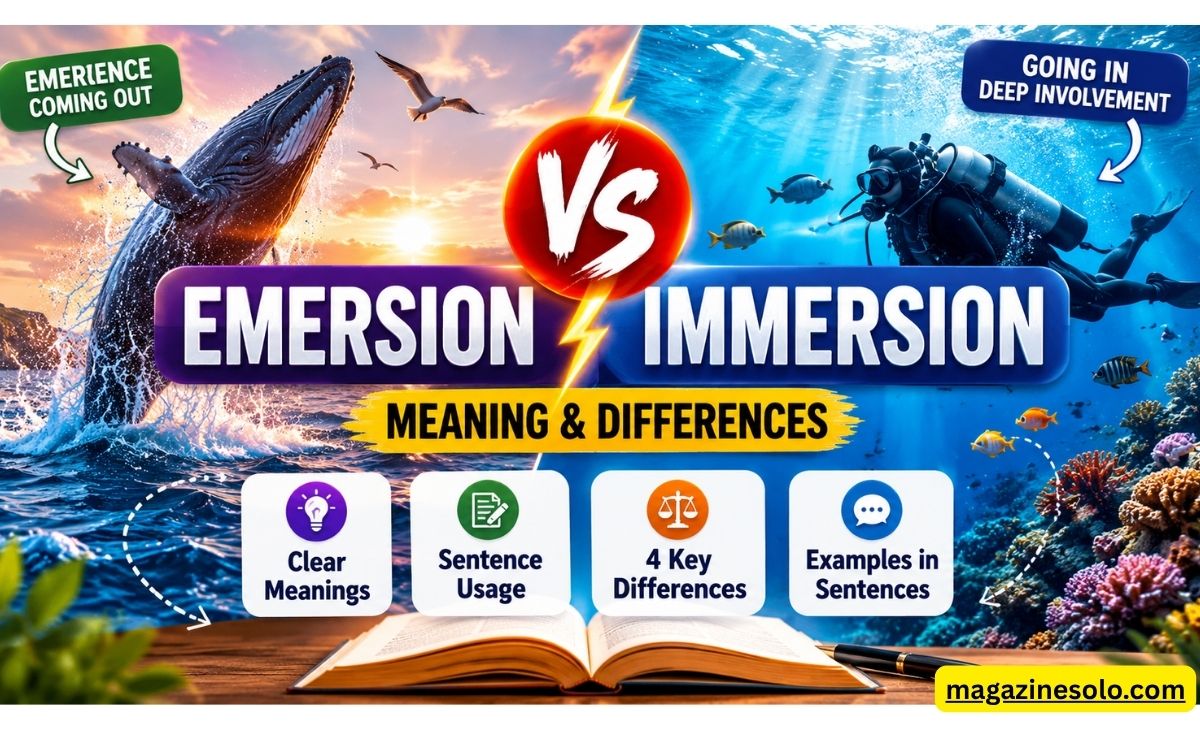
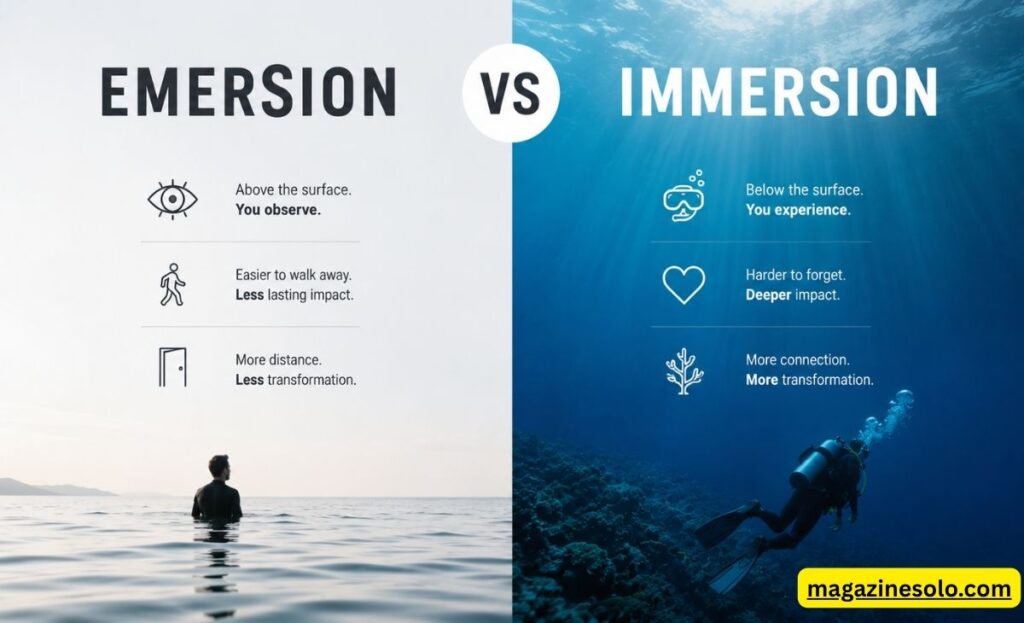
In simple terms, immersion usually refers to being deeply involved, submerged, or absorbed in something, while emersion means coming out from a liquid or emerging into view. Both words originate from Latin roots and are commonly used in science, language learning, psychology, education, and literature.
This guide explains the definitions, usage rules, sentence examples, and the four major differences between immersion and emersion in an easy-to-understand way.
Definitions Of Emersion And Immersion
Before comparing the two terms, it is important to understand their individual meanings.
What Is Emersion?
Emersion refers to the act of emerging or rising out of a liquid, surface, or hidden state. The word is commonly used in biology, botany, marine science, and technical fields.
For example:
- A submarine rising above water is experiencing emersion.
- A plant growing above the water surface is called an emergent plant.
Common Meanings Of Emersion
| Context | Meaning of Emersion |
| Biology | Coming out of water |
| Marine Science | Rising above the surface |
| Botany | Growth above water level |
| General Usage | Emerging into visibility |
What Is Immersion?
Immersion means being deeply involved, submerged, or completely absorbed in something. It can refer to physical submersion in water or mental involvement in an activity, culture, or experience.
For example:
- Language immersion helps students learn faster.
- Virtual reality creates total immersion for gamers.
Common Meanings Of Immersion
| Context | Meaning of Immersion |
| Education | Deep learning through exposure |
| Water/Physics | Being submerged |
| Gaming | Feeling fully involved |
| Psychology | Deep concentration or engagement |
Quick Definition Comparison
| Term | Basic Meaning |
| Emersion | Coming out of something |
| Immersion | Going deeply into something |
This simple distinction is the easiest way to remember emersion vs immersion.
How To Properly Use Emersion And Immersion In A Sentence
Knowing what each word means is half the battle. Knowing when to use them is what separates confident writers from hesitant ones. Here’s a practical guide for using emersion vs immersion correctly every time.
When to Use “Emersion”
Use emersion when you want to describe something or someone rising out of, coming forth from, or reappearing after being hidden. The key directional cue is outward movement, from inside to outside, from hidden to visible, from submerged to surfaced.
Tips for using emersion in a sentence:
- Use it to describe physical emergence from water or another medium.
- Apply it in astronomy when a celestial body reappears after an eclipse.
- Use it metaphorically to describe overcoming adversity or leaving a difficult period behind.
- Remember: emersion is a noun, not a verb. You don’t “emerse” something (though the adjective emersed exists in botany).
When to Use “Immersion”
Use immersion when you want to describe something or someone being placed into, submerged in, or deeply absorbed by something. The directional cue here is inward from outside to inside, from surface level to deep involvement.
Tips for using immersion in a sentence:
- Use it for the physical act of submerging in a liquid.
- Apply it in educational contexts when discussing language learning programs.
- Use it to describe total mental or emotional absorption in an activity.
- In astronomy, use it when a celestial body disappears behind another.
Quick memory trick: Think of the prefix. Im- sounds like “in,” pointing inward. E- (from “emerge”) points outward. In = immersion. Out = emersion.
Emersion vs. Immersion: Four Exciting Differences
While these two words are closely related and even function as antonyms in many contexts, their differences go deeper than just meaning. Here’s a clear breakdown of how immersion vs emersion diverges across four key dimensions.
| Feature | Emersion | Immersion |
| Core Meaning | Rising out of / coming forth | Submerging into / deep absorption |
| Directionality | Outward (from inside to outside) | Inward (from outside to inside) |
| Frequency of Use | Rare; specialized contexts | Common; used in everyday language |
| Fields of Use | Astronomy, marine biology, botany, abstract | Education, religion, technology, science, therapy |
1. Opposite Meanings (They Are True Antonyms)
The most fundamental difference between emersion and immersion is that they mean the exact opposite of each other. Immersion = going in. Emersion = coming out. In astronomy, you’ll see this pair used together to describe a complete cycle: a star undergoes immersion as it disappears behind a planet, and emersion when it reappears on the other side. They describe the full arc disappearing and returning.
2. Different Latin Origins, Same Family
Both words trace back to Latin, but their roots diverge in meaning. Immersion comes from immersio (to plunge or dip into), while emersion comes from emersio (to rise out of or bring forth). Even at the etymological level, immersion and emersion are defined by opposing directions of movement. Understanding this shared-but-divergent history helps writers use each term with confidence.
3. Frequency and Everyday Familiarity
Immersion is dramatically more common than emersion in everyday English. You’ll encounter immersion in conversations about language learning, virtual reality, baptism, cooking, and therapy. Emersion, by contrast, is largely confined to specialized or technical contexts primarily astronomy, marine biology, and botany. This means that in most casual or professional writing, if you’re reaching for one of these two words, you’re probably looking for immersion.
4. Scope of Metaphorical Use
Both words can be used metaphorically, but immersion dominates in figurative language. Writers and speakers regularly use immersion to describe being “lost in” a book, a project, or a culture. Emersion, on the other hand, is more narrowly used in abstract or metaphorical contexts typically to describe coming out of a challenging phase or a period of deep contemplation. Its metaphorical range is narrower but still meaningful.
List Of Examples Of Emersion And Immersion Use In Sentences
Seeing words in action cements understanding faster than any definition can. Below are example sentences covering a wide range of contexts literal, scientific, educational, religious, and metaphorical, for both emersion and immersion.
Example Sentences Using “Emersion”
- The slow emersion of the whale from the ocean’s depths drew gasps from everyone on the research vessel.
- Astronomers recorded the precise moment of emersion when Jupiter’s moon reappeared from behind the planet’s shadow.
- After years of isolation, her emersion into public life again felt both thrilling and overwhelming.
- The emersion of the submarine from the harbor sent shockwaves through the small coastal community.
- Marine biologists track the emersion patterns of intertidal organisms during low tide to measure stress responses.
- His emersion from the fog of grief was gradual, but each day brought a little more clarity.
- The telescope data confirmed the emersion of the star at exactly 03:47 GMT, matching the predicted calculations.
- During the documentary, the filmmaker captured the dramatic emersion of a sea turtle as it breached the surface for the first time.
- Botanists use the term emersion to describe aquatic plants whose leaves and stems grow above the waterline.
- The emersion of new leadership from within the organization marked a turning point in the company’s culture.
Example Sentences Using “Immersion”
- Full immersion in a foreign language, living, eating, and working among native speakers — is widely considered the fastest route to fluency.
- The baptism was performed by immersion, with the pastor lowering the candidate fully into the water.
- The chef recommended immersion of the chicken in brine for at least 12 hours before roasting.
- Her immersion in the novel was so complete that she didn’t notice three hours had passed.
- The virtual reality headset created a sense of total immersion, making it difficult to remember she was still sitting in her living room.
- Language immersion programs in schools have been shown to boost cognitive flexibility and academic performance.
- Astronomers noted the immersion of the star behind the moon’s limb at precisely the calculated time.
- Immersion therapy helped the patient confront his fear of elevators in a controlled, gradual way.
- The scientist lowered the probe into the chemical solution, allowing full immersion before recording the reaction.
- His immersion in Japanese culture during his exchange year gave him a depth of understanding no textbook could provide.
FAQ’s
Is emersion the opposite of immersion?
Yes, emersion and immersion are antonyms. Emersion means rising out or coming forth, while immersion means sinking in or being absorbed.
Is “emmersion” a correct spelling?
No. “Emmersion” is a common misspelling. The correct spellings are emersion (one “m”) and immersion (two “m”s).
Can immersion be used metaphorically?
Yes. Immersion is widely used figuratively to describe deep mental or emotional engagement — such as immersion in a project, a culture, or a story.
Which word is more common in everyday English?
Immersion is far more common. Emersion is mostly used in technical or scientific contexts like astronomy and marine biology.
Are emersion and immersion related to the verbs “emerge” and “immerse”?
Exactly right. Emersion is the noun form of “emerge,” and immersion is the noun form of “immerse.” Both follow standard English noun-formation patterns.
Can emersion be used in educational contexts?
Emersion is occasionally used in education to describe the reflective or analytical phase that follows an immersive learning experience the stepping-back to process and evaluate. Immersion, however, remains far more dominant in educational language.
Conclusion
The debate around emersion vs immersion becomes simple once you understand the core distinction. Emersion refers to coming out, emerging, or rising above a surface, while immersion means going deeply into something physically, mentally, or emotionally.
Although these words sound similar, they belong in different contexts. Immersion is widely used in education, gaming, psychology, and culture, whereas emersion mainly appears in science and marine studies.
Remember this easy rule:
- Immersion = Going in
- Emersion = Coming out
By understanding the difference between immersion vs emersion, you can avoid common mistakes, improve your vocabulary, and communicate more effectively in both professional and everyday writing.

Shoaib Ahmad is a language-focused content writer and researcher at magazinesolo.com, where he explains the meaning of words, phrases, and text in a clear and reader-friendly way. His work focuses on simplifying language, uncovering context, and helping readers understand text with confidence and clarity.