Training or Trainning: Which One Is Correct?
If you’ve ever paused while typing and wondered whether it’s “training” or “trainning,” you’re definitely not alone. This is one of the most common spelling mix-ups in English, and honestly, it makes sense why people get confused. The word has a double consonant pattern that trips up even native speakers sometimes.
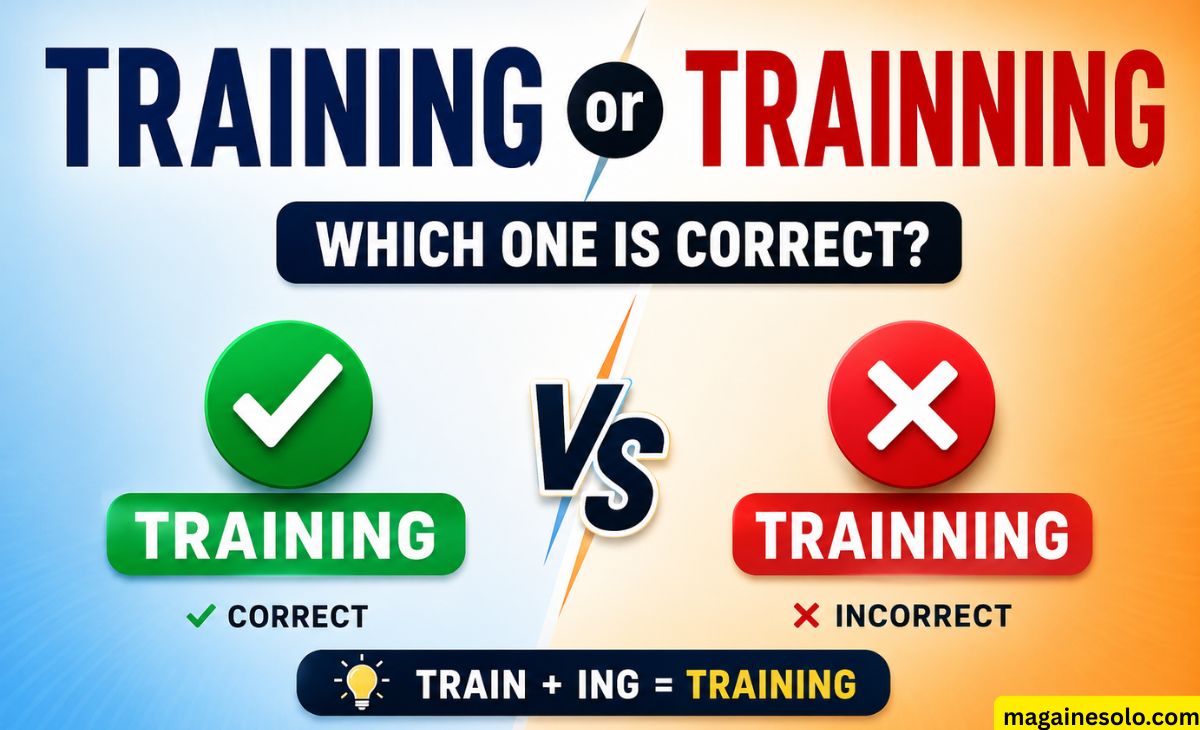
The short answer? “Training” is correct. “Trainning” is simply a misspelling, it doesn’t exist in any English dictionary, formal or informal.
But knowing the right answer isn’t enough. In this guide, we’ll break down exactly why “training” is the correct spelling, why “trainning” keeps showing up as a common error, where the word comes from, and how you can make sure you never misspell it again. Whether you’re writing a resume, a business email, or a school assignment, this article will clear up the confusion once and for all.
Understanding the Correct Spelling
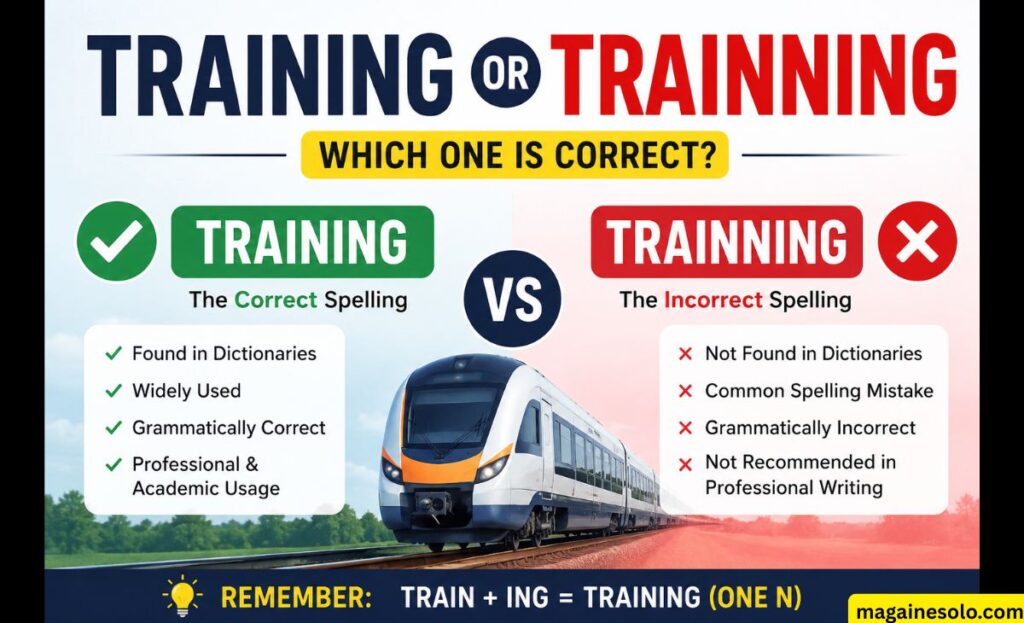
Let’s get straight to the point: the word is spelled T-R-A-I-N-I-N-G, with one “N” in the middle. It comes from the base word “train,” and when you add the suffix “-ing” to form the gerund or present participle, you get “training.”
Here’s the breakdown:
- Train (base verb) + -ing (suffix) = Training
There’s no rule in English that requires doubling the “N” here, which is exactly why “trainning” feels like it should be correct to some people, but it isn’t. The confusion usually stems from other words where consonants do double up when adding “-ing” (like “running” or “planning”), but “training” doesn’t follow that pattern because of how the word is structured.
So whenever you’re debating “training or trainning,” remember: training wins, every single time.
Why “Training” Is Correct
“Training” is the only accepted spelling recognized by major dictionaries, including Merriam-Webster, Oxford, and Cambridge. It’s used universally across:
- Academic writing
- Business and corporate communication
- Job descriptions and resumes
- Educational materials
- Everyday conversation
The word functions as both a noun and a verb form (specifically, the present participle of “train”). For example:
- Noun: “She completed her training last week.”
- Verb (gerund): “He is training for the marathon.”
Because “train” ends in a single consonant preceded by a vowel combination (“ai”), the standard English spelling rule says you simply add “-ing” without doubling the final consonant. This is the same pattern you see in words like “raining,” “gaining,” and “complaining.”
This consistency is part of why “training” is so easy to verify once you understand the underlying spelling rule, it’s not an exception, it’s the rule working exactly as expected.
Why “Trainning” Is Incorrect
“Trainning” is a spelling error that typically happens for one of a few reasons:
- Autocorrect confusion – Sometimes people type quickly and accidentally double a letter, and if autocorrect doesn’t catch it, the mistake goes unnoticed.
- Confusion with doubling rules – English has plenty of words where the final consonant doubles before “-ing” (like “stopping” or “running”). Some writers mistakenly apply that same rule to “train,” even though it doesn’t apply here.
- Non-native speaker influence – For people learning English as a second language, double-consonant patterns can seem more “standard,” leading to overcorrection.
- Simple typing error – Sometimes it’s just a fast-fingers mistake with no deeper reasoning behind it.
Regardless of the reason, “trainning” has no dictionary entry, no grammatical justification, and no acceptable use case in formal or informal English. If you search for it, you’ll likely find it flagged by spell-checkers, grammar tools, and search engines as an error.
The Origin and Meaning of “Training”
To really understand why “training” is spelled the way it is, it helps to look at where the word comes from.
The root word “train” has its origins in Old French, derived from “trainer,” meaning “to drag” or “to draw along.” Over time, the meaning evolved in English to describe the process of teaching, guiding, or preparing someone (or something) through practice and instruction.
Today, “training” generally refers to:
- The process of learning skills for a particular job, activity, or sport
- Physical exercise aimed at improving fitness or performance
- The act of teaching a person or animal a specific behavior
For example:
- “The company offers training programs for new employees.”
- “She’s been training for six months to run a half-marathon.”
- “Dog training requires patience and consistency.”
Because the word carries so many practical, everyday applications, from corporate settings to fitness to education, getting the spelling right matters more than you might think.
Why Spelling Accuracy Matters
You might think a single misspelled word isn’t a big deal, but in certain contexts, it absolutely is. Here’s why spelling “training” correctly matters:
1. Professional Credibility
If you’re writing a resume, cover letter, or business proposal, a spelling mistake like “trainning” can make you look careless, even if your skills and experience are top-notch. Hiring managers and clients often associate attention to detail in writing with attention to detail in work.
2. SEO and Online Visibility
If you’re writing content for a website, blog, or online course, search engines prioritize correctly spelled keywords. Misspellings like “trainning” can hurt your content’s visibility because people are searching for “training,” not “trainning.”
3. Clear Communication
Misspellings can create confusion, especially in instructional or technical documents where clarity is essential. A simple typo can make a sentence harder to read or understand.
4. Building Trust
Whether you’re a business, educator, or content creator, consistent and correct spelling builds trust with your audience. It signals professionalism and reliability.
Side-by-Side Comparison
Here’s a quick comparison table to settle the “training or trainning” debate once and for all:
| Feature | Training | Trainning |
| Correct spelling | Yes | No |
| Found in dictionaries | Yes (Merriam-Webster, Oxford, Cambridge) | No |
| Used in formal writing | Yes | Never |
| Recognized by spell-checkers | Yes | Flagged as error |
| Search engine recognition | High | Low/None |
| Grammatical basis | Follows standard “-ing” rule | No grammatical justification |
As you can see, there’s no scenario where “trainning” is the right choice. It’s simply an error that should be corrected wherever it appears.
Tips for Remembering the Correct Spelling
If you’ve struggled with this word in the past, here are a few simple tricks to help it stick:
- Break it down: Remember it’s “train” + “ing”, just add the suffix, no extra letters needed.
- Compare with similar words: Think of “raining” or “gaining.” These follow the same pattern, single consonant, no doubling.
- Use mnemonic devices: Try this: “One train, one track, one N.” It’s a small phrase, but it can help reinforce the single “N” rule.
- Read it out loud: Sometimes hearing the word helps you visualize the correct spelling, especially if you associate sounds with letters.
- Use spell-check tools: Most browsers, word processors, and writing apps will automatically flag “trainning” as incorrect. Don’t ignore those red squiggly lines!
- Practice writing it in context: The more you use the word correctly in sentences, the more natural it becomes.
Over time, these small habits will help “training” become second nature, no more second-guessing required.
Special Cases
While “training” is always the correct spelling, there are a few related situations worth mentioning:
1. Compound Words
“Training” is often used as part of compound nouns or phrases, such as:
- Training session
- Training program
- Training manual
- On-the-job training
- Cross-training
In all these cases, “training” retains its standard spelling, the rules don’t change just because it’s part of a larger phrase.
2. British vs. American English
Good news here, there’s no difference between British and American English when it comes to this word. Both spell it “training,” so you don’t need to worry about regional variations.
3. Informal Slang or Texting
Even in casual texting or informal writing, “trainning” is still considered a mistake, not an accepted informal variant (unlike words such as “gonna” or “wanna,” which have informal acceptance). So even if you’re texting a friend, stick with “training.”
4. Similar-Sounding Words
Sometimes people confuse “training” with other words that sound similar but have different meanings or spellings, such as “trainee” (a person being trained) or “trainer” (a person or device used for training). These are correctly spelled with their own distinct endings and shouldn’t be confused with the “-ing” form.
FAQ’s
Is “trainning” ever correct in any context?
No, “trainning” is always incorrect. It has no recognized use in any dialect, context, or form of English writing.
Why do people often misspell “training” as “trainning”?
It usually happens due to typing errors or confusion with other “-ing” words that double their final consonant, like “running” or “stopping.”
How can I remember the correct spelling of “training”?
Just remember it’s “train” + “ing”, one word, one extra syllable, no doubled letters. Comparing it to “raining” can also help.
Does British English spell “training” differently than American English?
No, both British and American English use the same spelling: “training,” with no regional variations.
What part of speech is “training”?
“Training” can function as a noun (e.g., “She attended training”) or as a verb form, specifically the present participle of “train” (e.g., “He is training daily”).
Conclusion
If you’ve ever wondered “training or trainning?”, the answer is simple and absolute: training is the only correct spelling.
The confusion usually happens because some English words double their final consonant before adding -ing, such as running or swimming. However, train does not follow that rule because it contains the vowel combination ai. As a result, the correct form is always training.
Whether you’re writing a resume, business email, academic assignment, website article, training manual, online course description, or social media post, always choose training and avoid trainning.
Remember this simple formula:
Train + ing = Training
One train. One “n”. One correct spelling.

Shoaib Ahmad is a language-focused content writer and researcher at magazinesolo.com, where he explains the meaning of words, phrases, and text in a clear and reader-friendly way. His work focuses on simplifying language, uncovering context, and helping readers understand text with confidence and clarity.