In Line or Inline or In-Line? Here’s How to Use Each One Correctly
Have you ever typed a sentence, stared at it, and wondered whether you should write “in line,” “inline,” or “in-line”? You are not alone. These three look almost identical, but they are not the same word wearing different outfits, each one has its own job to do.
The confusion is understandable. All three trace back to the same root idea of “being in a line,” but English split that idea into three separate forms over time, and each one settled into its own corner of the language. One belongs to everyday conversation, one belongs to technical writing, and one belongs to the digital world.
By the end of this guide, you will never have to pause and guess again. We will break down in line or inline, inline or in-line, and every variation in between, with simple rules, real examples, and a quick-reference table you can bookmark.
In Line or Inline or In-Line? Which is Correct?
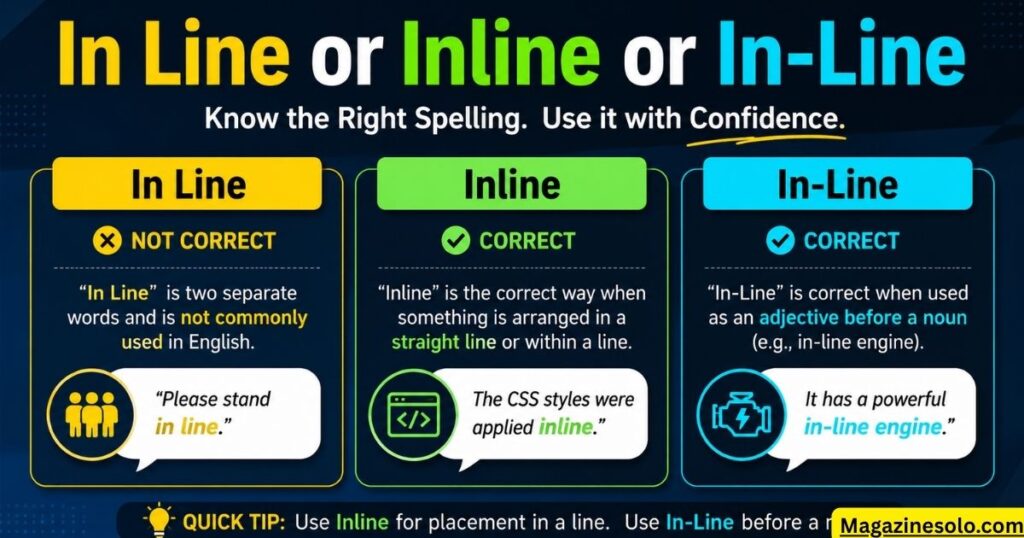
Here’s the short answer: all three spellings are correct, but only in their own context. None of them is universally “more correct” than the others. The trick is matching the right form to the right situation.
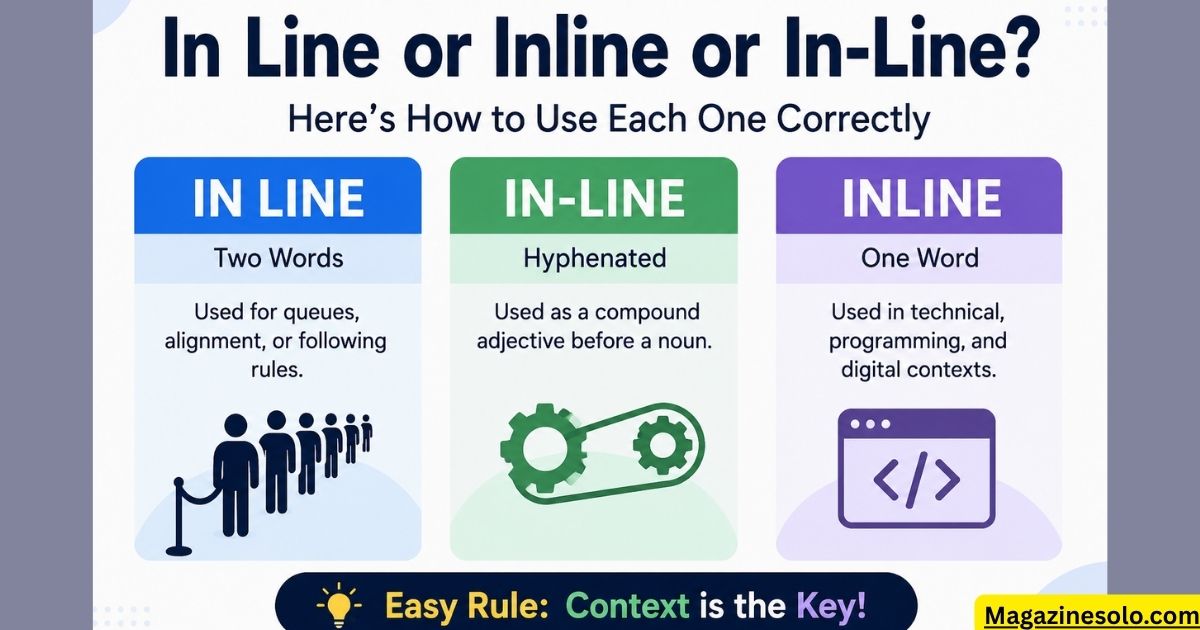
- In line (two words) — used for people, order, or agreement with rules
- In-line (hyphenated) — used as a technical adjective before a noun, often in engineering or machinery
- Inline (one word) — used in coding, web design, and other digital or computing contexts
So when people ask “inline vs in line,” they are really asking which topic they are writing about. Talking about a queue at the bank or matching company policy? Use “in line.” Describing a car engine or industrial equipment? Reach for “in-line.” Writing about HTML, CSS, or a programming function? “Inline” is your word.
Think of it like choosing between “their,” “there,” and “they’re”, they sound related, but the meaning of your sentence tells you exactly which one fits.
In Line: Meaning and Usage
“In line” is the original, everyday version, and it is by far the most commonly used of the three. It works as a phrase rather than a single word, and it covers two main situations.
1. Physical order or position
This is the most literal use. It describes people or objects arranged one behind another, like a queue.
- We had to wait in line for almost an hour to get concert tickets.
- The students walked in line toward the cafeteria.
- Please stand in line until your number is called.
2. Agreement, alignment, or conformity
This figurative use is extremely common in business, academic, and formal writing. It means something matches expectations, rules, or standards.
- Her proposal is in line with the company’s budget goals.
- Make sure your essay stays in line with the assignment guidelines.
- The new policy keeps us in line with industry regulations.
You will also see this idea inside common expressions like “fall in line” (to start following the rules) or “step out of line” (to break the rules). Since “in line” functions as a phrase rather than a compound adjective, it never takes a hyphen, no matter how it’s used in the sentence.
In-Line: Meaning and Usage
“In-line” is the hyphenated, technical sibling of the group. It works as a compound adjective, which means it directly describes a noun that comes right after it, and that’s the clue that tells you to add the hyphen.
You’ll see this version most often in engineering, manufacturing, automotive, and finance writing, where precision matters.
- The mechanic recommended replacing the in-line fuel filter.
- This car uses an in-line four-cylinder engine.
- The factory installed an in-line inspection system on the production belt.
- Our in-line water filter needs to be swapped every six months.
The hyphen here isn’t decorative, it tells the reader that the two words are working together as a single descriptive unit before a noun. Drop the hyphen in a sentence like “in line engine,” and the meaning becomes momentarily unclear, almost like it’s describing an engine waiting in a queue rather than an engine built with cylinders arranged in a straight row.
It’s worth noting that some modern style guides and tech writers are gradually moving away from the hyphen in favor of the single-word “inline,” even in technical fields. So you may occasionally see “inline engine” or “inline skates” in newer writing. Both are acceptable, but “in-line” remains the more traditional and widely recognized choice in formal technical documents.
Inline: Meaning and Usage
“Inline” no space, no hyphen is the modern, digital-first version of the word. It dominates in coding, web development, design, and anything related to computers or software.
Here’s where you’ll typically run into it:
- Web design and HTML/CSS: Elements that sit within the flow of text without breaking onto a new line are called “inline elements.”
- Programming: A function written directly into the code where it’s used, instead of being called separately, is an “inline function.”
- Styling: CSS written directly inside an HTML tag is called “inline CSS” or an “inline style.”
- Sports equipment: “Inline skates” (also written as in-line skates) refer to skates with wheels arranged in a single row.
Example sentences:
- The developer added inline styles directly to the HTML tag instead of using a separate stylesheet.
- Writing inline functions can reduce the number of function calls and speed up your program.
- Inline elements flow naturally with the surrounding text instead of starting a new line.
- Avoid relying too heavily on inline CSS, since it makes your code harder to maintain.
Because “inline” has become the standard spelling across coding documentation, developer blogs, and tech style guides, it’s now the safest choice whenever your topic involves software, websites, or digital systems.
Key Differences Explained Simply
If you only remember one section from this guide, make it this one. Here’s a side-by-side comparison to settle the inline vs in line debate for good.
| Form | Word Type | Best Used For | Example |
|---|---|---|---|
| In line | Two-word phrase | People, queues, agreement, rules | “We stood in line for coffee.” |
| In-line | Hyphenated adjective | Engineering, machinery, technical descriptions | “It has an in-line engine.” |
| Inline | One word | Coding, web design, digital content | “She used inline CSS.” |
A simple mental shortcut: ask what your sentence is about.
- Talking about people or rules? → “in line”
- Talking about machines or equipment? → “in-line”
- Talking about code, websites, or software? → “inline”
Another helpful tip: notice where the phrase sits in the sentence. “In line” almost always follows a verb (“stand in line,” “fall in line,” “stay in line”). “In-line” and “inline,” on the other hand, usually sit right before a noun, acting as descriptive adjectives (“in-line skates,” “inline function”).
Common Phrases You Should Know
Certain expressions show up again and again, so it helps to memorize them as fixed phrases rather than working out the spelling from scratch every time.
Phrases that always use “in line” (two words):
- Stand in line
- Wait in line
- Fall in line
- Stay in line
- In line with expectations
- In line with the rules/policy/budget
Phrases that typically use “in-line” (hyphenated):
- In-line engine
- In-line skates (also seen as “inline skates”)
- In-line pump
- In-line filter
- In-line inspection
Phrases that always use “inline” (one word):
- Inline function
- Inline CSS / inline styles
- Inline elements (web design)
- Inline images
- Inline editing
Keeping a short mental list like this makes the decision almost automatic, even before you think about grammar rules.
Avoiding Common Mistakes
Even confident writers slip up here, mostly because the three forms look so similar at a glance. Here are the mistakes to watch for:
- Using “inline” for people or rules. Writing “Please wait inline” is incorrect — it pulls a digital, coding-related term into a context where it doesn’t belong. The correct version is “Please wait in line.”
- Dropping the hyphen in technical writing. Writing “in line engine” instead of “in-line engine” can confuse readers, since it briefly reads like the engine is waiting in a queue rather than describing its cylinder layout.
- Hyphenating “in line” when it shouldn’t be hyphenated. Phrases like “her actions are in-line with policy” are incorrect. Since this is a verb phrase, not a compound adjective, it stays as two separate words: “in line with policy.”
- Assuming all three are interchangeable. They share a root idea, but swapping them carelessly changes the tone and clarity of your sentence, especially in professional or technical writing.
The fastest way to avoid all four mistakes is the same trick from earlier: identify your topic first — people, machines, or code, and the correct spelling will follow naturally.
FAQ’s
Is it “in line” or “inline” with company policy?
It’s “in line with company policy.” Since this describes agreement with rules, it always stays as two separate words, never hyphenated or combined.
Is “in-line skating” or “inline skating” correct?
Both are widely accepted. “Inline skating” is more common today, especially in casual and sports writing, though “in-line skating” still appears in some technical references.
What is an example of “inline” in coding?
An “inline function” is written directly where it’s called instead of as a separate block, and “inline CSS” refers to style code placed directly inside an HTML tag.
Can “in-line” ever be written without a hyphen?
Yes, especially in modern tech and casual writing, where “inline” has increasingly replaced the hyphenated form, even for technical equipment like engines or filters.
Why do people confuse “in line,” “inline,” and “in-line” so often?
They share the same root meaning of “being in a line,” and they sound identical when spoken, so the confusion usually comes from writing rather than speaking.
Is “fall in line” hyphenated?
No. “Fall in line” is always written as two separate words, since it functions as a verb phrase meaning to start following rules or expectations.
Conclusion
The difference between in line, in-line, and inline comes down to context, not personal preference. “In line” handles queues and agreement with rules. “In-line” steps in for technical, hyphenated descriptions before a noun. “Inline” owns the digital and coding world. Once you connect each spelling to its category, the inline or in line question stops being confusing and becomes second nature and your writing will instantly look more polished and professional because of it.

Shoaib Ahmad is a language-focused content writer and researcher at magazinesolo.com, where he explains the meaning of words, phrases, and text in a clear and reader-friendly way. His work focuses on simplifying language, uncovering context, and helping readers understand text with confidence and clarity.