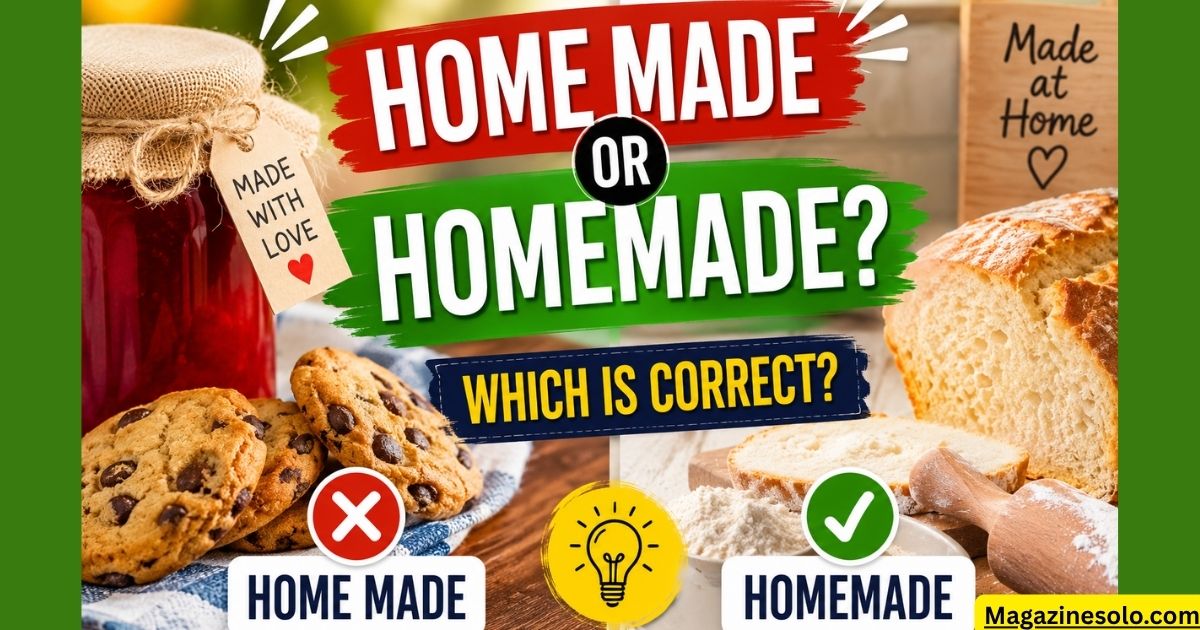
If you’ve ever stopped while writing and wondered, “Is it home made or homemade?”, you’re not alone. Many people get confused because both versions seem correct at first glance. However, modern English follows specific spelling rules, and only one form is considered standard.
Whether you’re writing a recipe, school assignment, blog post, product description, or social media caption, using the correct spelling helps your writing look professional and trustworthy.
In this guide, you’ll learn:
- Whether home made or homemade is correct
- Why homemade is the accepted spelling
- The difference between homemade, home made, and home-made
- How to use the word correctly in sentences
- Common grammar mistakes to avoid
Let’s clear up the confusion once and for all.
Home Made or Homemade? Which is Correct?
The correct spelling is homemade, one word, no hyphen, no space.
That is the short answer. If you are in a hurry, you can stop right there and go fix your document. But if you want to understand why, and avoid making this mistake ever again, keep reading.
Why Homemade is the Correct Spelling
The word homemade is what linguists call a compound adjective. That means two separate words, “home” and “made”, have been permanently joined together to create a brand new word with its own unified meaning.
This happens all the time in English. Think about words like:
- Handmade (not “hand made”)
- Handcrafted (not “hand crafted”)
- Homegrown (not “home grown”)
- Handpicked (not “hand picked”)
All of these follow the same pattern. Over time, English naturally merges two words that are used together constantly into a single, cleaner compound word.
The same thing happened to homemade. It started life as two words (“home made”), gained a hyphen in the middle (“home-made”), and eventually dropped the hyphen entirely to become the single word we use today: homemade.
Every major English dictionary confirms this:
| Dictionary | Listed Form | Notes |
| Merriam-Webster | homemade | One word, standard form |
| Oxford English Dictionary | homemade / home-made | One word preferred; hyphenated accepted |
| Cambridge Dictionary | homemade / home-made | One word is primary entry |
| Collins Dictionary | homemade | One word form listed |
The data from Google Ngram Viewer, a tool that tracks word usage across millions of books, shows that homemade (one word) overtook home-made (hyphenated) as the dominant form in the mid-twentieth century and has been growing ever since. Today, home made (two words) is simply not used in any standard form of English writing.
Writing “home made” as two separate words is incorrect. It creates a grammatical problem too: “home” becomes a noun and “made” becomes a verb, and they no longer work together to describe anything clearly.
Homemade: Meaning and Usage
Now that you know how do you spell homemade, let us talk about what it actually means and how to use it properly.
Homemade is an adjective. That means it describes a noun, a person, place, or thing. Specifically, it describes anything that was made at home rather than produced commercially in a factory or sold ready-made in a store.
Merriam-Webster defines it as: “made in the home, on the premises, or by one’s own efforts.”
The Cambridge Dictionary puts it simply: “made at home and not bought from a shop.”
But here is something interesting, homemade carries more meaning than just its literal definition. When you call something homemade, you are also suggesting:
- Authenticity, it was made with real care and attention
- Freshness, especially for food, it implies made from scratch
- Personal effort, someone put time and love into making it
- Uniqueness, it is not mass-produced or identical to thousands of other items
This is why the word is so powerful in food writing, product marketing, and personal storytelling. Saying “homemade cookies” feels warmer and more special than saying “cookies made at home”, even though they technically mean the same thing.
How to use homemade in a sentence:
Homemade always goes directly before the noun it describes:
homemade bread
homemade soup
homemade candles
homemade remedies
homemade gifts
It can also appear after a linking verb (like “is,” “was,” “are”):
“The jam is homemade.”
“Everything on the menu was homemade.”
Both positions are grammatically correct.
Homemade vs Home-made: Is the Hyphenated Form Correct?
Here is where things get a little more nuanced, because the answer is: sometimes, depending on your style guide.
The History of Home-Made
Home-made (with a hyphen) was actually the original standard spelling. Before English fully merged the two words, writers used the hyphen to show that “home” and “made” were working together as a unit. You will still find “home-made” in older recipe books, classic literature, and vintage packaging from the early and mid-twentieth century.
Over time, as compound words matured and became more established, the hyphen became unnecessary, just as it did with words like “to-day” (today), “to-night” (tonight), and “e-mail” (email).
Is Home-Made Still Acceptable Today?
It depends on two factors: where you are writing and which style guide you follow.
| Spelling | American English | British English | AP Style | Academic Writing |
| homemade | Preferred | Modern standard | (after noun) | Preferred |
| home-made | Outdated | Older texts | (before noun) | Less common |
| home made | Incorrect | Incorrect | Incorrect | Incorrect |
The AP Stylebook (used by journalists and news writers) adds a small twist: it recommends hyphenating compound adjectives when they appear directly before the noun they modify. So under strict AP Style, you would write:
- “She brought home-made cookies.” (before the noun → hyphenate)
- “The cookies were homemade.” (after the noun → no hyphen)
However, unless you are writing for a publication that specifically follows AP Style, homemade (one word, no hyphen) is correct and universally accepted in all positions.
The bottom line: In modern everyday writing, blog posts, recipes, emails, product labels, social media, always use homemade. It is clean, clear, and correct.
Homemade vs Handmade: Are They the Same?
A lot of people use these words interchangeably, but they mean slightly different things:
- Homemade = made at home (location matters)
- Handmade = made by hand (method matters)
Something can be handmade but not homemade (think of an artisan in a workshop). And something can be homemade but not handmade (think of bread made with a bread machine at home). When in doubt, choose the word that best fits what you are describing.
Examples of Using “Homemade” in a Sentence
Seeing a word in action is the best way to understand how it works. Here is a wide range of homemade examples across different topics and styles:
Food & Cooking
- She spent all morning preparing homemade pasta from scratch.
- Nothing beats the smell of homemade bread fresh from the oven.
- He brought a jar of homemade salsa to the backyard cookout.
- The restaurant is famous for its homemade soups and desserts.
- I always add homemade granola to my morning yogurt.
Crafts & DIY Projects
- The kids decorated the classroom with homemade paper flowers.
- She wrapped the gift in a homemade envelope made from old newspaper.
- His homemade bookshelf turned out better than anything from the store.
- They sold homemade candles and soaps at the weekend market.
Remedies & Personal Care
- Grandma swore by her homemade ginger tea whenever anyone had a cold.
- She made a homemade face mask using honey and oatmeal.
- The homemade lip balm she made lasted longer than the store-bought kind.
Gifts & Special Occasions
- A jar of homemade jam is one of the most thoughtful gifts you can give.
- For the holidays, they gave everyone a basket of homemade treats.
- She knitted a homemade blanket for the baby shower.
Professional & Marketing Contexts
- The bakery’s brand is built around the idea of homemade quality.
- Their marketing emphasized that every product is made using homemade recipes passed down through generations.
- The app allows small businesses to market their homemade goods to a wider audience.
Common Spelling Mistakes to Avoid
Even people who know the rule sometimes slip up. Here are the most frequent errors to watch for:
| Incorrect | Correct | Why |
| home made cookies | homemade cookies | Two words = incorrect |
| home-made bread | homemade bread | Hyphen not needed in most styles |
| home-made (no noun after) | homemade | Only AP Style uses hyphen before noun |
| handmade used for “at home” | homemade | Different meaning |
| home-crafted | homemade | Not a standard word |
Quick tip: Before publishing any piece of writing, do a quick search (Ctrl+F) for “home made”, two words, and replace every instance with the single word “homemade.”
FAQ’s
Is it “home made” or “homemade”?
Homemade (one word) is always correct. Writing “home made” as two separate words is incorrect in modern English.
How do you spell homemade?
The correct spelling is h-o-m-e-m-a-d-e, all one word with no space and no hyphen in most contexts.
Is “home-made” with a hyphen correct?
Home-made is an older, mostly outdated form. It is still accepted in some British texts and under AP Style when placed directly before a noun, but homemade (one word) is the modern standard.
What does homemade mean?
Homemade means something made at home by a person rather than produced commercially in a factory or store. It implies care, authenticity, and personal effort.
Is homemade one word or two?
One word. Homemade is a compound adjective, two words permanently joined together. Writing it as two words (“home made”) is a spelling error.
What is the difference between homemade and handmade?
Homemade refers to where something was made (at home). Handmade refers to how something was made (by hand). They are related but not interchangeable.
Can I use “homemade” after a noun, not just before it?
Yes. Homemade works both before a noun (“homemade cookies”) and after a linking verb (“the cookies were homemade”). Both are grammatically correct.
Is “homemade” used the same way in British and American English?
Yes. While older British texts sometimes use “home-made” with a hyphen, modern British English has largely adopted homemade as the standard spelling, just like American English.