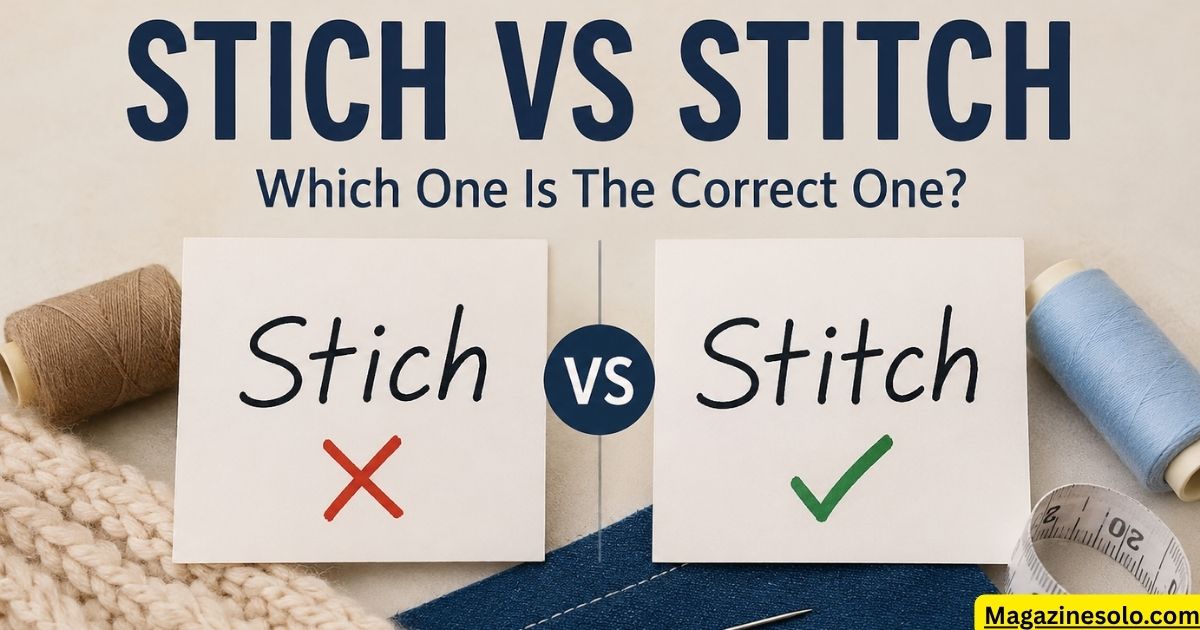
Have you ever typed “stich” and wondered if it was correct? You’re not alone. Many people get confused when comparing stitch vs stich because both words look similar and sound almost the same. However, only one spelling is commonly accepted in modern English.
Whether you’re writing about sewing, knitting, embroidery, medical sutures, or simply improving your grammar, understanding the difference between these words is important. In this guide, you’ll learn what is stich, what stitch means, how to use each word correctly, common mistakes to avoid, and practical exercises to help you remember the right spelling.
Quick Answer: Stich vs Stitch at a Glance
| Feature | Stich | Stitch |
| Correct in modern English? | Rarely / No | Yes |
| Used in sewing or knitting? | No | Yes |
| Used in medical sutures? | Only in very niche usage | Yes |
| Historical/literary meaning? | Line of poetry (archaic) | N/A |
| Found in dictionaries? | Only as an archaic term | Yes, Oxford & Merriam-Webster |
| Common spelling mistake? | Yes | Correct form |
Define Stich
“Stich” (pronounced the same as “stitch”) is an archaic, rarely used word that appeared in early English and literary texts. In classical poetry and prosody, a stich referred to a single metrical line or verse, particularly in ancient Hebrew poetry and early Germanic heroic verse like Beowulf.
Outside of those highly specialized literary or academic discussions, stich has no real place in modern English writing. Both the Oxford Dictionary and Merriam-Webster confirm that it is not the accepted standard spelling for anything related to sewing, knitting, or medical suturing.
So if someone tells you that “stich” is used in medical terminology or British knitting patterns, that is mostly a myth. The standard word across all English-speaking countries, in all fields, is stitch.
Think of “stich” like an old coin you might find in a museum, historically interesting, but not something you use at a shop today.
Define Stitch
“Stitch” is the correct, modern, universally accepted spelling. It is a versatile word that works as both a noun and a verb, and it shows up across many different everyday contexts:
As a noun:
- A single loop of thread or yarn made by a needle in sewing, embroidery, or knitting
- A suture used by doctors or surgeons to close a wound
- A sharp, sudden pain felt in your side during exercise (“I got a stitch from running”)
- A unit in knitting (e.g., “cast on 20 stitches”)
As a verb:
- To join or repair fabric using thread and a needle
- To close a wound with sutures
Examples:
- The tailor added a stitch to fix the loose seam.
- The doctor used five stitches to close the cut.
- I had to stitch the torn pocket back on by hand.
- After the sprint, she doubled over with a stitch in her side.
- The audience was in stitches after his opening joke.
The word “stitch” is also used in popular idioms and even pop culture. The Disney character from Lilo & Stitch is literally named after the word, spelled correctly, with two t’s.
How To Properly Use The Words In A Sentence
Using these words correctly comes down to one simple rule: in almost every situation, use “stitch.”
Here is a quick guide:
Use “stitch” when you are talking about:
- Sewing or tailoring, joining two pieces of fabric, mending a tear, hemming trousers
- Knitting or crochet, each loop on a needle is a stitch
- Embroidery, decorative loops of thread on fabric (cross-stitch, chain stitch, satin stitch)
- Medical sutures, a doctor stitches a wound shut using surgical thread
- Physical pain, the sharp cramp in your side during a run
- Idioms, “a stitch in time saves nine,” “not a stitch of clothing,” “in stitches”
Avoid “stich” unless:
- You are writing an academic paper about classical prosody or analyzing a line of ancient Hebrew poetry
- Even then, most modern style guides recommend the full term “stich” only when you have clearly defined it first
Correct sentence structure:
✅ She carefully stitched the torn hem back together.
✅ The surgeon placed three stitches along the incision.
✅ He laughed so hard he was in stitches.
❌ She carefully stiched the torn hem back together. (misspelling)
❌ The surgeon placed three stiches along the incision. (misspelling)
More Examples Of Stich & Stitch Used In Sentences
To really lock in the correct usage, let us look at a range of real-world examples across different contexts.
In sewing and fashion:
- The designer used a running stitch along the edge of the silk fabric.
- A single loose stitch caused the entire sleeve to unravel overnight.
- She spent hours hand-stitching the appliqué onto the quilt.
In knitting and crochet:
- The beginner accidentally dropped a stitch halfway through the row.
- This pattern requires alternating knit and purl stitches for a ribbed effect.
- Crochet uses a hook, but every loop is still called a stitch.
In medicine:
- The emergency room nurse removed the stitches after ten days.
- Getting stitches after a deep cut is routine for most surgeons.
- The patient asked how long before the stitches would dissolve.
In everyday conversation:
- I got a terrible stitch in my side during the last mile of the race.
- The comedian had the whole crowd in stitches from his very first joke.
- A stitch in time saves nine, better to fix the problem now.
Stich in its rare, correct literary use:
- The scholar examined the opening stich of the psalm to understand its meter.
- Each stich in the poem contained a balanced rhythmic pattern typical of Hebrew verse.
Common Mistakes To Avoid
Even strong writers make spelling errors under pressure. Here are the most frequent mistakes people make with these two words, and how to fix them:
Mistake 1: Writing “stich” when you mean “stitch”
This is by far the most common error. When you type quickly, your fingers can drop the second “t” without you noticing. Your brain hears one “t” sound, but the correct spelling has two.
Wrong: She got a stich in her side after the race. Right: She got a stitch in her side after the race.
Mistake 2: Misspelling the plural as “stiches”
The plural of stitch is stitches, not “stiches.” This is another very common typo.
Wrong: The quilt had hundreds of colorful stiches. Right: The quilt had hundreds of colorful stitches.
Mistake 3: Misspelling the past tense as “stiched”
Wrong: The nurse stiched the wound carefully. Right: The nurse stitched the wound carefully.
Mistake 4: Mixing up idioms
Wrong: The audience was in stiches after the show. Right: The audience was in stitches after the show.
Mistake 5: Thinking “stich” is a valid British spelling
Some websites claim that “stich” is an accepted British variant. It is not. British English uses “stitch” just like American English does.
Context Matters
The word “stitch” adapts beautifully to many different situations. Understanding the context helps you use it, and write around it, with confidence.
In craft and textile contexts, a stitch refers to the individual unit of work: one pass of the needle, one loop of yarn. Embroidery artists speak of the cross-stitch, satin stitch, and French knot. Knitters count their stitches. Tailors assess the quality of a garment stitch by stitch.
In medical contexts, stitches (or sutures) are used to close cuts, lacerations, or surgical incisions. When a wound is “stitched up,” thread or medical staples hold the skin edges together while they heal. Doctors may also use the verb: “I will need to stitch that closed.”
In casual, everyday language, a stitch is that sharp cramp you feel in your abdomen or side when you exercise too hard. It is also an idiom for uncontrollable laughter, being “in stitches” means laughing so hard you can barely breathe.
In literature and academia, the word “stich” (without the second “t”) appears only in highly specialized discussions of poetic meter, particularly in texts analyzing ancient Hebrew scripture or early medieval Germanic poetry. Unless you are writing in that specific academic lane, you will never need this spelling.
Exceptions To The Rules
While the rule is nearly always “use stitch,” there are a small handful of genuine exceptions worth knowing:
1. Classical poetry and prosody
In academic literary analysis, a stich (plural: stichs or stichi) refers to one line of verse. You may encounter this in discussions of distich (a two-line unit) or hemistich (a half-line). These are legitimate uses of the word in their proper context.
2. Historical texts
If you are reading or quoting very old English manuscripts, think pre-1700s, you may encounter “stich” used where modern English would use “stitch.” This is simply an older spelling convention, not a mistake in the original text.
3. Proper nouns and brand names
Some brand names, product labels, or artistic projects use “Stich” intentionally as a stylized or shortened form. In those cases, the spelling is a design choice, not a grammatical rule, and you should always follow the brand’s own style.
In all other everyday situations, sewing, knitting, medicine, conversation, writing, “stitch” is always correct.
Practice Exercises
Test yourself! These exercises will help lock in the correct spelling and usage.
Exercise 1, Fill in the blank with the correct word (stitch / stitches / stitched):
- The doctor needed to ______ the deep cut on his forearm.
- After surgery, the patient had twelve ______ along the incision.
- The seamstress ______ the hem by hand for a cleaner finish.
- She counted every ______ carefully to keep the pattern even.
- Make sure you remove the ______ after one week, the nurse said.
(Answers: 1. stitch, 2. stitches, 3. stitched, 4. stitch, 5. stitches)
Exercise 2, Spot the error and correct it:
- She used a running stich to sew the patch onto her jacket. → ______
- The surgeon placed four stiches to close the wound. → ______
- The crowd was in stiches throughout the entire performance. → ______
- He carefully stiched each piece of leather together. → ______
(Answers: 1. stitch, 2. stitches, 3. stitches, 4. stitched)
Exercise 3, True or False:
- “Stich” is the British English spelling of “stitch.” → False
- “Stitch” can be used as both a noun and a verb. → True
- “Stiches” is the correct plural form. → False (correct: stitches)
- A “stich” in classical poetry refers to a single line of verse. → True
FAQ’s
Is “stich” a real word?
Yes, but only in a very narrow literary context. In classical prosody, a “stich” is a single line of verse. In all other uses, sewing, knitting, medicine, it is simply a misspelling of “stitch.”
Is “stich” the same as “stitch” in British English?
No. Both British and American English use “stitch.” There is no regional variation that makes “stich” correct.
How do I remember which spelling is right?
Think of the phrase: “Two T’s make it tight.” A good stitch holds fabric tight, and so does the double “t” in the spelling.
Can “stitch” be used as a verb?
Yes. “I need to stitch this seam” is perfectly correct. Stitch works as both a noun and a verb in everyday English.
What does “in stitches” mean?
It is an idiom meaning to laugh uncontrollably. Example: “The comedian left the whole audience in stitches.”
Is Lilo & Stitch spelled correctly?
Yes! Disney’s beloved blue alien is named “Stitch”, with two t’s, referencing how he was genetically stitched together by a scientist.
Conclusion
When comparing stitch vs stich, the answer is straightforward: stitch is the correct spelling in almost every modern situation. Whether you’re discussing sewing, knitting, embroidery, tailoring, crochet, fabric repair, or medical sutures, stitch is the word you should use.
The term stich survives only in rare historical literary discussions and is not appropriate for normal writing. If you’re ever unsure, remember this simple rule:
If you’re talking about thread, fabric, sewing, knitting, embroidery, or wound repair, always use “stitch.”
By understanding what is stich, recognizing common spelling mistakes, and practicing with examples, you’ll avoid confusion and use the correct word confidently every time.