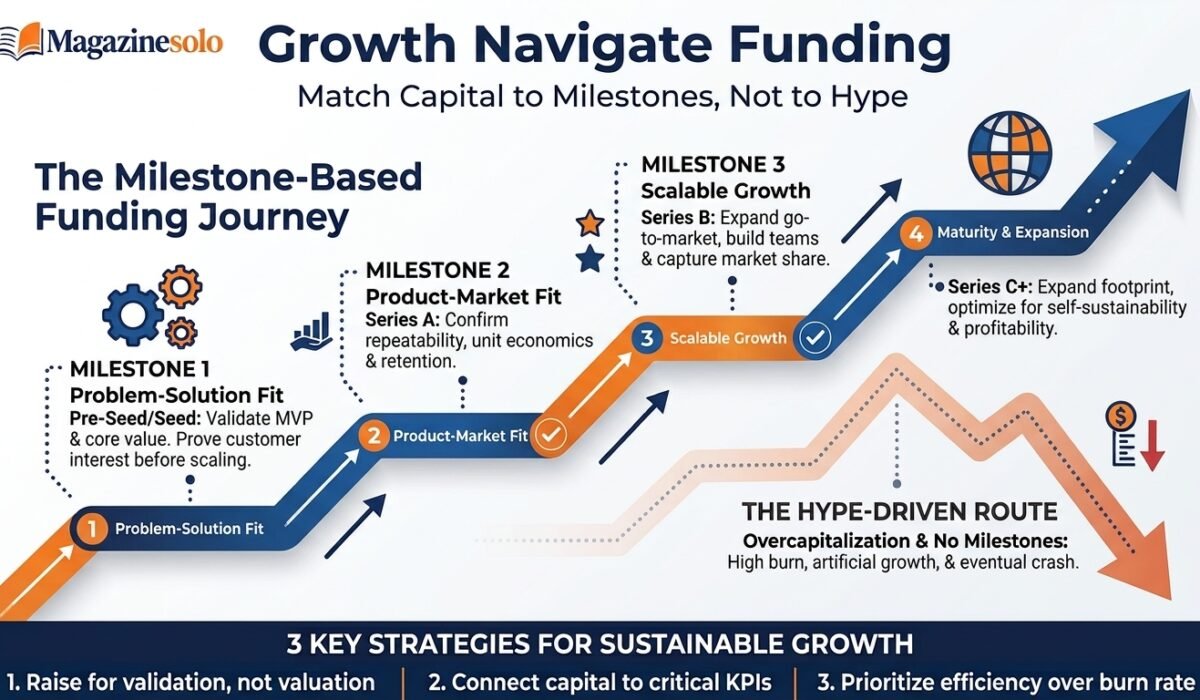
Growth navigate funding fixes that sequence. It starts with a measurable target, works backward to the capital needed, and only then chooses a funding type. That order protects runway, ownership, and cash flow at the same time.
Most founders do not fail because they lack ambition. They fail because they raise the wrong amount, at the wrong time, from the wrong source, for the wrong milestone.
What Growth Navigate Funding Means, and What It Is Not
Growth navigate funding means matching capital to a specific, measurable stage of business growth. You fund a milestone, such as product validation, first repeatable revenue, or market expansion, rather than funding a vague idea of growth.
That definition sounds simple, but it changes every later decision. Amount follows the milestone, source follows the risk, and timing follows runway. A business that needs to prove retention should not raise like a business that needs to scale a proven sales team.
Concept, brand, and product: three different things
First, the concept is a planning approach. It is not a loan, a grant, or a venture fund. Anyone can use the approach, with any capital source, in any US state.
Second, GrowthNavigate.com is a service brand that offers funding help and business advisory services. That brand is not the same as the concept, and using the concept does not require using that brand.
Third, a funding product is a specific instrument, such as an SBA 7(a) loan, a revenue based financing facility, or an equity round. Growth navigate funding helps you choose among products, but it is not itself a product.
The one sentence definition
Set the milestone, calculate the capital to reach it, choose the source that fits that stage, and protect runway and ownership while you deploy it. Every other detail in this article supports that one sentence.
Why timing matters more than amount
A large raise at the wrong time can hurt as much as a small raise. Too much capital too early can push over hiring before product market fit is proven. Too little capital too late forces a raise under pressure, with weaker terms.
Timing also affects valuation. A founder who proves a milestone before raising can often raise at a higher valuation than a founder who raises on a promise. Proof takes time, and time requires runway.
Why founders confuse the phrase with a lender
Search results mix concept articles, brand pages, and general funding guides under the same phrase. That mix creates a false impression that one company owns the term or sells a single product.
Read the page type before you trust it. A service homepage sells a service, a concept guide explains a method, and a lender page sells a loan. All three can be useful, but they answer different questions.
The 6 Step Growth Navigate Funding Process
A working strategy runs in order, with each step building on the last. Skipping a step does not save time, it moves the risk to a later, more expensive stage.
Step 1: Set a measurable milestone
Define growth in numbers, with a date attached. Examples include reaching $100,000 in monthly recurring revenue, signing 50 paying beta customers, entering a second market, or cutting churn below a stated level.
Vague milestones, such as grow fast or go big, cannot be funded well. A lender or investor cannot test a vague target, and a founder cannot know when it is reached. Measurable targets also make use of funds honest and checkable.
Step 2: Calculate capital to that milestone
Work backward from the milestone to the spend needed. Include product, team, marketing, operations, and a buffer for slower progress. Progress often runs slower than a first forecast, so a buffer is not pessimism, it is planning.
Add 18 to 24 months of runway as a planning rule, not as a slogan. That window gives time to build for about a year, then fundraise for about six months, without running out of cash in the middle.
Step 3: Choose the capital type that fits
Match risk to instrument, not to convenience. High risk, unproven ideas suit equity, because equity shares risk. Predictable cash flow suits debt, because debt must be repaid on schedule.
Non dilutive options, such as grants or revenue based funding, suit specific cases, such as research or recurring revenue. The best choice depends on stage, revenue predictability, and how much control you want to keep.
Step 4: Build investor readiness
Investor readiness means clean financials, a credible forecast, and a clear cap table. It also means knowing your customer acquisition cost, lifetime value, churn, and monthly recurring revenue cold, before any meeting.
A pitch deck should state the exact amount needed and what it will achieve. It should not only describe what the money could enable. Specific use of funds builds trust faster than broad vision statements.
Step 5: Negotiate terms, not just amount
Amount is only one term, and often not the most expensive one. Valuation, dilution, board control, liquidation preference, covenants, warrants, and repayment terms can cost more than the headline amount over time.
Compare total cost, repayment shape, ownership impact, and disclosed fees before you accept an offer. A larger offer with harsh terms can be worse than a smaller offer with clean terms.
Step 6: Deploy, track, and adjust
Deploy capital against the milestone plan, then track spend, revenue, retention, and burn each month. If a channel works, scale it with discipline. If a channel fails, cut it early and reallocate.
Monthly tracking turns funding from a one time event into a management system. That system also prepares you for the next round, because you will have real data, not just a forecast.
Funding by Growth Stage: Pre Seed to Series C
Each stage funds a different proof point. Raising for the wrong proof point wastes capital and confuses investors about what success looks like.
Stage and milestone table
| Stage | Main proof point | Typical focus | Planning note |
| Pre seed | Idea can become a product | MVP, team, early validation | Smallest raise, highest risk |
| Seed | Product can become a business | Product market fit signals | Retention and early revenue matter most |
| Series A | Model can scale repeatably | Go to market expansion | Repeatable revenue is the test |
| Series B | Market can expand | New markets, larger team | Efficiency must improve with scale |
| Series C | Business can optimise and lead | Scale, acquisitions, efficiency | Profit path must be clearer |
What investors expect at each stage
Pre seed investors bet mainly on team and problem. They accept limited revenue, but they still want a credible plan and a working prototype path. Seed investors want early traction, such as engaged users, early revenue, or strong retention signals.
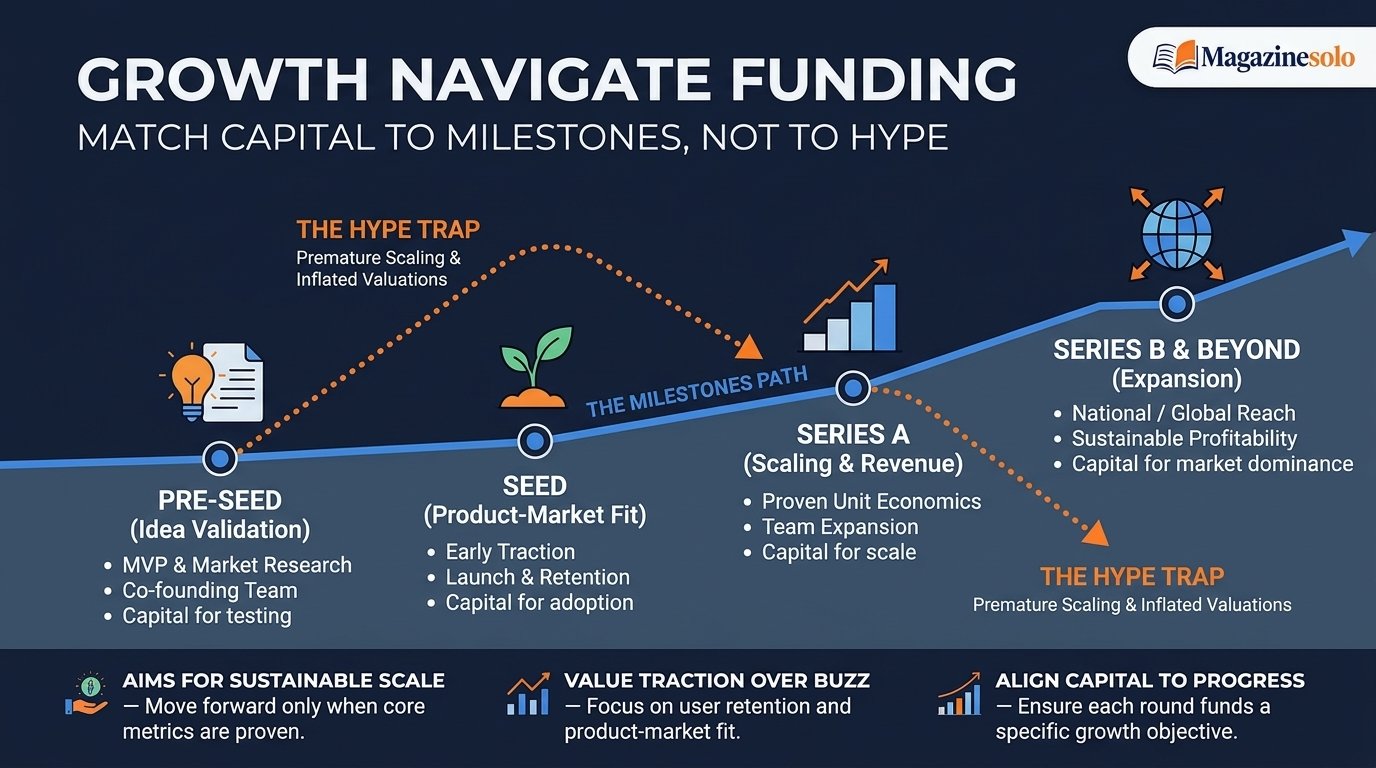
Series A investors need a repeatable model. They want proof that new customers can be acquired at a known cost and retained at a known rate. Later stage investors want scale plus a clearer path to profitability or a strong market position.
Stage amounts: competitor reported, not universal
Competitor guides report wide ranges, and those ranges overlap heavily. One accelerator guide reports pre seed and seed ranges that overlap, which shows why ranges alone cannot decide your raise.
Another secondary guide, citing Carta data, reports a seed median cash raise of $4 million at a $16 million pre money valuation, and a Series A median pre money valuation of $49.3 million. Treat those figures as competitor reported via Carta, and verify Carta directly before citing them as current facts.
Your raise should come from your milestone maths, not from a market average. Averages hide sector, geography, revenue, and team differences that change a fair raise by millions.
Runway Maths Every Founder Must Do
Runway is the number of months you can operate before cash runs out. It is the most important funding number, because it decides whether you raise from strength or from panic.
Burn rate, net burn, and runway formula
Gross burn is total monthly cash outflows. Net burn is outflows minus revenue, and net burn is the number to use for runway. Runway equals cash balance divided by net burn per month.
That formula looks basic, but it forces honesty about spend and revenue. A forecast that hides fixed costs, hiring plans, or marketing spend will produce a false runway and a late fundraising crisis.
Worked example: 20 months versus 5 months
Take two startups with $1,000,000 in cash. Startup A has $50,000 net burn per month, so runway is 20 months. Startup B has $200,000 net burn per month, so runway is only 5 months.
Startup A can build, test, and raise from a position of choice. Startup B must cut costs, raise urgently, or both, and urgent raises usually mean weaker terms and more dilution. Same cash, different burn, completely different future.
When to start fundraising
Start fundraising conversations well before cash becomes urgent. One practical guide suggests starting 3 to 6 months before you need money, while another suggests 9 to 12 months for building investor relationships.
Reconcile those views as a range, not a single rule. Start relationship building 9 to 12 months early with updates, then run a formal raise 3 to 6 months before your runway deadline. Never start a formal raise with less than 6 months of runway if you can avoid it.
Runway targets by stage
Target 18 to 24 months of runway after a raise, in most startup cases. That target gives a full year to execute, then about six months to raise again, with a buffer for delays.
Conservative founders target the top of that range, while aggressive growth plans may accept 12 to 15 months. Shorter runway only works if the next milestone is near, proven, and fundable on a tight timeline.
Compare Every Funding Type in One Table
No single funding type wins for every business. The right choice depends on stage, revenue, assets, control, speed, and cost. Use the matrix below as a decision aid, not as a recommendation.
Decision matrix
| Funding type | Cost type | Speed | Control loss | Best stage or use |
| Bootstrapping | None, but slower | Immediate | None | Validation, low capital needs |
| Angel investment | Equity share | Moderate | Small to moderate | Seed, mentorship, early traction |
| Venture capital | Equity share, large | 1 to 6 months typical | Significant, board input | Rapid, scalable growth |
| SBA loan | Interest, capped | Weeks, paperwork heavy | None, but guarantee and covenants | Stable revenue, expansion, acquisition |
| Bank or online loan | Interest, varies widely | Days to weeks | None, but repayment fixed | Working capital, short term needs |
| Revenue based financing | Fixed fee, revenue share | Days to weeks | None, but cash leak | Recurring revenue, ads, inventory |
| Venture debt | Interest plus warrants | Weeks | Low, but covenants | Extend runway after equity |
| Grants | None, but time cost | 1 to 6 months typical | None | Research, tech, social impact |
| Crowdfunding | Platform and processing fees | Slow to moderate | Varies, rewards or equity | Product validation, community |
| Invoice factoring | Fee per invoice period | Fast | None, but customer contact | Receivables gap |
Equity: angel and venture capital
Angel investors are individuals who invest early, often for a small equity share plus advice and networks. Competitor guides report angel amounts from $25,000 to several million dollars, with wide variation by sector and stage.
Venture capital suits businesses that can scale fast and defend a large market. Competitor guides report seed equity cost around 20 to 25 percent in one guide, and 15 to 30 percent per round in another. Treat those ranges as competitor reported, and model your own cap table before you accept terms.
Equity gives large capital and aligned partners, but it costs permanent ownership. Every percentage sold today is a percentage of all future value, not just current value.
Debt: SBA, bank, online, and venture debt
Debt must be repaid on schedule, with interest, whether revenue grows or not. That fixed obligation makes debt risky for unproven businesses, but cheap for predictable businesses compared with equity over the long term.
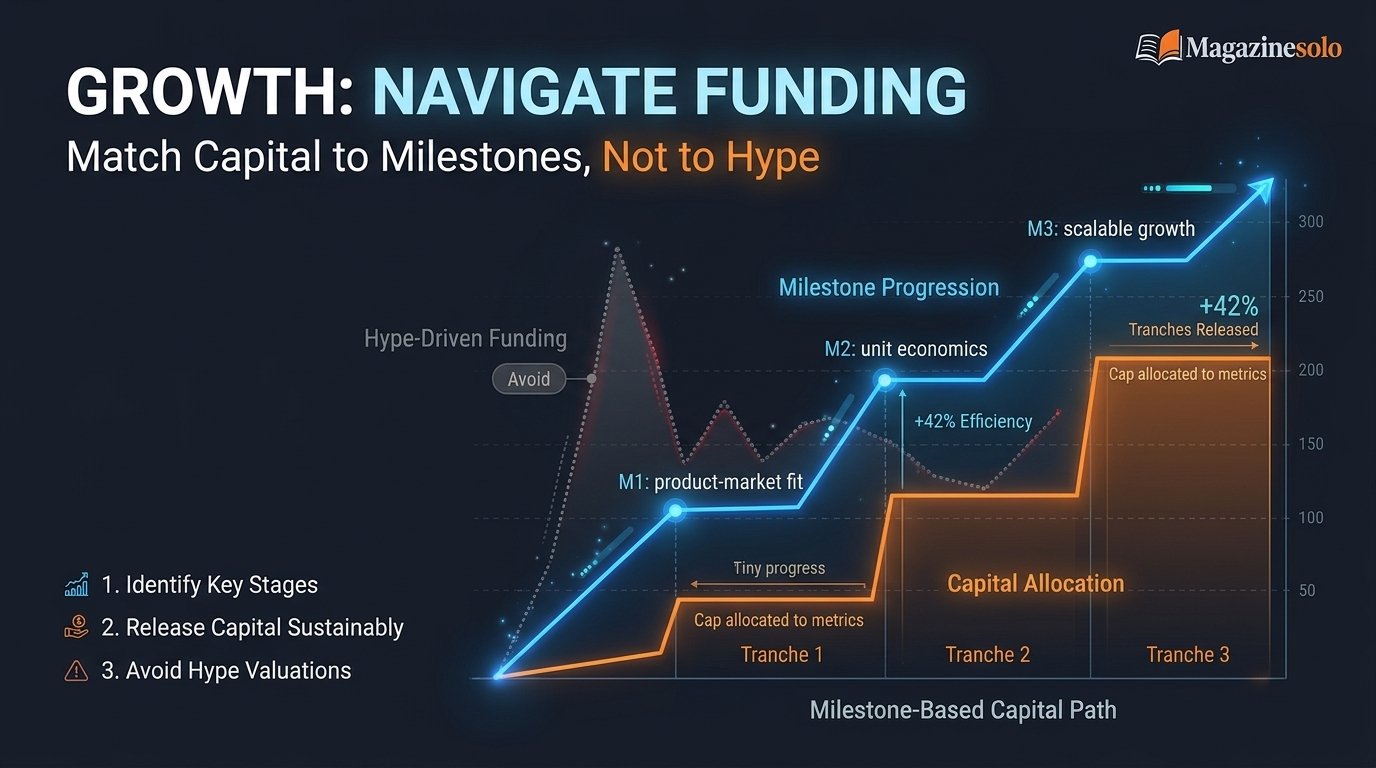
Online loans fund faster than banks, but competitor guides report effective costs from about 14 percent to 99 percent APR for some online products. That range is competitor reported and extremely wide, so never accept an online offer without a full cost disclosure in writing.
Venture debt sits between equity and bank debt. Competitor guides report venture term loans around 10 to 17 percent, with warrants around 0.5 to 2.0 percent, and MRR lines around 10 to 14 percent. Those figures are competitor reported, and actual terms depend on revenue, growth, and prior equity backing.
Non dilutive and hybrid: revenue based, grants, crowdfunding, bootstrapping
Revenue based financing repays as a share of revenue until a capped total is paid. It does not take equity, which protects control, but it takes cash from every new sale until repaid.
Grants do not require repayment or equity, but they are competitive, slow, and often restricted to research, technology, health, or social impact. One competitor table reports grant ranges from $2,500 to $500,000, with 1 to 6 months to funds, as competitor reported figures.
Crowdfunding can validate a product and build a community, but platform and processing fees, plus fulfilment work, can eat returns. Bootstrapping keeps full control, but limits speed to what revenue and savings can fund.
Dilution, Valuation, and Cap Table Basics
Dilution is the reduction in founder ownership when new shares are issued. It is not a punishment, it is the price of external capital. The danger is unplanned dilution, not dilution itself.
Worked dilution example: labelled illustrative only
Imagine founders own 100 percent before a seed round. They sell 20 percent at seed, so founders retain 80 percent. They later sell 20 percent of the enlarged company at Series A, so founders retain about 64 percent of the new total.
That simple example ignores option pools, convertible notes, and SAFEs, which can reduce founder ownership further. A clean cap table model should include every instrument, not just priced rounds, before you sign.
Down rounds and bridge rounds
A down round raises capital at a lower valuation than the previous round. Down rounds damage credibility, hurt morale, and dilute existing holders more than a flat or up round for the same amount.
A bridge round is a smaller interim raise to reach the next milestone. Bridges can be smart when a milestone is near, but repeated bridges signal that the main milestone keeps slipping. Investors read repeated bridges as a warning sign.
Term sheet terms in plain language
A term sheet is a non binding outline of deal terms, but its terms shape the final legal documents. Key terms include valuation, liquidation preference, pro rata rights, protective provisions, board composition, and option pool.
Liquidation preference decides who gets paid first in a sale or shutdown. Pro rata rights let existing investors maintain their percentage in later rounds. Protective provisions can give investors veto power over major decisions.
Do not sign a term sheet without professional review. A business attorney can explain how each term affects control, future fundraising, and exit outcomes for your specific cap table.
SBA Loans in the US: What Founders Must Verify
SBA loans are the main US debt anchor for stable, revenue generating businesses. They are government backed, not government lent, and that distinction matters for expectations and timelines.
7(a), 504, Express, and microloan
The SBA 7(a) loan is the most flexible SBA program, for working capital, equipment, owner occupied commercial real estate, refinancing business debt, and business acquisition. Competitor summaries of SBA.gov report a maximum loan of $5 million, and that figure must be rechecked on SBA.gov at writing time.
The SBA 504 loan focuses on major fixed assets, such as owner occupied real estate and long life equipment, delivered through a Certified Development Company. Competitor summaries report a maximum around $5.5 million for 504, also to be rechecked on SBA.gov.
The SBA Express loan processes faster, with lenders making their own credit decisions, but with a lower guarantee and a lower cap. Competitor summaries report that the Express maximum was reduced from $500,000 to $350,000 effective April 21, 2025, and that change must be verified on SBA.gov before use.
The SBA microloan suits startups and small working capital needs, with competitor summaries reporting a maximum around $50,000. Microloans often come through nonprofit intermediaries, not directly through banks.
What SBA guarantees and what it does not do
The SBA guarantees a portion of the loan, it does not lend directly to borrowers in the 7(a) and 504 programs. Participating banks and non bank lenders make the loan, and the SBA guarantee reduces lender risk.
That structure explains why SBA loans take longer than online loans. Lenders still underwrite credit, collateral, cash flow, and business history, even with a guarantee. A guarantee does not mean approval, and it does not remove repayment duty.
Personal guarantee and eligibility warnings
Competitor summaries of SBA rules cite a personal guarantee requirement for every owner of 20 percent or more of the business, under 13 CFR 120.160(a). Verify that rule on SBA.gov and with your lender, because personal guarantee terms affect personal risk.
Eligibility also depends on business size, use of funds, credit history, and lender requirements. SBA loans are not suitable for every startup, especially pre revenue companies without assets or cash flow. An SBA rejection does not mean a business is bad, it may mean debt is the wrong instrument for that stage.
Revenue Based Financing: When It Helps, When It Hurts
Revenue based financing, often shortened to RBF, buys a share of future revenue at a discount. It is not a loan in the traditional fixed schedule sense, and it is not equity.
How revenue share repayment works
You receive capital upfront, then repay a percentage of monthly revenue until a capped total is paid. When revenue rises, payments rise. When revenue falls, payments fall, which helps cash flow in slow months.
That flexibility is valuable for seasonal businesses, such as eCommerce brands with Q4 peaks. It also means total cost depends on how fast you repay, because a fixed fee paid quickly can have a high effective cost.
RBF before a VC round: the revenue leak problem
One RBF guide warns that venture investors may see an RBF facility as a revenue leak. Every new dollar of revenue is not fully reinvested in growth, because a slice goes to the RBF provider until the cap is reached.
That warning matters if you plan to raise venture capital within 18 months of taking RBF. Frame RBF as a specific, time limited tool for a proven channel, with a clear cap and end date, rather than as general operating capital.
Cost comparison: fee versus interest versus equity
Compare RBF by total fee and effective cost, not by monthly payment alone. Competitor guides report RBF effective rates around 15 to 25 percent, with repayment multiples around 1.3 to 1.5 times in some SaaS guides. Those figures are competitor reported and vary by provider, revenue, and term.

Equity looks free in cash terms, but it costs permanent ownership. Debt looks cheap in rate terms, but it costs fixed repayment and possible collateral. RBF looks flexible, but it costs cash flow during growth. No comparison is complete without all three costs side by side.
Investor Readiness Checklist
Investor readiness is not a pitch deck alone. It is a pack of evidence that lets an investor or lender verify your claims without chasing you for basic documents.
Numbered investor readiness checklist
- Clean cap table. List every founder, investor, option, SAFE, and convertible note, with percentages that add up correctly.
- Clean balance sheet. Reconcile bank, receivables, payables, and debt, with no unexplained gaps or manual adjustments.
- Revenue forecast with scenarios. Show base, upside, and downside cases, with assumptions for growth, churn, pricing, and hiring.
- Unit economics pack. Show customer acquisition cost, lifetime value, LTV to CAC ratio, CAC payback, churn, and monthly recurring revenue where relevant.
- Use of funds table. Show exact amounts by milestone, such as product, hiring, marketing, inventory, and buffer, with dates.
- Milestone history. Show what you promised last time, what you delivered, and what changed, with honest explanations.
- Customer evidence. Show pilot agreements, letters of intent, retention data, or signed contracts where they exist, without overstating them.
- Team and hiring plan. Show who is in place, who is missing, and how new capital fills specific gaps, not just headcount growth.
Pitch deck and use of funds
A strong pitch deck tells a short story: problem, solution, market, model, traction, team, ask, and use of funds. Each slide should support the milestone, not distract from it with vanity metrics.
Use of funds should map to the milestone in dollars and months. For example, a $50,000 eCommerce example in one competitor guide splits $30,000 to inventory and $20,000 to paid ads, with repayments as a share of sales. That split is a competitor example, not a template for every business, but it shows the level of specificity investors expect.
Due diligence pack
Due diligence is the investor or lender check of your claims, documents, and legal standing. Prepare formation documents, tax records, contracts, intellectual property records, and prior funding documents in one organised pack.
Delays in due diligence often come from missing documents, not from bad answers. A ready pack shortens timelines, reduces follow up questions, and signals that the business is managed with discipline.
Sector Playbooks: SaaS, eCommerce, Services, Capital Intensive
Funding that works for SaaS may fail for eCommerce, and funding that works for services may fail for hardware. Sector determines revenue shape, asset base, and cash timing.
SaaS and recurring revenue
SaaS businesses with monthly recurring revenue can use RBF, venture debt, or MRR lines more easily than pre revenue startups. Lenders can underwrite recurring revenue, churn, and retention, rather than only assets.
SaaS investors focus on net revenue retention, CAC payback, burn multiple, and Rule of 40, which balances growth and profit. A SaaS founder who cannot explain those metrics will struggle to raise, even with strong headline growth.
eCommerce and inventory
eCommerce growth needs inventory before revenue, which creates a cash timing gap. Inventory funding, revenue based funding, and lines of credit can bridge that gap, but only if margins and sell through rates are proven.
One competitor example shows an eCommerce brand using revenue share funding for inventory and ads, with payments rising in strong months and falling in slow months. That flexibility helps seasonal peaks, but it still requires a margin that survives the financing fee.
Services and receivables
Services businesses often grow through people, not inventory. Funding needs focus on hiring, working capital, and receivables timing, rather than large capital purchases.
Invoice factoring can help when clients pay slowly, but it costs a fee per invoice period and may involve customer contact. A business line of credit can smooth the same gap with less customer friction, if the business qualifies.
Capital intensive: hardware, climate, defence
Capital intensive businesses need larger, earlier capital for product development, testing, and manufacturing. Venture capital, grants, and strategic corporate investment often fit better than small debt facilities.
These sectors also face longer timelines to revenue, which makes runway planning even more important. A hardware founder who raises for 12 months, but needs 24 months to reach a testable product, will face a bridge round before proof exists.
Mistakes, Traps, and Scam Warnings
Funding mistakes rarely come from one bad decision. They come from a chain: too much spend, too little proof, too late a raise, and too harsh terms accepted under pressure.
Common mistakes to avoid
- Raising before a milestone is clear: Capital without a target becomes general spend, not progress.
- Over hiring before retention is proven: Headcount grows faster than revenue, and burn rises without traction.
- Ignoring unit economics: Scaling a channel that loses money per customer accelerates failure, rather than masking it.
- Accepting the first offer: First offers set a low anchor, especially when runway is short.
- Mixing personal and business finances: Messy records delay due diligence and damage lender trust.
- Using merchant cash advances as growth capital: High effective costs can drain cash flow for months.
- Funding inventory without sell through proof: Stock that does not sell becomes a cash hole, not an asset.
Traps: down rounds, bridges, and RBF leaks
A down round can trigger anti dilution protections, board changes, and morale damage beyond the cash raised. Avoid down rounds by raising earlier, cutting burn earlier, or choosing a smaller bridge with a clear milestone.
A bridge round can be useful for a near milestone, but repeated bridges suggest the milestone keeps moving. Investors will ask why the last bridge did not reach the next round, and a weak answer will cost terms.
An RBF leak can hurt a future venture round, as noted above. If venture capital is the next step, disclose RBF early, show its cap and end date, and explain why it created value rather than just filling a gap.
Scam warnings for US founders
Be wary of any funder that demands a large upfront fee before approval, guarantees funding regardless of credit or revenue, or pressures you to sign the same day. Legitimate lenders and investors disclose fees, terms, and timelines in writing.
Never pay a fee to release a grant, loan, or investment that you did not apply for through a known program. Check SBA programs on SBA.gov, grant programs on Grants.gov, and lender credentials through your state regulator or bank partner before you pay anything.
Numbered Expert Tips
- Fund the milestone, not the month. Every dollar should map to a proof point, a date, and a metric.
- Model dilution before you negotiate. A cap table model prevents surprise ownership loss after two rounds.
- Start investor relationships early. Share monthly updates without an ask, so the formal raise is not a cold introduction.
- Keep 18 to 24 months of runway as a target. Shorter runway only works for near, proven milestones.
- Compare total cost, not headline amount. Interest, fees, equity, warrants, and covenants all count as cost.
- Disclose RBF and debt early to equity investors. Surprise facilities in due diligence damage trust more than the facility itself.
- Use scenario forecasts, not single forecasts. Base, upside, and downside cases show how runway changes if growth slows.
- Track CAC, LTV, churn, and burn monthly. Those four numbers explain most funding decisions to investors and lenders.
- Verify SBA caps and rates on SBA.gov. Competitor tables go stale fast, and SBA policy changed in 2026 on cap coordination.
- Get term sheets reviewed professionally. A short attorney review can save years of control and ownership problems.
FAQs
What is growth navigate funding?
Growth navigate funding is a planning approach that matches capital to a specific growth milestone. It is not a lender, loan, or grant program, and it does not require using any single brand.
Is growth navigate funding a lender?
No, the concept is not a lender. GrowthNavigate.com is a separate service brand, while the general concept can be used with any lender, investor, grant program, or revenue based provider.
Is growth navigate funding legit?
The concept is legitimate as a planning method, but no single product called growth navigate funding is regulated as a loan. Check any provider that uses the phrase for real terms, fees, eligibility, and references before you pay or sign.
How does growth navigate funding work?
You set a measurable milestone, calculate capital to reach it, choose a capital type that fits that stage, build investor readiness, negotiate terms, and track deployment monthly. Each step builds on the last.
What is the difference between growth navigate funding and traditional business funding?
Traditional funding often starts with an application for a set amount. Growth navigate funding starts with a milestone and works backward, so amount, source, and timing follow the proof point, not the application form.
How much funding do I need to grow my business?
Calculate capital from your milestone, not from a market average. Add product, team, marketing, operations, and a buffer, then check that the total gives 18 to 24 months of runway in most startup cases.
How do I calculate burn rate and runway?
Net burn equals monthly outflows minus monthly revenue. Runway equals cash balance divided by net burn per month, so $1,000,000 divided by $50,000 equals 20 months.
When should a startup start raising capital?
Start investor relationships 9 to 12 months before you need money, and run a formal raise 3 to 6 months before your runway deadline. Never start a formal raise with less than 6 months of runway if you can avoid it.
What funding is best for a pre seed startup?
Pre seed funding often comes from founders, friends and family, angels, grants, or small equity rounds. Debt suits pre seed poorly, because pre seed businesses usually lack predictable cash flow to repay fixed obligations.
What do Series A investors expect?
Series A investors expect a repeatable revenue model, with known acquisition cost, retention, and growth. They want proof that the business scales, not just proof that the idea works.
What is LTV to CAC and why do investors care?
LTV to CAC compares lifetime value of a customer to the cost to acquire that customer. A ratio above 3 to 1 is often described as healthy in competitor guides, because it suggests each customer returns far more than acquisition cost.
How much equity do founders give up in a seed round?
Competitor guides report seed equity around 20 to 25 percent in one guide, and 10 to 20 percent in another, with variation by sector and valuation. Model your own cap table, because option pools and notes change the final founder percentage.
What is a down round?
A down round raises capital at a lower valuation than the previous round. It dilutes existing holders more for the same amount, and it can damage credibility and morale if not explained clearly.
What is a SAFE versus a convertible note?
A SAFE is a simple agreement for future equity, usually without interest or maturity in its standard form. A convertible note is debt that converts to equity later, often with interest and a maturity date, so terms differ and need professional review.
What is an SBA 7(a) loan and what is the maximum?
An SBA 7(a) loan is a government backed loan through participating lenders for working capital, equipment, real estate, refinancing, and acquisition. Competitor summaries of SBA.gov report a maximum of $5 million, to be rechecked on SBA.gov before use.
Does the SBA lend directly to businesses?
In the 7(a) and 504 programs, the SBA guarantees a portion of the loan, but participating lenders make the loan. That is why underwriting, paperwork, and timelines still apply even with a guarantee.
What is revenue based financing and how is it repaid?
Revenue based financing provides capital upfront, repaid as a percentage of monthly revenue until a capped total is paid. Payments rise with revenue and fall in slow months, which helps seasonal cash flow.
Can revenue based financing hurt a future VC round?
Yes, it can, if venture investors see the revenue share as a leak that reduces reinvestment. Disclose RBF early, show its cap and end date, and explain the specific value it created before the VC round.
What is venture debt and when does it fit?
Venture debt is debt for venture backed companies, often used to extend runway between equity rounds. It suits businesses with proven revenue and a clear path to the next round, not businesses still searching for product market fit.
Should I bootstrap or raise external capital?
Bootstrap if your business can grow from revenue without giving up control or taking repayment risk. Raise external capital if a proven milestone needs more speed than revenue alone can fund, and if the return on that capital exceeds its cost.
What do I do if I have less than 6 months of runway left?
Cut burn immediately, focus on the nearest revenue milestone, and start urgent, honest conversations with existing investors, lenders, and customers. Do not accept harsh terms in secret, and get professional advice before signing a bridge or high cost facility.
Conclusion: Fund the Milestone, Protect the Runway
Growth navigate funding works when you treat capital as a tool for a specific milestone, not as a reward for ambition. Set the target, calculate the capital, choose the source that fits the stage, and negotiate terms as carefully as amount.
That discipline protects the two assets founders lose first under pressure: time and ownership. Time comes from runway, ownership comes from planned dilution, and both come from starting early, modelling honestly, and tracking monthly.
Work out your next milestone today, calculate your runway from real burn and real revenue, and compare SBA, revenue based, and equity paths on total cost, speed, and control before you accept any offer. That single comparison, done before you need money, is the core of growth navigate funding, and it is what separates companies that scale from companies that stall.

Dilawar Mughal is an SEO expert with 8 years of hands-on experience helping websites grow their organic traffic, rankings, and revenue. He specializes in content-driven SEO, local SEO, and Pinterest SEO, and builds practical, results-focused strategies for businesses and publishers.