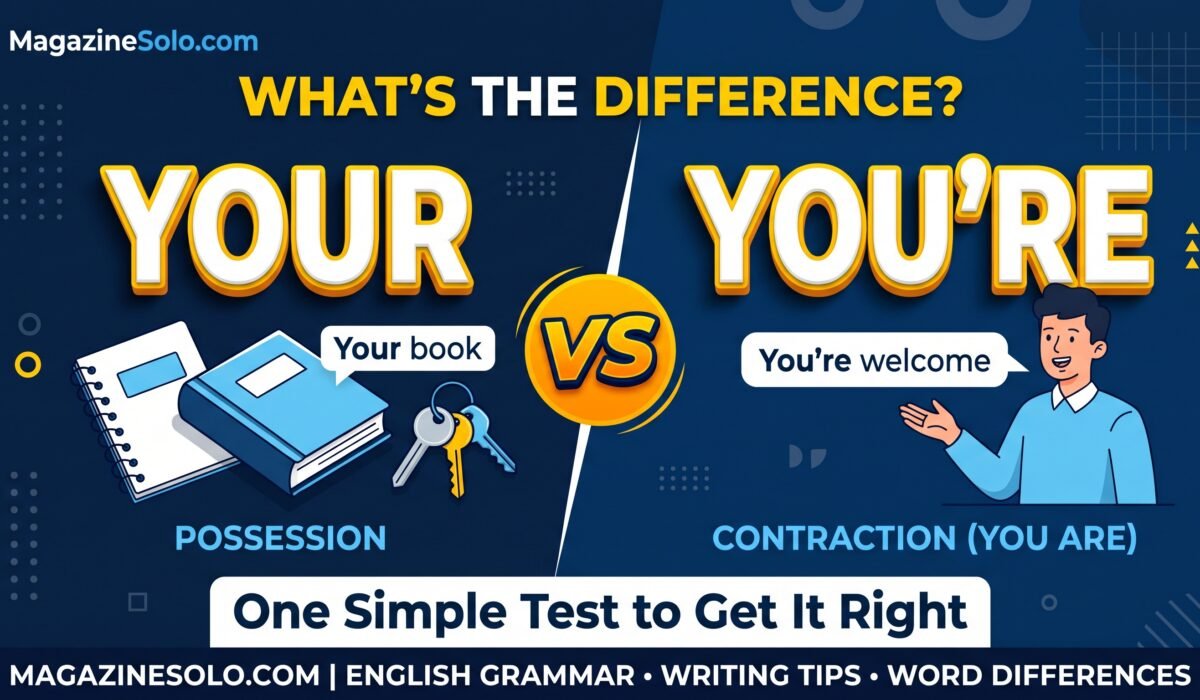
Your vs you’re difference is the most mechanical distinction in English spelling. Your shows belonging: your keys, your turn, your idea. You’re means you are: you’re right, you’re welcome, you’re late. One word attaches to a thing; the other is a pronoun and a verb.
The two words sound exactly alike, so the ear offers no help at all. What settles every case is one small act of grammar. Expand the word to you are and read the sentence again.
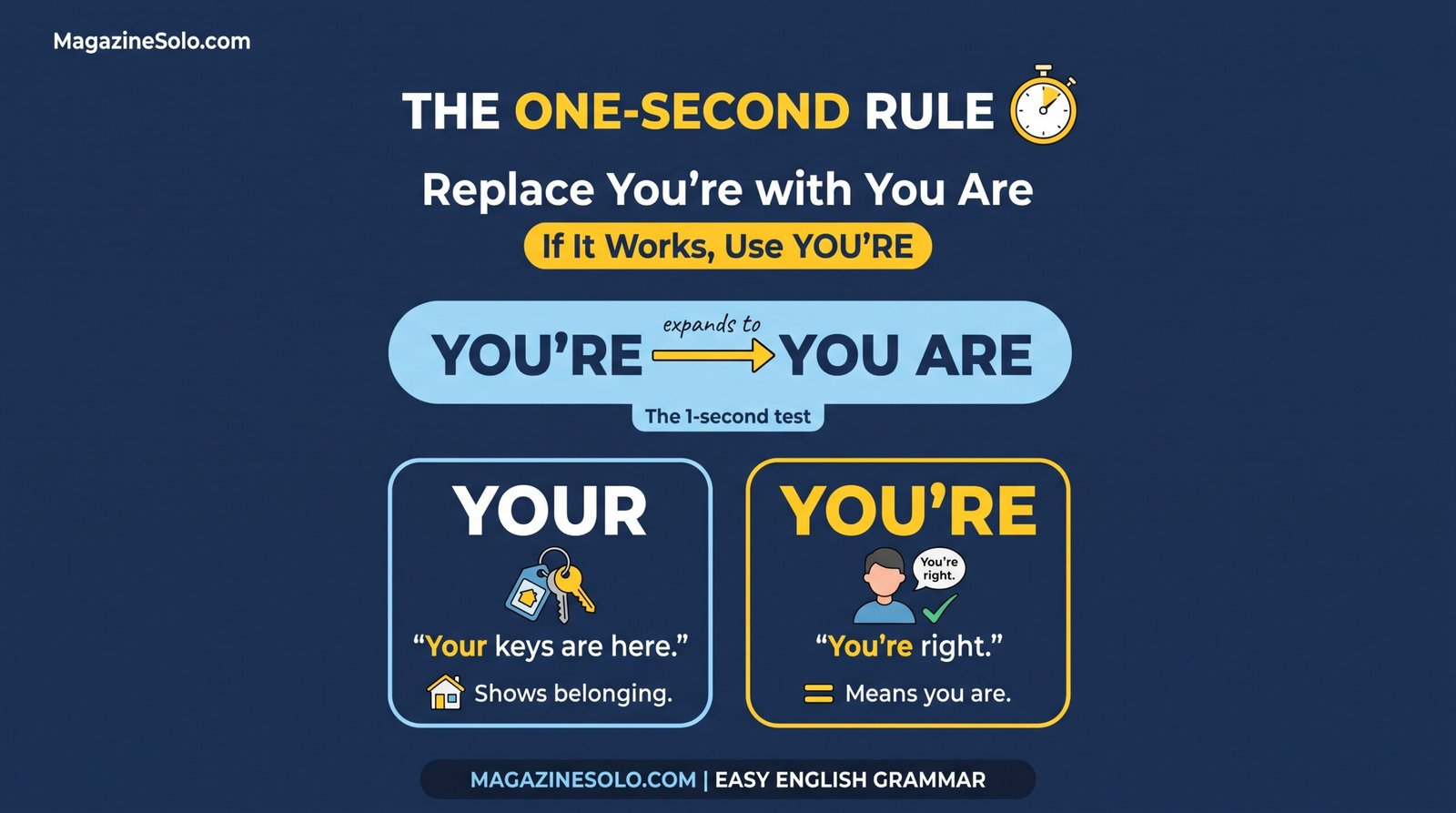
If the sentence survives the expansion, the word is you’re. If it collapses into nonsense, the word is your. The test takes one second, and it has no exceptions, because you’re has exactly one meaning to expand into.
What follows gives the rule, the test, and a complete phrase bank of fixed verdicts. It also explains the backwards apostrophe lesson that causes the error, and the one rule that retires three famous confused pairs at once.
The One-Second Rule
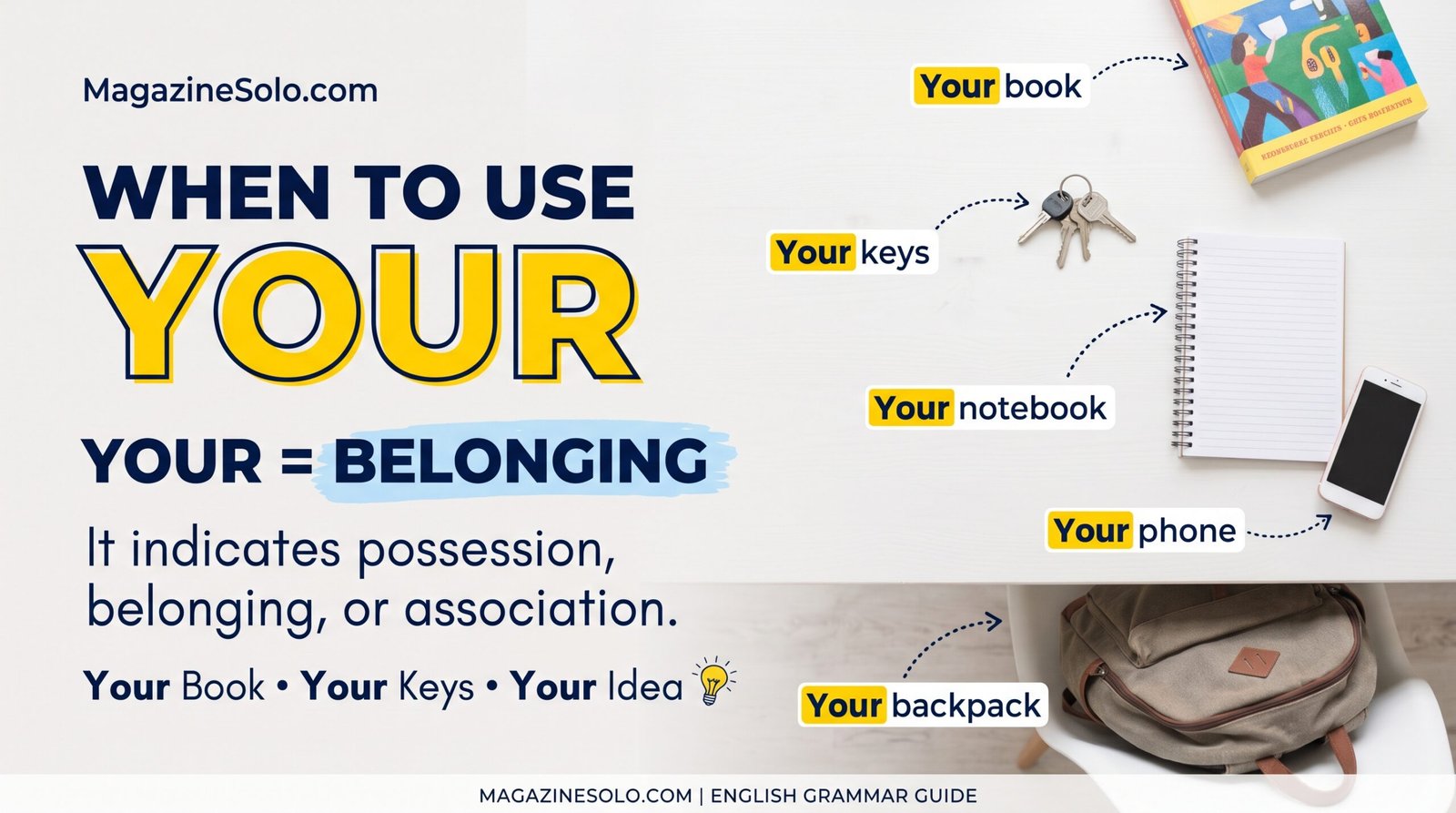
Your is a possessive adjective, also called a possessive determiner. It stands before a noun and answers the question whose. Your book. Your sister. Your turn. It never contains a verb, and it is never followed by silence.
You’re is a contraction, a shortened form of you are. The apostrophe stands exactly where the letter a dropped out of are. It carries a subject and a verb into the sentence, ready to state, identify, or act.
|
Question |
Word |
Example |
|---|---|---|
|
Whose is it? |
your |
Your keys are on the counter. |
|
Can it expand to you are? |
you’re |
You’re right about the time. |
|
Does a noun follow? |
your |
Bring your notes to the meeting. |
|
Does it state what you are? |
you’re |
You’re the best candidate we interviewed. |
The Cambridge Dictionary entry for your and the Cambridge Dictionary entry for you’re divide the pair exactly this way. Belonging on one side, a hidden you are on the other. Every sentence you will ever write with these words is one of those two situations.
The most searched case in the pair sits in the you’re column. The reply to thank you is you’re welcome, because it means you are welcome. Your welcome would claim ownership of a welcome, which is not what anyone means.
Your: The Belonging Word
Your belongs to the possessive adjective set: my, your, his, her, its, our, their. The Merriam-Webster entry for your treats it as the possessive form of you. Its whole job is to attach a following noun to the person being addressed.
H4: Your Before Nouns
The standard shape is your plus a noun. Your car. Your idea. Your presentation starts in five minutes. The noun can be a thing, a person (your uncle), a body part (your arm), or an event (your wedding).
The noun test is nearly as fast as the expansion test. If a thing word follows the blank, your is almost certainly the word standing in front of it. Verbs do not follow your; nouns do.
H4: Your Before Gerunds
Your can also stand before an ing form acting as a noun, called a gerund. Your shouting woke the baby. Your being late caused problems. Here your possesses the action itself, the way it would possess a thing.
Compare the near twin: you’re shouting means you are shouting right now. Same neighborhood, different grammar. Formal writing still prefers the possessive before a gerund, which makes this the one advanced corner of the pair.
H4: Association, Not Just Ownership
Your covers far more than legal ownership. Your bus stop, your doctor, your exit on the highway, your song on the radio. None of these belongs to you on paper. All of them are connected to you in the situation at hand.
Writers sometimes hesitate here, hunting for a stricter word. None is needed. English uses your for association as freely as for possession, and readers never pause over it.
H4: Generic Your
In advice and instructions, your often means anyone’s. Your mileage may vary. Check your spam folder. Know your rights. The writer addresses a general reader as you, and your points at whatever that reader has.
Manuals, signs, and service messages run on this generic your. It is one reason the word appears so often, and one reason its spelling is worth owning completely.
H4: Your Honor and the Fossil Titles
A small family of titles preserves an old possessive address. Your Honor. Your Majesty. Your Excellency. Your Grace. The quality is treated as belonging to the office holder, and the title addresses the quality rather than the person.
These forms always take your. No expansion into you are could ever fit inside them. They are useful anchors precisely because they look formal and strange while obeying the plainest version of the rule.
You’re: You Are in Short
You’re does one thing only, which is its great kindness to writers. The Merriam-Webster entry for you’re lists it simply as the contraction of you are. It has no second meaning, no possessive use, and no exceptions hiding anywhere.
H4: States and Identities
The commonest work of you’re is stating what you are. You’re right. You’re welcome. You’re late. You’re my best friend. You’re the reason the team did well. An adjective or a noun phrase completes the statement.
Each of these expands without a ripple. You are right. You are welcome. That clean expansion is the signature of the contraction, and checking for it becomes reflex with practice.
H4: Actions in Progress
You’re also carries actions happening now or planned next. You’re going to love this. You’re coming to the park later. If you’re finished with your draft, send it over. The ing form of a main verb follows the contraction.
Notice the draft sentence carries both words in their places. If you’re finished with your draft. Contraction for the state of being finished, possessive before the noun draft. Sentences mix the pair this closely all the time.
H4: Formal Writing and Expanding
The most formal registers often expand contractions on principle. Reports, legal documents, and academic papers may prefer you are in full. That is a style decision about contractions generally, not a defect in you’re.
Your is untouched by that decision. It is not a contraction and has no expanded form to switch to. Only the you’re side of the pair ever changes its clothes for formal occasions.
The Expansion Test
One test settles this pair completely. Run it whenever the spelling feels uncertain, and run it over finished drafts when the document matters.
1. Find the word in the sentence. Cover it mentally and prepare to substitute.
2. Say you are in its place. Read the whole sentence aloud or silently with the expansion installed.
3. Judge the result. If the sentence still works, the word is you’re. If it collapses (is that you are car), the word is your.
4. Check the neighbor as backup. A noun following the blank confirms your. An adjective, or an ing verb, following the blank confirms you’re. The neighbor test agrees with the expansion test every time.
Teachers of this pair state the rule at full strength for a reason. If a word cannot expand to you are, you’re is wrong, one hundred percent of the time. Few grammar tests anywhere can honestly promise that.
The Phrase Bank
Fixed phrases take one fixed word, and phrase lookups are how most readers arrive. Keep both families in view. The you’re family expands; the your family possesses.
H4: Always You’re
|
Phrase |
Expansion |
Example |
|---|---|---|
|
you’re welcome |
you are welcome |
Thanks for the ride. You’re welcome. |
|
you’re right |
you are right |
You’re right about the date. |
|
you’re the best |
you are the best |
You’re the best, thank you. |
|
you’re late |
you are late |
Hurry, you’re late already. |
|
you’re going to |
you are going to |
You’re going to love it. |
|
you’re not |
you are not |
You’re not going to believe this. |
|
you’re done |
you are done |
Rest now, you’re done for today. |
|
you’re ok |
you are ok |
I hope you’re ok after the fall. |
|
you’re hired |
you are hired |
You’re hired, start Monday. |
|
you’re amazing |
you are amazing |
You’re amazing under pressure. |
H4: Always Your
|
Phrase |
Possesses |
Example |
|---|---|---|
|
your turn |
the turn |
Your turn to deal the cards. |
|
your call |
the decision |
It is your call entirely. |
|
your move |
the move |
Your move, take your time. |
|
your guess |
the guess |
Your guess is as good as mine. |
|
your keys |
the keys |
Your keys are on the counter. |
|
your name |
the name |
What is your name? |
|
your fault |
the fault |
It is not your fault. |
|
your manners |
the manners |
Mind your manners at dinner. |
|
your service |
the service |
At your service, always. |
|
your rights |
the rights |
Know your rights before signing. |
Read the families as one machine with two outputs. If the phrase is a statement about what someone is, it expands and takes you’re. If the phrase hands someone a thing, a moment, or a decision, it possesses and takes your.
The Backwards Apostrophe Lesson
Here is why this error survives in the writing of people who know better. The first apostrophe lesson most of us learn is that apostrophes show possession. George’s house. Susan’s car. The dog’s bowl. For nouns, that lesson is perfectly true.
Then the same writer meets pronouns, where the system runs in reverse. Possessive pronouns show belonging with no apostrophe at all. And the apostrophe on a pronoun marks a contraction, the exact opposite signal. The error is the first lesson applied faithfully in the wrong territory.
The [LibreTexts apostrophes chapter](https://human.libretexts.org/Bookshelves/Composition/Introductory_Composition/Introduction_to_College_Composition_(Lumen)/04%3A_Grammar/23%3A_Punctuation/23.06%3A_Apostrophes), a university composition reference, states the pronoun rule in its strongest form. Possessive pronouns never have an apostrophe. If a pronoun carries an apostrophe, it is a contraction, not a possessive. That single sentence reorganizes the whole topic.
H4: The Complete List
Print this list whole, because its completeness is the point. The possessive forms that end in an s sound yet take no apostrophe are: ours, yours, his, hers, its, theirs, whose. Add your, my, and her, which end in other sounds, and the family is complete.
Every one of these words is already possessive in its shape. The belonging is built into the word, so English never bolts an apostrophe onto it. Your’s, its’, and her’s are not informal variants; they are nonstandard spellings, full stop.
H4: The Exception That Proves the Split
One family does take the apostrophe: indefinite pronouns. Somebody’s guess. One’s responsibility. Anyone’s problem. These words take apostrophe s exactly the way nouns do, because grammatically they behave like nouns.
The exception is a gift for understanding. It shows the split is not about the meaning of possession. It is about which word class is doing the possessing. Nouns and noun like pronouns mark it; personal pronouns carry it built in.
One Rule, Three Pairs
The rule you just learned is not really about your and you’re. It is the operating system for a whole family of famous pairs. Learn it once and three other error pairs retire with this one.
|
Possessive (no apostrophe) |
Contraction (apostrophe) |
Expands to |
|---|---|---|
|
your |
you’re |
you are |
|
its |
it’s |
it is |
|
their |
they’re |
they are |
|
whose |
who’s |
who is |
Its and it’s cause the most pain, because its looks like it should carry the possessive mark. It does not: the bird escaped from its cage, while it’s means it is. Their and they’re split the same way inside the larger their there they’re trio.
Who’s and whose complete the set. Who’s asks who is; whose asks belonging. Every row obeys the same two laws: possessives carry no apostrophe, and contractions mark the letters that went missing.
Your Right vs You’re Right
One phrase pair shows that this choice can change meaning, not just correctness. You’re right means you are correct. Your right means the right that belongs to you: your right to appeal, your right to remain silent, your right hand side.
Read the two aloud and they sound identical. On the page, the apostrophe decides whether the sentence praises someone or names their entitlement. Few spelling choices carry that much freight in two letters’ difference.
This is also why grammar checkers hesitate here. Both versions are grammatical in many sentences, with different meanings. Software must guess intent, and intent is exactly what a two second expansion check reveals to the writer.
Yours: The Standalone Form
Your has a partner that completes the system. Yours is the possessive pronoun, standing in for the noun instead of standing before it. Your coat is blue; the blue coat is yours. Is this yours? The word works alone, with nothing after it.
Yours never takes an apostrophe, under any circumstances. Your’s is not a word in standard English. If it appears in your draft, the sentence wants your before a noun or yours standing alone, and the expansion test plus the noun test will say which.
The form closes letters with old ceremony. Yours sincerely, yours faithfully, yours truly.
The closing means the letter is sincerely yours, delivered into the reader’s keeping. British convention pairs sincerely with a named greeting and faithfully with Dear Sir or Madam; the apostrophe rule does not move either way.
Mistakes Gallery
The errors below are the ones that actually circulate in emails, posts, and published pages. Each fails the expansion test in a checkable way.
- Your welcome. The flagship error. Expand it: you are welcome works, so the contraction is required. You’re welcome.
- Your the best. Compliments state what someone is. You are the best expands cleanly. You’re the best.
- I hope your ok. Ok describes a state after you. The sentence means you are ok. You’re ok.
- Your going to love it. Going to plus a verb is a future action by you, needing you are underneath. You’re going to love it.
- You’re style is great. Style is a noun being possessed. Expansion fails (you are style is great). Your style.
- You’re answer is correct. Answer is the possessed noun. Expansion fails again. Your answer.
- Your’s truly. The closing pronoun never takes an apostrophe. Yours truly.
- Mind you’re manners. Manners is a noun phrase belonging to the listener. Your manners.
Every gallery item shares one biography. It was typed by ear, at speed, and the ear cannot help with this pair. The test exists because sound was never going to settle it.
Choosing in Real Sentences

Walk through eight live choices, naming the test that decides each one. The expansion does the heavy lifting in all eight.
1. ___ welcome to stay as long as you like. Expand: you are welcome to stay works perfectly. Answer: you’re.
2. Is that ___ umbrella by the door? A noun, umbrella, follows the blank, and expansion collapses. Answer: your.
3. I think ___ right about the schedule. Right states what you are. You are right expands cleanly. Answer: you’re.
4. ___ guess is as good as mine. Guess is a possessed noun, the prediction belonging to you. Answer: your.
5. Do not forget ___ keys this time. Keys is the noun; expansion gives do not forget you are keys, which collapses. Answer: your.
6. ___ the reason we won the grant. The sentence states an identity: you are the reason. Answer: you’re.
7. None of this is ___ fault. Fault is a noun being assigned to its owner. Expansion fails. Answer: your.
8. ___ going to need a bigger room. A future action performed by you needs you are beneath it. Answer: you’re.
The pattern to notice is how little thinking each answer required. One expansion, one glance at the neighbor, done. That is what a mechanical pair offers: certainty at typing speed, once the routine is installed.
More Pairs That Work Like This One
This pair sits inside a family of sound alike traps, and the site cluster works through them with the same method. Name the job of each word, then test the sentence.
The comparison and time split in than vs then difference shows two words that were once a single word. The verb and noun split in affect vs effect adds its two famous exceptions. The friendship and verb pair in ally vs allie turns on one letter.
The spacing question in atleast or at least settles when two words stay two. The Latin phrase hiding in per say or per se explains a spelling nobody can hear. The gratitude and size adverbs in grately vs greatly split on meaning alone.
The hyphen decision in half day or half-day shows punctuation doing the disambiguating. Master the testing habit here, and the whole family becomes a set of one second checks instead of a set of anxieties.
Frequently Asked Questions
What is the difference between your and you’re?
Your shows belonging; you’re means you are. Your stands before a noun: your keys, your turn, your idea.
You’re is you are shortened, the apostrophe marking the dropped a: you’re right, you’re welcome. One attaches to a thing; the other is a pronoun and verb at work.
When do you use your?
When something belongs to, relates to, or is associated with the person you are addressing, and a noun follows. Your book, your sister, your arm, your presentation.
Your answers the question whose, and it never contains a verb. If the next word names a thing, a person, a body part, or an action treated as a thing (your shouting), the word in front of it is your.
When do you use you’re?
When you could say you are in full. You’re is you are with the a removed and an apostrophe marking the gap.
Use it for states (you’re right), identities (you’re my best friend), and actions in progress (you’re going to love this). The test is absolute: if you are does not fit the sentence, you’re is wrong, one hundred percent of the time.
Is it your welcome or you’re welcome?
You’re welcome. The phrase means you are welcome, a full sentence about the other person’s state, so it takes the contraction.
Your welcome would mean the welcome that belongs to you, which is not what anyone intends when answering thanks. This is the single most common your you’re error in everyday writing, and it is the best memory anchor for the whole pair.
What is the fastest test for your vs you’re?
Expand the word to you are and read the sentence. If it still works, the word is you’re.
If it collapses (is that you are car), the word is your. The test takes one second, never fails, and works on every sentence ever written with this pair, because you’re has exactly one meaning to expand into.
Why do people confuse your and you’re?
They sound identical, and the first apostrophe lesson points the wrong way. Apostrophes show possession on nouns (George’s house), so writers add them where possession feels strong.
Pronouns run the reverse system: possession takes no apostrophe, and the apostrophe marks a contraction. Speed and autocorrect finish the job.
Are your and you’re homophones?
Yes. Unlike some famous confused pairs, this one sounds exactly the same in normal speech in both major varieties of English.
There is no pronunciation rescue available. The choice is made by grammar alone, which is why the expansion test, a grammar tool, is the right instrument and the ear is useless here.
What part of speech is your?
A possessive adjective, also called a possessive determiner.
It belongs to the set my, your, his, her, its, our, their, and it modifies the noun that follows it. Grammarians argue about the label (adjective versus determiner) but not about the behavior: your always attaches to a following noun or gerund and shows whose it is.
Is yours the same as your?
No. Your stands before a noun (your coat); yours stands in for the noun (the coat is yours).
Yours is a possessive pronoun, one of the absolute possessives alongside mine, his, hers, ours, and theirs. It never takes an apostrophe and never stands directly before a noun.
Is your’s ever correct?
Never. Your’s is not a word in standard English, in any sentence, at any level of formality.
Possessive pronouns and possessive adjectives take no apostrophes: your, yours, its, hers, ours, theirs, whose. If you have typed your’s, the sentence wants your (before a noun) or yours (standing alone).
Why do possessive pronouns never take apostrophes?
Their possessive meaning is built into the word, so no marker is needed. The complete s-ending list with no apostrophe is ours, yours, his, hers, its, theirs, and whose. University grammar references state it flatly: an apostrophe on a pronoun always marks a contraction, never possession.
If apostrophes show possession in George’s house, why not in your’s?
Nouns and pronouns run different systems. Nouns add apostrophe s to show possession. Pronouns carry ready made possessive forms (my, your, his, hers, its, ours, theirs) that never took apostrophes. Indefinite pronouns like somebody’s and one’s do take them, because they behave like nouns.
Is it your right or you’re right?
Both exist, with different meanings. You’re right means you are correct.
Your right means the right that belongs to you: your right to appeal, your right hand, turn at your right. The apostrophe decides whether you are praising someone’s correctness or naming their entitlement, which is why this pair appears in so many phrase searches.
Is it your the best or you’re the best?
You’re the best. It expands cleanly to you are the best, a statement about what the person is.
Your the best would try to make the best into a possession, which the sentence does not intend. Compliments take the contraction: you’re the best, you’re amazing, you’re a star.
Is I hope your ok correct?
No. It should be I hope you’re ok, because the sentence means I hope you are ok. Ok here describes your state, and states after you take the verb are. Your ok would make ok a possession, and nobody owns an ok.
Is it your going to love it or you’re going to love it?
You’re going to love it.
Going to plus a verb is a future action performed by you, so the sentence needs you are underneath: you are going to love it. Your going appears in a different construction, where going is a noun like thing: your going surprised us, meaning the fact that you went.
Can your come before a verb ending in ing?
Yes, when the ing form works as a noun, called a gerund. Your shouting woke the baby. Your being late caused problems.
Here your possesses the action itself. Compare you’re shouting, where shouting is the main verb and you are doing it right now. The forms look alike and mean different things, and formal writing still prefers the possessive before a gerund.
Does you’re always expand to you are?
Always, without exception. It is a pure contraction with one source phrase.
That purity is what makes this pair easier than it looks: unlike some words with several lives, you’re can be checked mechanically. Expand it; if the sentence survives, keep it; if not, the word is your.
Should I avoid you’re in formal writing?
In the most formal registers, yes, expand it to you are: reports, legal documents, and academic papers often avoid contractions generally.
Your is unaffected, because it is not a contraction and has no expanded form. In ordinary professional writing, emails, reports, and articles, you’re is completely standard.
Why does autocorrect keep swapping your and you’re?
Both words are extremely common and identically pronounced, and each fits many sentence slots. Prediction engines guess from frequency and local pattern, not from your intended grammar. It is the human mistake, automated. A one second expansion check on any message that matters is the cure.
Is it your turn or you’re turn?
Your turn. A turn here is a thing, a slot in a sequence that belongs to you for the moment, like your call and your move.
Because a noun follows, the possessive stands in front of it. You’re turn would expand to you are turn, which no sentence survives.
What does yours sincerely mean, and why no apostrophe?
It is a traditional letter closing meaning the letter is sincerely yours, belonging to the reader in devotion, from the possessive pronoun yours.
No apostrophe, because yours is a possessive pronoun and possessive pronouns never take one. Yours faithfully follows the same pattern, and yours truly in American usage.
How are your and you’re connected to its and it’s, and their and they’re?
They are the same machine in three sizes.
Each set pairs a possessive form without an apostrophe (its, their, your) with a contraction that has one (it’s means it is, they’re means they are, you’re means you are). Learn the rule once, possessive pronouns never take apostrophes, contractions always mark missing letters, and three famous error pairs fall at once.
Is your used for things that are not really owned?
Constantly. Your covers association, not just ownership: your bus stop, your doctor, your exit on the highway, your song coming on the radio.
None of these is legally yours; all are connected to you in the situation. Writers should not hesitate over your just because no deed or receipt exists.
What is generic your?
In advice and instructions, your often means anyone’s: your mileage may vary, check your spam folder, know your rights.
The writer addresses a general reader as you, and your points at whatever that reader has. It is standard in manuals, signage, and service writing, and it is one reason the word is so frequent.
Why do titles like Your Honor and Your Majesty use your?
They are fossilized possessive addresses: the honor and majesty are treated as belonging to the office holder, and the title addresses the quality rather than the person.
Your Honor, Your Majesty, Your Excellency, and Your Grace all follow the pattern. The spelling is always your; the contraction could never expand into these phrases.
Is who’s or whose the same kind of pair?
Exactly the same kind, and it completes the set.
Who’s is a contraction (who is or who has); whose is the possessive, and like all possessive pronouns it takes no apostrophe. Anyone who masters the your you’re rule already owns the who’s whose rule, because it is the same rule wearing a question word.
Can you’re be used at the end of a sentence?
Rarely and awkwardly in writing, because English dislikes ending on a stressed contraction of are; speech does it in short answers (yes, you’re), but written prose usually expands or restructures: yes, you are.
This is a style observation, not a rule, and your never raises the issue since it must be followed by its noun.
Is it your guess is as good as mine, and which word is that?
Your guess, with the possessive. Guess is a noun, the prediction belonging to you, and it stands before that noun.
The idiom means neither of us knows. It is a handy anchor because the sentence is so common that its spelling settles into memory: your guess, your call, your move, all possessives before nouns.
How do I proofread for your and you’re errors?
Search the document for your and you’re. Expand every you’re to you are and confirm the sentence survives.
Check that every your is followed by a noun or a gerund. The pass takes under a minute and catches the whole error class, including swaps autocorrect introduced after you typed correctly.
Is there a sentence with both your and you’re that shows the difference?
The teaching classic: you’re so talented at playing your piano. It is often printed swapped (your so talented at playing you’re piano) so students fix both slots. Nine words carry the whole lesson: contraction for you are, possessive before the noun.
Do British and American English differ on your and you’re?
No. The forms, the rule, the exceptions, and the common errors are identical in both varieties.
The only nearby difference is letter closings: British convention pairs yours sincerely with a named greeting and yours faithfully with Dear Sir or Madam, while American usage leans on yours truly and sincerely yours. The apostrophe rule does not move.
What is the difference between your welcome and you are welcome in tone?
You’re welcome is the standard polite response to thank you in American English, warm and complete.
You are welcome, uncontracted, sounds slightly more formal or emphatic, and it is sometimes used to stress sincerity. Your welcome, by contrast, is simply the spelling error, and it is the version that circulates in screenshots of grammar mistakes.
Can your be a pronoun?
Grammar references classify your as a possessive adjective or possessive determiner, not a pronoun, because it cannot stand alone: a sentence cannot end is that your.
The pronoun job belongs to yours. Some school grammars loosely call the whole family possessive pronouns; the behavior test separates them cleanly either way.
Is it mind your manners or you’re manners?
Mind your manners. Manners is a noun phrase belonging to the person addressed, so the possessive stands before it. The phrase is a small fossil of the noun test: if a thing word follows, your is waiting in front of it.
Why do people write your welcome in professional emails so often?
Because the phrase is typed at pure speed, at the end of a message, by people who know the rule and are not applying it in that second.
Frequency plus haste plus an apostrophe lesson learned backwards produces the error even in careful writers. It is a performance slip, not a knowledge gap, in most professional cases.
How should teachers introduce your vs you’re?
Start with the expansion test as a spoken routine: read you are into the slot and let the class hear whether the sentence survives. Then teach the backwards apostrophe lesson explicitly, naming the George’s house trap. Finish with the swapped piano sentence as a fixing exercise.
Is your ever followed by a full verb?
Not directly.
Your attaches to nouns and gerunds; a full verb phrase after you belongs to you’re (you are running) or to you with another verb (you run). If the next word is a doing word in progress, ask whether you are fits underneath it; if it does, the spelling is you’re.
What about your in your being late, is that formal only?
The possessive before a gerund is the traditional formal choice, and edited prose still prefers your being late to you being late in careful contexts.
Everyday English widely uses you being late as well. Either way, the your version is a real possessive doing real work, not an error, and it never takes an apostrophe.
Is there a quick memory hook besides the test?
Two circulate widely.
The apostrophe in you’re is the missing a of are, so the mark literally shows the hole it fills; and your is the one with our inside it, pointing at belonging, since our is the first person belonging word. Hooks are decoration, though; the expansion test is the tool that never fails.
Do grammar checkers catch your you’re mistakes reliably?
Better than they used to, and still not fully.
In clear slots the fix is easy for software; in tangled sentences both words can be grammatical with different meanings (your right versus you’re right), and the checker must guess your intent. The human expansion pass remains the reliable method for anything published.
Is it at your service or you’re service?
At your service.
Service here is a noun, the help that belongs to you or is offered to you, so the possessive stands before it. The phrase is a small fossil of the noun test, like mind your manners and at your command: a thing word follows, so your is the word in front.
Conclusion
The your vs you’re difference comes down to one hidden phrase.
If you are lives inside the word, the apostrophe marks where its letter fell out, and the spelling is you’re. If no you are can survive in the sentence, the word is the belonging marker, your, standing guard before its noun.
Hold onto the system behind the pair and the spelling stops being a coin flip. Possessive pronouns never take apostrophes; contractions always mark missing letters. That one rule settles your and you’re, its and it’s, their and they’re, and who’s and whose in a single motion.
Run the expansion test on anything that will be read twice, and let autocorrect lose this one. More pairs, tests, and phrase banks are waiting at magazinesolo.com, where the confused words cluster keeps growing.

Dilawar Mughal is an SEO expert with 8 years of hands-on experience helping websites grow their organic traffic, rankings, and revenue. He specializes in content-driven SEO, local SEO, and Pinterest SEO, and builds practical, results-focused strategies for businesses and publishers.