

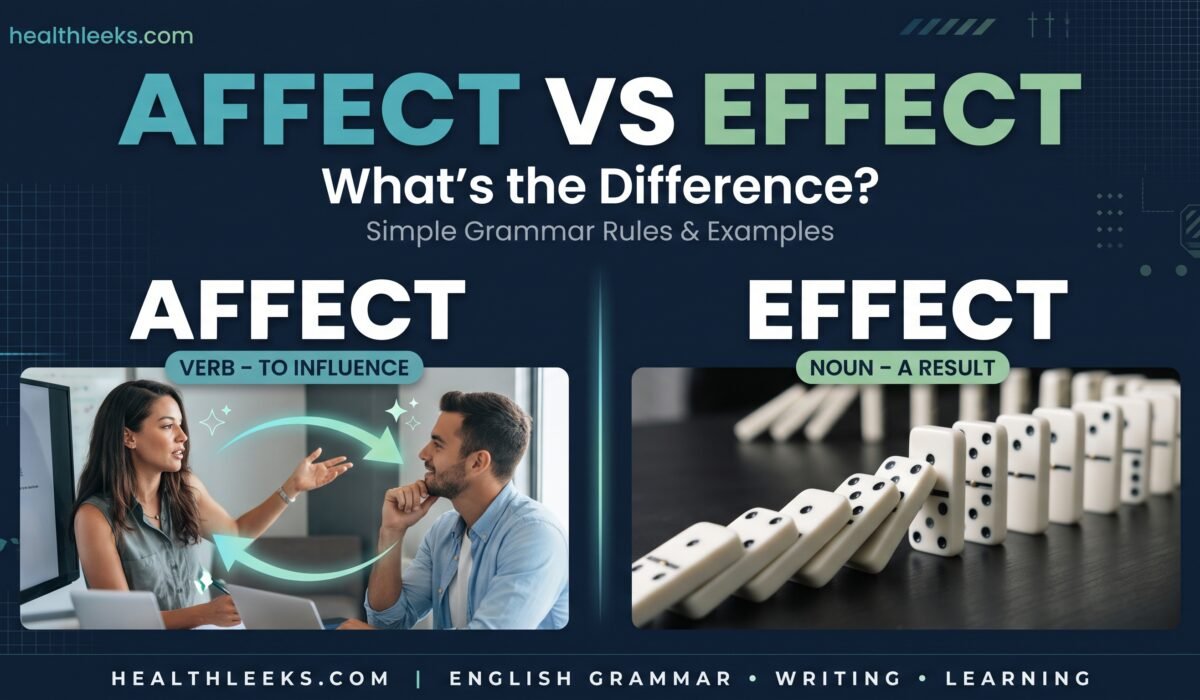
Affect vs effect is the most argued one letter choice in English, and it has a genuinely simple answer. Affect is the verb, to influence. Effect is the noun, a result. Most sentences you will ever write end there.
The pair keeps tripping people because the two words sound the same and live together. One thing affects another and produces an effect, so both words belong in the same breath constantly.
Merriam-Webster’s own usage note on the pair states the working rule in one sentence: think of affect as the verb and effect as the noun, and most of the time you will be using the word you want.
This page adds the tests, the exceptions and the phrases.
The Short Answer
Affect is a verb. It means to influence or produce a change in something. The rain affected the harvest. Stress affects sleep. Her words affected him deeply. In each case something is doing something to something else.
Effect is a noun. It means a result, a consequence, an outcome. The effect was immediate. The medicine had one side effect. Nobody knows what effect the announcement will have. In each case the word names a thing that followed a cause.
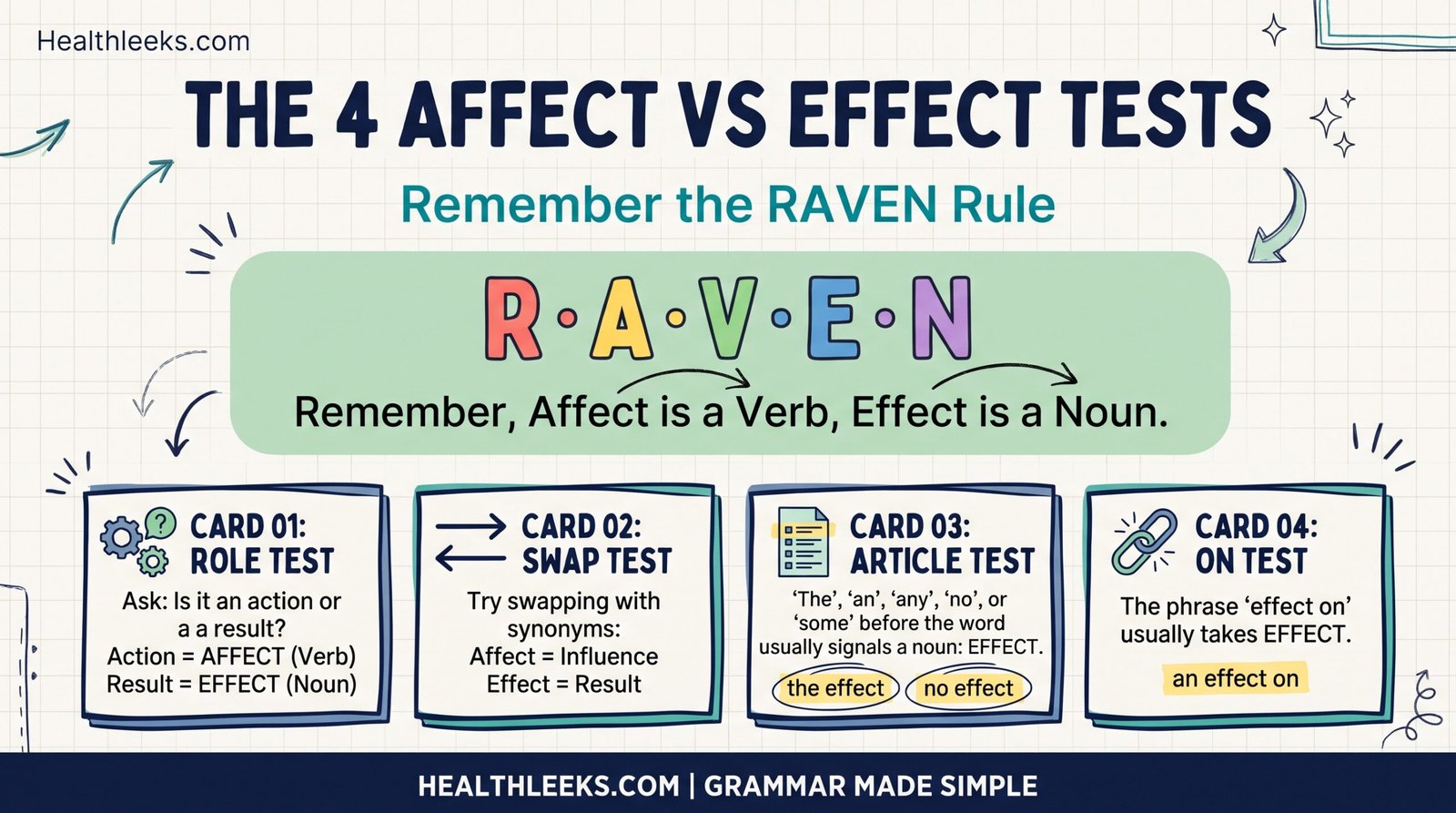
RAVEN carries the rule in five letters. Remember, Affect is a Verb, Effect is a Noun. Teachers have used it for decades because it resolves the great majority of real sentences in about two seconds.
The two words form a chain. To affect something is to have an effect on it. Learn that single sentence and you own the pair’s logic: the verb works on the cause side, the noun sits on the result side.
Two exceptions exist, and both are labelled. Effect works as a formal verb meaning to bring about, and affect works as a psychology noun for an emotional response. Each gets its own section below, after the tests.
Affect: The Verb of Influence
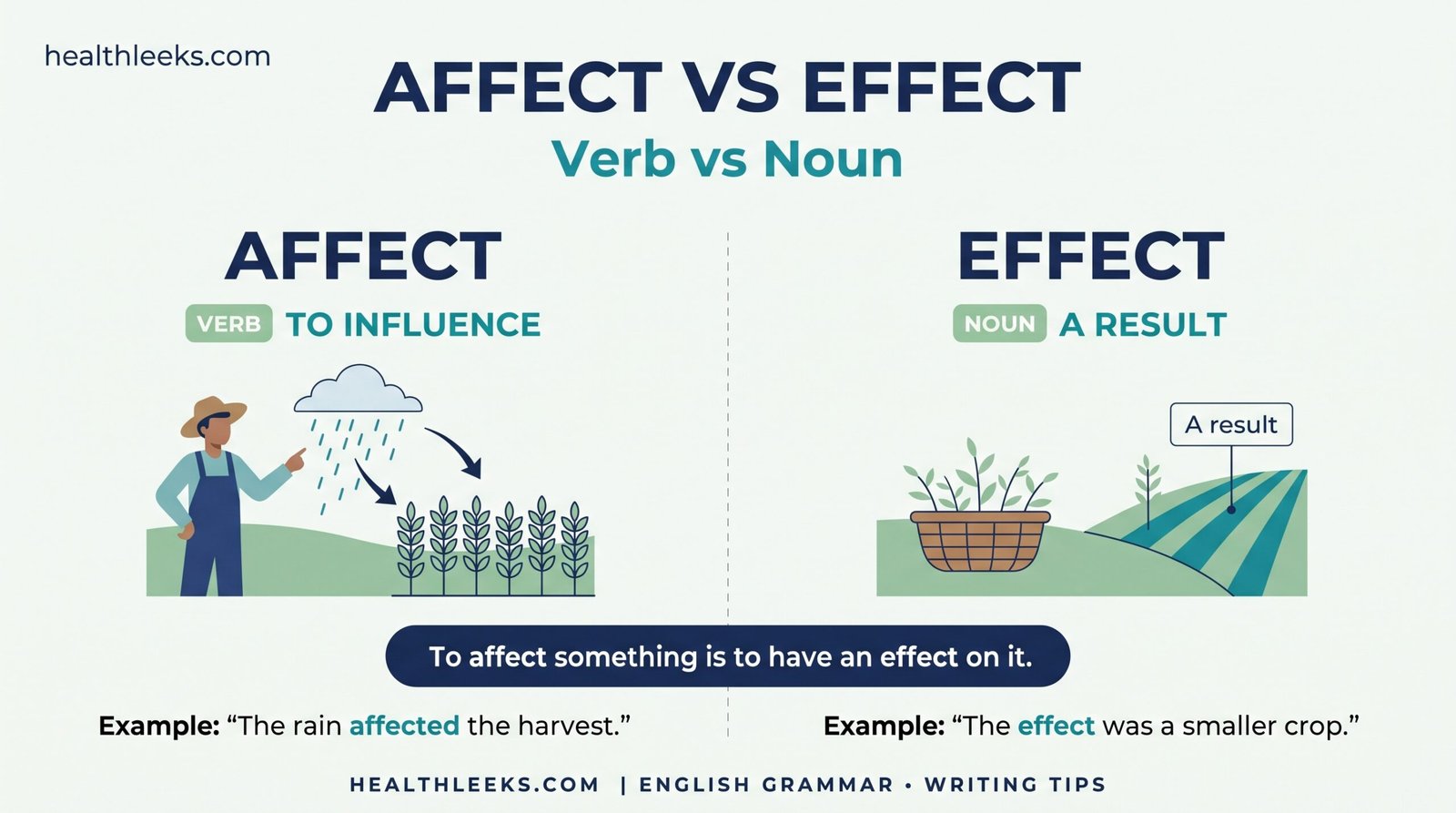
The dictionary definition at the Merriam-Webster entry for affect is built for this job: to produce an effect upon, to act on and cause a change in someone or something. The word is an action with a target.
Watch what follows it. Affect takes a direct object, immediately, with nothing in between. You affect the outcome, the price, the mood, the result. If your sentence has a thing being worked on right after the word, you are looking at the verb.
Its forms behave like any regular verb. It affects (third person), it affected (past), it is affecting (progressive). The final s in affects belongs to the verb’s agreement with a singular subject, not to any plural.
Emotion is one of its home grounds. Dictionaries list producing an emotional response among its core senses: the photograph affected her, the letter affected him more than he admitted. Being affected by news is this verb in the passive.
Medicine is the other home ground. A drug affects the liver, a treatment affects recovery times. Clinical and scientific writing leans on this verb daily, which is one reason the pair matters beyond the classroom.
Effect: The Noun of Result
At the Merriam-Webster entry for effect, the first sense is the everyday one: something produced by a cause, a result or outcome. Where affect does the working, effect names what the work produced.
Watch what comes before it. Effect travels with determiners: the effect, an effect, any effect, no effect, some effect.
An article or a word like the, an, any or no standing just in front of your problem word is a strong vote for the noun.
Watch what comes after it, too. Effect pairs with of and on: the effect of the drought, the effect on prices, a calming effect on the crowd. That second pattern, effect on, is so reliable it gets its own test below.
Its plural is effects, for more than one result. The effects of the policy unfolded slowly. The same plural is frozen into fixed phrases, special effects and personal effects, where it never means influence at all.
It also names a state of being operative. A law in effect is a law in force. That sense sounds different from result, but it is the same noun doing an older job, and it powers a family of phrases covered below.
The Four Tests, In Order
Tricks for this pair are usually taught as a pile. Used in this order, they become a procedure that settles nearly every sentence in seconds.
Test 1: the role test.
Ask what job the slot in the sentence is doing. Action being done to something: verb. Thing that resulted: noun. This one question is the whole topic in miniature, and RAVEN is just its memory hook.
Test 2: the swap tests.
Replace the word with influence. If the sentence still works as an action, write affect. Replace it with result. If the sentence still works as a thing, write effect. One of the two swaps almost always clicks audibly.
Test 3: the article test.
Look one word to the left. If the, an, any, no or some stands directly before the gap, the gap is a noun’s home. Write effect. Verbs do not take articles, so this test never fires for affect.
Test 4: the on test.
Look one word to the right. If on follows, write effect, as in the effect on morale. Affect takes its object directly and never uses on. This is the most reliable surface clue in the entire topic, and the least taught.
Exception One: Effect as a Verb
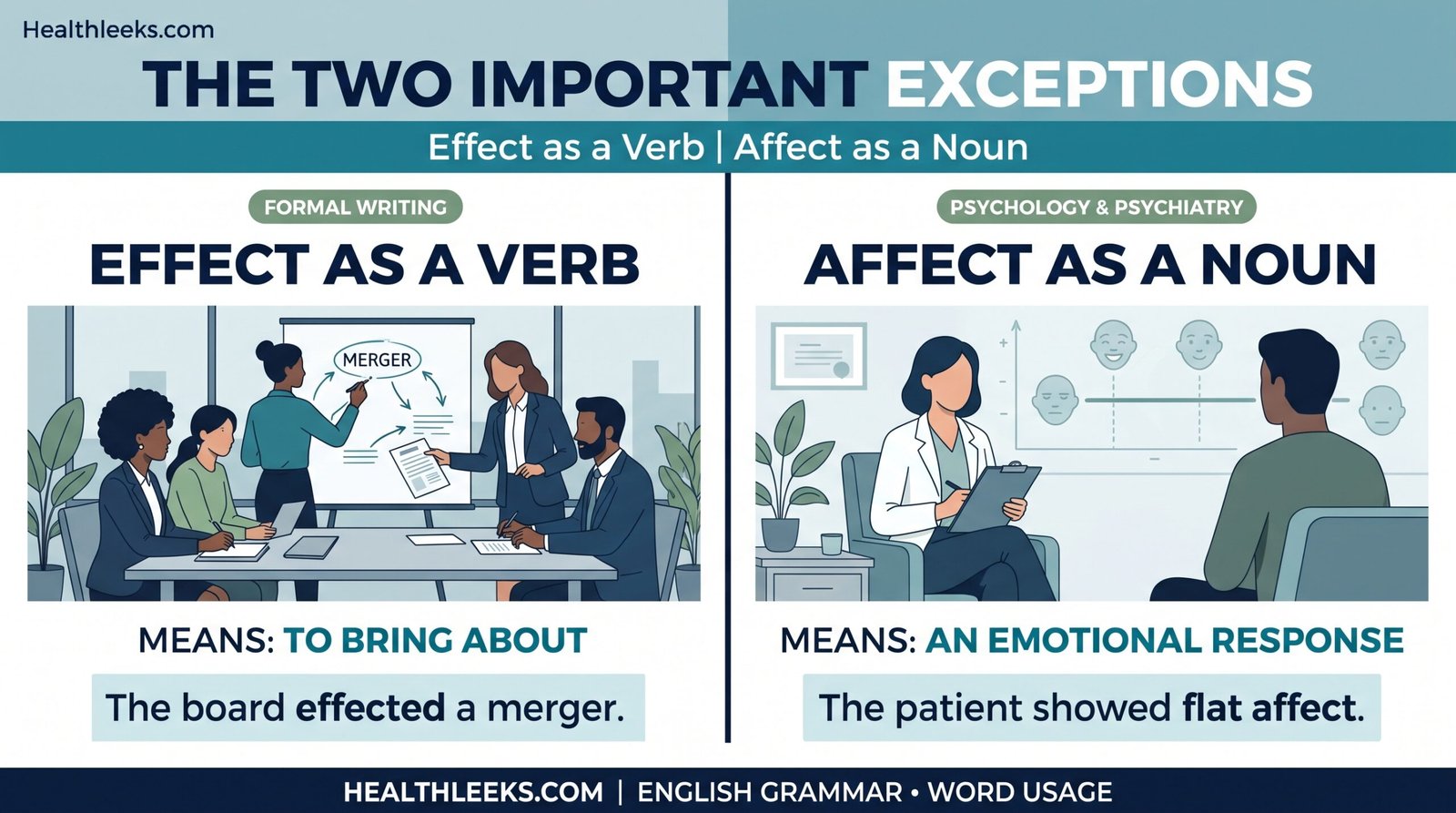
Effect has a second life as a formal verb meaning to bring about, to cause something to come into being. The dictionary’s own example is the famous one: policies that can effect change.
Its objects are created things. You effect change, effect a settlement, effect a merger, effect a rescue, effect an escape. Each object is something that did not exist until the verb produced it. That is the whole secret of this exception.
It never means influence. The merger will affect staffing warns that staffing will feel an influence. The merger will effect staffing would claim the merger creates the staffing, a claim almost nobody intends. Forcing effect into influence sentences is the classic overcorrection.
Its habitat is formal writing. Law, policy, corporate announcements and governance prose keep this verb alive. In a friendly email it sounds stiff, and many editors advise writing bring about instead, which says the same thing with zero confusion risk.
The past tense is effected. The board effected the changes it had promised. Notice how different that feels from the board affected the changes, which would mean the board influenced changes that already existed.
Affect Change vs Effect Change
This pair of phrases causes more hesitation than the headwords themselves, because both are correct English. They simply report different events.
|
Phrase |
Meaning |
Use it when |
|---|---|---|
|
Effect change |
To bring change about, to make it happen |
The change does not exist yet and someone is creating it |
|
Affect change |
To influence a change already under way |
A change exists and someone is steering, speeding or softening it |
Run the bring about swap. If bring about fits your sentence, you are describing creation, and effect is the precise word. Campaign promises, reform programs and turnaround plans almost always live on this row.
Run the influence swap for the other row. Protests, feedback and market pressure usually affect changes that institutions are already making. They steer the change; they do not author it, and affect reports that honestly.
Most everyday writers mean the first row. People who type affect change usually intend to make change happen. When the meaning matters, choose effect change. When you cannot tell which you mean, write bring about and let the sentence be unambiguous.
Exception Two: Affect as a Noun
In psychology and psychiatry, affect is a noun for an observable emotional response. The APA Dictionary of Psychology defines the territory: the feelings a person displays, as a clinician can observe and record them.
It announces itself in the pronunciation. The clinical noun is AFF-ekt, stressed on the first syllable, not uh-FEKT like the verb. Hear that stress in a case discussion and you are listening to the noun at work.
Its family is small and technical. Flat affect: little visible emotion. Blunted or restricted affect: markedly reduced expression. Labile affect: expression that shifts rapidly. These phrases fill mental health notes and almost never appear anywhere else.
It is not a synonym for feelings in general. The noun names the outward display a professional observes, which is narrower than mood or emotion. Rewriting it with effect produces nonsense, and rewriting ordinary results with affect produces errors.
An older noun sense survives only in dictionaries. Affect once meant a feeling or affection in general English, and entries still list that sense as obsolete. In current writing, if a noun is needed and no clinician is speaking, the word is effect.
The Other Affect: To Pretend
One more verb hides inside the same spelling. To affect a style, an accent or an indifference is to put it on, to cultivate or feign it. He affected a British accent. She affected not to notice.
This verb has its own adjective family. An affected manner is artificial and put on for show; the word is a small insult. An affecting story is the opposite compliment, a moving one that works on the feelings.
It never competes with effect. Nobody hesitates between affect an accent and effect an accent, because the feigning sense is unmistakable in context. The risk is only for readers meeting it the first time and reaching for the influence meaning.
The giveaway is the object. What follows this affect is a performance: an accent, a laugh, a worldly air, a limp, a yawn. When the object is something a person could put on like clothing, the feigning verb is the one on the page.
Pronunciation: Near Homophones With One Exception
In relaxed everyday speech, the pair effectively sound the same.
The verb affect is uh-FEKT, and the Cambridge Dictionary entry for effect records effect with first vowels that reduce toward the same sound, which is why nobody confuses them while listening carefully, only while writing.
Dictionaries do record small distinctions. Careful speakers may give effect a slightly different first vowel from affect, and the Cambridge Dictionary entry for affect shows the transcriptions entry by entry.
Treat those as careful speech variants, not a reliable test you can hear at conversational speed.
Beware tidy pronunciation rules. Some guides claim effect carries a clear long e that separates it cleanly. Actual dictionary transcriptions show variation in both words, so spelling must be chosen by grammar, not by ear.
The one hard pronunciation fact is the clinical noun. AFF-ekt, first syllable stress, belongs to the psychology noun alone. It is the only member of this family that sounds genuinely different, and it differs on purpose: the stress marks the technical term.
Fixed Phrases That Always Take Effect
Errors cluster in set phrases, so learn these as vocabulary items rather than grammar problems. Every one of them takes effect, and each has its reason.
|
Phrase |
What it means |
Why effect |
|---|---|---|
|
Side effect |
An unintended result of a medicine or treatment |
A result, so a noun |
|
Special effects |
Produced sights and sounds in film |
Things that are made: results |
|
Sound effects |
Produced or recorded sounds |
The same logic, in audio |
|
Personal effects |
A person’s belongings |
The noun in its property sense |
|
In effect |
In force; or in practical terms, essentially |
The operative sense of the noun |
|
Take effect, come into effect |
Become operative, start to apply |
The same operative sense |
|
To no effect |
Without success, pointlessly |
A result that failed to arrive |
|
Cause and effect |
The relationship between an action and its result |
The result side of the pair |
The science names belong here too. The greenhouse effect, the domino effect, the butterfly effect and the placebo effect all name results, so all take the noun.
The gases, the tiles, the wings and the sugar pill do the affecting; the named phenomenon is the effect.
Where the Words Come From
Both words grow from one Latin root: facere, to do or to make. The prefixes split them, and the split still predicts their modern jobs.
Affect comes from afficere, ad plus facere, literally to do something to someone or something. Its past participle is affectus. Doing something to a target is exactly what a transitive verb does, and that is the job the English word kept.
Effect comes from efficere, ex plus facere, to work something out, to accomplish. Its past participle is effectus, which also named the carrying out of a task.
What gets worked out is a finished thing, and that is why the English word settled as the noun for a result.
The confusion is ancestral, not careless. Two words built on one root, sharing letters and living in the same sentences, were always going to blur. The etymology also supplies the deepest memory hook available: toward makes the verb, out makes the outcome.
It also explains the formal verb. Efficere meant to bring about before it meant a result, so effect the verb is not an error that crept in.
It is the older Latin sense surfacing in formal English, which is why it survives in law and policy.
Worked Sentence Pairs
The fastest way to feel the distinction is to watch the same content cross the pair in both directions. In each pair below, the verb does the influencing and the noun names the result.
- The rain affected the harvest. The effect of the rain was a smaller crop.
- The medicine affected her sleep. The effect on her sleep was immediate.
- The announcement affected the markets. Its effect on the markets was brief.
- Stress affects concentration. The effects of stress show up at work.
- The new law will affect landlords from January. The law takes effect in January.
- His words affected her deeply. The effect of his words lasted for days.
- The heat affected the battery. The effect was a shorter range.
- The board effected a merger. The merger then affected both workforces.
Two rows of the family have no pair. She affected an accent uses the feigning verb, and the patient presented with a flat affect uses the clinical noun. Marking where the chain stops teaches as much as the chain itself.
Common Mistakes Gallery
Each sentence below is wrong in a way editors see weekly. The fix follows, with the test that catches it named, because the method matters more than the instance.
Wrong: The new schedule will effect morale from next week.
Right: The new schedule will affect morale from next week. Morale is influenced, not created. The bring about swap fails, and the influence swap succeeds, so the verb is affect.
Wrong: Please review the affect of the update on response times.
Right: Please review the effect of the update on response times. An article stands before the word, and on stands after it. The article test and the on test both fire for effect.
Wrong: The medicine had no affect on him at all.
Right: The medicine had no effect on him at all. No is a determiner, and on follows: two noun signals in one short phrase. Flat affect is the only everyday looking exception, and it lives in clinics.
Wrong: We hope to affect lasting change in the process.
Right, if the change is to be created: We hope to effect lasting change in the process. Hoping to make change happen is the bring about meaning.
If a change is already under way and the hope is to steer it, affect is honest and the sentence should make that clear.
Wrong: The training had a real affect on how I write.
Right: The training had a real effect on how I write. A result with an article in front and on behind it: the gallery’s most common pattern, and the easiest to catch with a two second scan.
A Note on the Wider Family
Affective and effective are different words, not forms of this pair. Affective means relating to emotion: affective disorders, seasonal affective disorder.
Effective means successful in producing a result: an effective treatment, effective immediately. A treatment can be effective for an affective disorder, with both words working different jobs in one sentence.
Confused pairs travel in packs. The same sound alike traps fill this family: ally vs allie turns on a name versus a partner, atleast or at least on spacing that changes the words, and per say or per se on a Latin phrase heard wrong.
Sound alike errors reward the same method. Grately vs greatly is a spelling built from a mishearing, and half day or half-day shows punctuation doing the work of grammar.
In every case the fix is a test, not a guess, which is the habit this page has been teaching.
Choosing in Real Sentences: A Guided Walk-Through
Rules settle into memory when they are used on live sentences. Six decisions follow, each walked through with the tests in their order, so the procedure becomes reflex.
Sentence 1: The drought will ___ farming across the valley.
The slot is an action aimed at farming, so the role test votes verb. The influence swap fits perfectly: the drought will influence farming. Verdict: affect. Every agricultural report ever written agrees.
Sentence 2: Nobody has measured the ___ of the drought yet.
The word the stands directly before the slot, so the article test fires before any meaning debate. The slot names a thing to be measured, a result. Verdict: effect, and the sentence will likely continue with on and a list of harms.
Sentence 3: The minister promised to ___ sweeping reforms.
A verb is needed, but which one? The reforms do not exist yet; the promise is to create them. The bring about swap fits, the influence swap does not, because there is nothing yet to influence. Verdict: effect, in its formal verb sense.
Sentence 4: Years of practice ___ her accent until it sounded native.
Tempting, because an accent can follow the feigning verb. Here, though, practice is doing slow influencing work on a real accent, not describing a performance she puts on. Verdict: affect, the ordinary verb. Context, not the object alone, separates the two affects.
Sentence 5: The report described a patient with a completely flat ___.
A noun is needed, and the habitat is clinical: a report, a patient, the word flat. This is the psychology noun describing an emotional display that does not move. Verdict: affect, pronounced AFF-ekt, and effect would be a genuine error here.
Sentence 6: His apology had no ___ on the committee.
The shortest walk of the six. No stands before the slot and on stands after it, so both neighbour tests fire at once. Verdict: effect. A sentence like this is where the pair should cost a writer under a second.
Sentence 7: The new privacy rules take ___ on the first of the month.
No slot test is even needed once the phrase is learned: rules take effect when they become operative.
The verb take belongs to the phrase, and the noun carries its oldest sense, being in force. Writers who type take affect here are blending the phrase with the verb they know better.
Sentence 8: Her personal ___ were returned in a sealed envelope.
Belongings again: a plural noun slot, a fixed phrase, and a meaning with no influence anywhere in it. Verdict: effects.
This sentence is the reminder that not every choice is a grammar decision; some are vocabulary, and the phrase list is the page to check.
Frequently Asked Questions
What is the difference between affect and effect?
In most sentences, affect is a verb meaning to influence, and effect is a noun meaning a result.
Something that affects a person has an effect on them. Two exceptions exist: effect as a formal verb meaning bring about, and affect as a psychology noun.
Which one is the verb, affect or effect?
Affect is the verb in everyday English: the weather affected the harvest. Effect is the verb only in the formal sense of bringing something about, as in to effect change. For an ordinary action word meaning influence, the answer is always affect.
What does RAVEN stand for?
Remember, Affect is a Verb, Effect is a Noun. RAVEN is the standard classroom mnemonic and resolves the great majority of real sentences. Dictionaries record both words in both roles, but the verb noun split covers nearly everything writers actually type.
How do you use affect in a sentence?
As the action, with the thing influenced directly after it: cold weather affects battery life, the delay affected our plans. If you can swap in the word influence and the sentence still works, affect is correct.
How do you use effect in a sentence?
As the result: the effect of the delay was chaos, the drug had one serious effect. Effect usually arrives with the, an, any or no in front of it. If you can swap in result or consequence, effect is correct.
Why is it side effect and not side affect?
Because a side effect is a result of taking a medicine, and results are nouns.
The verb in the family is the other word: the medicine may affect you, and its effects are what it does to you. The same logic gives special effects and sound effects.
What does effect change mean?
It means to bring change about, using effect as a verb in its formal sense: leaders effect change, the board effected a merger. If bring about or accomplish fits the sentence, effect is the precise word.
Is affect change ever correct?
Yes, with a different meaning: to affect change is to influence a change already under way. Most people who write it mean bring about change, so effect change is usually the intended choice. When in doubt, write bring about.
What is affect as a noun in psychology?
A noun for a person’s observable emotional response, pronounced AFF-ekt with first syllable stress. Clinicians describe flat affect, blunted affect and labile affect. Outside clinical writing you will rarely need it, but it is correct in that setting.
How do you pronounce affect and effect?
Nearly identically in relaxed speech: the verb affect is uh-FEKT, and effect is ih-FEKT or uh-FEKT. That is why the confusion is a writing problem. The one true difference is the psychology noun: AFF-ekt, stressed on the first syllable.
Are affect and effect homophones?
Nearly. Dictionaries record slightly different first vowels for careful speech, but in ordinary conversation the pair collapse to almost the same sound. Treat them as homophones whose spelling is chosen by grammar, not by ear.
Can effect be a verb?
Yes, in one formal meaning: to bring about or accomplish. Effect a settlement, effect a rescue, policies that effect change. It never means influence: the merger will affect staffing, because effect staffing would claim the merger creates the staffing.
Can affect be a noun outside psychology?
Only as an archaism. Older English used affect as a noun for a feeling, and dictionaries list that sense as obsolete. In current writing the living noun use is the clinical one. In an ordinary sentence, a noun slot wants effect.
What is the difference between affected and effected?
Affected is the past of the influence verb: the flood affected the town. Effected is the past of the formal bring about verb: the board effected the changes. Affected also works as an adjective meaning put on, as in an affected accent.
Is it affect on or effect on?
Effect on. The noun travels with on: the effect on prices. The verb affect takes its object directly and never uses on: the policy affected prices. If on follows the word in your draft, the word is almost certainly effect.
What does in effect mean?
In effect works two ways: in force (the law is in effect from January), and in practical terms, essentially (the ruling in effect ended the program). Its partner phrases are take effect and come into effect.
What are personal effects?
Belongings: the items a person carries or owns, returned to a family, listed in a will or covered by a travel policy. It is the noun effect in an older property sense, always plural in this use, with no influence involved.
Why do effect and affect get confused so often?
They sound almost the same, their meanings touch (an affect produces an effect), and both descend from the Latin facere, to do or make: affect from afficere, to do something to, and effect from efficere, to work out.
A grammar test, not a meaning guess, is the fix.
Does the rule change in British English?
No. British and American English apply the same verb noun split, the same RAVEN default and the same two exceptions. Learners writing for any exam can apply one rule worldwide.
How does a medicine affect or effect you?
It affects you (the verb of influence), and it has effects on you (the noun of results). The medicine did not affect her reports a drug failing to influence someone. The side effects were mild reports its results.
What is the greenhouse effect, and why effect?
The greenhouse effect is a named result, warming produced when gases trap heat, so it takes the noun. The gases affect the climate. The domino effect, butterfly effect and placebo effect follow the same logic.
Can you say the effect was that it affected everyone?
Yes. The noun names the result and the verb does the influencing, which is the pair’s whole logic in one sentence: to affect something is to have an effect on it. The verb sits on the cause side, the noun on the result side.
Is affect ever used to mean pretend?
Yes. To affect an accent, a style or an indifference is to put it on, to cultivate or feign it. Its adjective affected means artificial in this family, while an affecting story is a moving one. This verb never competes with effect.
What is an affecting story?
A moving one. Affecting is an adjective meaning emotionally touching: an affecting portrait of grief. It belongs to the influence family but sits outside the verb noun test. Do not confuse it with affected, which of a person means put on and insincere.
What does affect mean in a cause and effect essay?
Usually nothing: the fixed phrase is cause and effect. Inside the essay both words appear on their merits: one factor affects another, producing an effect. The essay’s own title rehearses the correct noun every time it is written.
How can I check my choice quickly while writing?
Run two swaps: replace the word with influence (fits, write affect) or with result (fits, write effect). Then check the neighbors: an article just before the word points to effect, and on just after it settles the matter for effect.
Why do spellcheckers and grammar checkers miss this error?
Because both words are real and correctly spelled, and in many sentences both are grammatical with different meanings. Affect change and effect change both pass. A checker cannot know whether you meant influence or bring about, so run the swap tests yourself.
What is the plural of effect, and when do I use effects?
Effects, for more than one result: the effects of the drought. It is also the fixed plural in special effects, sound effects and personal effects. Affects is the third person verb form: stress affects sleep. The s follows the role.
Is no effect correct, or no affect?
No effect. The phrase reports an absent result: the medicine had no effect, his pleading was to no effect. No affect exists only in the clinic, in notes about a patient’s emotional display.
What does it mean when a law takes effect?
The law becomes operative: it starts to apply and can be enforced. Laws are passed on one date and take effect on another.
This operative sense of the noun is one of its oldest, which is why legal English also keeps the verb effect alive.
How do you use effect as a verb in a business sentence?
Give it a created thing as its object: the firms effected a merger, the team effected a turnaround. Keep it out of influence sentences: the merger will affect headcount. Many editors advise bring about unless the created object is unmistakable.
What is the difference between affect and impact?
Impact works as a verb meaning influence strongly and as a noun meaning a strong effect. Use affect for the neutral verb and effect for the noun result, and reserve impact for cases where force or collision is genuinely part of the meaning.
Does affect have synonyms I can swap in safely?
For the verb: influence, shape, sway, alter, change. For the noun effect: result, consequence, outcome, upshot. The swaps double as the tests: a synonym that fits proves the role. Where none fits, rewrite the sentence.
What does affective mean?
Affective is the adjective of the psychology family: relating to emotion and its expression, as in affective disorders and seasonal affective disorder. It is spelled with an a, belongs with the clinical noun, and never substitutes for effective.
Affect vs effect: which is more formal, and does register matter?
The words are neutral; their exceptions carry the register. Effect as a verb is formal, at home in law and policy. Affect as a noun is technical, at home in clinical notes. The everyday pair belongs at every level of writing.
How should students remember this for exams?
Learn RAVEN, then the two exceptions as labelled boxes: effect the verb in effect change, affect the noun in flat affect. Examiners test the exceptions precisely because they are exceptions. In timed writing, the article clue and the on clue save the seconds.
What are the most common affect effect mistakes in emails?
Three patterns: affect after an article (the affect on our timeline, should be effect); effect as the routine verb (this will effect your access, should be affect); and affect change written for effect change. A ten second swap test catches all three.
Can a person be affected by an effect?
Yes: the effect of the announcement affected the whole office. The noun names the result first, then the verb does the influencing. If you can say which word is doing which job, you understand the distinction.
Is there an easy sentence that contains both words correctly?
The plain classic: the rain affected the harvest, and the effect was a smaller crop. One thing affects, and an effect follows. Any sentence built on that skeleton, cause taking the verb and outcome taking the noun, places both words correctly.
Do dictionaries ever disagree about affect and effect?
On the core, no. Every major dictionary records affect primarily as the verb of influence and effect primarily as the noun of result, with the same two exceptions. Disagreement lives at the margins: register labels, pronunciation variants and how the clinical noun is tagged.
What is a blunted affect?
A clinical description of markedly reduced emotional expression in the face, voice and gestures. Blunted, restricted, flat and labile are the standard family of affect descriptions in mental health notes. All use the psychology noun, pronounced AFF-ekt.
What is the difference between affective and effective?
Affective (a) means relating to emotion: affective disorders, seasonal affective disorder. Effective (e) means successful in producing a result: an effective treatment, effective immediately. A treatment can be effective for an affective disorder, both words working different jobs.
Conclusion
Affect vs effect resolves to a habit, not a talent: ask what job the word is doing. Influence in progress takes affect.
A result that followed takes effect. RAVEN remembers it, the four tests prove it, and the two exceptions stay in their labelled habitats.
Keep the phrases by heart and the pair stops costing you time: side effect, personal effects, in effect, take effect. More one letter traps and sound alike fixes live across MagazineSolo, where the same test first habit untangles every pair in the family.
One last encouragement for the perfectionists: this pair has confused good writers for centuries, because its confusion is built into the words themselves.
You are not behind; you are joining a long queue of careful people. The difference between them and everyone else is simply that they run a two second test instead of trusting their ear.

Dilawar Mughal is an SEO expert with 8 years of hands-on experience helping websites grow their organic traffic, rankings, and revenue. He specializes in content-driven SEO, local SEO, and Pinterest SEO, and builds practical, results-focused strategies for businesses and publishers.



1 Comments