

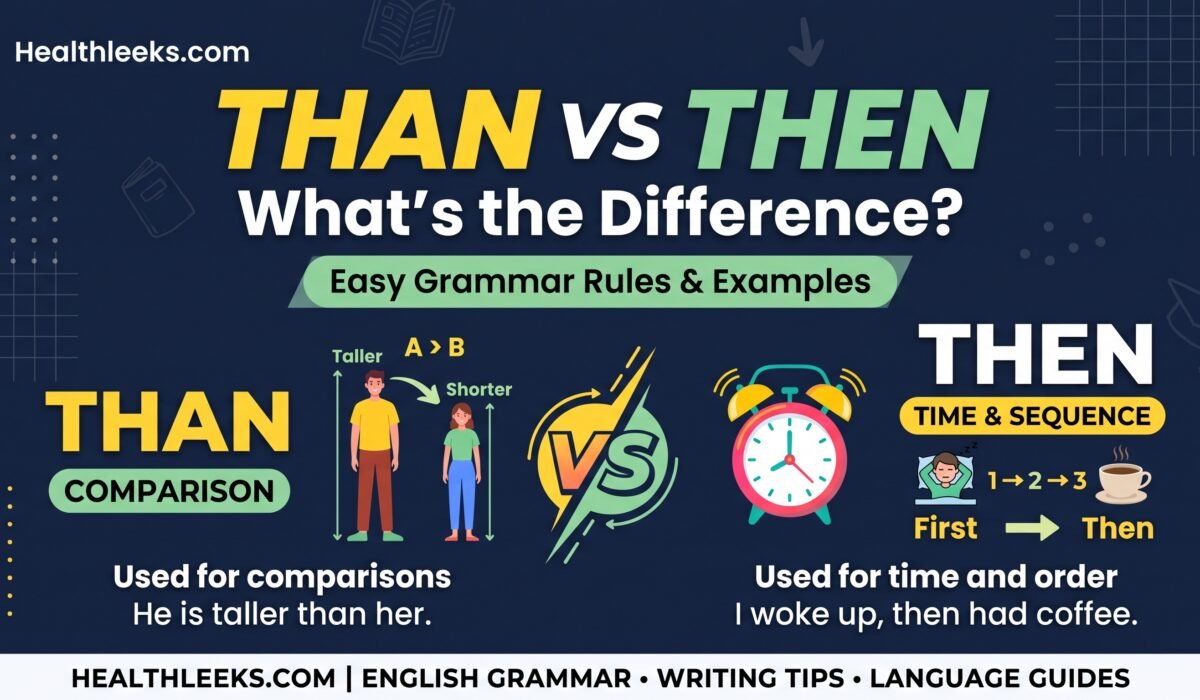
Than vs then difference is a one-line rule wearing a thousand disguises. Than compares: taller than, more than, rather than. Then tells time: back then, and then, if then. One vowel separates the weighing word from the clock word.
The errors survive because the two words sound nearly identical in real sentences. Than is usually unstressed, and its vowel weakens. So writers spell what they hear, and what they hear is a blur.
There is a deeper excuse, and it is a good one. For most of English history, these were the same word. The spellings split only around the year 1700. The confusion is older than the distinction itself.
What follows is the rule, the two questions test that settles hard cases, and a phrase bank. It also covers the trap, no later than, and the pronoun choice that can quietly change a sentence’s meaning.
The One-Line Rule
Than is the comparison word, a conjunction or preposition. It introduces the second element of a comparison. Something is bigger, earlier, more, less, or other than something else.
Then is the time word, chiefly an adverb. It means at that time, next in sequence, or in that case. It answers when, and what happens next.
|
Question |
Word |
Example |
|---|---|---|
|
Compared to what? |
than |
She runs faster than her brother. |
|
When, or what next? |
then |
We ate, then we left. |
|
At that past time? |
then |
Rent was cheap back then. |
|
In that case? |
then |
If it rains, then we stay home. |
The Cambridge Dictionary entry for than and the Cambridge Dictionary entry for then divide the senses exactly this way. Comparison on one side, time and consequence on the other. Every hard case in English is one of these jobs in disguise.
Notice what the rule is not. The rule is not about the topic of the sentence. A sentence about clock times can still take than, as the trap section below proves in detail.
Than: The Comparison Word
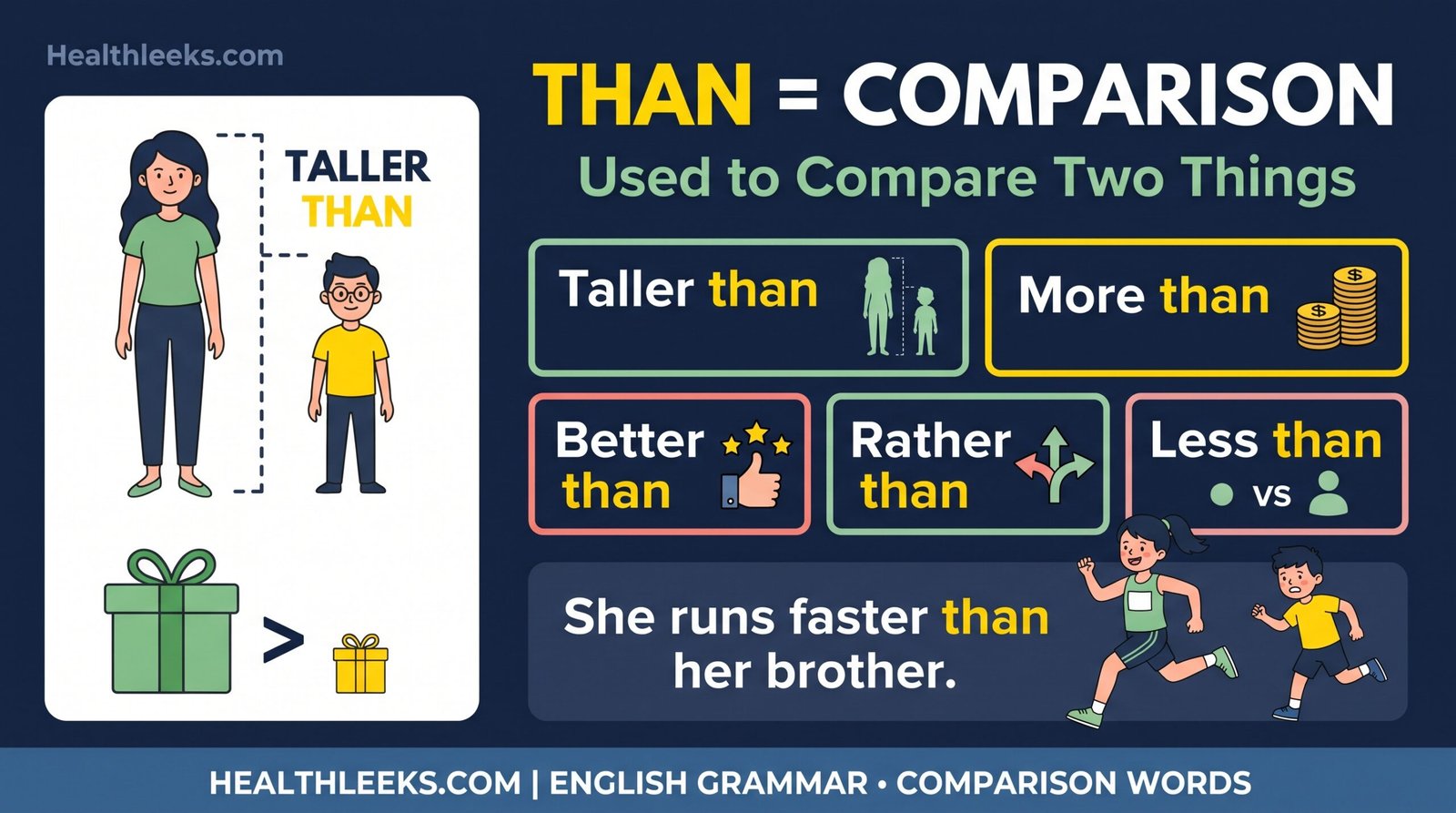
Than has one job with several costumes. It sets one thing against another and reports the difference. The Merriam-Webster entry for than defines it by that comparison function, in both its conjunction and preposition roles.
H4: What Than Follows
Than almost always follows a signal word you can spot first. Learn the signals and the word chooses itself.
- Comparative adjectives: taller than, older than, cheaper than, better than.
- Comparative adverbs: faster than, more carefully than, sooner than.
- Quantity words: more than, less than, fewer than, more than half.
- Preference frame: rather than, would rather.
- Exception frame: other than.
If one of these signals stands in front of the blank, the answer is than. No signal and no comparison usually means the other word. The signals are the fastest check in fast writing.
H4: Rather Than Means Instead Of
Rather than weighs a chosen option against a rejected one. Walk rather than drive. Tea rather than coffee. The weighing is the comparison, even when nothing is measured.
Would rather works the same way when options are weighed. I would rather stay than go. One option is preferred over the other, and preference is comparison in everyday clothes.
H4: Other Than Means Except
Other than sets one thing apart from the rest. No one other than us. Nothing other than water. It reads like an exception, but its machinery is comparison: one item measured against the group and excluded.
Merriam-Webster usage note on then lists no one other than us among its own than examples. That is the dictionary itself filing the exception phrase under comparison. Other then is never correct, in any register.
H4: Quantity Comparisons
Than carries most of the numbers in everyday writing. More than 100 people. Less than zero. Fewer than ten tickets. More than half the class. Business and news writing lean on these frames constantly.
A neighboring refinement lives here. Careful usage prefers fewer than for countable things and less than for amounts. Fewer than ten tickets, less than ten dollars. Both frames take than either way.
Then: The Time Word
Then does three main jobs, and all of them live on a timeline or a chain. The Merriam-Webster entry for then gives it adverb, noun, and adjective lives. Each one points at time in a different grammatical costume.
H4: At That Time
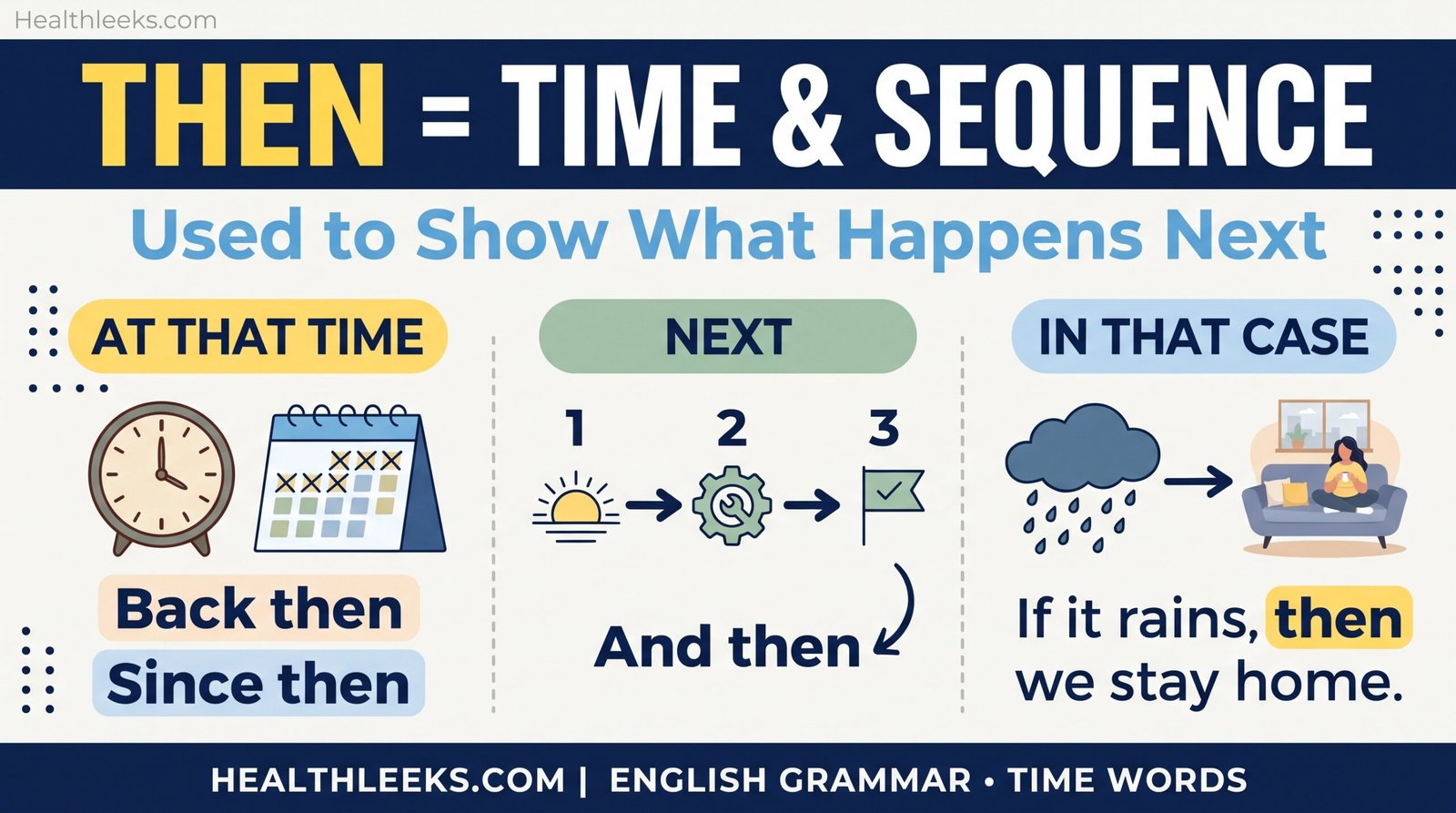
The core meaning is at that time. We lived in Ohio then. I was younger then. The word points backward or forward to a moment the sentence has already established.
This is the sense inside the whole back then family. Back then, since then, until then, by then. Every member of that family is a time pointer, so every member takes then.
H4: Next in Sequence
Then also means next. Mix the flour, then add the eggs. First the interview, then the offer. Recipes, instructions, and stories run on this word.
The sequence sense often follows and. We packed, and then we drove north. And adds the next event to the list, and then stamps its position in the order.
H4: In That Case, After If
After a condition, then means in that case. If the shop is closed, then we wait. If you are ready, then let us begin. The timeline here is logical rather than clock based, but the word is the same.
Logic and programming borrowed this exact then for their if then conditionals. The condition comes first, then the consequence follows. Everyday English allows dropping the word, but keeping it adds clarity.
H4: Then as a Noun
After prepositions, then becomes a noun meaning that time: since then, until then, by then, from then on. The preposition needs an object, and then supplies the named moment itself.
H4: The Then President
Before a title, then works as an adjective. The then president. Her then husband. The then mayor of the town. It means the person holding that role at the time under discussion.
News writing uses this constantly, because it is compact. One word locates a person in a past period. No clause, no dates, no extra scaffolding needed.
The Two Questions Test
When a sentence will not settle, run two questions in order. The test takes five seconds. It handles every trap in this article, including the time comparisons below.
1. Ask: compared to what? If the sentence quietly answers that question, the word is than. Faster than the old model compares speeds. No later than six compares two times.
2. Ask: when, or what happens next? If the sentence answers that instead, the word is then. We left, then we drove answers what next. Back then answers when.
3. Check the neighbors. A comparative signal just before the blank guarantees than. An if earlier in the sentence almost guarantees then. The neighbors usually confess before the test even runs.
4. Swap and listen. Compared with fits than sentences. At that time, next, or in that case fits then sentences. The wrong swap sounds broken immediately, which is the confirmation.
The Phrase Bank
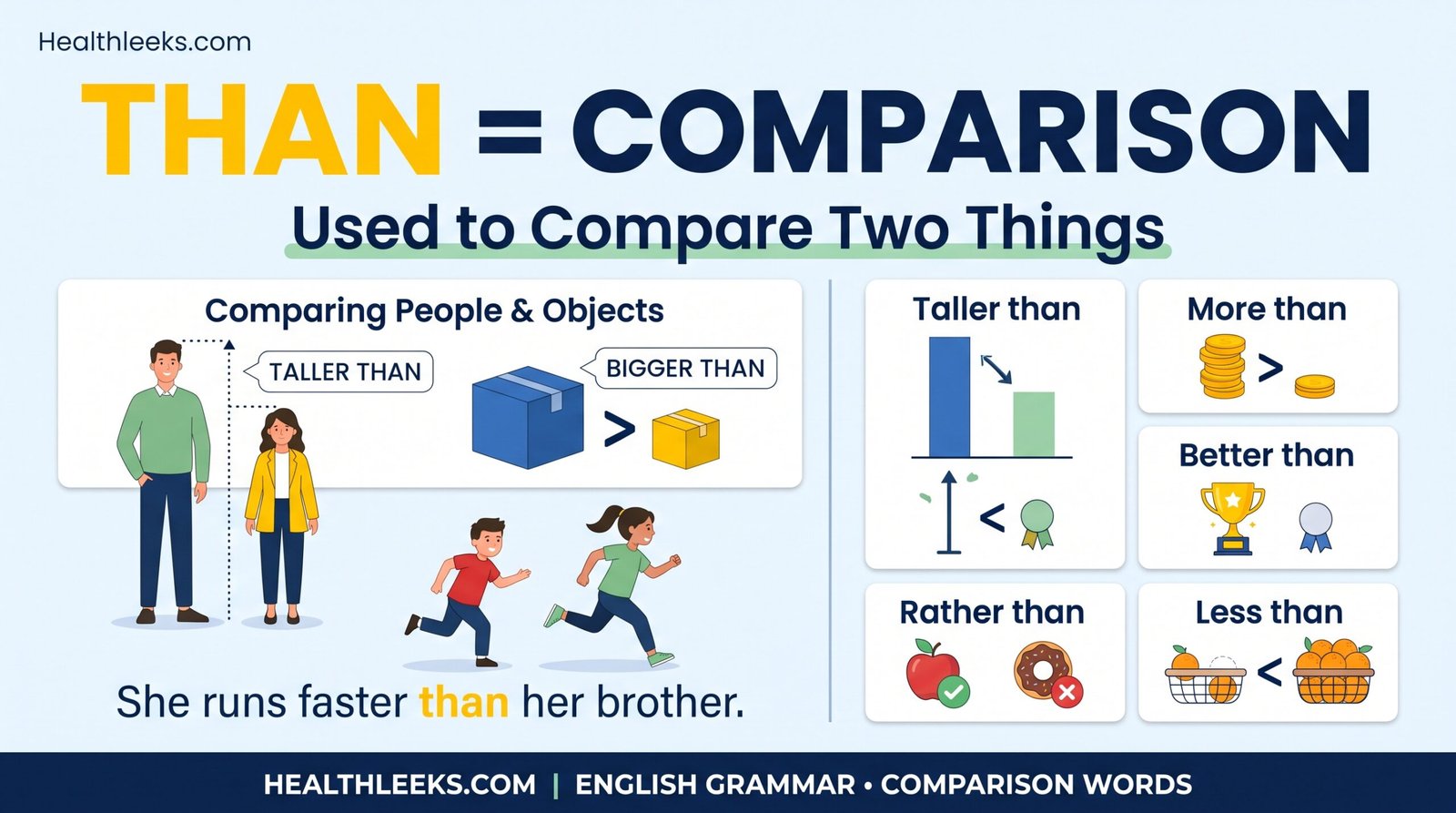
Every fixed phrase in English takes one fixed word. There are no phrases where writers may choose. Print this bank, because phrase lookups are how most readers arrive here.
H4: Always Than
|
Phrase |
Meaning |
Example |
|---|---|---|
|
more than |
greater amount |
More than 100 people came. |
|
less than |
smaller amount |
Less than zero on the gauge. |
|
fewer than |
smaller count |
Fewer than ten tickets left. |
|
better than |
comparative of good |
Better than ever. |
|
rather than |
instead of |
Walk rather than drive. |
|
other than |
except |
No one other than us. |
|
no later than |
deadline comparison |
No later than Friday. |
|
no sooner than |
instant sequence frame |
No sooner had we left than it rained. |
|
more often than not |
usually |
More often than not, he walks. |
|
easier said than done |
proverb frame |
Easier said than done. |
H4: Always Then
|
Phrase |
Meaning |
Example |
|---|---|---|
|
back then |
at that past time |
We were kids back then. |
|
since then |
from that time onward |
Since then, prices rose. |
|
until then |
up to that time |
Until then, wait here. |
|
by then |
before that time |
By then it was dark. |
|
from then on |
starting at that time |
From then on, she checked twice. |
|
now and then |
occasionally |
We meet now and then. |
|
every now and then |
occasionally |
Every now and then, it snows in April. |
|
then and there |
immediately |
He apologized then and there. |
|
and then |
next event |
We ate, and then we left. |
|
if then |
consequence |
If it rains, then we stay home. |
Read the two tables as one machine. The than family weighs, counts, prefers, and excepts. The then family points, sequences, and concludes. A phrase belongs to its family’s job, always.
The Trap: When Time Takes Than
Here is where the simple rule breaks in learners’ hands. People learn time means then, then meet no later than. The sentence is about a clock, yet than is correct, and the simple rule gives no reason.
The reason is the job, not the topic. Than compares times as happily as it compares heights. No later than six weighs your call time against six and finds it not later. Two points on the timeline are being measured against each other.
The whole trap family works this way. Earlier than expected. Later than planned. Sooner than we thought. Every one compares a real time with a reference time.
No sooner than is the family’s trickiest member. No sooner had we sat down than the phone rang. Sooner is a comparative, so its partner is than. The second event feels like sequence, which tempts writers toward then, but the frame is built as a comparison.
The defense is the test, not the topic. Ask compared to what, and time sentences answer it cleanly. A deadline is always compared against something: a plan, a promise, or a clock.
Than I or Than Me
Than wears two grammatical analyses, and dictionaries record both. As a conjunction, it joins a shortened clause: taller than I am. As a preposition, it takes an object: taller than me. The Merriam-Webster usage note on then prints both shapes in its own examples.
Formal writing traditionally prefers than I, than he, than she. The pronoun acts as subject of the understood clause. Informal English widely uses than me, than him, than her, and no dictionary calls it wrong.
The choice is usually about register, not correctness. Match the formality of the document. A legal brief and a text message may honestly choose different forms of the same sentence.
H4: When Case Changes the Meaning
Sometimes the pronoun choice changes what the sentence says. She likes him more than I most naturally means more than I like him. She likes him more than me means more than she likes me.
Two different facts hide behind one small pronoun. The understood clause completes differently in each case. This is the real reason the old debate matters: case is a meaning tool before it is a politeness question.
The safe habit is simple. When both readings are possible, write the clause out. More than I do, more than she likes me. Three extra words remove every doubt a reader could have.
H4: Different Than or Different From
A cousin question lives nearby. Different from is the safer formal choice, and most style guides recommend it. Different than is long established and widely accepted, especially before a clause.
Things are different than they used to be shows why than survives. Rebuilding that sentence around from takes clumsy extra words. Treat the choice as register, and prefer from in formal documents.
Why They Sound the Same
In careful speech, the words do not match. Than carries the vowel of can. Then carries the vowel of hen.
Sentences change everything. Than usually sits unstressed in the middle, carrying no emphasis. Unstressed vowels weaken, and than shrinks toward a mumbled thun. At conversational speed, its vowel lands close to the vowel of then.
That is why the references disagree about the label. Some dictionaries call the pair homophones, treating the blur as the fact. Others keep the vowels distinct and describe a near match. Both describe the same mouth at different speeds.
Sound cannot settle this spelling, because the sound itself is unreliable here. Function settles it, every time, which is why the test outranks the ear.
This is also why spellcheckers fail you. Both words are real words, correctly spelled. A checker sees two legal options and stays silent, so the error walks into published documents daily.
One Word for a Thousand Years
The history explains the modern muddle better than any scolding. Old English wrote the ancestor forms thonne and thaenne for both jobs. One word pointed at time and introduced comparisons alike.
Middle English kept the arrangement. Writers used the spellings interchangeably, and readers sorted the meaning from context. For centuries, nobody was wrong, because there was no distinction to break.
The split came late. Etymology references date the separation of the spellings to around the year 1700, when print culture fixed than for comparison and then for time, and the modern rule was born as a convention.
Hold the rule confidently, then. But hold it without anxiety. You are enforcing a three century old spelling agreement, not a law of nature. Even the dictionary’s own word history shows how young the boundary is.
Mistakes Gallery
Real errors cluster into predictable shapes. Each one below fails a named test. Learn the shapes and you will catch them in your own drafts at reading speed.
- More then, in a report. More sets up a quantity comparison. The compared to what test answers instantly. More than, always.
- Better then, in marketing copy. Better is a comparative adjective. Comparatives take than, as the proverb better late than never has shown for centuries.
- Review the draft, than send it. Sequence error. The second action is the next event, not a comparison. The word is then.
- Other then that, all good. The exception phrase is other than. It sets one thing apart from the rest, which is comparison machinery.
- No sooner then. The frame is comparative: sooner than. The felt sequence misleads, the grammar decides.
- Back than. The time phrase is back then. It points at a past period, and time pointers take then.
- And than we left. Next event after and takes then. And then is the sequence pair; and than is not an English phrase.
The gallery shares one moral. Each error sounds fine when read aloud. Every one fails in writing, because writing is where the function shows.
Choosing in Real Sentences
Walk through eight live choices, naming the test that decides each one. This is the skill the whole article builds toward.
1. The new route is faster ___ the old one. The signal word faster stands in front. Comparatives take than. Answer: than.
2. We packed the car, ___ drove north. Packing ends, driving begins. The blank marks the next event, so the sequence word wins. Answer: then.
3. Call me no later ___ six. A trap in plain sight. Your call is weighed against six on the clock. Comparing times takes than. Answer: than.
4. You are taller ___ your brother was at your age. Height against height, with an understood clause after it. Comparison, plainly. Answer: than.
5. If the shop is shut, ___ we try the market. The if sets a condition. What follows is the consequence, in that case. Answer: then.
6. No sooner had we left ___ the rain began. Sooner is a comparative wearing a sequence costume. Its partner is than. Answer: than.
7. Back ___, this street was all fields. The blank sits inside a past time phrase. The sentence points at a period, not a comparison. Answer: then.
8. She would rather walk ___ ride. A preference between two options. Weighing choices is comparison work. Answer: than.
More Pairs That Work Like This One
This pair belongs to a family of sound alike traps, and the same method unlocks them all. Name each word’s job, then test the sentence. The cluster below is the practice set.
Our guide to affect vs effect covers the verb noun split with its own exceptions. The spelling trio in ally vs allie shows how one letter changes a friend into a verb. The spacing question in atleast or at least settles when two words stay two.
Sound traps continue with per say or per se, where a Latin phrase hides inside English spelling. The adverb pair in grately vs greatly separates gratitude from size. The hyphen call in half day or half-day shows punctuation doing the same disambiguating work.
Master the method once and the family shrinks. Every confused pair is two jobs sharing a sound. Learn the jobs and the spelling follows, here and everywhere else.
Frequently Asked Questions
What is the difference between than and then?
Than compares; then tells time. Than introduces the second element of a comparison: taller than, more than, other than. Then marks time, sequence, or consequence: back then, and then, if then. Weighing takes than; placing on a timeline takes then.
When do you use than?
Whenever the sentence compares two things, states, or amounts and finds them unequal.
Than follows comparatives (bigger than, faster than), quantity words (more than, less than, fewer than), and the fixed frames rather than (instead of) and other than (except). It is always followed, openly or by implication, by the second element of the comparison, the thing the first is being measured against.
When do you use then?
When the sentence is about time, order, or consequence.
Then means at that time (we lived in Ohio then), next in sequence (mix the flour, then add the eggs), and in that case after a condition (if the shop is closed, then we wait). It also works as a noun for that time (since then, until then) and as an adjective meaning existing at the time mentioned (the then president).
Is it more than or more then?
More than. More sets up a comparison of quantity, and comparisons take than.
More then is one of the most common spelling errors in English, appearing in emails and even print, because unstressed than and then sound nearly identical in fast speech. If a number, amount, or degree is being weighed, the answer is than, every time.
Is it better than or better then?
Better than. Better is the comparative of good, and comparatives are followed by than: better than ever, better than expected, better late than never.
The proverb itself is a memory hook: it has carried the correct spelling for centuries. Better then is always a typo, never a variant.
Why do people confuse than and then?
Three reasons stack up. The spellings differ by one letter. The sounds blur, because unstressed than weakens toward then. And historically they were one word, written thonne and thaenne in Old English, with the spellings separated only around 1700.
Are than and then homophones?
Not strictly. In careful speech than has the vowel of can and then has the vowel of hen, and dictionaries transcribe them differently.
But than usually appears unstressed mid sentence, where its vowel reduces, and at conversational speed the two become hard or impossible to tell apart. Many dictionaries and teaching sites simply call them homophones for practical purposes. The safe conclusion: choose by function, never by ear.
How can I remember the difference between than and then?
Use the letter hooks plus the job test. Than has an A, like compare and comparison; then has an E, like time, and rhymes with when.
Then run the two questions: is the sentence comparing (than), or is it sequencing in time or logic (then)? The hooks settle most cases instantly, and the job test settles the rest, including the traps below.
Is it other than or other then?
Other than. Other than means except or besides: no one other than us, nothing other than water.
It belongs to the comparison family because it sets one thing apart from the rest. Merriam-Webster’s own usage note lists no one other than us among its than examples. Other then is always an error.
Is it rather than or rather then?
Rather than. The phrase means instead of or in preference to: walk rather than drive, tea rather than coffee.
It weighs a chosen option against a rejected one, which is comparison work, so it takes than. Would rather follows the same pattern when a comparison is implied: I would rather stay than go.
What does back then mean?
At that time in the past. Back then points the sentence at an earlier period: rent was cheap back then, we were kids back then.
It is one of a family of time phrases built on then: since then, until then, by then, from then on, now and then, every now and then, then and there. Every one of them takes then, because every one of them is about time.
Is no later than correct, or no later then?
No later than. This sentence is about clock time, yet it takes than, because it is still a comparison: the deadline is set against 7 pm and found not later.
Than compares times as happily as sizes. The rule is about the job, not the topic: comparing two times is comparison, and comparison takes than. The same logic gives earlier than, sooner than, and no sooner than.
What does no sooner than mean?
It belongs to the pattern no sooner had we done one thing than another happened: no sooner had we sat down than the phone rang.
No sooner is a comparative frame (sooner is the comparative of soon), so the partner word is than. Writing no sooner then is a common error precisely because the second event feels like sequence; grammatically the sentence is built as a comparison of times.
Is than a conjunction or a preposition?
Both analyses exist. As a conjunction, than joins a shortened clause: taller than I am. As a preposition, it takes an object: taller than me. Dictionaries list both functions. The debate matters for the pronoun choice, not for choosing the word.
Is it than I or than me?
Formal writing traditionally prefers than I (the understood clause view: taller than I am).
Informal English widely uses than me, and dictionaries record both; Merriam-Webster usage note on then itself prints younger than I am and taller than me. Watch ambiguity: case can change the meaning, as the next answer shows.
Why does than I versus than me sometimes change the meaning?
The understood clause changes. She likes him more than I completes as more than I like him. More than me completes as more than she likes me. Different facts, one pronoun apart. If a misreading is possible, write the clause out in full.
Is different than correct, or should it be different from?
Different from is the safer formal choice, and most style guides recommend it. Different than is long established and widely accepted, especially before a clause: different than it used to be. Dictionaries record both. Treat it as a register decision, not an error.
Can then be a noun?
Yes. As a noun, then means that time, and it appears after prepositions: since then, until then, by then, from then on.
You cannot say since than. The noun use is why then sometimes feels like a thing rather than an action marker in a sentence; it is naming a point on the timeline the speaker has already established.
Can then be an adjective?
Yes, in one narrow pattern: the then president, the then mayor, her then husband. Placed before a title or role, then means existing or acting at the time under discussion.
It is a compact way to locate a person in a past period without a clause, and news writing uses it constantly. This adjective has been in use since the 1500s, according to dictionary dating.
What does then mean in if then statements?
In that case, or as a consequence. If the road is closed, then we take the train.
Logic, mathematics, and programming borrowed this then wholesale for their if then conditionals, because it cleanly separates the condition from what follows from it. In ordinary sentences the word can be dropped without loss (if it rains, we stay home), but keeping it adds clarity and emphasis.
Is and then correct, or should it be and than?
And then, for sequence: we ate, and then we left. And signals the addition of the next event, and then places it next in time.
And than appears only inside comparisons that happen to use and elsewhere in the sentence. If the second half of your sentence is the next event rather than the second element of a comparison, the word is then.
Do you put a comma before then?
Usually not when then simply continues a sequence inside one sentence: we finished and then left.
A comma can appear when then opens a distinct clause or adds emphasis, and then, at the start of a sentence, Then often stands alone as a transition without one. What never happens is a comma rule that swaps the word: punctuation follows structure, and the than then choice follows function, so settle the word first and punctuate after.
How do you pronounce than and then?
Then has the vowel of hen: then. Than in careful speech has the vowel of can, but in ordinary sentences than is unstressed and its vowel weakens dramatically, often to little more than thun.
That weakening is the mechanical cause of most spelling errors: writers transcribe what they hear, and what they hear is a blur. Sound is a witness here, but an unreliable one, so the function test outranks it.
Were than and then always different words?
No. For most of English history they were one word.
Old English wrote the ancestor forms thonne and thaenne for both the comparison and the time jobs, and Middle English writers used the spellings interchangeably, leaving readers to sort the meaning from context. Dictionaries and etymology references date the separation of the spellings to around 1700. The modern rule is therefore a convention younger than Shakespeare, which is some comfort to everyone who still mixes them up.
Is it more often than not or more often then not?
More often than not.
The phrase means usually, in more cases than not, which is a comparison of frequencies: more cases on one side than the other. Any phrase built on more, less, fewer, better, worse, rather, or other is comparison architecture, and comparison architecture takes than.
What are the greater than and less than symbols?
In mathematics, the symbol > means greater than and < means less than: 7 > 5 reads seven is greater than five. Schoolchildren learn them as comparison signs, which is precisely the than family at work in symbols.
A common memory hook compares the sign to an open mouth eating the larger number. The spoken forms always take than, never then.
Can than compare times as well as things?
Yes, and this is the trap that breaks the simple time rule people learn first. Earlier than, later than, sooner than, and no later than all concern time and all take than, because the sentence is comparing two points on the timeline.
Then is for locating or sequencing, than is for weighing, and weighing two times is still weighing. Ask compared to what, and the answer names the second point.
What mistakes do professionals make with than and then?
The same ones as everyone, at typing speed: more then in reports, better then in marketing copy, and than submitted for then in process documents (review the draft, than send it).
Because both words are correctly spelled, spellcheckers pass them, and grammar checkers catch the pair inconsistently. The professional defense is a targeted proofread: search the document for then and than and test each instance, a thirty second pass that catches a credibility denting error class completely.
Is it older than or older then?
Older than.
Older is a comparative adjective, and comparatives take than: older than dirt, older than the hills, older than I look. The idioms are useful memory hooks because they are so familiar that the correct spelling feels inevitable inside them, which is exactly how the rule should feel everywhere else.
What does more than happy mean?
It is an idiom meaning very, extremely: more than happy to help, more than ready, more than meets the eye.
Literally comparative in shape, idiomatically it is an intensifier. It always takes than, and it shows how deeply the more than frame is built into English: even when no real second element is being weighed, the comparison frame supplies the word.
Can a sentence need both than and then?
Easily: first we were younger than everyone else in the room, and then we were not. Than handles the comparison, then handles the timeline shift, in a single breath.
Back then, I was faster than you is the compact version: a time phrase and a comparison sharing a sentence without touching each other. The two words are neighbors, not rivals, and fluent sentences deploy both constantly.
Is than used in British English the same way?
Yes. The distinction, the spellings, and the exceptions are identical in British and American English, as are the common errors.
Nothing in this pair divides the varieties. Learners and writers can apply one rule on both sides of the Atlantic, which is more than can be said for many spelling pairs.
How is than used with numbers?
Directly: more than 100 people, less than zero, fewer than ten tickets, more than half.
Quantity comparisons are among the most frequent uses of than in news and business writing. Note the fewer less point that lives nearby: fewer than for countable things (fewer than ten tickets), less than for amounts (less than ten dollars of fuel) in careful usage, though less than with numbers is widely accepted.
What does then and there mean?
Immediately, at that very moment and place: she apologized then and there, he was hired then and there. It is a fixed phrase built on the time adverb, emphasizing instant action with no delay.
It always takes then. Its cousin, there and then, means the same and is common in British English.
Should then start a sentence?
It can: Then the door opened. Then, we need a new plan.
Sentence initial then is standard in narrative and in structured writing alike, marking the next step or the consequence. Style guides do not forbid it. What deserves a second look is overuse: a paragraph where every sentence starts with then reads like a recipe, and varying the transitions usually improves the prose.
Is until then one word or two, and which spelling?
Two words, and then: until then, meaning up to that time. The error until than appears because until feels like it might govern a comparison; it does not.
Until marks a time boundary, and time boundaries take then. The same applies to since then and by then, the whole preposition family around the noun use.
What is the quickest test when I am stuck mid sentence?
Ask two questions. Compared to what? If the sentence answers it, write than.
When, or what happens next? If the sentence answers that, write then. If neither question fits, look at the neighbors: a comparative word just before (more, less, better, rather, other) guarantees than, and an if earlier in the sentence almost guarantees then.
Does grammar check software catch than then errors reliably?
Not fully. Both words are real, and in many sentences both are grammatical with different meanings, so a checker must guess intent.
Modern tools catch the loud cases (better then, more then) fairly often and miss the quiet ones, especially where a comparison hides inside a time sentence like no later then. A find and test pass over the two words remains the reliable method for important documents.
Than vs then: which is used more often in writing?
Both rank among the most common words in English, which is part of why the error is so visible: the pair occurs constantly, in every register.
Exact frequency comparisons vary by corpus and by whether speech or writing is counted, and any precise percentage quoted without a named corpus should be treated as decoration. What matters practically is that readers notice this error, because both words are so familiar that the wrong one jars immediately.
How should teachers present than vs then to young students?
Start with jobs: than is the weighing word, then is the clock word.
Add the letter hooks as memory paint, then drill sentence pairs differing by one word. Introduce the no later than trap only after the base rule is automatic, and name it as a trap.
Is it fewer than or less than for numbers?
Careful usage prefers fewer than for countable things (fewer than ten tickets, fewer than a hundred words) and less than for amounts and measures (less than ten dollars, less than a mile).
Both take than, so the pair choice is unaffected; the fewer less distinction is a neighboring refinement. Many edited publications accept less than with numbers, but fewer is the safer formal choice for countable nouns.
Is then afterwards redundant?
Often, mildly. Then already means next or afterward, so then afterwards repeats the sequence idea; edited prose usually keeps one of them.
It is a style point, not an error that changes meaning, and speech uses the doubled form for emphasis all the time. Note that the question is about then’s family only: afterwards is spelled with an s in British English and both ways in American English, which is a separate pair entirely.
Conclusion
The than vs then difference reduces to two jobs sharing one sound. Than weighs: amounts, heights, speeds, preferences, exceptions, and even clock times set against each other. Then points and sequences: past moments, next steps, and consequences after if.
Keep the two questions within reach and the pair stops costing you edits. Compared to what calls for than. When, or what next calls for then. The letter hooks, A in compare and E in time, settle the everyday cases before the questions are even needed.
For a polished document, run the professional pass: search the draft for both words and test each instance. More pairs and tests are waiting at magazinesolo.com, where the confused words cluster keeps growing.

Dilawar Mughal is an SEO expert with 8 years of hands-on experience helping websites grow their organic traffic, rankings, and revenue. He specializes in content-driven SEO, local SEO, and Pinterest SEO, and builds practical, results-focused strategies for businesses and publishers.


1 Comments