Gold Rate Forecast India: How Global Events Move Your Local Price
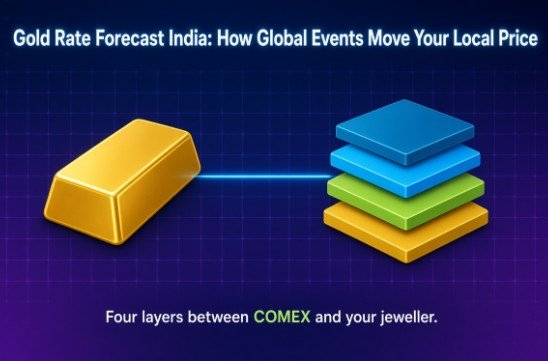
The gold rate in an Indian jewellery shop is set in London and New York, translated through a currency market in Mumbai, taxed at the border, and marked up by a wholesaler before it reaches the display case. A buyer comparing yesterday’s COMEX close to today’s IBJA rate and finding a gap is not being misled: they are seeing four separate mechanisms operating on the same underlying metal. The gold rate prediction India is therefore not one forecast but a chain: XAU/USD moves first, USD/INR translates it, import duty fixes a floor cost, and seasonal demand determines whether Indian buyers pay at or above that floor.
The Four Layers Between COMEX and Your Jeweller
Most commentary on Indian gold prices treats the local rate as a simple derivative of the dollar spot price. It is not. Each layer adds its own variability.
| Layer | Current reading | What moves it |
| XAU/USD spot | $4,439.57 | Fed policy, real rates, central bank demand |
| USD/INR rate | 94.43 | RBI intervention, current account, dollar index |
| Import duty | 15% (restored May 13 2026) | Government policy, budget decisions |
| IBJA wholesale rate | ~₹1,53,730 / 10g | All of the above combined |
| Retail (jeweller) price | IBJA + GST + making charges | Local competition, brand, city |
The import duty is the most politically sensitive layer. It was cut in July 2024 to boost legal imports and reduce smuggling, then restored to 15% on 13 May 2026 as the government balanced revenue needs against trade policy. Each change produced a sharp repricing in the domestic market within days, regardless of what XAU/USD was doing.
Three Global Events That Reliably Move the Indian Gold Rate
Federal Reserve decisions. Gold prices and the US dollar move in opposite directions most of the time, because gold is priced in dollars and a weaker dollar makes it cheaper for non-US buyers. When the Fed signals rate cuts, real yields fall, the dollar weakens, and XAU/USD rises. For an Indian buyer, a simultaneous dollar weakening and rupee strengthening can partially offset the XAU/USD gain, but in 2026 both the dollar and the rupee have been weak against gold, compounding the local price rise. The next FOMC decisions in November and December 2026 are the single most watched macro events for gold into year-end.
Central bank buying. The World Gold Council has documented three consecutive years of record-pace central bank purchases, driven by China, India’s own RBI, Turkey, and several Gulf central banks diversifying away from dollar reserves. This buying sets a structural floor that is not responsive to short-term price levels: central banks do not pull bids because gold is expensive. Goldman Sachs attributes a significant portion of its $4,900 year-end target to this demand base. Bank of America’s $6,000 cycle target assumes it accelerates.
Geopolitical risk episodes. Gold’s role as a crisis hedge means it spikes on conflict escalation, sanctions announcements, and financial stress events. These moves are fast, often partially reversed, and difficult to trade for most retail participants. The relevant point for Indian buyers is that the premium paid during a geopolitical spike tends to compress back over weeks, making those moments poor entry points for physical purchases.
The Rupee Variable: When Currency Amplifies or Cushions the Move
USD/INR at 94.43 is the translation rate that determines how much of a global gold move Indian buyers feel. In 2026, rupee weakness has amplified the XAU/USD rally in rupee terms: even in months when the dollar gold price was consolidating, the Indian price kept rising because the rupee was softening. This relationship cuts both ways. A sudden rupee strengthening, triggered by RBI intervention or a shift in capital flows, could produce a fall in the Indian gold price even if XAU/USD is flat or rising.
The seasonal demand window adds its own layer. Dhanteras on 6 November and Diwali on 8 November 2026 drive the largest Indian physical buying window of the year. Jewellers and bullion dealers typically restock six to eight weeks before Dhanteras regardless of prevailing prices, which creates a demand-driven premium in the domestic market that does not show up in international spot. After the festival window closes, that premium usually compresses.
Conclusion
The Indian gold rate in 2026 is high because four mechanisms are simultaneously pushing it upward: XAU/USD near $4,439 with Goldman’s $4,900 target ahead, a rupee at 94.43 that has been weakening, a restored 15% import duty, and pre-festival physical demand building toward Dhanteras and Diwali in November. The base case for the remainder of 2026 puts the IBJA rate tracking toward approximately ₹1,59,600 per 10 grams, with Fed decisions in November and December as the next major catalyst in either direction. Buyers waiting for a significant correction have waited through most of 2026 without one arriving.

Sam Kuran is a passionate content writer and researcher who specializes in creating informative, engaging, and SEO-friendly articles. With a strong interest in technology, business, lifestyle, entertainment, and trending topics, Sam focuses on delivering accurate, well-researched, and easy-to-understand content. His goal is to help readers discover useful information, explore new ideas, and make informed decisions through high-quality, people-first content.