Cardiac Arrest vs Heart Attack: The Difference, Real Examples and Easy Memory Tricks
Two phrases get mixed up all the time: cardiac arrest and heart attack. People use them as if they mean the same thing. They don’t, and mixing them up can cost seconds in an emergency. Knowing the words is step one. Step two is finding the best First Aid training you can, so you know what to do when it counts.
Let’s sort out the words first, then the actions.
What Is the Difference in 10 Seconds?
Cardiac arrest means the heart suddenly and unexpectedly stops beating. The person collapses, doesn’t respond, and isn’t breathing normally.
Heart attack means blood flow to the heart is blocked, so part of the heart isn’t getting enough blood. The heart keeps pumping, and the person is usually awake.
That’s the core of it. One is a heart that has stopped. The other is a heart that is struggling. Both are medical emergencies, and both mean calling 9-1-1.
How Do They Compare Side by Side?
This table follows Heart & Stroke’s own comparison.
| Cardiac arrest | Heart attack | |
| What is it? | The heart suddenly stops beating | The heart isn’t getting enough blood |
| Cause | An abnormal heart rhythm | A blockage of blood flow to the heart |
| Is the heart pumping? | No. Blood and oxygen stop reaching the brain and other organs | Yes, the heart continues to pump blood |
| What it looks like | Sudden collapse, no response, not breathing or not breathing normally | Person is generally conscious, with chest or upper-body discomfort, sweating, nausea, shortness of breath or light-headedness |
| First steps | Call 9-1-1 and shout for an AED, start CPR, use the AED | Call 9-1-1, stop all activity, sit or lie down and wait for help |
Notice the difference in the last row. Cardiac arrest needs CPR and an AED right away. A heart attack needs rest and fast medical care. Heart & Stroke also notes that a heart attack can lead to a cardiac arrest if it is severe enough.
What Are Some Easy Memory Tricks?
Words stick better when they come with a picture. Try these.
Trick 1: Think “arrest” means “stop.” The word “arrest” comes from an old word meaning to stop. A police officer arrests someone to stop them in their tracks. In cardiac arrest, the heart is stopped.
Trick 2: Think plumbing versus power. This one is a memory aid, not a medical definition. A heart attack is like a blocked pipe. Cardiac arrest is more like a power cut, because it’s caused by an abnormal heart rhythm.
Trick 3: Ask “Is the person talking?” In a heart attack, the person is generally conscious and can usually tell you how they feel. In cardiac arrest, they’ve collapsed and don’t respond.
Pick the one that works for you and say it out loud a few times. It really does help in a stressful moment.
How Do You Use Each Term in a Sentence?
Examples make the difference clear. Here are correct uses:
- “She felt pressure in her chest and started sweating, so she called 9-1-1. Doctors said it was a heart attack.”
- “He collapsed and stopped breathing normally. A coworker started CPR for the cardiac arrest.”
- “The AED delivered a shock to help restart the heart after the cardiac arrest.”
And here are mistakes, with fixes:
- “He had a cardiac arrest, but he was talking and walking around.” If someone is conscious and talking, that doesn’t match a cardiac arrest.
- “Cardiac arrest is just another name for a heart attack.” They are different conditions with different causes.
- “A heart attack always stops the heart.” It doesn’t. In a heart attack, the heart continues to pump.
What Other Mistakes Do People Make?
A few more traps catch writers and speakers.
Mixing up cause and result. A heart attack can cause a cardiac arrest, but they aren’t the same thing. One can lead to the other.
Assuming it only happens to older people. According to Heart & Stroke, nearly half of out-of-hospital cardiac arrests in Canada happen to people under 65.
Confusing both with a third term. “Heart failure” is something else again. It generally means the heart isn’t pumping as well as it should. It doesn’t mean the heart has stopped.
Waiting for certainty. You don’t need to name the emergency before you act. Call 9-1-1, describe what you see, and follow the call taker’s instructions.
Why Does the Difference Matter?
Because the first steps are different, and speed matters.
According to Heart & Stroke, approximately 60,000 cardiac arrests happen outside hospitals in Canada each year, which is about one every nine minutes. Only one in 10 people survives. Doing CPR and using an AED can double a person’s chance of survival.
Time is the key. Heart & Stroke says every minute without CPR or an AED lowers the chance of survival by about 10%, and brain injury can begin within minutes. It also warns not to wait for paramedics, because response times can be six minutes or more in urban centres and longer in remote communities.
That’s why a bystander matters. The person closest to the emergency is the one who can start.
Where Do You Learn What to Do?
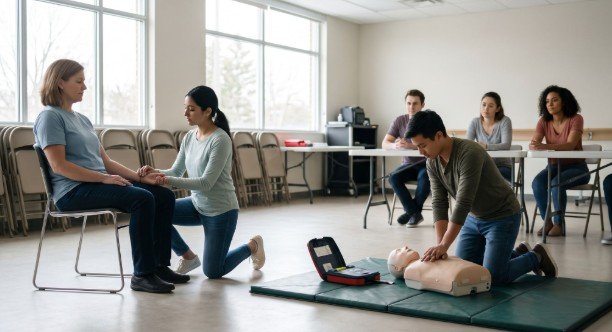
Reading helps. Practice helps more. A hands-on course lets you try compressions on a mannequin, use an AED trainer and get feedback from an instructor.
Use this checklist when you compare courses:
- Hands-on practice. You want real time with mannequins and an AED trainer.
- A clear instructor. Look for someone who explains steps in plain language and checks your understanding.
- The right level. Match the course to your purpose, whether that’s home, school or work.
- A flexible format. Many providers offer blended courses, with theory online and a shorter in-person session for skills.
- Certificate details. Ask how long the certificate is valid and how renewals work.
To compare formats and dates, explore Coast2Coast First Aid class formats and ask any provider the same questions.
Did the Course Names Change Too?
Yes, and it’s another case of words that trip people up. In Ontario, workplace first aid requirements come from WSIB Regulation 1101, which applies to workplaces with WSIB-covered employers. On June 22, 2026, the WSIB aligned its First Aid Program with the national CSA Z1210:24 standard.
Two names changed:
- Emergency First Aid is now Basic First Aid
- Standard First Aid is now Intermediate First Aid
The thresholds didn’t change. A shift with one to five workers needs at least one worker with Basic First Aid. A shift with six or more needs at least one with Intermediate First Aid. Earlier certificates stay valid until they expire, and certificates are valid for three years. Only providers the WSIB lists can deliver the new certifications.
If you’re booking a course for work, use the new names when you ask. It saves confusion.
If you are looking for first aid training near Kennedy Road South and Queen Street, the Bramalea City Centre area, or surrounding areas in Brampton, you may reach out to Coast2Coast First Aid & Aquatics in that area.
FAQs
Q: Is cardiac arrest the same as a heart attack?
A: No. In cardiac arrest, the heart suddenly stops beating because of an abnormal rhythm. In a heart attack, blood flow to the heart is blocked, but the heart keeps pumping.
Q: Can a heart attack cause cardiac arrest?
A: Yes. According to Heart & Stroke, a heart attack can lead to a cardiac arrest if it is severe enough.
Q: What are the signs of cardiac arrest?
A: Sudden collapse, loss of consciousness, no response to touch or sound, and not breathing or not breathing normally.
Q: What should I do if someone collapses and isn’t breathing normally?
A: Call 9-1-1 and shout for an AED, start CPR right away, and use an AED as soon as one is available. Heart & Stroke stresses that you can’t hurt the person by trying, you can only help.
Q: How long is an Ontario workplace first aid certificate valid?
A: Three years.

Andy is a senior content editor at MagazineSolo, covering technology, business, finance, and digital trends. He focuses on creating informative, well-researched, and easy-to-understand articles that help readers make smarter decisions. Andy is passionate about delivering accurate, practical, and engaging content for everyday readers.