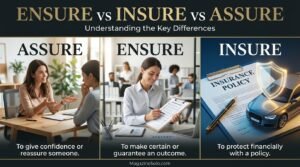
Ensure vs Insure: What Is the Difference?

Ensure vs insure difference questions get settled by one look at the sentence. Find what follows the verb, and the word chooses itself.
If a that clause or an outcome follows, the verb is ensure. Please ensure that the door is locked, and ensure accuracy in the report.
If a thing follows, usually with against and a risk, the verb is insure. Insure the car against theft, and the house against fire.
One more fact keeps careful writers honest. Insure can sometimes do the ensure job, but ensure can never do the insure job.
That one way overlap is the part most guides leave out. It sits at the center of this page, next to the test.
Dictionary backing matters here, because this pair has a real authority. The confused words library at MagazineSolo’s confused words library hosts the sibling pages, including the full trio guide to ensure, insure, and assure.
The Object Test, Step by Step
The object test works on any sentence in a few seconds. It asks one question about the words after the verb.
Step 1: Find what follows the verb.
Does a that clause follow, like ensure that the files are ready? Or does an outcome noun follow, like accuracy, safety, or success?
Either pattern points to ensure. The verb is making something certain, and its object is a result.
Step 2: Look for a thing plus a risk.
Does a thing follow, like a car, a house, or a shipment? Is there an against phrase naming a risk, like theft, fire, or damage?
That pattern points to insure. The verb is arranging financial protection, and a policy stands behind it.
Step 3: Apply the money test.
Ask whether a policy could pay out if things go wrong. If money would change hands under a contract, the verb is insure.
If nothing could ever be paid, because the sentence is about a result, the verb is ensure. Money is the cleanest separator.
|
What follows the verb |
Verb |
Example |
|---|---|---|
|
A that clause |
ensure |
Ensure that the door is locked. |
|
An outcome noun |
ensure |
The checks ensure accuracy. |
|
A thing plus against plus a risk |
insure |
Insure the car against theft. |
|
A thing a policy covers |
insure |
She insured her health and home. |
|
A person |
assure |
I assure you it is handled. |
Ensure: Making Outcomes Certain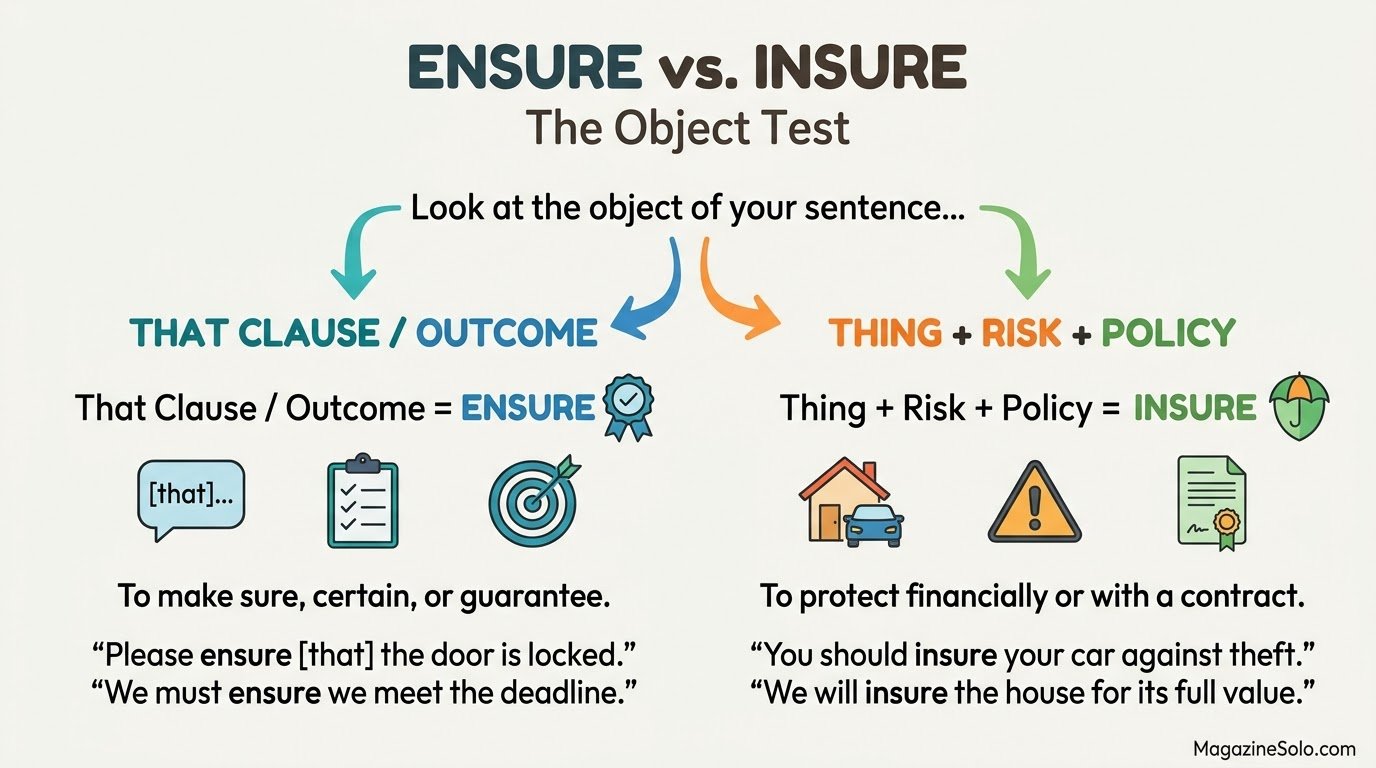
Ensure means to make certain that something happens or holds true. Merriam Webster defines it as to make sure, certain, or safe.
Its partners are clauses and outcomes. Ensure that the report is correct, ensure the meeting starts on time, ensure safety on site.
Notice the objects: correctness, punctuality, safety, success, compliance, completion. None of them can be bought, and no policy pays for them.
In procedures and instructions, ensure is the workhorse. Please ensure your seatbelt is fastened is the classic announcement phrasing.
The verb also fits systems and habits. Regular backups ensure that a failure never becomes a disaster for the team.
Insure: Protection With Money Behind It
Insure means to provide or obtain insurance on or for something. That is the dictionary definition, and it names the money directly.
Its partners are things and risks. Insure the warehouse against fire, the shipment against loss, your life, your health, your car.
A policy, a premium, and possible compensation stand behind every true insure. If none of those exist, the word is probably wrong.
The family tells the same story. Insurance is the noun, insured and insurable are the adjectives, and an insurer does the insuring.
The One Way Overlap, Stated Plainly
Now the part that separates an honest guide from a slogan. Insure sometimes carries the ensure meaning in recognized usage.
Merriam Webster’s usage note says the distinctions are generally made today, not that they are absolute. Dictionaries record the overlap, they do not invent it.
The same note defines one sense of insure as making certain, especially by taking necessary measures and precautions. That sense is real and current.
But the traffic runs one way only. Insure has the extra insurance meaning that ensure does not share, and ensure never means insure.
So using insure where ensure would be clearer is, at worst, a style choice. Using ensure for a policy is simply wrong.
A recent teaching analysis reaches the same balanced verdict. Reading the GrammarJobs ensure vs insure analysis shows the overlap stated openly before the clean rule is recommended.
Insure Against: The Prevention Sense
The overlap has a favorite home: insure against. Trying to insure against a negative outcome is the dictionary’s own example.
Here insure means something like guard in advance, taking steps so a bad result cannot happen. No policy need exist at all.
This is where careful writers get overcorrected. An editor who changes every insure to ensure breaks sentences that were right.
Careful planning should insure the success of the party. That sentence, with insure, is the dictionary’s own illustration of the nuance.
The lesson is balance. Prefer ensure for outcomes in your own writing, but never “fix” another writer’s insure without checking its object.
The Fine Shades Between the Verbs
The dictionary’s synonym note adds shades worth knowing. The verbs are interchangeable in many contexts about making an outcome certain.
Even there, each leans its own way. Ensure may imply a virtual guarantee, a promise that the outcome is as good as settled.
Insure, in that shared zone, stresses the measures taken beforehand. The planning, the precautions, and the preparation sit inside the word.
Secure, the fourth cousin, guards against attack or loss. Its flavor is defensive, closer to protection than to promises.
These shades explain real sentences. A plan insures success by preparation, while a track record ensures confidence by results.
Assure: One Boundary Box
A third verb shares the root and the confusion. Assure works on a person, removing doubt from someone’s mind.
I assure you the issue will be resolved. The object is you, a mind with doubts, not a result and not a thing.
Merriam Webster’s note puts it crisply: assure is used when someone is removing, or attempting to remove, doubt. That is the whole lane.
The full three way treatment lives in the full trio guide to ensure, insure, and assure. This page keeps assure to this box, so the pair stays sharp.
One Root, Three Lanes: The Short History
The overlap exists because the words were never strangers. Insure descends from Middle English, probably an alteration of assuren, to assure.
Its first known use dates to 1635, and, tellingly, in the make certain sense. The insurance meaning grew later, as policies did.
For centuries the spellings traded senses freely. The clean split readers learn today is a hardened convention, not an original design.
That history has a practical moral. When an older text uses insure for ensure, it is not a typo; it is the older, shared usage.
Modern professional writing still follows the split. Convention, backed by every current usage guide, is what your readers will judge by.
The Word Family Trap
Writers often meet this pair at the noun, not the verb. They need a noun, reach for the verb family, and land wrong.
Insure owns a complete family. Insurance names the contract, the insured names the covered party, and insurable names what qualifies.
Ensure owns almost nothing. Ensurance exists in dictionaries and is genuinely rare; almost nobody writes it, and few readers know it.
So a writer wanting a noun for certainty must rephrase. Say steps that ensure safety, or the certainty itself, never the ensurance.
The verb choice then stays clean. If the sentence needs insurance, insure was the verb; if it needs a result, ensure was.
Sound, Spelling, and the Letter That Helps
Your ear cannot rescue you here. For most speakers the two words land on the same pronunciation, which is why the confusion survives.
In the ProWritingAid explainer on insures and ensures, the pair is called near homophones outright. A minority of teaching sites claim careful speech separates them; treat that as a strand.
The written difference is exactly one letter. Ensure opens with e, insure with i, and that i carries the memory hook.
I is for insurance. If the sentence involves insurance in any way, the word with i is the one you want.
Every other case defaults the other way. Outcomes, clauses, results, and promises take ensure, the broader and more common verb.
The same ear trap drives several famous pairs, and one classic case is the affect vs effect difference guide, which untangles a verb and noun pair that sound alike in the same way.
Document Clinics: Where Each Verb Works
Different documents lean on different lanes. Safety writing runs on ensure: ensure the guard is fitted, ensure the area is clear.
Insurance documents run on both. The insurer insures the risk, while the contract ensures the process and the timeline.
Business email mixes them rarely but visibly. Please ensure the invoice is attached is right; please insure it would claim a policy exists.
Compliance text is ensure territory. Companies ensure compliance, ensure records are kept, and ensure audits happen on schedule.
Contracts are the danger zone. A clause saying a party will ensure goods against damage mixes the lanes and invites argument.
An audit habit fixes documents fast. Search for both verbs, apply the object test to each hit, and correct only the failures.
Errors in Both Directions
Direction one is the famous one. Insure used for ensure in formal prose, like “insure that the form is signed,” reads old fashioned to wrong.
Most editors will change it, and in your own writing you should too. Ensure is clearer, and clarity is the professional standard.
Direction two is the absolute one. Ensure used for insurance, like “ensure your car with our policy,” is wrong in every register.
No usage note rescues it, because ensure has no insurance sense at all. This is the error that costs money and trust.
Direction three is the hidden one. Overcorrection changes correct insure sentences into ensure and quietly damages meaning, especially with against.
The balanced rule handles all three. Split the lanes in your writing, respect the overlap in your reading, and test every object.
Writers who like pair drills will find a cousin case in the accept vs except difference guide. The pattern of one test per pair repeats across the cluster.
Practice: Twelve Sentences, Verdicts Attached
- Please ___ that the gate is locked. Ensure. A that clause follows, and clauses take ensure.
- They ___ the gallery’s paintings before shipping. Insure. Things a policy covers, with real money behind the shipment.
- Regular testing helps ___ the system stays reliable. Ensure. The object is an outcome about the system, not a covered thing.
- She ___ her car against theft and fire. Insure. Thing, against, and two named risks: the full insure pattern.
- Careful planning should ___ the launch succeeds. Insure is the dictionary’s nuance pick here, stressing measures beforehand; ensure is also acceptable.
- We ___ you that the delay is temporary. Assure. A person with doubts is the object, so the third lane applies.
- The policy ___ the building for two million. Insures. A policy is the subject, so the verb must carry the insurance sense.
- Steps were taken to ___ against a repeat outage. Insure, in the prevention sense. Against plus a bad outcome is its home ground.
- ___ the address is correct before sending. Ensure. A clause about correctness, the everyday ensure job.
- He ___ his tools with a specialist insurer. Insured. The insurer’s presence settles it instantly.
- Training ___ that new staff work safely. Ensures. The outcome is safe working, delivered through a clause.
- Can I ___ my engagement ring? Insure. A valuable thing plus an implied policy question.
British, American, and Editor Standards
The lane split is transatlantic, not an American invention. British guides reserve insure for insurance and ensure for certainty in the same way.
The tolerance around the split is where editors differ. American usage keeps the insure overlap most visibly, especially in the prevention construction.
British prose allows it too, but some house styles prune harder. A British editor may change insure that on sight, while an American one pauses.
Neither standard changes the hard rule. Ensure for insurance fails in London and in New York alike, because no dictionary gives it that sense.
Freelancers meet this in style sheets. When a client’s guide is silent, default to the split and leave insure against sentences untouched.
The professional habit is consistency over conquest. Pick the split, apply it everywhere, and save your queries for sentences that truly argue back.
The Sentence Clinic: Ten Real Fixes
- “Please insure that the form is signed.” Fix to ensure. A clause follows, and modern formal prose expects ensure there.
- “Ensure your car with our family policy.” Fix to insure. A policy is being sold, so the insurance verb is mandatory.
- “Steps to insure against a repeat failure.” Leave it. The prevention sense is dictionary backed, and against is its home.
- “We ensured the shipment for its full value.” Fix to insured. Value plus shipment means coverage was purchased.
- “The checklist insures accuracy.” Fix to ensures. Accuracy is an outcome, and no policy pays out for it.
- “I ensure you, the money is safe.” Fix to assure. A person with doubts is the object, so the third verb applies.
- “Insure the report reaches the board.” Fix to ensure in formal writing. A clause about delivery is outcome territory.
- “They ensured against flooding with sandbags.” Debated, leaning fix. Prevention with against belongs to insure in the dictionary’s pattern.
- “Our cover will ensure your peace of mind.” Marketing copy, acceptable as rhetoric. Peace of mind is an outcome, though insurers writing it should note the irony.
- “Ensure against theft with our locks.” Fix to protect or insure against. Locks prevent rather than cover, so protect is the honest verb.
The clinic shows the test earning its keep. Every verdict came from the object, never from how the sentence sounded.
Teaching the Pair Without Tears
Teachers meet this pair early, because learners ask about it constantly. The sound identity makes it a listening trap before it is a writing one.
The winning order is objects first, definitions second. Learners sort twelve sentences by what follows the verb, and the rule discovers itself.
Only then name the lanes. Ensure makes outcomes certain, insure covers things against risks, and assure calms a person.
The overlap deserves one honest minute. Tell advanced learners that insure can carry the certainty sense, then show why professionals still choose ensure.
Skipping that minute backfires later. Learners meet “insure against failure” in real text and conclude the whole lesson was wrong.
Finish with production, not recognition. Each learner writes one sentence per lane, and the class checks each other’s objects.
The pair then stays learned. A test a learner can run alone beats a definition a teacher must repeat forever.
Reading Older Text Without Panicking
Older books will use insure where a modern editor wants ensure. That is the shared root showing, not an error to hunt.
Nineteenth century prose insured success, insured happiness, and insured that things happened. The certainty sense came first, historically, and faded slowly.
Editors of reprints usually leave it. Changing historical usage would rewrite the author’s English, and the meaning stays clear from the object.
Legal historians meet the reverse patience test too. Old policies use language loosely by modern standards, and courts read by context, not by slogans.
Your own archive deserves the same calm. A 1990s company memo saying “insure that” needs no apology, only modernization at the next revision.
The takeaway is proportion. History explains the overlap, the present tense split governs new writing, and neither fact cancels the other.
The Pair Across the Workplace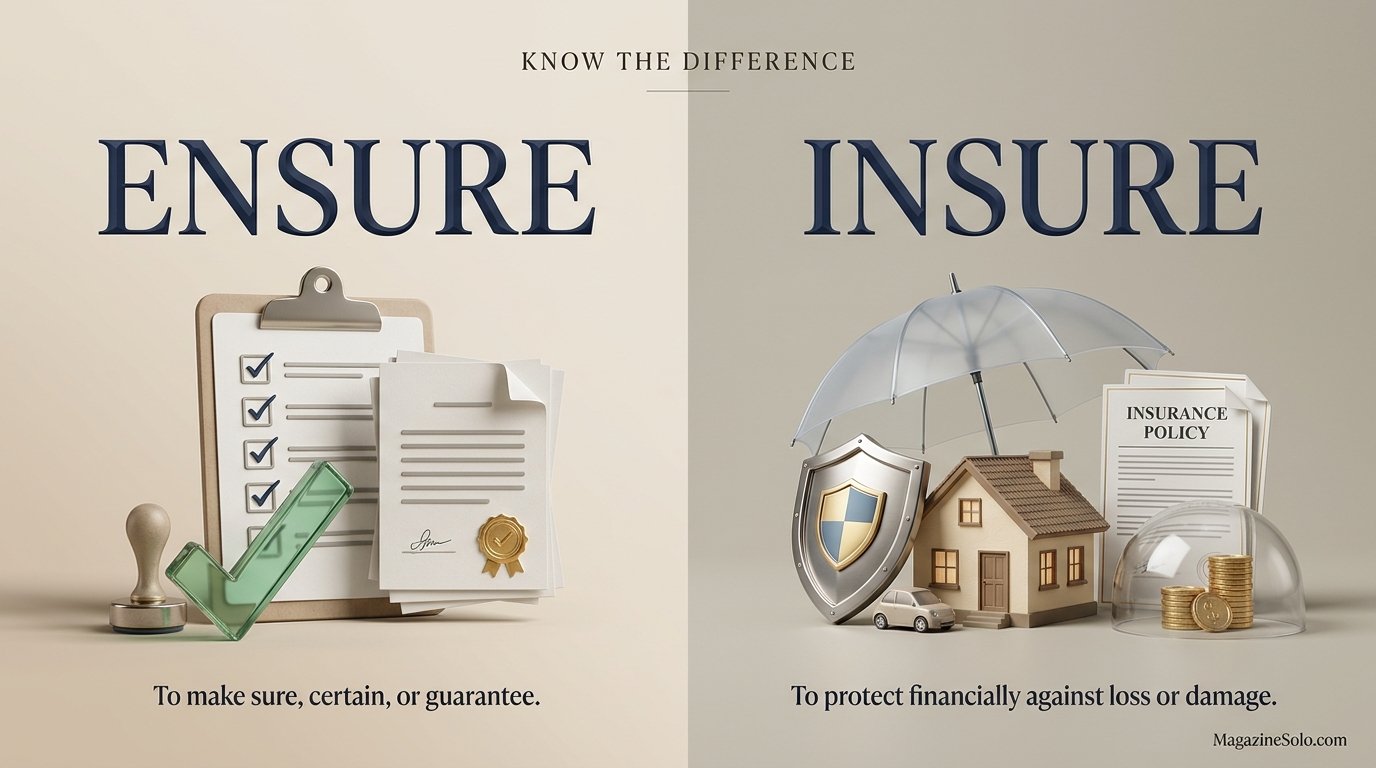
Operations teams write ensure all day. Ensure the route is staffed, ensure the cold chain holds, ensure the handover is signed.
Finance teams meet both in one afternoon. They insure the fleet, then write memos to ensure the premiums are budgeted and paid.
Human resources lives on the boundary. HR insures employees through group cover and ensures employees complete their enrollment forms on time.
Customer support writes the person lane constantly. Agents assure customers in chat, ensure refunds are processed, and never touch insure unless policies are sold.
Marketing flirts with all three for rhythm. Honest copy checks the objects anyway, because a slogan with ensure your car is still wrong.
Founders writing investor updates lean on ensure hardest. Ensure is the verb of control over outcomes, which is exactly the promise being made.
The pattern across departments never changes. Outcomes, coverage, and people sort the verbs, in every tone from memo to manifesto.
A Final Checklist Before You Send
One: Read the verb’s object aloud. If you hear a clause or an outcome, the verb should be ensure.
Two: Ask the money question. If a policy could pay, the verb should be insure, and no other answer survives.
Three: Check every against. Against plus a risk after a thing is insure; against plus a feared outcome may be insure in prevention.
Four: Scan for assure strays. A person after the verb wants assure, especially in I assure you constructions.
Five: Audit nouns nearby. Insurance in the sentence almost always means insure was the verb the writer needed.
Six: Leave history alone. Older insure for ensure in quoted or archival text is evidence, not an error to repair.
Seven: Keep the document consistent. One writer, one convention, applied from the headline to the footnotes.
Run this list once and the pair is settled permanently. The test is small because the distinction, honestly stated, is small too.
Why This Pair Outranks Bigger Grammar Topics
Teachers report that this pair generates disproportionate anxiety. The stakes feel high because the wrong word can claim a contract exists.
That anxiety is rational in insurance adjacent jobs. A misused verb in a coverage letter can promise protection nobody sold.
Elsewhere the cost is credibility, not money. The reader notices, quietly downgrades the writer, and moves on without reporting the error.
Which is why the object test matters so much. It converts a reputation risk into a five second check with a certain answer.
Few grammar habits pay back this reliably. Learn this one test, and an entire category of doubt leaves your writing day permanently.
One Last Contrast: Certainty You Build, Coverage You Buy
Everything on this page reduces to a difference in how safety is made. Ensure builds certainty through action, attention, and follow through.
Insure buys a financial answer to a risk that action cannot remove. The house can still burn; the policy decides what happens next.
Writers who feel that contrast stop confusing the verbs. The words stop being spellings and become two different kinds of promise.
Keep the object test for the hard cases anyway. Even a strong feel for the pair deserves a check when money or a contract is nearby.
The Habit That Replaces the Rule
Rules fade; habits survive deadlines. The habit here is a half second glance at the words sitting right after the verb.
Make that glance automatic and the rule stops needing recall. The object announces itself: clause, outcome, covered thing, or a person.
Writers who build the glance stop fearing the pair entirely. Job done, in the only way writing skills ever really get done.
Frequently Asked Questions
1. What is the difference between ensure and insure?
Look at what follows the verb. A that clause or outcome noun (ensure that, ensure accuracy) means ensure, to make certain.
A thing with against and a risk (insure the car against theft) means insure, financial protection.
2. What does ensure mean?
To make certain something happens or holds true. Ensure takes clauses and outcomes: ensure that the door is locked, ensure accuracy, ensure safety, ensure compliance.
Merriam Webster defines it as to make sure, certain, or safe.
3. What does insure mean?
To provide or obtain insurance on or for something. Insure takes things and risks: insure the house against fire, insure your health, insure a shipment.
A policy, a premium, and possible compensation stand behind every true use.
4. Is it ensure or insure the car?
Insure. A car is a thing a policy covers, so the insurance lane applies.
You insure a car against theft, damage, or accidents.
Ensure would wrongly claim you are making the car certain rather than covering it.
5. Can insure mean ensure?
Yes, in recognized usage. Merriam Webster records a sense of insure meaning to make certain, especially by taking necessary measures beforehand.
It is especially American.
Even so, ensure is usually clearer in your own professional writing.
6. Can ensure mean insure?
No, never for insurance. Ensure has no insurance sense at all, which is the one way rule of this pair.
Saying ensure your car with a policy is wrong in every register, while insure for ensure is merely old fashioned.
7. Is insure against failure correct?
Yes. Insure against a negative outcome is the dictionary’s own example of the prevention sense, meaning to guard in advance by taking steps.
No policy needs to exist.
Overcorrecting such sentences into ensure damages correct English.
8. Ensure or insure the success of the event?
Either can appear, and insure is the dictionary’s nuance pick. Its synonym note uses careful planning should insure the success of the party, where insure stresses measures taken beforehand.
Ensure the success is also fully acceptable modern usage.
9. Why do people confuse ensure and insure?
Sound, spelling, and a shared root all conspire. The words sound the same for most speakers, differ by one letter, and descend from one Middle English root, so neither the ear nor history warns the writer in time.
10. Do ensure and insure sound the same?
Effectively yes. Reference and teaching sources treat them as near homophones: same pronunciation, different spelling and meaning.
A minority of teaching sites claim careful pronunciation separates them, which is best treated as a minor strand only.
11. How can I remember ensure vs insure?
Use the letter and the object. I is for insurance: if a policy, coverage, or money against risk is involved, choose insure.
Everything else, outcomes, clauses, and results, takes ensure.
The mnemonic plus the object test rarely fails.
12. What is the object test for ensure and insure?
Apply three quick checks to the words after the verb. Clause or outcome means ensure.
Thing plus against plus risk means insure.
Could a policy pay out?
That money test settles any sentence the first two checks leave open.
13. Is it ensure that or insure that?
Ensure that. Clauses belong to ensure almost without exception, because a clause states a result to be made certain.
Insure that survives only as an old fashioned overlap use, and careful writers replace it with ensure that.
14. Can you insure a person?
Yes, in the policy sense. People insure themselves and their families for life and health coverage every day.
The object is still coverage, not the person as a result, which is why insure, not ensure, is correct.
15. Can you ensure a house?
Not in the insurance sense. You can ensure a house stays locked, clean, or safe, because those are outcomes.
You cannot ensure a house against fire; covering a building against a risk is insure, with a policy behind it.
16. What does assure add to ensure vs insure?
Assure is the third lane: a person. It removes doubt from someone’s mind, as in I assure you the issue is resolved.
Ensure takes results, insure takes things and risks, and assure takes people.
17. Assure a person, ensure a result, insure a thing: is that the rule?
Yes, as a working rule it is exact. Assure a person (doubt removed), ensure a result (outcome made certain), insure a thing (risk covered by a policy).
It covers nearly every real sentence; the overlap note handles the exceptions.
18. Is ensurance a word?
It exists and is rare. Dictionaries list ensurance, but almost nobody writes it and few readers recognize it.
Writers needing a noun should rephrase, saying steps that ensure safety, rather than reaching for a noun that reads as a mistake.
19. What is the noun for insure?
Insurance is the noun. The family is complete: insurance the contract, insured the covered party or covered, insurable what qualifies, and insurer the company providing cover.
Ensure, by contrast, has no common noun form at all.
20. Ensure vs guarantee: what is the difference?
Guarantee promises; ensure arranges. Ensure means taking the steps that make an outcome certain.
Guarantee adds a promise or a formal assurance behind the outcome, often with a remedy attached.
Careful planning ensures success; a warranty guarantees the repair.
21. Insure vs underwrite: what is the difference?
Underwrite is the insurer’s side of the desk. To insure is to obtain or provide coverage.
To underwrite is to assess the risk and set the terms and price of that coverage, the professional evaluation behind the policy.
22. Is the ensure insure rule the same in British English?
The split holds in British English too. British usage guides likewise reserve insure for insurance and ensure for making certain, and British dictionaries record the same insure overlap.
The convention is transatlantic, even if tolerance for overlap varies by editor.
23. Did ensure and insure used to mean the same thing?
Yes, for centuries. The trio descends from one Middle English root, assuren, and the spellings traded senses freely.
Insure’s first known use, 1635, was in the make certain sense; the insurance meaning grew later as policies did.
24. When was insure first used?
In 1635, in the make certain sense. Merriam Webster dates insure’s first known use to 1635, before its insurance sense developed.
That order explains today’s overlap: the certainty meaning is the original, and the money meaning is the later specialization.
25. Is using insure for ensure a grammar error?
It is a style issue, not a hard error. Dictionaries recognize insure in the certainty sense, so it is not flatly wrong.
In formal professional writing, though, most editors will change it to ensure, because ensure is clearer and expected.
26. Is using ensure for insurance ever correct?
No. Ensure carries no insurance meaning in any dictionary, so using it for coverage is the pair’s one absolute error.
If a policy, a premium, or compensation is anywhere in the sentence, the verb must be insure.
27. Which is more common, ensure or insure?
Ensure is far more common. Ensure serves every field, from safety instructions to software documentation.
Insure lives mostly inside insurance contexts, plus its prevention against uses.
Most writers need ensure many times for every one insure.
28. Ensure or insure in a formal email?
Ensure, almost always. Business email deals in outcomes: please ensure the invoice is attached, ensure the figures are final.
Insure appears only when actual coverage is being discussed, which most working email never touches.
29. Ensure or insure in insurance documents?
Both, in divided labor. The insurer insures the risk, the vehicle, or the building.
The same document then uses ensure for process: ensure claims are filed within the window, ensure records are retained.
Each verb keeps its lane.
30. Ensure or insure for safety instructions?
Ensure, nearly without exception. Safety instructions command outcomes: ensure the guard is fitted, ensure the area is clear before starting.
Insure would falsely suggest a policy, so procedure writers keep ensure for every instruction line.
31. What does insure against mean with ensure’s meaning?
It is insure in its prevention sense. Paired with ensure’s territory, it means guarding in advance: steps taken so a bad outcome cannot occur, like insuring against a repeat outage.
The dictionary illustrates it with insuring against a negative outcome.
32. Can a company ensure its employees or insure them?
Both, for different objects. A company insures its employees when it buys group health or life coverage for them.
It ensures its employees are trained, paid, or informed when the object is an outcome about the staff.
33. Ensure the package arrives or insure the package?
Both, for different jobs. Ensure the package arrives by choosing tracked delivery and a correct address.
Insure the package by buying coverage against loss or damage in transit.
Many senders do the first and then decide about the second.
34. Ensure accuracy or insure accuracy?
Ensure accuracy. Accuracy is an outcome, not a covered thing, so ensure is the only fit.
Insure accuracy would claim a policy pays for errors, which belongs to a different sentence about professional liability coverage.
35. How do dictionaries define ensure and insure?
Both start from making sure. Merriam Webster defines ensure as to make sure, certain, or safe, and gives insure two centers: the same make certain sense, especially by measures beforehand, plus the insurance sense ensure lacks.
36. What does Merriam Webster say about ensure and insure?
Distinctions are generally made today. Its usage note assigns assure to removing doubt, ensure to making sure, certain, or safe, and insure sometimes to that same meaning but more often to insurance, or prevention with against.
37. Are ensure and insure homophones?
Effectively, for most speakers. They are taught and listed as near homophones: identical or near identical pronunciation, different spelling and meaning.
That is why the confusion is a writing problem, not a listening one.
38. Which letter helps: why is i for insurance a good memory hook?
Because it is true at the decision point. The i word is the insurance word in nearly every real choice a writer faces.
Pair the hook with the object test and the pair stops being a coin flip permanently.
39. Ensure vs insure in one sentence: give an example with both.
One sentence can hold both cleanly. We insured the shipment to ensure it would be replaced if lost.
The verb with a thing and a risk is insure; the verb with a clause about outcomes is ensure.
40. Is rest assured related to assure?
Yes, directly. Rest assured is a fossil phrase built on assure, meaning be confident and stop doubting.
It keeps the person’s mind object of the original verb, which is why assured, not ensured, is the form inside it.
41. Should a style guide ban insure for ensure?
A good style guide steers rather than bans. Because dictionaries recognize the insure overlap, a ban misstates the language.
Better guidance: default to ensure for certainty in house writing, and never change another writer’s insure against without checking its object.
42. How do I check ensure and insure in a long document?
Search the document for both verbs. Apply the object test to every hit: clause or outcome to ensure, thing and risk to insure.
Correct the failures, leave legitimate prevention uses alone, and the pass takes minutes even in long files.
Conclusion
The ensure vs insure difference is a one look habit, not a memory feat. Check the object, and the verb follows it home.
Clauses and outcomes take ensure, because making certain is its whole job. Things against risks take insure, because a policy stands behind it.
Hold the asymmetry too, because it protects good sentences. Insure can borrow the certainty job in recognized usage, while ensure can never borrow the insurance job.
When a word pair keeps defeating you, it usually has a test like this one, and the same object first approach powers the affect vs effect difference guide too.
Two more cousins repay the same minute of attention: one is the advise vs advice difference guide, which splits a verb from its noun, and another is the principal vs principle difference guide, which separates money and rank from rules.
Sound alike traps finish the tour neatly, since the its vs it’s difference guide solves the apostrophe pair and the full trio guide to ensure, insure, and assure closes this family with assure in its place.
Apply the object test to the sentence on your screen right now. That is the whole skill, and it will not fail you.

Dilawar is a content writer at MagazineSolo, covering travel, home improvement, interior design, and everyday lifestyle topics. He enjoys researching practical solutions, exploring travel destinations, and sharing helpful guides that make daily life easier. His writing focuses on clear information, useful advice, and engaging stories for a wide audience.