
Ensure vs Insure vs Assure: Assure a Person, Ensure an Outcome, Insure a Policy

Ensure vs insure vs assure stops being confusing the moment you stop asking what the verbs mean and start asking what follows them: you assure a person, you ensure an outcome, and you insure a policy.
The three verbs share one root and one loose idea, making sure. That shared idea is why definitions alone never fix the confusion. The word sitting after the verb is what separates them, every time.
One of the three is not like the others in a second way. Ensure has no noun form of its own, a gap hiding inside a term you already know: quality assurance.
Below: the three lanes in one table, the object test that chooses between them, each verb in its own section, the root story, the British lane, the honest overlap, the workplace cases, and a ten sentence practice set.
The Quick Answer: Person, Outcome, Policy
Here is the whole distinction on one screen. Every section after this one explains a row, a lane, or an exception, so keep this table in view.
|
Verb |
What follows it |
What it does |
Example |
|---|---|---|---|
|
Assure |
A person |
Removes their doubt |
I assure you, it is handled |
|
Ensure |
An outcome, a that clause |
Makes it certain |
Ensure that the gate is closed |
|
Insure |
A policy, a risk, a thing of value |
Protects it financially |
Insure the van against theft |
Assure works on a mind. Someone feels doubt, and the verb talks it down. If the words after the verb name a person, assure is the answer.
Ensure works on the world. Steps get taken, checks get run, and an event becomes certain. If the words after the verb name an outcome, ensure is the answer.
Insure works on a balance sheet. Money moves to an insurer so a loss, if it comes, lands on them. If the sentence involves a policy, insure is the answer.
The Grammarly guide to assure, ensure, and insure prints the same split in one line each: assure removes doubts, ensure guarantees something happens, insure covers it with a policy. The lanes are not in dispute anywhere serious.
The Object Test: One Check That Chooses the Verb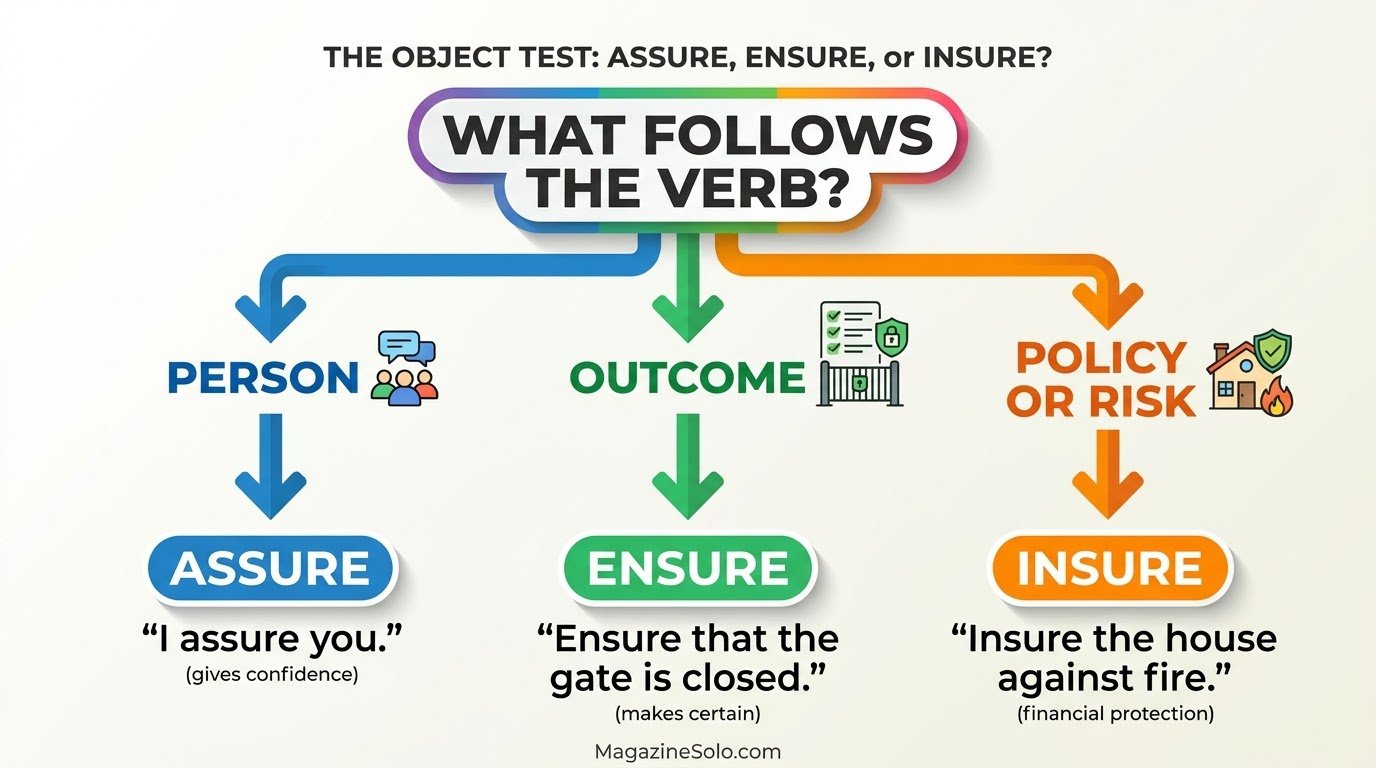
Definitions describe the trio; the object test operates it. When a sentence stalls you, ignore the verb for a second and read only what follows it.
Step one: find the object. Look at the first noun, pronoun, or clause after the verb. That object, not the topic of the sentence, decides the verb.
Step two: sort the object into three kinds. A person or people. An outcome, condition, or that clause. A thing of value, a risk, or an against phrase.
Step three: match the lane. Person takes assure. Outcome takes ensure. Policy and risk take insure. Three kinds, three verbs, no fourth case in ordinary writing.
Test it on the classic trap. The manager ___ the employees that their jobs were safe. The object is the employees, people being comforted, so the verb is assured, whatever your fingers typed first.
Test it on the quiet one. We ___ the car before the trip. If a policy was bought, the verb is insured. If the brakes were checked so the trip would go well, the verb is ensured, and the sentence should probably say so.
The Writing Explained difference guide states the sharpest version of the lane rule: we only ensure events or states of being, we do not ensure things, while insure applies to things. The object test is that rule turned into a habit.
Assure: The Verb That Takes a Person
Assure means to tell someone something confidently so that their doubt goes away. Its home ground is speech between people: reassurance given, confidence restored, a worry answered.
Frame one: assure someone that. I assure you that the money was wired. The nurse assured the family that the doctor was coming. This is the verb’s most common shape in modern English.
Frame two: assure someone of something. She assured him of her support. He assured the board of his commitment. The of frame vouches for a thing, but the direct object is still the person being told.
What assure changes. Not the world, and not a risk register. Assure changes a state of mind, which is why only someone who can feel doubt can be assured. You cannot assure a door, a deadline, or a database.
The fourth verb in the room. When the comfort must be repeated or kept up, English reaches for reassure. The Grammar Girl column on this trio makes the point neatly: assure once, reassure when doubt returns, which is why reassure fills healthcare and customer care language.
The fixed phrase. Rest assured is the idiom the family left behind: you may rest assured that it is handled. It is always assured, never ensured or insured, and it carries the comfort sense in fossil form.
Ensure: The Verb That Takes an Outcome
Ensure means to make certain that something happens, or does not happen, by taking the steps that control it. Its home ground is instruction, procedure, and planning.
The that clause is its signature. Ensure that the gate is closed. Ensure that all valves are shut before starting. The clause names an outcome, and the verb promises the work behind it.
Outcomes without clauses. Ensure accuracy. Ensure compliance. Ensure a smooth handover. The object is still an outcome or a condition, never a person being comforted and never a thing being covered.
What ensure changes. It changes the state of the world, measurably. Either the gate is closed or it is not. That is why standards, contracts, and safety documents run on ensure: the verb can be audited.
The trap inside ensure. Ensure looks like the safe default, and it is, until a person follows it. Ensuring a client in an email is the single most common error in this whole topic, and the object test catches it in one glance.
The limit of ensure. Ensure cannot buy protection. A sentence about a car being ensured against theft mixes the lanes, because against theft is the language of policies, and policies belong to insure.
Insure: The Verb That Takes a Policy
Insure means to protect financially by arranging for compensation if a specified loss occurs. Its home ground is the insurance contract, and outside that ground it should travel carefully.
The two frames. Insure something against a risk: insure the house against fire. Insure something for a sum: the paintings are insured for two million dollars. Against names the danger, for names the money.
What insure changes. Not the event, and not anyone’s feelings. Insure changes who bears the loss when the event happens anyway. The fire risk stays; the bill moves.
The narrowest lane. The LanguageTool insure vs ensure explainer calls insure the financial term and prints the pronunciations that explain the confusion, covered in the sound section next. Careful style guides reserve insure for this lane alone.
Insure is not a typo. It is a full dictionary word with a sense ensure never carries. Calling it a misspelling of ensure is the most common false claim in this topic, and the root section below shows why the two spellings exist at all.
Sound and Spelling: Why the Ear Cannot Help
If these verbs sounded different, this page would not exist. Ensure and insure are homophones, pronounced identically in American English, so the ear offers no vote at all between the two spellings people confuse most.
Assure sounds close but not identical. It opens with a soft, unstressed uh sound, uh SHUR, while the other two open with a clearer in. In fast speech the difference shrinks, which is why dictation and hurried typing produce so many of these errors.
The spelling difference between ensure and insure is one letter at the front, e against i, and that letter carries the whole insurance industry on one side and every instruction manual on the other.
The first letters are also the memory hooks, and the hooks bank is short enough to keep whole. A for assure and alive: only the living feel doubt. E for ensure, and the two e letters at the end of guarantee. I for insure, income, and insurance.
Hooks first, test second. The hooks get you to a candidate spelling in a blink, and the object test confirms it before the sentence leaves your hands.
One Root, Three Lanes: The Securus Story
All three verbs descend from one Latin word, securus, meaning secure or free from care. Break it open and it is se, without, plus cura, care: to be secure was to be without worries.
The word traveled through Medieval Latin assecurare and Anglo French assurer, and assure is the direct heir, in English since the 14th century by Merriam Webster’s dating.
Ensure arrived as an alteration of the same French verb, and Merriam Webster dates its modern sense, to make certain, to 1744. Same parent, different spelling, slightly different job.
Insure began as a variant spelling of ensure and then specialized as the insurance trade grew, until the i spelling owned the financial sense outright. Words that split this way are called doublets.
The root story explains the overlap you will meet below. These were not three words that drifted together. They were one word that split apart, and the seams still show wherever the lanes cross.
A fourth sibling completes the family portrait. Secure, from the same securus, handles guarding, fastening, and taking possession: secure the building, secure the lid, secure a loan.
The Missing Noun: Why There Is No Ensurance
Ask for the noun forms and the trio breaks symmetry. Assure gives assurance. Insure gives insurance. Ensure gives nothing: there is no standard noun ensurance in modern English.
Usage writers flag this with genuine surprise, because the gap is invisible until a sentence needs the noun. Writers then paraphrase, with phrases like steps to ensure, or rewrite around guarantee or safeguard.
The gap explains a term you already use. Quality assurance is not named wrongly. The quality field needed a noun for confidence in processes, ensure had none to give, so it borrowed assurance, the confidence noun, and kept it.
Read the two real nouns by their lanes and they behave. Assurance is confidence, a promise, freedom from doubt, in the US sense. Insurance is the financial contract. Only in Britain does assurance double as a product name, which is the next section.
|
Verb |
Its noun |
Example |
|---|---|---|
|
Assure |
assurance |
words of assurance |
|
Ensure |
none in standard use |
steps to ensure (paraphrase) |
|
Insure |
insurance |
an insurance policy |
Keep this table in mind on forms and in reports. The sentence that wants an ensurance is really asking for a rewrite, and knowing that early saves the awkward draft.
The British Lane: Life Assurance, Sum Assured, the Assured
Everything above holds in British English too, with one product lane renamed, and a US writer must flag it rather than absorb it.
In Britain, life assurance is the standard name for the product Americans call life insurance. The reasoning inside the trade: assurance covers an event certain to happen eventually, above all death, while insurance covers events that may happen, like fire or theft.
Policy documents in that tradition carry two more terms. The sum assured is the amount the policy guarantees to pay, the counterpart of the American sum insured. And the assured is the person covered, the counterpart of the American the insured.
Historic British insurers kept assurance in their company names for centuries, and the word still stands on old buildings and live brands. None of this changes US practice: in American writing, life insurance, sum insured, and the insured are the forms, and assurance means confidence.
The lane matters here for one reason: US writers meet these terms in international documents, older contracts, and imported policy wording, and the object test still works once the naming is translated.
The Honest Overlap: Where the Lanes Still Cross
Honesty section, because the dictionaries insist on it. Merriam Webster states plainly that across the centuries each of these words has at times been defined as a synonym of the others, and that distinctions are a modern habit, generally made today.
The same authority notes the three remain interchangeable in many contexts where an outcome is being made certain. Its synonym note adds the fine shades: ensure may imply a virtual guarantee, insure can stress taking measures beforehand, and assure distinctively removes doubt from a person’s mind.
One overlap is still live in American English. Insure meaning make certain is a recorded dictionary sense, not an error, and Cambridge records the same American use. Careful writers choose ensure for that job anyway, because the convention is what readers now expect.
Assure carries a guarantee sense too, listed in dictionaries, which older writing uses freely. In modern edited prose it reads as a lane error, so this page teaches the strict lanes and labels this section as the record of where they soften.
The convention, then, in one sentence. The three lane split is not a law of nature; it is the current agreement among dictionaries, style guides, and editors, and following it is what makes your writing look edited.
At Work: Contracts, Compliance, and Client Email
The trio stops being a grammar topic where money and duty enter, and three workplaces meet it daily.
Contracts and policies. Inside an insurance policy, the insured is a defined term naming who is covered, repeated exactly through hundreds of clauses. The same drafting discipline uses ensure for obligations about outcomes. A drafter who swaps synonyms for variety creates ambiguity where none is allowed.
Compliance and safety. Regulations and standards run on ensure: ensure compliance, ensure traceability, ensure that records are kept. Insure in those sentences would promise a policy nobody bought. The set phrases are fixed, and audits quote them word for word.
Client and patient communication. Care and service writing lives in the assure lane, and its modern form is usually reassure: the client is assured once, then reassured at every delay. Writing ensure to a person in these emails is the error recipients actually notice.
|
The sentence as drafted |
The problem |
Corrected |
|---|---|---|
|
The manager ensured the staff that hours were safe |
Person after the verb |
assured the staff |
|
We ensured the van against theft |
Policy language on ensure |
insured the van |
|
Please insure that the gate is locked |
Outcome clause on insure |
ensure that the gate |
|
Steps for the ensurance of quality |
A noun that does not exist |
steps to ensure quality |
|
He insured her that the results were normal |
Comfort delivered by insure |
assured her |
Each correction is the object test doing its job. Nothing in the table needs a definition; it needs one look at what follows the verb.
Example Sentences for Every Lane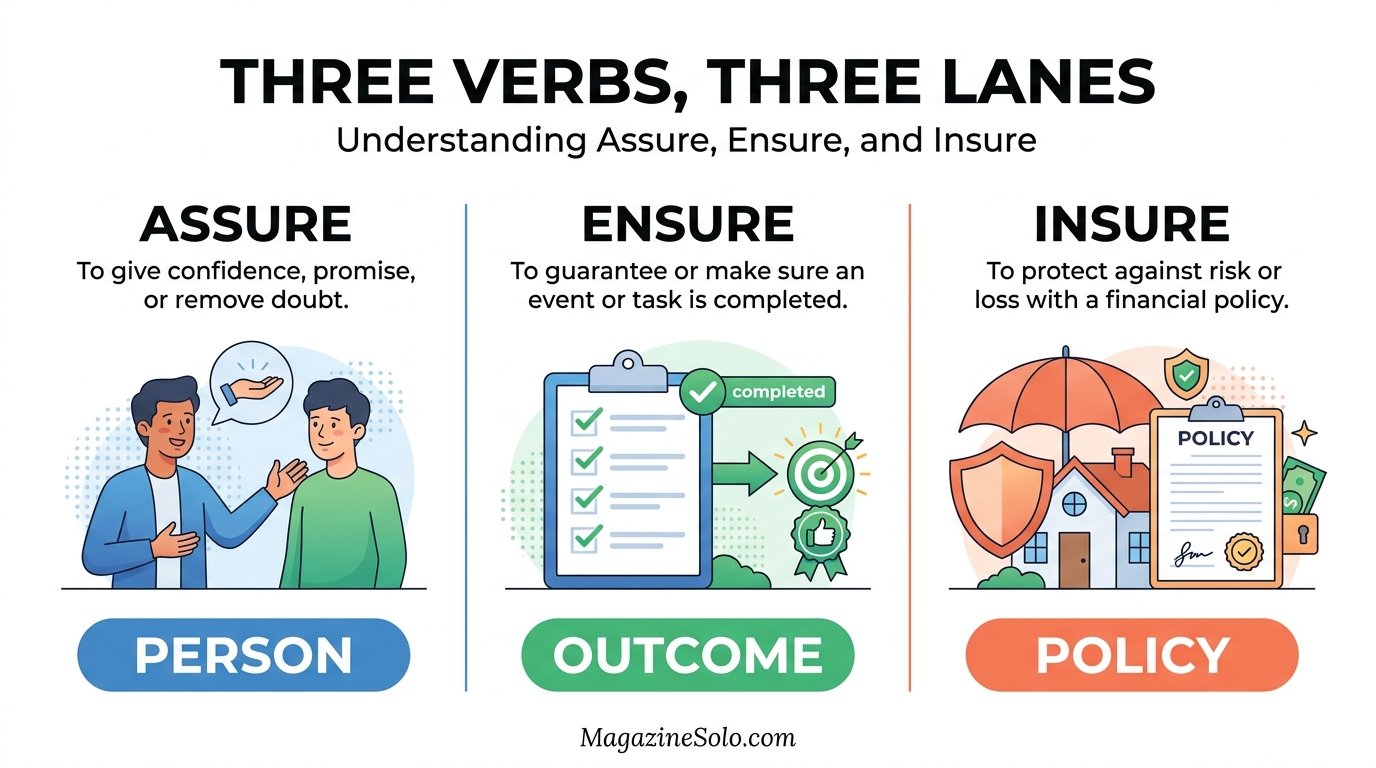
One clean sentence per job, so the lanes can be heard as well as read.
Assure, that frame: I assure you that the report was checked twice.
Assure, of frame: She assured the investors of her full commitment.
Ensure, clause: Ensure that the backup finishes before midnight.
Ensure, condition: The new checklist ensures consistency across shifts.
Insure, against: They insured the studio against water damage.
Insure, for: The violin is insured for eighty thousand dollars.
All three, one sentence: I assure you that I will ensure the shipment leaves insured. Person, outcome, policy, in order, which is the object test performing in public.
The wider shelf on Magazine Solo runs on the same one test thinking. The affect vs effect guide on this site sorts a verb pair by job, and The fewer vs less difference guide sorts a quantity pair by count.
Pairs decided by a single look at the sentence continue in The further vs farther difference guide, The lose vs loose difference guide, and The accept vs except difference guide, and The than vs then difference guide closes the set with the timing pair.
Ten Sentence Practice Set
Choose assure, ensure, or insure for each blank. Answers follow, keyed to the object test.
- Please ____ that the gate is closed before dark.
- I ____ you, the money was wired this morning.
- They ____ the warehouse against flood damage.
- The nurse ____ the child that the shot would be quick.
- Double check the totals to ____ accuracy.
- The van is ____ for commercial use.
- Rest ____, your deposit is completely safe.
- Steps were taken to ____ compliance with the new rule.
- He ____ her of his support before the vote.
- The gallery ____ the paintings for two million dollars.
Answers: 1 ensure (outcome clause). 2 assure (person). 3 insured (against a risk). 4 assured (person). 5 ensure (condition). 6 insured (policy cover). 7 assured (the fixed phrase). 8 ensure (compliance outcome). 9 assured (the of frame). 10 insured (for a sum).
A clean ten means the trio is finished for you. Any miss names its lane: rerun the object test on that sentence and watch the verb choose itself.
1. What is the difference between ensure, insure, and assure?
The object decides.
Assure takes a person: you assure someone to remove their doubt.
Ensure takes an outcome: you ensure that something happens.
Insure takes a policy or a risk: you insure a car, a house, or a shipment against loss.
Assure a person, ensure an outcome, insure a policy.
2. How do you remember ensure vs insure vs assure?
Use the first letters.
A is for alive: you can only assure someone alive, because only the living feel doubt (assure, alive).
E is for ensure, and guarantee ends in two e letters.
I is for income and insurance: insure protects money through a policy.
Then confirm with the object test: person, outcome, policy.
3. When should you use assure?
When a person is being told something confidently so their doubt goes away.
I assure you the figures are correct.
The manager assured the team that jobs were safe.
The nurse assured the family.
If the words after the verb name someone who can feel doubt, the verb is assure.
4. When should you use ensure?
When steps are taken to make an outcome certain.
Ensure that the door is locked.
We revised the checklist to ensure accuracy.
The object of ensure is an event, a condition, or a that clause, never a person being comforted and never an insurance policy.
5. When should you use insure?
When insurance is being bought, sold, or described.
They insured the house against fire.
The shipment is insured for two million dollars.
Insure belongs to policies, premiums, and financial protection against loss, and careful style guides reserve it for exactly that.
6. What is the object test for these three verbs?
Look at what follows the verb.
A person or people: assure.
An outcome, condition, or that clause about an event: ensure.
A thing of value, a risk, or the word against: insure.
The test runs in about two seconds and settles nearly every real sentence, including the ones in contracts and forms.
7. Are ensure and insure pronounced the same?
Yes.
Ensure and insure are homophones, both pronounced in SHUR in American English, which is exactly why they get confused in writing.
Assure sounds slightly different: it starts with a soft uh sound, uh SHUR, because its first syllable is unstressed.
8. Can insure mean make certain?
Yes, and dictionaries record it.
Merriam Webster gives insure a sense meaning to make certain, especially by taking necessary measures and precautions, and Cambridge records the same American use.
Careful writers still prefer ensure for make certain and keep insure for insurance, which is the convention style guides teach.
9. Can ensure be used for insurance?
No, not in careful modern usage.
Ensure means make certain and carries no financial protection.
Writing that a car was ensured against theft would be read as an error by editors, insurers, and courts of style.
The insurance lane belongs to insure alone.
10. Why do people confuse ensure, insure, and assure?
Three reasons stack up.
The words share one Latin root, securus, so their core idea, making sure, is genuinely the same.
Ensure and insure sound identical.
And for centuries the three were used as synonyms, so older writing models the overlap.
The modern split by object is a convention laid over a shared history.
11. Is it ensure or insure in ‘please ___ that the door is locked’?
Ensure.
The verb is followed by a that clause about an outcome, making something certain, with no insurance anywhere in the sentence.
Please ensure that the door is locked is the fixed, correct form in instructions and signs worldwide.
12. Is it assure or ensure in ‘I ___ you that everything is fine’?
Assure.
The word after the verb is you, a person, and the speaker is removing doubt, not arranging an outcome.
I assure you is one of the most fixed phrases in the language.
Ensuring a person is the classic error this topic exists to fix.
13. Is it insure or ensure for a car?
It depends what is happening to the car.
If a policy covers it, insure: we insured the car against theft.
If steps make an outcome certain, ensure: check the brakes to ensure the car is safe.
Cars sit in both lanes, which is why the object test asks what follows, not what the topic is.
14. Can you ensure a person?
Not in careful usage.
Ensure takes outcomes, events, and conditions, not people.
The manager ensured the employees that their jobs were safe is wrong twice over: the object is people and the act is comfort, so the verb is assured.
You ensure that employees are paid; you assure employees that they will be.
15. Can you assure an outcome?
Mostly no, with a historical footnote.
Modern convention gives outcomes to ensure.
Older and looser usage does let assure mean to make certain of an outcome (Merriam Webster lists a guarantee sense), and set phrases preserve it, but in current professional writing assuring an outcome reads as an error.
Use ensure for outcomes.
16. What does ‘assure someone of something’ mean?
It is the second frame assure lives in: to tell someone confidently that something is true or secured.
She assured him of her support.
He assured the board of his commitment.
The pattern is assure plus a person plus of plus the thing vouched for, and no other verb in the trio takes this frame.
17. What is the noun form of ensure?
There is no standard one.
Assurance belongs to assure and insurance belongs to insure, but ensurance is not an accepted general noun, a point usage writers note with surprise.
Writers paraphrase instead: steps to ensure, the ensuring of, or a plain rewrite with guarantee or safeguard as the noun.
18. Why is it called quality assurance and not quality ensurance?
Because of the missing noun.
The quality field needed a noun for the confidence building side of its work and borrowed assurance, the noun of the confidence verb.
Quality assurance promises that processes inspire confidence in outcomes, while quality control inspects them.
The name is the noun gap fossilized in every factory and software team.
19. What is the difference between assurance and insurance as nouns?
Assurance is confidence, a promise, or freedom from doubt: words of assurance, a tone of assurance.
Insurance is the financial contract: an insurance policy, insurance premiums.
The exception is British English, where assurance is also the standard name for life insurance products, covered in the British lane questions below.
20. What is life assurance in British English?
It is what American English calls life insurance.
In Britain, assurance is the traditional term for cover that pays on an event certain to happen eventually, above all death, while insurance covers events that may happen, like fire or theft.
The distinction is a British convention, flagged as such, and US writers should simply use life insurance.
21. What does ‘sum assured’ mean?
On life assurance documents, mainly British and in markets influenced by British practice, the sum assured is the amount the policy guarantees to pay.
It is the counterpart of the American sum insured or face amount.
Seeing sum assured on a policy is a reliable sign the document follows British insurance naming.
22. What does ‘the assured’ mean in insurance?
In British policy language, the assured is the person covered by the policy, the counterpart of the American the insured.
Both are defined terms inside contracts, which is why legal and insurance writing cannot treat this trio casually: the noun forms name parties to the contract.
23. Where do ensure, insure, and assure come from?
All three descend from Latin securus, meaning secure or free from care, built from se, without, and cura, care.
The word reached English through Anglo French assurer and Medieval Latin assecurare.
Ensure is an alteration of the same French verb, and insure began as a variant spelling of ensure.
One root, three lanes.
24. Are ensure and insure the same word historically?
They are doublets: two words descended from a single source that split apart in spelling and then in meaning.
Ensure kept the general sense, make certain.
Insure specialized into the financial sense as the insurance industry grew.
The split is why the pair feels like one word wearing two spellings, because historically it was.
25. Is insure just a misspelling of ensure?
No.
Insure is a full dictionary word with its own entry, its own insurance sense that ensure never carries, and a recorded make certain sense of its own.
Calling it a misspelling is the most common false fact in this topic.
It is a separate, narrower word, not a typo.
26. What is the difference between assure and reassure?
Reassure is assure done again, or kept up over time.
You assure someone once with a statement; you reassure them when doubt returns or comfort must continue, which is why reassure dominates in healthcare and customer care.
Grammar Girl’s column makes exactly this point: reserve reassure for repeated or ongoing assurance.
27. Where does ‘secure’ fit in this family?
Secure is the fourth sibling from securus, and usage writers place it beside the trio.
Secure handles guarding, fastening, and taking possession: secure the building, secure a loan, secure the lid.
Where assure works on a mind, ensure on an outcome, and insure on a risk, secure works on things and places directly.
28. What does ‘rest assured’ mean?
It means be confident and stop worrying: you may rest assured that the matter is handled.
The phrase preserves assure in its comfort sense inside a fixed idiom, and it is always assure, never ensure or insure.
Rest ensured is not an English phrase.
29. Why do insurance contracts say ‘the insured’?
Because inside a policy, insured is a defined term naming the person or entity the contract covers, and defined terms must stay exact and consistent through hundreds of clauses.
The same drafting discipline is why contracts choose ensure for obligations about outcomes and never drift between synonyms the way essays can.
30. Is it ‘ensure compliance’ or ‘insure compliance’?
Ensure compliance.
Compliance is an outcome a company arranges through procedures, training, and audits, with no policy being bought.
The phrase ensure compliance is the set wording across regulations, standards, and corporate policies, and insure compliance would wrongly suggest an insurance product.
31. Is it ‘ensure safety’ or ‘insure safety’?
Ensure safety.
Safety is a condition to be made certain by action: guards, training, maintenance.
Insure enters only when a policy pays after safety fails: insure against injury claims.
The pair of sentences shows the whole topic: you ensure safety so that you rarely need the insurance you also carry.
32. Do British and American English treat these words the same way?
Mostly, with two flagged divergences.
British English keeps the assurance lane for life cover (life assurance, sum assured, the assured).
American English more freely uses insure for make certain, a sense Cambridge records as American.
The core object test, person outcome policy, holds on both sides of the Atlantic.
33. What do style guides say about insure vs ensure?
The major guides converge: reserve insure for insurance and use ensure for make certain.
The Microsoft Style Guide states the three way distinction outright, assure for people, ensure for outcomes, insure for policies, and Merriam Webster’s usage note reports the same recommendation from usage guides generally.
34. How do universities teach this distinction?
With the object rule.
The Mayfield Handbook of Technical and Scientific Writing, hosted by MIT, glosses assure as to state convincingly and ensure as to make certain.
Washington State University puts it as making a person confident.
The University of Nebraska Lincoln states the rule directly: the direct object of assure is usually a person or persons.
35. What are the past forms, and why do forms go wrong?
Ensured, insured, and assured.
Forms and applications go wrong because the writer must pick a lane while filling boxes about real money: was the vehicle insured (policy) is a different fact from was delivery ensured (arranged).
The past tense is where this trio stops being a grammar topic and becomes a paperwork risk.
36. Is ‘ensured the package arrived’ or ‘insured the package arrived’ right?
Ensured, if you mean arranged or made certain: we ensured the package arrived by tracking it hourly.
Insured the package means a policy covers its loss: we insured the package for five hundred dollars, a different sentence about money, not arrival.
Shipping writing uses both, one clause apart.
37. Can a company assure quality?
A company assures customers, and ensures quality.
Assure quality on its own mixes the lanes, unless it is the set noun phrase quality assurance, which is its own term.
In a sentence, write: we assure our clients that every batch is tested, and we test to ensure quality.
Both verbs, each in its lane.
38. How do you use all three words in one sentence?
With one object per lane: I assure you (person) that I will ensure (outcome) the shipment leaves insured (policy).
The classic combined sentence works because each verb is followed by its own kind of object, which is the object test performing in public.
39. Ensure vs insure vs assure: which is most common?
Ensure is the everyday workhorse of instructions, standards, and business prose.
Insure appears wherever money and risk are discussed.
Assure is the least frequent and the most personal, living in speech like I assure you and in reassurance heavy professions.
Frequency claims beyond that shape would need a corpus citation, so this page makes none.
40. What is the fastest way to check a sentence before sending?
Underline what follows the verb.
Person: assure.
Outcome or that clause: ensure.
Policy, risk, or an against phrase: insure.
If the verb is followed by a person and the word is ensure, that is the single most common error in the topic, and the check catches it every time.
41. Are these three words interchangeable?
Sometimes, historically, and less than people think.
Merriam Webster notes they remain interchangeable in many contexts where an outcome is made certain, and insure keeps a genuine make certain sense.
But assure with a non person object and ensure in an insurance sentence are errors in modern edited English, and the object test costs two seconds.
42. What should a learner learn first in this topic?
The three lanes and the object test, in that order, before any exception.
Assure a person, ensure an outcome, insure a policy solves the overwhelming majority of sentences.
The overlap, the British lane, and the missing noun are second pass knowledge for writers who work in contracts, care, or compliance.
Conclusion
Ensure vs insure vs assure resolves the moment the object steps forward. A person takes assure, an outcome takes ensure, and a policy takes insure, and that one look replaces every definition you were asked to memorize.
The lanes have a history worth keeping. One Latin root, securus, split into three spellings, left ensure without a noun, and handed Britain an assurance lane of its own. Knowing the story is what makes the exceptions stop looking like traps.
And keep the honesty of the topic with you. The split is a modern convention, the words overlapped for centuries, and insure still carries a recorded make certain sense. Following the lanes is not obedience to an ancient law; it is how edited writing signals care.
Run the object test on your next stalled sentence. The verb you need is already sitting in the words that follow it.

Dilawar is a content writer at MagazineSolo, covering travel, home improvement, interior design, and everyday lifestyle topics. He enjoys researching practical solutions, exploring travel destinations, and sharing helpful guides that make daily life easier. His writing focuses on clear information, useful advice, and engaging stories for a wide audience.


