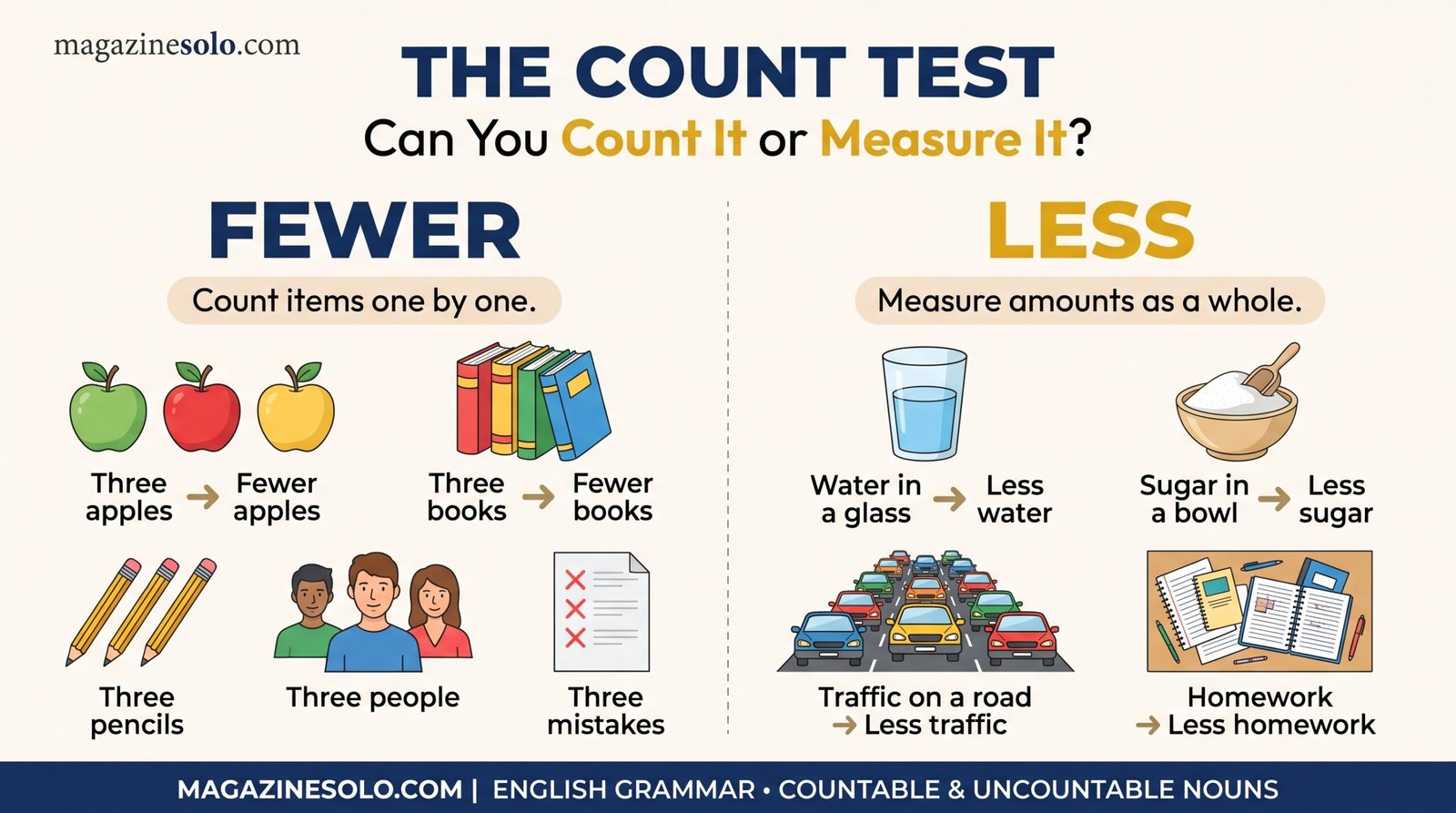
The fewer vs less difference comes down to one question: are you counting, or are you measuring? Fewer counts items one by one, and less measures amounts as a whole.
Fewer is the comparative of few, and it belongs with plural countable nouns: fewer emails, fewer mistakes, fewer people in the queue. It says not as many.
Less is the comparative of little, and it belongs with uncountable nouns: less traffic, less water, less patience. It says not as much.
That is the rule every guide teaches, and it is correct as far as it goes.
Where writers actually get caught is the territory the simple rule does not cover: money, time, distance, and totals that look countable but are read as single amounts, and a handful of fixed patterns where less wins outright.
So this article teaches the rule in two layers: the count test for the ninety percent, and the measured whole exception for the rest, with the supermarket sign, the 1770 origin of the rule, and a practice set that includes the trap items.
One promise about method before the details: every verdict on this page can be traced to a named authority or a stated test.
Where the authorities soften the schoolroom rule, the softening is printed, not hidden, because a rule page that hides its exceptions teaches its readers to distrust it at exactly the moment they meet a real sentence.
Fewer vs Less at a Glance
|
Family |
Base |
Comparative |
Superlative |
Pairs With |
Example |
|---|---|---|---|---|---|
|
Number |
few |
fewer |
fewest |
many |
fewer than ten applicants |
|
Amount |
little |
less |
least |
much |
less than a week |
Read the two rows as two territories. Fewer inherits the counting territory from few and many; less inherits the measuring territory from little and much, and nearly every hard case is a border dispute between them.
The Count Test
Countable Nouns Take Fewer
A countable noun names separate things with a singular and a plural: one email, two emails; one mistake, two mistakes. When you compare a smaller number of them, edited English uses fewer.
- Fewer students enrolled this term.
- Send fewer reminders; the inbox is full.
- The second draft has fewer errors than the first.
The mechanical check: put a number directly in front of the noun. If “three ___” sounds natural with the plural, the noun is countable in that use, and fewer is its comparative.
Uncountable Nouns Take Less
An uncountable (mass) noun names a substance, material, or abstraction that is measured rather than counted: water, traffic, homework, information, advice. Its comparative is less.
- Less traffic after nine in the morning.
- Add less sugar than the recipe suggests.
- The new process creates less paperwork.
The same check in reverse: “three waters” and “three traffics” fail as ordinary sentences, which is the signal that these nouns live in the measuring territory. Merriam-Webster’s entry for less records less as the comparative of little used before exactly this class of nouns.
The Many/Much Bridge
When the noun itself does not settle the question, rewrite the phrase with the bridge pair. Not as many leads to fewer; not as much leads to less.
Not as many people signed up becomes fewer people signed up. Not as much time remains becomes less time remains.
The bridge works because many and much are unambiguous: nobody hesitates between many water and much water. Borrow their certainty whenever fewer and less feel like a coin flip, a habit Dictionary.com’s fewer vs less explainer also recommends for this pair.
The Three Questions, in Order
1. Can a number sit directly before the noun, pluralized? Three emails, seven meetings, twelve items. If yes, start from fewer.
2. Does not as many sound right with it? If the many bridge sounds natural and the much bridge sounds wrong, fewer is confirmed.
3. Is the sentence nevertheless reading it as one measured whole? A sum, a span, a total, a scale reading. If yes, stop: the exception in the next section overrides the count, and the answer is less.
Amount Of vs Number Of: The Locked Pairs
English keeps the same split one level up, in the phrases amount of and number of, and aligning them prevents mistakes before they form.
A smaller amount of pairs with less: a smaller amount of water, less water. A smaller number of pairs with fewer: a smaller number of errors, fewer errors.
The mirror errors, a fewer amount and a less number, fail instantly to an editor’s ear. If you ever write amount or number in the sentence, let it choose the comparative for you: amount points to less, number points to fewer, every time.
The Measured Whole Exception
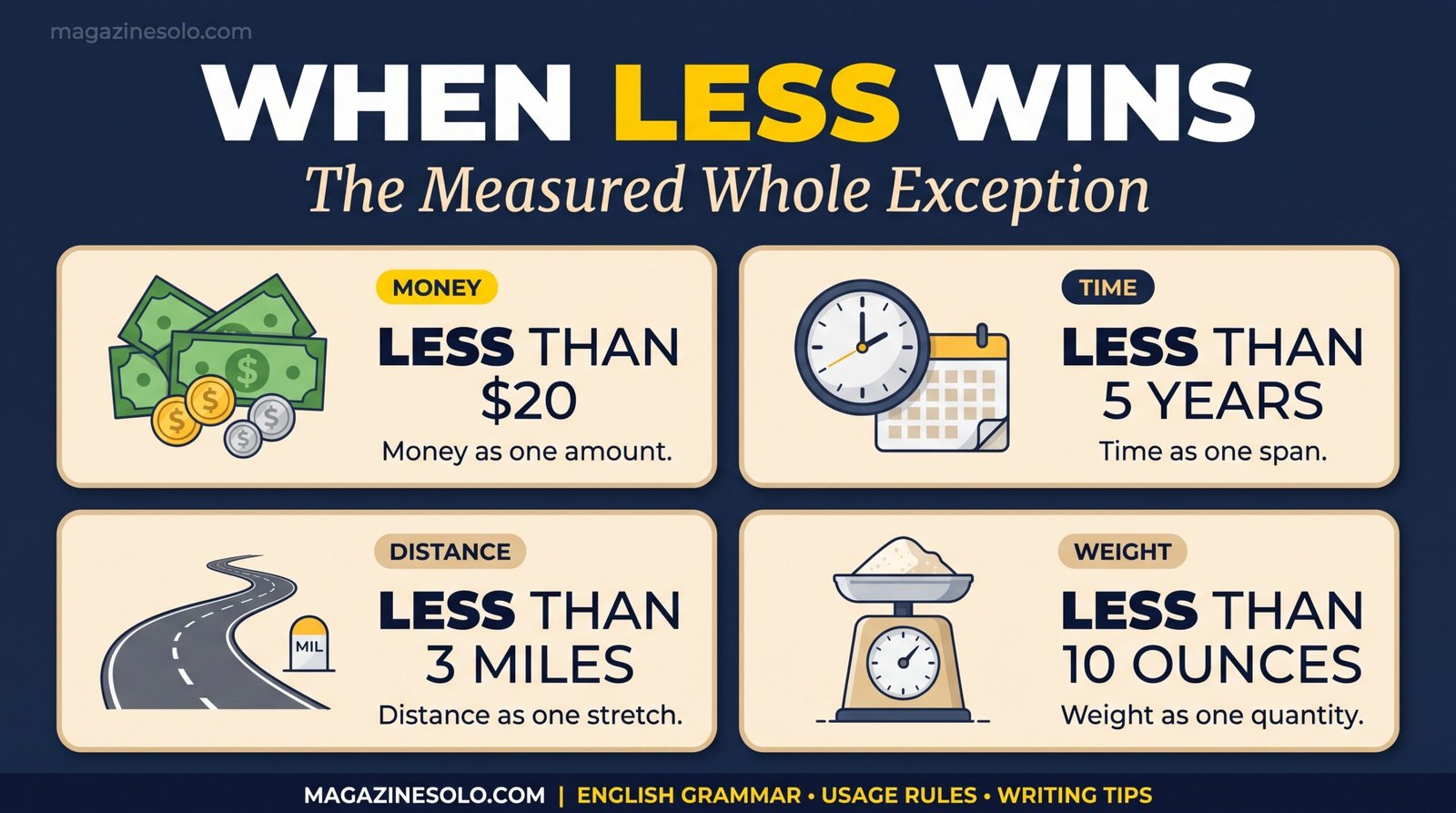
Some plural looking quantities are read as one amount, and amounts take less. This is not sloppiness; Merriam-Webster’s entry for fewer and the usage tradition behind it name these families explicitly, and careful writers follow them.
|
Family |
Example |
Why Less Wins |
|---|---|---|
|
Money as a sum |
less than twenty dollars |
The sum is one amount, not twenty separate dollars |
|
Time as a span |
less than five years |
The period is one stretch, not five counted years |
|
Distance |
less than three miles |
The journey is one stretch of road |
|
Weight |
less than ten ounces |
The scale reads one quantity |
|
Statistical total |
less than 50,000 people |
The crowd is reported as one figure |
Money Read as a Sum
Twenty dollars can be counted, but a price is not a count. “Less than twenty dollars” treats the money as a single amount of value, which is how prices, budgets, and balances actually work.
Fewer would need the dollars themselves to be the subject as individual bills or coins, a reading almost no real sentence has. When you mean the value, the answer is less, and “fewer money” is wrong in every register.
Time Read as a Span
“Less than five years” measures one stretch of time, the way “less than a week” does. The years are the unit marks on the ruler, not items being tallied.
The count reading returns when the units are genuinely separate entries: fewer than five class sessions remain on the calendar, because each session is its own event. Same word, years or sessions; different reading, different comparative.
Distance and Weight Read as Amounts
A distance is one stretch (less than three miles to the exit), and a weight is one scale reading (less than ten ounces of flour). Nobody experiences a journey as three individual miles laid end to end for counting purposes.
This is the family where fewer sounds wrongest even to strict rule followers, a useful calibration: if “fewer than three miles” makes you wince, your ear already knows the measured whole exception.
Statistical Totals Read as One Figure
News style writes “less than 50,000 people attended” because the crowd enters the sentence as a single statistic, one figure on a page. The people are not being counted by the reader; the total is being reported.
Shrink the scale until individuals matter and fewer returns naturally: fewer than fifty residents attended the meeting. The border is the reading (figure versus persons), not a magic number, and editors judge it sentence by sentence.
Why does the exception exist at all? Because English speakers process quantities both ways, and the language kept a form for each processing mode.
A price, a span, and a scale reading arrive in the mind as single magnitudes, and less, the amount comparative, is the form that matches a magnitude. Counting arrives as a sequence, one, two, three, and fewer matches a sequence.
The exception is the grammar following cognition, which is why it survives every attempt to rule it away.
Fixed Patterns That Always Take Less
Three patterns are frozen with less regardless of counting, and learning them prevents the most visible overcorrections.
One less. The idiom after one is one less: one less problem, one less thing to carry.
One fewer exists in careful counting prose but is the marked, unusual choice; the Cambridge Dictionary entry for less and the usage guides treat one less as the typical pattern.
Number + or less. Word limits, capacities, and thresholds run on or less: 250 words or less, twelve items or less. Merriam-Webster’s usage guidance calls this the preferred choice after a number, a verdict the supermarket section below unpacks.
No less than. Used for emphasis, it takes less even before countable nouns: no less than the mayor attended. Its counting twin, no fewer than, is the formal tally form; choose by whether you mean importance or arithmetic.
Percentages Follow the Noun
Percentages inherit their comparative from the noun underneath them, never from the percent sign itself.
Fewer than 30 percent of voters switched sides: voters are counted, so fewer. Less than 30 percent of the water evaporated: water is measured, so less.
The same logic governs fractions and halves: fewer than half the applicants (counted), less than half the budget (measured). When a percentage sentence feels slippery, delete the number and ask what remains: people, or stuff?
Borderline Nouns: When the Reading Decides
A popular alternative model, taught by some grammar tools, says simply: fewer for plural nouns, less for singular nouns. It is tidy, and it fails exactly where real writers struggle, because less than five years is plural and still takes less.
The count test plus the measured whole reading handles those cases, because it asks the better question: not “is the noun plural?” but “how is this sentence reading the quantity, as items or as one whole?”
People, dollars, miles, and years are double citizens. Read as individuals, they take fewer (fewer people applied this year). Read as totals, spans, and sums, they take less (less than fifty dollars, less than two miles).
Data behaves the same way in modern usage: treated as a mass (less data than expected) in general prose, whatever its Latin plural ancestry. The dictionary entry starts the analysis; the sentence’s reading finishes it.
The Supermarket Sign, Settled
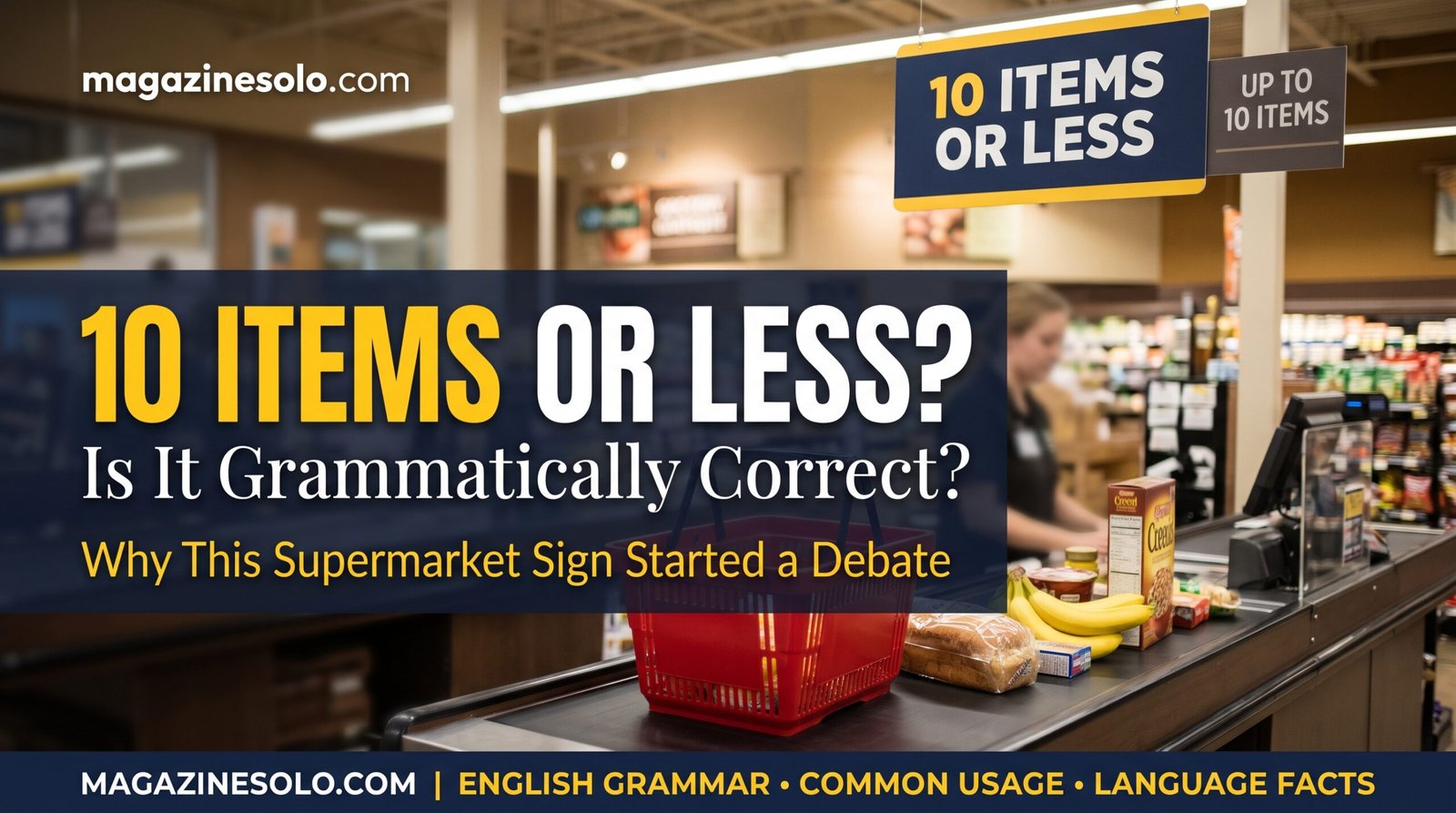
“10 items or less” is the most litigated sentence in everyday English, and all three authorities a writer needs can be stated in one breath.
The strict count rule asks for fewer, since items are countable. Merriam-Webster’s usage guidance answers that or less after a number is the preferred pattern in exactly this construction, and notes that stores using “items or fewer” are the minority.
Cambridge’s blog tells the ending: in 2008 the UK chain Tesco, advised by the Plain English Campaign, retired the argument by changing its signs to up to 10 items, wording many retailers have since copied.
So the sign is defensible English, the objection is understandable, and the resolution the market chose was to leave the battlefield.
If you write signage or limits yourself, up to is the diplomat’s option; if you judge others’ signs, or less has the stronger pedigree than its critics admit.
A Rule Invented in 1770: Baker’s Preference
The distinction between number and amount is old, but the rigid rule is not. Less has been used with countable nouns for over a thousand years; the Oxford English Dictionary’s oldest example dates to 888, from the age of King Alfred.
The rule as taught descends from one passage. In Reflections on the English Language (1770), the critic Robert Baker wrote that fewer seemed to him more elegant and more proper with numbers than less, offering “No Fewer than a Hundred” as his model.
Baker stated a preference, in the language of taste. Later grammarians generalized it into an absolute, inviolable rule, exceptions and all ironed flat, which is the version most schoolrooms inherited.
A caution worth printing: several websites misname Baker’s book “Remarks on the English Language.” The correct title is Reflections, and checking it takes ten seconds, which is exactly the kind of detail that separates a rule page from a rumor page.
Does Fewer Sound Formal? Register and Reality
Cambridge’s learner blog observes what native speakers feel: fewer, especially in fewer than, sounds formal, and less than dominates everyday speech even with countable nouns.
Both halves of that observation matter. In an exam, an edited article, or a formal report, fewer is expected with counts and its absence is marked. In conversation, less people and less items are the unremarkable majority pattern, as they have been for centuries.
The skill this topic actually teaches is register control: knowing which formality the room expects, and being able to produce it on purpose.
The writer who can explain why the sign says or less, and why their own report says fewer, understands the pair better than the writer who only knows a slogan.
Sound alike neighbors obey the same principle of one clear distinction each.
That is the working method of our guide to the there, their, they’re difference and of our guide to the your vs you’re difference.
The possessive contractions behave the same way in our guide to the its vs it’s difference: find the single test that decides, and the pair stops costing you time.
Common Slips, Corrected
Less people attended than expected. Speech: unremarkable for a thousand years. Edited writing: fewer people, because the readers are being counted. Know both facts and choose by setting.
Fewer money was raised this year. Wrong in every register. Money as a sum is measured: less money was raised. Fewer can only return if individual bills or coins are literally the subject.
Less mistakes were found in the final draft. The classic slip. Mistakes are counted; the edited form is fewer mistakes. This single correction is the highest value edit in the whole topic, because it is the error real documents actually contain.
Fewer than three miles remain. The overcorrection. Distance is read as one stretch, so less than three miles remain, and the writer who applied the simple rule hardest got it wrongest. The exception families exist precisely for this sentence.
The limit is 500 words or fewer. Understandable, and increasingly common, but the established pattern is or less, the one the usage guides call preferred after a number. Match it in professional documents unless a house style says otherwise.
The Quick Decision Card
For the sentence in front of you, ask in this order and stop at the first answer:
- Am I counting separate items? Fewer. (fewer meetings, fewer errors)
- Am I measuring a substance, quality, or total? Less. (less traffic, less doubt)
- Does it look countable but read as one amount? Less. (less than five years, less than twenty dollars)
- Is it a frozen pattern? Less. (one less, 250 words or less, no less than)
- Is it a percentage? Ignore the sign; judge the noun underneath it.
Five questions, under five seconds, and the pair is settled. The practice set below trains the borderline cases where the card’s third question does the work.
Practice: Ten Sentences, Tested
Choose fewer or less, then check the reading, not just the answer. The test is the skill; the answers are only receipts.
1. The revised manuscript has ___ than 300 pages. Answer: fewer. Pages are counted one by one; no whole reading is in play.
2. The venue is ___ than two miles from the hotel. Answer: less. Distance read as one stretch; the measured whole exception.
3. There is ___ than forty dollars in the petty cash box. Answer: less. A sum read as one amount of value.
4. ___ students chose the morning section this term. Answer: Fewer. Students counted individually; the count test, clean case.
5. The report must be 500 words or ___. Answer: less. The frozen number plus or less pattern.
6. ___ than 20 percent of the reservoir evaporated this summer. Answer: less. Percentages follow the noun; water is measured.
7. ___ than 20 percent of the members voted by mail. Answer: Fewer. Percentages follow the noun; members are counted.
8. One ___ signature is needed before the form can be filed. Answer: less. The fixed pattern after one is one less.
9. The festival drew ___ than 90,000 people across the weekend. Answer: less. A statistical total reported as one figure.
10. She finished the course in ___ than three years, attending ___ sessions than anyone else. Answer: less, then fewer. One sentence, both territories: the span is measured, the sessions are counted.
Fewer and Less in Professional Documents
Reports and proposals are where this pair earns its keep, because numbers fill every page and each one quietly asks the counting question.
Budgets take less (less than budgeted, less expenditure), headcounts take fewer (fewer staff, fewer applicants), timelines split by reading (less than six weeks for the phase; fewer than six meetings in it), and statistics follow the total rule from the exception table.
A style sheet entry settles most of it in advance: house style can declare the or less pattern, the treatment of statistical totals, and the formality level for client facing text, so individual writers stop re-litigating the pair document by document.
What no style sheet can fix is the unexamined default, and that is the real professional risk: not choosing less where fewer belongs in a board report, where the slip reads as carelessness rather than dialect.
The count test takes five seconds; the impression lasts longer.
Frequently Asked Questions
What is the difference between fewer and less?
Fewer counts items one by one: it is the comparative of few and goes with plural countable nouns (fewer emails, fewer mistakes).
Less measures amounts as a whole: the comparative of little, for uncountable nouns (less traffic, less water). Bridge test: not as many takes fewer; not as much takes less.
When do you use fewer?
Use fewer when the noun names separate things you can count individually, and a number plus the plural sounds natural: fewer than ten applicants, fewer meetings, fewer errors. If you can count them one, two, three, fewer is the edited choice.
When do you use less?
Use less when the noun names a substance, quality, or amount measured as a whole: less sugar, less patience, less downtime.
Less is also standard for measured wholes that look countable: sums of money, periods of time, distances, and weights read as single amounts.
How do you remember fewer vs less?
Run the count test: can the things be counted one by one, with a number and a plural? Then fewer. Are they measured as a single whole? Then less.
A second bridge: fewer pairs with many (not as many people), less pairs with much (not as much time).
Is it fewer people or less people?
Fewer people, in edited English: people are counted individually.
Less people is common in speech and has centuries of history, but Merriam-Webster notes this use is rare in writing. In anything formal, examined, or published, fewer people is the safe form.
Is it less than or fewer than with money?
Less than, when the money is read as one sum: less than twenty dollars, less than a hundred pounds in the account. A sum functions as a single amount even though dollars can be counted.
Fewer appears when individual bills or coins are genuinely the subject, which is rare in practice.
Do you use fewer or less with time?
Less, when the time is one stretch: less than five years, less than a week to decide. The period is read as a single amount.
Fewer appears when separate time units are counted as individual entries, such as fewer than five class sessions remaining on the calendar.
Is ’10 items or less’ grammatically wrong?
It is the most argued sign in English. Strict application of the count rule asks for fewer, but Merriam-Webster’s usage guide calls or less after a number the preferred choice (250 words or less, twelve items or less).
Stores using or fewer are the minority. The sign is defensible; the debate says more about the rule’s limits than about the sign.
Why do supermarkets write ‘items or less’ on signs?
Because or less is the established pattern after numbers, and the total is read as one amount at the till.
In 2008 the UK chain Tesco, advised by the Plain English Campaign, sidestepped the argument by changing its signs to up to 10 items, a widely reported fix many retailers have copied.
Do you use fewer or less with percentages?
Percentages follow the noun they measure. Countable noun: fewer than 30 percent of voters.
Uncountable noun: less than 30 percent of the water. Decide by the noun, never by the percent sign.
Is it one less or one fewer?
One less is the standard idiom: one less problem, one less thing to carry. One fewer exists and appears in careful counting prose, but it is the marked, unusual choice after one specifically. Merriam-Webster treats one less as the typical pattern.
Do you use fewer or less with weight?
Less, when weight is an amount: less than ten ounces of flour, the parcel weighs less than two kilos. The scale reads a single quantity. Fewer would need individually counted units as the real subject, which weight sentences almost never have.
Do you use fewer or less with distance?
Less, for distance read as one stretch: less than three miles to go, less than a mile from the station. The journey is a single amount.
This is one of the measured whole families where fewer sounds wrong even to writers who follow the count rule strictly elsewhere.
Can less be used with countable nouns?
Yes, and it has been for over a thousand years: the Oxford English Dictionary’s oldest example of less with a countable noun dates to 888, in the writing of King Alfred.
Modern edited English still prefers fewer for straightforward counts, but less with countables is a native pattern with exceptions, not a modern corruption.
Is less ever correct with plural nouns?
Yes, in defined families: measured wholes (less than five years, less than twenty dollars), statistical enumerations read as one figure (less than 50,000 people, as a total), the number plus or less pattern, and fixed phrases like no less than.
Outside those families, edited English chooses fewer for plurals.
What are countable and uncountable nouns?
Countable nouns name separate items with singular and plural forms: one email, two emails.
Uncountable (mass) nouns name substances and abstractions measured as wholes: water, traffic, advice. The test is mechanical: if a number plus the plural sounds natural, the noun is countable in that use.
Which pairs with many and which with much?
Fewer pairs with many: many and few count items (many people, few people, fewer people). Less pairs with much: much and little measure amounts (much time, little time, less time).
When unsure, rewrite with not as many or not as much; whichever bridge sounds right names the comparative you need.
Is it fewer mistakes or less mistakes?
Fewer mistakes. Mistakes are counted one by one, and edited writing uses fewer.
Less mistakes is the single most common real world slip of this pair; you hear it in speech constantly, and it is rare in writing precisely because editors switch it to fewer.
What are the superlatives of fewer and less?
Fewest for counts and least for amounts: the fewest errors of any candidate; the least traffic of any route.
The same split runs through the whole family: few, fewer, fewest for number; little, less, least for amount.
Where did the fewer vs less rule come from?
From one man’s stated preference. In Reflections on the English Language (1770), the critic Robert Baker wrote that fewer seemed to him more elegant and proper with numbers than less.
It was offered as a taste judgment, then generalized into an absolute rule. Note: some websites misname the book Remarks; the correct title is Reflections.
Is the fewer vs less rule real grammar or just a style preference?
Both, in layers. The underlying distinction (number versus amount) is real and old.
The rigid rule as taught is an 18th century preference that hardened into doctrine, and it has always had exceptions. Follow it in edited writing, with the exception families, and you match professional practice.
Do you say fewer homework or less homework?
Less homework. Homework is uncountable in English, however many assignments it contains. The countable partner is assignments: fewer assignments. Many learner errors in this area come from counting the contents instead of the noun actually on the page.
Do you say fewer traffic or less traffic?
Less traffic. Traffic is a mass noun in English, like water or information. The countable partners are cars and vehicles: fewer cars on the road. If the sentence needs a plural, change the noun, not the quantifier.
Is it fewer water or less water?
Less water, always. Water is the textbook mass noun: measured in liters, glasses, and bottles, never counted as waters in this sense. The countable partners are the containers: fewer bottles of water.
Is it fewer emails or less emails?
Fewer emails. Emails are discrete, countable items, and the inbox even counts them for you. Less emails is the speech pattern; in writing, fewer is expected, and it is one of the easiest marks of edited prose.
Is it no less than or no fewer than?
Both exist with different flavors. No less than is the emphatic idiom: no less than the mayor attended (importance, not just counting).
No fewer than is the formal counting form Baker himself championed: no fewer than a hundred signatures.
How many words: fewer than 100 words or less than 100 words?
Less than is the common professional choice when the total is read as one amount, and the pattern number plus or less (250 words or less) is the one Merriam-Webster calls preferred.
Fewer than 100 words also appears in strict count style. Consistency within a document matters more than the coin flip.
Does fewer sound formal?
It can. The Cambridge Dictionary blog notes that fewer, especially in fewer than, sounds formal to many speakers, which is why less than dominates speech even with countable nouns.
Formality is a register fact, not a correctness verdict: exams and edited prose expect fewer; conversation forgives less.
Is it fewer sugar or less sugar?
Less sugar. Sugar is a mass noun measured in spoons and grams. The countable partners are the units: fewer spoons of sugar, fewer sugar cubes. As with traffic and homework, count the container or unit noun if you need fewer.
Why do news reports write ‘less than 50,000 people’?
Because the figure is a statistical enumeration read as a single total, one of the measured whole families in Merriam-Webster’s usage guidance.
The crowd is reported as one amount, not counted person by person. When individuals matter as individuals (fewer than fifty residents attended), fewer returns.
Do you use fewer or less with ‘amount of’ and ‘number of’?
They pair off exactly: a smaller amount of takes less (a smaller amount of water, less water), and a smaller number of takes fewer (a smaller number of errors, fewer errors).
Amount of pairs with less, number of pairs with fewer, and keeping the pairs aligned prevents most mistakes before they happen.
Can you say ‘a fewer amount’?
No. Fewer never modifies amount; amount is itself an uncountable noun and takes less (a smaller amount, less of an amount). The mirror error, a less number, fails the same way.
The four words form two locked pairs: fewer with number and countable plurals, less with amount and mass nouns.
Is less the comparative of little and fewer the comparative of few?
Yes, exactly. Few compares as few, fewer, fewest (number). Little compares as little, less, least (amount).
Knowing the family tree explains the whole topic: the two comparatives inherited different territories from their base words, and the confusion is really about which territory a given noun lives in.
Why is it ‘less is more’ and not ‘fewer is more’?
Because the phrase is about amount in the abstract: an amount of stuff, ornament, or effort, none of it counted item by item.
Less is more is a fixed idiom (associated with the architect Mies van der Rohe’s minimalism), and fixed phrases keep their historical forms regardless of the count rule.
Do you use fewer or less with abstract nouns like information and advice?
Less. Information, advice, knowledge, evidence, and progress are uncountable in English, however many facts or tips they contain.
The countable partners are pieces and items: fewer pieces of advice, fewer items of information.
Is it fewer than one or less than one?
Less than one for quantities and measures: less than one percent, less than one liter. Amounts below one are still amounts.
Fewer than one would claim a count of individual items below a single item, which is why it sounds like a puzzle rather than a measurement.
Do you use fewer or less with decimals and fractions?
Less, for measured quantities: less than 2.5 liters, less than half a mile. Decimals and fractions present the value as one amount on a scale, not as counted units.
When a fraction clearly counts discrete items in formal prose, fewer can appear, but the measured reading is the default.
How do editors decide borderline cases?
They ask how the noun is being read in that sentence: as separate items, or as one whole.
Years as a stretch of time: less. Years as individually counted entries on a list: fewer becomes possible. The reading, not the dictionary entry alone, decides.
Is ‘less people’ acceptable in conversation?
It is extremely common in conversation and has been for a thousand years, so no listener will misunderstand you.
The distinction that matters is setting: speech forgives it, edited writing and exams mark it. Knowing the rule lets you choose deliberately instead of accidentally.
Do you use fewer or less for age, like five years old?
Less, when age is given as one amount: less than five years old, a car less than ten years old. The years are read as a single span.
If birthdays or individual years are genuinely being counted as events, fewer is possible but rare; the amount reading dominates age expressions.
What is the count test for fewer and less?
Three questions in order. One: can you put a number directly before the noun and pluralize it (three emails)? Two: does not as many sound right with it?
Three: is the sentence nevertheless reading it as one measured whole (a sum, a span, a total)? Yes, yes, no means fewer. Anything else usually means less, or a check against the exception families.
Fewer vs less in one line: what is the fastest rule?
Count items, fewer; measure amounts, less. Or by the bridge: not as many, fewer; not as much, less.
Then run the exception check: money, time, distance, weight, and totals read as one whole take less even when they look countable.
Conclusion
The fewer vs less difference is a counting question wearing a measuring question’s coat: run the count test first (items take fewer, amounts take less, and the many/much bridge confirms it), then run the exception check before you finalize.
Money as a sum, time as a span, distance, weight, and totals reported as one figure all take less, and so do the frozen patterns one less, number plus or less, and no less than. Percentages ignore their sign and follow their noun.
Borderline nouns are not exceptions at all once the reading is named; they are the rule working at full resolution, which is the deepest version of the test this article teaches.
Hold both layers and the pair stops generating arguments, including the one about the supermarket sign. The neighboring pairs yield to the same one test discipline, from our guide to the than vs then difference to our guide to affect vs effect.
The full set lives in the MagazineSolo difference library, where difference questions get settled by rule and reading rather than by slogan.

Dilawar Mughal is an SEO expert with 8 years of hands-on experience helping websites grow their organic traffic, rankings, and revenue. He specializes in content-driven SEO, local SEO, and Pinterest SEO, and builds practical, results-focused strategies for businesses and publishers.