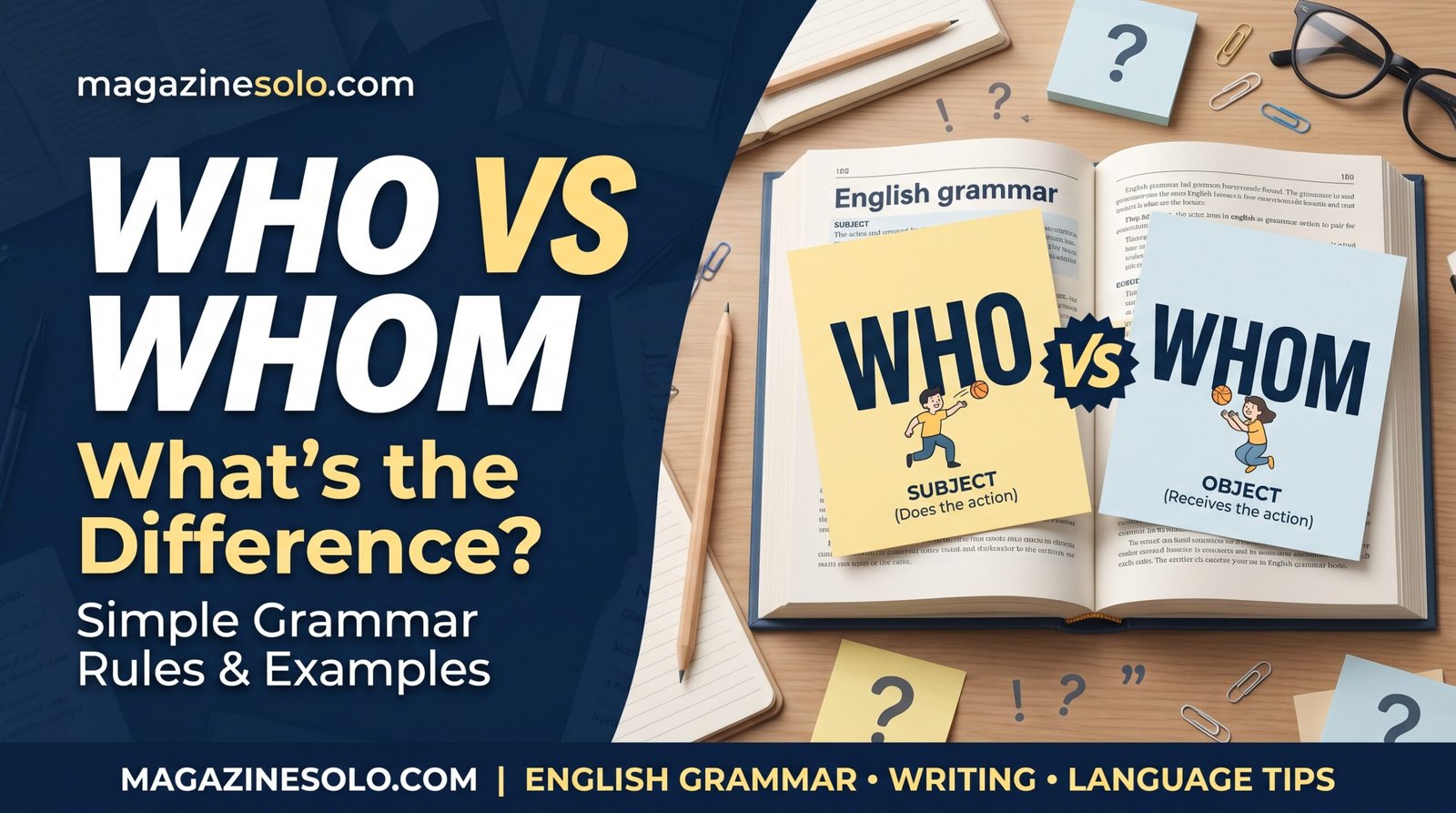
The who vs whom difference is not a difference in meaning. It is a difference in job: who does the action in a sentence, and whom receives it.
One pronoun, two case forms. Who is the subject form, the nominative case, and it pairs with he, she, and they.
Whom is the object form, the objective case, and it pairs with him, her, and them. Every correct choice on this page follows from that single split.
So the practical skill is not memorizing two words.
It is spotting which job the pronoun is doing inside its own clause, and this article gives you a two second test for exactly that, the formality dial for the cases where both forms circulate, and the three traps that catch even careful writers.
The family has a third chair, whose, the possessive form; it appears wherever it prevents a mix up, and its twin confusion (whose vs who’s) works exactly like the one settled in our guide to the its vs it’s difference.
Who vs Whom at a Glance
| Form | Case | Job in the Sentence | Pairs With | Example |
|---|---|---|---|---|
| who | Nominative (subjective) | Subject, does the action | he, she, they, I, we | Who called? |
| whom | Objective | Object of a verb or preposition, receives | him, her, them, me, us | Whom did you call? |
| whose | Possessive | Shows ownership or association | his, her, its, my | Whose is this? |
Read the table once and the rest of the article is commentary and worked examples: find the verb the pronoun belongs to, ask whether the pronoun does it or receives it, and the form chooses itself every single time.
Who Acts, Whom Receives: The Case Rule
The Pronoun Pairs
English lost its case endings on nouns centuries ago, but pronouns kept theirs. That is why you already know this rule in six other pairs without ever studying it.
You would never say “Him called me” or “I spoke to he.” Your ear assigns he to the subject slot and him to the object slot automatically.
Who and whom are the same machinery pointed at a person you are asking about or referring to. Who behaves like he; whom behaves like him.
The one asymmetry: nobody hesitates over he and him, because those forms are learned in childhood speech. Who and whom are learned mostly from writing, which is why the test in the next section borrows the childhood pair to settle the written one.
Who as Subject
Use who when the pronoun performs the action of its verb, or completes a linking verb as its subject complement.
- Who wrote this report? (who performs wrote)
- Who is at the door? (who is the subject of is)
- She is the engineer who designed the bridge. (who is the subject of designed)
- It was Maria who noticed the error. (Maria noticed; who carries the subject role)
In every example, substituting he or she produces a grammatical sentence, which is the signature of the subject form.
Whom as Object of a Verb
Use whom (in formal grammar) when the pronoun receives the action of its verb: it is the direct or indirect object.
- Whom did you invite? (you invited him)
- The consultant whom we hired starts Monday. (we hired her)
- Whom should I contact about the invoice? (contact him)
In questions, the object pronoun moves to the front of the sentence, which hides its job. The job does not change with the position, and restoring statement order (covered in the test below) exposes it instantly.
Whom as Object of a Preposition
When a preposition is fronted (placed before the pronoun), edited English requires the object form, without exception worth arguing about.
- To whom should I address the letter?
- The colleague with whom I share an office.
- For whom are you working?
- One of whom, many of whom, none of whom.
This is the most durable home of whom in modern English. Merriam-Webster’s who vs whom usage guide treats the fronted preposition case as the stronghold where whom remains expected, and every style tradition agrees.
The He/Him Test, Done Right
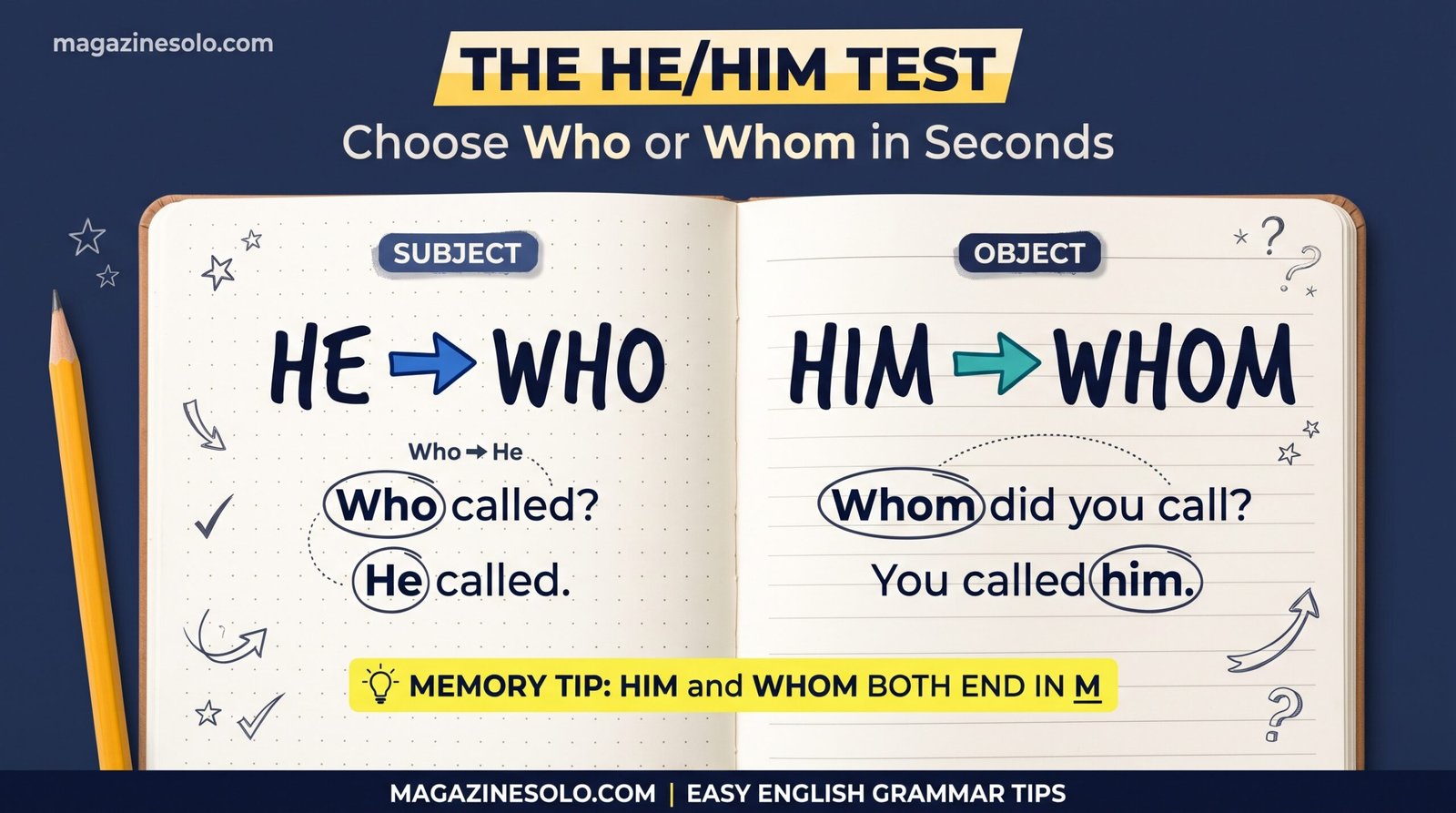
The substitution test is recommended by the Purdue OWL’s who vs whom page and by Grammarly’s who vs whom guide alike, and it works on every sentence in this article.
It fails only when it is rushed: the substitution must happen in statement order, inside the pronoun’s own clause.
1. Find the clause the pronoun belongs to. Ignore insertions like do you think, do you believe, and shall I say; they are guests in the sentence, not owners.
2. Restore statement order. Turn “Whom did you email?” into “You emailed .” Turn “Who called?” into “ called.”
3. Substitute he or him. If he fits, the answer is who. If him fits, the answer is whom.
4. Read it back. “You emailed him” gives “Whom did you email?” “He called” gives “Who called?”
The M Hook
If you remember one letter, remember M: him ends in M, and whom ends in M. The object pair shares the letter; the subject pair (he, who) has none.
Teachers have used the hook for generations because it converts a grammar question into a spelling glance. It is not a coincidence of the test; it is the test, compressed.
A second substitute pair helps when he and him feel loaded: they and them run the same split (they called, I called them), and them even keeps a visible M relative in sound if not in spelling.
Use whichever pair your ear trusts; the machinery underneath is identical, and a test you actually run beats a rule you merely remember.
Where the Test Gets Misapplied
The test breaks when the pronoun is fed to the wrong verb. In “Who do you think is calling?”, impatient readers test against think and land on an object answer.
Think is not the pronoun’s verb. Remove the insertion and the sentence is “Who is calling”: he is calling, subject, who. Section by section, every trap below is this single mistake wearing a different costume.
The Formality Dial: Required, Optional, Never
Case tells you the traditional form. Register tells you how much the choice matters in the room you are writing for, and honest guidance needs both dials.
| Situation | Whom Status | Guidance |
|---|---|---|
| After a fronted preposition (to whom, for whom) | Required | Use whom at every level of edited English |
| Partitives (many of whom, few of whom) | Required | Whom is the living standard, journalism included |
| Set phrases (To Whom It May Concern) | Required | Fixed formulas; do not modernize the pronoun |
| Object questions (Whom did you call?) | Formal option | Whom in formal writing and exams; who standard in speech |
| Object relative clauses (the man whom I met) | Formal option | Whom edited; who common; pronoun often dropped |
| Stranded preposition (Who did you speak to?) | Who standard | Whom possible but stiff; fronting forces whom |
| Subject of any verb (___ is calling) | Never | Who is the only correct form, everywhere |
| Subject of a clause after a preposition | Never | Whoever/who heads the clause as its subject |
The dial explains real usage without surrendering the rule.
A job applicant writing “the manager to whom I reported” is correct and sounds precise; the same applicant writing “Whom is calling?” has made the one error this table marks Never, and it costs more than a dozen casual whos.
Merriam-Webster’s own verdict captures the middle band honestly: in constructions like “It depends on whom you ask,” whom may be technically correct yet feel fussy, and who is perfectly standard. Register is a choice; case is not.
The Three Traps
Trap 1: The Parenthetical
Sentences smuggle in little guest phrases: do you think, do you believe, shall I say, do you suppose. Strip the guest out before you test, because the pronoun never belongs to it.
- Who do you think is calling? (Strip the guest and it reads: Who is calling? He is calling.)
- Who do you believe won the award? (Who won.)
- Whom do you think we should hire? (We should hire him. Here the guest hides an object.)
The same sentence frame flips its answer depending on what remains after the guest leaves, which is why this trap catches people who genuinely know the rule.
Trap 2: Subject of the Clause After a Preposition
A preposition can take a whole clause as its object. When it does, the pronoun inside that clause keeps the job the clause gives it, and a subject pronoun stays who.
- Give it to whoever asks first. (whoever is the subject of asks)
- I cheered for who played hardest. (who is the subject of played)
- Send the file to whoever is on duty. (subject of is)
The rule that “after a preposition use whom” applies when the pronoun itself is the preposition’s object (to whom). When a clause intervenes, test inside the clause. This is the exception most guides skip, and it decides a surprising share of real sentences.
Trap 3: Hypercorrection, Whom as Subject
Hypercorrection is overapplying a prestige rule: reaching for whom to sound correct and landing on the one form that is simply wrong.
- Wrong: Whom is at the door? Right: Who is at the door?
- Wrong: Whom shall I say is calling? Right: Who shall I say is calling?
- Wrong: The candidate whom everyone thought was ready. Right: The candidate who everyone thought was ready (subject of was).
The telephone formula deserves its reputation: generations of receptionists were trained into “Whom shall I say is calling?”, and it fails Trap 1 and Trap 3 simultaneously, since shall I say is a guest phrase and the pronoun is the subject of is calling.
Calibrate your instincts with the cost table: object who in a formal document is a register slip; subject whom anywhere is an error. When genuinely unsure, who is the safe default, and sounding natural beats sounding decorated.
Who and Whom in Relative Clauses
Relative clauses follow the same law, judged clause by clause. The pronoun takes the case of its job inside the clause it introduces, regardless of the main sentence around it.
- The author who signed my book (she signed: subject)
- The author whom I admire (I admire him: object)
- The neighbors who moved in last spring (they moved: subject)
- The neighbors whom we invited for dinner (we invited them: object)
Two freedoms soften the object cases in everyday writing. The pronoun can be who in informal style (the author who I admire), or it can be dropped entirely (the author I admire), an option English allows for objects but never for subjects.
Subject clauses allow no such freedom: the pronoun must be present and must be who. That asymmetry is a useful field check: if the pronoun can vanish, it was an object; if the sentence collapses without it, it was a subject.
Pronoun confusion rarely travels alone, by the way.
The same readers who stall on who and whom often stall on the possessive sets, which is why our guide to the there, their, they’re difference and our guide to the your vs you’re difference sit in the same family of one test fixes everything guides.
Whoever and Whomever: The Same Test
The ever pair obeys the identical law, with one wrinkle: the pronoun’s job is decided inside its clause, even when the whole clause sits behind a preposition or a verb.
- Whoever finishes first wins the round. (subject of finishes)
- Give the form to whoever is at the desk. (subject of is; the preposition to takes the whole clause)
- Sign up whomever you trust with the keys. (object of trust)
- We will interview whomever the panel recommends. (object of recommends)
The second example is the famous battleground: a preposition sits directly before the pronoun, and the instinct screams whomever. The clause disagrees: someone must be at the desk, and that someone is a subject.
Run the substitution inside the clause and the answer is mechanical: he is at the desk, so whoever. The M hook works here too, since whomever carries the M of the object pair.
Famous Whom: Donne, Hemingway, and the Salutation
The most quoted whom in English belongs to John Donne, who wrote in Meditation XVII (1624): “never send to know for whom the bell tolls; it tolls for thee.”
Ernest Hemingway borrowed the phrase three centuries later as the title of his 1940 novel, For Whom the Bell Tolls, which is why the line survives on bookshelves long after everyday whom began thinning out.
Notice that Donne’s whom is not decoration: the bell tolls for someone, the pronoun is the object of the preposition, and the formal rule and the famous line agree exactly.
The other surviving monument is bureaucratic rather than literary: To Whom It May Concern, the salutation of open reference letters.
The pronoun is the object of to, the form is frozen, and modern replacements (Dear Hiring Manager, Dear Recruiting Team) exist because writers prefer a named reader, not because the whom was wrong.
Whom also persists quietly in partitives inside ordinary journalism: “forty applicants, few of whom were qualified”; “two finalists, both of whom declined.” When you meet whom in the wild today, it is usually standing after a preposition or an of, exactly where the rule keeps it.
How to Avoid Whom Gracefully
Dodging whom is a legitimate professional skill, because a stiff whom can cost more warmth than a plain who costs correctness. Four recasts cover nearly every situation:
1. Name the person. “Email Priya about the invoice” replaces “Whom should I email?” with zero loss.
2. Drop the object pronoun. “The client I met on Tuesday” carries the same meaning as the version with whom, and reads lighter.
3. Strand the preposition with who. “Who is this form for?” is neutral standard English, no fronting required.
4. Switch to a noun phrase. “The intended recipient,” “the hiring manager,” and “the person responsible” all retire the pronoun entirely.
The one dodge to avoid is the random whom: inserting whom somewhere in a sentence you have restructured, hoping it lands correctly. A recast sentence has no slot for it; let the recast do its work.
The Quick Decision Card
For the sentence in front of you right now, run this sequence and stop at the first line that answers:
- Is the pronoun doing the action? Use who. No further questions.
- Is it receiving the action, or completing a fronted preposition? Use whom in formal writing; who is acceptable in neutral and informal writing, except directly after a fronted preposition, where whom is required.
- Is there a guest phrase (do you think, shall I say)? Delete it mentally and restart the card.
- Is a whole clause sitting after the preposition? Test the pronoun’s job inside that clause.
- Are you reaching for whom mainly because it sounds smarter? Stop. That reach is hypercorrection warming up, and who is the safer word.
Printed beside a keyboard, the card settles ninety percent of real world cases in under five seconds; the practice set below trains the remaining ten percent, which is where the traps live.
Practice: Ten Sentences, Tested
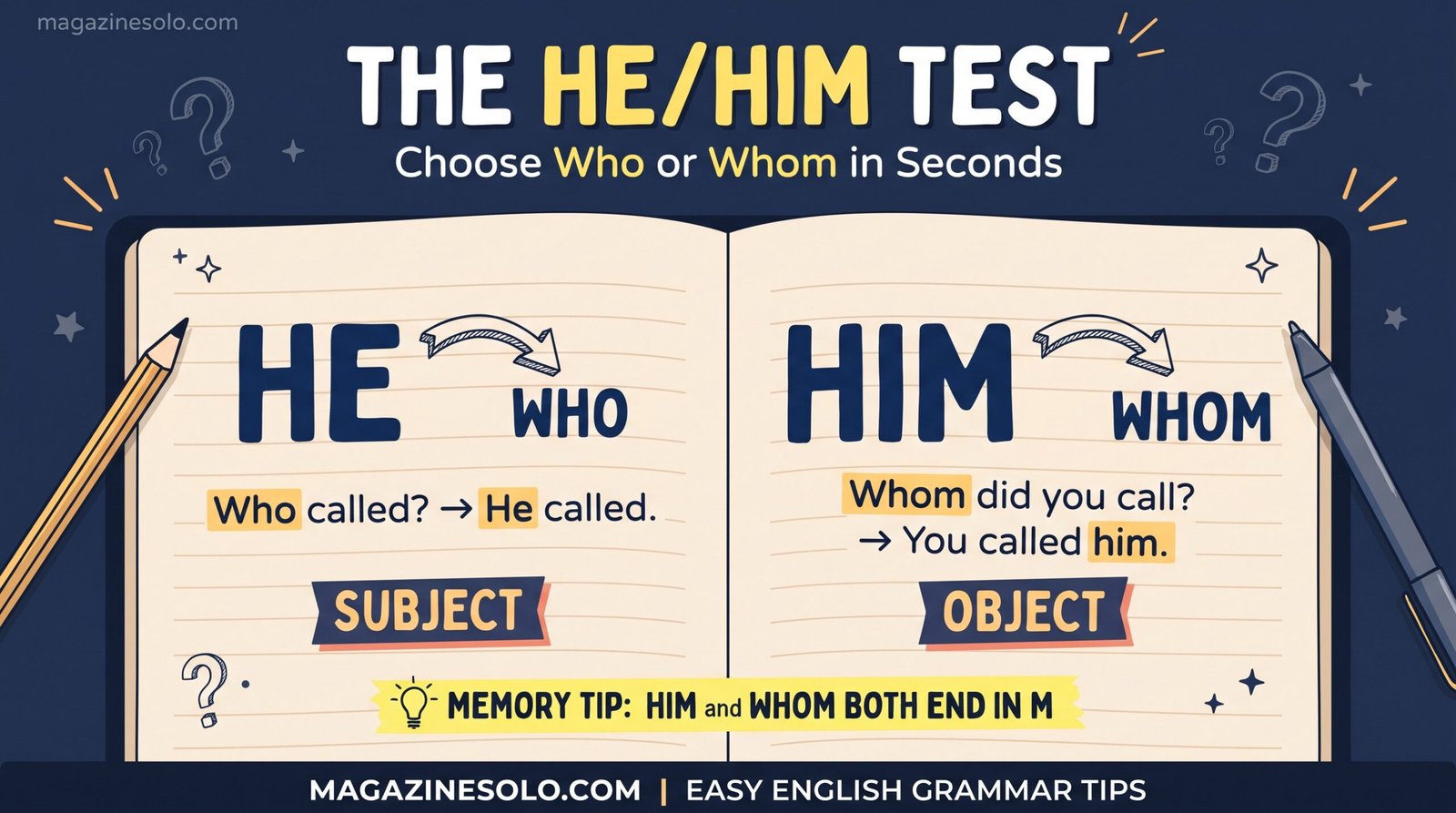
Choose who or whom, then check the test, not just the answer. The test is the skill being trained here; the answers are only receipts.
1. ___ left this package at reception? Answer: Who. He left it; subject of left.
2. ___ did the committee select? Answer: Whom (formal). The committee selected him; object of select.
3. ___ do you think left this package? Answer: Who. Remove the guest: Who left it?
4. The analyst ___ the director praised has resigned. Answer: whom (formal), who acceptable informally. The director praised her; object inside the clause.
5. ___ shall I say is calling? Answer: Who. The pronoun is the subject of is calling; the famous formula is wrong.
6. Send the keys to ___ is covering the desk. Answer: whoever. Subject of is covering; the preposition takes the clause.
7. She is the one ___ I trust with the accounts. Answer: whom (formal). I trust him; object of trust.
8. ___ are you working for these days? Answer: Who in neutral style. Stranded preposition, object job, who is standard; fronting would require For whom.
9. Twelve interns applied, several of ___ were hired. Answer: whom. Partitive: object of of, required form.
10. He is a manager ___ everyone respects and ___ leads by example. Answer: whom, then who. Everyone respects him (object); he leads (subject). One sentence, both jobs: the whole article in miniature.
Frequently Asked Questions
What is the difference between who and whom?
Who is the subject pronoun: it does the action (Who called?). Whom is the object pronoun: it receives the action or follows a preposition (Whom did you call?).
The pair works exactly like he and him, or I and me.
When do you use whom?
Use whom when the pronoun is the object of a verb (Whom did you invite?) or the object of a preposition in formal writing (the colleague with whom I work).
If you can answer the question with him or her, whom is the form traditional grammar requires.
How do you know whether to use who or whom?
Turn the question into a statement and substitute a personal pronoun. If he or she fits, use who. If him or her fits, use whom. Example: Who/Whom did you email? becomes You emailed him, so whom is correct: Whom did you email?
What is the he/him test for who and whom?
The standard diagnostic used by Merriam-Webster, Grammarly, and Purdue OWL: reimagine the sentence with he or him in the pronoun’s slot. He pairs with who (both subject forms), him pairs with whom (both object forms).
A memory hook: him and whom both end in the letter M.
Is it ‘who did you call’ or ‘whom did you call’?
Strictly, whom: you called him, so the pronoun is an object.
In casual speech and informal writing, who did you call is widely used and accepted by modern usage guides. In formal writing or an exam, whom did you call is the safe choice.
Is whom still used in modern English?
Yes, but unevenly. Whom remains standard in formal writing, after fronted prepositions (to whom, for whom), in partitive phrases (many of whom), and in set phrases like To Whom It May Concern.
It is rare in casual speech, where who covers both jobs.
Can you start a sentence with whom?
Yes, when it is genuinely an object: Whom did you see? Whom should we hire?
What you cannot do is use whom as a subject: Whom is calling? is wrong, because the caller is the subject. Using whom as a subject is the classic hypercorrection error.
Do you always use whom after a preposition?
Almost always in formal writing: to whom, for whom, with whom, one of whom.
The exception is when the pronoun is the subject of the clause that follows: Give it to whoever asks first (whoever is the subject of asks), and I cheered for who played hardest, where who is the subject of played.
Is it ‘to who’ or ‘to whom’?
To whom, in any register that cares about the distinction: the pronoun is the object of the preposition to.
To who is heard in casual speech but is not accepted in edited writing, which is why the business salutation is fixed as To Whom It May Concern.
What is the difference between who and whom in questions?
Ask what job the answer does. If the answer is the subject of the verb (Who wrote this? He wrote it), use who. If the answer is an object (Whom did she marry? She married him), strict grammar uses whom.
The substitution test with he and him settles every case.
Which one is the subject, who or whom?
Who. Who is the nominative (subjective) case form, like I, he, she, we, and they. Whom is the objective case form, like me, him, her, us, and them.
English kept case endings on pronouns after losing them almost everywhere else, which is why this pair survives.
Can who be used as an object?
In modern usage, yes, very commonly: Who did you see? and Who are you waiting for? are standard in speech and informal writing.
Formal edited prose and exams still expect whom in object position, especially right after a preposition.
Is whom dying out?
Usage guides agree whom is declining in speech and informal writing, a trend centuries old; Shakespeare and the King James Bible already mix the forms.
But declining is not dead: whom survives after fronted prepositions, in partitives (some of whom), and in formal registers. No reliable percentage for the decline exists.
What does whom mean?
Whom means the same person as who; it carries no different meaning, only a different grammatical job. It is the object form of who.
Meaning stays constant; case changes. That is why swapping the two rarely changes what a sentence says, only how correct it sounds.
Is it ‘who do you think is calling’ or ‘whom do you think is calling’?
Who. The phrase do you think is an insertion; remove it and the sentence reads Who is calling, with the pronoun as subject of is calling.
The mirror image takes whom: Whom do you think we should hire? There the pronoun is the object of hire.
Why do people use whom incorrectly?
Mostly through hypercorrection: writers who know whom is the formal form reach for it whenever they want to sound correct, including in subject position.
Whom shall I say is calling? is a famous wrong example; the pronoun is the subject of is calling. Apply the substitution test to the pronoun’s own clause.
What is hypercorrection with whom?
Hypercorrection is overapplying a prestige rule: using whom where who is required, typically as a subject (Whom is at the door?).
It is the error of careful writers, not careless ones, and examiners test for it deliberately.
Who vs whom vs whose: what is the difference?
Three jobs, one family. Who: subject (Who owns this?). Whom: object (Whom did you lend it to?). Whose: possessive (Whose is this?).
Whose pairs with his and its; do not confuse it with who’s, which is the contraction of who is or who has (Who’s at the door?).
What is the difference between whoever and whomever?
The same case rule inside a fused clause. Whoever when the pronoun is the subject of its clause: Whoever finishes first wins.
Whomever when it is an object: Give the prize to whomever you choose (object of choose). Judge by the job inside the clause, not the preposition outside it.
Is it ‘for who’ or ‘for whom’?
For whom. After the preposition for, formal and edited English uses the object form: For whom are you working?
Stranding the preposition at the end (Who are you working for?) is natural in speech; fronting it without switching to whom mixes registers and reads as an error.
How do you use whom in a relative clause?
Use whom when the pronoun is the object inside its own clause: the author whom I admire (I admire him).
Use who when it is the clause’s subject: the author who signed my book. In object clauses, informal style often drops the pronoun: the author I admire.
Is ‘whom did you speak to’ correct?
Yes, strictly correct but stiff for most ears. The pronoun is the object of the stranded preposition to (you spoke to him).
Everyday standard is Who did you speak to? Fronting the preposition forces the formal version: To whom did you speak? All three are grammatical; they differ in register.
Can you end a sentence with a preposition when you use whom?
You can strand the preposition and keep whom (Whom are you waiting for?), or front it for maximum formality (For whom are you waiting?).
Ending sentences with prepositions is ancient and grammatical. What fails in edited prose is fronting the preposition and keeping who: For who are you waiting?
What grammatical case is who?
Nominative, also called subjective: the case of subjects and of complements after linking verbs (It was she who called). Who belongs to the set I, he, she, we, they. Test: if the slot accepts I or he, it accepts who.
What grammatical case is whom?
Objective (accusative and dative in older terms): the case of direct objects, indirect objects, and objects of prepositions.
Whom belongs to the set me, him, her, us, them. It descends from the Old English dative form hwam, which is why it covers both direct and prepositional objects today.
Is whom formal?
Whom is register sensitive rather than simply formal. After a fronted preposition it is required at almost every level of edited English.
As a sentence opening question word (Whom did you see?) it now reads formal or old fashioned to many speakers, and who is the neutral modern choice.
Do native speakers actually use whom?
In speech, rarely, outside set phrases and fronted prepositions; usage guide consensus is that who does both jobs in conversation.
In writing, speakers use whom where editors expect it: after prepositions, in partitives like many of whom, and in formal correspondence.
Is it ‘the person who I met’ or ‘the person whom I met’?
Both occur; they differ in formality. The pronoun is the object of met (I met him), so traditional grammar prefers whom, and edited prose uses the person whom I met.
Informal standard widely uses who here, or drops the pronoun: the person I met. Whom as a subject (the person whom met me) is always wrong.
When is who correct right after a preposition?
When the pronoun is the subject of the clause that follows, not the object of the preposition itself: Give it to whoever arrives first (subject of arrives).
The preposition takes the whole clause as its object, and case is decided inside the clause. This is the exception most guides skip.
What is the M trick for remembering whom?
Him and whom both end in M. If the answer to your question, or the substitution in your sentence, ends in M (him, them in sound if not spelling), choose the word that ends in M: whom.
Teachers pair it with the he/him test: he has no M and pairs with who; him has the M and pairs with whom.
Is ‘whom is calling’ ever correct?
No. A caller is the subject of the sentence, and subjects take who.
The famous telephone formula Whom shall I say is calling? is wrong for the same reason: strip out shall I say and the pronoun is the subject of is calling. Correct: Who shall I say is calling?
How is whom used with words like many, some, and none?
In partitive of phrases, formal English requires whom: many of whom, some of whom, none of whom, both of whom, a few of whom. The pronoun is the object of of.
This is one of the commonest surviving homes of whom in modern prose, including journalism: 200 applicants, few of whom were qualified.
Who or whom in ‘It depends on who you ask’?
Strict analysis says whom: the pronoun is the object of ask inside the clause (you ask him), so formal writing uses It depends on whom you ask.
But Merriam-Webster lists this sentence as a case where whom can feel fussy, and who is perfectly standard. Both are defensible; choose by register.
Should you use whom in emails and cover letters?
In the places where it is structurally required, yes: To Whom It May Concern, the manager to whom I reported.
A correct whom never hurts in formal correspondence, while a wrong whom (as a subject) hurts more than a neutral who. When unsure of the case, recast or use who; never guess whom upward.
Is whom used only for people?
Yes. Who and whom refer to people (and occasionally to personified animals or pets with names and characters). For things, the relative pronouns are which and that, which have no case distinction: the report that you cited, never whom.
Whose is the exception in the family: it can serve things as well (a book whose pages are torn).
What is the difference in ‘the teacher who taught us’ and ‘the teacher whom we hired’?
The clause decides. In who taught us, the pronoun does the teaching: subject, so who. In whom we hired, we do the hiring and the pronoun receives it: object (we hired her), so whom.
Same teacher, same sentence frame; the verb inside the clause assigns the case.
Why does the word sometimes come before the verb and sometimes after?
Word order follows the job. Subjects normally precede their verbs (Who called), objects follow theirs (You called whom, fronted in questions as Whom did you call?).
In questions the object pronoun moves to the front, which is what makes the pair confusing: position changes, case does not. The substitution test works because it restores statement order, where the job is visible.
Is it wrong to use who instead of whom?
It depends on the setting. In conversation and informal writing, object who is standard and unremarkable.
In formal edited prose, after fronted prepositions, and in most grammar exams, object who is marked as an error. The reverse mistake, whom as a subject, is wrong in every register, so the safe default under uncertainty is who.
Where does ‘for whom the bell tolls’ come from?
From John Donne’s Meditation XVII (1624): never send to know for whom the bell tolls; it tolls for thee.
Ernest Hemingway took the phrase as the title of his 1940 novel. The line follows the rule exactly: object of the preposition for.
How can you avoid using whom altogether?
Recast. Name the person (Email Priya, not Whom should I email?), drop the relative pronoun in object clauses (the client I met), or strand the preposition with who in neutral style (Who is this for?).
Skilled writers dodge whom whenever it would sound stiff, and no meaning is lost.
Does whom work for groups of people too?
Yes. Neither form changes for number: who for subjects of any size (the students who passed), whom for objects of any size (the students whom I taught).
That is why partitives read naturally at any scale: two guests, both of whom; two hundred applicants, few of whom.
Who vs whom in one line: what is the fastest rule?
Answer the question with he or him: he means who, him means whom, and him and whom share the M.
If no question is involved, find the verb the pronoun belongs to: doing the action takes who, receiving it takes whom, and anything after a fronted preposition takes whom.
Conclusion
The who vs whom difference is a job description, not a vocabulary list: who takes the subject’s chair, whom takes the object’s.
And the he/him test with its shared M settles any real sentence in mere seconds once you restore statement order and test inside the right clause.
Hold the three traps alongside the test (the parenthetical guest, the clause subject behind a preposition, and hypercorrection, the prestige error) and the pair stops being a gamble in any sentence you will meet this year.
Where the dial says formal option, choose by audience with a clear conscience; where it says required or never, the rule has already chosen for you.
The neighboring pairs submit to the same discipline of one clear test each, from our guide to the than vs then difference to our guide to affect vs effect.
The full set lives in the MagazineSolo difference library, where difference questions get settled by rule rather than by ear.

Dilawar Mughal is an SEO expert with 8 years of hands-on experience helping websites grow their organic traffic, rankings, and revenue. He specializes in content-driven SEO, local SEO, and Pinterest SEO, and builds practical, results-focused strategies for businesses and publishers.