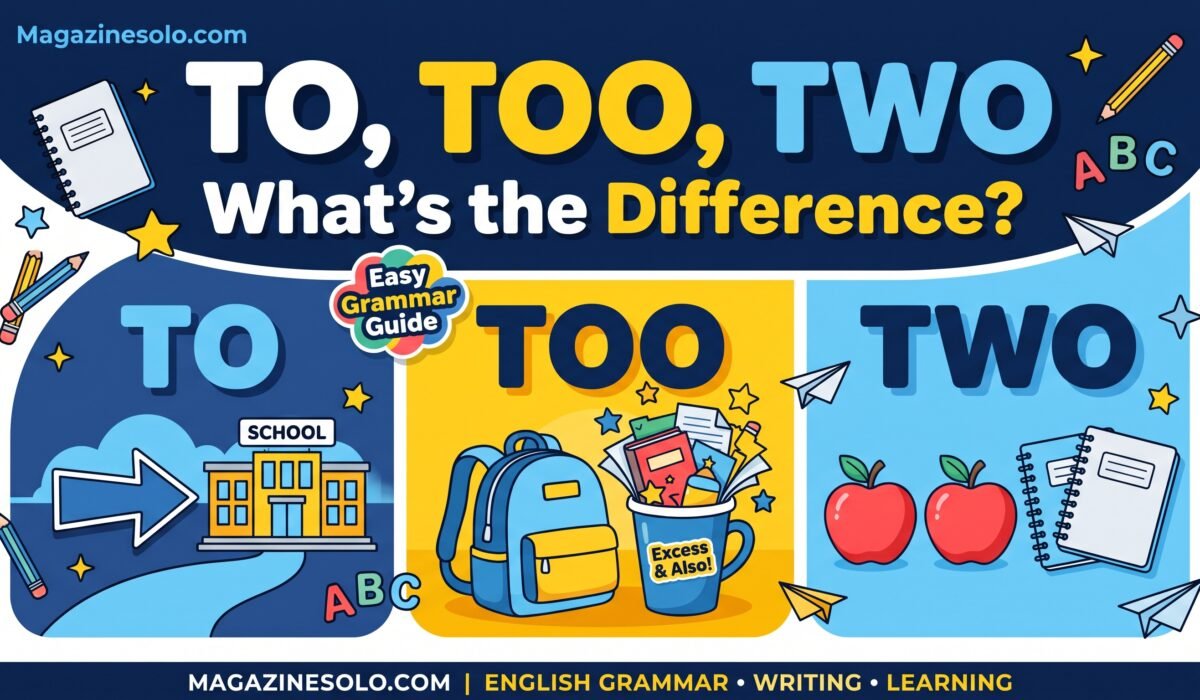
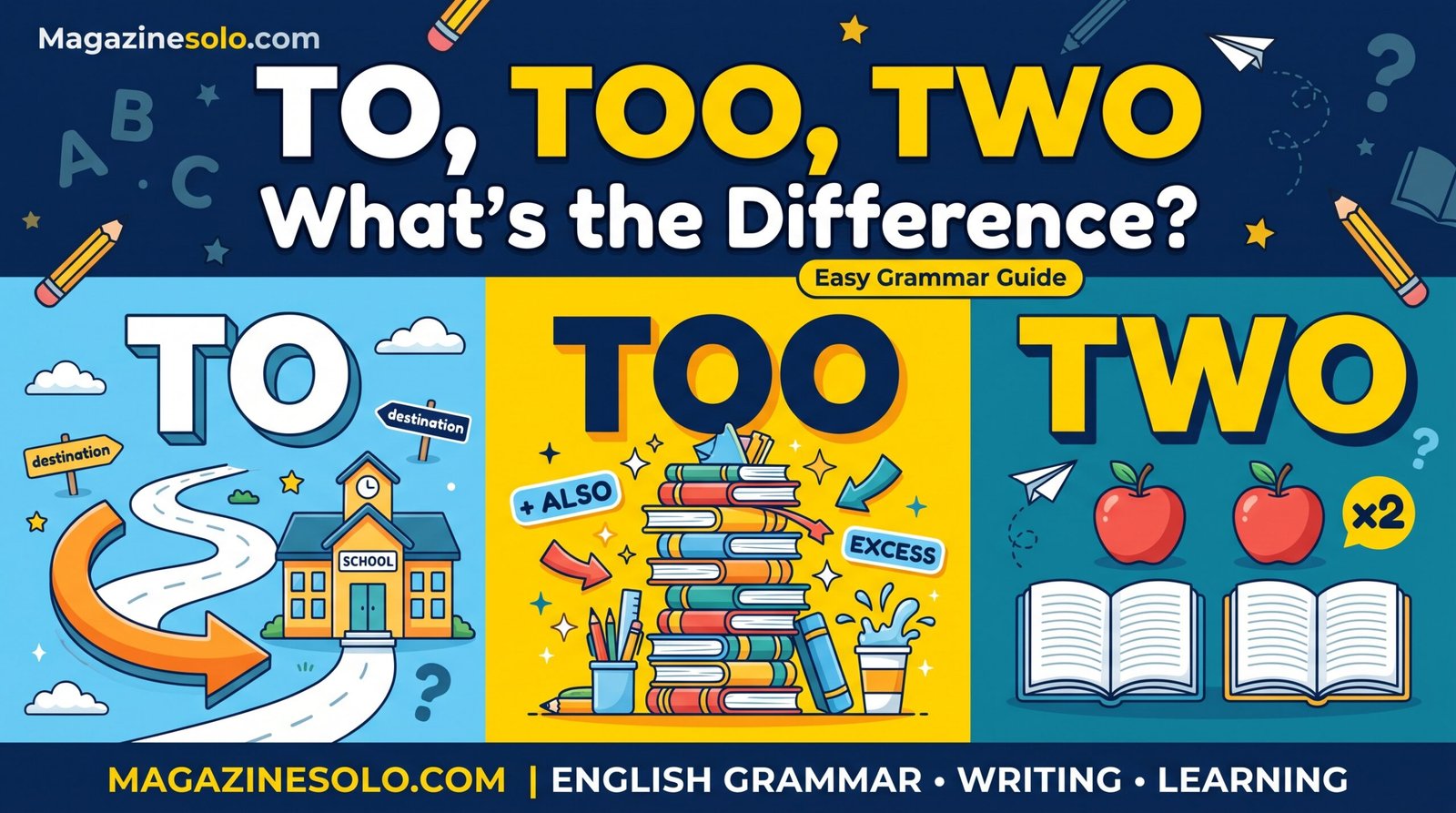
The to too two difference is the first homophone trio most writers ever meet, and the one they use most often: three spellings, one sound, and a choice made dozens of times a day. Two is the number 2.
Too means also or excessively. To is everything else: direction, recipient, and the infinitive marker before verbs.
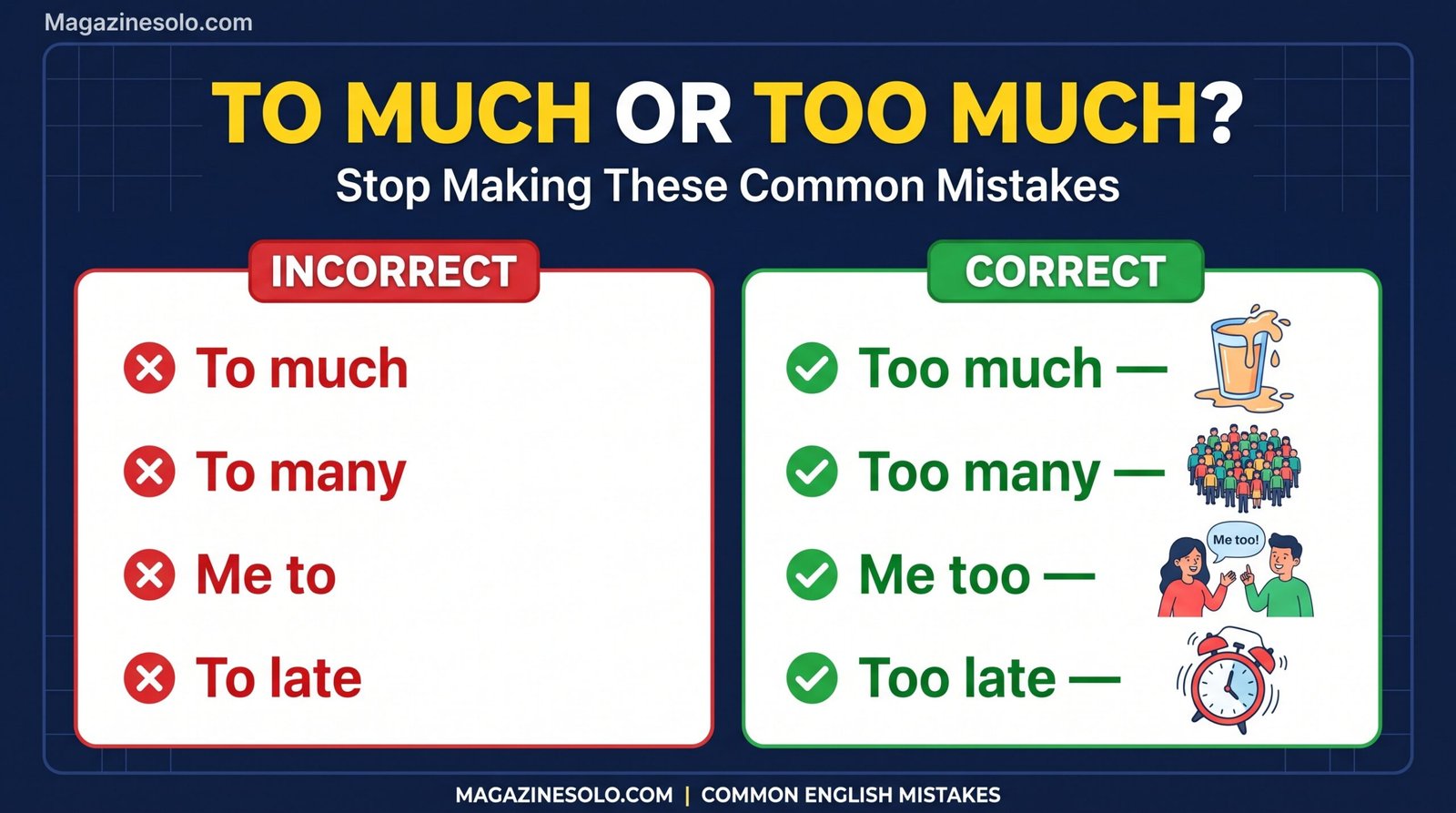
Because the choice is so frequent, it runs on autopilot, and autopilot is where the errors breed: to much, me to, two many people.
Sound cannot help, since all three are pronounced identically, so the choice has to be made by job, not by ear.
This guide teaches the trio as a decision order: ask about the number first, then about extra, and take to as the leftover.
It joins the word confusion guides at MagazineSolo, alongside there their they’re difference and the apostrophe pairs that run on the same job first method.
The Three Jobs Answer
|
Word |
Job |
Letter anchor |
Swap test |
Signature example |
|---|---|---|---|---|
|
Two |
The number 2 |
The w (twelve, twenty, twins) |
Does 2 fit? |
Two cats; the two of us |
|
Too |
Also; excessively |
The extra o |
Does also or excessively fit? |
I want to go too; too hot |
|
To |
Direction, recipient, infinitive |
The plain single o |
Neither fits, so to by elimination |
Go to school; to read |
Merriam-Webster’s entry for two anchors the number, Merriam-Webster’s entry for too anchors the adverb, and Merriam-Webster’s entry for to confirms the workhorse preposition.
The matrix adds what separate entries cannot show: the spellings carry their tests inside their letters, and the third row has no swap of its own because to is reached by elimination.
Read the anchors once. A counting word carries the w of its counting family. A word about extra carries an extra o, as if another o had asked to come too. The plain word, with nothing extra and no w, does everything left over.
The Decision Order
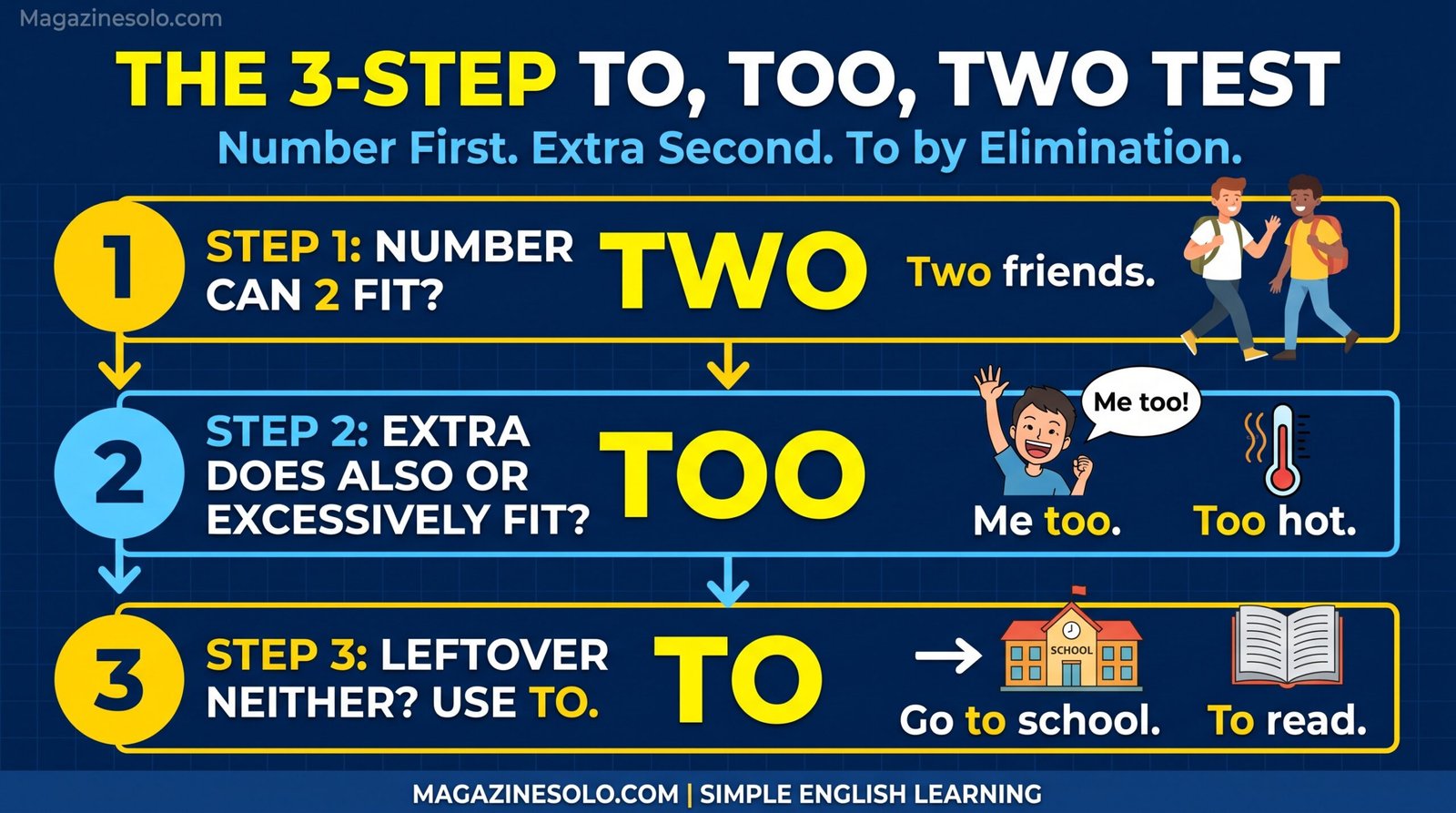
Definitions alone leave writers testing the biggest job first, which is backwards. Run the order the other way, smallest jobs first.
Step 1: Ask about the number. Can the word be replaced by 2, or by another number, without breaking the sentence? Two cats becomes 2 cats, or three cats, cleanly. If a number fits, write two and stop.
Step 2: Ask about extra. Swap in also, then excessively. I want to go too survives as I want to go also. Too hot survives as excessively hot. If either swap keeps the meaning, write too and stop.
Step 3: Take the leftover. If neither the number nor extra fits, the word is to.
Direction (to the store), recipient (to me), infinitive (to go): all arrive here by elimination, exactly as official language guidance puts it when it defines to as the form for every use the other two do not cover.
The set piece runs the order in one breath: I tried to go to the movie with two friends, but we got there too late. Two friends (number), to the movie (direction, leftover), too late (extra degree).
Three words, three jobs, three checks, in order.
Two: The Number
Two is the easiest member of the trio, and guides agree it causes the fewest errors, because the number announces itself.
It does two grammatical jobs: a determiner before a noun (two cats, two brothers, two wheels) and a pronoun standing alone (I have two; the two of us; two of them left).
Its spelling anchor is a whole family: twelve (two and ten), twenty (two tens), twice (two times), twins (two at once), and between, whose ancestry runs through twain.
For learners, the Cambridge Dictionary entry for two presents the same number in frames from ages to arithmetic.
One style rule rides with the word: general prose spells out small numbers. Chicago and AP style both write two in running text, reserving the figure 2 for tables, data, and technical contexts.
So the writer’s question is rarely two or 2 in a sentence; it is two, spelled with its w, whenever the word appears in prose at all.
Too: Also and Excessively
Too is an adverb with two meanings that look unrelated until the extra o explains both: each is about something extra.
As also, it adds a person or thing to the set (I liked it too; can I come too?). As excessively, it adds degree beyond what is right, enough, or wanted (too hot, too expensive, too late).
The swaps police the meanings separately: replace too with also for the adding sense, and with excessively or overly for the degree sense.
In relaxed praise, the degree sense softens into plain very (you are too kind; that is too funny), but careful writing keeps the warning inside too: too hot still means hotter than it should be.
For learners, the Cambridge Dictionary entry for too shows both senses in its everyday examples.
The Quantifier Bank
Excess meets quantity in a fixed set of phrases, and they are where the trio’s most photographed errors live.
- Too much with uncountable things: too much sugar, too much work, too much noise
- Too many with countable things: too many cats, too many people, too many emails
- Too few and too little: too few chairs, too little time
- Too often, too soon, too late: the degree adverbs of daily complaint
Every one takes too, because every one is about excess. To much and two many are never correct, in any sentence, and the excessively swap proves it in one second.
The Idiom Bank
Fixed phrases give the memory permanent anchors, because their spellings cannot change without breaking the phrase.
- Too bad: a pity, unfortunately (it is too bad he cannot come)
- Too little, too late: help that was insufficient and overdue
- Not too pleased: understatement for rather annoyed
- Me too: the agreement reply, also, at the end of the sentence
The Comma Ruling
Half the questions about too are really about its comma, so here is the ruling plainly: modern style prefers no comma before a sentence final too. I want to go too, written bare, is the current default in Chicago style and in most edited prose.
Older books often set the comma (I want to go, too), and the comma remains available when too is set off as a genuine aside or for deliberate emphasis mid sentence.
Treat it as a style choice to keep consistent within a document. The spelling, unlike the comma, is never optional.
Too, Very, and So: The Degree Ladder
Writers choosing between too and its neighbors should feel the ladder’s rungs. Very raises degree neutrally (very hot, a fact).
So raises it with a pointing flavor (so hot that…). Too alone adds the judgement that the line has been crossed: too hot means hotter than the purpose allows.
That judgement is why too partners with consequences: too hot to drink, too late to matter, too much to carry. When no consequence and no crossed line exists, careful writers usually mean very, and choosing too anyway is how excess creeps into neutral reports.
To: Direction, Recipient, and the Infinitive
To is the busiest word in English, and its jobs fill a shelf: direction (drive to the office), recipient (give it to me), range and limits (nine to five), comparison and attachment (senior to her; pinned to the wall), and relation (the key to the door).
For learners, the Cambridge Dictionary entry for to organizes the same territory around movement and purpose.
Its second career is the infinitive marker: to plus the base form of a verb (to go, to read, to be).
Grammars call this to a particle rather than a preposition, but writers need only recognize the shape: a verb’s plain form follows, and the pair names an action in the abstract.
Given this workload, testing to job by job would take all day, which is precisely why the decision order reaches it by elimination. Number and extra are small, testable jobs.
To is the residue, and the residue is enormous. Elimination is not a shortcut here; it is the only workable procedure.
The Fixed Phrase Bank
A handful of phrases built on to generate a steady share of the trio’s errors, because they sound exactly like too territory.
- Going to: direction (going to the store) and future (going to rain). Always to; the spoken reduction gonna represents going to, never going too.
- Used to: past habit (I used to smoke). The spelling used too is always an error.
- Ought to: obligation, a should in older dress (you ought to rest). Always to.
- Look forward to seeing: here to is a preposition, so the ing form follows (I look forward to seeing you). The phrase fools advanced writers, and it is still plain to.
The Too Construction: Too Hot to Eat
English owns a construction where the trio’s two confusables stand side by side, each doing its own job: too plus adjective plus to plus verb. Too hot to eat.
Too tired to go. Too expensive to buy. The soup is so hot that eating it is impossible or unwise; the excess word opens the phrase, and the infinitive marker closes it.
The construction carries a built in logic check: the adjective’s degree must genuinely block the action.
Too young to drive, too far to walk, too late to apologize all pass. It also manufactures the trio’s most instructive error, to hot to eat, which breaks both halves at once and is worth showing learners precisely because one phrase can hold the whole lesson.
A quieter cousin deserves a line: too plus adjective plus for (too hot for me, too big for the box), where no infinitive follows. The too is unchanged; only the tail of the construction differs.
Teachers drill the construction early for a reason: it packs the trio’s hardest choice and its most useful pattern into four words.
A learner who can build ten honest examples (too cold to swim, too far to walk, too young to drive) has usually stopped confusing the spellings altogether, permanently.
One Word Twice: The To and Too History
Here is the surprise that explains the whole trap: to and too are historically the same word.
Too began life as the stressed form of the preposition to, used when the word carried emphasis. During the 1500s and 1600s the spellings separated, as too took over the also and excessively meanings.
The pair that looks most alike is the pair that shares a root; they are doublets, not coincidences.
Two is the outsider, descending from Old English twa, the number word, related to the tw family it still travels with. It has no historical connection to the other two beyond the accident of sound.
The pronunciation tells the same story today: in flowing speech, unstressed to shrinks to a weak, reduced sound, while too and two keep their full stressed vowel.
The spelling split fossilized a stress split, and dictation software, guessing from the sound, inherits the confusion daily.
All Three in One Sentence
Set pieces are the trio’s finest teaching tool, because one sentence can hold all three jobs and let the decision order verify each in turn.
- I tried to go to the movie with two friends, but we got there too late, and the tickets cost too much anyway. Infinitives, direction, the number, excess twice over.
- She gave two cookies to her brother, and I got one too. The number, the recipient, and the sentence final also.
- The two of us went to the zoo, and the elephants came to the fence too. A pronoun two, direction twice, and also at the end.
- It is too early to take two trains to the airport. The construction, the number, and direction in one commute.
Write five sentences of your own on this pattern and the order installs itself: production fixes what reading only describes.
Sentence Surgery
Real errors from the places this trio is photographed failing, corrected, with the step of the order that catches each one.
|
As written |
Corrected |
The step that catches it |
|---|---|---|
|
I ate to much at lunch |
I ate too much at lunch |
Extra: excessively much |
|
Me to, I hate that song |
Me too, I hate that song |
Extra: also, at sentence end |
|
Two many people showed up |
Too many people showed up |
Extra beats number: not a count |
|
I need too go home now |
I need to go home now |
Leftover: infinitive marker |
|
We arrived to late for the show |
We arrived too late for the show |
Extra: degree exceeded |
|
He is going too the store |
He is going to the store |
Leftover: direction |
|
I used too smoke years ago |
I used to smoke years ago |
Fixed phrase: used to |
|
She has to cats at home |
She has two cats at home |
Number: 2 fits the slot |
One modern caution belongs in this gallery: dictation and autocorrect manufacture these errors after correct typing, because the software hears one sound and guesses by statistics.
The pass below exists because the tools cannot run the decision order for you. Only the writer can ask what the word is doing.
Near Misses: Job First, Everywhere
The method that runs this trio runs the whole cluster: name the job, run its test, let the sentence grade itself.
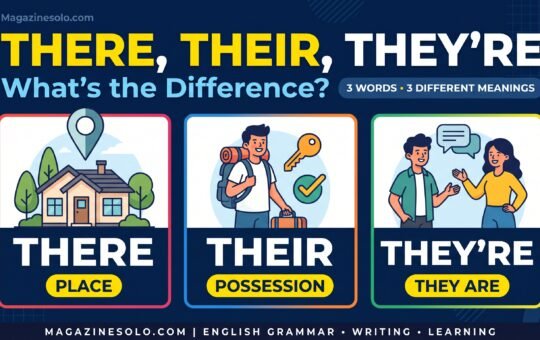
- There, their, they’re: expand to they are, then place or existence, then ownership; the same ordered thinking with three jobs.
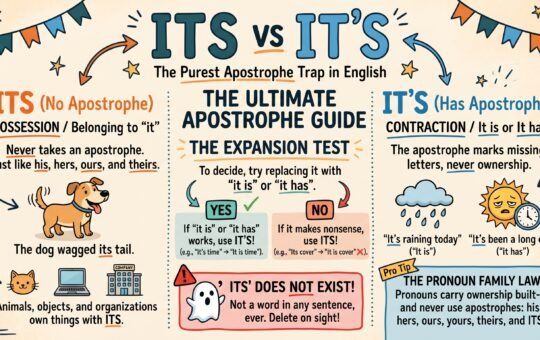
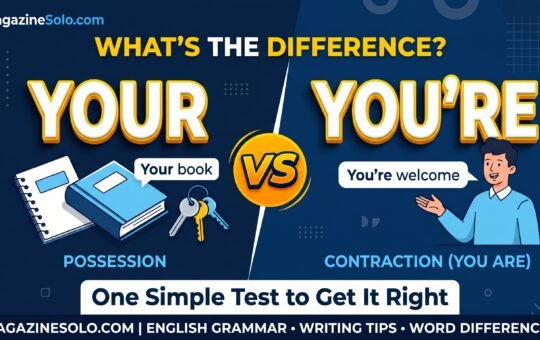
- Your vs you’re and its vs it’s: one expansion test each (you are; it is or it has), the pronoun apostrophe law behind both.
- Than vs then: compared to what, or when; two questions, no sound clues, the same discipline.
A learner who internalizes job first thinking stops collecting separate tricks per pair and starts running one procedure everywhere, which is the cluster’s real curriculum.
The Find and Swap Proofreading Pass
For documents where this trio carries a price (applications, essays, instructions, safety notes), a two minute pass removes the risk entirely. The pass works because the errors are not randomly scattered: they gather in predictable habitats, and habitats can be searched.
1. Search the habitats first. Find much, many, and every sentence ending in the trio’s sound. Error concentrates at quantity words and sentence ends; audit those before reading anything else.
2. Run the number step. At every candidate, ask whether 2 fits. If it does, the spelling is two, with its w.
3. Run the extra step. Swap in also, then excessively. A survivor takes too, with its extra o.
4. Confirm the leftovers. Everything remaining should be direction, recipient, range, or an infinitive. If a leftover sentence cannot name its to job, look again; an extra may be hiding in it.
5. Re scan the final version. Dictation and autocorrect make their swaps last, so the pass belongs on the finished text, not the draft.
The Word Confusion Cluster
This trio belongs to a family of sound alike traps, each settled by its own test. Its nearest relatives run on ordered jobs and single tests, and the rest of the cluster makes good next reads.
- there their they’re difference: expand, place or existence, ownership, in fixed order
- its vs it’s difference: the backwards apostrophe pair, its owns and it’s expands
- your vs you’re: the sibling pair where your welcome is the flagship error
- than vs then difference: compared to what, or when: the two questions procedure
- affect vs effect: the verb and noun pair settled by RAVEN, with its honest exceptions
- ally vs allie: the friend and partner against the girl’s name, one sound apart
- atleast or at least: two words or one, decided by what the sentence is measuring
- per say or per se: the Latin phrase hiding inside an English sound alike
- grately vs greatly: the grateful word against the grating sound alike
- half day or half-day: the hyphen question that changes what a day off means
The method transfers intact: name the job each word does, attach a test to each job, and let the sentence grade itself.
Frequently Asked Questions
What is the difference between to, too, and two?
Three jobs, one sound, settled in order. Two is the number 2 (two cats).
Too means also (I want to go too) or excessively (too hot, too much). To is everything else: direction, recipient, range, and the infinitive marker (go to school; to read). Ask number first, then extra, then take to as the leftover.
How can I remember to, too, and two?
Read the letters. Two keeps its w, shared with twelve, twenty, twice, and twins; if a number fits, write two.
Too has an extra o because it means extra: an extra person (coming too) or an extra degree (too hot). To is the plain leftover with one o, correct whenever neither number nor extra fits.
What does too mean?
Two meanings. Also or as well: I liked it too; can I come too? And excessively, more than is right, enough, or wanted: too hot, too expensive, too late.
In relaxed speech it can also mean very: you are too kind. Both main meanings pass the swap test with also or excessively.
What does to mean?
Jobs that point or connect: direction (drive to the office), recipient (give it to me), range (nine to five), comparison and attachment (senior to her; pinned to the wall), and the infinitive marker before verbs (to read, to be).
If a to does no too or two job, it is to.
What does two mean?
The number 2, used as a determiner before a noun (two wheels, two brothers) and as a noun or pronoun standing alone (I have two; the two of us).
It is the only member of the trio that names a quantity, and it is the least confused of the three because the number test is instant: if 2 fits, write two.
Is it ‘too much’ or ‘to much’?
Too much. Much is a quantity, and too marks it as excessive: too much sugar, too much work.
To much is always an error. The same ruling covers too many (too many cats), too few, too little, and too often. Wherever excess is the meaning, the word carries the extra o.
Is it ‘me too’ or ‘me to’?
Me too. The phrase means I also, and also requires too with its extra o. Me to is the error form. The sentence final slot is the trio’s classic trap: the ear hears only the sound, and the hand must supply the test alone.
Is it ‘too late’ or ‘to late’?
Too late. Late here is a degree exceeded, the excessively meaning: arrival beyond the acceptable time.
To late survives only in rare literal sequences like go to late showings, where to is a preposition. The deadline phrase is always too late, as in too little, too late.
Can too go at the end of a sentence?
Yes, in its also meaning, and that is its most common home: I will go too; she wants some too; me too.
Modern style usually writes no comma before a sentence final too (Chicago style agrees), though older teaching often added one. The comma is a style choice; the spelling is not.
Do I need a comma before too?
Usually no.
Current guidance, Chicago included, advises against a comma before sentence final too (I want to go too) and generally mid sentence, unless too is a genuine aside or needs emphasis. When in doubt, leave it out; the sentence stays correct either way on spelling.
What is the fastest test for to vs too?
Run the order. First, does the number 2 fit? Then it is two.
Next, swap in also, then excessively; if either keeps the meaning, it is too. If neither swap works, the word is to, the leftover, and the case is closed. The procedure takes seconds and has no exceptions.
Why is to called the leftover word?
Because its jobs are too many to test one by one (direction, recipient, range, infinitive), while the other two words have single testable meanings.
Teachers therefore define to by elimination: use to for all meanings not covered by two and too, as Canada’s Language Portal puts it. Elimination is a feature, not a weakness; it makes the decision order reliable.
What is the ‘too adjective to’ pattern?
A classic construction: too plus an adjective plus the infinitive, meaning so much that the action cannot or should not happen. Too hot to eat, too tired to go, too expensive to buy.
Note both trio members appear: too carries the excess, and to marks the infinitive. Writing to hot to eat doubles the error in one phrase.
Is ‘I want to go to’ ever correct at the end of a sentence?
Only when to is a preposition whose object is understood: I want to go to (the party, understood from context) is rare and awkward; the everyday ending is I want to go too, meaning also.
If the sentence means also, it is too. If a destination follows, the destination completes the to phrase.
Can two be used without a noun?
Yes. Two works as a pronoun: I bought two; the two of us; two of them left.
It also appears in arithmetic sentences (two plus two is four) and comparisons (the better of the two). In all of them the number test decides: if 2 can replace it, the spelling is two.
Should I write two or 2?
In ordinary prose, most style guides spell out numbers from one to nine (or ten) and use figures above: two cats, 12 dogs. Chicago and AP both spell out two in running text.
Figures belong in tables, statistics, and technical contexts. Either way, when the word is spelled out, its spelling for the number is always two.
Are to, too, and two homophones?
Yes, in their stressed forms all three are pronounced identically, which is why the confusion lives entirely in writing.
One refinement: to is usually pronounced in a weak, reduced form in flowing speech (a quick schwa sound) because it is rarely stressed, while too and two keep their full sound. Dictation tools trip on exactly this.
Which mistake is the most common in this trio?
Dictionary teaching names it: using to when too belongs, and the reverse; two is seldom the culprit because the number announces itself.
The epidemic forms are to much, to many, and the sentence final trap, I want to go to written when also is meant. Error hides at quantity words and sentence ends.
Is too the same as very?
Close, with a warning attached. Very is neutral intensity (very hot).
Too adds a judgement: the degree exceeds what is right or wanted (too hot to drink). Casual praise softens it into pure emphasis (too kind), but careful writing keeps the warning: too hot means hotter than it should be.
What does ‘too bad’ mean?
An idiom of regret or sympathy: it is too bad he cannot come (a pity).
The too is the excessively degree word historically, but the phrase now functions as a fixed expression meaning unfortunately. It is always spelled too bad; to bad is an error.
What does ‘not too pleased’ mean?
Understatement, a polite litotes: not too pleased means rather displeased, quite annoyed. The too is the degree word, softened by the not.
Similar forms: not too happy, not too sure, not too late (which means still in time). These are too in its degree sense, never to.
Is ‘going to’ spelled with to or too?
To, always: going to the store (preposition, direction) and going to rain (infinitive like marker for the future).
The informal spoken reduction gonna represents going to, never going too. If a destination or a verb follows and no excess or also is meant, the word is the single o to.
What about ‘used to’ and ‘ought to’?
Both are fixed phrases built on the infinitive marker to: used to (past habit: I used to smoke) and ought to (obligation, like should). Neither takes too. The spelling traps are used too and ought too, both errors; the phrases belong wholly to to.
Can to be followed by an ing form?
Yes, in a different structure: when to is a preposition before a noun phrase, a gerund can fill it (I look forward to seeing you; I am used to waiting).
This is the famous look forward to plus ing pattern. It is still to, the preposition, and never too; the test is that no verb base form follows.
Is ‘to you’ in ‘happy birthday to you’ a too case?
No. Happy birthday to you uses to as a preposition naming the recipient of the wish, like give it to me. The also word would need a different sentence entirely (I sang too, meaning I also sang). Recipient and direction belong to to.
What is the difference between too and also?
Meaning overlaps; grammar differs. Also is a freestanding adverb that usually sits mid sentence (I also went), while too prefers the end (I went too) or before adjectives (too hot).
Too also carries the excessively meaning that also never has. In the trio, too is chosen when also or excessively can swap in.
Why does dictation get to and too wrong?
Because speech hides the difference twice over: the words sound alike in stressed form, and to usually shrinks to a weak sound that software must guess from context.
Voice typing picks by statistics, not by the swap tests, so to much and me to appear in transcripts constantly. Proofreading with the decision order is the repair.
Is there a British vs American difference for to, too, and two?
No. Spellings, meanings, and tests are identical in both varieties. Style defaults agree too: no comma before sentence final too is the modern preference on both sides, and numbers under ten are spelled out in general prose in both Chicago and British style.
Do two and too have the same origin?
Two is the outsider (Old English twa, the number).
To and too are the same word historically: too began as the stressed form of to and split into its own spelling in the 1500s and 1600s, as the also and excessively meanings separated. The lookalike pair is the related pair.
What are sentences using all three words?
The set piece: I tried to go to the movie with two friends, but we got there too late, and the tickets cost too much anyway.
Also: she gave two cookies to her brother, and I got one too. Each word does its own job, and the decision order verifies each in turn.
Is ‘two many’ ever right?
No. However many the people, the meaning is excess, so the word is too: too many people showed up.
Two many is the trio’s most photographed error precisely because many feels countable; but countability is not the test. Also and excessively swaps decide, and excessively fits, so too wins.
Can too start a sentence?
Rarely and awkwardly; too is an adverb that attaches to something before it, so sentence initial too usually signals a broken edit.
Sentences start comfortably with to in quotations and titles (To be or not to be) and with two (Two of us went). If your sentence opens with too, check whether you meant to continue the previous one.
What does ‘the two of us’ mean, and which two is it?
The number, used as a pronoun naming a pair of people: the two of us went (2 of us).
The spelling is two because the quantity test passes instantly. The phrase also shows two standing without a following noun, which learners sometimes doubt; two can carry a sentence’s counting by itself.
Is ‘to’ ever a verb or noun?
No; to is a function word only, a preposition and an infinitive marker (grammars call the infinitive use a particle). It never names a thing or an action.
Two can be a noun and determiner; too is always an adverb. Knowing to’s limited wardrobe helps the elimination test feel principled rather than residual.
How do teachers test to, too, and two?
With gap fills in the signature contexts (numbers of cats, cups too hot, trips to places), correction hunts, and all three in one sentence items like the movie set piece.
The decision order answers every item: number, then also or excessively, then to. Worksheets teach the order, not three definitions.
What is the tw family in two?
Two belongs to a visible family of tw number words: twelve (two and ten), twenty (two tens), twice (two times), twins (two at once), and between (by twain in its ancestry).
The shared tw is the spelling anchor for the number: if the word is counting, the w comes with it.
Is ‘me too’ a complete sentence?
It is a fragment used as a complete reply, and standard in both speech and informal writing: the verb is understood (it applies to me too).
Style guides accept it conversationally. Its spelling is fixed by the also test: me too, never me to, which remains one of the most common texting errors.
Why does spellcheck miss these errors?
Because all three are correctly spelled words; a spellchecker validates letters, not meanings.
Grammar checkers catch some cases by parsing, and autocorrect creates others by statistics. The swap tests are the reliable instrument, which is why the trio tops lists of errors that survive professional editing.
What does ‘too little, too late’ mean?
An idiom meaning the help or effort was insufficient and arrived after it could work.
Both words are too (excess inverted: so little and so late as to fail). The phrase is a durable spelling anchor: it is always too little, too late, never to little, to late.
Can I say ‘I am going to the mall too’ and ‘I am going to the mall, too’?
Both punctuation versions circulate, but current guidance prefers no comma before the final too in ordinary sentences. The comma version survives in older books and in sentences where too is set off for emphasis. Choose one style per document; the spelling too is constant.
Is ‘too’ used in formal writing?
Yes, both meanings are fully formal: the excessively sense is essential in reports (too costly, too late), and sentence final also too appears in edited prose, comma free.
What formal style avoids is the casual very sense (too kind) and fragments like me too. The word is formal; only some of its costumes are not.
What are the other trios this method fixes?
There, their, they’re runs on the same decision order thinking (job first, spelling second), and pairs like your and you’re and its and it’s use a single expansion test.
The transferable habit is universal: name the job, run the matching test, and let the sentence grade itself instead of guessing from sound.
Conclusion
The to too two difference is a decision order wearing three spellings: two for the number, with the w of its counting family; too for extra, also or excessively, with the extra o that means extra; and to for everything left over, direction and the infinitive.
Ask number first, then extra, and the trio stops being a coin flip.
That is the whole method, and it fits on a single index card for the classroom wall. It becomes a habit that checks itself every time the three words appear, from too much in a report to me too in a text.
Work through the sibling trios and pairs next: the same job first procedure settles there, their, and they’re, and a single expansion test retires your and you’re and its and it’s in one sitting.

Dilawar Mughal is an SEO expert with 8 years of hands-on experience helping websites grow their organic traffic, rankings, and revenue. He specializes in content-driven SEO, local SEO, and Pinterest SEO, and builds practical, results-focused strategies for businesses and publishers.