

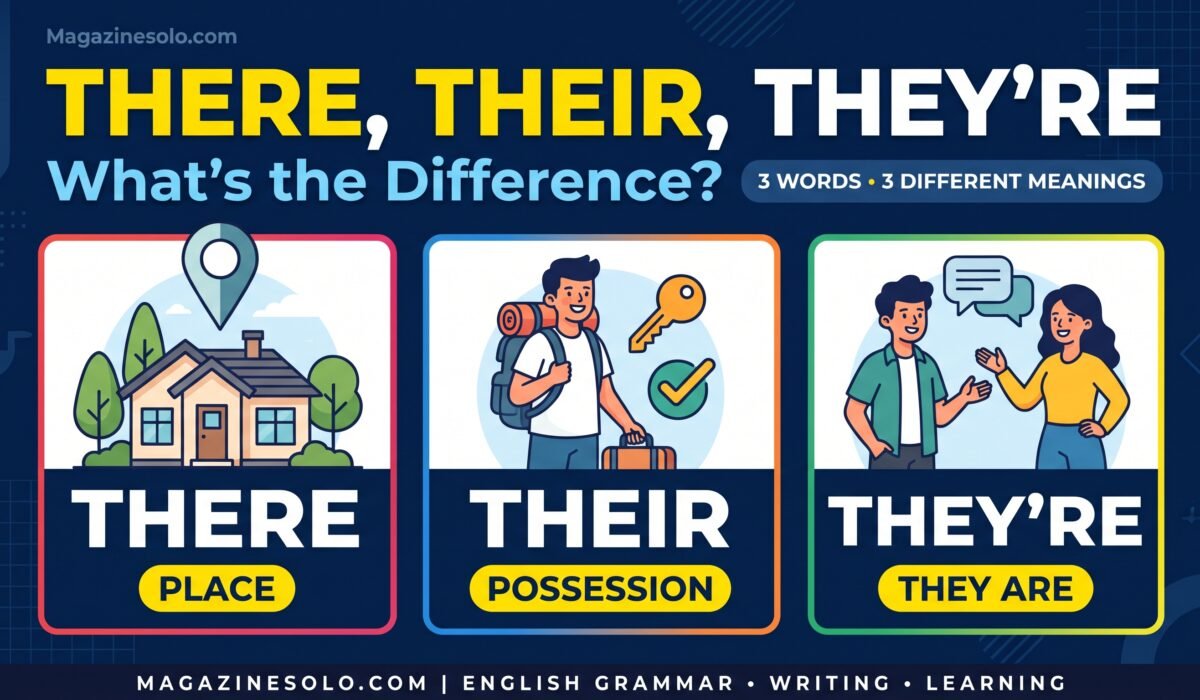
The there their they’re difference is the most tested, most taught, and most failed distinction in written English.
Three words share one sound and do three completely different jobs: there marks place and existence, their marks possession, and they’re means they are and nothing else.
The errors are everywhere because speech gives no warning. The trio sounds identical in every sentence ever spoken, so the choice exists only on the page, where it is judged instantly: in applications, essays, captions, and messages, this is the mistake readers notice first.
This guide teaches the trio as a machine, not a list: the three jobs, the helper word hidden inside each spelling, three tests that run in a fixed order, the family’s two extra members, and the modern updates that keep the rules current.
It joins the word confusion guides at MagazineSolo, next to your vs you’re, the sibling pair that runs on the same apostrophe law.
The Three Jobs Answer
|
Word |
Job |
Hidden helper |
Test |
Signature example |
|---|---|---|---|---|
|
There |
Place; existence |
Here inside it |
Can here replace it, or does it announce existence? |
Over there; there is a problem |
|
Their |
Possession, before a noun |
Heir inside it |
Can our replace it? |
Their car; their names |
|
They’re |
They are |
The apostrophe, a missing a |
Can it expand to they are? |
They’re late |
Merriam-Webster’s entry for there anchors the place and existence senses, Merriam-Webster’s entry for their anchors possession, and Merriam-Webster’s entry for they’re confirms the contraction.
The matrix adds what the entries cannot show side by side: each word carries its reminder inside its own letters, which is why this trio, once seen properly, stays learned.
Read the helpers once and they are hard to unsee. A word about place contains the place word here.
A word about ownership contains heir, the person who inherits what is owned. A word with an apostrophe is the one with letters missing, and the missing letter is the a of are.
The Three Tests, In Order
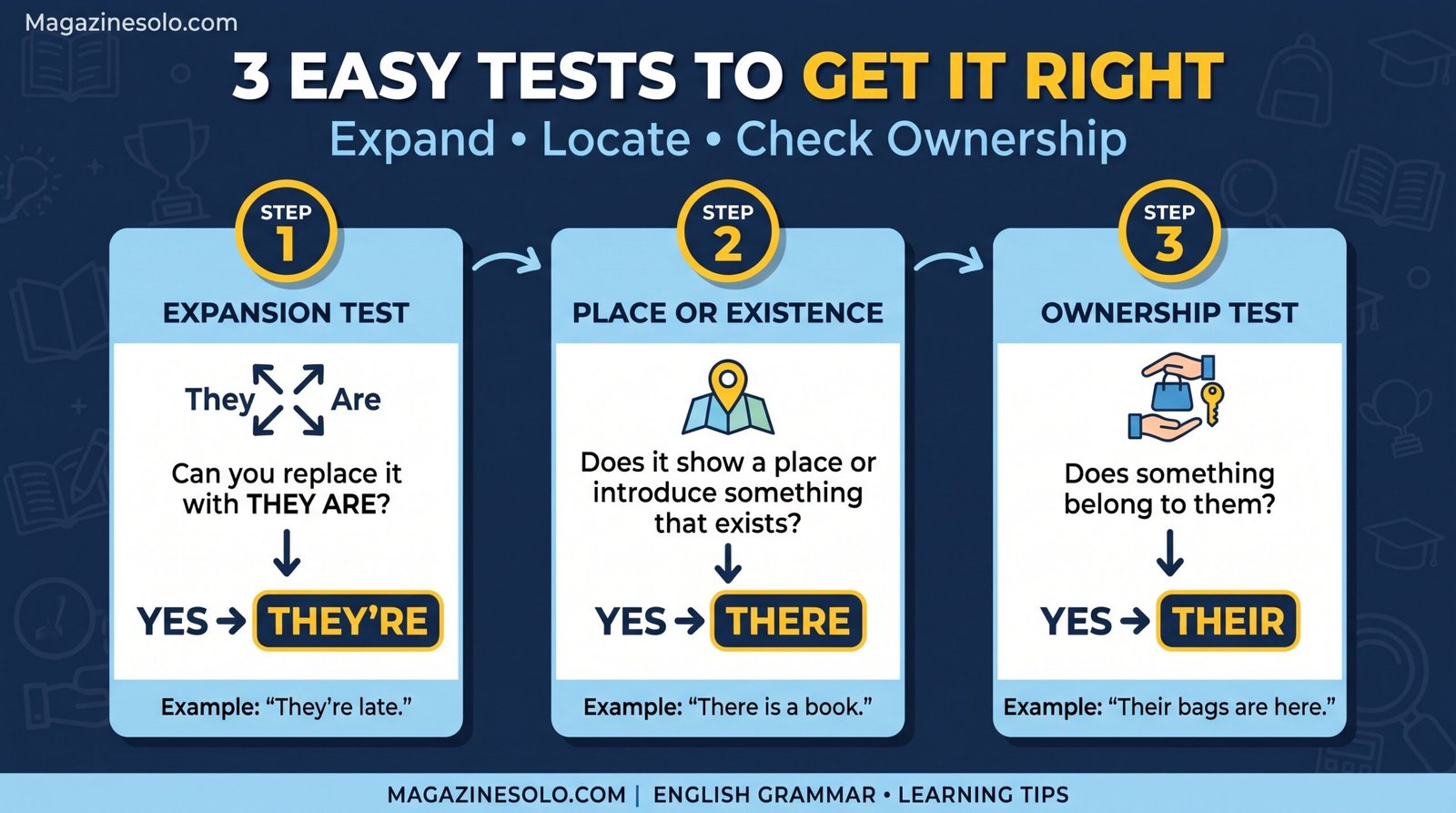
Tests only help if they run in the right sequence, because the first test is the only one with no exceptions at all. Run them in this order every time.
- Test 1: Expand. Try replacing the word with they are, in full. If the sentence survives intact, the word is they’re, and the search ends. They’re means they are and nothing else, ever, so this test cannot misfire.
- Test 2: Place or existence. Ask whether the sentence points at a place (here’s partner: over there, back there, in there) or announces that something exists (there is, there are, there was). Either yes means the word is there.
- Test 3: Ownership. Ask whether the next word belongs to them and whether our can swap into the slot with the sentence keeping its shape (they packed their bags; they packed our bags).
A yes means the word is their, standing before its noun as possessives do.
The set piece runs the whole machine in one line: They’re going to leave their coats over there. Expand the first word (they are going), check the coats’ ownership (their), and confirm the last word points at a place (there).
Three words, three jobs, three tests, zero doubt.
There: Place and Existence
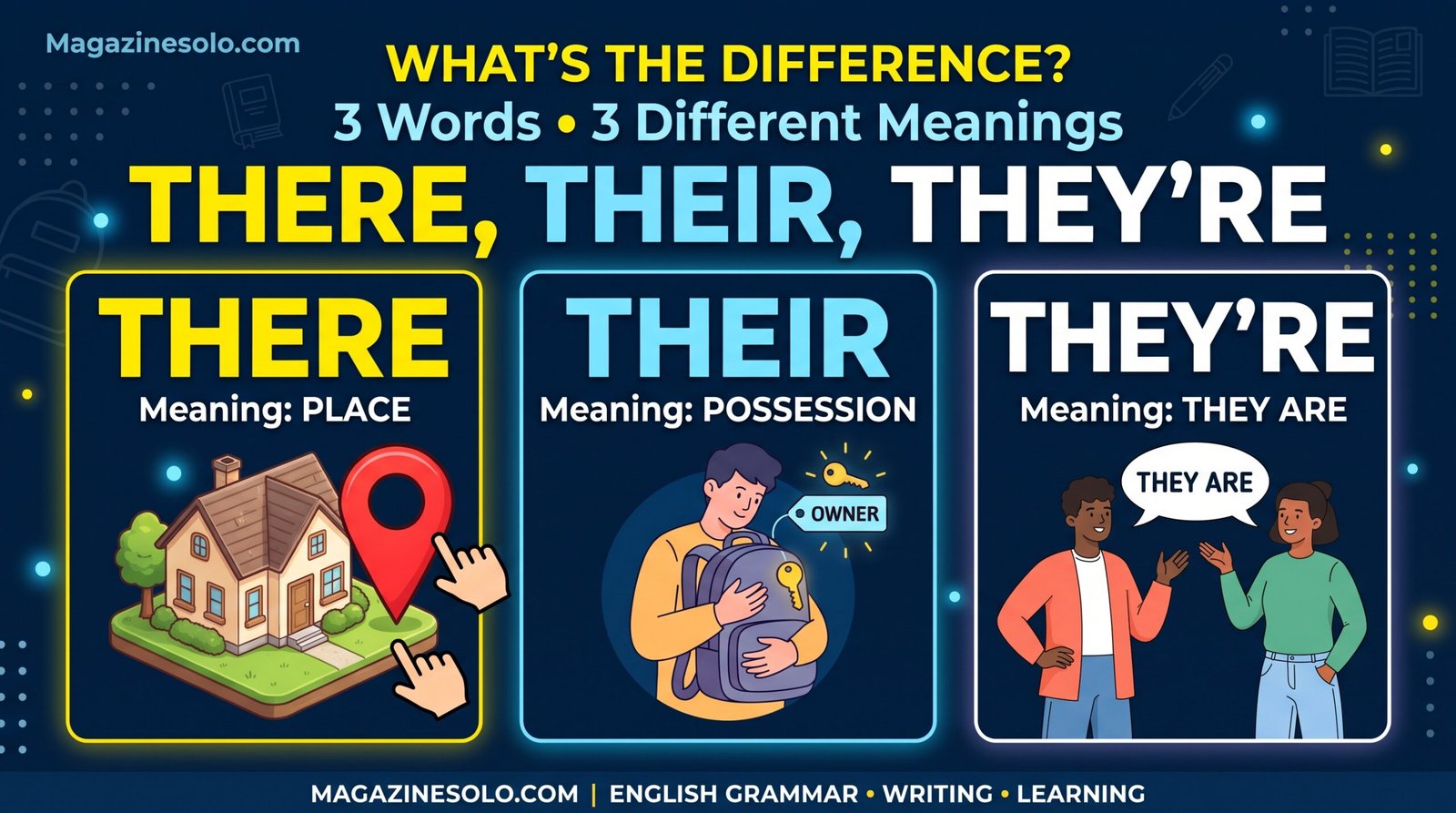
There is the hardest working word of the trio, the most common of the three, and, according to dictionary teaching, the one writers wrongly reach for most. It does two related jobs.
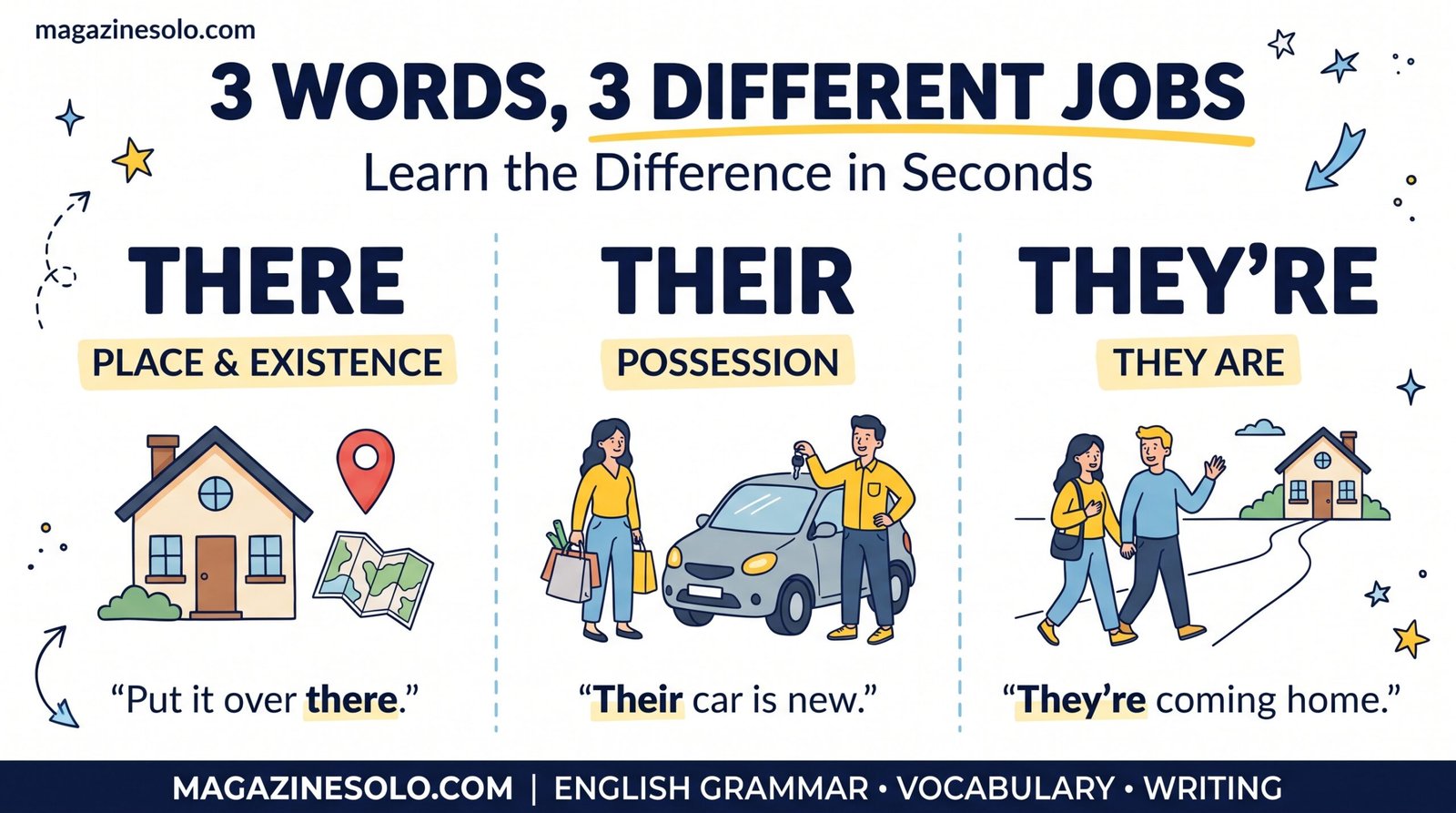
The place job is the original: there means in, at, or to that place, the natural partner and opposite of here. Put it over there.
We will meet there after work. I have never been there, and the Cambridge Dictionary entry for there organizes the same ground for learners around position and existence.
The existence job introduces something: there is a book on the table, there was cheering when the news broke, there are two options left.
Grammars call this existential there: the word is a dummy subject that presents the real subject after the verb, which is why the construction feels backwards the first time it is explained and natural forever after.
The pointing job covers the spoken extras: the exclamation (There! next to the glasses), the handover formula (there you go), the comfort phrase (there, there), and the resignation idiom (been there, done that). All spelled there, all place family.
The Agreement Rule
Existential there carries a rule most trio guides never mention, and it generates its own error class: the verb agrees with the noun after there, not with there itself.
- There is a problem (one problem)
- There are three problems (three problems)
- There was a delay; there were delays
Writing there is three problems is the signature slip of this construction.
The check is mechanical: cover the word there, find the real subject, and let that noun choose the verb. Formal writing runs this check automatically; speech rarely does, which is why the error sounds fine and reads wrong.
There in Formal Openings
Formal writing leans on the existence job to open arguments gracefully: there are several reasons, there is no evidence, there remains one question. The pattern presents information without naming an actor, which suits reports and letters.
Writers should still run the agreement check on every such opening, because formality raises the cost of the slip: there is several reasons in an official letter is exactly the error this guide exists to retire.
Their: Possession Before a Noun
Their is the possessive form of they: belonging to them. Its behavior is fixed and simple: it stands immediately before a noun and answers the question whose. Their car. Their names. Their decision. The students handed in their essays.
For learners, the Cambridge Dictionary entry for their works the same possession ground, with coats and boxes among its model examples.
The ownership is broader than learners expect: the owners need not be people. The dogs wagged their tails. Put the pens back in their boxes. The houses lost their roofs. Anything that can be a plural they can own with their.
Grammars name the role two ways: school grammar often says possessive adjective, modern grammar says possessive determiner.
The label is negotiable; the behavior is not. Their never stands alone at the end of a sentence doing the owning by itself; that is a different word’s job, held for the family section below.
Singular Their: The Modern Update
Here is where many older lessons quietly expire. Their is no longer only plural. When the owner is one person of unknown or unspecified gender, modern standard English uses singular their: everyone took their seat; a student left their book; Alex forgot their keys.
This is not a recent invention or a slang drift. Singular they has centuries of literary history (Chaucer and Shakespeare are the names usually cited), and the major style guides, Chicago and APA among them, now accept it in formal writing.
A writer may still rephrase for a conservative audience, but that is an audience choice, not a correctness rule. Teaching the plural only version as law misinforms every student who will write this decade.
Their Before Gerunds
One formal refinement completes the word: before an ing form used as a noun, edited style prefers the possessive: their leaving early surprised us; their being chosen was announced (the same pattern as your being late, from the sibling pair).
Informal writing often uses them leaving instead, and both are heard daily. The possessive version is the one formal prose reaches for, because the action itself is being treated as the thing owned.
They’re: They Are, Nothing Else
They’re is the simplest word of the trio to define and the most mechanical to check: it is they are, contracted, with the apostrophe standing where the a was removed. They’re coming on vacation. They’re in the cupboard. They’re running out of time.
The word’s whole law fits in one sentence: if they are cannot replace it, it is not they’re.
There are no exceptions, no contexts, and no formal registers where they’re means anything else. That exceptionlessness is why the expansion test runs first in the order: it is the only test in English spelling that returns a verdict with total certainty.
For learners, the Cambridge Dictionary entry for they’re gives the same contraction in its everyday frames, going to London and sitting in cupboards.
Two habits follow.
In short answers, the contraction sits awkwardly (Yes, they’re feels unfinished), so writers spell they are in full. And in formal prose, contractions are often expanded throughout, which removes they’re from the page entirely while leaving there and their to be chosen on their own merits.
The Wider Family: There’s and Theirs
Most guides stop at three words. Real writing does not, because two more forms share the sound and generate half the surviving errors.
There’s is the contraction of there is (there’s a problem) or there has (there’s been a delay). It belongs to the there family with an apostrophe added, and informal writing uses it constantly. Its danger is its twin: theirs.
Theirs is the possessive pronoun: it does their’s job without needing a noun after it. Their house (determiner, noun follows) becomes the house is theirs (pronoun, standing alone).
The choice is theirs. The fault was not theirs. Whenever the owning word ends the phrase, theirs is the form.
And then the ghost: their’s is not a word. Neither is theirs’ or any other apostrophe variant.
The law underneath is the one the LibreTexts chapter on apostrophes states in textbook form and the sibling pair teaches as well: possessive pronouns never take apostrophes, because they are already possessive by nature.
The complete no apostrophe list is short enough to memorize whole: his, hers, its, ours, yours, theirs, whose.
The apostrophe in this family has exactly one job: marking missing letters in contractions (they’re, it’s, there’s, who’s).
Read that way, the punctuation sorts itself: apostrophe means something was removed; no apostrophe means possession. Writers who internalize that single law stop making four famous errors at once.
Three Roads In
The trio’s history explains its trap shape: the three words arrived by three different roads, which is why their spellings share letters without sharing logic.
There is the native: it descends from Old English thaer, the place word English has always had.
Their is an import: in Middle English, the possessive arrived from Old Norse, the language of the Viking settlers, replacing the native form so completely that modern English owns its their to Scandinavia.
They’re is a printers’ artifact: the contraction of they are, written with an apostrophe once the convention arose that missing letters get marked.
One sound in the mouth, three histories on the page. The spellings were never designed as a set, which is precisely why a system, not resemblance, has to choose between them.
All Three in One Sentence
Set pieces are the trio’s finest teaching tool, because one sentence can hold all three jobs and let the tests verify each in turn.
- They’re going to leave their coats over there. They are going (contraction); the coats are theirs (possession); over there (place).
- There is a problem with their car, and they’re fixing it. Existence first; the car belongs to them; they are fixing it.
- The children left their shoes over there, and now they’re looking for them. Possession, place, and contraction in a single small story.
- Their names are on the list over there, and they’re next. Ownership before a noun; the list sits in a place; they are next.
Write five sentences of your own on this pattern and the machine installs itself: production fixes what reading only describes, which every practice based guide in this topic quietly confirms.
The Quick Decision Card
For the wall, the notebook, or the top of a worksheet, the whole trio compresses into three lines.
|
You mean |
Write |
Because |
|---|---|---|
|
A place, or that something exists |
There |
It hides here |
|
Belonging to them, before a noun |
Their |
It hides heir |
|
They are |
They’re |
The apostrophe marks the missing a |
|
Belonging to them, standing alone |
Theirs |
Possessive pronouns take no apostrophe |
|
There is, or there has, contracted |
There’s |
It expands to there is / there has |
The card also quietly teaches the family: the two extra rows are where the errors that survive trio lessons go to hide.
Sentence Surgery
Real errors from the places this trio is photographed failing, corrected, with the test that catches each one.
|
As written |
Corrected |
The test that catches it |
|---|---|---|
|
What are there names? |
What are their names? |
Ownership: names belong to them |
|
I do not like these trousers because there too big |
I do not like these trousers because they’re too big |
Expansion: they are too big |
|
Their going to be late again |
They’re going to be late again |
Expansion: they are going |
|
The decision is their’s to make |
The decision is theirs to make |
Their’s is not a word; the pronoun stands alone |
|
There is three problems with the plan |
There are three problems with the plan |
Agreement: the verb follows problems |
|
Put there coats over their |
Put their coats over there |
Both slots tested: ownership, then place |
|
The house is there’s, not ours |
The house is theirs, not ours |
There’s means there is; theirs owns |
|
Your welcome to use there car |
You’re welcome to use their car |
The sibling pair and this pair in one repair |
One modern caution belongs in this gallery: autocorrect manufactures these errors after correct typing, swapping in the statistically frequent word, usually there.
A sentence can leave the writer’s fingers right and arrive wrong, which is why the proofreading pass below searches spellings rather than trusting memory of having typed them. The same caution applies to dictation and voice typing, which choose spellings by statistics, not by jobs.
Near Misses: One Rule, Four Pairs
The apostrophe law that runs this trio runs three more famous pairs, and they retire together once the law is learned.
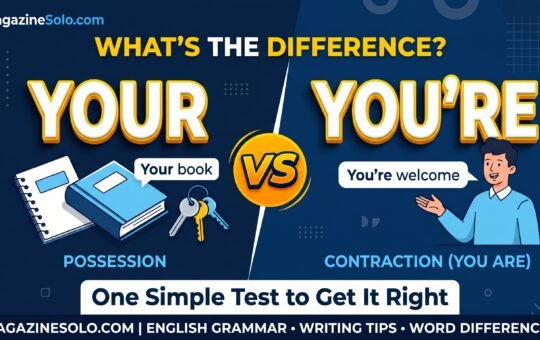
- Your vs you’re: your is possession (your car), you’re is you are. The flagship printed error of that pair is your welcome; the correct form is you’re welcome, because you are welcome expands.
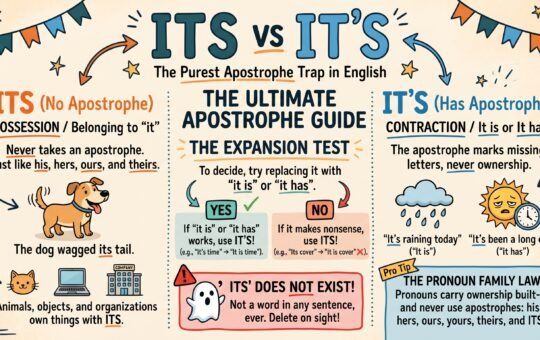
- Its vs it’s: its is possession (the cat licked its paw), it’s is it is or it has. Same machine, smaller cast.
- Who’s vs whose: who’s is who is or who has, whose is possession (whose shoes are these?).
In every pair, the form with the apostrophe expands and the form without it owns. A learner who truly owns that sentence owns four topics at once, which is why the cluster teaches the pairs together rather than as isolated accidents.
Teaching the Trio in One Lesson
Teachers ask how this much system fits one lesson, and the honest answer is that the lesson teaches the machine, not the memorization. Ten minutes on the three jobs with the hidden helpers.
Ten on the test order, run aloud on the set piece. Ten on production: five sentences of their own, each using all three words, checked by a partner with the tests.
The family extensions and updates belong to the second lesson: there’s and theirs once the trio is automatic, agreement and singular their once the class writes formally.
Sequenced this way, nothing is skipped and nothing is rushed, and the wall card carries the whole first lesson at a glance.
The Find and Test Proofreading Pass
For documents where this trio carries a price (applications, essays, reports), a two minute pass removes the risk.
1. Search for the whole family. Find there, their, they’re, there’s, and theirs, and list every hit. The family is small enough to audit completely in most documents.
2. Interrogate every there first. Error runs toward the commonest word, so ask of each there: is this truly place or existence? If possession or they are is hiding there, it is the classic error.
3. Run the expansion test on every apostrophe form. They’re and there’s must expand cleanly (they are; there is or there has). Any that cannot is wrong.
4. Check every their for its noun. Their must stand before a noun it owns. A their with no noun after it usually wants to be theirs.
5. Check existential agreement. At every there is or there was, read to the real subject and confirm the verb matches its number.
The Word Confusion Cluster
This trio belongs to a family of sound alike traps, each settled by its own test. Its nearest relatives run on the same apostrophe law, and the rest of the cluster makes good next reads.
- your vs you’re: the sibling pair where the apostrophe law first appears (your welcome is its flagship error)
- than vs then difference: compared to what, or when: the two questions procedure
- affect vs effect: the verb and noun pair settled by RAVEN, with its honest exceptions
- ally vs allie: the friend and partner against the girl’s name, one sound apart
- atleast or at least: two words or one, decided by what the sentence is measuring
- per say or per se: the Latin phrase hiding inside an English sound alike
- grately vs greatly: the grateful word against the grating sound alike
- half day or half-day: the hyphen question that changes what a day off means
The method transfers intact: name the job each word does, attach a test to each job, and let the sentence grade itself.
Frequently Asked Questions
What is the difference between there, their, and they’re?
Three jobs, one sound. There marks place or existence (over there; there is a problem). Their marks possession and stands before a noun (their car). They’re is a contraction of they are (they’re late). Test in order: expand, then place or existence, then ownership.
How can I remember there, their, and they’re?
Look inside the spellings. There hides the word here, and both are place words.
Their hides the word heir, and an heir inherits possessions. They’re carries an apostrophe where the a of are went missing. Here for place, heir for ownership, apostrophe for missing letters.
What does there mean?
Two related jobs: place (in, at, or to that place: put it over there; we went there last year) and existence, introducing something (there is a problem; there was cheering).
In the existence job it is a dummy subject and the verb agrees with the noun that follows it.
What does their mean?
Belonging to them: the possessive form of they, used before a noun (their house, their coats, their boxes). It answers the question whose. Their never takes an apostrophe, and it can belong to people, animals, or things (the pens go back in their boxes).
What does they’re mean?
They are, and nothing else.
They’re is a contraction, and the apostrophe marks the missing a. The expansion test is exceptionless: if replacing the word with they are keeps the sentence correct, they’re is right; if it breaks the sentence, one of the other two words belongs there.
Is it there, their, or they’re for belonging?
Their. Belonging and ownership always take their when the owner is they: their car, their decision, their names. Swap test: replace it with our; if the sentence keeps the same shape (they packed their bags; they packed our bags), their is correct.
Why does there have two meanings?
Because place and existence are historically the same pointing gesture: there points at a spot, and there is points at a fact.
English grammars call the existence use existential there, a dummy subject that introduces the real subject after the verb (there are three problems). Both uses are spelled there.
Is there is correct with plural nouns?
No: the verb agrees with the noun after there.
There is a problem (singular), there are problems (plural), there was cheering, there were delays. Writing there is three problems is the agreement error this construction invites, and it is checked by reading past there to the real subject.
What is the difference between their and theirs?
Their is a possessive determiner and must be followed by a noun: their house.
Theirs is a possessive pronoun and stands alone, replacing the whole phrase: the house is theirs; the decision is theirs. You never write theirs house, and you never write their at the end of a sentence doing that job.
Is their’s a word?
No. There is no such word as their’s in standard English.
Possessive pronouns never take apostrophes: his, hers, its, ours, yours, theirs, whose are already possessive by nature. The apostrophe in this family belongs only to contractions (they’re, it’s, there’s), where it marks missing letters.
What does there’s mean?
There’s is a contraction of there is (there’s a problem) or there has (there’s been a delay).
It is a fourth form hiding beside the trio, and it collides with theirs in fast writing: there’s (there is) announces existence, theirs (belonging to them) announces ownership. Sound cannot separate them; the expansion test can.
Are there, their, and they’re homophones?
Yes, in standard pronunciation all three sound identical, which is why the confusion lives entirely in writing. They do three completely different jobs, and naming the job (place or existence, ownership, they are) is what makes the choice automatic.
Which of the three is used most often, and misused most?
There is the most common of the three, and dictionary teaching notes that the most frequent error runs in its direction: writers reach for there when their or they’re belongs (What are there names? is the classic printed error).
Familiarity makes the common word the default, and the default is often wrong.
Can their be used for one person?
Yes, in modern standard English. Singular their (everyone took their seat; Alex left their keys) is accepted by major style guides including Chicago and APA style, and singular they has centuries of literary history behind it. Older teaching that called it wrong is outdated.
Is ‘everyone took their seat’ correct?
Yes.
Everyone is grammatically singular but notionally plural, and their is the accepted possessive: everyone took their seat now appears in the shared guidance of major style manuals. The older alternatives (his seat, his or her seat) read as dated or clumsy in most current writing.
Where do there, their, and they’re come from?
Three roads: there descends from Old English thaer, the native place word. Their is a borrowing from Old Norse that replaced the native possessive in Middle English. They’re is the contraction of they are, its apostrophe a printers’ convention for missing letters.
What are some sentences using all three words?
The set piece: They’re going to leave their coats over there. More: There is a problem with their car, and they’re fixing it.
The children left their shoes over there, and now they’re looking for them. Each word does its own job, and the three tests verify each one.
How do you use there in a sentence?
For place: we will meet there after work; I’ve never been there. For existence: there is a stain on your shirt; there are two options. If here could replace it (place) or the sentence announces that something exists, there is correct.
How do you use their in a sentence?
Before a noun that belongs to them: Hannah and Jan put on their coats; the students handed in their essays.
If whose answers the sentence and our can swap in without breaking the shape, their is correct. Remember it works for things too: their boxes, their hinges.
How do you use they’re in a sentence?
Wherever they are fits: they’re coming on vacation; they’re in the cupboard; they’re running out of time. Expand before you commit: write they are in full in your head, and if the sentence stands, the contraction is safe.
Why does spellcheck not catch there, their, they’re errors?
Because all three are correctly spelled words, and a checker validates letters, not jobs.
Autocorrect makes it worse by swapping in the statistically common word after you typed the right one. Only the job tests catch this family, which is why it tops lists of the most common written errors.
What are the most common there, their, they’re mistakes?
The recurring set: there for their (What are there names?); there for they’re (there too big); their for they’re (their going home); their’s with an apostrophe; and there is with plural nouns. Comment sections and first drafts everywhere supply fresh examples daily.
Is the apostrophe in they’re about possession?
No, and that misreading powers half the confusion.
In pronouns, the apostrophe never shows possession; it marks missing letters in a contraction. Possession in this family is shown by the words that have no apostrophe at all: their, theirs, its, his, hers, ours, yours, whose.
What is the our swap test for their?
Replace the doubtful word with our (or your, my, his, her).
Possessive determiners share one slot in the sentence, so if the swap keeps the sentence grammatical, the word you need is their: they packed their bags passes, because they packed our bags has the same shape.
What is the expansion test for they’re?
Replace they’re with they are, in full, and read the sentence. If it survives intact, the contraction is correct; if it collapses, the word is there or their. The test has no exceptions, because they’re means they are and nothing else, ever.
Does their come before a gerund, as in their leaving?
In formal style, yes: the possessive is preferred before a gerund (their leaving early surprised us; I appreciate your coming, same pattern).
Informal writing often uses them leaving instead. Both are heard; edited prose generally chooses their before the ing form when the action is the subject.
What does ‘there, there’ mean?
It is a comfort phrase, said while soothing someone: there, there, it’s all right. It uses the place word as a calming pat and belongs to spoken English. Its doubled form is a fixed idiom; neither their nor they’re can stand in it.
Is it ‘there names are’ or ‘their names are’?
Their names are. Names belong to people, so the possessive determiner is required. There names are is such a common error that learner dictionaries print it as the warning example. Ownership before a noun is always their.
Can animals and things take their?
Yes. Their covers any plural owner, not only people: the dogs wagged their tails; put the pens back in their boxes; the houses lost their roofs. The test is belonging to them, where them can be any plural they, human or not.
What is existential there in grammar?
The use of there as a dummy subject that introduces the real subject after the verb: there is a book on the table (the book is the real subject).
It exists to delay and present new information. Its practical consequence is agreement: the verb matches the noun after it, not the word there.
How do tests and exams ask about there, their, they’re?
As gap fills and corrections in the signature contexts: coats left over a place (there), possessions (their coats), and actions in progress (they’re looking). The job order answers all three in seconds: expand, then place or existence, then ownership.
Is their an adjective or a pronoun?
Both descriptions circulate: school grammar often calls their a possessive adjective, while modern grammar calls it a possessive determiner, a pronoun form that determines a noun.
Either way its behavior is fixed: it belongs to the pronoun family and stands immediately before the noun it owns.
What is the difference between there and there’s?
There alone points or introduces (over there; there is a problem written in full). There’s is the contracted form of there is or there has, used in speech and informal writing.
Formal prose often writes there is in full. Watch the collision with theirs: there’s has an apostrophe and missing letters; theirs has an s and ownership.
Can they’re be used at the end of a sentence?
Rarely, and it reads awkwardly, because they are wants something after it (they’re here is fine; yes, they’re is not natural alone). Writers usually write they are in full in short answers. The contraction thrives mid sentence, before verbs and adjectives.
What is the difference between their and they’re in ‘their going’ sentences?
Their going can be possessive plus gerund in formal style (their going surprised us, the going belongs to them as an event) or an error for they’re going (they are going) in ordinary narrative.
Context decides: if the sentence means they are going right now, write they’re going.
Why do native speakers mix up there, their, and they’re?
Because the words are identical in speech, extremely frequent, and learned by ear long before they are analyzed in writing; learner guides note that native speakers fill newspaper comment sections with these errors.
Frequency plus silence in speech equals errors in writing, for natives and learners alike.
Is it ‘there too big’ or ‘they’re too big’ for trousers?
They’re too big: the trousers are too big, so the contraction of they are is required. There too big is a printed error in learner materials precisely because it is so common. Expand the sentence and the answer appears: they are too big.
What does ‘there you go’ mean?
A spoken formula with several tones: handing something over (there you go), confirming a point (there you go, exactly), or mild resignation.
It uses the place word there in all its tones. The family also includes there you are and been there, done that, all spelled with there.
How can I check my writing for these errors?
Run a find pass for all three spellings plus there’s and theirs. At each hit, name the job out loud: place or existence (there), ownership before a noun (their), they are (they’re).
Any hit whose job and spelling disagree is the error. The pass takes a minute and catches the whole family.
Does their have a plural?
Their is already the plural possessive form of they, and it also serves the singular they.
It does not change form for number: their book (one owner using they), their books, their shared house. The form that changes the job is theirs, which stands alone without a noun after it.
What are the other pairs this one rule fixes?
Your and you’re, its and it’s, and who’s and whose run on the same machine: the apostrophe form is always a contraction (you are, it is, who is), and the plain form is always the possessive (your, its, whose).
Learn the apostrophe rule once and four famous confusions retire together.
Is there a British vs American difference for there, their, they’re?
No. The spellings, meanings, and tests are identical in both varieties, and the error statistics are shared. Singular their is accepted in both. The only regional flavor is in example sentences, not in the rules.
Conclusion
The there their they’re difference is three jobs wearing one sound: there for place and existence, their for possession before a noun, they’re for they are and nothing else.
The spellings themselves carry the reminders: here inside there, heir inside their, and an apostrophe where a letter went missing.
Run the tests in order, expand first, and the trio stops being a coin flip. It becomes a habit that checks itself every single time the three words appear in anything you write.
Add the family’s edges and the system is complete: there’s contracts there is, theirs stands alone, their’s does not exist, and singular their is simply how modern English writes.
Work through the sibling pairs next: the same apostrophe law that settles this trio retires your and you’re, its and it’s, and who’s and whose in a single sitting.

Dilawar Mughal is an SEO expert with 8 years of hands-on experience helping websites grow their organic traffic, rankings, and revenue. He specializes in content-driven SEO, local SEO, and Pinterest SEO, and builds practical, results-focused strategies for businesses and publishers.

2 Comments