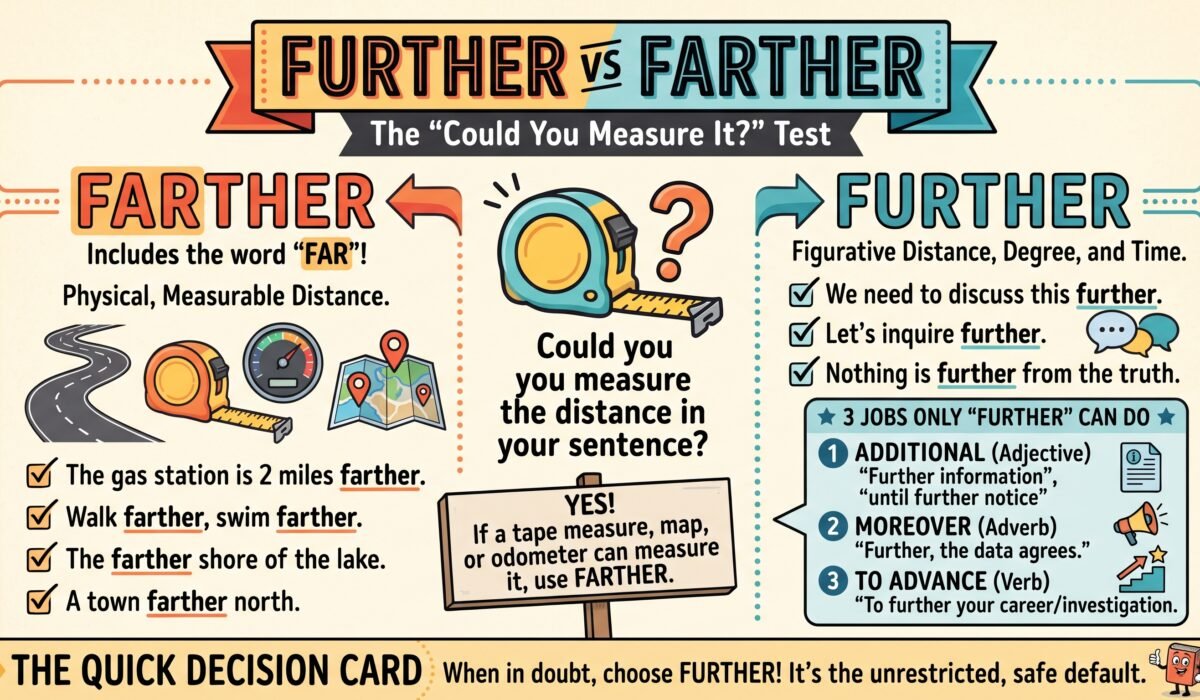
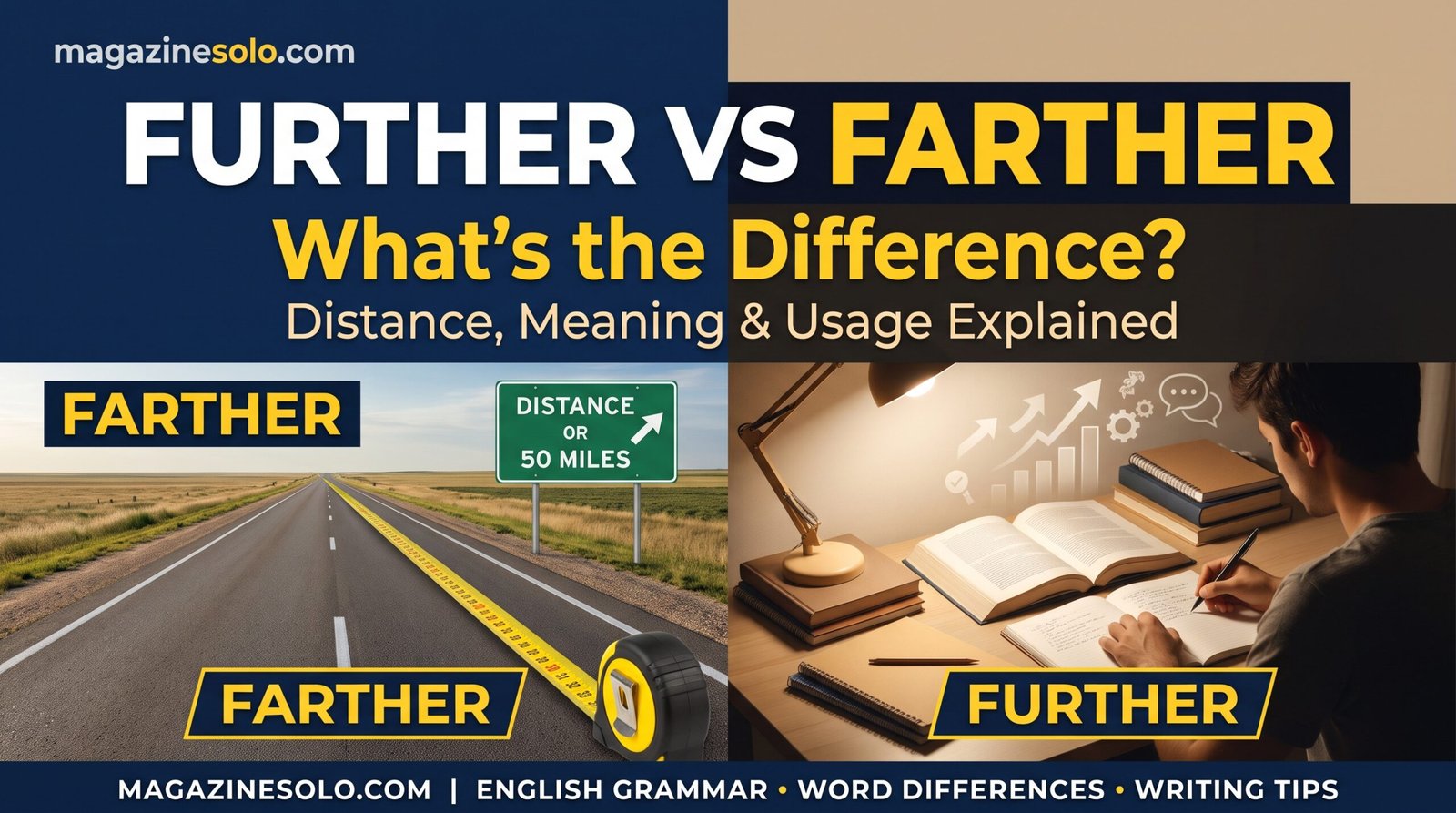
The further vs farther difference can be settled with one question: could you measure it? Farther reports physical, measurable distance, and further covers everything else, including three jobs farther cannot do at all.
The gas station is two miles farther down the road: an odometer can settle that sentence. We need to discuss this further: no instrument measures a discussion, and the word means something closer to more deeply.
Further then works three extra shifts. It is the adjective meaning additional (further information), the sentence adverb meaning moreover, and the only one of the pair that can be a verb: to further a career or an investigation.
One honest warning before the rules harden: the strict split between these words is a convention taught by edited American English, not an ancient law of the language, and the last sections of this article show exactly where it bends.
But conventions are what exams, editors, and style guides grade on, so the article teaches the convention first, at full strength, and then shows its borders honestly.
A word about what counts as evidence here. Every verdict on this page traces to a dictionary entry, a named style authority, or a test you can rerun on your own sentence.
Where the authorities disagree, and on this pair they genuinely do, both positions are printed with their owners named.
A rule page that hides a live disagreement teaches its readers to distrust it the first time they meet a British novel or a relaxed style guide.
Further vs Farther at a Glance
| The Job | The Form | Example |
|---|---|---|
| Measurable distance | farther | The exit is farther than we thought |
| Degree or extent | further | Do not press the matter further |
| Additional | further only | Further information is available |
| Moreover, in addition | further only | Further, the data agree |
| Advance (verb) | further only | She furthered the investigation |
Read the table as a map of territories. Farther owns one row; further owns four, which is why further is statistically the word you will need more often, and why it is the safe default when a sentence refuses to declare itself.
The Tape Measure Test
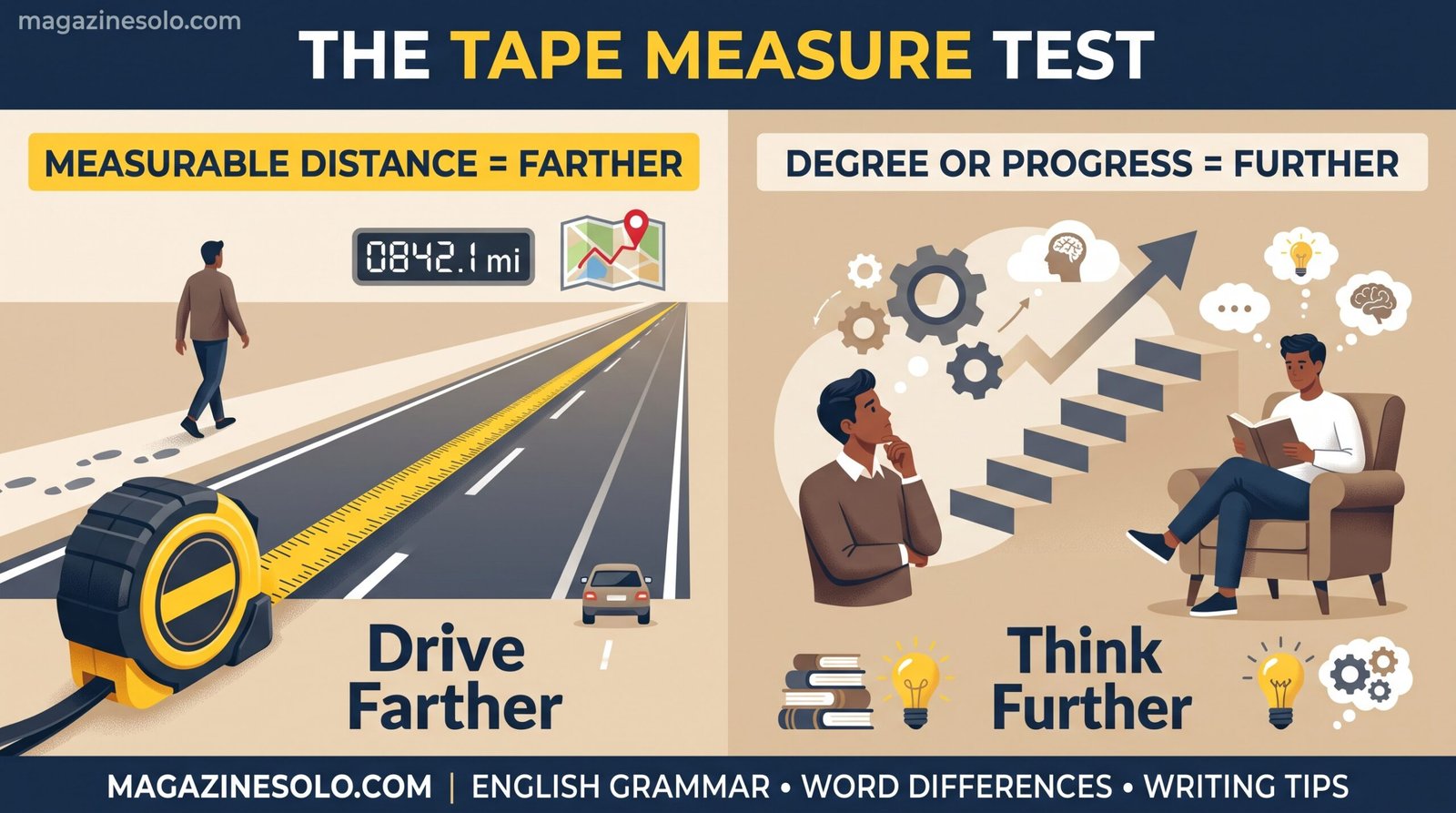
The test is literal: imagine the instrument. If a tape measure, an odometer, a map, or a pedometer could in principle measure the distance in your sentence, the edited choice is farther.
Drive farther, walk farther, swim farther, the farther shore of the lake, a town farther north. Each sentence reports space that exists independently of anyone’s opinion, which is precisely what measuring instruments are for.
If no instrument could measure it, the word is further: think further, argue further, inquire further, a matter taken further. Degree, progress, and extent are distances only by metaphor, and metaphors belong to further.
Merriam-Webster’s entry for farther anchors the distance end of the pair in its dictionary entry, and the Cambridge Dictionary entry for farther records the same core sense for learners, which is why the test survives translation into every classroom version of the rule.
The Substitution Shortcut
When the tape measure image does not settle it, try swapping. Replace the word with more distant: if the sentence survives, farther is available.
Replace it with additional, moreover, or to advance: if one of those fits, the answer is further, and farther is not merely worse, it is impossible.
The shortcut matters because it runs on grammar, not vibes. “More distant information” collapses on contact; “additional information” is the phrase English actually uses, so the sentence was never a distance sentence at all.
The Doubt Default
Some sentences genuinely sit on the border, and usage guides from Grammar Girl onward give the same counsel: when in doubt, choose further.
The reason is asymmetry. Farther is the restricted form: distance only, never a verb, never additional, never moreover.
Further is unrestricted, and even its use for physical distance is recorded by the dictionaries, so an unnecessary further passes quietly while a misplaced farther (farther information, farther the cause) fails loudly.
The Three Jobs Only Further Can Do
Additional: The Adjective Job
Further information, further details, further questions, further instructions, further notice. In each phrase the word means more of the same, added, and addition is not distance in any sense a tape measure respects.
This is the highest frequency job of the pair in professional writing, because offices run on additions: further to our call, pending further instructions, no further comment. Every one of them is further, and farther in any of them marks the writer instantly.
Moreover: The Sentence Adverb Job
At the head of a sentence, further adds a point: “Further, the committee recommends a pause.” Its stronger cousin furthermore does the same job with more weight and does nothing else.
Farther cannot open a sentence this way; “Farther, the committee recommends” reads as a direction to travel. If your word introduces an additional argument, the choice is already made.
Advance: The Verb Job
To further a career, a cause, an investigation, or a group’s interests is to help it progress. Merriam-Webster’s entry for further lists this verb sense as a core meaning of further, and it descends from the word’s oldest family: forth, forward, onward.
Farther has never been a verb in English. This is the one absolute in the entire topic, stronger than the distance convention itself: if the sentence needs a verb, further is the only candidate, full stop.
One trap hides inside the verb job: further means advance a thing, not increase a distance. You cannot “further the distance” between two cities; you extend it, lengthen it, or widen the gap. The verb test points to further only in the advance sense.
The Ambiguity Zone: When the Reading Decides
Three territories refuse the clean split, and honest teaching names them instead of pretending the test is magic.
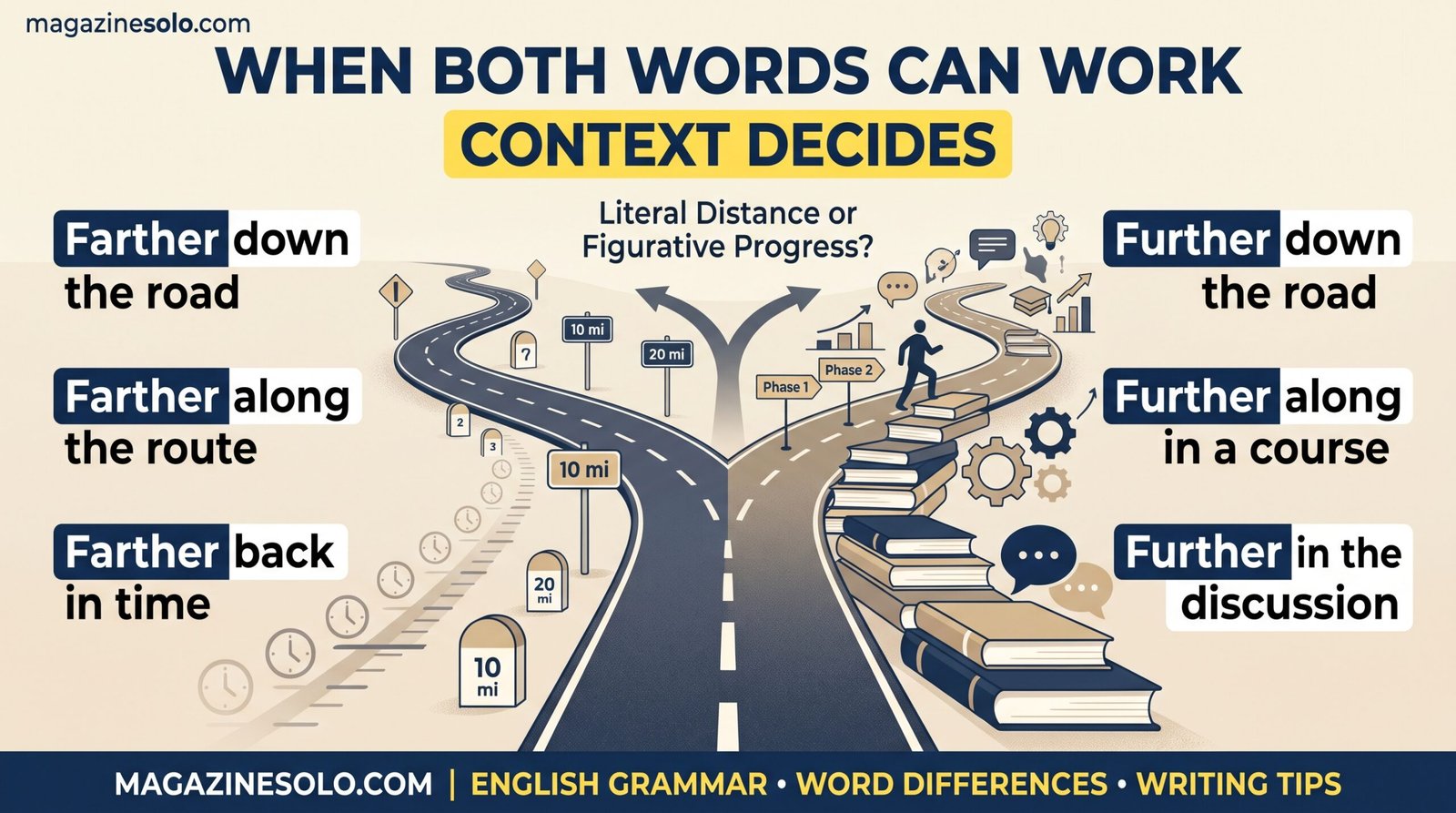
Down the road splits by reading: the literal road takes farther (the barn is farther down the road), the metaphorical future takes further (we will cross that bridge further down the road).
Dictionary.com’s farther vs further explainer treats the phrase the same way: the sentence’s meaning, not the phrase’s shape, decides.
Time behaves like a road you cannot walk. A span read as timeline distance can take farther (no farther back than 1900); planning and development extent takes further (we cannot schedule further than Friday).
Both are defensible, and editors pick by the metaphor the sentence is actually running.
Along the route mixes position and progress: a house farther along the road is a measurement; a student further along in the course is a stage.
Major guides accept both forms for the house, which tells you the border is porous in real prose, whatever the rule cards say.
Into the depths splits the same way. A diver descending farther into the water column is measured in meters; an inquiry going further into the evidence is measured in understanding.
Fiction writers exploit the pair constantly, because a quest can travel both distances at once, and choosing the form tells the reader which journey the sentence is on.
The mature skill in the ambiguity zone is not finding the one true answer; there often is not one.
It is noticing that a choice exists, picking the form that matches the metaphor you intend, and staying consistent when the same phrase returns later in the document.
Fixed Phrases: The Verdict Bank
Phrase queries are half the real demand for this pair, and the verdicts are frozen. Learn the bank once and a whole class of hesitation disappears.
| Phrase | Verdict | Why |
|---|---|---|
| Without further ado | further | Fixed phrase; ceremony, not distance |
| Until further notice | further | An additional announcement ends it |
| Further education | further | Additional study; also the UK sector name |
| Further afield | further | The idiom of ranging widely; farther afield is the classic error |
| Look no further | further | The search of attention ends here |
| Nothing could be further from the truth | further | Truth has no measurable distance |
| Take it further | further | Escalate or develop the matter |
| Any further questions | further | Additional questions; meeting formula |
| Further your career | further | The verb job; farther is never a verb |
Two of these deserve a sentence each. Further afield is the phrase where the distance logic betrays writers: the ranging is real travel in the oldest examples, yet the idiom crystallized with further, and edited prose treats farther afield as a mistake.
Idioms outrank logic; that is what makes them idioms.
Until further notice shows the adjective job doing institutional work: the notice that ends the state of affairs will be an additional notice.
That additional sense stands at the head of the Cambridge Dictionary entry for further, which is why the phrase could never have settled on farther.
Farthest and Furthest: The Superlative Split
The superlatives inherit the comparative’s territories. Farthest is the physical extreme: the farthest planet, the farthest point on the trail, the farthest anyone has thrown.
Furthest is the figurative extreme: the furthest thing from my mind, the furthest a rumor has traveled, the furthest the committee has ever gone.
Writers who keep the comparative split get the superlatives free, because the same tape measure question decides them. Writers who use further for everything usually use furthest for everything too, and British practice largely agrees with them.
The Split Is Younger Than You Think: 1906 and Fowler’s Miss
Here is the part of the story most guides skip, and it changes how the rule should be held. Further is the older word: Old English furthor, the comparative of forth.
Farther arrived in the 14th century as a variant of further, not as a child of the word far.
Merriam-Webster’s entry for further states the relationship plainly, and it matters because the most repeated sentence in this topic, “farther comes from far,” is false. The far inside farther is a spelling coincidence that makes a fine memory hook and a false etymology.
Anyone teaching it as derivation is copying, not checking.
For centuries the two spellings overlapped freely for distance. Merriam-Webster’s Dictionary of English Usage traces the strict separation to a usage guide of 1906, the first to urge writers to assign physical distance to farther and everything else to further.
The convention is younger than the airplane.
Fowler’s Modern English Usage in 1926 then predicted the experiment would fail and further would swallow farther altogether.
A century on, the prediction has not come true: edited American English kept farther alive exactly where the 1906 guide planted it, in measurable distance, and the AP Stylebook still enforces the border there.
So the honest summary is double. As history, the words are interchangeable for distance, and the dictionaries say so. As edited practice, the split is real, taught, and graded.
A good writer knows both sentences and chooses by audience, which is a stronger position than either the slogan or the shrug.
The same discipline, one distinction cleanly drawn and honestly bounded, is the working method of our guide to the there, their, they’re difference and of our guide to the your vs you’re difference.
The contraction pairs obey it too, as our guide to the its vs it’s difference shows: find the test that decides, and know where the test runs out.
US Edited Practice vs the UK Default
Cross the Atlantic and the problem mostly dissolves. British English uses further for both territories, physical and figurative, and farther is the marked, less frequent choice.
That is why British edited prose can print “further down the road” for a literal road without a single reader blinking, and why UK institutions froze the word into names like further education.
The American convention is a house rule of American editing, not a law of English.
For a US writer the practical consequences are three. Exams and test makers build items on the split. Newsrooms following AP enforce it. And American readers of formal prose notice farther information as an error while barely registering further for a road.
Write for your audience’s convention, and say which one you are following when it matters.
The Quick Decision Card
For the sentence in front of you, ask in this order and stop at the first answer:
- Does the word need to be a verb? Further. (further the inquiry)
- Does it mean additional or moreover? Further. (further information; further, note that)
- Could a tape measure or odometer measure the distance? Farther. (two miles farther)
- Is it degree, progress, or extent? Further. (discuss it further)
- Is it a fixed phrase? Check the verdict bank; nearly all are further.
- Still undecided? Further, the unrestricted default.
Six questions, under five seconds, and the pair is settled. The card works because it checks the absolute jobs first (verb, additional) before the conventional one (distance), so the cases that cannot be wrong are decided before the cases that are matters of practice.
Farther in Travel and Sport Writing
Distance writing is where farther does its most visible professional work, because routes, legs, and records are nothing but measurements.
Race reports live on it: runners cover the final mile farther from the pack, a record throw lands farther than the old mark, a hiker’s farthest point of the day gets logged in miles.
In each case a number exists or could exist, which is the tape measure test passing in its natural habitat.
Travel prose uses the same forms for structure: the farther town makes the better overnight stop, each village sits farther along the valley, and the journey’s farthest reach becomes the story’s turning point.
When a travel writer reaches for further in these sentences, nothing breaks, but the measurement flavor of farther is the professional finish American editors expect.
Contrast the same writer’s process sentences: planning went no further, the road took us further into debt, the guidebook ventures no further into the dispute. Extent and degree, all further, often within a paragraph of the distance sentences.
Skilled prose switches forms without noticing; the card above is how the switch becomes deliberate.
Further in Professional and Academic Writing
Workplaces and universities run on the further family, because their core actions are extension, addition, and advancement rather than travel.
Business English freezes the forms into formulas: further to our conversation, further action required, no further questions, pending further review.
Each is the additional or extent sense wearing a suit, and each would collapse with farther, which is why a single farther in a client email reads as a louder error than the same slip in a novel.
Academic writing adds the verb and the research phrases: studies further the understanding of a field, papers call for further research, theses take an argument further.
The scholarly verbs of progress are further’s oldest territory, descended from forth and forward, and they carry a faint sense of the whole enterprise moving onward.
Reports then mix the territories on one page: a warehouse two miles farther from the port (measurement) requires further investment (addition) before the committee discusses it further (extent).
Professional competence is not memorizing a slogan; it is switching territories sentence by sentence without a stumble, exactly the skill the decision card rehearses.
Examiners know this, which is why test items cluster on the professional phrases. A candidate who knows that information, notice, education, and careers all belong to further has already banked the easiest marks the topic offers, before a single distance sentence appears.
Common Slips, Corrected
Farther information is available on request. The classic. Information is additional, not distant: further information. This single correction is the highest value edit in the topic.
We will farther the investigation. Impossible English. Verbs take further only: we will further the investigation. If a form cannot be a verb, the sentence has already chosen.
Search farther afield for a better price. The idiom is further afield, however logical the distance reading feels. Frozen phrases keep their historical forms.
Nothing could be farther from my mind. The set phrase runs on further: nothing could be further from my mind. The farther variant exists in the record for the truth version of the phrase, but edited prose prints further in both.
To further the distance between the shelves. The verb trap. Further as a verb means advance, not lengthen: to widen the distance, or to move the shelves farther apart, which also demonstrates the correct adverb doing honest distance work.
A Proofreading Pass: Marking the Pair in a Real Draft
Editors do not read for this pair word by word; they run three sweeps, and the sweeps are worth stealing for your own drafts.
Sweep one: hunt the absolutes. Search the document for information, notice, ado, afield, education, and every verb use. Any farther standing next to them is a certain error, corrected without a moment’s thought. This sweep alone removes the mistakes readers actually notice.
Sweep two: mark the measurements. Find every sentence with a number, a unit, or a route: miles, meters, exits, shores, points on a map.
Here the convention applies in the other direction, farther for the measured cases, and each one gets the tape measure question individually rather than a global replace, because a road sentence and a road metaphor can sit in the same paragraph.
Sweep three: read the borderline cases aloud. Down the road, along, back in time, into the depths. Decide the intended metaphor once, mark the choice on the style sheet, and make every later occurrence match it.
Consistency inside a document outranks any single verdict, because readers experience wobbling forms as carelessness even when each form is defensible alone.
Three sweeps, perhaps ninety seconds on a long article, and the pair stops being a source of late night doubt. That is the unglamorous reality behind clean prose: not genius, a checklist.
Practice: Ten Sentences, Tested
Choose further or farther, then check which territory the sentence lives in. The test is the skill; the answers are only receipts.
1. The trailhead is two miles ___ than the ranger station. Answer: farther. Odometer distance between two places; the tape measure test, clean case.
2. ___ details will be sent after registration closes. Answer: Further. Additional details; the adjective job, farther impossible.
3. She moved to Montana to ___ her research on wolves. Answer: further. A verb is required, and only further can be one.
4. We cannot commit ___ than the end of the quarter. Answer: further. Planning extent, the figurative reading of a timeline.
5. Swim out to the ___ buoy, then turn back. Answer: farther. Physical position in the water, measurable from shore.
6. ___, the panel found the method unreliable. Answer: Further. The moreover job at the head of a sentence.
7. Do not look ___ than the approved vendor list. Answer: further. The look no further family: search of consideration, not of space.
8. The comet is the ___ object ever photographed. Answer: farthest. Superlative of physical distance across the whole set.
9. That outcome is the ___ thing from what we planned. Answer: Further inside the phrase: the furthest thing from what we planned, in full superlative form. Figurative extent takes the further family at every degree.
10. Prices may fall ___ before they recover, the report warned, as the storm pushed ___ inland. Answer: further, then farther. One sentence, both territories: degree of prices takes further; the storm’s measurable path inland takes farther.
Frequently Asked Questions
What is the difference between further and farther?
Farther is for physical, measurable distance: the station is farther down the road.
Further covers figurative distance and degree, plus three jobs farther cannot do: additional (further information), moreover (further, note that), and the verb advance (further your career).
When do you use farther?
Use farther when the sentence reports distance you could measure in miles, meters, or steps: we drove farther than planned; the cabin sits farther from the lake.
In edited American English this is the convention the style guides keep; AP Stylebook follows it.
When do you use further?
Use further for degree and extent (look into it further), for addition (further information is available), as a sentence adverb meaning moreover, and as a verb meaning to advance (further the investigation).
Farther can do none of these jobs.
Is it further down the road or farther down the road?
Both occur, and the reading decides. A literal road and a literal distance: farther down the road is the edited choice.
A metaphorical future (we will deal with that further down the road): further. When the phrase is genuinely ambiguous, either form is defensible.
Can further and farther be used interchangeably?
For distance senses, largely yes: Merriam-Webster’s usage guide records the two as interchangeable for distance through their history, and further is widely used for physical distance too.
They are not interchangeable in further’s three exclusive jobs: additional, moreover, and the verb. Farther never replaces further there.
Which is older, further or farther?
Further is older: it is the Old English comparative furthor, from forth.
Farther appeared in the 14th century as a variant of further. Contrary to the popular guess, farther is not built from the word far; Merriam-Webster states the two are historically unrelated despite the spelling.
Is farther derived from far?
No. That is the most repeated error in this topic. Farther is a Middle English variant of further, not a derivative of far. Use ‘far in farther’ only as a memory hook for the distance sense, never as an etymology.
What is the tape measure test?
Ask whether the distance in the sentence could be measured with a tape measure, odometer, or map. If yes, farther is the edited choice.
If the distance is figurative (degree, progress, extent), or the word means additional, moreover, or to advance, the answer is further.
Is it further information or farther information?
Further information. Additional is one of further’s exclusive jobs; farther information is simply wrong in modern usage. The same rule covers further details, further questions, and further instructions.
Can farther be a verb?
Never. Only further works as a verb meaning to advance or promote: to further your career, to further the cause.
If the sentence needs a verb, the choice is made for you.
Is it further your career or farther your career?
Further your career. Career advancement is the verb job, and verbs take further only. The same holds for further your education and further the investigation.
Is it without further ado or without farther ado?
Without further ado, always. It is a fixed phrase (popularized in its modern form by Shakespeare’s Much Ado About Nothing), and fixed phrases keep their historical forms.
Is it until further notice or until farther notice?
Until further notice, always. The phrase means until another announcement is made; announcement and addition territory belongs to further, and the phrase is frozen.
Is it further afield or farther afield?
Further afield is the standard idiom for searching or ranging more widely.
Farther afield appears by analogy with distance but is treated as an error in edited prose; the usage guides record the idiom with further.
Is it look no further or look no farther?
Look no further. The phrase means the search, in the figurative sense of attention and consideration, ends here; it is a fixed expression with further.
Is it nothing could be further from the truth or farther from the truth?
Further is the common and safer choice: truth has no physical distance.
Merriam-Webster records the farther variant as well, since the phrase plays on distance, but edited prose overwhelmingly prints further here.
What are the superlatives, farthest or furthest?
Both exist and split the same way: farthest for physical distance (the farthest planet), furthest for figurative extent (the furthest thing from my mind).
The pair mirrors the comparative split.
Is it go further or go farther?
It depends on what is moving. Bodies moving through space: go farther (walk farther, drive farther).
Arguments, inquiries, and efforts extending: go further (the investigation went further). If in doubt, further is the safer default because farther carries the restrictions.
Is it further along or farther along?
For physical position on a route, farther along is the measurable reading. For progress in a process (further along in the course), further is standard.
Even major guides accept both for a house along the road, which shows how porous the border is in real sentences.
Is it further away or farther away?
Away measures physical distance, so farther away is the edited preference in American English.
Further away is extremely common and recorded by the dictionaries, especially in British English, where further dominates both territories.
What does ‘further’ mean as a verb?
To help something progress: to advance, promote, or forward it. Further the investigation, further your career, further the interests of the group.
It is further’s oldest job family (from forth, forward) and the one farther has never shared.
Does further mean ‘moreover’?
Yes. As a sentence adverb, further means in addition, moreover: ‘Further, the committee recommends…’ Furthermore is its stronger cousin. Farther cannot open a sentence this way.
Is ‘further than’ or ‘farther than’ correct for time?
Time is the ambiguity zone. A span read as distance on a timeline can take farther (no farther back than 1900); extent and development read as degree take further (we cannot plan further than Friday). Both are defensible; consistency and reading decide.
Which is correct in British English?
Further dominates British English for both physical and figurative distance; farther is understood but less frequent. UK writers rarely go wrong with further, which is one reason the split is mainly an American edited prose convention.
What do style guides say about further vs farther?
AP Stylebook keeps the split: farther for physical distance, further for figurative and for the additional senses. The Chicago Manual of Style defers to Webster’s 11th, which notes the words diverging, with further used where there is no notion of distance.
Merriam-Webster’s usage guide is the most relaxed: interchangeable for distance senses.
Where did the rule separating them come from?
From a convention, not from history. Merriam-Webster’s Dictionary of English Usage traces the strict distinction to a usage guide of 1906 that first urged writers to separate them.
Before that, and since, the words have overlapped for distance; the etymology record notes there is no historical basis for the split.
Did Fowler predict farther would disappear?
Fowler’s Modern English Usage (1926) expected further to swallow farther entirely. A century later it has not: edited American English kept farther alive precisely for physical distance, and the pair survives as a register marker.
How do you remember further vs farther?
Two hooks: FARther carries FAR, and far belongs to measurable distance (a memory hook, not an etymology).
And further does the FURTHER jobs: furthermore (addition), further information (additional), further a career (advance). Anything beyond distance defaults to further.
If in doubt, which one should you choose?
Further. When you cannot decide, further is safer because farther has the restrictions (distance only, never a verb, never additional).
An unnecessary further is barely noticeable; a wrong farther in further information is an error everyone sees.
Is it further education or farther education?
Further education. In the UK it is also the name of the post 16 education sector, a fixed institutional term. Education here is additional study, squarely in further’s additional territory.
Is it ‘can’t go any further’ or ‘can’t go any farther’?
The Language Portal of Canada draws the distinction: ‘I can’t go any farther’ can mean I cannot take another physical step; ‘I can’t go any further’ can mean I cannot do anything more.
Choose by which limit you mean: the body’s, or the situation’s. The Canadian example is an illustration, not a US ruling.
Can you say ‘further the distance’?
No. Further as a verb means advance or promote a thing (a career, a cause), not increase a distance. To increase a distance you extend, lengthen, or widen the gap.
This is a useful trap item: the verb test always points to further, but only in the advance sense.
Is it how much further or how much farther to travel?
For remaining travel distance, farther is the measured reading (how much farther to the exit?). How much further is heard constantly on road trips and is recorded usage; in edited travel writing, farther marks the odometer reading.
Do you use further or farther for ‘more distant’ in comparisons of places?
Farther: Denver is farther from Miami than from Chicago. Place to place comparisons are the purest physical distance case, and edited American English uses farther. Degrees of remoteness in time or importance switch to further (the matter is further from settled than it looks).
What is the difference between further and furthermore?
Furthermore is the stronger, purely additive sentence adverb: it adds a point to an argument and does nothing else. Further can do that job too, more lightly, in addition to its distance, degree, and verb jobs.
Furthermore never means distance: there is no farther/furthermore confusion because furthermore has only one territory.
Is ‘take it further’ about distance?
No: take it further means escalate or develop the matter (take the complaint further, take the research further). Extent of process, not space. Fixed business and academic phrases of this kind always use further.
Can farther describe time, like ‘farther back in history’?
It can, and dictionaries record it: farther back in time treats time as a line you measure along. Many editors still prefer further for time because chronology is abstract. Either can be defended; what matters is choosing deliberately and staying consistent within a document.
Is it further research or farther research?
Further research. Research extends in scope, not in meters: additional and degree territory. The same applies to further study, further analysis, further work, and further investigation.
Which one do exams and tests expect?
Edited convention: farther for measurable distance sentences, further for additional, moreover, verb, and figurative items. Test writers build items on exactly this split, including the trap items: further information, further your career, until further notice, without further ado.
Why do two spellings exist for one idea?
Because further (Old English furthor) developed a Middle English variant, farther, and the variant survived alongside the original. English kept both spellings for centuries with overlapping meanings, and only in 1906 did usage writers begin assigning them separate territories.
Is ‘further notice’ the same kind of further as ‘further discussion’?
Yes: both are the adjective meaning additional. A further notice is an additional notice; further discussion is additional discussion. The adjective job is one of the three that belong to further alone.
Further vs farther in one line: what is the fastest rule?
Measure it: farther. Extend it, add it, or advance it: further.
And when a sentence gives you no way to decide, choose further, the unrestricted form.
Conclusion
The further vs farther difference resolves into a measurement question and a jobs list: if a tape measure could settle it, farther is the edited choice, and every other sentence belongs to further.
Further alone means additional, opens sentences as moreover, and works as the verb to advance, while farther stays in its single territory of measurable distance. The superlatives split the same way, farthest for space and furthest for extent.
Hold the convention at full strength for edited American prose, and hold its history honestly too: a 1906 assignment of territories to two spellings that had overlapped for centuries, with further the elder of the pair.
The neighboring pairs yield to the same discipline, from our guide to the than vs then difference to our guide to affect vs effect.
The full set lives in the MagazineSolo difference library, where difference questions get settled by test and territory rather than by slogan, one honest distinction at a time, with the borders of each rule printed in plain view where readers can see them.

Dilawar Mughal is an SEO expert with 8 years of hands-on experience helping websites grow their organic traffic, rankings, and revenue. He specializes in content-driven SEO, local SEO, and Pinterest SEO, and builds practical, results-focused strategies for businesses and publishers.