The Difference in 10 Seconds
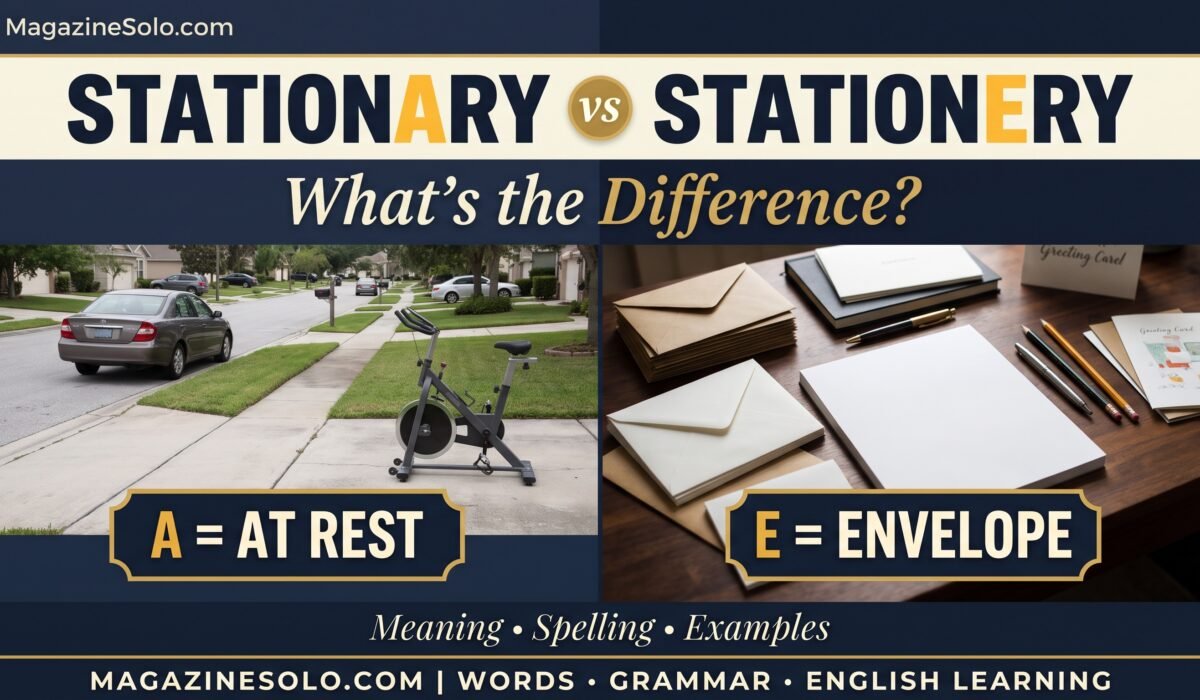
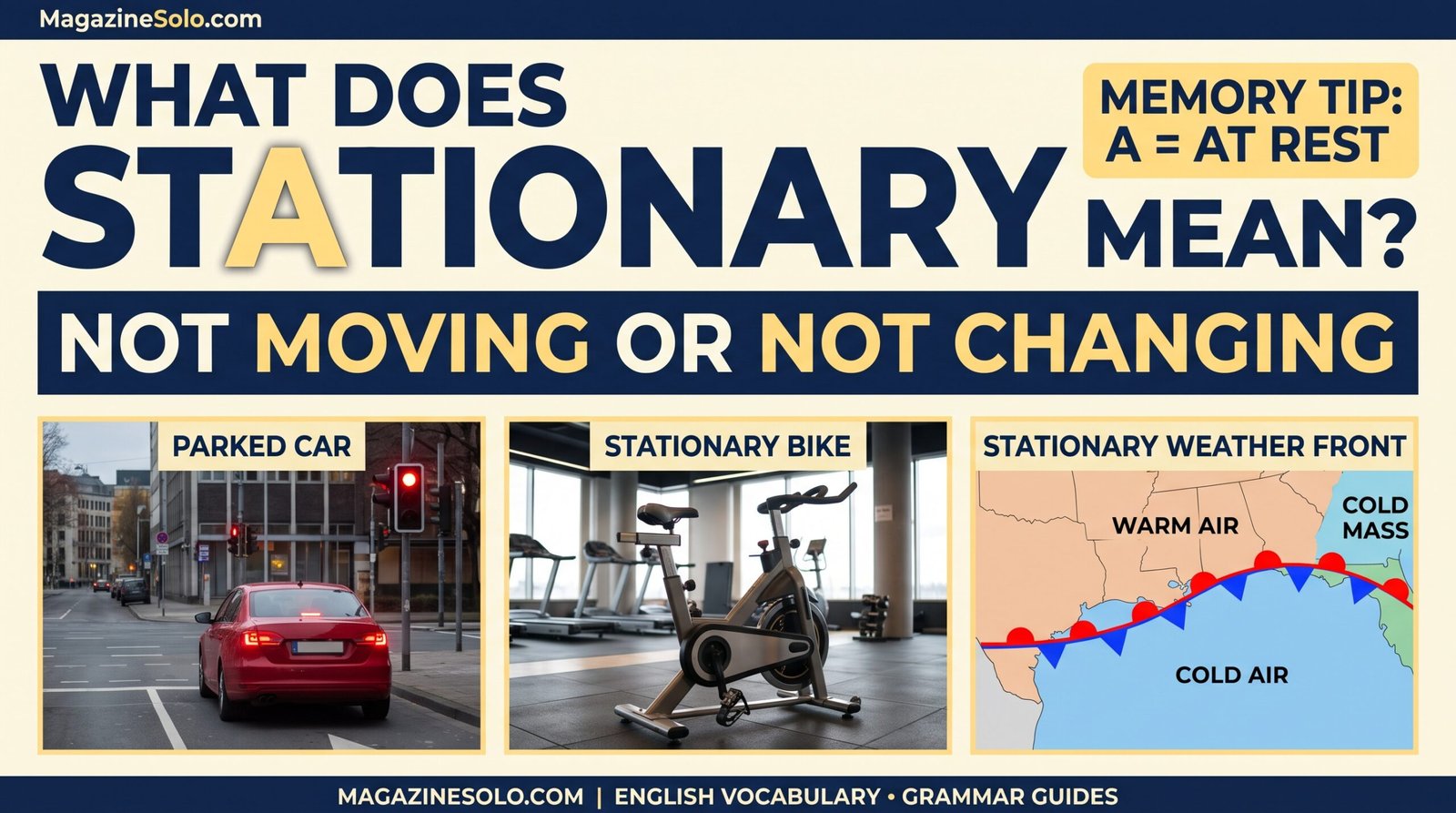
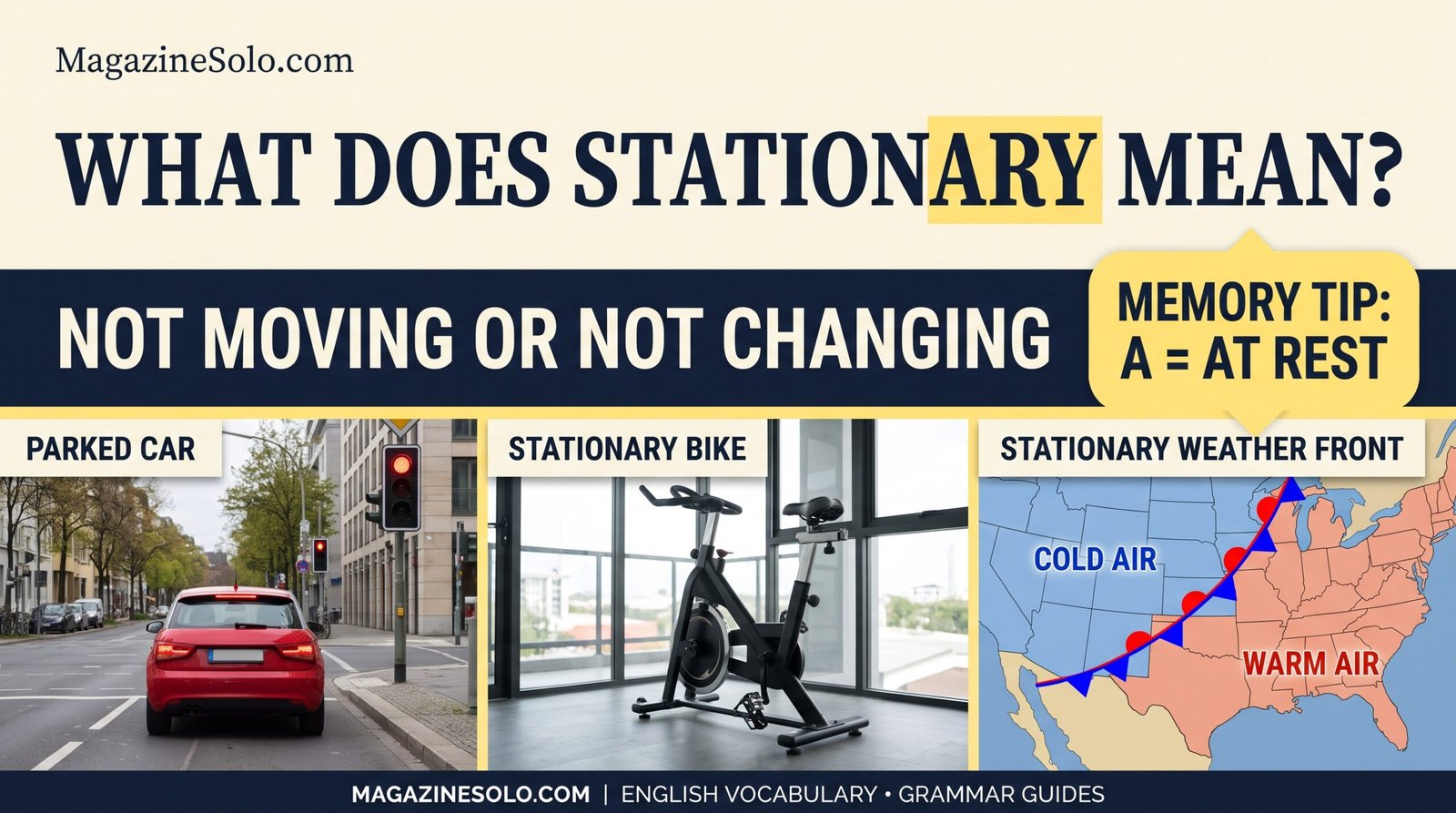
Stationary (with an A) means not moving or not changing. It is an adjective. Stationery (with an E) means writing materials like paper and envelopes. It is an uncountable noun. Remember: A is for at rest, and E is for envelope.
Introduction
Stationary vs stationery is the word pair that spellcheck refuses to help with. Both words are real, both sound identical, and they differ by a single vowel. Yet one describes a parked car and the other names the paper you write a letter on. This guide gives you the instant rule, maps both meanings completely, tells the remarkable story of how one Latin word became two, warns you why your spellchecker stays silent, and finishes with a practice quiz so the distinction sticks.
What Does Stationary Mean?
Stationary is an adjective with two related senses. The familiar one is not moving. The overlooked one is not changing. Both describe a lack of motion, whether physical or numerical.
Stationary as Not Moving
A stationary object stays in one place. The car remained stationary at the red light. The train sat stationary for twenty minutes. The camera was mounted in a stationary position.
This is the sense behind the stationary bike: an exercise bicycle that stays put while you pedal. It also covers people: the guard stood stationary at the entrance. Anything fixed in position qualifies.
Stationary as Not Changing
Cambridge defines stationary as not moving or not changing, and the second sense matters. Population growth remained stationary over the decade. Stock prices stayed stationary all month. The rate held stationary.
Weather forecasters use it constantly. A stationary front is a boundary between air masses that stalls and stops advancing, often bringing days of rain. The National Weather Service treats it as standard terminology.
This sense is the one most guides skip. If your sentence is about numbers, rates, or trends holding steady, stationary with an A is the word.
What Does Stationery Mean?
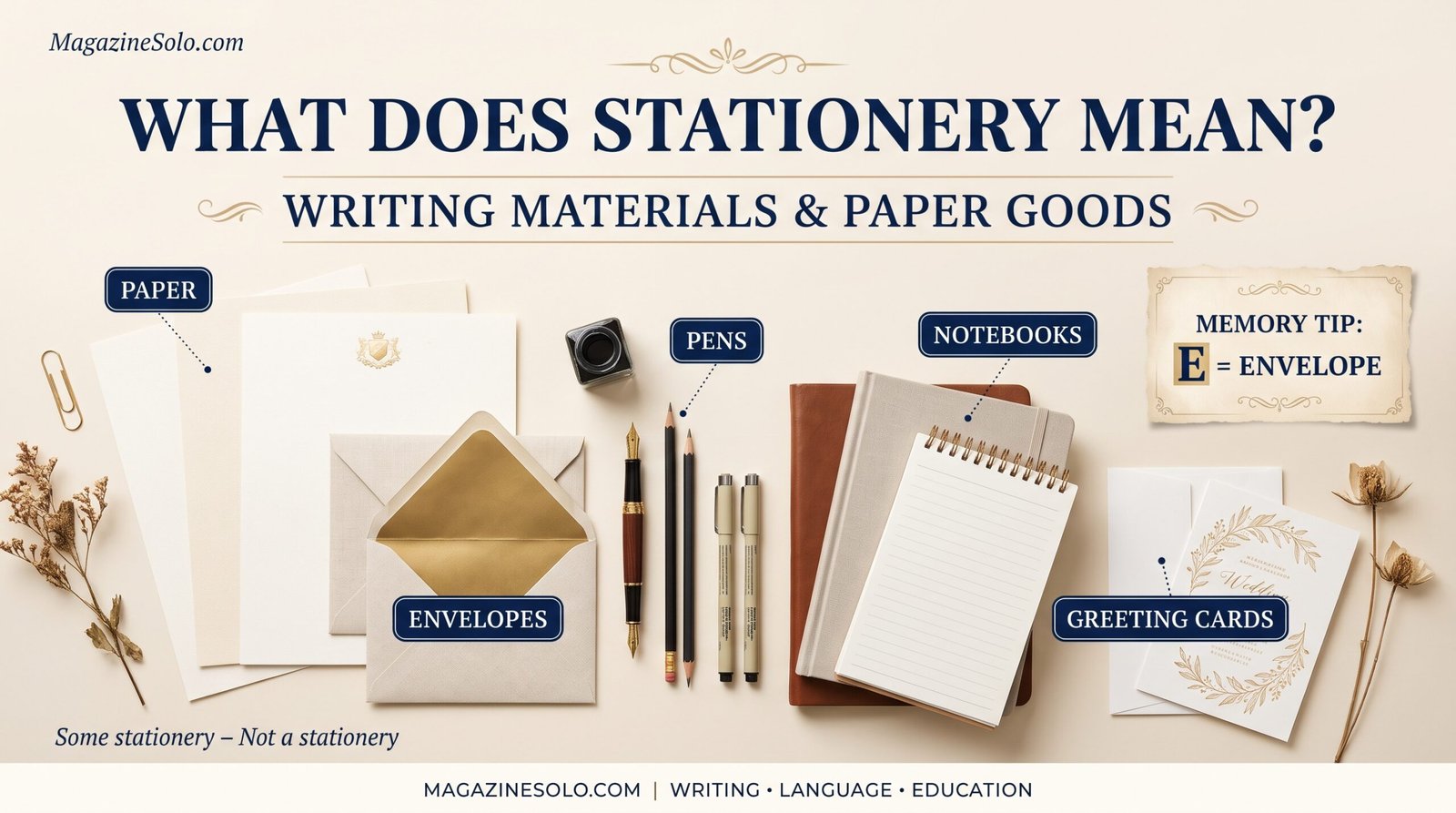
Stationery is a noun naming the materials of writing: paper, envelopes, pens, pencils, ink, notepads, greeting cards, and letterheads. Merriam-Webster’s entry covers everything from letter paper with matching envelopes to the broader set of writing tools.
The Items Stationery Includes
Think of stationery as the supply drawer of written communication. Personal stationery means monogrammed paper and envelopes for letters. Business stationery means letterheads and branded envelopes. Wedding stationery means invitations, RSVP cards, and menu cards.
The E-for-envelope mnemonic works because the envelope is the signature item. If envelopes could be involved, the E spelling is your signal.
The Grammar Rule: Stationery Is Uncountable
Stationery is normally an uncountable noun. You say “some stationery,” never “a stationery.” You never write “stationeries.” For a countable unit, say “a stationery set” or name the item: “an envelope,” “a notepad.”
This rule trips writers who treat it like an ordinary noun. “I bought three stationeries” is wrong. “I bought three stationery sets” is right. Master this and you sound instantly more polished.
Side-by-Side Comparison
| Word | Part of speech | Meaning | Memory trick | Example |
|---|---|---|---|---|
| Stationary | Adjective | Not moving; not changing | A = at rest | The bus was stationary at the stop. |
| Stationery | Noun (uncountable) | Writing materials | E = envelope | She ordered personalized stationery. |
One Word, Two Histories: The Etymology
The resemblance is historical, not accidental. Both words descend from the Latin stationarius, meaning “of a station” or “belonging to a fixed position.” Then the two meanings took different roads.
Stationary kept the literal sense. It describes what stays put: the parked car, the stalled front, the unchanging rate. The meaning never really moved.
Stationery took the human road. In medieval markets, a stationer was a bookseller or paper seller who operated from a fixed stall, unlike traveling peddlers. The goods of the stationer became “stationery.” The person stayed still; the paper got the name.
So the single vowel records a real fork: the -ary branch stayed with stillness, while the -ery branch passed through the shop of a man who never moved. Etymology references trace both histories, and knowing the story makes the spelling feel inevitable.
Stationery Through the Ages
Stationery has a history as rich as the word itself. Before paper, writing materials meant clay tablets, papyrus, and parchment. Each era’s stationery defined who could write and what writing was worth.
The letter-writing age made stationery a social art. From the 1700s through the mid-1900s, a person’s paper announced their standing. Heavy cotton paper, engraved monograms, and wax seals turned correspondence into ceremony. The stationer’s shop was the era’s design studio.
The fountain pen era deepened the craft. Quality paper had to handle liquid ink without feathering, so paper and pen evolved together. Typewriters later shifted stationery toward standardized business paper, and the letterhead became the corporate signature.
Today, premium stationery is a deliberate revival. In an age of email, choosing paper signals intention. Wedding suites, letterpress invitations, and fountain-pen-friendly notebooks sell precisely because they are slow in a fast medium. The E spelling carries five centuries of that weight.
Stationary in Science and Technology
Beyond weather and markets, stationary does precise work in science. A geostationary orbit keeps a satellite fixed above one point on Earth, matching the planet’s rotation. Weather and communications satellites live there, appearing stationary from the ground.
In physics and chemistry, a stationary state is a condition that does not change over time. In mathematics, a stationary point is where a function’s derivative is zero: the curve momentarily stops climbing or falling.
Medicine uses it too. A stationary patient is one held still for imaging or treatment. Physical therapists prescribe stationary bikes for low-impact rehabilitation, since the fixed position protects healing joints.
Every one of these uses the A spelling. The scientific vocabulary never borrows the paper word. When precision matters most, the distinction holds firm.
The Business of Stationery: An Industry Snapshot
Stationery is not just a word; it is an industry. Office supply retailers stock it, wedding planners design it, and premium paper mills still manufacture it. The category spans dollar-store notebooks and hundred-dollar letterpress suites.
Wedding stationery is the premium segment. A full suite (invitations, RSVP cards, menus, place cards, programs) can cost hundreds of dollars, and designers treat it as event branding. The paper sets the tone before a single guest arrives.
Corporate stationery remains a trust signal. Law firms, banks, and government offices still issue formal letters on branded letterhead. In an era of phishing, the physical paper authenticates in a way email struggles to match.
The analog revival keeps the category growing. Fountain pen communities, bullet journalers, and paper planners drive demand for quality notebooks. Each buyer learns the E spelling the moment they join the hobby.
Stationary Exercise: Why the Bike Never Moves
The stationary bike deserves its own note because it is the most-searched stationary compound. Invented for indoor training, it lets cyclists ride without weather, traffic, or destination. The defining feature is right there in the A spelling: it stays put.
Rehabilitation made it essential. After knee or hip surgery, doctors prescribe stationary cycling because the fixed position removes balance risk while rebuilding strength. The bike’s stillness is the therapy.
Spin classes turned it into culture. Rows of stationary bikes, one instructor, loud music: the workout is collective while every bike stays exactly where it started. The paradox is the product.
Other equipment shares the pattern: stationary rowers, climbers, and ellipticals all trade travel for training. The A spelling marks the whole category of fitness without forward motion.
Stationery Etiquette: The Unwritten Rules
Stationery carries etiquette that email never learned. A thank-you note on paper outranks a text message in every formal context: after interviews, after gifts, after hospitality. The paper says you took time.
Wedding RSVPs traditionally go on the enclosed card, mailed back in the provided envelope. Responding by text to a paper invitation breaches the formality the hosts chose. Match the medium to the invitation.
Condolence letters belong on plain, quality stationery. Never send condolences by email if paper is possible. The weight of the paper carries the weight of the sentiment.
Business thank-yous after interviews go on simple personal or company stationery. Recruiters remember the candidate who wrote. In a stack of emails, the envelope stands out.
The rule behind the rules: paper signals effort. Every etiquette norm around stationery rewards the sender who chose the slower medium. The E spelling marks the world where that choice lives.
Stationary in Literature and Film
Writers love stationary for tension. A stationary figure in a doorway. A stationary car with its engine running. Stillness on the page creates suspense because readers expect motion.
Film uses it visually. The stationary camera shot, locked on a tripod, forces the audience to watch action unfold without the comfort of movement. Directors choose stillness deliberately.
Poets use the not-changing sense. A stationary grief. A stationary afternoon. The word freezes time, holding a moment or a feeling in place for examination.
Notice that literature never confuses the pair. Professional writers keep the A for stillness and the E for paper with total discipline. Their example is worth following.
The Stationer’s Shop: A Walking Tour
Step into a proper stationery shop and the E spelling surrounds you. Walls of notebooks: dot grid, lined, blank. Pens in every weight, from disposable ballpoints to fountain pens with gold nibs.
The paper section is the heart. Cotton resume paper, deckle-edge notecards, envelopes in a dozen sizes. Wedding albums show letterpress suites. The gift corner holds journals, desk sets, and sealing wax.
Behind the counter, the custom order book records monograms and wedding suites. Personalized stationery takes weeks: design, proof, print, deliver. The wait is part of the luxury.
Every item in the shop answers to the E spelling. Nothing here is stationary in the A sense; the whole store exists to put words in motion. The irony is the mnemonic: the shop of stillness sells movement.
Stationery as a Gift
Personalized stationery is a classic gift for graduates, newlyweds, and new homeowners. A monogrammed set says: your correspondence matters. It is personal without being presumptuous.
For writers, a fountain pen and quality notebook is the stationery gift that converts. The tools invite the habit. Many journaling practices began with gifted paper.
For professionals, premium business cards or a leather desk set upgrades the daily grind. The E spelling marks gifts of the writing life, and recipients use them for years.
Choose cotton paper for the best impression. It feels substantial, takes ink beautifully, and ages well. The gift of good stationery is the gift of good writing.
Why Spellcheck Cannot Save You
Here is the danger most guides understate: both words are real. A spellchecker flags misspellings, not wrong words. Type “the boat was stationery in the harbor” and no red line appears, because “stationery” is a legitimate word.
This makes the pair spellcheck-proof. Autocorrect will not rescue you, grammar tools may miss it in context, and the error sails into emails, essays, and reports unchallenged. Only your own knowledge stands guard.
The defense is a personal checklist. Add stationary/stationery to the confusion pairs you search for in every final proofread, alongside affect/effect and its/it’s. Machines handle spelling; humans handle meaning.
5 Memory Tricks That Actually Stick
1. A is for at rest. Stationary with an A means at rest. Both share the letter A. If it is standing still, use the A version.
2. E is for envelope. Stationery with an E includes envelopes. Both share the letter E. If paper goods are involved, use the E version.
3. Parked has “ar.” A car that is not moving is parked. The “ar” in parked matches the “ar” at the end of stationary. Parked things are stationary.
4. Stay-tionary. Read stationary as “stay-tionary.” It has an A like stay, and it means to stay in place. The pronunciation carries the spelling.
5. One sentence to rule them all. Memorize this: “The paperweight keeps the stationery stationary.” The writing materials stay still. Reciting it rebuilds both spellings whenever doubt strikes.
The 1-Second Replacement Test
When you hesitate mid-sentence, run this three-step check. It takes about one second with practice.
Step 1: Cover the word. Read your sentence with a blank. “The guard stood ___ at the entrance.”
Step 2: Try “still.” “The guard stood still” works perfectly. Still points to stationary.
Step 3: Try “paper.” “The guard stood paper” is nonsense. Paper is out, confirming stationary.
Reverse it for the other direction. “I need to restock the office ___.” “Restock the office still” fails; “restock the office paper” works. Paper points to stationery. The test checks meaning, so it never misfires.
Common Mistakes to Watch For
Mistake 1: The parked paper. Wrong: “The boat was stationery in the harbor.” Right: “The boat was stationary in the harbor.” A vessel at rest is stationary, not paper.
Mistake 2: The moving materials. Wrong: “She bought new stationary for her thank-you notes.” Right: “She bought new stationery for her thank-you notes.” Writing supplies take the E.
Mistake 3: The countable error. Wrong: “We ordered three stationeries.” Right: “We ordered three stationery sets.” The noun is uncountable.
Mistake 4: The article error. Wrong: “I need a stationery for the letter.” Right: “I need some stationery for the letter.” No indefinite article with uncountable nouns.
Mistake 5: The shop sign. Wrong: “The stationary shop sells notebooks.” Right: “The stationery shop sells notebooks.” The store sells paper goods, so the E spelling rules.
Stationery in Business: More Than Paper
In business, stationery is a branding asset, not just supplies. Company stationery means letterheads, business cards, and envelopes carrying the logo, colors, and typography of the brand. It is part of the corporate identity.
Official correspondence goes out on company stationery for a reason. The branded paper signals authenticity: a letter on official stationery carries weight that plain paper does not. “Please use the company’s official stationery” is standard office instruction.
Designers speak of a stationery suite: the coordinated set of printed materials a business or event uses. Wedding planners use the same term for invitation suites. The word has grown from “paper” into “the printed face of an organization.”
When you see “stationery” in a professional context, think identity. It is never about stillness. The E spelling marks the world of paper, print, and presentation.
Stationery by Occasion
| Occasion | Typical stationery | What it signals |
|---|---|---|
| Wedding | Invitations, RSVP cards, menu cards, place cards, programs | Elegance and planning |
| Business | Letterheads, business cards, branded envelopes | Professionalism and authenticity |
| Personal | Monogrammed paper, thank-you notes, greeting cards | Thoughtfulness and care |
| School/office | Notebooks, notepads, pens, pencils | Readiness and organization |
Stationary Beyond Movement: Weather, Markets, Populations
The “not changing” sense of stationary deserves its own spotlight because it produces the sentences most writers get wrong.
In meteorology, a stationary front stalls between air masses and can park rain over one region for days. Forecasters say the front “becomes stationary” when it stops advancing. The National Weather Service uses the term as standard vocabulary.
In economics, stationary describes flat trends. Population growth remained stationary. Interest rates held stationary. The word says: no movement in the numbers, even though the world keeps turning.
In markets, traders say a stock “went stationary” when its price stops climbing. The shares are not physically still; their value is. This figurative extension is the sense learners miss most.
The rule of thumb: if the sentence is about change versus stability, stationary with an A is the word, whether the subject moves or not.
Sentence Bank: Stationary at Work
Not moving: “The car remained stationary at the red light.” “The train was stationary for twenty minutes.” “Keep the camera stationary to avoid blur.” “The guard stood stationary at the entrance.” “The satellite appeared stationary in the night sky.”
Not changing: “Population growth has remained stationary over the past decade.” “The cold front stalled and became stationary.” “Stock prices stayed stationary all month.” “The rate held stationary through the quarter.”
Notice how the not-changing sentences never involve physical stillness. The numbers sit still while everything else moves. That is the sense to watch for.
Sentence Bank: Stationery at Work
“She bought new stationery for her thank-you notes.” “The company printed new stationery with its logo.” “He ordered personalized stationery with his initials.” “The wedding stationery included invitations and RSVP cards.” “Please use the company’s official stationery for all correspondence.” “We are running low on envelopes; add them to the stationery order.”
Every sentence names paper goods or the order of them. If you can file it in a desk drawer, it is stationery with an E.
Examples in Real Life
At the gym: “She pedaled the stationary bike for thirty minutes.” The bike goes nowhere. Its whole purpose is motion without travel.
At the office: “The assistant restocked the stationery closet.” Paper, pens, envelopes. The E spelling serves the supply run.
In the news: “Traffic was stationary for over an hour.” Cars at a standstill. “The front turned stationary, extending the rain.” Weather holding its ground.
At a wedding: “Her personal stationery had her initials embossed in gold.” Paper as presentation. The E spelling carries the elegance.
Readers browsing celebrity profiles meet both words in the wild: stars photographed beside stationary vintage cars, and fan mail written on personalized stationery. The pair lives in everyday writing.
The Trickster’s Gallery: Sentences That Fool Everyone
Some sentences resist the quick test because both readings seem plausible. Decode them slowly.
“The stationary store sells bikes.” A store that never moves, which is odd. “The stationery store sells bikes,” also odd. The real sentence is “The stationery store sells notebooks.” Context crowns the E.
“The office ordered new stationery.” Paper goods for the office. “The office ordered new stationary.” The office ordered stillness, which is nonsense. The E wins by meaning.
“The figure remained stationary under the tree.” Not moving. “The figure remained stationery under the tree.” The figure remained paper, which is absurd. The A wins by meaning.
When a sentence survives both readings, rewrite it. “The shop sells writing supplies” can never be misread. Clarity beats cleverness every time.
How the Pros Keep Them Straight
Professional editors catch stationary/stationery errors with systems, not memory. Borrow their workflow.
1. Search, don’t skim. Run a find-all for the pair in every document. Your eyes glide over familiar words; the search function does not. Add both spellings to your personal checklist.
2. Read with the synonym swapped in. “The boat was paper in the harbor” sounds wrong out loud in a way it might not on screen. Hearing “paper” where stillness belongs exposes the error instantly.
3. Flag the uncountable trap. Stationery errors cluster around articles and plurals. Scan for “a stationery” and “stationeries” as their own check, separate from the A/E choice.
4. Slow down at the end. Most homophone errors survive because proofreading happens when attention is lowest. Check confusion pairs in a dedicated final pass.
Putting It All Together: A Worked Example
Watch both words fire in a single scene. “The delivery truck sat stationary outside the stationery shop. Inside, the clerk restocked the stationery shelves while the line of customers remained stationary. The new wedding stationery had just arrived, and not a single box had moved.”
Count them: stillness, paper, paper, stillness, paper. Five uses, two spellings, zero errors. Each choice follows the same one-second test: still or unchanged points to stationary, paper goods point to stationery.
Write your own paragraph next. Pick three uses, build one scene, and check each word with the substitution test. Producing the distinction cements it far better than reading about it.
How Schools Teach the Pair
Teachers introduce stationary vs stationery as a classic homophone lesson, usually around the middle grades. The A/E mnemonics are classroom staples, often taught with a simple chant: “A is for at rest, E is for envelope.”
Spelling tests pair the words with sentence dictation. The teacher reads “The truck remained stationary” and students must choose the spelling from meaning alone. The exercise trains exactly the skill adult writers need.
ESL programs teach the pair alongside uncountable nouns. “Some stationery” becomes the example sentence for the whole grammar category, giving the vocabulary lesson double duty.
The lesson sticks because the story helps. Students who hear about the medieval stationer’s fixed stall remember the E spelling years later. Narrative beats drill, in classrooms and everywhere else.
Practice Quiz: Test Yourself
Choose the correct word for each sentence. Answers with explanations follow.
1. The security guard stood _____ at the entrance.
2. I need to restock the office _____.
3. The satellite appeared _____ in the night sky.
4. The _____ shop on the corner sells beautiful notebooks.
5. Traffic was _____ for over an hour on the motorway.
6. Her personal _____ had her initials embossed in gold.
7. The cold front stalled and became _____.
8. We ordered three _____ sets for the new hires.
9. The doctor recommended a _____ bike after the knee operation.
10. Please print the contract on official company _____.
Quiz Answers
1. stationary. The guard is not moving. A = at rest.
2. stationery. Restocking means supplies. E = envelope.
3. stationary. Fixed in position. Not moving.
4. stationery. The shop sells writing materials. E = envelope.
5. stationary. Traffic at a standstill. A = at rest.
6. stationery. Personalized writing paper. E = envelope.
7. stationary. A stalled front is not advancing. The not-changing sense.
8. stationery. Uncountable: three stationery sets, never “three stationeries.”
9. stationary. The exercise bike goes nowhere. A = at rest.
10. stationery. Official letterhead and paper. Business stationery.
Extended Challenge: 5 Harder Questions
1. Population growth has remained _____ for a decade.
2. “I need _____ for the letter” is wrong; the fix is “some _____.”
3. The _____ front brought three days of rain.
4. She keeps a drawer of elegant _____ for personal letters.
5. The paperweight keeps the _____ _____.
Answers: 1. stationary (not changing). 2. “some stationery” (uncountable, no “a”). 3. stationary (weather front). 4. stationery (writing paper). 5. “stationery stationary” (the paper stays still).
Question 5 is the hardest because it demands both spellings in order. The writing materials (E) remain motionless (A). Master that sentence and the pair is yours.
Key Takeaways
Stationary with an A is the adjective of stillness: not moving, not changing, at rest. Stationery with an E is the uncountable noun of writing: paper, envelopes, pens, the materials of correspondence.
The mnemonics do the heavy lifting: A for at rest, E for envelope. The etymology explains the fork: the Latin stationarius split into the thing that stays put and the fixed-stall stationer who sold paper. Merriam-Webster’s stationery entry confirms the writing-materials definition, and etymology references trace stationary and stationery to their shared root.
Quick Reference Card
Pin this master table until the distinction is automatic.
| You mean… | Write… | Remember |
|---|---|---|
| Not moving | stationary | A = at rest |
| Not changing | stationary | A = at rest (rates, fronts) |
| Writing materials | stationery | E = envelope |
| Paper goods, uncountable | stationery | Some stationery, never “a stationery” |
| Shop selling paper goods | stationery shop | E = envelope |
| Exercise bike that stays put | stationary bike | A = at rest |
When in doubt, cover and substitute. “Still” or “unchanged” points to stationary. “Paper” or “supplies” points to stationery. The whole system fits on an index card.
Frequently Asked Questions
What is the difference between stationary and stationery?
Stationary (A) means not moving or not changing; it is an adjective. Stationery (E) means writing materials like paper and envelopes; it is an uncountable noun.
Is it stationary or stationery?
It depends on your meaning. Use stationary for stillness or stability. Use stationery for paper goods and writing supplies. Try substituting “still” and “paper” to decide.
How do you remember stationary vs stationery?
Two mnemonics: A is for at rest (stationary), and E is for envelope (stationery). Together they cover every use.
Are stationary and stationery homophones?
Yes. Both are pronounced /ˈsteɪʃənri/ in standard English. Pronunciation cannot guide you; only meaning and spelling can.
Is stationery a noun?
Yes, and specifically an uncountable noun. Say “some stationery” or “a stationery set,” never “a stationery” or “stationeries.”
Is stationary an adjective?
Yes. It describes nouns: a stationary car, a stationary front, stationary traffic. It is never a noun itself.
Is stationery countable?
No. Stationery is uncountable. For countable units, say “a stationery set,” “a box of stationery,” or name the item directly.
Can you say “a stationery”?
No. The indefinite article does not work with uncountable nouns. Say “some stationery” or “a piece of stationery” in formal contexts.
Can stationary mean not changing?
Yes. Cambridge defines it as “not moving or not changing.” Population growth, stock prices, and weather fronts can all be stationary.
What does “stationary front” mean?
A weather boundary between air masses that stalls and stops advancing. It often brings prolonged rain to one region. The National Weather Service uses the term routinely.
What is an example of stationary?
“The car remained stationary at the red light.” For the not-changing sense: “The rate stayed stationary all quarter.”
What is an example of stationery?
“She ordered personalized stationery with her initials.” Paper, envelopes, and writing tools for correspondence.
What items count as stationery?
Paper, envelopes, pens, pencils, ink, notepads, greeting cards, letterheads, and business cards. Anything in the writing-supply drawer qualifies.
What is a stationer?
Historically, a bookseller or paper seller operating from a fixed market stall. The stationer’s goods became “stationery.” The word preserves the fixed-position root.
Why do they sound the same?
They share the Latin root stationarius (“of a station”). The pronunciations converged while the spellings and meanings diverged.
What is the etymology of stationery?
From the medieval stationer, a fixed-stall seller of books and paper. The goods took the seller’s name with an E spelling, separating from “stationary.”
Is it “stationery shop” or “stationary shop”?
“Stationery shop.” The store sells writing materials, so the E spelling rules. A “stationary shop” would be a shop that never moves, which is odd.
What is business stationery?
Branded writing materials: letterheads, business cards, and envelopes carrying a company’s logo and identity. It signals professionalism and authenticity.
What is a stationery set?
A countable collection of writing materials, often matching paper and envelopes in a box. The word “set” makes the uncountable noun countable.
What is wedding stationery?
The printed suite for a wedding: invitations, RSVP cards, menu cards, place cards, and programs. Designers call the coordinated set a stationery suite.
Does stationary always mean physical stillness?
No. It also means not changing: rates, populations, prices, and weather fronts can be stationary without anything physically standing still.
Can a person be stationary?
Yes. “The guard stood stationary at the entrance.” A person not moving is stationary, just like an object.
What is a stationary bike?
An exercise bicycle that stays in one place while you pedal. The A spelling marks its defining feature: it goes nowhere.
Is it “stationary bicycle” or “stationery bicycle”?
“Stationary bicycle.” The bike does not move. A “stationery bicycle” would be a bicycle made of paper, which is a different invention.
What does “remain stationary” mean?
To stay still or stay unchanged. The phrase covers both senses: a car remaining stationary in traffic, or a rate remaining stationary over time.
How do you spell the paper one?
Stationery, with an E. E is for envelope.
How do you spell the not-moving one?
Stationary, with an A. A is for at rest.
Which has an E, stationary or stationery?
Stationery, the writing materials. The E matches envelope.
Which has an A?
Stationary, the not-moving word. The A matches at rest.
Can you use both words in one sentence?
Yes: “The paperweight keeps the stationery stationary.” The writing materials stay still. It is the classic demonstration sentence.
What is the most common mistake?
Writing “stationery” for a still object (“the boat was stationery”) or “stationary” for paper goods (“new stationary for notes”). The A/E swap is the whole error.
Do British and American English differ here?
No. The spelling distinction is identical in all English varieties. Quillbot notes the meanings and spellings match across British, American, Canadian, and Australian English.
How do you teach this to ESL students?
Start with the A/E mnemonics, then drill the substitution test with ten sentences. Add the uncountable-noun rule early, since learners meet “stationery” in real shopping contexts.
What does “stationery order” mean?
An office supply order for writing materials: paper, envelopes, pens, and notepads. “Add it to the stationery order” is standard workplace language.
What is personalized stationery?
Custom writing paper printed with a name, monogram, or initials, often with matching envelopes. A classic gift and a mark of formal correspondence.
Is “stationeries” a word?
No. Stationery has no plural form. Say “stationery sets” or “types of stationery” when you need a plural idea.
What does “on official stationery” mean?
Written on a company’s branded letterhead. The phrase signals formal, authorized communication. The branded paper authenticates the message.
Can stationery include pens?
Yes. Merriam-Webster’s entry includes pens, pencils, ink, and markers alongside paper. The writing tools belong to the stationery family.
What is the difference between stationery and office supplies?
Stationery is the writing-and-paper subset: paper, envelopes, pens. Office supplies is the broader category, adding staplers, folders, toner, and furniture.
Will spellcheck catch the error?
No. Both words are real, so spellcheckers flag neither. This pair is spellcheck-proof; only your own knowledge catches the swap.
What is a geostationary orbit?
An orbit that keeps a satellite fixed above one point on Earth, matching the planet’s rotation. The satellite appears stationary from the ground. Always the A spelling.
What is the history of the stationery industry?
It grew from medieval stationers selling paper from fixed stalls, through the letter-writing age’s social stationery, to today’s office, wedding, and premium-paper markets.
Why is wedding stationery so expensive?
It is event branding: design, premium paper, printing techniques like letterpress and foil, and full suites of coordinated pieces. The paper sets the event’s tone.
Can “stationary” describe a trend?
Yes. A flat trend is stationary: “Sales remained stationary this quarter.” The not-changing sense covers numbers, rates, and trends.
What is letterpress stationery?
Stationery printed by pressing type into thick paper, creating a tactile impression. A premium technique for wedding invitations and luxury business cards.
Is it “stationary point” or “stationery point”?
“Stationary point,” the mathematics term for where a function’s derivative is zero. The A spelling serves science without exception.
What does a stationery designer do?
Designs printed paper goods: wedding suites, business stationery, and branded materials. The job sits at the intersection of graphic design and print craft.
Conclusion
Stationary vs stationery stops being confusing the moment each vowel carries its meaning. The A word handles stillness: the parked car, the stalled front, the unchanging rate. The E word handles paper: the envelope, the letterhead, the wedding suite.
The mnemonics do the heavy lifting: A for at rest, E for envelope. The etymology explains the fork: one Latin word for fixed position split into the thing that stays put and the stationer who sold paper from a fixed stall. And the grammar seals it: stationary is an adjective, stationery an uncountable noun. Run the substitution test whenever doubt appears, and the right vowel will follow.
For more word pairs that reward the same careful attention, explore the grammar guides alongside profiles like Kate Connelly and Arch Kelley III, where precise language does its quiet work. The next time one vowel decides your meaning, you will choose it with confidence.
Keep the quick reference card within reach for the first month. After a dozen correct choices, the mnemonics fade into instinct, and the right spelling simply arrives. That is the quiet payoff of mastering a word pair: one less decision, made correctly, every time you write.
And remember the deeper lesson this pair teaches. English is full of words that sound alike and mean different things, and no software will ever sort them for you. The defense is always the same: know the meaning, run the test, and trust the system. Master stationary and stationery, and every homophone after them gets easier.

Dilawar Mughal is an SEO expert with 8 years of hands-on experience helping websites grow their organic traffic, rankings, and revenue. He specializes in content-driven SEO, local SEO, and Pinterest SEO, and builds practical, results-focused strategies for businesses and publishers.