The Difference in 10 Seconds
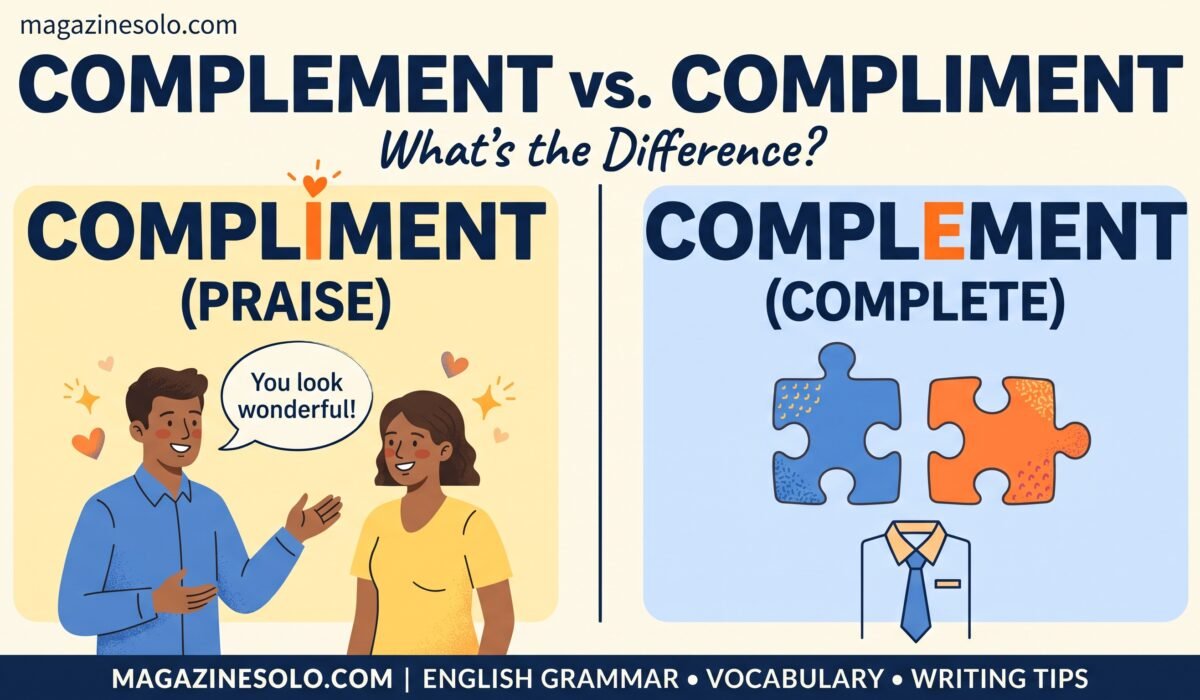
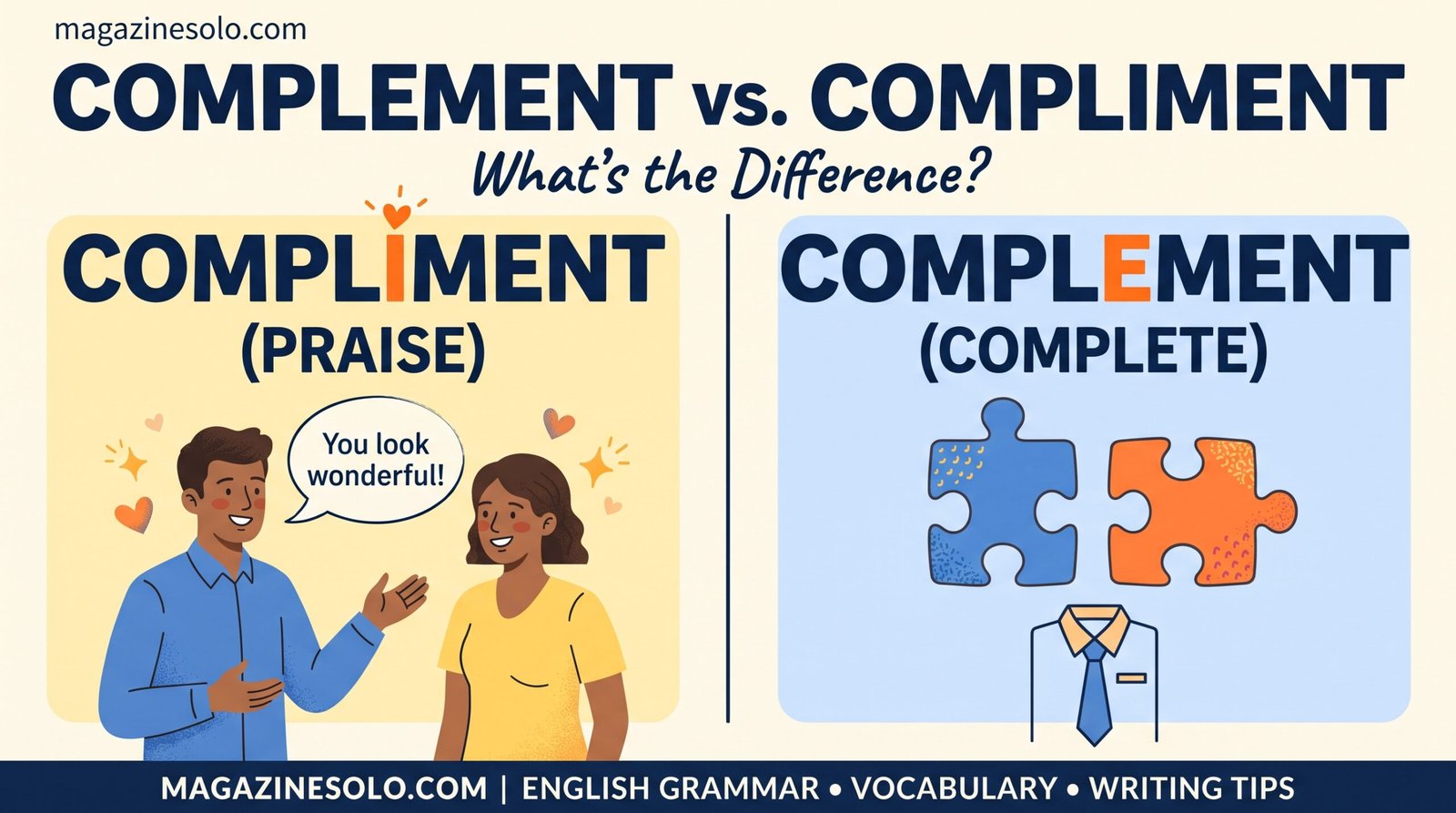
Compliment with an I means praise. Complement with an E means complete. One tiny vowel separates a kind remark from a perfect pairing, and mixing them up changes your meaning entirely.
Introduction
Complement vs compliment is one of the most persistent spelling traps in English. The two words sound identical, look nearly identical, and differ by exactly one letter. Yet their meanings share nothing at all. This guide gives you the clear rule, shows both words working as nouns and verbs, untangles the complementary vs complimentary trap, explains the surprising grammar meaning of “complement,” and ends with a practice quiz so the distinction sticks.
What Does Compliment Mean?
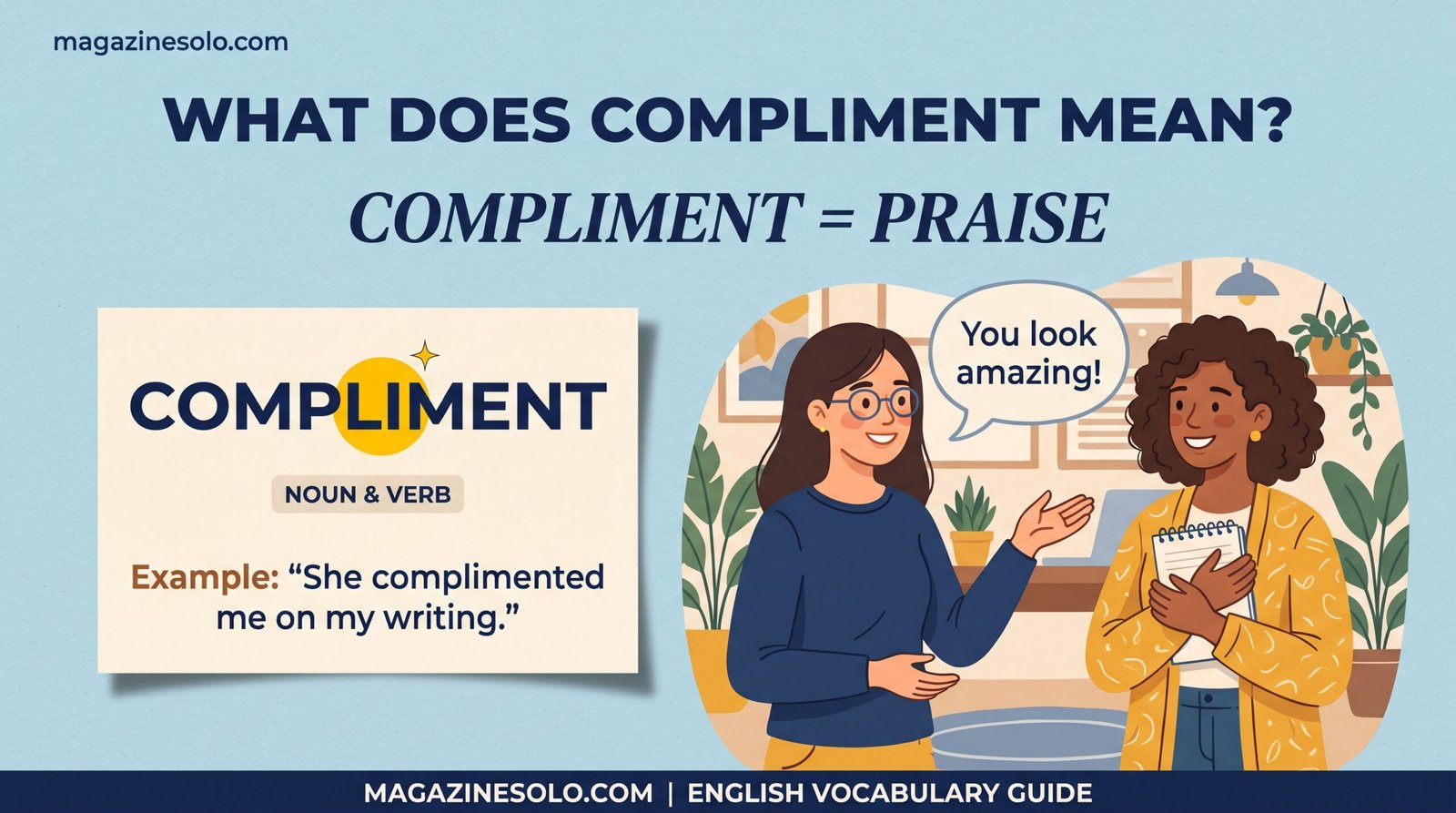
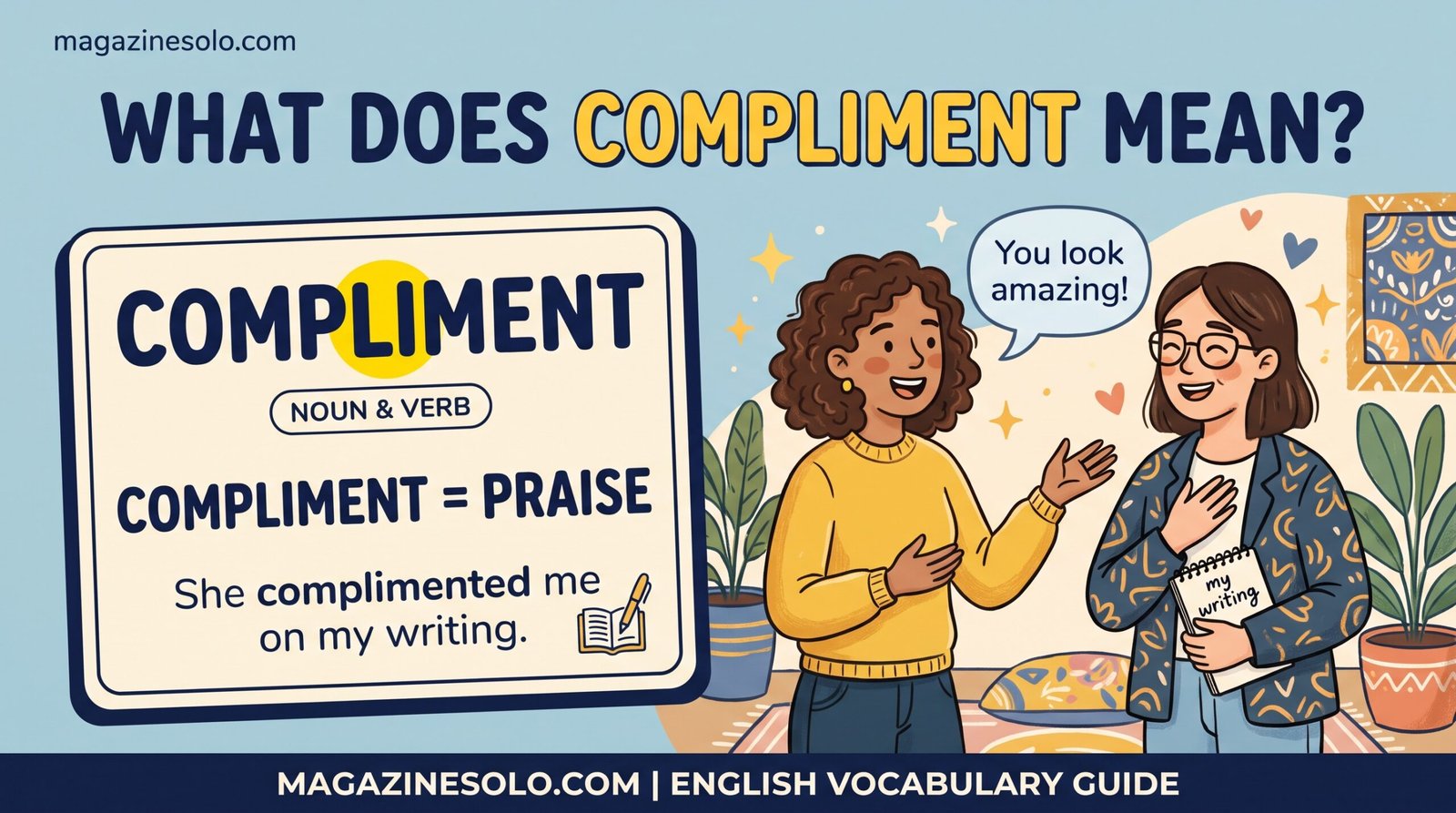
A compliment is an expression of praise, admiration, approval, or respect. It is something nice said about a person, their work, or something they have done. When someone tells you your presentation was excellent, that is a compliment.
As a noun, it names the remark itself. She gave him a sincere compliment on his cooking. The sentence works because the remark expresses admiration. As a verb, to compliment means to deliver that praise. The director complimented the actor on a flawless performance.
A useful pattern locks the verb in place: compliment + someone + on + something. She complimented me on my writing. He complimented the chef on the dessert. The on introduces whatever earned the praise.
Compliments also appear in fixed phrases worth knowing. Compliments to the chef praises whoever cooked the meal. A backhanded compliment sounds like praise but carries an insult inside it. To fish for compliments means to say things designed to draw praise from others.
What Does Complement Mean?
A complement is something that completes, enhances, balances, or improves something else. It is the missing piece that makes the whole work better. When two things go well together, each complements the other.
As a noun, it names the completing thing. The lemon sauce is a perfect complement to the fish. The sauce does not praise the fish. It completes the dish. As a verb, to complement means to complete or enhance. The blue curtains complement the gray walls.
The noun carries a special fixed sense: a full complement means the complete number required. A ship sails with a full complement of crew. A team fields a full complement of players. Here the “completion” meaning is at its most literal.
Watch the verb’s sentence pattern: complement + something, usually without a preposition. Her calm manner complements his energy. The side salad complements the main course. Her practical experience was a useful complement to his technical knowledge.
Side-by-Side Comparison
| Word | Core meaning | Noun example | Verb example |
|---|---|---|---|
| Compliment (I) | Praise or admiration | She gave me a kind compliment. | She complimented my work. |
| Complement (E) | Something that completes or enhances | The scarf is a perfect complement to the coat. | The scarf complements the coat. |
Both Words Are Nouns AND Verbs
Many quick guides oversimplify this pair as “complement is a noun, compliment is a verb.” That is wrong. Both words work as both parts of speech, and knowing all four forms prevents a whole class of errors.
| Word | As a noun | As a verb |
|---|---|---|
| Compliment | A remark of praise (“a warm compliment”) | To praise (“she complimented him”) |
| Complement | A completing thing (“a fine complement”) | To complete or enhance (“it complements the room”) |
Test yourself with the pair in one sentence: Liam complimented Ava on her jacket because its color complemented her shoes. The first verb praises. The second verb completes. One sentence, both spellings, zero confusion.
Complementary vs Complimentary: The Second Trap
Master the nouns and verbs, and a second trap waits in the adjectives. Complementary with an E means going well together. Complimentary with an I means free of charge, or expressing praise. This pair causes even more real-world errors than the original.
| Word | Meaning | Example |
|---|---|---|
| Complementary (E) | Combining well; completing each other | Their skills are complementary. |
| Complimentary (I) | Free, given as a courtesy | The hotel offered a complimentary upgrade. |
| Complimentary (I) | Expressing praise | She was complimentary about the service. |
The classic error is writing “complimentary colors” when you mean colors that pair well. Colors that go together are complementary colors, with an E, from complement. Free colors would be a strange concept indeed.
Note one more fixed term: a complimentary close is the sign-off of a letter, such as “Best regards” or “Sincerely.” It is spelled with an I because it belongs to the courtesy family, not the completion family.
Pronunciation: Why Your Ears Cannot Help You
Spelling is the only reliable clue with this pair, because pronunciation offers none. In everyday American speech, both words sound like KOM-pluh-ment. In British English, both share the transcription /ˈkɒm.plɪ.mənt/ as nouns, with no audible difference at all.
This makes complement vs compliment a spelling trap, not a pronunciation trap. You cannot hear your way to the right answer. Context and meaning are the only guides, which is exactly why the replacement test matters more here than with most confused pairs.
Some speakers report a tiny stress difference when the words are verbs, but it is unreliable in fast speech. Do not trust your ears. Trust the meaning check: praise or completion.
Complement in Specialized Fields
Beyond grammar and everyday use, complement does technical work in several fields. Knowing these senses prevents confusion when you meet the word outside ordinary writing.
In mathematics, the complement of a set contains everything not in the set. In probability, the complement of an event is everything except that event. The complement of a 40-degree angle is 50 degrees, because the two complete a right angle.
In music, complementary parts interlock to complete the texture. A bass line complements a melody the same way a scarf complements a coat. The completion metaphor holds steady across domains.
In biology and immunology, the complement system is a set of proteins that completes the immune response. Even in science, the E word keeps its ancient job: finishing what is incomplete.
Notice that compliment has no such technical senses. Praise stays in the human world of manners and admiration. This asymmetry is itself a memory aid: if the context is technical, the answer is almost always complement.
Real-World Errors and What They Cost
Mixing up this pair is rarely just a cosmetic slip. In professional writing, the wrong word can confuse or amuse your reader at exactly the wrong moment. A restaurant advertising “complimentary colors” in its decor suggests the paint was free. A cover letter claiming your skills “compliment” the company’s values suggests you intend to flatter the company rather than complete its team.
In marketing copy, the error is common and visible. “Complimentary design consultation” is correct when the consultation is free. “Complementary design consultation” means the consultation pairs well with something else. Businesses have printed both, meaning only one.
In academic writing, precision is graded. A student who writes that a secondary source “compliments” a thesis has said the source flatters the thesis, which is nonsense in context. The intended word, complements, means the source adds supporting evidence. Examiners notice.
The fix is always the same one-second test. Before you send the email or submit the essay, cover the word and try “praise” and “completes.” Ten seconds of checking beats the cost of the error.
The Other Meaning of Complement: A Grammar Term
Here is the meaning almost every quick guide skips. In grammar, a complement is a word or phrase that completes the predicate, the part of the sentence that says something about the subject. It finishes a thought the verb alone leaves incomplete.
A subject complement follows a linking verb and describes or renames the subject. In “She is a teacher,” the phrase “a teacher” is the subject complement. The verb “is” alone says nothing; the complement completes the meaning.
An object complement follows a direct object and describes it. In “They named the baby Nora,” the name “Nora” is the object complement. It completes the idea by telling us what the baby was named.
| Type | Example sentence | The complement |
|---|---|---|
| Subject complement | The soup tastes delicious. | delicious |
| Subject complement | He became captain. | captain |
| Object complement | She painted the wall blue. | blue |
| Object complement | We elected her president. | president |
This grammatical sense connects directly to the everyday meaning. A complement completes something, whether that something is an outfit, a meal, or a sentence. Purdue University’s Online Writing Lab covers these structures in its sentence-structure guides for students working through grammar fundamentals.
A Brief History of the Confusion
The mix-up is centuries old, which may comfort anyone who struggles with it. When compliment entered English in the 1500s and 1600s, it still carried the sense of fulfilling formal courtesies. To “pay one’s compliments” meant to perform the expected polite ceremonies, not necessarily to praise sincerely.
Over the 1600s and 1700s, the courtesy sense narrowed toward flattering speech. Formal bows became formal words, and formal words became nice words. By the 1800s, compliment meant what it means today: an expression of admiration.
Meanwhile complement kept the original Latin job without drama. It meant completion in the 1300s, and it means completion now. The spelling with an E never wavered, which is why the E mnemonic is historically honest, not just a trick.
The confusion persists because sound froze while spelling split. Pronunciation merged the two words completely, leaving writers with a single sound and two spellings. Every generation rediscovers the trap, which is why guides like this one never go out of date.
Complement vs Supplement: A Related Distinction
Once complement is clear, a neighboring confusion often surfaces: complement vs supplement. Both involve adding something, but they add it differently.
A complement completes something, making it whole. A supplement adds to something that is already complete, making it larger or better. Vitamins supplement a diet; they do not complete it. An appendix supplements a book.
The test: if removing the thing leaves something incomplete, it is a complement. If removing it leaves something merely smaller, it is a supplement. The bass line complements the melody; the bonus track supplements the album.
This distinction sharpens the core meaning of complement. It is not just “goes with.” It is “makes whole.” Holding that stronger sense makes the E spelling easier to defend in every sentence.
The Business Case for Getting It Right
Correct word choice is a credibility signal. Readers may not consciously analyze your spelling, but errors register. A proposal that says your services “compliment” the client’s needs plants a small doubt: if the writer confuses basic words, what else is sloppy?
Recruiters report the same effect in cover letters. A candidate claiming their background “compliments” the role has written a sentence about flattering the role. The intended claim, that their background completes the team, uses complements. One letter changes the entire pitch.
The reverse error costs warmth. A thank-you note offering “complements to the staff” reads as a vocabulary failure at the exact moment you wanted grace. “Compliments to the staff,” with an I, delivers the intended kindness.
None of these mistakes is fatal on its own. But writing is cumulative: each small precision builds trust, and each small error spends it. This pair is worth mastering because it appears in exactly the high-stakes documents where trust matters most.
How Editors Proofread Homophone Pairs
Professional editors catch complement/compliment errors with systems, not memory. Borrowing their workflow protects your own writing.
1. Search, don’t skim. Editors run a find-all for known confusion pairs in every document. Your eyes glide over familiar words; the search function does not. Add complement and compliment to your personal checklist.
2. Read the sentence aloud with the synonym swapped in. “The wine praises the pasta” sounds absurd out loud in a way it might not on screen. Hearing the meaning exposes the error.
3. Check the adjectives separately. Complementary and complimentary cause more published errors than the base pair. Verify each -ary form on its own, because your brain autocorrects familiar letter patterns.
4. Slow down at the end. Most homophone errors survive because proofreading happens when attention is lowest. Check confusion pairs in a dedicated final pass, not during the first read-through.
Why Are They Spelled So Similarly?
The resemblance is not a coincidence. Both words descend from the Latin complementum, meaning “that which completes.” For centuries they were essentially one word family about completion and fullness.
Compliment branched off through Italian complimento and French compliment, words of courtesy and ceremony. The idea traveled from “fulfilling the formalities” to “saying the polite thing” to simply “praise.” Etymology dictionaries trace this journey from completion, through ceremony, to flattery.
So the spelling difference records a real history. The E kept the original job of completing things. The I went off to the world of manners and praise, and never came back. Remembering the split makes the distinction feel logical instead of arbitrary.
5 Memory Tricks That Actually Stick
1. E completes, I impress. ComplEment contains the E of complEte. ComplIment contains the I of admIre. Match the vowel to the meaning and you cannot go wrong.
2. “I” give compliments. The letter I looks like a person standing alone. A compliment is something one person says to another. Picture yourself handing the praise over.
3. The replacement test. Swap in a synonym and see which preserves the meaning. If “completes” or “goes well with” fits, write complement. If “praise” or “a nice remark” fits, write compliment.
4. Think of the free breakfast. A complimentary breakfast is free, and it is spelled like compliment. Once that spelling is anchored, complementary must be the other one, the “goes well together” word.
5. One sentence to rule them all. Memorize this: “She complimented the decor because the rug complemented the curtains.” Reciting it rebuilds both spellings from scratch whenever doubt strikes.
The 1-Second Replacement Test
When you hesitate mid-sentence, run this three-step check. It takes about one second with practice.
Step 1: Cover the word. Read your sentence with a blank where the word sits. “The wine ___ the pasta beautifully.”
Step 2: Try “praises.” “The wine praises the pasta beautifully” is nonsense. Praise is out.
Step 3: Try “completes.” “The wine completes the pasta beautifully” makes sense. Write complements, with an E.
Reverse it for the other direction. “My boss gave me a ___ on the project.” “Gave me a praise” works, so the noun is compliment, with an I. The test never fails because it checks meaning, not memory.
Common Mistakes to Watch For
Mistake 1: Praising the pasta. Wrong: “The red wine compliments the pasta.” Right: “The red wine complements the pasta.” The wine improves the meal; it does not admire the sauce.
Mistake 2: Completing the boss. Wrong: “My boss gave me a complement.” Right: “My boss gave me a compliment.” Unless your boss was literally finished by your arrival, praise is the meaning.
Mistake 3: Free colors. Wrong: “The room uses complimentary colors.” Right: “The room uses complementary colors.” Colors that pair well take the E.
Mistake 4: The courtesy upgrade. Wrong: “We received a complementary upgrade.” Right: “We received a complimentary upgrade.” Free things take the I, like compliment.
Mistake 5: Skills that flatter. Wrong: “Her skills compliment his.” Right: “Her skills complement his.” Skills complete each other; they do not exchange praise.
Complement With Prepositions: A Small Grammar Note
The verb complement usually takes a direct object: “The scarf complements the coat.” But the noun often pairs with to: “a perfect complement to the meal.” Both patterns are standard, and mixing them causes no error as long as the spelling is right.
Watch one construction: “complemented by.” “The exhibit was complemented by a lecture series” means the lectures completed the exhibit. The passive voice is fine here, though active voice (“A lecture series complemented the exhibit”) reads stronger.
Compliment has its own fixed prepositions. You compliment someone on something: “She complimented him on his courage.” You pay someone a compliment, give a compliment, or accept a compliment. These little words are part of the word’s identity; learning them together prevents awkward phrasing.
More Example Sentences: Both Words at Work
Fluency comes from exposure. Read through these sentences slowly, noting which meaning each one uses.
Compliment (praise): “The teacher complimented her essay.” “He accepted the compliment graciously.” “They complimented the hosts on a wonderful evening.” “What a lovely compliment!” “She complimented his courage in speaking up.”
Complement (completion): “The garden complements the house.” “His experience is the perfect complement to her training.” “The illustrations complement the text.” “A good night’s sleep complements healthy eating.” “The new wing complements the historic building.”
Complimentary (free or praising): “Guests receive a complimentary breakfast.” “The critic was complimentary about the film.” “Parking is complimentary for hotel guests.”
Complementary (going well together): “They offer complementary services.” “Blue and orange are complementary colors.” “The courses are complementary, not overlapping.”
Notice how the surrounding words signal the meaning. Praise contexts mention people and their actions. Completion contexts mention things fitting together. Training your eye on the neighbors of the word makes the choice automatic.
Examples in Real Life
At work: “I want to compliment the team on hitting the deadline.” Praise flows from person to person. “The new dashboard complements our existing reports.” The tool completes the toolkit.
In a performance review: “She complimented his attention to detail.” A manager praises an employee. “His field experience is a strong complement to her academic training.” Two backgrounds complete each other.
Everyday life: “Thank you for the compliment!” Someone said something nice. “This tie really complements your shirt.” The items look great together.
Writing about people: Profiles and biographies run on both words. A writer might compliment a subject’s craft while noting how a co-star’s energy complements their style. Readers of celebrity profiles see this pairing constantly: praise for the person, completion language for the collaboration.
At school: “The professor complimented her thesis argument.” Praise for the student. “The lab work complements the lectures.” The practical part completes the theoretical part.
On social media: “She complimented his photography in the comments.” A kind remark, typed. “The caption complements the photo.” Words and image enhance each other.
Compliment in Social Life: Giving and Receiving
Because compliment lives in the human world, it is worth a brief look at how the word behaves socially. Giving compliments well is a small skill with outsized returns, and the language around it is precise.
A good compliment is specific. “I admired how you handled that difficult question” lands harder than “great job.” Specificity shows attention, and attention is the real gift inside praise.
Receiving compliments has its own etiquette. A simple “thank you” accepts the praise gracefully. Deflecting with “oh, this old thing” or immediately returning a compliment can cheapen the moment. Accepting kindly honors the giver’s intent.
Watch for the compliment sandwich, a feedback technique that places criticism between two praises. Managers use it to soften difficult messages. Knowing the term helps you hear feedback clearly: the praise is real, but so is the filling.
None of this social machinery touches complement. You do not give someone a complement at a party. Keeping the human context attached to the I spelling reinforces the distinction every time you use it.
Extended Challenge: 5 Harder Questions
Mastered the basics? Try these trickier cases.
1. The consultant’s report (complemented / complimented) the internal audit by adding industry benchmarks.
2. Passengers received (complimentary / complementary) drinks during the delay.
3. “Your analysis (complements / compliments) the data beautifully,” the reviewer wrote.
4. The two treatments are (complimentary / complementary); doctors often prescribe both.
5. She took the criticism as a backhanded (complement / compliment).
Answers: 1. complemented (the report completed the audit). 2. complimentary (the drinks were free). 3. complements (the analysis completes the data; the reviewer describes fit, not praise). 4. complementary (the treatments go well together). 5. compliment (a backhanded compliment is praise-shaped).
Question 3 is the hardest because a reviewer is involved. The temptation is to read praise into it. But “complements the data” describes how the analysis fits the evidence. Always test the meaning, not the scene.
Practice Quiz: Test Yourself
Choose the correct word for each sentence. Answers with explanations follow.
1. Red wine is a good (complement / compliment) to roast beef.
2. She was pleased by the (complement / compliment) about her work.
3. The hotel gave us a (complimentary / complementary) breakfast.
4. Their personalities are (complimentary / complementary); together they make a great team.
5. He (complemented / complimented) her on the excellent presentation.
6. The scarf (complemented / complimented) her coat perfectly.
7. “You look wonderful tonight” is a lovely (complement / compliment).
8. A full (complement / compliment) of players took the field.
9. In “She is a doctor,” the phrase “a doctor” is a subject (complement / compliment).
10. “With (compliments / complements) to the chef” appeared on the card with dessert.
Quiz Answers
1. complement. The wine completes the meal. E completes.
2. compliment. She received praise. I admire.
3. complimentary. The breakfast is free, spelled like compliment.
4. complementary. The personalities go well together. E completes.
5. complimented. He praised her. The pattern is compliment + someone + on.
6. complemented. The scarf completed the outfit. Try the replacement test.
7. compliment. The sentence is a nice remark, not a completing thing.
8. complement. A full complement is the complete number required.
9. complement. The phrase completes the predicate. This is the grammar-term sense.
10. compliments. The card sends praise to the chef, with an I.
Key Takeaways
Compliment with an I is praise: a kind remark, a sincere tribute, compliments to the chef. Complement with an E is completion: a sauce finishing a dish, an outfit coming together, a full crew, a predicate finding its end.
Both words serve as nouns and verbs, so learn all four forms rather than the oversimplified version. Their adjectives split along the same fault line: complementary goes well together, complimentary is free or praising. And “complement” moonlights as a grammar term for the words that complete a predicate.
The shared Latin root explains the family resemblance, and the replacement test settles every doubtful sentence in about a second. Merriam-Webster’s dictionary entries for complement confirm the completion-centered definitions, while etymology references trace both words to the Latin complementum and the courtesy-branch compliment. Keep the one-sentence mnemonic handy, run the test when unsure, and this pair will never embarrass you again.
Tricky Sentences, Decoded
Some sentences resist the quick test because both meanings seem plausible. Decode them slowly.
“The review complemented the interview.” The review completed the coverage. E. “The review complimented the interview.” The review praised the interview. Both are grammatical; only context tells you which the writer meant.
“A complimentary copy of the report.” Free copy, I spelling. “A complementary copy of the report.” A copy that pairs with something else, an odd thing to say, which is your clue that the writer probably meant free.
When a sentence survives both readings, rewrite it. “The review added depth to the interview” can never be misread. Clarity beats cleverness every time.
Quick Reference Card
Pin this master table near your desk until the distinction is automatic.
| You mean… | Write… | Remember |
|---|---|---|
| Praise or admiration | compliment (I) | “I” admire you |
| Completion or enhancement | complement (E) | E completes |
| Goes well together | complementary (E) | E completes |
| Free of charge | complimentary (I) | Free praise-style courtesy |
| Expressing praise | complimentary (I) | Spelled like compliment |
| Completes a predicate | complement (E) | Grammar keeps the E |
When in doubt, cover and substitute. “Praise” points to the I. “Completes” points to the E. The whole system fits on an index card, and it answers every question on this page.
Frequently Asked Questions
What is the difference between complement and compliment?
Compliment with an I means praise or admiration. Complement with an E means something that completes or enhances. One praises people; the other completes things.
Is it complement or compliment?
It depends on your meaning. Use compliment for praise, as in “a kind compliment.” Use complement for completion, as in “a perfect complement to the meal.”
How do you remember complement vs compliment?
Match the vowel to the meaning: complEment goes with complEte, and complIment goes with “I” as in “I admire you.” The replacement test also works: if “praise” fits, use compliment; if “completes” fits, use complement.
Are complement and compliment homophones?
Yes. In everyday speech both are pronounced KOM-pluh-ment, and in British English both share the transcription /ˈkɒm.plɪ.mənt/ as nouns. Spelling is the only difference, which is why they are so often confused.
Can compliment be a verb?
Yes. To compliment means to praise someone: “She complimented him on his cooking.” Both compliment and complement work as nouns and verbs.
Can complement be a verb?
Yes. To complement means to complete or enhance: “The curtains complement the walls.” The verb usually takes a direct object with no preposition.
What is the difference between complementary and complimentary?
Complementary with an E means going well together, as in “complementary skills.” Complimentary with an I means free of charge (“a complimentary upgrade”) or expressing praise (“complimentary remarks”).
Is it “complimentary colors” or “complementary colors”?
Complementary colors, with an E. Colors that pair well on the color wheel complete each other. “Complimentary colors” would mean free colors.
Does complimentary mean free?
Yes, that is one of its two meanings. A complimentary breakfast or upgrade costs nothing. Its other meaning is “expressing praise,” as in “complimentary feedback.” Both senses use the I spelling.
What does “full complement” mean?
It means the complete number of people or things required. A ship sails with a full complement of crew. This is the most literal use of complement’s “completion” sense.
What is a subject complement?
A word or phrase that follows a linking verb and describes or renames the subject. In “She is a teacher,” the phrase “a teacher” is the subject complement. It completes the predicate.
What is an object complement?
A word or phrase that follows a direct object and describes it. In “They named the baby Nora,” the name “Nora” is the object complement. It completes the thought about the object.
Do complement and compliment have the same origin?
Yes. Both descend from the Latin complementum, meaning “that which completes.” Compliment branched off through Italian and French words of courtesy, traveling from “fulfilling formalities” to “praise.”
What does “compliments to the chef” mean?
It is a fixed expression sending praise to whoever cooked the meal. Note the I spelling: compliments, not complements. You are admiring the chef, not completing them.
What is a backhanded compliment?
A remark that sounds like praise but contains an insult, such as “You look nice today, for a change.” The “compliment” is undercut by the hidden criticism.
What is a “complimentary close” in a letter?
The sign-off of a letter, such as “Best regards” or “Sincerely.” It uses the I spelling because it belongs to the courtesy family. This term trips up even careful writers.
Is it “pay a compliment” or “pay a complement”?
“Pay a compliment.” The idiom means to offer praise. “Pay a complement” is not an idiom; it would oddly suggest handing someone a completing thing.
Which is correct: “the wine complements the meal”?
“Complements” with an E is correct. The wine completes or enhances the meal. “Compliments” would mean the wine is praising the food.
Which is correct: “she complimented my work”?
“Complimented” with an I is correct. She praised your work. The pattern is compliment + someone + on + something.
Can colors complement each other?
Yes. Colors that look good together are complementary colors, spelled with an E. “The blue complements the gray” means the colors enhance each other.
What is the adjective form of complement?
Complementary, meaning going well together or completing something. Example: “They have complementary strengths.”
What is the adjective form of compliment?
Complimentary, meaning either free of charge or expressing praise. Example: “The review was highly complimentary.”
What is a synonym for complement?
Depending on context: counterpart, companion, match, supplement, or addition. Each carries a slightly different shade, so choose by sentence.
What is a synonym for compliment?
Depending on context: praise, admiration, commendation, tribute, or flattery. Note that flattery implies insincerity, while compliment does not.
How do you use both words in one sentence?
Try: “Liam complimented Ava on her jacket because its color complemented her shoes.” The first verb praises; the second completes. Memorizing one such sentence rebuilds both spellings on demand.
What is the most common mistake with these words?
Writing “compliments” for a good match, as in “the wine compliments the pasta.” The second most common is writing “complimentary” for things that go well together, as in “complimentary colors.”
Is “complement” a formal word?
It is slightly more formal than everyday vocabulary, common in writing about design, business, and academia. In casual speech, people often say “goes well with” instead. The formality is no excuse for swapping in “compliment.”
What is the opposite of a compliment?
An insult or criticism. A backhanded compliment sits between the two: praise-shaped, insult-centered. There is no single-word opposite of complement, since “incomplete thing” is not one concept.
What does “with compliments” mean on a package?
It means the item is sent free, with the sender’s good wishes. The phrase uses the praise/courtesy spelling with an I. It often appears on complimentary samples and gifts.
Can skills complement each other?
Yes, and this is one of the most natural uses of the word. “Her analytical skills complement his creativity” means the two skill sets complete each other, making the team stronger than either person alone.
Is it “a nice complement to the team” or “compliment”?
“A nice complement to the team,” with an E. A new hire who fills a gap completes the team. Save “compliment” for praising the team, as in “the manager complimented the team.”
Is “compliment sandwich” a real term?
Yes. It describes feedback that places criticism between two praises. Managers use it to soften difficult messages. The term uses the I spelling because it is about praise.
Do British and American English differ here?
No. The distinction is identical in both varieties. The only difference is pronunciation detail: British /ˈkɒm.plɪ.mənt/ versus American /ˈkɑːm.plə.mənt/, but both varieties pronounce the two words the same as each other.
How do you teach this to ESL students?
Start with the vowel mnemonic (E completes, I admire), then drill the replacement test with ten sentences. Follow with the complimentary/complementary pair, since learners meet “complimentary breakfast” in hotels. Finish with the quiz.
What other word pairs work like this?
Many one-letter homophone pairs reward the same method: affect/effect, principal/principle, stationary/stationery, and discreet/discrete. Each pair splits on meaning, and each has a mnemonic waiting to be learned.
Can “complement” describe people?
Yes, when people complete something together. “She is a great complement to the team” means she fills a gap. But “She paid the team a compliment” means she praised them. The E completes; the I praises, even with people involved.
Is it wrong to say “complimentary colors” if the paint was free?
Strictly, no: if the paint genuinely cost nothing, “complimentary paint” is correct with an I. The error is only when you mean colors that go well together. Context decides, which is why the replacement test beats memorized rules.
Conclusion
Complement vs compliment stops being confusing the moment the vowel carries the meaning. The E completes things: a sauce, an outfit, a crew, a sentence. The I praises people: a kind remark, a sincere tribute, compliments to the chef.
Both words serve as nouns and verbs, their adjectives split along the same fault line, and their shared Latin root explains why they look like twins. Run the replacement test whenever doubt strikes, keep the one-sentence mnemonic handy, and this pair will never embarrass you again.
For more word pairs that reward the same careful attention, explore the grammar guides alongside profiles like Kate Connelly and Arch Kelley III, where precise language does its quiet work. The next time a single vowel decides your meaning, you will choose it with confidence.

Dilawar Mughal is an SEO expert with 8 years of hands-on experience helping websites grow their organic traffic, rankings, and revenue. He specializes in content-driven SEO, local SEO, and Pinterest SEO, and builds practical, results-focused strategies for businesses and publishers.