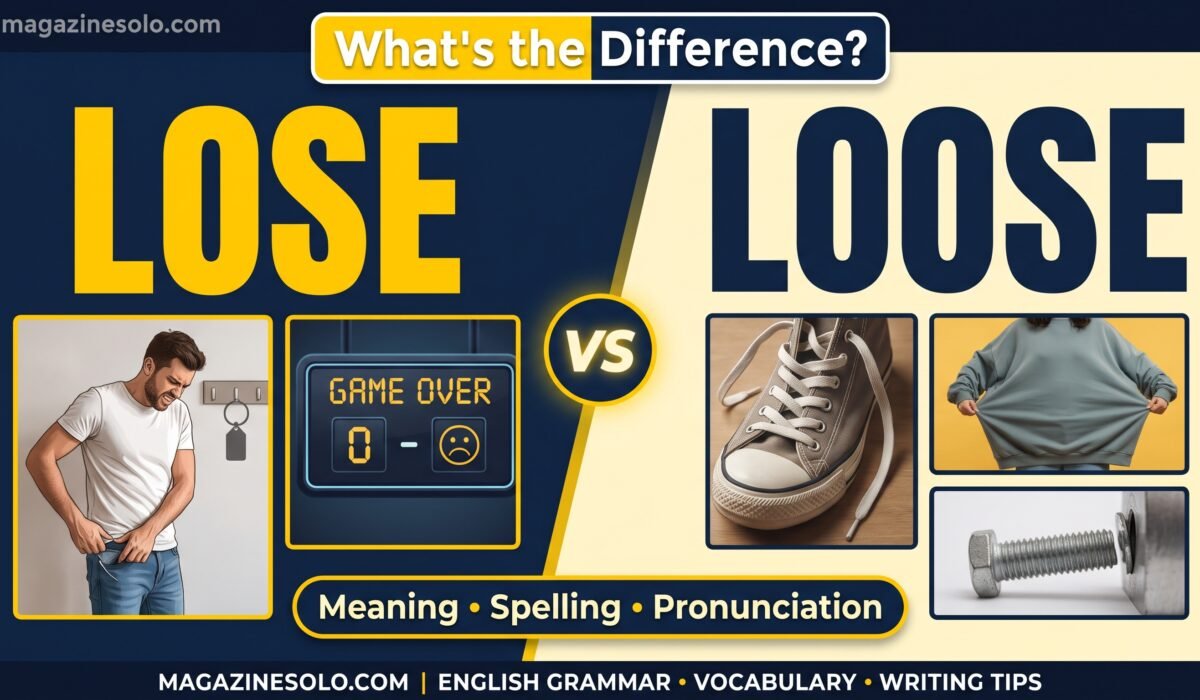
The lose vs loose difference is the one letter trap that survives every spellchecker: both words are real, both are spelled correctly, and only one of them means what your sentence needs.
Here is the whole distinction in one breath. Lose is a verb, and only a verb: to misplace something, to fail to win, to cease to have. Loose is a describer first: not tight, not firmly fixed, free to move.
They differ in sound, too, which almost nobody teaches. Lose ends in a buzzing z sound and rhymes with choose. Loose ends in a crisp s sound and rhymes with goose.
This guide gives you the three step test that settles the pair by ear, by eye, and by grammar, then the whole family: lost, loss, losses, loses, and the verb people actually want, loosen.
Lose vs Loose at a Glance
|
Word |
Spelling Cue |
Sound |
Grammar Role |
Core Meaning |
|---|---|---|---|---|
|
Lose |
One o |
Looz, rhymes with choose |
Verb only |
Misplace, fail to win, cease to have |
|
Loose |
Two o’s |
Loos, rhymes with goose |
Adjective first, sometimes a verb |
Not tight, not fixed, free |
Read the table as three witnesses giving the same testimony. Spelling, sound, and grammar role always agree, so a sentence only has to pass one of the three checks to be settled.
It is the same species of problem as the sound alike set in our guide to there, their and they’re difference and the one letter swap in our guide to its vs it’s difference: two real words, one small difference, one test as referee.
The Sound and Shape Test
Step One: Say It
Say the sentence aloud and listen to the last sound of the word. If it buzzes like a z, the word is lose: looz. If it hisses like an s, the word is loose: loos.
The rhyme anchors make it permanent. Lose lives with choose, snooze, and booze. Loose lives with goose, juice, and moose. If you snooze, you lose is the oldest teaching rhyme in the pair, and it works because the sound is the spelling’s shadow.
Step Two: Count the O’s
Loose has two o’s, and loose things have extra room: a loose shirt, a loose screw rattling in its hole, a loose dog with the whole park to run. The doubled letter pictures the slack.
Lose has one o, because it lost the other one. Writers who picture the missing letter stop adding it within a week. The mnemonic is visual, instant, and available mid sentence, which is why it outlasts grammar lectures.
Step Three: Ask the Grammar Question
Ask what job the sentence needs done. An action (misplacing, failing, ceasing to have) takes the verb, lose. A description (not tight, not fixed, not exact) takes the adjective, loose.
This step is the court of last resort, and it never fails, because the roles never overlap. Merriam-Webster’s usage guide to lose and loose puts the foundation plainly: lose typically functions only as a verb, while loose spreads across several parts of speech.
When the Checks Seem to Disagree
In your head, silently, the sound check can blur: most people do not hear their own inner voice precisely. When that happens, do not average the checks. Demote sound and promote grammar.
The grammar question works in total silence, on paper, at speed. Action or description is a fact about the sentence itself, not about your ear, which is why editors who never pronounce anything still never make this error.
The Choose Trap: Why Your Brain Wants Two O’s
The error has a specific cause, and naming it disarms it. Lose rhymes with choose, and choose is spelled with two o’s, so the brain helpfully offers the same spelling to its rhyming neighbor.
Merriam-Webster’s guide names exactly this analogy as a driver of the confusion. The defense is one sentence of knowledge: lose sounds like choose but is spelled like it lost something, because that is what it means.
The trap is the same species as the sound alike pair in our guide to affect vs effect, where one letter decides between causing a change and the change itself. English is full of these near misses, and each one falls to its own small test.
Lose: The Verb That Only Acts
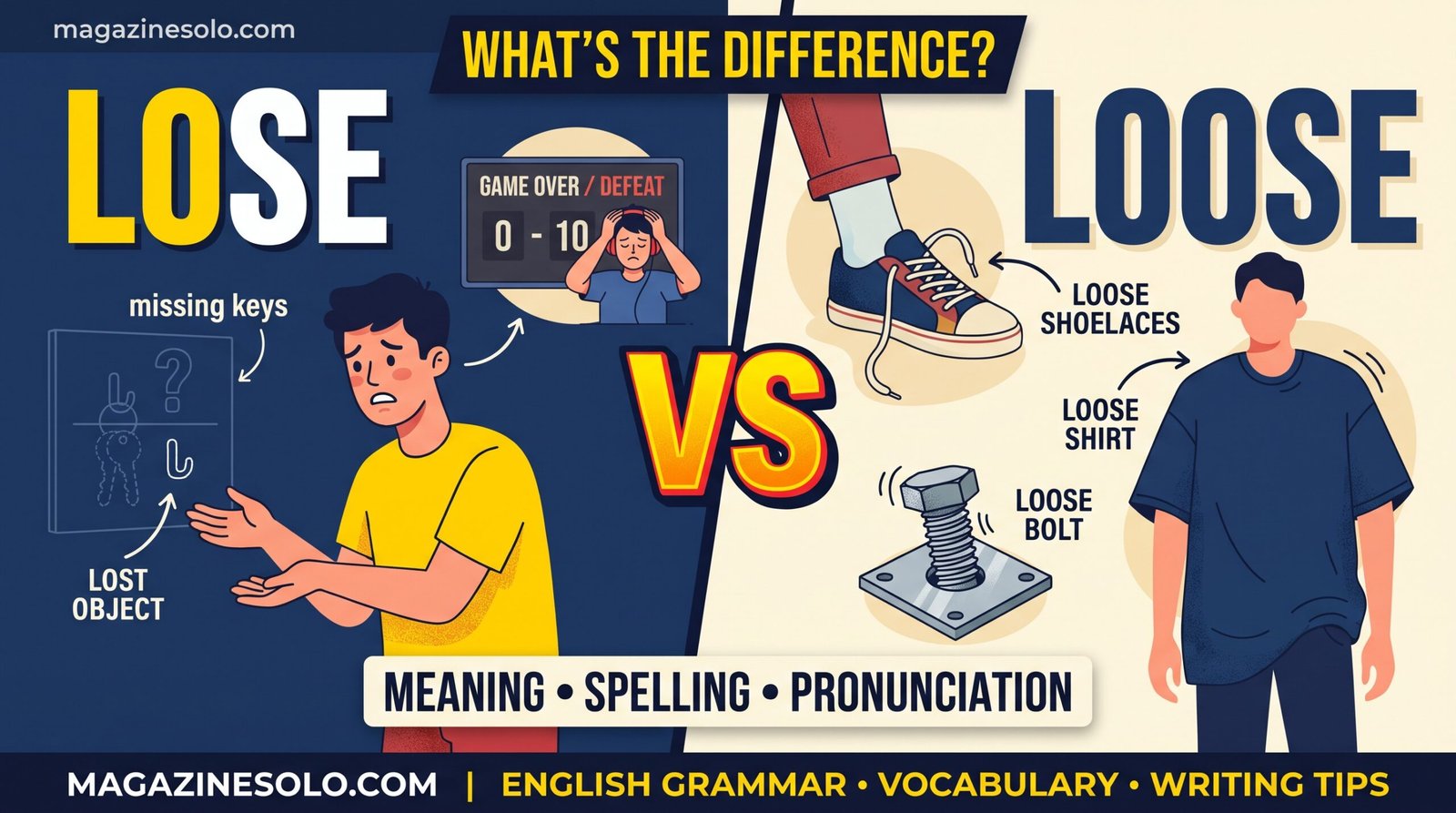
The Jobs of Lose
Lose does four related jobs, and recognizing which one your sentence needs is most of the skill.
- Misplace: to become unable to find something. I lose my keys every winter. Don’t lose the receipt.
- Fail to win: to be defeated, the opposite of win. They lose every final. We might lose the contract.
- Cease to have: to be deprived of something once held. She lost her job. He could lose his license.
- Have less of: to shed quantity. Lose weight, lose height, lose two inches off the waist.
A fifth, quieter job deserves a line: fail to keep. Lose balance, lose patience, lose track, lose count. The thing slips from your grip rather than from your possession, but the verb is the same.
The Family Forms of Lose
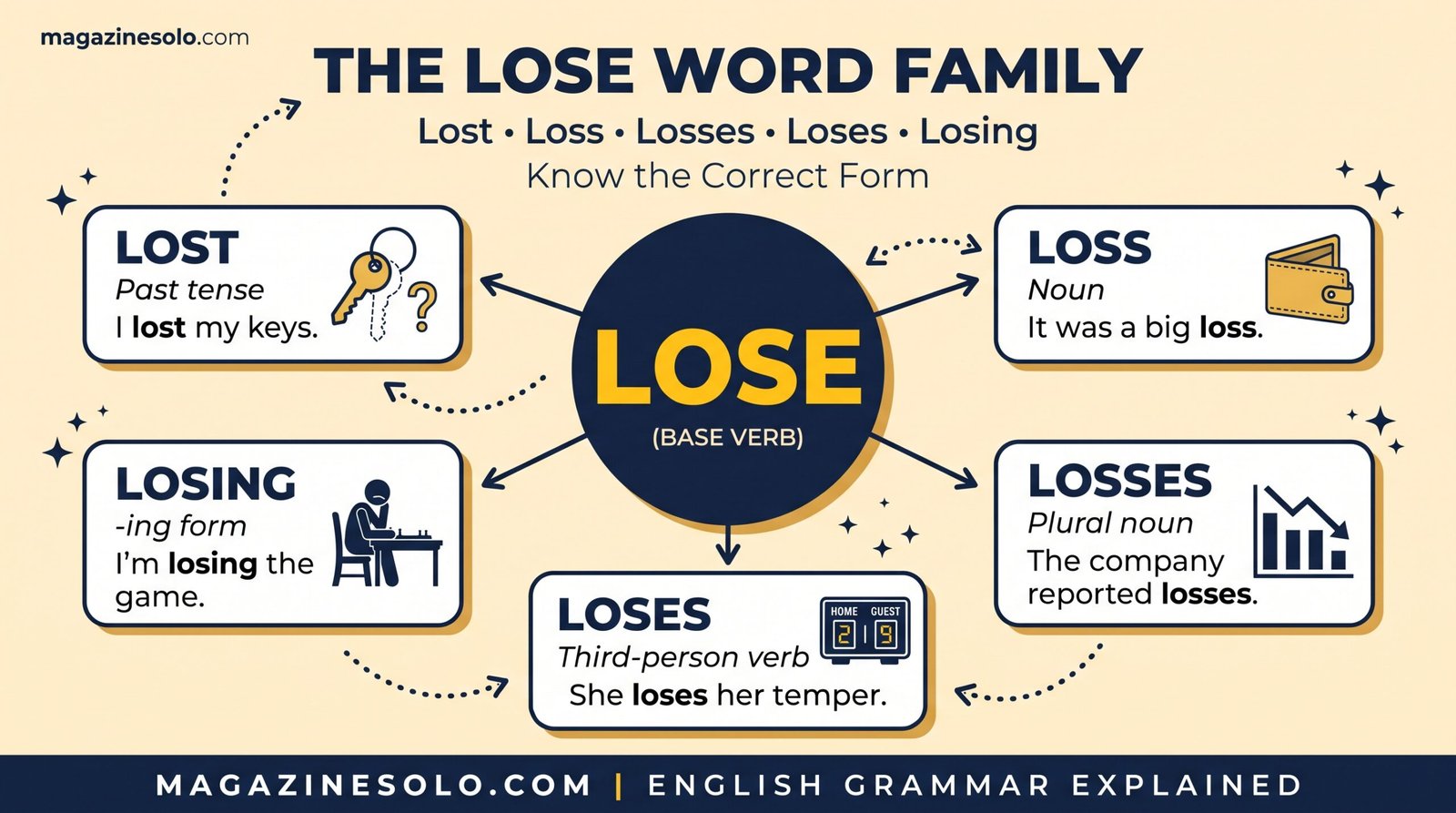
The verb conjugates irregularly, and the forms are half the confusion in this whole topic.
- Lost is the past tense and past participle: lose, lost, lost. There is no losed, ever. I lost my wallet yesterday; I have lost it twice.
- Losing is the ing form: losing the game, losing my mind, a losing streak.
- Loses is the third person singular: she loses her temper rarely; the team loses at home.
Lost doubles as an adjective meaning missing or unable to find the way: a lost child, lost property, a lost look. That adjective use is why lost sits so close to loose in learners’ minds, and the family table below separates them for good.
Lose in the Wild
Notice how every natural example is an action or an outcome, never a description: lose an election, lose a bet, lose consciousness, lose interest, lose signal, lose money, lose time, lose face.
If the phrase you are writing names something happening to a person or a team, the word is almost certainly lose. Descriptions belong to the other word, and the border between the two territories is the whole lesson.
Loose: The Word That Describes
The Adjective Jobs
Loose earns its keep in four descriptive territories, set out fully in Merriam-Webster’s entry for loose and Cambridge Dictionary’s entry for loose alike.
- Not tight: loose jeans, a loose lid, loose skin after weight loss.
- Not firmly fixed: a loose screw, a loose tooth, loose bricks in a wall.
- Free from restraint: the dog got loose; a horse on the loose; boats breaking loose from the dock.
- Not strict or exact: a loose translation, loose rules, a loose interpretation of the data.
The four territories share one root image: something with room to move. Fit, fastening, freedom, and precision are all measurements of slack, which is why one adjective covers them all.
Loose as a Verb: Release
Less often, loose works as a verb meaning to release, set free, or let fly: the soldiers loosed their arrows; they loosed the hounds at dawn. Its past form is loosed.
This verb is real but rare in daily writing, and it releases completely. That completeness is what separates it from loosen, the everyday verb of partial slack, which gets its own section below.
Looser and Loosest
Loose grades like any adjective: loose, looser, loosest. These jeans are looser than those; this is the loosest knot of the three.
Lose cannot grade, because verbs do not compare. So if your sentence is comparing fit, tightness, or freedom, only the loose family can appear in it, and the choice makes itself.
The Rare Loose
Two corners complete the word’s map. In archery, loose is a noun: the release of an arrow from the bow. And loose appears as an adverb in phrases like play loose or stay loose, describing manner rather than a thing.
Neither corner will appear in most writers’ sentences. They matter here because they explain dictionary entries that confuse learners, and because completeness is what separates a reference from a tip sheet.
The Whole Family in One Table
|
Word |
Role |
Meaning in One Line |
Example |
|---|---|---|---|
|
Lose |
Verb, present |
Misplace, fail, cease to have |
Do not lose the key |
|
Lost |
Verb, past; adjective |
Already lost; or missing |
We lost the key; a lost key |
|
Loss |
Noun |
The act or thing lost |
The loss of the key hurt |
|
Losses |
Noun, plural |
Several losses counted |
Three losses in a row |
|
Loses |
Verb, third person |
He or she loses |
She loses every key |
|
Losing |
Verb, ing form |
In the act of losing |
Losing my mind |
|
Loosing |
Verb, ing form of loose |
In the act of releasing |
Loosing the arrows |
|
Loosen |
Verb |
Make or become less tight |
Loosen the knot |
|
Loose |
Adjective; verb |
Not tight; or set free |
A loose knot; loose the dogs |
Read down the role column and the family’s logic shows itself: one verb (lose) and its forms, one noun (loss) and its plural, one adjective (loose) and its two verb relatives (loose itself, and loosen).
The losses against loses row pair is the family’s sharpest trap, sharp enough that Grammarly’s guide to losses vs loses exists solely to police it. The count test resolves it: countable things take losses; a person or team doing the action takes loses.
Role splitting of this kind is the cluster’s house pattern.
The role pair in our guide to who vs whom difference splits its two forms by job: the one acting takes who, the one acted on takes whom. This family splits by a simpler question: is the word acting, being counted, or describing?
Loosen vs Loose: The Verb People Actually Want
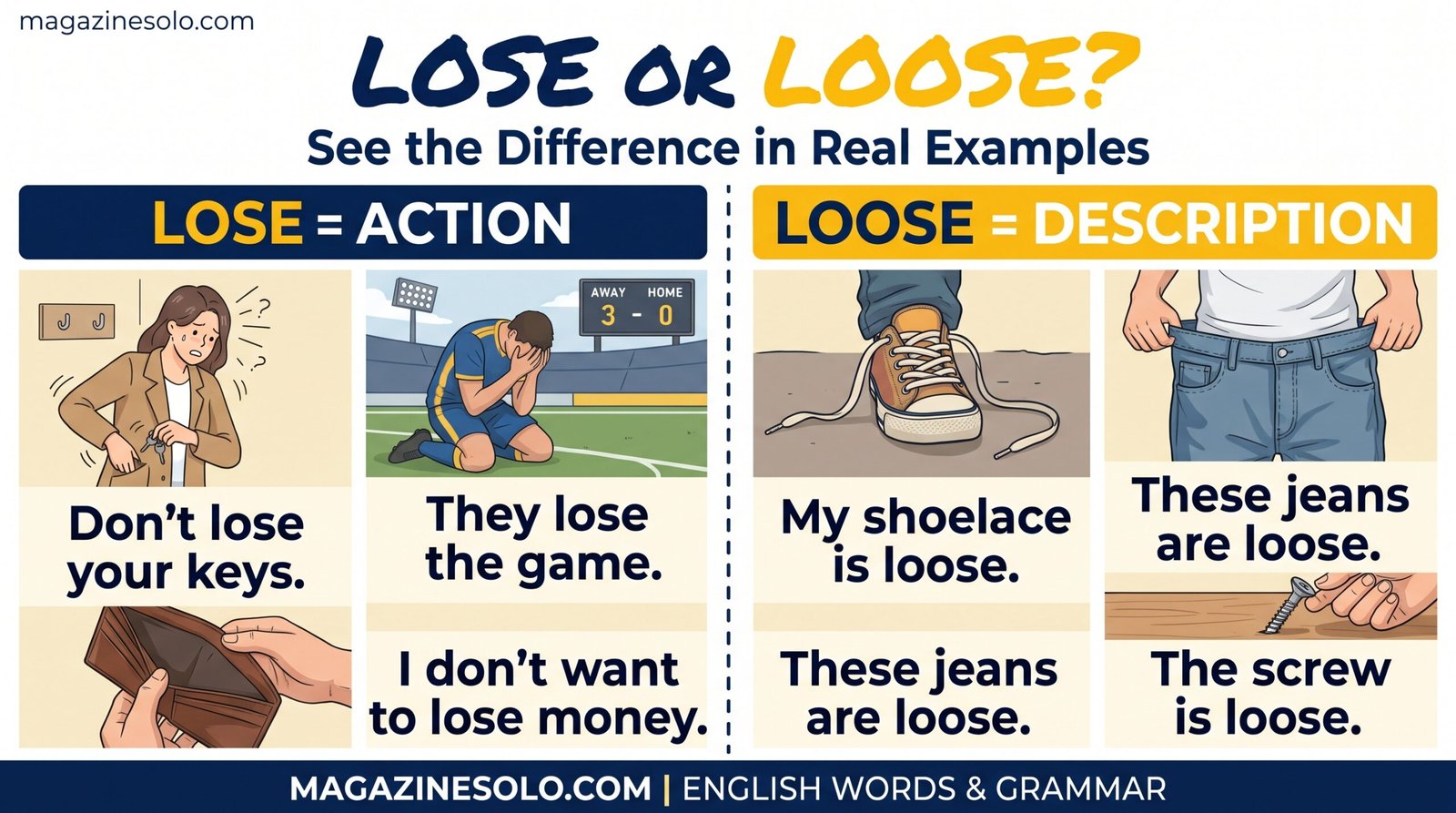
Most writers who reach for loose as a verb want loosen: to make or become less tight, less firm, or less strict. Loosen your tie. Loosen the bolt a quarter turn. The committee loosened the rules.
The verb loose does something stronger: it ends the restraint. You loose a dog from its chain, loose an arrow, loose a volley. Nothing is left partially fastened, because the point is release.
The Knot Test
Picture a knot. If the sentence leaves the knot tied but slacker, the word is loosen.
If the sentence leaves the rope free in your hand, the word is loose. If the knot is gone entirely and something is lost, you are back in lose territory, and the test has walked you home.
The Idiom Map
Idioms are where the pair hides in plain sight, because nobody analyzes a phrase they have said a thousand times. Sorted by owner, the stock looks like this.
Things You Lose
- Lose your temper: cease to control it. Timing traps of exactly this size live in our guide to than vs then difference, where one letter separates comparing something from sequencing it.
- Lose your mind: go frantic or irrational, usually hyperbolic.
- Lose it: lose composure entirely; the it is deliberately vague.
- Lose your way: become lost, literally or in a project or argument.
- Lose out: fail to receive an expected gain; apply early or lose out.
- Lose sleep over: worry so much that sleep goes; usually negative: I’m not losing any sleep over it.
Things That Are Loose
- Loose change: coins carried unpackaged, the pair’s favorite teaching sentence: do not lose your loose change.
- Loose cannon: a person whose uncontrolled behavior endangers their own side, from a ship’s gun broken free of its mountings.
- Loose lips: careless talk, from the wartime warning that loose lips sink ships.
- Loose ends: unfinished details, pictured as untied rope ends; finishing a project is tying them up.
The Escape Phrases
- On the loose: free and uncontrolled after escaping; the phrase always carries a little caution.
- Break loose: escape restraint suddenly; boats, dogs, and crowds break loose.
- Let loose: release, or erupt: let the dogs loose; she let loose a scream.
- Hang loose: relax, stay easy; surf culture’s gift to the adjective.
Every idiom on these lists obeys the main rule. The lose list is all actions and outcomes; the loose lists are all states of slack or freedom. Learn the lists as sorted, and you have quietly learned the rule twice.
Two Honest Notes
Loose About People: A Dated Sense to Retire
Loose applied to a person historically suggested lax morals, and applied to a woman it became a derogatory label that dictionaries record and modern writers avoid.
The guidance is simple: describe talk, habits, and organization as loose if you must (loose discipline, a loose talker), and do not use the word as a character verdict on a person.
A reference that hides this sense fails its readers; one that recommends it fails worse.
Unrelated by Birth: The Etymology Split
The two words are not relatives who drifted apart; they were never family. Lose descends from Old English losian, to perish or become lost. Loose arrives from Old Norse lauss, free and unbound, through Middle English.
That separate birth explains everything frustrating about the pair. No shared root means no shared pattern to lean on, which is why the sound and shape test, not a family resemblance, has to do the work.
It is also why this guide follows the dictionary record where competitor pages disagree about the origins. One widely read page gives loose an Old English ancestry the dictionaries do not support, and repeating it would build the lesson on a cracked stone.
Why This Pair Matters at Work and in Exams
This is not a pedant’s distinction. Teaching and proofreading sites flag the swap as one of the errors that most damages a writer’s credibility, precisely because it is so visible and so easy to avoid once known.
A loose weight in a fitness article, a loosing in a business email, a lose ends in a project report: each one tells the reader the writer did not check.
In exam English, including IELTS style tests, the pair is a standard trap item, set because markers know it separates careful writers from fast ones.
The encouraging arithmetic is that the fix costs almost nothing. One test, learned once, retires the error permanently, which is more than can be said for most spelling traps. Few corrections in English offer this ratio of effort to safety.
Common Mistakes and Corrections
1. Loose weight. “I want to loose ten pounds before summer.” The internet’s signature error. Weight is ceased to have, which is the verb. Correction: lose weight. Its twin rides along: after you lose weight, jeans hang loose, and loose skin names skin no longer tight.
2. Loosing my mind. “I’m loosing my mind over this form.” Nothing is being released; a mind is being lost. Correction: losing my mind. Loosing exists only where arrows, hounds, or volleys are being set free.
3. I loss my keys. “I loss my phone at the station.” Loss is a noun and can never carry a past action. Correction: I lost my keys. The verb’s past is lost; the noun names the event afterward: the loss of my phone.
4. Don’t loose your temper. “Don’t loose your temper with the clerk.” Temper is lost, not released; the idiom belongs to the verb family. Correction: don’t lose your temper. The same fix covers loose hope, loose track, and loose count.
5. Lose ends. “Let’s tie up the lose ends on this project.” The image is rope: untied ends are loose, and tying them is the work. Correction: tie up loose ends. Lose ends would mean misplacing the ends, the opposite of finishing.
The discipline behind all five corrections is the same one that runs through our guide to fewer vs less difference and our guide to further vs farther difference: a small test, applied once, beats a page of memorized examples.
Its verb companion lives in our guide to your vs you’re difference and our guide to there, their and they’re difference, where one letter likewise decides whether the sentence you wrote is the sentence you meant.
Practice: Ten Sentences
Choose lose, loose, lost, loss, or loosen for each sentence. The key follows, with the reasoning compressed to the test.
1. Do not ___ your passport at the airport.
2. The screw is ___, so the shelf wobbles.
3. She ___ her wallet on the train yesterday.
4. After the diet, his jeans were ___ at the waist.
5. The company reported heavy ___ for the third year running.
6. ___ the knot a little before you try to untie it.
7. The dog broke ___ and ran for the park.
8. He ___ his temper whenever the traffic stops.
9. I’m ___ my mind over this paperwork.
10. Careful with those coins, or you will ___ your ___ change.
Key: 1 lose (the verb of misplacing). 2 loose (not firmly fixed). 3 lost (the action already happened). 4 loose (not tight). 5 losses (countable noun; losses is the plural).
Key, continued: 6 Loosen (make less tight, still tied). 7 loose (escaped restraint). 8 loses (third person verb). 9 losing (the ing form of lose). 10 lose, loose (the classic stack: verb first, adjective second).
Score it honestly: most misses cluster on sentences 3, 5, and 8, the family forms. That is normal, and it is exactly what the family table above is for.
The 30 Second Decision Card
Say it. Z sound, rhymes with choose: lose. S sound, rhymes with goose: loose.
Count it. One o: lose, it lost one. Two o’s: loose, room to spare.
Ask it. Action or outcome? Lose. Description of slack or freedom? Loose.
Verb check. Releasing completely takes loose; making less tight takes loosen; everything else verbal takes lose.
Four checks, thirty seconds, and the pair never costs you a second thought again. What it should cost you is one read of the family table, because lost, loss, and losses are where the second errors breed.
Frequently Asked Questions
What is the difference between lose and loose?
Part of speech, sound, and meaning at once. Lose is only a verb: misplace, fail to win, cease to have. Loose is mainly an adjective: not tight, not fixed, free.
They also sound different. Lose ends in a z sound, loose in an s sound.
How do you remember lose vs loose?
Two tricks cover almost everyone. Count the o’s: loose has two, like the extra room in a loose shirt; lose has one, because it lost the other.
Then listen: lose rhymes with choose and snooze, loose with goose and juice. If you snooze, you lose.
Is it lose weight or loose weight?
Lose weight. Shedding body mass is ceasing to have it, which is the verb in action. Loose weight is one of the most common spelling errors in English.
The useful contrast: after you lose weight, jeans may hang loose, and loose skin is correct for skin no longer tight.
Is it lose or loose for a screw that is not tight?
Loose. A loose screw is not firmly fixed, the adjective doing its core job.
If the screw then falls out and cannot be found, you lose it. The pair meets constantly in repair writing, which is why the distinction matters there.
What does lose mean?
Lose is a verb with a family of senses: be unable to find something, fail to win, cease to have or be deprived of something, and have less of something.
Lose your keys, lose the game, lose a job, lose weight. Its past tense and past participle are both lost.
What does loose mean?
Loose is mainly an adjective: not tight or not firmly attached, free from restraint, and not strict or exact. Loose jeans, a loose tooth, a loose translation.
Less often it is a verb meaning release or set free, and rarely a noun in archery for an arrow’s release.
How do you pronounce lose and loose?
Differently, and the difference is the fastest ear test in the pair. Lose is pronounced looz, rhyming with choose, because its s sounds like a z.
Loose is pronounced loos, rhyming with goose, with a crisp s sound. They are near homophones, not true homophones.
Is lose a verb or an adjective?
Only a verb. Merriam-Webster notes that lose typically functions only as a verb, while loose spreads across adjective, verb, and rarer uses.
If your sentence needs a describing word, lose can never fill the slot. That single fact resolves most real sentences before spelling is considered.
Can loose be a verb?
Yes, though it is the less common use. As a verb, loose means to release, set free, or let fly: the soldiers loosed the arrows. Its past form is loosed.
Do not confuse it with loosen, which means make less tight rather than free completely.
What is the past tense of lose?
Lost. Lose is an irregular verb with the pattern lose, lost, lost; no ed ending is ever added.
I lose my keys most weeks; I lost them twice last month; I have lost them again. Lost also works as an adjective meaning missing.
What is the difference between lose and lost?
Time. Lose is the present and base form: do not lose the receipt. Lost is its past tense and past participle: we lost it yesterday, we have lost it.
Choose by when the losing happened, not by meaning. The meaning is the same verb at two points in time.
What is the difference between lose and loss?
Grammar role. Lose is the verb, the action; loss is the noun, the thing or event. The team may lose tonight; another loss would hurt.
If the sentence needs something countable, weighable, or sufferable, it needs loss. Its plural is losses.
Losses vs loses: what is the difference?
One letter decides noun against verb. Losses is the plural of the noun loss: the company reported heavy losses.
Loses is the third person singular of the verb: she loses her temper rarely. Usage guides maintain whole pages on this neighbor pair because the confusion is constant.
Is it losing or loosing?
Losing, in almost every real sentence. Losing is the ing form of lose: losing my mind, losing the game.
Loosing exists only as the ing form of the verb loose, to release: loosing the arrows. If nothing is being set free, the word is losing.
Is it loose skin or lose skin?
Loose skin. Skin that hangs after weight loss is not tight, which is the adjective at work. No verb sense of lose fits skin you still have.
Pair it with its twin: you lose weight, the verb, and may then have loose skin, the adjective.
What does loosen mean, and how is it different from loose?
Loosen is the everyday verb for making something less tight or less strict: loosen your tie, loosen a bolt, loosen the rules.
The verb loose means release completely, a stronger and rarer act. You loosen a knot before untying it; you loose a dog from its chain.
Is it lose your temper or loose your temper?
Lose your temper. The idiom belongs to the lose family: to lose one’s temper is to cease controlling it.
Merriam-Webster lists it among the standard things one can lose, alongside one’s mind and one’s way. Loose your temper would mean releasing it on purpose, which is not the idiom.
Why do people confuse lose and loose?
Three pressures combine. The spellings differ by one letter; the pronunciations are close cousins, z against s.
And lose breaks the pattern writers expect: it rhymes with choose, so the brain offers it choose’s second o. Merriam-Webster names exactly that analogy as a driver of the error.
Is it don’t lose or don’t loose?
Don’t lose. Commands against misplacing, wasting, or being defeated take the verb: don’t lose your ticket, don’t lose hope.
Don’t loose would instruct someone not to release something, almost never the intended command outside archery and animal handling.
What does on the loose mean?
Free and not under control, usually after escaping: the prisoner is on the loose; the dog is on the loose in the park.
The phrase uses loose in its free from restraint sense and carries a note of caution or mischief. It is always loose, never lose.
What does loose change mean?
Coins carried in a pocket or bag rather than in a wallet or roll, listed by Merriam-Webster among the standard loose idioms.
The coins are loose because they are not contained. A favorite teaching sentence stacks the pair: if you are not careful, you could lose your loose change.
What does lose it mean?
To lose control of your emotions or composure: she completely lost it in the meeting.
Merriam-Webster glosses lose it as losing one’s composure, and the it is deliberately vague, standing for temper, calm, or grip. Informal, universal, and always spelled with lose.
What is a loose cannon?
A person whose uncontrolled behavior endangers their own side, from a ship’s cannon broken loose from its mountings and rolling across the deck.
The adjective is loose in the not secured sense, and the idiom warns that loose things under force are dangerous. Always loose cannon.
Is it break loose or break lose?
Break loose. To escape from restraint is to break loose: the boat broke loose from its moorings.
Break lose is not an English phrase. The same spelling holds for get loose, come loose, and cut loose.
What does at a loose end mean?
Having nothing to do, with time unoccupied: I was at a loose end on Sunday, so I visited a friend.
The phrase pictures a rope end left untied and dangling. It is common in British English and understood everywhere, and the word is the adjective loose.
Is loose the opposite of tight?
Yes, in its core adjective sense: loose is the standard antonym of tight for fit, fastening, and tension. A loose lid, a tight lid.
Its near synonyms include slack and baggy. Lose, by contrast, takes win as its famous opposite in the competition sense.
What is the opposite of lose?
It depends on the sense, which is itself the lesson. Opposite of lose a game is win; of lose an object, find; of lose weight, gain.
Writers who pin the sense first rarely make the spelling error, because each opposite belongs to the verb, and the verb is lose.
How do you use lose and loose in one sentence?
Put each word in its own job: the verb acts, the adjective describes. If your ring is loose, you could lose it.
Or the classic: do not lose your loose change. One sentence like this, written by hand once, fixes the pair for many learners.
Is it lose or loose when a dog escapes?
The escape itself takes loose: the dog got loose, broke loose, is on the loose.
Lose enters only if someone cannot find the dog afterward. Sequence separates the words: first the dog gets loose, then the owner worries she will lose it.
What does a loose translation mean?
A translation that renders the sense freely rather than word for word. Loose here means not strict or exact.
It is the same sense as a loose interpretation or loose rules, the adjective’s figurative branch, and it is always loose. A lose translation does not exist.
Is looser a word?
Yes. Loose forms regular comparatives: loose, looser, loosest. These jeans are looser than those.
Lose has no comparative, because verbs do not grade. If a sentence compares fit or tightness, only the loose family can appear in it.
What does loose lips mean?
Careless talk, from the wartime slogan loose lips sink ships: talking freely can give away what should be guarded.
Loose here means unrestrained, applied to speech. The phrase survives in offices and security briefings, spelled with loose.
Is it tie up loose ends or lose ends?
Tie up loose ends. Loose ends are a project’s unfinished details, pictured as untied rope ends; tying them up finishes the work.
Lose ends is a common written error that reverses the image. The noun is ends, and its adjective is loose.
Can loose describe a person, and is it polite?
It can, and usually it is not. Loose applied to a person historically suggested lax morals, and applied to a woman it became a dated, derogatory label.
Modern dictionaries mark the sense, and modern writers avoid it about people. Loose about talk or discipline stays descriptive rather than insulting.
What does lose out mean?
To fail to receive an expected gain: buyers lost out on the house; apply early or lose out.
Merriam-Webster lists lose out among the standard lose idioms. The out adds the missing of a benefit, and the phrase is common in property, jobs, and tickets. Always lose out.
Is it lose sleep over or loose sleep over?
Lose sleep over something: worry about it so much that sleep suffers. Merriam-Webster notes it is usually used in the negative: I’m not losing any sleep over it.
The verb is lose, because the sleep is genuinely being lost. Loose sleep is not an English phrase.
What is the noun form of lose?
Loss. The verb lose produces the noun loss for the act, event, or thing lost: the loss of his job, a heavy financial loss.
One trap rides along: loss is never a verb, so I loss my keys is wrong twice over. The past verb is lost.
How do you spell the plural of loss?
Losses, with a double s before the es: one loss, two losses. Companies report losses; teams pile up losses.
Do not confuse it with loses, the verb form in he loses. The count test resolves the pair: countable things take losses.
What does let loose mean?
To release, set free, or stop restraining: they let the dogs loose; she let loose a scream; he let loose with a string of complaints.
Let loose takes loose as an adjective after the object, or stands as a phrase meaning erupt. It never takes lose.
Is it hang loose or hang lose?
Hang loose, an informal instruction to relax and stay calm, popularized in surf culture.
Loose describes the state you are told to keep: un tense and easy. Hang lose is not a phrase, and the same adjective appears in play loose and stay loose.
Lose vs loose in British and American English: any difference?
No difference in the words themselves: both varieties split the pair identically, and the classic errors appear on both sides of the Atlantic.
What varies is the surrounding idiom stock: at a loose end leans British, hang loose is American in origin. The spelling rule travels unchanged.
What is the fastest test to choose between lose and loose in a sentence?
Two questions, in order. Does the sentence need an action (misplace, fail, cease to have)? Then it is the verb, lose, with one o.
Does it need a describing word for not tight, not fixed, or free? Then it is loose, with two o’s for the extra room.
Conclusion
The lose vs loose choice is a question about sound, shape, and job at once: lose is the verb with one o and a z sound, loose is the describer with two o’s, an s sound, and room to move.
Run the test, respect the family table, and the spellchecker stops being your only defense. What remains is the more useful habit: hearing the difference, so the right spelling arrives with the right sound.
The neighboring calls live throughout the MagazineSolo word pair library, where every pair gets the same treatment: a test first, the exceptions named, and no claim the evidence cannot carry.

Dilawar Mughal is an SEO expert with 8 years of hands-on experience helping websites grow their organic traffic, rankings, and revenue. He specializes in content-driven SEO, local SEO, and Pinterest SEO, and builds practical, results-focused strategies for businesses and publishers.