

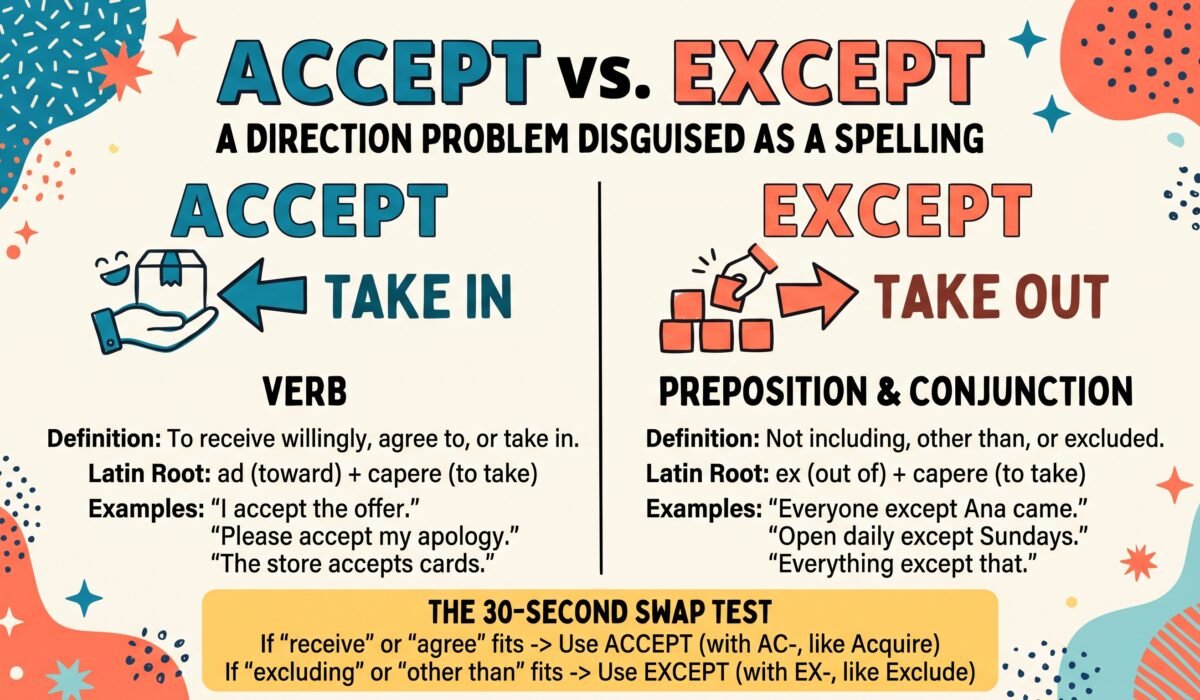
The accept vs except difference is a direction problem disguised as a spelling problem: one word takes something in, the other takes something out, and swapping them reverses your sentence.
Here is the whole distinction in one breath. Accept is a verb, and only a verb: to receive something willingly, to agree to it, to take it in. Except is the exclusion word: not including, other than, left out.
They sound nearly identical, which is why the error survives every spellchecker. Both words are real, both are spelled correctly, and only the meaning can referee between them.
This guide gives you the test that settles the pair by direction, by grammar job, and by a two word swap, then the whole family: accepted, excepted, exception, and the phrases that trap working writers.
It is the same species of problem as the sound alike set in our guide to there, their and they’re difference and the small letter swap in our guide to its vs it’s difference: two real words, one small difference, one test as referee.
Accept vs Except at a Glance
|
Word |
Direction |
Grammar Role |
Core Meaning |
Example |
|---|---|---|---|---|
|
Accept |
Take in |
Verb only |
Receive willingly, agree to |
I accept the offer |
|
Except |
Take out |
Preposition, conjunction, rare verb |
Not including, other than |
Everyone except Ana |
Read the table as one action seen from two ends. Accept pulls something toward you and into your hands, your group, or your beliefs. Except pushes one item out of the group the sentence just built.
One Root, Two Directions: The Take Test
The Shared Root Nobody Teaches
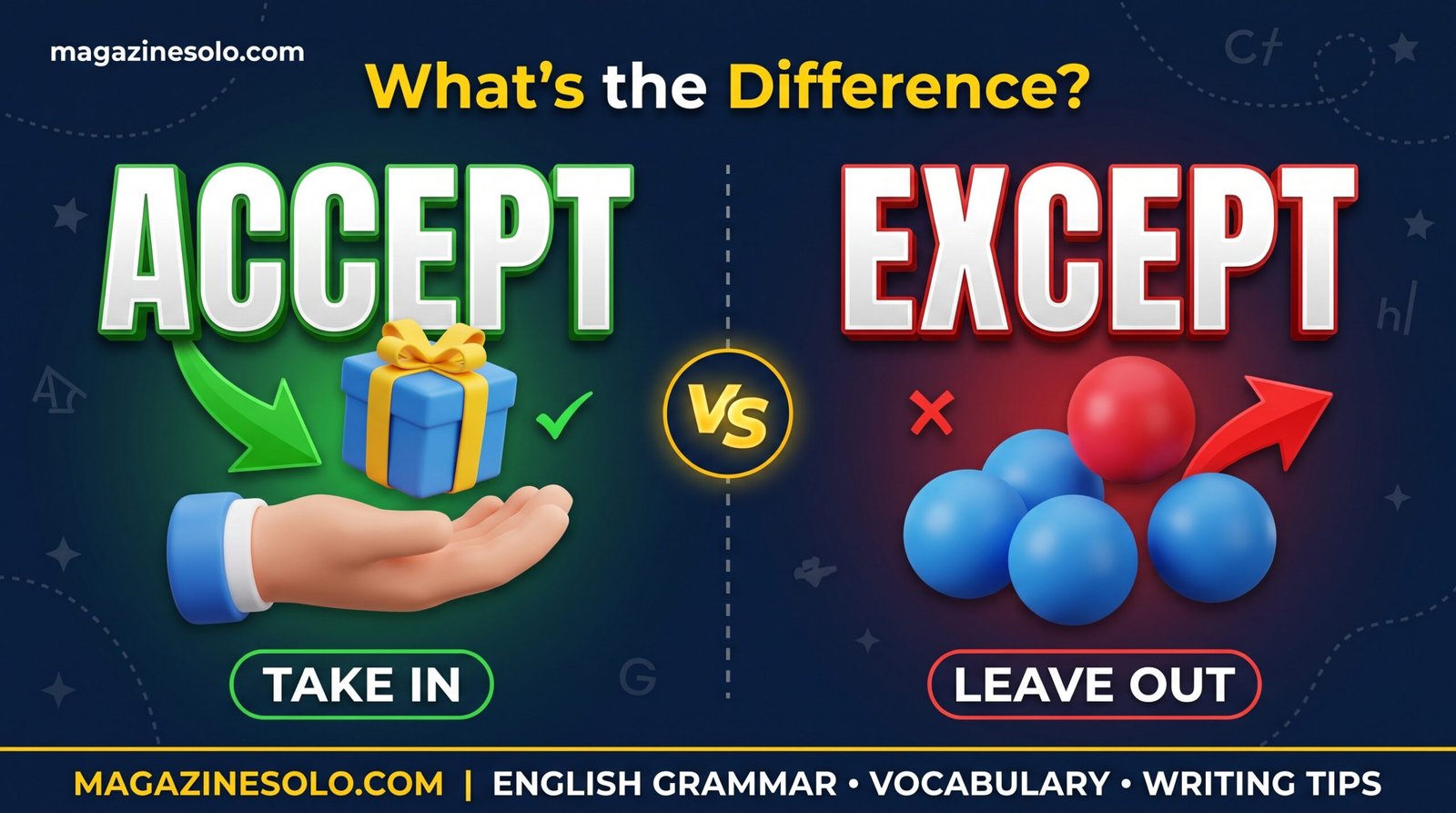
The pair’s secret is that they are relatives. Both words descend from the Latin verb capere, which means to take. They are the same action, pointed in opposite directions.
Accept grows from accipere: the prefix ad, meaning toward, joined to capere. To accept is to take toward yourself. Except grows from excipere: the prefix ex, meaning out of, joined to the same root. To except is to take out.
Dictionary.com’s accept vs except guide teaches this shared ancestor, and it deserves more weight than it usually gets. Once you see the two prefixes, the meanings stop being facts to memorize and become directions you can reason out.
Step One: Ask the Direction
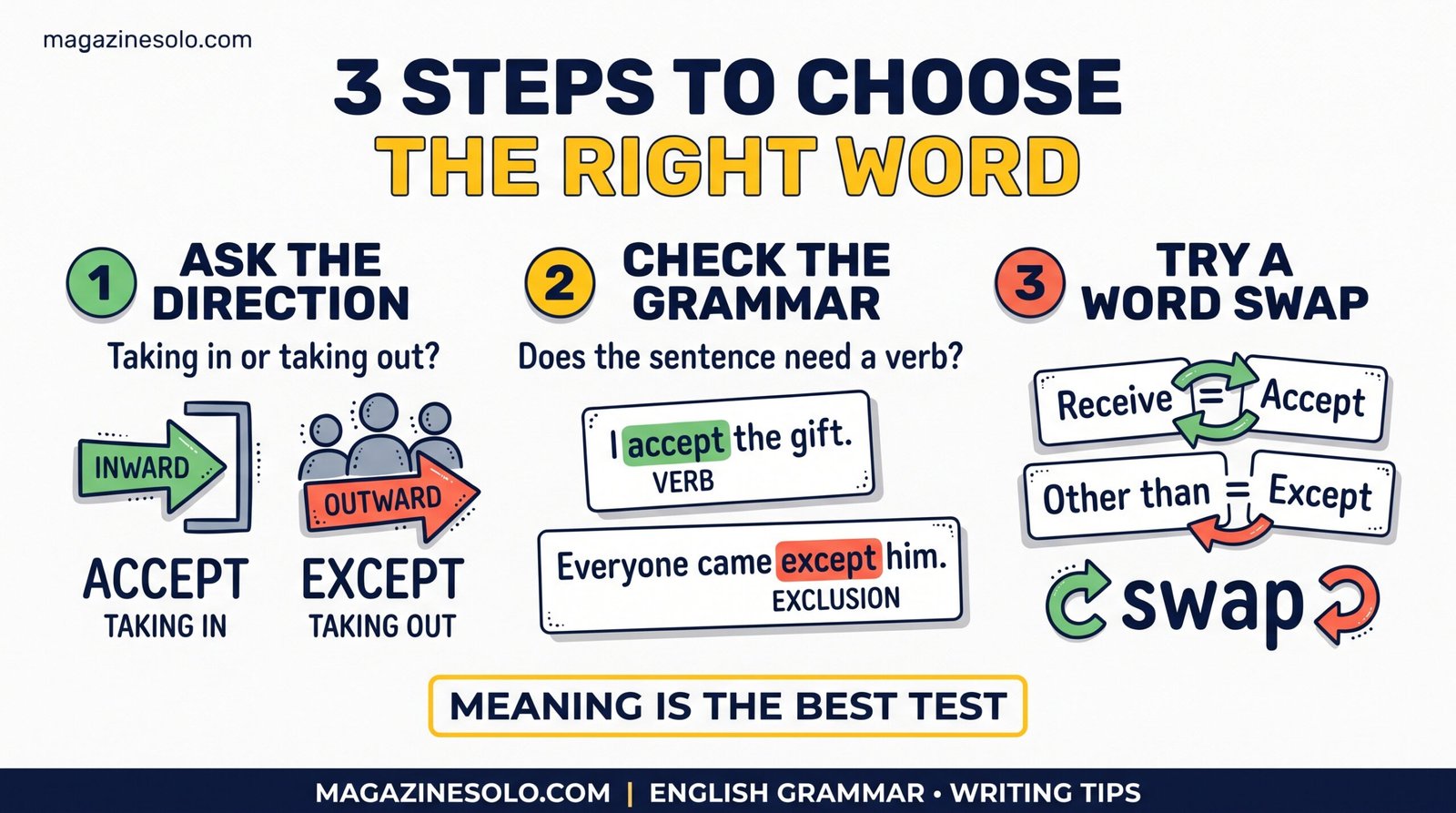
Ask what the sentence is doing with the thing in question. Is it being taken in: received, welcomed, agreed to, admitted? Then the word is accept, spelled with ac.
Is it being taken out: excluded, carved off, left off the list? Then the word is except, spelled with ex. Direction is a fact about the sentence’s meaning, so this step works in silence, on paper, at speed.
Step Two: Ask the Job
Ask what part of speech the slot needs. If the sentence needs an action performed by a subject, only accept can apply, because accept exists solely as a verb.
Merriam-Webster’s usage guide to accept and except puts the foundation plainly: accept only functions as a verb, while except spreads across preposition, conjunction, and a rare verb use. If the slot is not a verb slot, the answer is except before meaning is even consulted.
Step Three: Run the Swap
Test the sentence with a plain substitute. If receive or agree to fits, the word is accept. If excluding, other than, or but not fits, the word is except.
The swap is the fastest of the three steps in live writing. Editors run it mid sentence: everyone receive me fails instantly, everyone other than me passes, and the ruling makes itself.
Why the Ear Cannot Referee
Do not trust pronunciation here. Except is spoken ik-SEPT, with a short i in the first syllable. Accept is usually uh-SEPT, with a reduced vowel that shrinks toward the same sound in fast speech.
Merriam-Webster observes that both words are primarily pronounced with that same initial ik sound. The pair are near homophones, not perfect ones, and the faint difference vanishes exactly when you speak quickly.
The sound first pair in our guide to lose vs loose difference can be settled by ear. This pair cannot. Direction, job, and swap are the referees here, and all three live in the sentence, not in your ear.
Accept: The Verb That Takes In
The Five Jobs of Accept
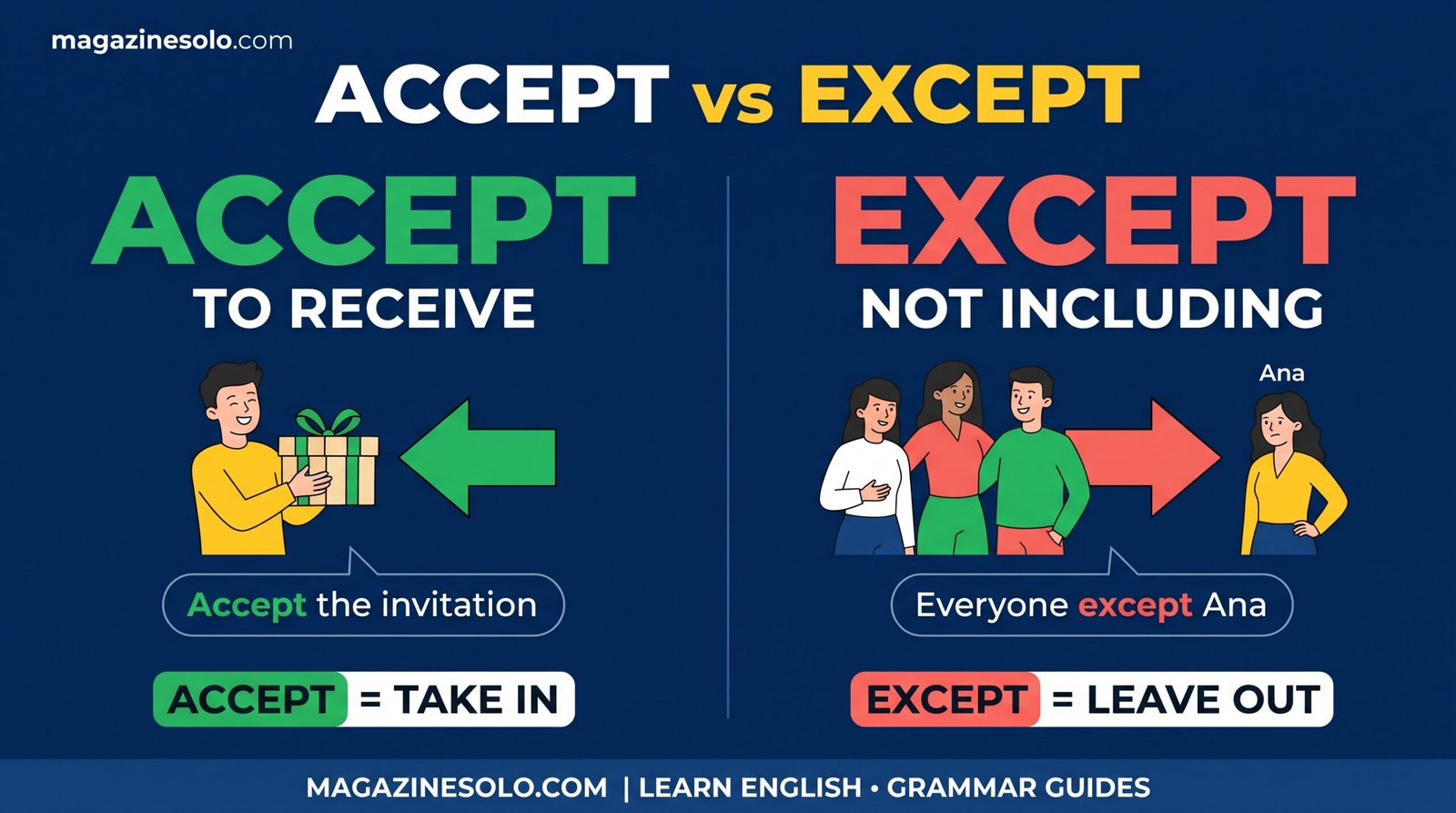
Accept does five related jobs, all catalogued in Merriam-Webster’s entry for accept, and recognizing which one your sentence needs is most of the skill.
- Receive willingly: to take what is offered. Accept a gift, accept the award, accept the package at the door.
- Agree to: to say yes to terms or a proposal. Accept the offer, accept the conditions, accept the invitation.
- Regard as true: to acknowledge a fact or explanation. Accept the results, accept that mistakes happen, accept responsibility.
- Admit into a group: to let someone in. The college accepted her; the club accepts new members in spring.
- Endure without protest: to bear an outcome. Accept defeat, accept the decision, accept the delay.
Every job shares the root image: something crosses a boundary inward, into your hands, your membership, your beliefs, or your tolerance. If nothing is coming in, accept is not your word.
The Forms of Accept
Accept conjugates regularly, and its forms are where the family’s sharpest trap hides.
- Accepts is the third person singular: she accepts the award; the store accepts cards.
- Accepted is the past tense and past participle: they accepted the offer; he has accepted the ruling.
- Accepting is the ing form: accepting the invitation, accepting applications until Friday.
Accepted doubles as an adjective meaning generally recognized: the accepted method, an accepted fact. That adjective is legitimate and common, and it is still spelled with ac, because recognition is a kind of taking in.
What Accept Never Does
Accept never introduces an exclusion, never precedes a carved out item, and never names a thing. There is no noun accept in standard English; the noun is acceptance, the act of taking in.
So a sentence like everyone accept me fails twice. The slot is not a receiving action, and the word forced into it cannot do exclusion work. The correction is except, the word built for leaving out.
Except: The Word That Takes Out
Except as a Preposition
The everyday except is a preposition meaning not including or other than, set out in Merriam-Webster’s entry for except and Cambridge Dictionary’s entry for except alike. The pattern is a general claim first, then except plus the excluded piece.
The shop is open daily except Mondays. Everyone passed except one student. He ate everything except the crusts. In each sentence, except removes exactly one item from a group the sentence just described.
Except as a Conjunction
Except also joins clauses, introducing the exception to a statement: I would help, except that I am leaving tonight. The house was dark except that one lamp burned upstairs.
Older English let except stand where unless stands now. Modern style prefers except that or unless, and reserving except for exclusions keeps your sentences, and your accept decisions, cleaner.
Except as a Verb: The Legal Corner
Except is also a real verb meaning to exclude or leave out, and this is the pair’s rare corner. Merriam-Webster notes the verb appears mostly in legal and formal writing.
Its surviving everyday home is a fixed phrase: present company excepted, meaning the people here are excluded from the criticism just made. You will also meet errors and omissions excepted on certificates and invoices.
Outside those frames, a verb slot almost always wants accept. Receiving is the common action of daily writing; excluding is usually done by the preposition, not the verb.
Except For: One Phrase, Two Jobs
Except for does the standard exclusion job: except for the rain, the picnic was perfect. Everyone was present except for one guard. One item is carved out of a general statement.
It also does a second, quieter job meaning if it were not for: except for your help, I would have failed. Except for the traffic, we would have arrived early.
Both jobs are exclusion at heart: the phrase names the one factor standing apart from the rest. Accept for, by contrast, is not a phrase at all, because accept needs a direct object, not a for phrase.
The Whole Family in One Table
|
Word |
Role |
Meaning in One Line |
Example |
|---|---|---|---|
|
Accept |
Verb, present |
Receive, agree to, take in |
Accept the invitation |
|
Accepts |
Verb, third person |
He or she accepts |
She accepts the award |
|
Accepted |
Verb, past; adjective |
Received; or generally recognized |
Accepted the offer; the accepted way |
|
Accepting |
Verb, ing form |
In the act of receiving |
Accepting applications |
|
Acceptance |
Noun |
The act of taking in |
Her acceptance speech |
|
Except |
Preposition, conjunction, verb |
Not including; or exclude |
Everyone except Ana |
|
Excepted |
Verb, past |
Excluded, left out |
Present company excepted |
|
Exception |
Noun |
The item left out of a rule |
No exceptions allowed |
|
Exceptional |
Adjective |
Unusually good; or forming an exception |
Exceptional service |
Read down the direction hidden in each row. The accept rows all pull inward: things received, people admitted, facts acknowledged. The except rows all push outward: items excluded, cases carved off, rules with one piece missing.
Accepted vs Excepted: The Past Form Trap
The two past forms differ by the same two letters as their parents, and swapping them produces the family’s most embarrassing written error. Accepted means received or admitted: accepted into the program, an accepted explanation.
Excepted means excluded: two names were excepted from the list, present company excepted. Write excepted where accepted belongs and a welcome letter becomes an exclusion notice, in front of exactly the wrong reader.
Exception and Acceptance: The Two Nouns
Each word grew a noun, and the nouns face opposite ways like their parents. Acceptance is the act of taking in: your acceptance of the offer completes the agreement.
Exception is the thing taken out: an exception to the rule, no exceptions will be made. When a sentence needs a noun, choosing between these two is the same direction test, one level up.
Role splitting of this kind is the cluster’s house pattern. The pair in our guide to who vs whom difference splits its forms by job, actor against receiver. This family splits by direction: everything is either coming in or being taken out.
Exceptional: The Word That Drifted
Exceptional began as the adjective of exception, meaning forming an exception. In modern everyday English it has drifted into a compliment: unusually good, outstanding, far above the ordinary.
An exceptional student is not an excluded student; exceptional service is praised, not carved out. Learn the drift explicitly, because it is the one family member whose modern meaning points away from its root.
The Phrase Bank: Who Owns What
Phrases Built on Accept
- Accept responsibility: acknowledge a duty or fault as yours and take it on.
- Accept the terms: agree to conditions, the sentence behind every I Accept button.
- Accept defeat: acknowledge a loss and stop resisting the outcome.
- Accept an apology: receive it and let the matter close.
- Accept the fact that: acknowledge something true, often reluctantly.
Phrases Built on Except
- No exceptions: nobody is left out of the rule; the sign painter’s favorite.
- With the exception of: the formal noun version of except, meaning other than.
- Make an exception: deliberately carve one case out of a rule.
- Except as otherwise provided: contract language meaning unless a different rule elsewhere applies.
- Errors and omissions excepted: a certificate formula excluding mistakes from a guarantee.
The Trap Phrase: Take Exception To
Take exception to means to object to something or take offense at it: she took exception to the remark. It does not mean leaving something out, despite wearing exception on its face.
The phrase preserves an older sense of exception as an objection. Learn it as a fixed unit, and never reason from it back to the plain exclusion meaning.
The Neighbor Traps
Accept vs Expect: The Typo Triangle
A third word haunts this pair. Expect means to anticipate something: I expect the train at six. Merriam-Webster notes that except is sometimes written where expect belongs, a typing slip between near shapes.
Keep the triangle sorted by job: anticipate is expect, receive is accept, exclude is except. Three similar silhouettes, three different actions, and the sentence’s meaning always knows which one it needs.
Except vs Besides: Opposite Directions
Except and besides look interchangeable and are not. Except removes from the group: everyone except Ana means Ana stayed home. Besides adds to it: besides Ana, three cousins came, meaning Ana plus three more.
Swap them and the guest list reverses. The check is the partner phrase: except travels with other than; besides travels with in addition to.
Except vs But and Apart From
But often does except’s job informally: everyone but me, nothing but trouble. Except is the more explicit exclusion word, safer in formal writing, and required in patterns like except for and except that, where but cannot go.
Apart from is the ambiguous cousin: apart from Ana can mean excluding Ana or in addition to Ana, depending on context. When direction matters, in a rule, a contract, or a guest list, except is the unambiguous choice.
Comparison traps of this kind run through the cluster.
The pair in our guide to than vs then difference separates comparing from sequencing with one letter, and the family in our guide to affect vs effect splits a cause from its result. Each pair falls to its own small test.
Accept and Except at Work
This pair earns its keep in adult writing, where the swap is read by clients, employers, and counterparties. Four sentences carry the stakes.
The terms sentence. Every signup page on earth ends with a button reading I Accept, because terms are offered for agreement, and agreeing is accept’s job. I except the terms would claim you are excluding them, nearly the opposite legal act.
The policy sentence. Stores print the pair together constantly: we accept all returns except final sale items. Accept states what is received; except carves out the excluded category. Trade the words and the policy refunds nothing and excludes the customers.
The contract sentence. Agreements carve with except: deliveries occur weekly, except as otherwise provided in section four. The phrase means the rule holds wherever the document has not stated a different one, and reading it correctly is a job skill.
The offer sentence. Job offers run on the same verb: the candidate accepted the position; the offer was accepted on Friday. Hiring templates repeat the sentence thousands of times a year, which makes the offer letter the last place an except can afford to hide.
Common Mistakes and Corrections
1. Except your apology. “I except your apology and we can move on.” An apology is offered, and receiving it is accept’s first job. Correction: I accept your apology. Nothing is being excluded; something is being let in.
2. Everyone accept me. “The whole team came accept me.” The sentence needs one person carved out of the group. Correction: everyone except me. The swap test catches it in one second: other than me fits, receive me reverses the meaning.
3. Accept for. “Accept for the director, everyone signed.” The writer reached for the exclusion phrase and grabbed the verb. Correction: except for the director, everyone signed. Remember the shape: the exclusion phrase is except for, always.
4. I except the offer. “After a week of thought, I except the offer.” An offer accepted is a job started; an offer excepted is a job excluded, which no candidate means. Correction: I accept the offer. Offers, invitations, and awards are always accepted.
5. Accepted from the list. “Two interns were accepted from the training list.” The writer meant the interns were removed, which is exclusion wearing the wrong word. Correction: two interns were excepted from the list, or plainly, removed from it.
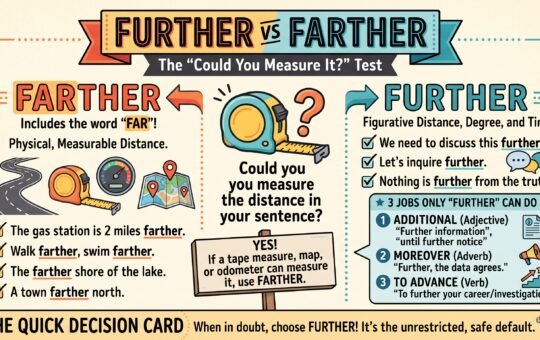
The discipline behind all five corrections is the same one that runs through our guide to fewer vs less difference and our guide to further vs farther difference: a small test, applied once, beats a page of memorized examples.
Its companions live in our guide to your vs you’re difference and our guide to affect vs effect, where a small difference likewise decides whether the sentence you wrote is the sentence you meant.
Practice: Ten Sentences
Choose accept, except, accepted, or exception for each sentence. The key follows, with the reasoning compressed to the test.
1. Please ___ my apology for the delay.
2. The museum is open every day ___ Tuesday.
3. She ___ the job offer the same afternoon.
4. Everyone on the crew ___ the captain agreed to sail.
5. The warranty covers everything ___ accidental damage.
6. He took ___ to the suggestion that he had cheated.
7. The committee ___ her into the honors program.
8. Entries close on Friday, with no ___ allowed.
9. We ___ all major cards for payment.
10. ___ for the wind, the crossing was smooth.
Key: 1 accept (an apology is received). 2 except (one day carved out). 3 accepted (the offer, taken in, past tense). 4 except (the captain excluded). 5 except (damage left outside the cover).
Key, continued: 6 exception (the fixed phrase take exception to, meaning objection). 7 accepted (admitted into a group). 8 exceptions (the noun on the rule sign). 9 accept (receiving payment). 10 Except (the if it were not for job of except for).
Score it honestly: most misses cluster on sentences 6, 8, and 10, the phrase jobs. That is normal, and it is exactly what the phrase bank above is for.
The 30 Second Decision Card
Direction. Taking in, receiving, agreeing? Accept, with ac. Taking out, excluding, carving off? Except, with ex.
Job. Action slot? Accept, the verb only word. Any other slot? Except, before meaning is consulted.
Swap. Receive fits? Accept. Other than or excluding fits? Except.
Letters. Ac pairs with acquire and action; ex pairs with exclude, exit, and exception.
Four checks, thirty seconds, and the pair never costs you a second thought again. What it should cost you is one read of the family table, because accepted against excepted is where the second errors breed.
Frequently Asked Questions
What is the difference between accept and except?
Direction and job at once. Accept is a verb only: receive willingly, agree to, take in. Except means not including or other than, and works as preposition, conjunction, or rarely a verb.
Both grow from Latin capere, to take: accept takes toward you, except takes out.
How do you remember accept vs except?
Three hooks. Except starts with ex, like exclude and exit, and leaves something out. Accept starts with ac, like acquire, and takes something in.
Underneath sits one root, capere, to take: taking toward yourself is accept, taking out of the group is except.
Is it accept or except in ‘everyone ___ me’?
Except. Everyone except me means everyone other than me: an exclusion, the preposition’s core job.
Everyone accept me would claim everyone receives me, a different sentence. If other than fits, the word is except.
Do you accept an invitation or except an invitation?
Accept. An invitation is something offered, and receiving it willingly is the verb’s first job: I accept your invitation.
Excepting an invitation would mean excluding it from a group. Offers, invitations, apologies, awards, and gifts are all accepted, never excepted.
Is it accept your apology or except your apology?
Accept your apology. An apology is offered, and accepting it receives it and closes the matter.
Except your apology would read as leaving the apology off a list, reversing the courtesy. The same ruling covers accept my thanks and accept the award.
What does accept mean?
Accept is a verb with related senses: receive something willingly, agree to something, regard something as true, admit someone to a group, and endure an outcome.
Accept a gift, accept the terms, accept the fact, accept defeat. Every sense involves taking something in.
What does except mean?
Except is mainly a preposition meaning not including or other than: everyone came except Ana; open daily except Sundays.
As a conjunction it introduces an exception, like except that. As a rare formal verb, it means exclude: names were excepted from the list.
Can except be a verb?
Yes, but it is the pair’s rare corner. As a verb, except means leave out or exclude, and Merriam-Webster notes it appears mostly in legal and formal contexts.
Present company excepted is its everyday home. In daily writing, a verb slot almost always wants accept.
Is accept a noun?
No. Accept functions only as a verb; Merriam-Webster’s usage guide states it plainly.
The nouns live nearby: acceptance, the act of accepting, and exception, the thing left out. If the sentence needs a noun, neither accept nor except’s verb sense fills the slot.
Is it except for or accept for?
Except for. It introduces the item left out of a general statement: except for the rain, the day was perfect.
It also means if it were not for: except for your help, I would have failed. Accept for is not a phrase; accept needs a direct object.
What does ‘with the exception of’ mean?
It is the formal noun version of except: other than, leaving out. With the exception of one late payment, the record is clean.
It points back to the noun exception, the thing excluded from a rule. In plain writing, except alone usually does the same work shorter.
What is the noun form of except?
Exception. An exception is a person, thing, or case left out of a general rule: everyone must attend, no exceptions.
Watch the adjective: exceptional has drifted and usually means unusually good, not merely excluded. The verb partner of exception is except, past form excepted.
What does ‘present company excepted’ mean?
It means the people present are excluded from a criticism just made: modern drivers are careless, present company excepted, meaning not you.
It uses the verb except in its past form, excepted. The phrase is a politeness formula, carving the listeners out of a general remark.
What does ‘take exception to’ mean?
It means to object to something or take offense: she took exception to the remark.
This idiom is a trap, because its meaning drifted far from exclusion: taking exception is protesting, not leaving out. Learn it as a fixed phrase built on the noun exception.
What does exceptional mean?
Usually, unusually good: an exceptional student, exceptional service. It also has a neutral use meaning forming an exception, and an educational use for differing needs.
The trap is assuming exceptional means excluded. In modern everyday English it is a compliment far more often than a carve out.
How do you pronounce accept and except?
Almost identically, which is the root of the confusion. Except is ik-SEPT, short i first. Accept is usually uh-SEPT, with a reduced vowel, and fast speech merges them.
Merriam-Webster notes both are primarily pronounced with the same initial sound. Both stress the second syllable.
Are accept and except homophones?
Near homophones. The spellings differ in the first two letters, ac against ex, and careful speech keeps a faint vowel difference: reduced in accept, short i in except.
In fast speech the difference vanishes, so the ear cannot referee. Grammar and meaning do that job.
What is the past tense of accept?
Accepted. Accept is regular: accept, accepted, accepted; accepts for third person; accepting for the ing form.
The university accepted her application. Do not confuse accepted with excepted, the past of the verb except, which means excluded. The same ac and ex letters decide both generations.
Accepted vs excepted: what is the difference?
Direction, inherited. Accepted means received, agreed to, or admitted: accepted into the program, an accepted explanation.
Excepted means excluded or left out, and lives in formal phrases: present company excepted. Swap them and a welcome becomes an exclusion notice.
Why do people confuse accept and except?
Three pressures combine. The words sound nearly identical, differing in one weak vowel. The spellings differ by two letters mid word, easy to mistype.
And both grow from Latin capere, to take, so their shapes echo by birth. The defense is the test: taking in is accept, taking out is except.
Accept vs expect: what is the difference?
A neighbor trap driven by typing. Expect means anticipate: I expect the package Friday. Accept means receive or agree.
Merriam-Webster notes except is also written where expect belongs, a slip. Sorted by job: anticipate is expect, receive is accept, exclude is except.
Is it ‘I accept the terms’ or ‘I except the terms’?
I accept the terms. Terms are presented for agreement, and agreeing is accept’s contractual job, which is why the button reads I Accept.
I except the terms would mean excluding the terms, nearly the opposite act. This is the highest stakes everyday example of the pair.
What does ‘except as otherwise provided’ mean in contracts?
Legal boilerplate built on the preposition: it means unless a different rule stated elsewhere in the document applies.
Except does the carving out. For readers, the translation is simple: this rule holds wherever the document has not carved out an exception to it.
Can accept and except appear in the same sentence?
Yes, and the classic sentence teaches the whole pair: I accept all the packages except that one.
Accept does the receiving, except does the excluding, each in its own slot. Another version: we accept everyone except late applicants. Build one yourself and the distinction sticks.
What does it mean to accept responsibility?
To acknowledge that a duty or fault is yours and take it on: she accepted responsibility for the error.
Nothing physical is received, but the commitment is taken in, the verb’s root image. The refusal verbs are decline or evade; except responsibility does not exist.
Is it ‘accept defeat’ or ‘except defeat’?
Accept defeat. To accept defeat is to acknowledge you have lost and stop resisting the outcome; sports reports use it weekly.
Except defeat would try to exclude defeat from a list of outcomes, which no scoreboard allows. The verb here is accept in its endure sense.
What does ‘except that’ mean?
It introduces a statement that qualifies what came before, like but or only: I would help, except that I am leaving tonight.
Grammarians class this except as a conjunction. After except that, a full clause follows, and the word still does exclusion work on the larger claim.
Except vs besides: what is the difference?
Direction of the arithmetic. Except removes: everyone except Ana means Ana is out. Besides adds: besides Ana, three others came means Ana plus three.
Swapping them reverses who attended. Check with partners: except pairs with other than; besides pairs with in addition to.
Except vs but: are they the same?
Often interchangeable as prepositions informally: everyone but me, everyone except me.
Except is the more explicit exclusion word and the safer formal choice, and it is required in except for and except that, where but cannot go. But also does contrast work except never does.
Is ‘accept for’ ever correct?
Not as a phrase. Accept takes a direct object directly: accept the offer, accept payment, accept my apology.
When for appears nearby it belongs elsewhere: we accept cards for payment, where accept still governs cards. The exclusion pattern writers need is except for.
What is acceptance, and how is it different from accept?
Acceptance is the noun: the act of receiving or agreeing. Your acceptance of the offer completes the contract; her acceptance speech followed the award.
Accept is the action a subject performs; acceptance names the event. Its facing opposite is exception, the noun of taking out.
What does acceptable mean?
Acceptable means good enough to be received or approved: an acceptable standard, acceptable behavior. Its opposite, unacceptable, fills formal complaints and school reports.
Both adjectives come from accept and judge whether something may be taken in. They never carry except’s exclusion meaning.
How do you use accept in a sentence?
Place accept where a subject receives, agrees, or acknowledges, with the thing received as its object: the store accepts credit cards; she accepted the invitation.
Frames that work: accept plus a gift, offer, apology, fact, decision, or person into a group. No receiving, no accept.
How do you use except in a sentence?
Place except where a statement needs one item carved out: open every day except Sunday; he ate everything except the crusts.
The pattern is a general claim first, then except plus the excluded piece. If the sentence reports agreeing or receiving instead, the word is accept.
Is it ‘no accept’ or ‘no except’ in rules like ‘no exceptions’?
The rule phrase is no exceptions, built on the noun exception: entries close Friday, no exceptions. It means nobody is left out of the rule.
No accept is not a phrase. Cousin signs read no exceptions will be made and without exception, both from the except family.
What does ‘the exception proves the rule’ mean?
The proverb’s older logic runs through prove meaning test, and the legal idea that stating an exception confirms a rule for the other cases.
A sign saying no parking on Sundays implies parking is allowed other days. Recognize the phrase, and use it carefully; its surface reading misleads.
Accept vs except in business email: which mistakes matter most?
Three swaps do real damage. Except your proposal, written for accept, reverses agreement into exclusion before a client.
Everyone accept the intern, meaning except, invites the office to receive one person. And payment rules flip when accept and except trade places. Proofread this pair in offers and invoices first.
Can I use except to mean unless?
Sometimes, in an older pattern: I will not go except I am invited. Modern English prefers except that or unless.
Reserve except for exclusions and let unless carry conditions; the sentence reads cleaner, and the accept decision gets simpler.
Is ‘excepting’ a word?
Yes. Excepting is the ing form of the verb except, seen in formal and legal phrasing: not excepting the chair, meaning not excluding the chair.
It also opens older legal sentences: excepting as herein provided. Everyday writers rarely need it, but it should be recognized, not corrected on sight.
What is the difference between except and apart from?
Apart from is ambiguous in a way except is not: apart from Ana can mean excluding Ana or in addition to Ana, depending on context.
Except always excludes. When direction matters, a contract, a guest list, a rule, except is the unambiguous choice.
How do you spell accept and except correctly every time?
Anchor on the first two letters; the rest of the words is identical. Ac begins the taking in word and pairs with acquire and action.
Ex begins the taking out word and pairs with exclude, exit, and exception. Proofread by finding both words and testing each one.
What is the fastest test to choose between accept and except?
Two questions, in order. Is something being received, agreed to, or acknowledged? Then the verb is accept, with ac.
Is something being left out of a group or statement? Then the word is except, with ex, like exclude. Meaning first, spelling second; the ear is never consulted.
Conclusion
The accept vs except difference is a question of direction: both words come from the Latin capere, to take, and accept takes toward you while except takes out.
Run the direction test, respect the family table, and the spellchecker stops being your only defense. What remains is the more useful habit: seeing the prefix, so the right word arrives with the right direction already attached.
The neighboring calls live throughout the MagazineSolo word pair library, where every pair gets the same treatment: a test first, the exceptions named, and no claim the evidence cannot carry.

Dilawar Mughal is an SEO expert with 8 years of hands-on experience helping websites grow their organic traffic, rankings, and revenue. He specializes in content-driven SEO, local SEO, and Pinterest SEO, and builds practical, results-focused strategies for businesses and publishers.


1 Comments