Desert vs Dessert: One S of Sand, Two of Sweet

Desert vs dessert is a one letter decision with a permanent fix: desert with one s is the dry land and the act of leaving it, and dessert with two is the sweet course at the end of a meal.
Count the s letters and the sentence resolves itself.
The pair hides a second trick. The land is pronounced DEZ ert, but the verb to abandon is pronounced de ZERT, exactly like the food. Two of the three uses share one sound, which is why careful writers still pause over this pair.
And there is a third word hiding between them, inside the phrase just deserts. It takes one s, for a reason almost nobody is told, and it is the most interesting thing on this page.
Below: the quick answer, the stress split, four memory hooks, the idiom explained, the desert island ruling, both word worlds in full, and a ten sentence self check to make the rule permanent.
The Quick Answer: Count the S
Everything in this topic hangs on one count, so it comes first, complete, before any explanation.
|
Word |
S count |
Meaning |
Pronunciation |
|---|---|---|---|
|
Desert (noun) |
One s |
Dry land with very little rain |
DEZ ert |
|
Desert (verb) |
One s |
To abandon, to leave behind |
de ZERT |
|
Dessert (noun) |
Two s letters |
The sweet course ending a meal |
de ZERT |
One s: sand and leaving. The Sahara is a desert. A soldier who abandons his post deserts it. Emptiness, dryness, and departure all live behind the single s.
Two s letters: sweet. Cake, pie, ice cream, and the whole dessert menu live behind the double s. If the sentence could be served after dinner, it takes two.
The Grammarist guide to desert vs dessert states the same division with a biologist’s precision, defining the land by its rainfall: less than 10 inches of precipitation a year.
The Linguix common mistake entry builds its quick answer on the same count. The rule has no exceptions in standard English, in either American or British spelling.
Three Words Wearing Two Spellings
The count works because there are three words here, not two, and seeing all three once is what ends the confusion for good.
Desert the noun: the land. Arid land with sparse vegetation, defined by scarce rain rather than by heat or sand. Merriam Webster’s threshold is less than 25 centimeters (10 inches) of sporadic rainfall a year. Its stress falls on the first syllable: DEZ ert.
Desert the verb: the leaving. To withdraw from a place or a duty, usually without intending to return, and often with a whisper of disloyalty. Soldiers desert posts, friends refuse to desert each other, and rats desert sinking ships. Its stress falls on the second syllable: de ZERT.
Dessert the noun: the sweet course. A usually sweet dish served at the end of a meal. It is only ever a noun, it never becomes a verb, and it shares its pronunciation with the leaving word above.
The verb is the troublemaker. Because desert the verb and dessert sound identical, the ear offers no help at the exact point the writer needs it, and the hand writes the spelling it has seen most recently. The stress split, next, is the tool that fixes the ear.
The Stress Split: Why the Verb Sounds Like the Food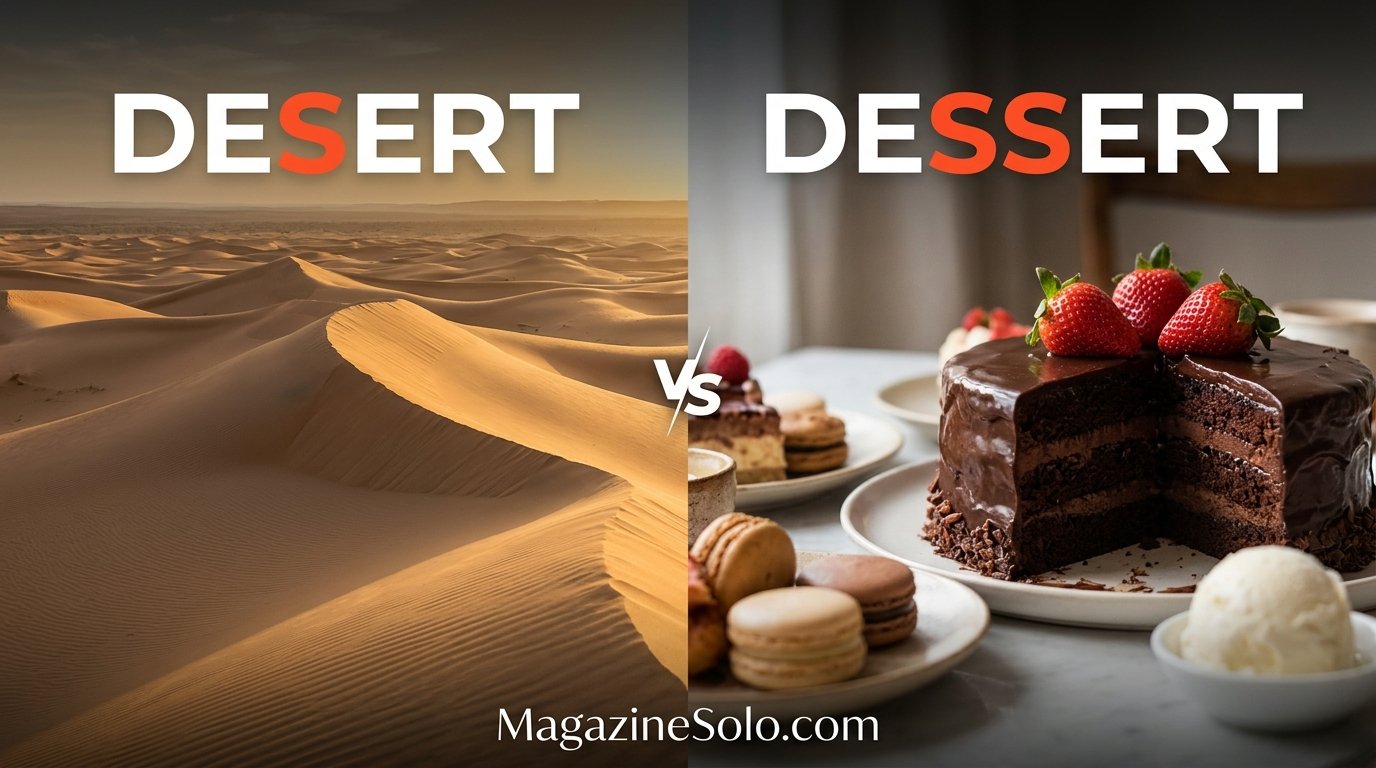
English has a quiet pattern for pairs like this: the noun takes early stress, the verb takes late stress. Record the noun and record the verb work the same way, and so does desert.
DEZ ert is a place. You can stand in it, photograph it, and name it on a map. First syllable stress, one s, dry land.
De ZERT is either an action or a course. You desert a post (an action) or you order dessert (a course). Second syllable stress separates them from the land, and the s count then separates them from each other.
That gives you a two stage test that resolves any sentence aloud. Say the word with its stress. If the stress lands early, it is the land and one s is certain.
If the stress lands late, ask whether the sentence means leaving or eating: leaving is one s, eating is two.
The pattern also explains the phrase everyone mishears. Deserted island sounds natural because deserted is a common word, but the established idiom is desert island, with desert as an adjective meaning uninhabited.
The island section below gives that ruling its own space, because the query deserves it.
Four Memory Hooks: Seconds, Sand, Shortcake, and Stressed Backwards
Rules fade; hooks stick. This pair has four good ones, and the right approach is to read all four and keep the one your brain refuses to drop.
Hook 1: Seconds. Dessert has two s letters because you always want second servings of something sweet. Nobody asks for seconds of sand. This is the classic hook, the one The LanguageTool spelling guide and most guides teach, and it works because it ties the count to appetite.
Hook 2: Sand. Desert has one s, like the word sand itself. One s in sand, one s in the land made of it. The mirror image for the other side: sweet begins with s and leans on it, and the sweet course doubles it.
Hook 3: The names. Sahara is a desert: one s in the great desert’s own name, one s in the word. Strawberry shortcake is a dessert: s letters stacked through the name, double s in the word. Two proper names carry the whole rule between them.
Hook 4: Stressed backwards. Spell stressed backwards and you get desserts, letter for letter: s, t, r, e, s, s, e, d reversed is d, e, s, s, e, r, t, s.
It is the strongest hook of the four because it needs no story, only counting, and it comes with its own joke: the sweet course is what stressed people reach for.
Teach a child with hook 3, remind a colleague with hook 1, and keep hook 4 for yourself. Between them, the count becomes reflex within a week of ordinary writing.
Just Deserts: The Third Word Hiding in the Idiom
Now the phrase that breaks the pattern, and the reason it does not actually break anything.
Just deserts is spelled with one s. He got his just deserts. The committee received its just deserts. One s, every time, even though the phrase is pronounced de ZERTS, exactly like the sweet course, which is why the double s spelling tempts almost everyone who writes it.
The explanation is the best piece of word history in this topic, and Merriam Webster states it plainly. The desert inside just deserts is neither the land nor the food.
It is a third, old noun meaning what someone deserves: a reward or punishment earned by their actions. It belongs to the family of the verb deserve, not to sand and not to cake.
That gives you the deserve test, a two second check for the idiom. If you can swap deserved into the sentence and it still makes sense (he got what he deserved), the word is the deserve cousin, and it takes one s.
If the swap fails, you are probably writing about cake, and cake takes two.
Watch the trap in the wild: menus, headlines, and even edited books print just desserts regularly, trading on the joke that punishment should be sweet.
As a pun in a bakery window it is charming. As the idiom in serious writing, it is simply wrong, and now you know the reason, which almost none of the pages ranking for this pair bother to give.
Desert Island or Deserted Island?
The castaway question, answered with the care it keeps asking for.
Desert island is the established idiom. Here desert works as an adjective meaning uninhabited and desolate. The phrase claims nothing about sand: a green, rainy, well watered island with nobody on it is a desert island, because desert describes the absence of people, not the presence of dunes.
Deserted island is grammatical but narrower. Deserted is the past participle of the verb: an island people once occupied and then left.
A ruined village on its shore makes it deserted; an island never settled makes it only desert. Writers who picture abandoned huts usually mean deserted, and writers who picture untouched isolation mean desert.
The sound is what keeps the confusion alive. Deserted is the more common everyday word, so the ear reaches for it, but the idiom froze centuries ago with the adjective.
Desert island discs, desert island books, marooned on a desert island: the fixed phrases all carry the single word.
One more member of the family deserves a line, because it appears in city reporting constantly. A food desert is an area where fresh, affordable food is hard to buy.
It uses the land word, one s, as a metaphor for scarcity, and jokes about cake do not change its spelling.
The Two Worlds in Full: Named Deserts and the Dessert Course
A page earns its ranking by knowing both worlds, not just the spelling seam between them. Here is each world stocked.
The land world. The Sahara is the largest hot desert on Earth. The largest desert of all is Antarctica, a polar desert, because the definition runs on rainfall, not temperature.
The Gobi in Asia is a famous cold desert; the Mojave and the Atacama complete the standard school list, the Atacama often cited among the driest places on Earth.
The definition underneath. Under about 10 inches (25 cm) of rain a year, with sparse vegetation, is the dictionary criterion. Heat is optional, sand is optional, emptiness is usual. That is why a frozen continent qualifies and why cold deserts exist is a fact, not a riddle.
The sweet world. The dessert course closes the meal: cake, pie, ice cream, pastry, custard, fruit. Around it sits a small vocabulary of compounds that all take two s letters: dessert menu, dessert wine, dessert spoon, dessert plate. If the compound names the course, it doubles the s.
The British shelf, labelled. British speakers often call the same slot pudding (whatever the dish actually is) or afters informally, and Merriam Webster notes a formal British sense of dessert as a fresh fruit course served after the sweet course.
The spellings of desert and dessert themselves are identical across the Atlantic; only the vocabulary around them moves.
Word pairs cluster, and this site keeps the whole shelf in one place.
The same one test thinking powers The affect vs effect guide on this site, The fewer vs less difference guide, and The further vs farther difference guide.
And the spelling first pairs The lose vs loose difference guide and The accept vs except difference guide sit one click away for the next time a sentence stops you.
Word Forms, Family, and Phrases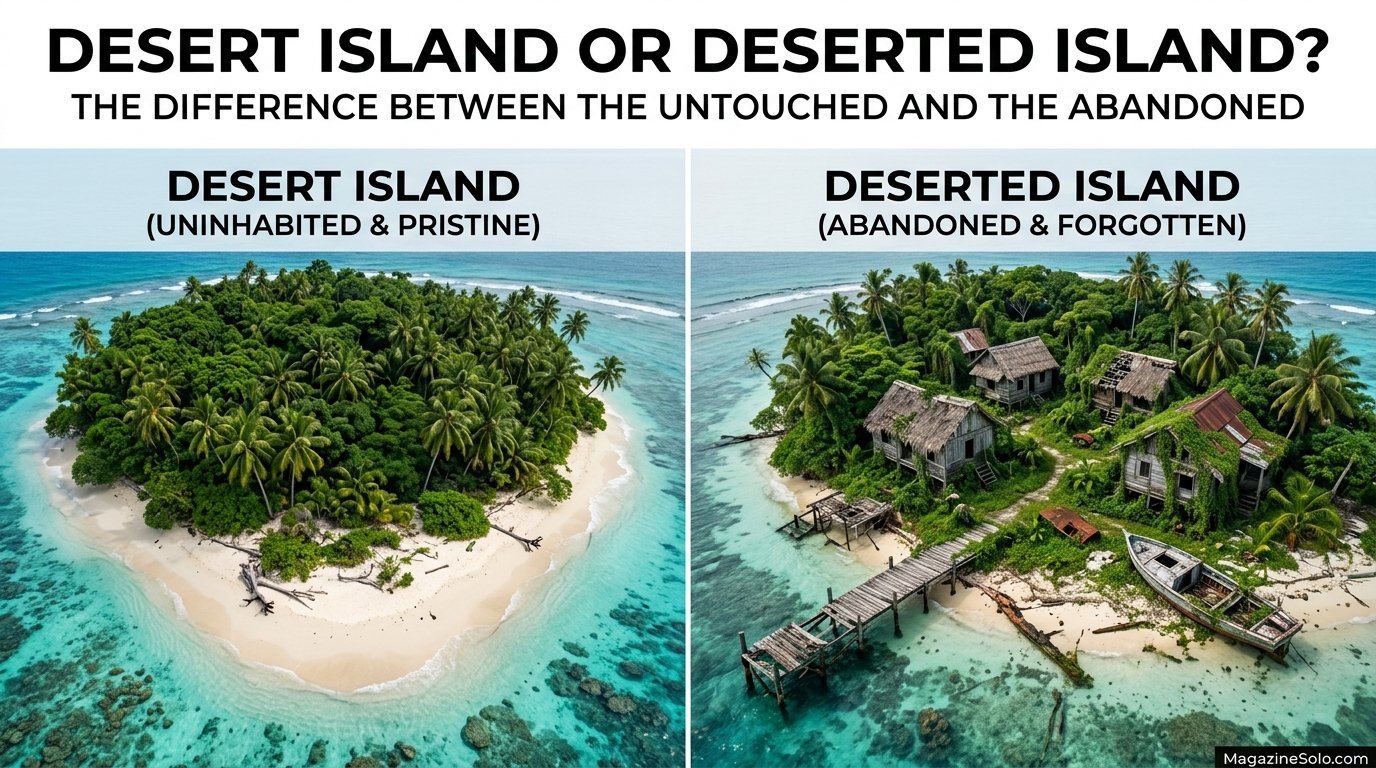
Confusions are beaten for good when the whole family is visible at once, forms included.
|
Form |
The leaving and land family (one s) |
The sweet family (two s) |
|---|---|---|
|
Base word |
desert |
dessert |
|
Plural |
deserts (the lands) |
desserts (the courses) |
|
Verb forms |
deserts, deserted, deserting |
none: never a verb |
|
Family nouns |
desertion, deserter |
dessert menu, dessert wine (compounds) |
|
Adjective use |
a desert island |
a dessert spoon |
Read the verb row twice, because it carries a trap. He deserts his post uses the one s verb in the present tense, while two desserts on a menu uses the double s noun. Same sound, opposite counts, separated only by the part of speech test.
The phrases that smuggle both words through daily life: desert rose (a plant and a mineral, land word), desert storm (wind and history, land word), rats deserting a sinking ship (verb), save room for dessert (course), and just deserts (the deserve cousin, one s against its pronunciation).
Example Sentences for Every Use
Land: The caravan crossed the desert under a white sky. The Atacama is one of the driest deserts on Earth.
Leaving: He would never desert a friend in trouble. The guards deserted their posts before dawn.
Adjective: They were shipwrecked on a desert island. A desert road ran north without a single town.
Sweet course: For dessert, we had strawberry shortcake. She skipped dinner and went straight to dessert.
Idiom: The fraudster finally got his just deserts. One s, because the word inside is the deserve cousin, not the cake.
The trap sentence, corrected: Wrong: we ordered desert at the new cafe and read about dessert islands. Right: we ordered dessert at the new cafe and read about desert islands. If a sentence contains both worlds, the count test runs twice.
Two Roots: The Abandoned Place and the Cleared Table
End with the story that makes the spellings feel inevitable, because etymology is the memory hook that never wears out.
Desert, both jobs, one root. The land word comes from Latin desertum, an abandoned or waste place, from deserere, to abandon. Sit with that for a moment: the land and the leaving are not two words that collided.
They are one word that never split. The desert is, in the root’s own terms, the place that has been deserted, which is why a single spelling honestly does both jobs.
Dessert, the cleared table. The sweet word comes from French desservir, to clear the table, by way of Middle French desserte, the course served at the end.
The dessert is what arrives after the clearing, and Merriam Webster dates its arrival in English to about 1600. The double s is French luggage the word never unpacked.
The third root. And the idiom’s desert belongs to deserve, from Latin deservire, to serve well or zealously. Three roots, two spellings, one pronunciation collision: that is the entire topic.
It is why no single letter count alone could ever tell the whole story. The count wins your sentences; the roots win your memory.
Magazine Solo keeps this difference shelf growing pair by pair, in the same spirit as The than vs then difference guide: one test per pair, honestly derived, with the traps named instead of hidden.
Mistakes in the Wild: Menus, Headlines, and Homework
The pair earns its keep in the places where the error is public, and each venue has its own signature slip.
Menus. The desert menu is the classic: a final course of sand, offered in print, sometimes framed. The fix is procedural, not intellectual.
Menu writers know the rule; they miss it at proofreading, tired, at midnight, with the printer waiting.
The seconds hook read aloud at the proof stage catches it, because the eye slides over what the ear would flag if the words differed in sound throughout, and in the noun uses they do not.
Headlines. Just desserts is the headline trap, because headline writers reach for the pun and the pun metastasizes into the idiom.
A headline about a chef getting his just desserts is a joke that works once; the same spelling in a court story is an error with a byline.
The deserve test is the headline desk’s friend: swap deserved in, watch the sentence hold, spell one s.
Homework and essays. Students lose marks on desert island in geography essays and on desserted villages in history ones. Both errors come from the same place: writing by ear in a pair where the ear is only half reliable.
The teaching fix that works is forms first: write out desert, deserted, deserting, and dessert in a row, say the stresses aloud, and the hand learns what the ear cannot teach it.
Social posts and captions. The pair survives autocorrect because both spellings are real words, so the wrong one sails through with a green light from the phone.
A caption promising a dessert safari or a desert buffet reads as confidence to everyone who knows, which is most readers. Two seconds with the count test is cheaper than the screenshot.
The Two Tests, Side by Side
Everything on this page reduces to two checks. Print them mentally above your keyboard.
|
The sentence is about |
Test |
Spelling |
|---|---|---|
|
A sweet course, a menu, a dish |
Could it be served after dinner? |
dessert (two s) |
|
Land, dryness, emptiness |
Could you stand in it or photograph it? |
desert (one s) |
|
Leaving, abandoning, walking away |
Is it a verb in the sentence? |
desert (one s) |
|
What someone has earned |
Does deserved swap in cleanly? |
deserts (one s) |
|
An uninhabited island |
Is anyone claimed to have left it? No: idiom |
desert island |
Run the tests in order and the pair never survives contact with your writing. The first row catches the food, the middle rows catch the land and the leaving, and the last two rows catch the traps that catch everyone else.
Ten Sentence Self Check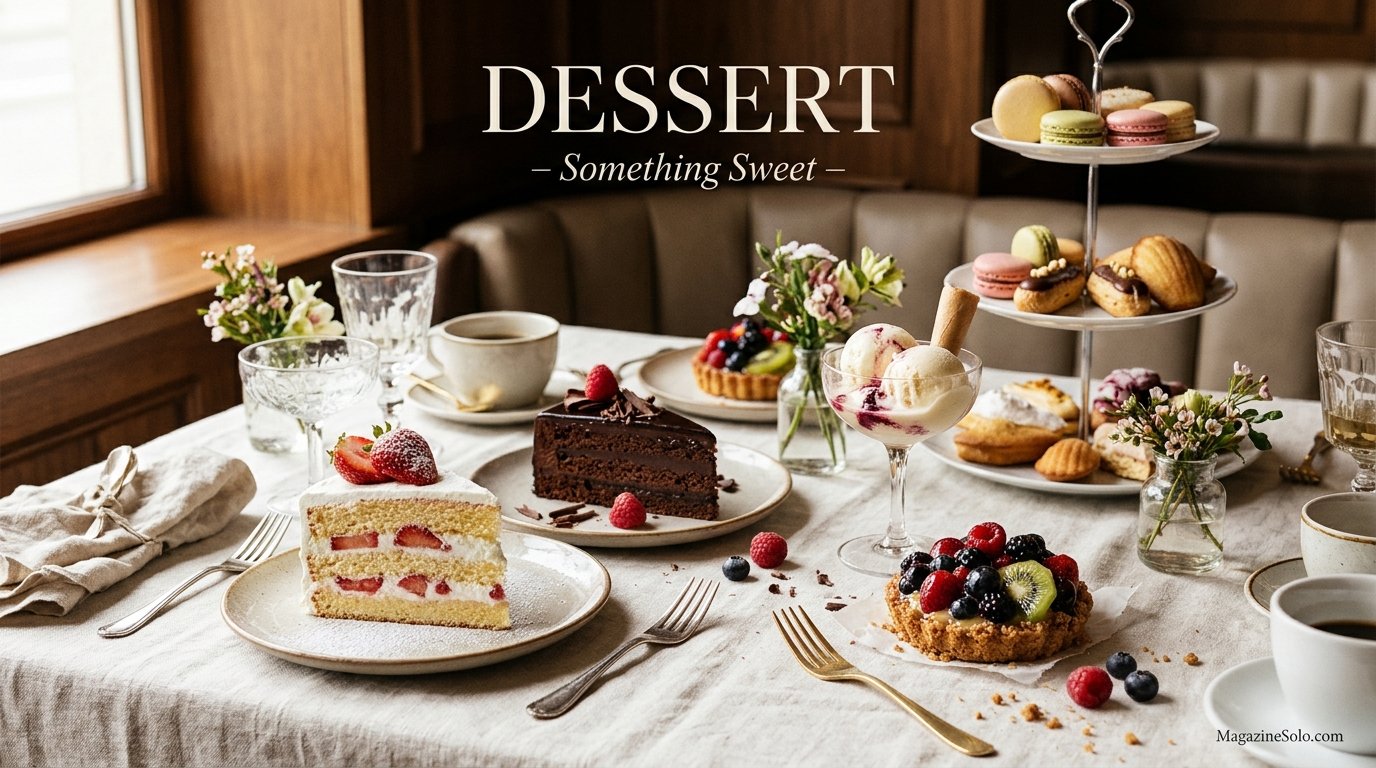
Choose desert or dessert in each sentence. Answers follow, keyed to the tests.
- For ____, the bistro serves a lemon tart.
- The soldiers who ____ their posts face charges.
- The Sahara is the largest hot ____.
- He finally got his just ____.
- Save room for ____; the shortcake is famous here.
- They found fresh water on the ____ island.
- The village stood ____ after the factory closed. (deserted form expected)
- Antarctica counts as a ____ because so little falls there.
- A ____ wine accompanied the cheese and fruit.
- She would never ____ her team in a crisis.
Answers: 1 dessert (sweet course). 2 desert (verb, leaving). 3 desert (land). 4 deserts (deserve test, one s). 5 dessert (course). 6 desert (the idiom, uninhabited). 7 deserted (the participle). 8 desert (rainfall definition). 9 dessert (compound naming the course). 10 desert (verb).
A perfect score means the pair is finished for you. Any miss names its own repair: recount the hooks section, and run the two stage test aloud once.
1. What is the difference between desert and dessert?
One letter.
Desert with one s is dry land (the Sahara) or the verb to abandon.
Dessert with two s letters is the sweet course at the end of a meal.
Remember it by servings: dessert has two s letters because you want seconds; desert has one s, like sand.
2. How do you spell dessert, the food?
D e s s e r t, with two s letters in the middle.
The food is always the double s spelling, in American and British English alike.
If the sentence is about something sweet served after a meal, it is dessert.
3. Why does dessert have two s letters?
History, not logic: dessert comes from the French desservir, to clear the table, the course served after the table was cleared.
The double s came with the French word.
The seconds mnemonic (two s letters for second servings) is a memory hook built on top of that spelling, not its cause.
4. How do you remember desert vs dessert?
Pick the hook that sticks.
Seconds: dessert has two s letters because you want second servings.
Sand: desert has one s, like the word sand.
Names: Sahara (one s) is a desert, strawberry shortcake (two) is a dessert.
And the strongest: stressed spelled backwards is desserts, so stress calls for the sweet spelling.
5. Is it desert or dessert for cake?
Dessert.
Cake, pie, ice cream, and every other sweet course take the double s spelling.
Desert with one s would put your cake in the Sahara.
6. What does desert mean?
As a noun, dry land that receives very little rain, under about 10 inches (25 cm) a year, with sparse vegetation: the Sahara, the Gobi.
As a verb, to abandon someone or something, or to leave a place without intending to return.
As an adjective, uninhabited and desolate, as in a desert island.
7. What does dessert mean?
The sweet course served at the end of a meal: cake, pie, ice cream, pastry, fruit.
It is always a noun and always spelled with two s letters.
In British use, dessert can also mean a fresh fruit course served after the sweet course, and pudding or afters serve as everyday British words for the same slot.
8. How is desert pronounced?
It depends which desert.
The land is DEZ ert, stress on the first syllable.
The verb, to abandon, is de ZERT, stress on the second syllable, pronounced exactly like dessert.
The stress tells you which word you are hearing before the spelling does.
9. How is dessert pronounced?
De ZERT, with the stress on the second syllable.
It sounds identical to the verb desert (to abandon), which is the main reason the pair confuses people in writing: two of the three uses share one pronunciation.
10. Are desert and dessert homophones?
Only partly.
Dessert and the verb desert (abandon) are true homophones, both de ZERT.
The noun desert (land) is pronounced DEZ ert and is not a homophone of either.
The pair is best described as a partial homophone set with a stress split.
11. Is it just deserts or just desserts?
Just deserts, with one s.
The idiom uses neither the land nor the food: it uses an old noun desert meaning what someone deserves, related to the verb deserve.
It is pronounced like the sweet word, de ZERTS, which is why the double s spelling tempts everyone.
If you can swap in deserved, spell it with one s.
12. What does just deserts mean?
The reward or punishment someone has earned by their actions: he got his just deserts means he received what he had coming.
The desert in it is an archaic noun from the same family as deserve, per Merriam Webster, and has nothing to do with sand or cake.
13. Is it desert island or deserted island?
Desert island is the established idiom: desert works as an adjective meaning uninhabited and desolate, and no one needs to have left the island for the phrase to apply.
A deserted island is also grammatical, but it says something narrower: people were there and abandoned it.
For the classic castaway sense, use desert island.
14. Why is it called a desert island if there might be trees?
Because desert as an adjective means uninhabited and desolate, not sandy.
The word describes the absence of people, not the presence of sand, which is why a green, rainy island with nobody on it is still a desert island.
15. What is a deserted island then?
An island that people once occupied and then left.
Deserted is the past participle of the verb desert, to abandon, so a deserted island tells a small story of departure.
A desert island makes no such claim; it simply has no inhabitants.
16. Can desert be a verb?
Yes.
To desert means to abandon a person, place, duty, or cause, often with a note of disloyalty: soldiers deserting a post, a friend who would never desert you, rats deserting a sinking ship.
Its forms are deserts, deserted, deserting, and the nouns desertion and deserter.
17. Can dessert be a verb?
No.
Dessert is only ever a noun.
If your sentence needs a verb of leaving, the word is desert, and if it needs the sweet course, the word is the noun dessert.
Part of speech is a reliable test: verbs in this family always take one s.
18. What is the plural of desert and dessert?
Both add s in the ordinary way: deserts for the lands (the deserts of North Africa) and desserts for the sweet courses (the desserts were excellent).
Watch the verb trap inside the forms: he deserts his post uses the one s verb, while two desserts on the menu uses the double s noun.
19. What is the difference between deserted and desserted?
Deserted is a real word: abandoned or empty, from the verb desert (deserted streets, a deserted village).
Desserted is not a standard English word at all; if you have typed it, you almost certainly mean deserted, or the noun desserts.
20. Is the Sahara a desert or a dessert?
A desert, one s, and the memory hook depends on it: Sahara takes a single s in its own name and pairs with the single s land word, while strawberry shortcake stacks s letters like the sweet word it names.
21. What is the largest desert in the world?
By area, Antarctica: it is a polar desert, receiving very little precipitation, which is what makes a desert, not heat or sand.
The Sahara is the largest hot desert.
Both facts test the same definition, rainfall, and both belong on any page teaching the noun properly.
22. Are all deserts hot and sandy?
No.
A desert is defined by low precipitation, under about 10 inches (25 cm) a year, not by temperature.
Cold deserts exist, the Gobi among them, and the polar regions qualify as deserts outright.
Sand is common in hot deserts but is not part of the definition.
23. What makes land a desert?
Scarce rainfall.
Dictionaries define a desert as arid land receiving less than about 25 cm (10 inches) of sporadic precipitation a year, usually with sparse vegetation.
Heat, sand, and emptiness are common companions, but rainfall is the criterion.
24. Where does the word dessert come from?
From French: desservir, to clear the table, because the sweet course arrived after the main dishes were cleared away.
Merriam Webster dates the English word to about 1600, from Middle French desserte, the course served at the end of the meal.
25. Where does the word desert come from?
From Latin desertum, an abandoned or waste place, from deserere, to abandon.
That is why one spelling covers both the empty land and the act of abandoning: historically they are the same word.
The land is, in the root’s own terms, the place that has been deserted.
26. Is stressed really desserts spelled backwards?
Yes, letter for letter: s t r e s s e d reversed gives d e s s e r t s.
It is the most reliable mnemonic in this topic because it needs no story, only counting, and it doubles as a reminder that the sweet course is what stressed people reach for.
27. Does British English spell desert and dessert differently?
No.
The spellings are identical in British and American English: desert one s, dessert two.
What differs is vocabulary around the sweet course: British speakers often say pudding or afters for the slot, and a formal British dessert can be a fruit course after the sweet.
One Indian exam site in the results even spells favourite with a u inside this topic; the spellings of the pair itself never change.
28. What is a food desert?
An area, usually urban, where residents have little access to affordable fresh and nutritious food.
It uses the land word, one s, metaphorically: a place where something essential is scarce, the way water is scarce in a desert.
It has nothing to do with the sweet course, despite frequent menu style jokes.
29. What is dessert wine?
A sweet wine served with or after the dessert course, spelled with the double s food word.
The phrase is a useful spelling anchor: any compound naming the sweet course (dessert menu, dessert spoon, dessert plate) takes two s letters.
30. How do you use desert in a sentence?
For the land: The Atacama is one of the driest deserts on Earth.
For the verb: He promised he would never desert his post.
For the adjective: They were shipwrecked on a desert island.
Three uses, one spelling, and the pronunciation splits the noun from the verb.
31. How do you use dessert in a sentence?
For dessert, we had strawberry shortcake.
The dessert menu listed six cakes.
Save room for dessert.
Every sweet course sentence takes the double s spelling, whatever the dish.
32. What are common mistakes with desert and dessert?
Four recur: writing dessert island for the castaway idiom; writing just desserts with two s letters under pronunciation pressure; calling an abandoned place desserted; and menu typos that offer sand for the final course.
Each is caught by one of the three tests: s count, part of speech, or the deserve swap.
33. Why do spellcheckers not catch desert vs dessert errors?
Because both spellings are real words.
A spellchecker verifies that a word exists, not that it is the word the sentence means.
Only grammar and context checkers, or your own three tests, catch a dessert island in the making.
34. What is desertion?
The act of deserting, most often used of soldiers abandoning duty, and by extension abandoning a duty or a spouse in legal contexts.
It belongs to the verb family: desert, deserted, deserting, desertion, deserter, all one s.
35. What is a deserter?
A person who deserts, classically a soldier who leaves military service without permission and without intending to return.
One s throughout the family; there is no double s form anywhere in the abandoning line of the word.
36. Is desert a homograph?
Yes, in effect: the noun and the verb share one spelling but differ in pronunciation and meaning (DEZ ert the land, de ZERT to abandon), which makes desert a stress shifting homograph, like record and resume.
Dessert stands outside that pair as a separate spelling that happens to sound like the verb.
37. What is the adjective form in desert island?
Desert itself, used attributively: an uninhabited, desolate island.
English allows the noun to modify another noun, and the idiom froze that use.
Deserted island substitutes the participle and changes the claim, as the island entries above explain.
38. Do restaurants ever misspell dessert?
Often enough that menu typo collections feature the error, and the mistake is costly in a small way: a desert menu promises sand.
The fix for menu writers is the same seconds rule, applied at proofreading, plus one read aloud pass, since the words sound alike only in the verb pairing.
39. How can I teach desert vs dessert to kids?
With the name hook and a drawing: Sahara the desert has one s and dunes; strawberry shortcake the dessert has s letters stacked like its name and layers.
Then the stressed trick for older children, and a five sentence sorting game mixing both worlds.
Hooks first, definitions second, quiz last.
40. What is the fastest test while writing?
Ask what the sentence is about.
Sweet course after a meal: dessert, two s letters.
Land, leaving, or emptiness: desert, one s.
If the phrase is just deserts, swap in deserved; if the swap works, one s.
The whole check takes two seconds once the hooks are in place.
41. Desert vs dessert: which one means sweet?
Dessert, with two s letters, is the sweet one: the course of cake, pie, or ice cream at the end of a meal.
Desert, one s, is never sweet; it is sand, emptiness, or the act of leaving.
Sweet and seconds share the double s habit, which is the whole mnemonic system in one line.
42. What is the desert in just deserts related to?
To deserve.
Merriam Webster explains that the idiom’s desert is a little used noun meaning a deserved reward or punishment, from the same family as deserve, spelled like the land word and pronounced like the food word.
It is a third word hiding between the two famous ones, and it is the reason this FAQ section exists.
Conclusion
Desert vs dessert resolves to a count, a stress, and a story.
One s for the land and the leaving, two for the sweet course, and the stress tells you which family you are in before the spelling does: DEZ ert stands on a map, de ZERT either walks away or arrives with cake.
Keep the hooks that fit your hand. Seconds for the appetite, sand for the land, Sahara against strawberry shortcake, and stressed spelled backwards is desserts when you want the proof instead of the picture.
And keep the third word in its place. Just deserts takes one s because its desert is the deserve cousin, a small old noun about what people have earned, hiding between the two famous spellings.
Run the tests once more on your next sentence, then let the pair go. It has taken its letter; it does not get to take your time anymore.

Dilawar is a content writer at MagazineSolo, covering travel, home improvement, interior design, and everyday lifestyle topics. He enjoys researching practical solutions, exploring travel destinations, and sharing helpful guides that make daily life easier. His writing focuses on clear information, useful advice, and engaging stories for a wide audience.