Capital vs Capitol: What Is the Difference?
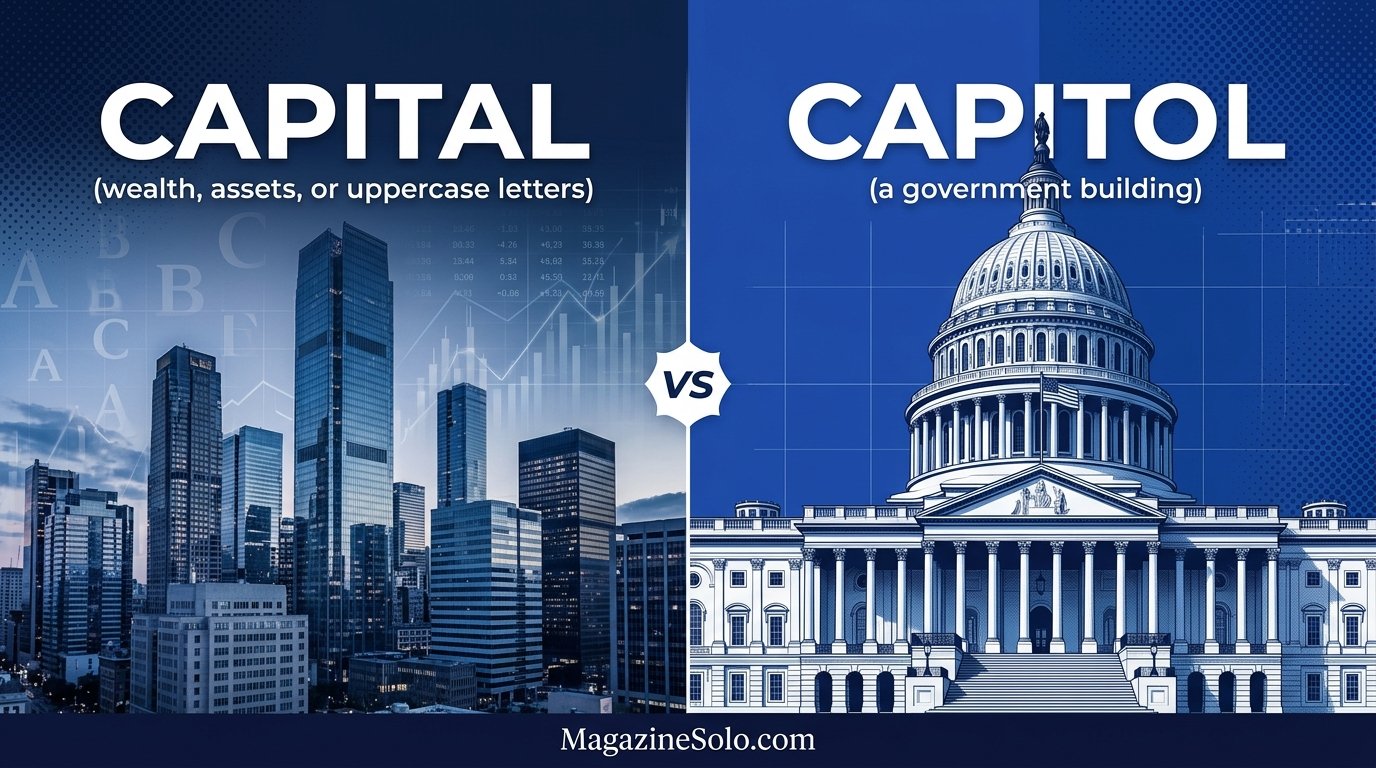
Capital vs capitol comes down to one question about your sentence. Is a legislature meeting inside a building?
If yes, the word is capitol, with an o. It names the building, and it never names anything else in modern English.
If no building is involved, the word is capital, with an a. It covers the city, the money, the letter, and more.
Capitol has one meaning. Capital has all the rest, which is why capital is the safe default.
The trap is built into geography itself. The capital city houses the capitol building, so correct sentences need both words.
The wider family of spelling traps lives in MagazineSolo’s confused words library. This page settles the pair that civics, news, and homework share.
The Building Test, Step by Step
The building test takes two seconds. It asks whether lawmakers meet inside the thing you are naming.
Step 1: Picture the sentence’s subject.
Are you naming a physical building where a legislature sits? A congress, a state senate, an assembly, in session?
If so, write capitol. The word exists for that building and for no other modern purpose.
Step 2: Check for everything else.
A city, a sum of money, an uppercase letter, a serious crime, a chief concern? None of those is a building.
All of them take capital. When in doubt, capital is right far more often than capitol.
|
The sentence is about |
Word |
Example |
|---|---|---|
|
A legislature building |
capitol |
The capitol steps filled with protesters. |
|
The US Congress building |
the Capitol |
The Capitol stands on Capitol Hill. |
|
A seat of government city |
capital |
Sacramento is California’s capital. |
|
Money or assets |
capital |
The startup raised fresh capital. |
|
An uppercase letter |
capital |
Begin with a capital letter. |
|
A chief or main thing |
capital |
Safety was their capital concern. |
Capitol: One Meaning Only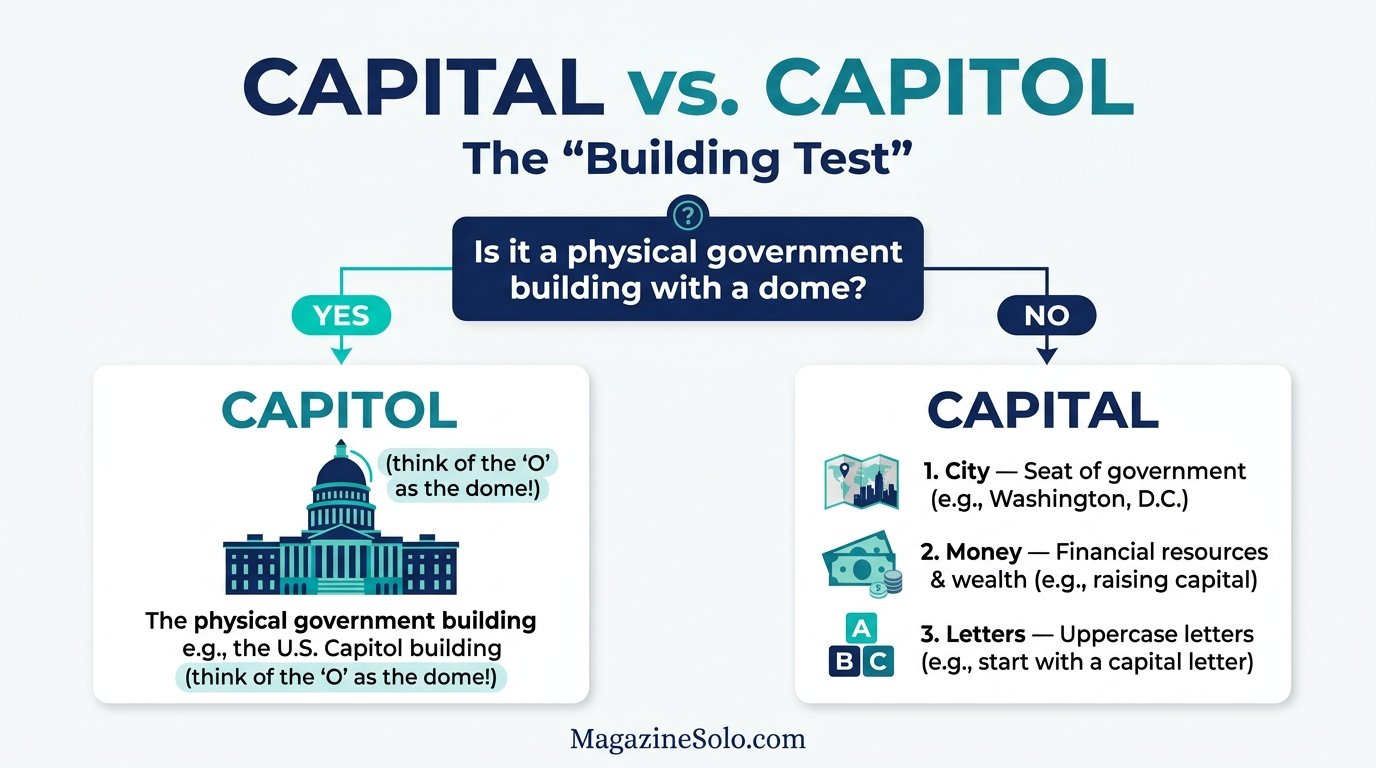
Capitol names a building, or a complex of buildings, where a legislature meets. That is the whole modern job description.
The famous instance is the US Capitol in Washington, DC. Congress, the Senate and the House, meets and works there.
Every state has its version too. A state capitol houses the state legislature and is often called a statehouse.
Beyond buildings, the word has no reach. It is never an adjective, never money, never a city, never a letter.
Its one older sense is historical. Capitol first named the temple of Jupiter at Rome, which the history chapter tells properly.
Reading the ESLBuzz guide to capital and capitol shows the same narrow definition held across teaching sources. The building, and only the building, takes the o.
The sharpest statement of the asymmetry comes from the Dictionary.com explainer on capital and capitol. Its letter logic deserves memorizing: the o stands for only one meaning, the a for all the rest.
Capital: All the Rest
Capital is the busiest word in the pair. Start with its most searched sense: the seat of government city.
Washington, DC is the capital of the United States. Sacramento is the capital of California, and Austin is the capital of Texas.
Next comes money. Capital is wealth used in business: raising capital, working capital, capital investment, and capital gains.
Then letters. A capital is an uppercase letter, and every sentence you write begins with one.
As an adjective, capital means principal or chief. A capital concern is the main one, and a capital idea once meant an excellent one.
The law keeps another: capital punishment and capital offenses, the crimes carrying the death penalty. Five senses, one spelling, all with an a.
Watch the principal vs principle difference guide wrestle with a cousin problem. There, too, one spelling carries money and rank while its twin carries rules.
The Container Sentence
One sentence can hold the whole distinction permanently. The state capitol is located in the middle of the state capital.
Read it slowly and the logic shows itself. The building sits inside the city, and each word keeps its own vowel.
That is why the pair confuses everyone. Civics writing needs both words within a breath, often within a single sentence.
Memorize the container sentence whole, the way it stands. When a new sentence wobbles, rebuild it against this one.
Protesters march on the capitol to petition the government of the capital. The building receives them; the city hosts them.
The Capitalization Clinic
The word choice brings a second choice with it. When does capitol take a capital C?
Name a specific building and capitalize it. The US Capitol, the Texas State Capitol, and the California State Capitol are names.
Describe the class of building and keep it lowercase. A state capitol, any capitol, and the nation’s many capitols stay small.
The same logic governs the hill. Capitol Hill is a proper name for the Washington neighborhood and for the seat of Congress there.
Cities never take the building word at all. A capital city is always spelled with an a, however grand its dome may be.
Style guides differ at the margins, mostly on state names. The named versus class distinction, though, is stable everywhere.
Two Latin Paths From One Root
Both words grow from Latin caput, meaning head. What separates them is the road each one traveled from Rome.
Capital comes from capitalis, of the head, and capitale, wealth. Chief things, head cities, and head sums all follow from head.
Capitol comes from Capitolium, a proper name. It was the temple of Jupiter Optimus Maximus on Rome’s Capitoline Hill.
Middle English used Capitol for that temple itself. The word arrived in English as a name before it became a category.
The American building sense is recorded in the 1690s. Settlers were already calling their legislature houses capitols by then.
The founders later chose the name deliberately. A Roman temple’s name gave the young republic’s Congress a classical, civic dignity.
Capitol Hill: Building, Hill, and Metonym
Capitol Hill names three things at once, and context separates them. First, it is the hill the US Capitol stands on.
Second, it is the Washington neighborhood around that hill. Residents live on Capitol Hill the way they live in any district.
Third, and most often in news, it is a metonym for Congress. Word on Capitol Hill means word among lawmakers and staff.
The metonym works because the building houses the institution. Reports from Capitol Hill are reports about Congress acting, not about masonry.
Writers should let the phrase stay vague only when vagueness is true. When a specific chamber acts, name the Senate or the House.
State Capitols Worth Knowing
State buildings make the abstract pair concrete. Texas built its capitol in Austin from pink granite, in the state’s own telling.
Teaching sources note it stands taller than the US Capitol itself. Whether or not visitors measure, the claim is part of its legend.
California’s capitol stands in Sacramento, the capital city, crowned in gold tones. The pairing in one view teaches the whole lesson.
New York’s capitol in Albany took decades to build and shows it. Its carved stonework is a monument to patience and budgets.
Each state maintains its building as a working office and a museum. Tours run daily in most of them, school groups first.
The pattern for writers never changes. The city is the capital, the building is the capitol, and the tour teaches both spellings at once.
The Column Trap
Here is the pair’s best party trick. The top of a column, in architecture, is called a capital, with an a.
A column’s capital is genuinely part of a building. It is carved, load bearing, and sits in capitols across the country.
Yet it takes the a spelling, every time. The rule survives because the building test asks about legislatures, not about buildings generally.
Only a building where lawmakers meet earns the o. A building part, however grand, stays in capital’s long list of jobs.
File this under delights, not dangers. Examiners love it precisely because it punishes writers who learned a slogan instead of a test.
Document Clinics: Civics, News, and Finance
Civics writing meets both words per paragraph. The legislature (in the capitol) governs the state (from its capital), and both spellings must survive.
Newsrooms feel the pressure in headlines. Space shrinks, the words look alike, and capitol for the city is the classic alert error.
A desk rule fixes most of it. Buildings get the o, everything else in the story gets the a, and proper names get checked once.
Finance writing barely meets capitol at all. Its capital means money, and its errors run the other way, toward calling a building a capital asset.
Tourism copy needs both, warmly and exactly. Visit the capitol, in the heart of the capital, is a sentence the industry writes weekly.
Errors in Both Directions
Direction one is the famous error. Capital building for the legislature’s home appears in essays, captions, and even signage drafts.
Direction two is the quieter one. Writers who just learned the o start calling the city the capitol, reversing the mistake.
Direction three lives in capitalization. The capitol for the US building drops a required capital C, while generic buildings get one they did not earn.
Direction four is the finance crossover. A report that a firm will capitol its expansion has invented a verb that does not exist.
The building test prevents all four. Ask what the sentence names, apply the one question, and let the vowel follow the answer.
The same one test habit rescues pair after pair, and a close cousin is the stationary vs stationery difference guide, which sorts two words that differ by a single letter in the same way.
Practice: Twelve Sentences, Verdicts Attached
- The tour begins on the ___ steps. Capitol. The building’s steps, so the o spelling names them.
- Denver is the ___ of Colorado. Capital. A seat of government city takes the a.
- She typed the headline in ___ letters. Capital. Uppercase letters are capital’s letter sense.
- The firm needs more ___ to expand. Capital. Money for growth is always capital.
- Reporters gathered outside the state ___. Capitol. A legislature building, described as a class, lowercase and with an o.
- ___ punishment remains debated. Capital. The legal adjective sense, punishable by death, takes the a.
- The ___ of the column was carved with leaves. Capital. The architecture sense: part of a building, still an a.
- Austin is Texas’s ___, and its ___ is pink granite. Capital, then capitol. City first, building second, in one breath.
- Leaders on ___ reacted cautiously. Capitol Hill. The metonym for Congress in a news sentence.
- Safety was their ___ concern. Capital. The adjective meaning principal or chief.
- The governor’s office sits in the ___. Capitol. The state legislature building where she works.
- Start every sentence with a ___ letter. Capital. The letter sense again, the pair’s friendliest reminder.
The Sentence Clinic: Ten Real Fixes
- “The capital building was evacuated at noon.” Fix to capitol building. A legislature’s home is a building, so the o spelling applies.
- “Albany is New York’s capitol.” Fix to capital. Albany is the city, and cities always take the a.
- “They raised capitol for the new factory.” Fix to capital. Money raised for business is the a word’s finance sense.
- “The bill passed the Capitol on Tuesday.” Fix the verb’s object. Bills pass chambers, the Senate or the House; the Capitol is the building they sit in.
- “Protesters filled the capital steps.” Fix to capitol steps. The steps belong to the building, not to the city.
- “Write your name in capitol letters.” Fix to capital letters. Uppercase letters are the a word’s oldest classroom job.
- “The state Capitol in Boise is worth a visit.” Keep, with Boise checked. A named state building takes its capital C, and Boise is Idaho’s capital city.
- “Our capitol concern is safety this quarter.” Fix to capital concern. The adjective meaning chief takes the a, however formal it sounds.
- “The column’s capitol was restored last year.” Fix to capital. Even attached to a building, the column’s top is the a word.
- “Leaders on capital hill promised a vote.” Fix to Capitol Hill. The metonym is a proper name, and both words capitalize.
Every fix came from the same one question. Building or not decides the vowel, and named or class decides the case.
Teaching the Pair in Civics Class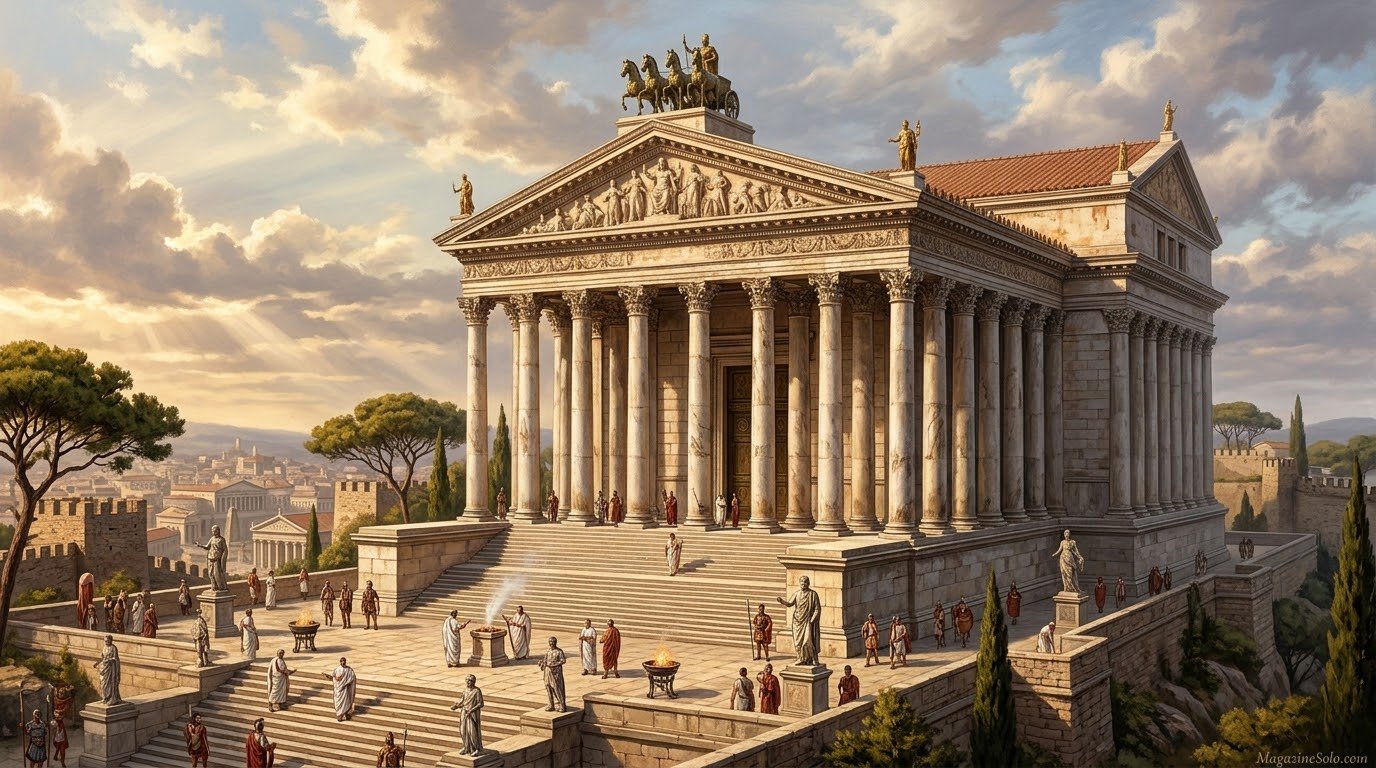
Teachers meet this pair inside a content lesson, not a spelling unit. Students are learning government and hitting the words simultaneously.
The winning order is geography first. Put the city on the map, walk the class to the building inside it, and the container appears physically.
Only then name the spellings. The building that holds the legislature is the capitol, and the city around it is the capital.
The dome mnemonic lands after the logic, as a picture for the o. Students who meet the trick first memorize it backwards half the time.
Practice should rotate the senses deliberately. One city, one sum of money, one letter, one building, and the sorting becomes the lesson.
Finish with the trap question that examiners love. The top of a column is a capital, and the class that laughs has understood.
Assessment writes itself from there. Five sentences, five senses, and a student who sorts them owns the pair permanently.
Names All Around the Building
The US Capitol lends its name to a small city of proper nouns. Each one capitalizes, and each one confuses writers in its own way.
The Architect of the Capitol is the federal office that maintains the building and grounds. The title names a person, not a style of column.
The Capitol Police protect the complex and its lawmakers. The force takes the building’s spelling and its capital letters together.
The Capitol Visitor Center receives the public underground, east of the dome. Its name is a name, however descriptive it sounds.
State buildings grow the same family locally. Capitol complexes, capitol tours, and capitol grounds appear in every state guidebook.
The writer’s rule stays boring and safe. If the phrase names the building or its household, capitalize; if it describes, do not.
Covering Government Without the Classic Error
Election seasons flood drafts with both words hourly. A candidate campaigns in the capital, speaks at the capitol, and files papers between them.
Deadline pressure is the error’s best friend. The words look alike at speed, and a tired eye reads the vowel it expected.
Desks that cover legislatures build the check into the workflow. One find and replace pass for capital building, the error’s signature phrase, catches most slips.
Photographers’ captions deserve the same pass. A caption naming the wrong word under a dome photograph is the mistake readers screenshot and share.
The fix is never knowledge; everyone on the desk knows the rule. The fix is a habit at the exact point where speed beats memory.
The Pair Around the World
Travel writers meet the American scope of capitol quickly. London’s legislature sits in the Palace of Westminster, and no editor calls it a capitol.
Canada’s Parliament Hill offers a neat contrast. Ottawa has a hill and a parliament, and English kept both words local rather than Roman.
The pattern teaches the deeper lesson. Capitol is not the English word for legislature buildings; it is the American name for them.
International readers deserve that sentence early. It explains why their dictionaries treat capitol as a US term and why their own usage is not wrong.
American writers abroad return the favor by learning local names. The word a country uses for its seat of power is part of its civic identity.
A Final Checklist Before You Publish
One: Search the draft for “capital building.” That exact phrase is the error’s fingerprint and should almost never survive.
Two: Search for “capitol city.” The reverse fingerprint is rarer, and it should never survive at all.
Three: Check every capital C Capitol. Each one must be a name, of a specific building or its household institutions.
Four: Check every finance paragraph twice. Money is capital with an a, in every compound from working capital to capital gains.
Five: Read the container test into any doubtful sentence. If the word could sit inside “the ___ stands in the ___,” the building takes the o.
Six: Leave quotations and historical names untouched. A source’s wording is evidence, and modernizing it silently is a different error.
Run the list once per document and the pair is settled permanently. Two fingerprints, one case check, and one container test cover the field.
Why One Letter Carries So Much Weight
A single vowel separates a city from a building, and readers notice. The error is small on the page and large in impression.
That is because this pair sits in ceremonial territory. Government names, money, and the law are places where precision signals respect.
Getting it right is therefore a credibility deposit. The reader who trusts your capitol trusts your reporting, teaching, or selling a little more everywhere else.
Getting it wrong once is forgiven; getting it wrong in a headline is remembered. The building test costs two seconds and buys the deposit every time.
The Habit That Replaces the Rule
Rules fade under deadline pressure; habits survive it. The habit here is a two second glance at what the sentence is actually naming.
Make the glance automatic and the vowel follows on its own. Building, city, money, or letter: the subject announces the spelling.
Writers who build the glance stop fearing the pair entirely. The mnemonic retires to the classroom wall, and the test does the work.
That is the real graduation this page aims at. Not a trick remembered, but a question so small it asks itself.
One Last Contrast: A City You Govern From, a Building You Meet In
Everything here reduces to a difference in scale. A capital is a whole city, with neighborhoods, budgets, and a government somewhere inside it.
A capitol is one address in that city. Lawmakers walk into it, argue inside it, and leave it at night, and the city continues around it.
Writers who feel that scale difference stop confusing the words. The spellings become containers, not coin flips between two vowels.
Keep the building test for the stubborn cases anyway. Even a strong feel for the pair deserves a check when a headline or an exam is watching.
A Short Word to the Perfectionists
Some readers arrive here after years of mixing the pair up in public. Take the comfort the record offers: everyone with your job has done it.
The pair is engineered by history to be mixed up. Same sound, same root, one vowel apart, and a city that insists on containing the building.
What separates careful writers is not a spotless past. It is the two second question asked in the present tense, sentence by sentence.
Ask it kindly, fix what it catches, and move on. That is the whole professional secret, and it is now yours.
Say It Once, Out Loud, Correctly
One spoken drill fixes the container in memory for good. Say it with me: the capitol stands in the capital, and both words are right.
Hearing your own voice place the building inside the city does what silent reading cannot. The sentence becomes a sound you recognize, correctness included.
Use it in classrooms, newsrooms, and study groups without embarrassment. The pairs we say out loud correctly are the pairs we write correctly under pressure.
Keep This Page Where the Writing Happens
Bookmark pages earn their keep at the moment of doubt, not at the moment of reading. Keep this one beside the style guide you actually open.
The doubt will come mid sentence, mid deadline, mid caption. Two seconds here beats a correction later, in print, in front of everyone.
That is the entire case for the bookmark. The pair is small, the test is smaller, and the audience for both is your next sentence.
Frequently Asked Questions
1. What is the difference between capital and capitol?
Capitol is only a building, capital is everything else. Capitol with an o names a building where a legislature meets.
Capital with an a covers the seat of government city, money and assets, uppercase letters, and more.
2. What does capitol mean?
A building where a legislature meets. Most famously the US Congress building in Washington DC, but also every state legislature’s building.
It is exclusively a noun, and its one older sense is the temple of Jupiter at Rome.
3. What does capital mean?
Capital covers nearly everything else here. It means the seat of government city, wealth or assets used in business, an uppercase letter, and, as an adjective, chief or punishable by death.
All of those take the a spelling.
4. Is it state capital or state capitol for the building?
State capitol for the building, state capital for the city. The building where the legislature meets is the capitol with an o.
The city that hosts it is the capital with an a, as in Sacramento, California’s capital.
5. Is Washington DC a capital or a capitol?
Washington DC is the capital; the building inside it is the Capitol. DC is the nation’s capital city, spelled with an a.
The Congress building standing on its hill is the US Capitol, spelled with an o.
6. Why is the US Capitol spelled with an o?
It carries the name of a Roman temple. Capitol descends from Capitolium, the temple of Jupiter Optimus Maximus on Rome’s Capitoline Hill.
The founders deliberately adopted that name for the Congress building, and the o came with the name.
7. How can I remember capital vs capitol?
Use the building test and the container sentence. Ask whether a legislature meets inside it: yes means capitol.
Then anchor memory with the state capitol standing in the state capital, building inside city, each with its vowel.
8. What does the o in capitol stand for in the mnemonic?
Only one meaning. One teaching tradition reads the o as only one: capitol has a single definition, a legislature building, while the a in capital stands for all the rest, the city, the money, the letters.
9. Is the dome trick for capitol reliable?
Yes, as a memory picture it works. The round o mirrors the round dome on the US Capitol and most state capitols.
It is a picture, not a rule, so pair it with the building test for sentences without domes.
10. Are capital and capitol homophones?
Yes, they are homophones. Capital and capitol are pronounced identically, which is why the confusion survives every spellchecker: both spellings are real words, so no tool flags the wrong one in a sentence.
11. Do capital and capitol sound the same?
Identically, for practical purposes. Dictionaries give the two words the same pronunciation.
Your ear cannot separate them at all; only the meaning, building or not, can.
That is the building test’s whole reason for existing.
12. Is capitol always a building?
In modern usage, yes, only ever a building. Capitol names the building or complex where a legislature meets, plus its historical temple sense.
It never means a city, money, or a letter, and it is never an adjective.
13. Can capitol mean money?
Never. Money, wealth, and business assets are always capital with an a: raise capital, working capital, capital gains.
Capitol has no financial sense at all, and using it for money is the pair’s clearest error.
14. Is it raise capital or raise capitol?
Raise capital. Raising money for a business is capital with an a, from the same Latin line as capitale, wealth.
Capitol would claim the company is raising a legislature building, which no investor has ever funded.
15. Why are uppercase letters called capital letters?
Because capital once meant head or chief letters. Uppercase letters were the head letters, used at the heads of sentences and names, from Latin capitalis, of the head.
The name stuck through centuries of printing and teaching.
16. Is it capital letter or capitol letter?
Capital letter. Letters take capital with an a, always.
Capitol letter is not an alternative spelling; it is simply the building word misplaced.
Every sentence starts with a capital, and none starts with a capitol.
17. What is a capital city?
The city or town that is a government’s official seat. A capital city hosts the government of a country or state: Washington DC for the United States, Sacramento for California.
It is spelled with an a, like every city sense.
18. What is the capital of California, and where is its capitol?
Sacramento is the capital; its capitol stands in it. California’s seat of government city is Sacramento, spelled capital with an a.
The gold domed building housing its legislature is the California State Capitol, spelled with an o.
19. Should capitol be capitalized?
Capitalize it when it names a specific building. The US Capitol and the Texas State Capitol take a capital C as names.
The class stays lowercase: a state capitol, any capitol, several capitols under renovation.
20. When do I write the Capitol with a capital C?
When you are naming that building or a specific one. The Capitol, with capital C, refers above all to the US Congress building in Washington DC.
State names work the same way: the California State Capitol is a name.
21. Is a state capitol lowercase?
Yes, as a class term it stays lowercase. A state capitol, the capitol in the next county’s essay, capitols in general: these describe a type of building rather than naming one.
So the word stays small even though the building is grand.
22. What is Capitol Hill?
Three things sharing one name. Capitol Hill is the hill under the US Capitol, the Washington neighborhood around it, and, most often in news, a metonym for Congress itself, as in leaders on Capitol Hill reacted.
23. Is Capitol Hill the building or the neighborhood?
Both, and more. The name began with the hill and the building on it, grew into the neighborhood’s name, and now usually means the institution, Congress.
Context tells you which: addresses mean the place, reactions mean the lawmakers.
24. Why is Congress called Capitol Hill in the news?
Because the building houses the institution. News shorthand borrows the famous building’s name for the people inside it, a classic metonym.
Capitol Hill reacted means members of Congress and their world reacted, reported from their building.
25. Is a statehouse the same as a capitol?
In American usage, effectively yes. Statehouse is the everyday synonym for a state capitol building, the house where the state legislature sits.
Capitol is the formal and more common term in names, tours, and news.
26. Do other countries have capitols?
Not by that name. Capitol is chiefly American usage.
Other countries house legislatures in parliament buildings, assemblies, and palaces, and their English keeps those local names.
The o word belongs to the United States and its Roman borrowing.
27. What was the original Capitol in Rome?
A temple, not a legislature. The original Capitol was the Capitolium, the temple of Jupiter Optimus Maximus on Rome’s Capitoline Hill, the religious and symbolic heart of the Roman state.
American buildings inherited its name, not its function.
28. What is the Capitoline Hill?
Rome’s hill of the temple. The Capitoline is one of Rome’s hills, crowned by the Capitolium temple.
Latin Capitolium took its name from that hill, and English capitol descends from the temple’s name through it.
29. Who was Jupiter Optimus Maximus in the capitol story?
The chief god of Rome. Jupiter Optimus Maximus, Jupiter the Best and Greatest, was the Roman state’s supreme deity, and his Capitoline temple was Rome’s civic heart.
The founders borrowed the temple’s name to lend Congress classical dignity.
30. When did capitol get its American building meaning?
In the 1690s, as an Americanism. Dictionaries record the legislative building sense between 1690 and 1700, labeled an American usage.
Colonists applied the Roman temple’s name to their own legislature houses generations before independence.
31. Did the founders choose the name Capitol on purpose?
Yes, the name was a statement. The young republic designed its Congress building to echo Roman civic ideals and adopted the Capitol name deliberately, temple and all.
State legislatures then followed the federal example with capitols of their own.
32. Which Texas capitol fact surprises visitors?
Its height and its stone. Teaching sources note the Texas Capitol in Austin stands taller than the US Capitol itself, and it is built of pink granite.
Treat the height as the state’s proud and often repeated claim.
33. Is the top of a column a capital or capitol?
Capital, with an a. The topmost part of a column is its capital, part of the word’s chief and head family.
It is the one capital that is part of a building, and it never takes the o.
34. What does capital punishment have to do with capital?
Both grow from caput, the head. Capital punishment is punishment by the head penalty, from Latin capitalis, of the head, in its sense of what touches life itself.
The legal adjective is the a word at its gravest.
35. What does capital mean in finance?
Wealth used to produce more. In finance, capital is money and assets put to work: the funds a business raises, owns, and invests.
It is always spelled with an a, in working capital, capital gains, and capital investment alike.
36. What is working capital?
The funds a business uses day to day. Working capital is current assets minus current liabilities, the money available for daily operations.
Despite sounding like a place, it is pure finance and always takes the a spelling.
37. Can capital be an adjective?
Yes, in several senses. Capital works as an adjective meaning principal or chief (a capital concern), punishable by death (a capital offense), and, old fashionedly, excellent (a capital idea).
Capitol, by contrast, is never an adjective.
38. What does a capital concern mean?
The main or most important concern. A capital concern is the chief worry, the one at the head of the list.
The phrase uses capital’s adjective sense of principal and takes the a spelling.
39. Is a capital idea the same word?
The same word, in an older sense. A capital idea meant a first rate, excellent idea, capital in its adjective sense of chief in quality.
The usage is dated now, but it is the a word, not a misprint.
40. Can capitol be an adjective?
No, never. Capitol is exclusively a noun naming a building.
It cannot modify another noun as an adjective in its own right, and it has no comparative, adverb, or verb forms in standard usage.
41. Capital vs capitol in one sentence: give an example with both.
The container sentence does it. The state capitol is located in the middle of the state capital.
Building inside city, o inside a, and Wiktionary itself uses a version of that sentence to teach the pair.
42. How do I check capital and capitol in a long document?
Search for both spellings and interrogate each hit. Building where lawmakers meet keeps capitol.
City, money, letter, and adjective hits take capital.
Then check every capital C Capitol is a name, and the pass takes minutes.
Conclusion
The capital vs capitol question settles the moment the building test is asked. Lawmakers inside means capitol; everything else on Earth means capital.
Hold the asymmetry and the pair stops biting. Capitol guards one building type, while capital carries the city, the money, and the letters.
The homophone shelf has more pairs built the same way, including the there, their, they’re difference guide, which untangles three words that share a single sound.
Possession traps reward the same pause before writing, and the same short test powers the your vs you’re difference guide, separating belonging from a contraction.
Number words join the set neatly, since the to, too, two difference guide sorts three spellings by the job each one does in the sentence.
Time words finish the tour, with the than vs then difference guide drawing the line between comparisons and sequences through the same one test habit.
Ask the building test of the sentence on your screen right now. That is the whole skill, and it will not fail you.

Dilawar is a content writer at MagazineSolo, covering travel, home improvement, interior design, and everyday lifestyle topics. He enjoys researching practical solutions, exploring travel destinations, and sharing helpful guides that make daily life easier. His writing focuses on clear information, useful advice, and engaging stories for a wide audience.