Capital vs Capitol Difference, Explained

Capital vs capitol difference questions are not really about spelling. They are about scope, and scope is easier to judge.
Capital, with an a, is a wide word. It means the city, the money, the uppercase letter, and several things besides.
Capitol, with an o, is a narrow word. It means one building type, the building where a legislature meets, and nothing else.
So the whole difference fits in one judgment. Wide meaning in the sentence? Take the a word. The building? Take the o.
The two scopes meet in the hardest place possible. The capital city contains the capitol building, so both words share sentences daily.
The pair belongs to a family of sound alike traps catalogued in MagazineSolo’s confused words library. This page gives the difference its own full treatment.
The Difference in One Line: Scope, Not Spelling
Most confused pairs differ in meaning. This pair differs in how much meaning each word is allowed to carry.
Capital carries a crowd: a city, a fortune, a letter, a rank, a death sentence. Capitol carries a single building.
That is why the standard advice works. Default to capital, and reserve capitol for the one job it alone can do.
That letter logic comes from the Dictionary.com explainer on capital and capitol, and it encodes the scopes neatly. The o stands for only one meaning; the a stands for all the rest.
When a sentence could take either word, ask about scope first. The vowel then stops being a guess and becomes a measurement.
|
Capital (a) |
Capitol (o) |
|
|---|---|---|
|
Scope |
Wide: many senses |
Narrow: one sense |
|
Core meaning |
Seat of government city |
Legislature building |
|
Other jobs |
Money, letters, chief, law, column top |
None in modern use |
|
Part of speech |
Noun and adjective |
Noun only |
|
Example |
Austin is the capital. |
The capitol stands in Austin. |
Capital: The Wide Word
Start with the sense that causes the trouble. A capital is the city or town that is a government’s official seat.
Washington, DC is the national example. Sacramento serves California, Austin serves Texas, and Albany serves New York the same way.
The same spelling then runs a finance desk. Capital is wealth put to work: raising it, investing it, gaining on it.
It also runs the keyboard. A capital letter opens every sentence and every proper name you will write today.
As an adjective it ranks things. A capital concern is the chief one, and a capital offense is the gravest kind.
One more hides in architecture. The top of a column is a capital, a sense the trap chapter returns to with pleasure.
A wide word earns its width honestly across centuries, and a cousin case is the principal vs principle difference guide, which shows a spelling carrying money and rank in the same way.
Capitol: The Narrow Word
Capitol names a building, or a complex of buildings, where a legislature meets. Read that again; it is the entire definition.
The US Capitol in Washington is the famous instance. The Senate and the House sit there, and the building lends Congress its nickname.
State versions repeat the pattern fifty times. A state capitol, often called a statehouse, houses a state legislature.
Narrowness has sharp edges worth respecting. Capitol is never an adjective, never a sum of money, never a city, never a letter.
Its only other sense is a fossil. In history books, the Capitol is the temple of Jupiter that once stood in Rome.
Teaching sources hold the line without exception. In the ESLBuzz guide to capital and capitol, the same narrow definition appears with the state buildings as proof.
The Difference in Sentences: Pairs That Flip
Abstract rules fade; flip sentences stay. Each pair below changes one vowel and flips the whole meaning with it.
They marched on the capitol to petition the government. They marched on the capital would send them to a city, not a building.
The firm raised capital for a second factory. The firm raised capitol would claim it built a legislature, which no firm does.
Start the sentence with a capital. Start it with a capitol and the sentence begins with a building on the page.
She photographed the capitol at dawn, dome first. She photographed the capital at dawn means the whole city woke for her lens.
The pattern across every pair is identical. The building takes the o, and everything wider takes the a.
Why the Difference Exists: A Temple Name vs a Head Word
Scope differences have histories, and this one is a tale of two Latin roads. Both start at caput, the Latin word for head.
Capital widened from capitalis, of the head. Head city, head sum, head letter, head crime: the adjective kept absorbing chief things.
Capitol stayed narrow because it began as a name. Capitolium was the temple of Jupiter Optimus Maximus on Rome’s Capitoline Hill.
Names do not widen the way adjectives do. The word crossed the Atlantic as a temple’s name and was fitted onto legislature buildings.
Dictionaries date that American use to the 1690s. The founders then chose the Roman name deliberately for Congress in the following century.
So the modern difference is two histories frozen mid journey. One word kept growing; the other kept its name tag on.
The Capitalization Difference Inside the Difference
Inside the spelling difference sits a second one. Capitol sometimes takes a capital C, and the rule mirrors the scope rule.
Name one specific building and capitalize it. The US Capitol and the Texas State Capitol are names, like people’s names.
Speak of the class and keep it small. A capitol, any capitol, and capitols in general stay lowercase, however grand they are.
Cities need no such care, because they never take the o. A capital city is the a word in every register and style.
Writers who learn both differences together stop making both errors. The case check takes one glance, the same glance as the scope check.
Capitol Hill: Where the Difference Meets a Metonym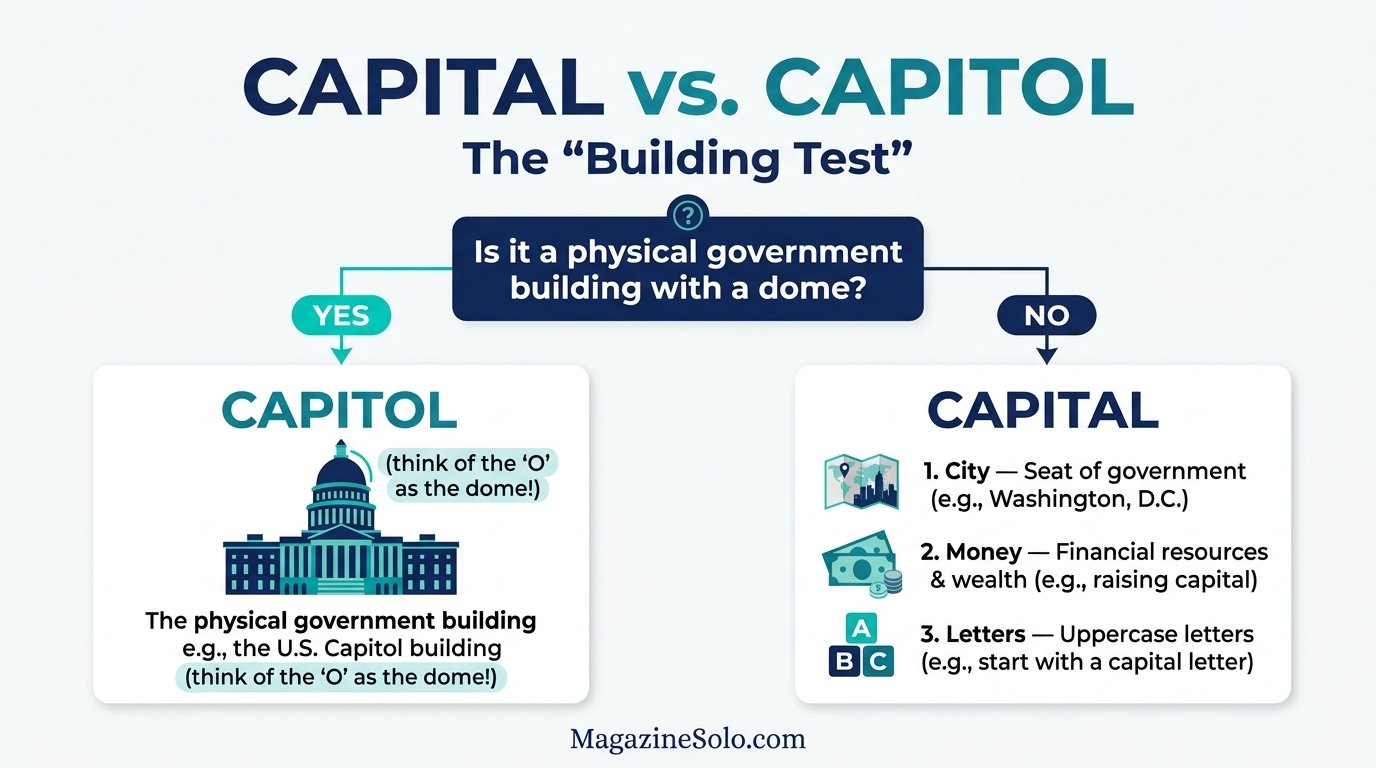
The narrow word has one wide second life. Capitol Hill names the hill, the neighborhood, and, in the news, Congress itself.
The building houses the institution, so the name transfers. Word on Capitol Hill means word among lawmakers, not among stones.
This is the difference’s pressure valve. Everywhere else, capitol stays the building; on the Hill, it becomes the people inside it.
Context keeps the three readings apart without effort. Addresses mean the place, reactions mean the institution, and tours mean the building.
Writers should still name the chamber when a chamber acts. The Senate passed it is information; Capitol Hill passed it is weather.
The Column Capital: The Difference’s Favorite Trap
Every good rule deserves one honest exception to test it. Here, the exception is carved in stone at the top of every column.
That carved top is called a capital, with an a. It is part of a building, sometimes part of the capitol building itself.
The scope rule survives because the test is about legislatures, not lumber or stone. A building only takes the o when lawmakers meet inside.
Parts of buildings, however official, stay in the wide word’s territory. The column’s capital is capital’s architecture sense, one of its many jobs.
Examiners adore this trap for exactly that reason. It catches slogan learners and rewards anyone who learned the difference as scope.
Difference Clinics: Classroom, Newsroom, Finance Desk
Classrooms meet the difference inside civics, not spelling drills. The city on the map and the building inside it teach scope physically.
Newsrooms meet it at deadline speed. The classic alert error, capital for the building, slips in when the vowel is chosen by habit.
Finance desks meet it in reverse. Their capital is money all day, so the building word feels exotic and gets avoided or misused.
Tourism copy meets it warmly and constantly. Visit the capitol in the heart of the capital is the industry’s signature sentence.
Each desk fixes it the same way. One scope question at the point of writing, and the difference handles itself from there.
The one question habit transfers across the whole shelf, and a close cousin is the stationary vs stationery difference guide, sorted by the same glance at what the sentence names.
Practice: Fifteen Flip Sentences With Verdicts
- The class toured the ___ in Sacramento. Capitol. The building toured is the legislature’s home, in the capital city.
- Sacramento is California’s ___. Capital. The city itself takes the wide word.
- Investors supplied the ___ for the expansion. Capital. Money supplied is the finance sense.
- Her name begins with a ___. Capital. The letter sense, uppercase, takes the a.
- The ___ dome glowed at sunset. Capitol. The dome belongs to the building.
- It was a ___ mistake to skip the rehearsal. Capital. The adjective sense, chief or serious, in older phrasing.
- The ___ of the column cracked in the quake. Capital. Architecture’s sense survives even inside a capitol.
- Lawmakers returned to the ___ after recess. Capitol. The building they work in, lowercase as a class here.
- The state’s ___ moved twice in its history. Capital. Cities move; buildings are rebuilt, a scope clue in itself.
- ___ Hill announced a hearing schedule. Capitol. The metonym names Congress acting through its building’s name.
- Working ___ kept the bakery open. Capital. The finance compound, current assets in daily use.
- The jury weighed a ___ charge. Capital. The legal adjective, punishable by death.
- Every state has a ___ building to maintain. Capitol. The class of building, named generically across states.
- Denver is a ___ at a mile high. Capital. The city, famous for its altitude, takes the a.
- The ___ stands in the ___, as always. Capitol, then capital. The container sentence closes the set, building inside city.
The Sentence Clinic: Ten Difference Fixes
- “The capital was built in 1888.” Ambiguous, leaning fix. Buildings get built on dates; cities get founded. If the dome is meant, write capitol.
- “She works in the state capital.” Keep, usually. Working in the city is the wide reading; working at the capitol is the fix when the building is her office.
- “The capitol of Texas is Austin.” Fix to capital. The of a state construction names the city, and cities take the a.
- “They raised enough capitol to begin.” Fix to capital. Fundraising is the finance sense; no building was raised.
- “Meet me at the capital at noon.” Fix to capitol when the building is the meeting point. Places you can stand inside take the o.
- “His letter began with a capitol.” Fix to capital. Letters are the wide word’s typography sense.
- “The capital steps were crowded.” Fix to capitol steps. Steps belong to the building, not to the municipality.
- “The governor addressed the capitol.” Keep with care. Addressing the building means addressing the lawmakers inside it, a metonym print accepts.
- “The column’s capitol gleamed.” Fix to capital. The carved top is the architecture sense, part of the wide word’s list.
- “A capitol idea for the fundraiser!” Fix to capital idea if the old fashioned excellent sense is intended. Praise is an adjective job.
Each fix asked the same scope question. Wide or the building decided every vowel without a single coin flip.
The Difference Across a School Year
September starts with geography. Students memorize state capitals, and the wide word enters as a list of cities to pin on maps.
October brings the field trip. The class buses to the capitol, walks its steps, and meets the narrow word as a place with doors.
Winter essays mix the two freely, and the errors bloom. The difference lesson lands best there, when both words are live in the same notebook.
Spring tests sort the survivors. The students who learned scope sort new sentences calmly; the slogan learners hesitate at the column question.
Teachers who plan for that arc teach the difference once, properly. The rest of the year becomes practice, not re-teaching.
The Difference for Visitors and Tourists
Visitors meet the difference as an itinerary. They fly into the capital, book a room, and tour the capitol the next morning.
Guidebooks write both words on every page, and the good ones never slip. A single capitol city in a tour text undermines the whole book’s authority.
Tour scripts make the difference a small performance. Guides point at the dome for the o and sweep an arm at the city for the a.
Souvenir spelling matters more than shops expect. A magnet reading “Greetings from the Capitol City” sells a mistake to be fridged for years.
The visitor’s takeaway is the resident’s rule. Buildings you can enter take the o; the city that hosts your whole trip takes the a.
Proofreading the Difference: A Three Pass Method
Pass one hunts the fingerprints. Search for capital building and capitol city; both phrases are the error wearing its name tag.
Pass two checks every capital C Capitol. Each must name a specific building or its household, or it drops to lowercase.
Pass three reads the finance and geography lines aloud. Money and cities should all carry the a, and any o in those lines is a suspect.
Three passes take minutes in most documents. Together they catch the difference errors that single readings miss, because each pass hunts a different failure.
Make the passes a checklist wherever government copy is produced. The difference then survives deadlines, staff changes, and election night itself.
Why Scope Beats Every Mnemonic
Mnemonics picture the answer; scope produces it. A writer facing a new sentence needs production, not a picture of a dome.
The dome picture also fails quietly at the edges. Plenty of capitols are domeless, and plenty of domed buildings are not capitols at all.
The only one picture survives better, because it states a scope fact. Even it cannot tell you whether this sentence names the one meaning.
The scope question can. Wide or building is a judgment about the sentence in front of you, which is exactly where the error lives.
Teach the pictures for memory, by all means. Then teach the question for the writing itself, and the pair is finished.
The Difference in Your Own Address Book
Daily life sprinkles the wide word everywhere and the narrow word almost nowhere. That imbalance is itself a proofreading clue.
Your contacts live in capital cities, your bank tracks capital gains, and your keyboard starts sentences with capitals. Capitol appears only when government buildings do.
So an o in an ordinary document deserves a second look. It should be defending a building; if it is not, it is almost certainly wrong.
The reverse check is weaker, because the wide word is everywhere. An a is suspicious only in the building’s own sentences: steps, dome, chambers, tours.
Writers who internalize the imbalance stop proofreading the pair word by word. They proofread by territory, which is faster and catches more.
One Last Contrast: The Word That Grew vs the Name That Stayed
Everything on this page is a story of growth and loyalty. Capital grew, century by century, into every head and chief thing English needed named.
Capitol stayed loyal to a single building type, the way names do. It crossed an ocean, changed countries, and still points at one kind of roof.
Writers who feel that story stop treating the pair as a spelling bee. The words become biographies, and biographies are hard to confuse.
Keep the scope question for the stubborn sentences anyway. Even a well told story deserves a check when an exam or a headline is watching.
The Habit That Replaces the Rule
Rules fade under deadline pressure; habits survive it. The habit here is a two second scope glance at what the sentence names.
Make the glance automatic and the vowel follows unforced. City, money, letter, or the building: the subject announces the spelling.
Writers who build the glance stop consulting pages like this one, which is the point. The difference becomes reflex, and reflexes do not expire.
That graduation is the real product here. Not a trick remembered for a test, but a question so small it asks itself mid sentence.
Say the Difference Once, Out Loud
One spoken drill fixes the scope in memory for good. Say it plainly: the capitol stands in the capital, and listen to the building land inside the city.
Hearing your own voice assign the scopes does what silent reading cannot. The sentence becomes a sound with the difference built in.
Use it in classrooms, newsrooms, and study groups without ceremony. The pairs we say correctly out loud are the pairs we write correctly under pressure.
A Short Word to Anyone Still Mixing Them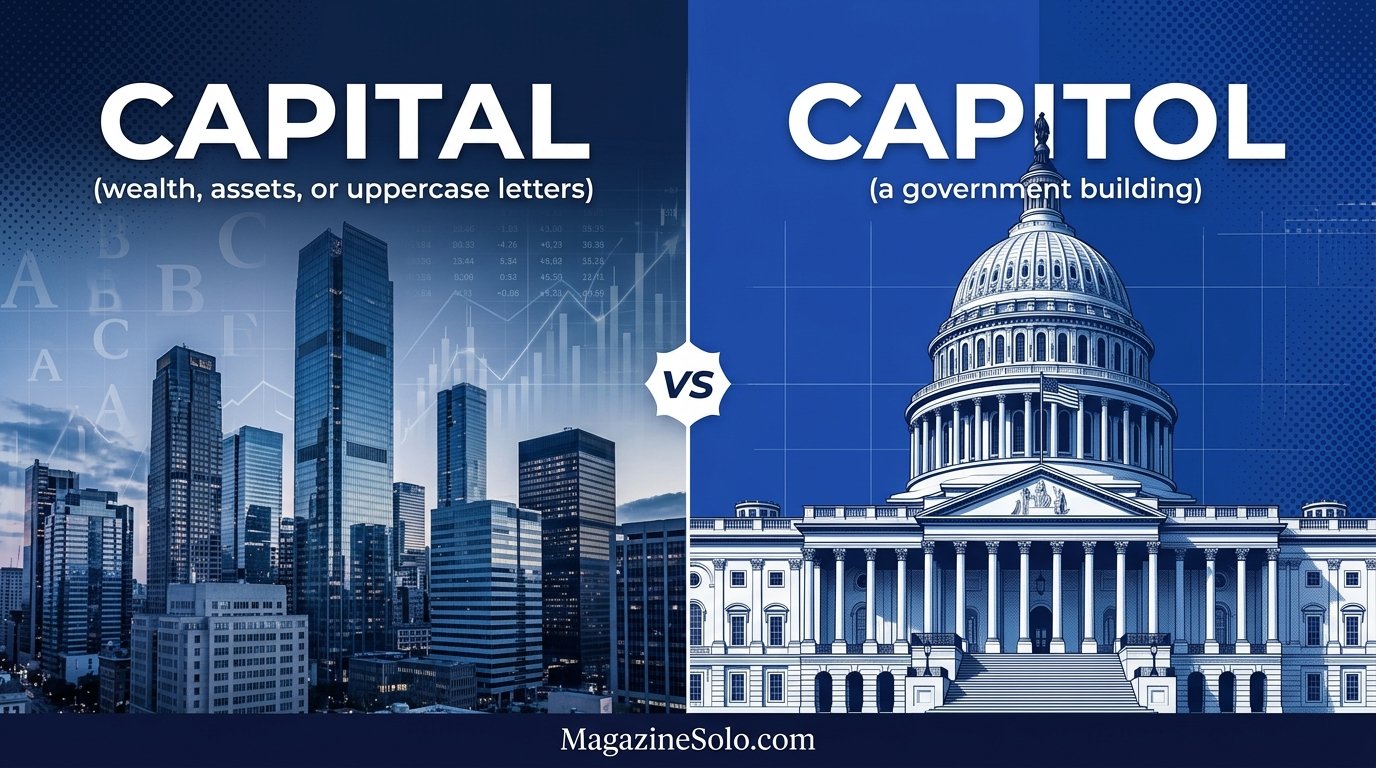
Some readers arrive here after years of swapping the pair in public. Take the comfort the record offers: the pair is engineered by history to be swapped.
Same sound, same root, one vowel apart, and a city that insists on containing the building. Confusion is the default setting, not a personal failure.
What separates careful writers is not a spotless past. It is a two second question asked in the present tense, sentence by sentence, kindly and without drama.
Ask it, fix what it catches, and move on. That is the whole professional secret, and as of this page, it is yours too.
Keep This Page Where the Doubt Happens
Bookmark pages earn their keep at the moment of doubt, not the moment of reading. Keep this one beside the style guide you actually open.
The doubt will arrive mid sentence, mid caption, mid headline. Two seconds here beats a correction later, in print, in front of the whole readership.
That is the entire case for the bookmark. The difference is small, the question is smaller, and its audience is your next sentence.
Why the Difference Deserves Its Own Page
Skeptics ask why one vowel deserves thousands of words. The honest answer is that the vowel is load bearing in ceremonial territory.
Government, money, and law are the subjects where readers judge precision hardest. An error there discounts everything around it, fairly or not.
A page that settles the pair permanently is therefore cheap insurance. Two seconds per future sentence, bought once, is the best rate in all of usage.
The Difference, One Final Time, Slowly
Breathe, and run the pair past one last fresh sentence. The delegation toured the capitol before returning to the capital for the winter.
Building first, city second, and the scopes never touched. That calm separation, repeated a thousand times, is what mastery of this difference actually looks like.
Carry the Question, Not the Page
Nobody should need to reopen a reference for a two word pair forever. The goal of every section above is to make the scope question portable.
Carry it into the next essay, caption, filing, and headline. Wide or building, asked once, answers the difference for the rest of your writing life.
Frequently Asked Questions
1. What is the capital vs capitol difference in simple words?
It is a scope difference. Capital with an a is a wide word: the seat of government city, money, uppercase letters, and more.
Capitol with an o is a narrow word: one building where a legislature meets.
2. What is the difference between a capital and a capitol building?
One is a building, the other is not. A capitol building houses a legislature.
A capital is never a building in that sense; the word capital names the city around it, plus money, letters, and other wide meanings.
3. How does the difference between capital and capitol work with examples?
The building flips the vowel. Protesters gathered at the capitol (the building).
The protest filled the capital (the city).
Raise capital (money) has no building anywhere.
Each sentence’s scope picks its spelling.
4. What is the difference between a capital city and a capitol?
The city contains the building. A capital city is the government’s seat, a whole city.
A capitol is one address inside it, the legislature’s building.
Sacramento is the capital; the domed building in it is the capitol.
5. What is the difference between capital and capitol in money terms?
In money terms there is no contest. Money is always capital with an a: raise capital, working capital, capital gains.
Capitol has no money sense at all, so financial writing uses the wider word in every line.
6. What is the difference between capital letters and capitol?
Letters belong to capital entirely. A capital letter is an uppercase letter, named from the head and chief sense.
Capitol never names a letter; capitol letters would mean letters belonging to a building, which is not a usage.
7. Why does the capital vs capitol difference exist at all?
Because the words took different Latin roads. Capital widened from capitalis, of the head, absorbing city, money, and letter senses.
Capitol began as a proper name, the Capitolium temple, and proper names stay narrow.
8. What is the difference between the Capitol and a capitol?
Name versus class. The Capitol, capitalized, names a specific building, above all the US Congress building.
A capitol, lowercase, names the class: any legislature building anywhere.
Same spelling choice, plus a case choice on top.
9. What is the difference between capitol and statehouse?
They are synonyms for the building. Statehouse is the everyday name for a state capitol building, the house where the state legislature sits.
Capitol is the formal term used in names, tours, and news reports.
10. What is the difference between capital and principal in finance?
Principal is the older, narrower finance word. In finance writing, capital covers all funds and assets put to work, while principal names the original sum itself, as against interest or gains.
Both take wide spellings; neither is capitol.
11. Is there a difference between uppercase and capital letters?
Almost none in ordinary use. Uppercase is the typographer’s plain term, capital is the traditional name for the same letters.
Teachers say capital letters; printers say uppercase.
The letters are identical either way.
12. How do I explain the capital vs capitol difference to a child?
Use the container picture. Tell the child the building lives inside the city, like a toy inside a box: the capitol (with the round o, like its dome) stands in the capital.
One picture usually settles it.
13. How do I teach the capital vs capitol difference in class?
Teach scope before spelling. Put the city on the map, walk to the building inside it, and let students sort sentences by what each names.
The vowel then attaches to a judgment they already know how to make.
14. What trick captures the capital vs capitol difference best?
The scope trick beats the letter tricks. Letter mnemonics (o for dome, o for only one) help memory, but the scope judgment, wide word or the one building, decides new sentences the tricks never pictured.
15. Does the capital vs capitol difference matter in British English?
Less, because capitol is chiefly American. British English keeps capital for cities, money, and letters, but its legislature buildings are parliaments, so the o word rarely arises.
The difference matters most in American civics and news.
16. Is the capital vs capitol difference tested in exams?
Yes, in civics and language tests alike. State capitals units test the city, and spelling and usage sections test the building word.
Citizenship and GED materials use both, which is why the pair recurs every school year.
17. What is the most common capital vs capitol difference mistake?
Calling the building the capital building. It is the most printed version of the error, in essays, captions, and drafts.
The reverse error, calling the city the capitol, usually appears right after someone first learns the o.
18. Which side of the capital vs capitol difference is used more often?
Capital, by a wide margin. The wide word serves finance, geography, typography, and law every day.
Capitol serves one building type in one country’s vocabulary, which is why defaulting to capital is statistically safe.
19. Can the capital vs capitol difference change a sentence’s meaning?
Completely. The governor addressed the capitol puts her inside the legislature building, speaking to lawmakers.
The governor addressed the capital addresses the whole city.
One vowel moves the audience by thousands of people.
20. Give a sentence where the capital vs capitol difference is the whole point.
The container sentence is built for it. The state capitol is located in the middle of the state capital.
Building inside city, o inside a’s territory, and both spellings proven correct by a single breath.
21. What is the difference between Capitol Hill and the Capitol?
The building versus its name in the news. The Capitol is the building itself.
Capitol Hill is the hill, the neighborhood, and the metonym for Congress.
A report from the Capitol is place; reaction on Capitol Hill is people.
22. What is the difference between the Roman Capitol and the US Capitol?
A temple versus a legislature building. Rome’s Capitol was the Capitolium, Jupiter’s temple, a place of worship.
The US Capitol borrowed the temple’s name for a working legislature building, inheriting the word, not the function.
23. Does the capital vs capitol difference apply to other countries?
Only loosely. The capital city half is universal, every country has a seat of government.
The capitol half is American: other countries name their legislature buildings parliaments and assemblies, so the pair is a US vocabulary item.
24. What is the difference between a capital and a seat of government?
They are the same thing from two angles. A capital is a seat of government described as a city.
Seat of government is the role; capital is the word for the city filling it.
Both take the a spelling always.
25. How is the capital vs capitol difference handled in headlines?
Headlines compress, and compression endangers the pair. Desks handle it with a signature phrase check: search for capital building before publication.
The error is so classic in alerts that many style guides name it directly.
26. How is the capital vs capitol difference handled in legal documents?
Legal documents use both with care. A statute may appropriate capital funds (money) for the capitol’s repair (the building) in one sentence.
Drafters define terms and proofread the pair deliberately, because each spelling carries obligations.
27. What is the difference between capital as a noun and capital as an adjective?
The noun names things; the adjective ranks them. Capital the noun is a city, a sum, or a letter.
Capital the adjective means chief (a capital concern) or punishable by death (a capital offense).
One spelling serves both grammars.
28. What is the difference between capitol as a name and capitol as a class?
A name singles out; a class describes. Capitol as a name (the Texas State Capitol) points at one building.
Capitol as a class (a capitol) describes a type.
The capital letter C is the visible sign of the naming.
29. Why is the capital vs capitol difference a scope difference?
Because one word kept widening and the other could not. Capital absorbed new chief and head senses for centuries.
Capitol, born as a proper name, was borrowed for one building type and stayed there.
Scope is the fossil of that history.
30. What is the difference between the dome trick and the only one trick?
They picture different scopes. The dome trick pictures the building’s shape, a memory image.
The only one trick states the scope itself: capitol has one meaning.
Both work; the scope version explains why it works.
31. How does the capital vs capitol difference appear in tourism writing?
Tourism writes the container sentence weekly. Visit the capitol in the heart of the capital sells the building and the city in one line.
The difference is the copy’s accuracy and its charm at the same time.
32. What is the difference between the capital of a state and its largest city?
A capital need not be the largest city. The capital is the seat of government by law or custom, which is why Albany, not New York City, is New York’s capital.
Size and status are different facts, and only status takes this word.
33. How do dictionaries state the capital vs capitol difference?
By scope and by senses. Dictionaries define capitol with its building sense and its temple history, then give capital a long sense list running from city to money to letters to law.
The length of the two entries is the difference, printed.
34. What is the difference between capital punishment’s capital and capitol?
They share a root, not a spelling choice. Capital punishment’s capital is the adjective from caput, the head, touching life itself.
Capitol is the building word from the temple’s name.
Only the distant Latin ancestor is shared.
35. What is the difference between a column’s capital and a capitol building?
Everything except the setting. A column’s capital is its carved top, the architecture sense of the wide word.
A capitol building is a whole legislature building.
The part takes the a; the building takes the o.
36. Is there a difference between capitol complex and capitol building?
A small one of scale. A capitol building is the legislature’s main building.
A capitol complex is that building plus its surrounding offices and grounds, the whole campus.
Writers name the complex when the story covers more than the dome.
37. What is the difference between raising capital and visiting the capitol?
They are different verbs’ objects entirely. Raising capital gathers money for a purpose.
Visiting the capitol tours a building.
Placing both in one biography is possible; confusing their spellings is the only error available.
38. How does the capital vs capitol difference show up in resumes and addresses?
In addresses, the city line carries capital’s sense silently. Writers list the state capital in cover letters and locate offices in the capital, all with an a.
The building appears in experience lines for anyone who worked at the capitol.
39. What is the difference between the words’ Latin roots?
One widened; one was a name. Capital descends from capitalis and capitale, of the head and wealth, common words that grow senses.
Capitol descends from Capitolium, one temple’s proper name, and proper names resist widening.
40. Which word came first in the capital vs capitol difference?
Capitol’s ancestor is older as a name; capital’s senses are older as words. The Roman temple’s name predates English entirely.
In English, capital’s head and chief senses came first, and the American building sense of capitol is recorded in the 1690s.
41. How can I check the capital vs capitol difference while proofreading?
Search the two fingerprint phrases. Capital building and capitol city are the error’s signatures; check every hit.
Then glance at each capital C Capitol to confirm it names a specific building, and the document is clean.
42. What one line summarizes the capital vs capitol difference?
A is everything, o is the building. Capital with an a covers the city, the money, the letter, and the rest.
Capitol with an o names the one building where a legislature meets.
That sentence is the whole difference.
Conclusion
The capital vs capitol difference is a scope judgment wearing a spelling costume. Wide meanings take the a word; the one building takes the o.
Hold that shape and the pair resolves itself in sentence after sentence. Capital carries the city, the money, and the letters, because it always has.
The sound alike shelf rewards the same judgment everywhere, including the there, their, they’re difference guide, which untangles three spellings of one sound by the job each does.
Possession and number pairs follow the same pattern, with the your vs you’re difference guide and the to, too, two difference guide each sorting their spellings by function, not by sound.
Comparison words finish the set in the same spirit, with the than vs then difference guide separating comparisons from sequences through one small test of its own.
Ask the scope question of the sentence on your screen right now. That is the whole skill, and it will not fail you.

Dilawar is a content writer at MagazineSolo, covering travel, home improvement, interior design, and everyday lifestyle topics. He enjoys researching practical solutions, exploring travel destinations, and sharing helpful guides that make daily life easier. His writing focuses on clear information, useful advice, and engaging stories for a wide audience.