Less Then or Less Than – Which Is Correct? (Examples)
Many English learners and even native speakers confuse “less then or less than.” The two phrases look almost identical, but only one is grammatically correct in comparisons.
If you have ever written sentences like “I have less then you” or “The project took less then a week,” you are not alone. This is one of the most common grammar mistakes in English writing because the words then and than sound similar.
In simple terms:
- Less than = correct
- Less then = incorrect in comparisons
Understanding the difference can instantly improve your writing clarity, grammar accuracy, and professionalism. In this guide, you’ll learn the correct usage, see real examples, avoid common mistakes, and understand why “less than” is the proper phrase.
Less Then or Less Than – Which Is Correct?
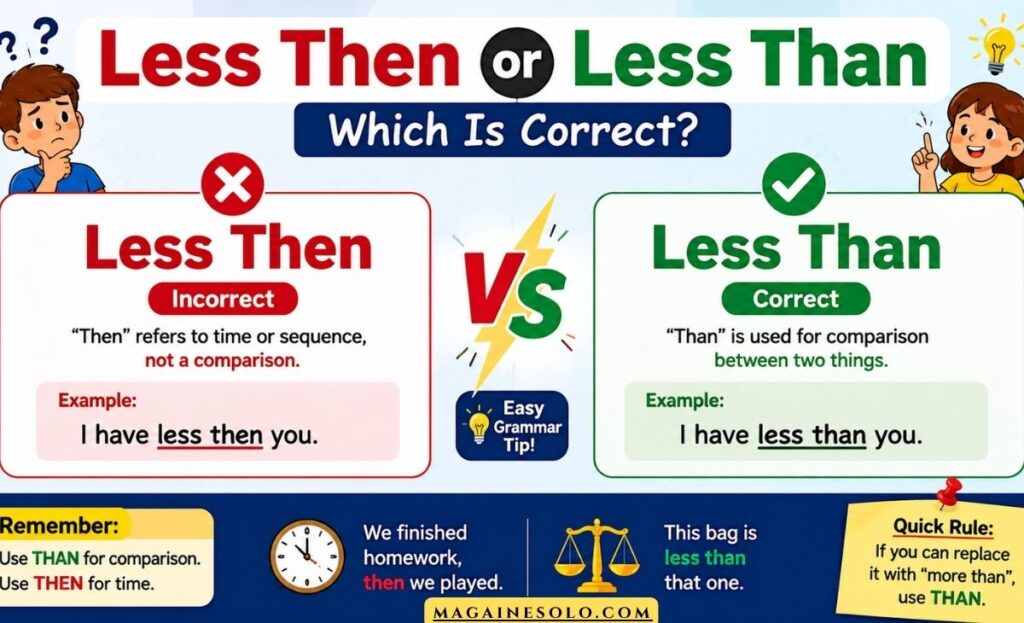
When it comes to less then or less than, there is only one right answer: “less than.” It is the correct phrase for comparing amounts, quantities, numbers, or degrees, showing that one thing is smaller or lower than another. “Less then” is a grammatical error with no valid use in English, period.
A quick self-test: if you can replace the word with compared to or under, you need than. If the sentence is about timing or what happens next, you need then.Quick Difference Table
| Phrase | Correct or Incorrect | Meaning |
| Less than | Correct | Used for comparison |
| Less then | Incorrect | Common spelling mistake |
| Then | Correct word alone | Refers to time or sequence |
| Than | Correct word alone | Used in comparisons |
Easy Rule to Remember
Use:
- Than → for comparisons
- Then → for time or sequence
Example
- She is taller than me.
- We ate dinner, then watched a movie.
This simple rule helps prevent many common English grammar mistakes.
Less Then
“Less then” is incorrect in every context, every register, every style of writing. It is a misspelling of “less than” caused by mixing up then and than, two words that look nearly identical and sound the same in everyday speech.
Why Do People Write “Less Then”?
The two words differ by just one vowel “e” versus “a” and most people pronounce them identically in conversation. To make matters worse, spell-checkers rarely flag “less then” as an error because both words are spelled correctly on their own. The mistake is grammatical, not typographical, so it slips through undetected.
Then indicates time, sequence, or consequence. It answers when? or what comes next?
Correct uses of then:
- Finish the draft, then send it.
- We had coffee and then left.
- Back then, nobody owned a smartphone.
None of these involve comparison. Then is doing its proper job , marking sequence or time. The moment your sentence compares one thing to another, then is the wrong word. That is the heart of the less then or less than question.
“Less Then” — Wrong vs. Right
| ❌ Incorrect | ✅ Correct |
| She earns less then her colleague. | She earns less than her colleague. |
| The trip took less then two hours. | The trip took less than two hours. |
| He has less patience then before. | He has less patience than before. |
| I need less then ten minutes. | I need less than ten minutes. |
| There were less then 50 guests. | There were fewer than 50 guests. |
In every wrong example above, then is being forced into a comparison it cannot make. Only than carries comparative meaning in English.
Bottom line: If you see “less then” written anywhere, it is an error, no exceptions, no regional variations, no informal pass.
Less Than
“Less than” is the grammatically correct phrase, accepted universally across formal writing, journalism, academic papers, and everyday conversation. It expresses that one amount, level, or measurement falls below another.
The Grammar Behind It
Less is the comparative form of little. In English, comparative words more, better, worse, less are always paired with than when comparing two things:
- More than expected
- Better than yesterday
- Less than the average
Just as you would never write “more then expected,” writing “less then” is equally wrong. The structure demands than because a comparison is being made. So when anyone asks is it less than or less then, the grammar rule settles it immediately: it is less than, always.
When to Use “Less Than”
Money: The repairs cost less than $200.
Time: The meeting ran for less than thirty minutes.
Distance: The school is less than a mile away.
Degree: His explanation was less than satisfactory.
Data and stats: The error rate is less than 1%.
In every one of these sentences, two things are being compared — and than is the correct connector each time. Writing “less then” in any of them would be a mistake.
Quick Note: “Less Than” vs. “Fewer Than”
While tackling less than or less then, it is worth knowing one more related rule:
- Use “less than” for uncountable things — time, money, water, distance, effort.
- Use “fewer than” for countable things — people, items, errors, words.
| Less Than | Fewer Than |
| Less than $50 | Fewer than 10 people |
| Less than 3 hours | Fewer than 5 mistakes |
| Less than a gallon | Fewer than 20 applicants |
In informal writing, “less than” is widely accepted with countable items too Merriam-Webster notes it is standard with money, time, and distance. For formal or academic work, stick with “fewer than” for countable nouns.
Which Is Used the Most?
There is no real contest. “Less than” appears millions of times in published books, news articles, legal documents, and academic writing. “Less then” appears almost exclusively as an uncorrected typo in informal digital text social media posts, casual messages, unedited drafts.
You will find “less than” in every kind of serious writing:
- News: “Inflation fell to less than 3% last month.”
- Medicine: “Consume less than 2,300 mg of sodium per day.”
- Law: “Penalties apply to amounts less than the statutory minimum.”
- Everyday speech: “I’ll be there in less than five minutes.”
“Less then” carries no alternative meaning. It is not a dialect form, not an informal shortcut, it is simply an error.
The easiest memory trick:
Than has an a — just like a comparison. Then has an e — just like time.
Comparison → than. Time → then. Apply that and the less then or less than question answers itself every single time.
FAQ’s
Is it less than or less then?
Always less than. “Less then” is a grammatical error in every context.
Can “less then” ever be correct?
No. There is no situation — formal or informal — where “less then” is acceptable in English.
What is the difference between “then” and “than”?
“Then” refers to time or sequence. “Than” is used for comparisons. They are not interchangeable.
Why does spell-check miss “less then”?
Because both words are spelled correctly on their own. The error is grammatical, not a spelling mistake, so most automated tools do not catch it.
Should I use “less than” or “fewer than”?
Use “fewer than” for countable nouns (fewer than five people). Use “less than” for uncountable amounts (less than an hour). In casual writing, “less than” works for both.
Final Thoughts
The less then or less than debate has exactly one correct side. “Less than” is right because than is the word English uses for comparisons, and less is a comparative word that always needs than beside it. “Less then” is wrong because then belongs to time and sequence, not to measurement or contrast.
Whenever you compare two amounts, quantities, or levels, write less than. No exceptions. And remember: the answer to is it less than or less then is always, without question, less than.

Shoaib Ahmad is a language-focused content writer and researcher at magazinesolo.com, where he explains the meaning of words, phrases, and text in a clear and reader-friendly way. His work focuses on simplifying language, uncovering context, and helping readers understand text with confidence and clarity.