
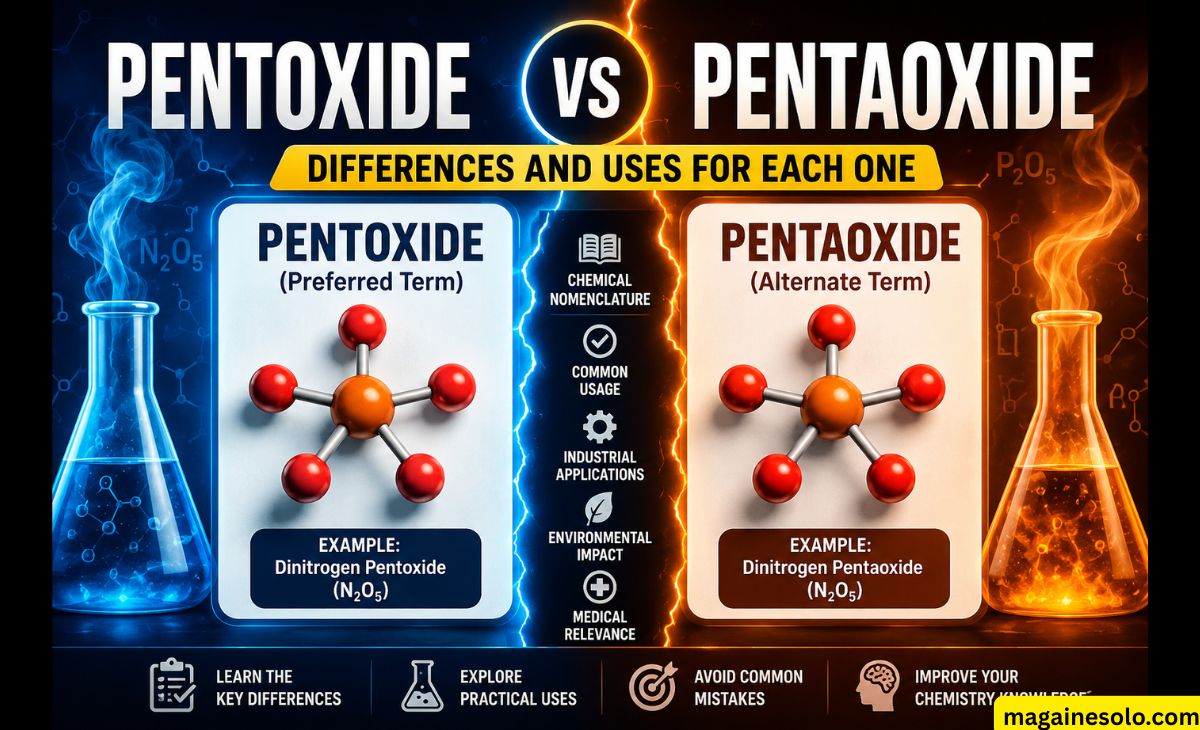
Pentoxide vs Pentaoxide: Differences And Uses For Each One
If you have ever studied chemistry, even just a little, you may have come across two words that look almost identical: pentoxide and pentaoxide. They sound alike. They look alike. And yes, they are easy to mix up.
But here is the truth: only one of them is correct in modern scientific writing, and knowing which one to use (and when) can make a real difference in your chemistry assignments, research papers, or professional documents.
In this guide, we break down pentoxide vs pentaoxide in the simplest, clearest way possible. We will cover definitions, sentence examples, common mistakes, context-based usage, exceptions, and practice exercises. Let us get started.
What Is the Difference Between Pentoxide and Pentaoxide?
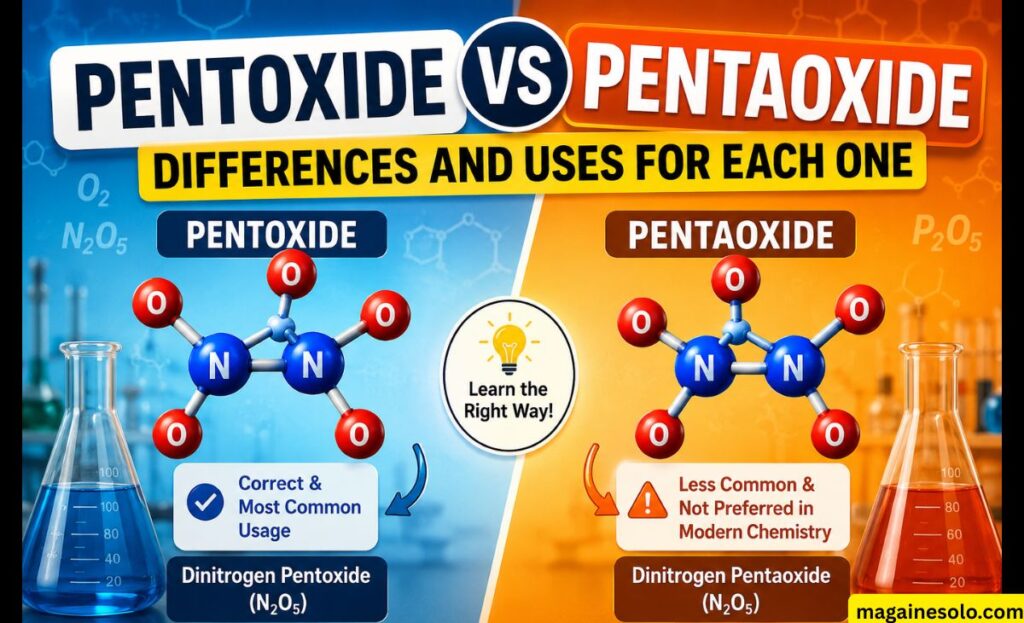
At a glance, both terms describe a chemical compound that contains five oxygen atoms bonded to another element. The difference is not in meaning, it is in correctness and standard usage.
| Feature | Pentoxide | Pentaoxide |
| Correct in IUPAC rules? | Yes | No |
| Used in modern science? | Widely used | Rarely used |
| Formal/academic writing? | Always preferred | Avoid |
| Informal or older texts? | Sometimes | Sometimes appears |
| Example compound | Phosphorus pentoxide (P₄O₁₀) | Phosphorus pentaoxide (informal) |
The key rule in chemistry naming is simple: when a prefix ends in a vowel (like “penta-“) and the next word also starts with a vowel (like “oxide”), you drop the extra vowel. So “penta” + “oxide” = pentoxide, not pentaoxide.
Define Pentoxide
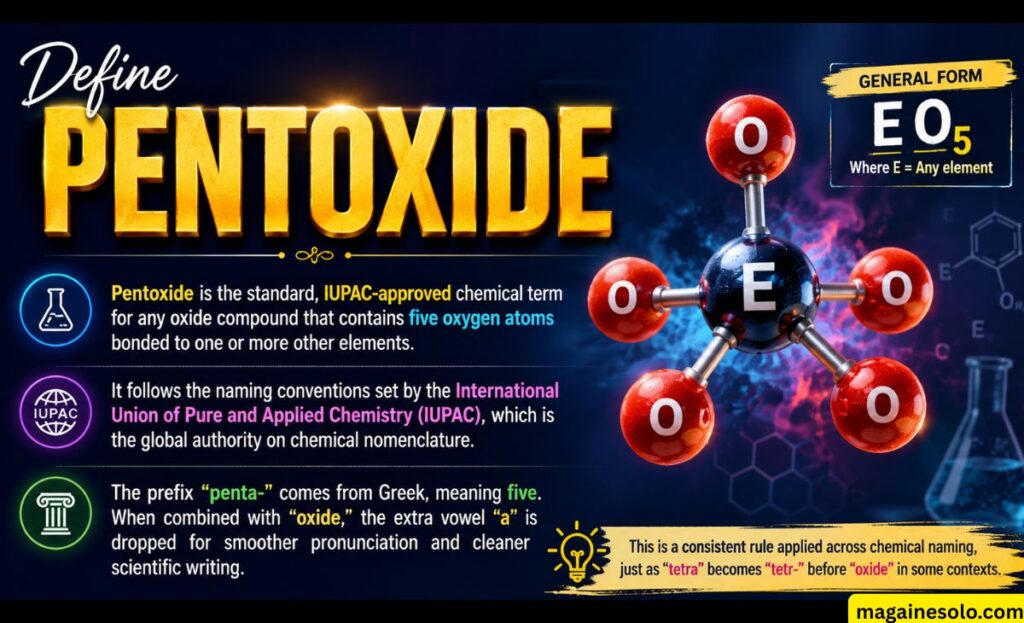
Pentoxide is the standard, IUPAC-approved chemical term for any oxide compound that contains five oxygen atoms bonded to one or more other elements. It follows the naming conventions set by the International Union of Pure and Applied Chemistry (IUPAC), which is the global authority on chemical nomenclature.
The prefix “penta-” comes from Greek, meaning five. When combined with “oxide,” the extra vowel “a” is dropped for smoother pronunciation and cleaner scientific writing. This is a consistent rule applied across chemical naming, just as “tetra” becomes “tetr-” before “oxide” in some contexts.
Common examples of pentoxide compounds include:
- Phosphorus pentoxide (P₄O₁₀), used as a powerful drying and dehydrating agent
- Vanadium pentoxide (V₂O₅), an important industrial catalyst
- Dinitrogen pentoxide (N₂O₅), used in organic synthesis
- Arsenic pentoxide (As₂O₅), used in pesticides and glass manufacturing
- Antimony pentoxide (Sb₂O₅), used as a flame retardant
Pentoxide is the term you will find in every modern chemistry textbook, peer-reviewed journal, and scientific database.
Define Pentaoxide
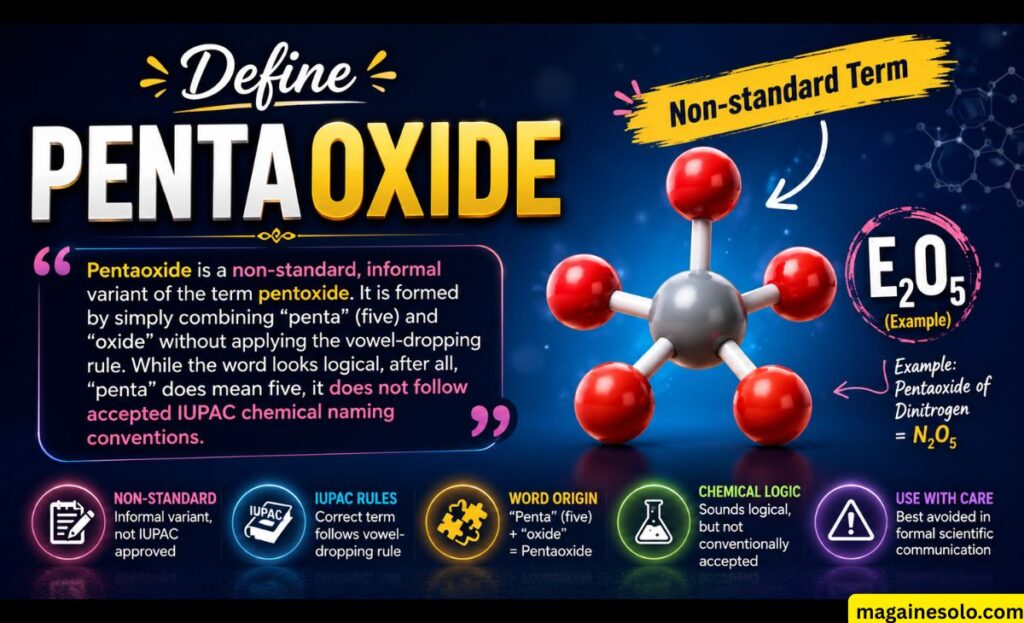
Pentaoxide is a non-standard, informal variant of the term pentoxide. It is formed by simply combining “penta” (five) and “oxide” without applying the vowel-dropping rule. While the word looks logical, after all, “penta” does mean five, it does not follow accepted IUPAC chemical naming conventions.
You may encounter pentaoxide in:
- Older chemistry textbooks predating modern IUPAC guidelines
- Informal educational materials or beginner-level resources
- Some regional or non-standardized scientific texts
- Early historical chemical literature
Writers sometimes use pentaoxide when they are not fully familiar with chemical nomenclature rules. It is not necessarily “wrong” in the sense that a reader will understand what you mean, but it is considered nonstandard and should be avoided in any formal, academic, or professional chemistry context.
How To Properly Use The Words In A Sentence
Understanding the difference is one thing, using these words correctly in real writing is another. Here is how to approach both terms when you need to write them in a sentence.
How To Use Pentoxide In A Sentence
When using pentoxide in a sentence, always pair it with the name of the element it is bonded with (e.g., phosphorus, vanadium, nitrogen). Make sure the context is scientific, technical, or academic. This term fits naturally in lab reports, research papers, textbooks, and industrial documentation.
Tips for using pentoxide correctly:
- Always name the element before pentoxide (e.g., “vanadium pentoxide,” not just “pentoxide”).
- Include the chemical formula in parentheses when writing formally, such as V₂O₅ or P₄O₁₀.
- Use it when describing a compound’s role in a reaction, industrial process, or experiment.
Sample sentences using pentoxide:
- The chemistry lab produced phosphorus pentoxide (P₄O₁₀) during a controlled high-temperature oxidation experiment.
- Vanadium pentoxide serves as a key catalyst in the industrial production of sulfuric acid.
- Dinitrogen pentoxide (N₂O₅) reacts violently with water to form nitric acid.
- The technician handled arsenic pentoxide with extreme caution due to its highly toxic properties.
- Researchers studied how antimony pentoxide could improve the flame-resistance of certain polymers.
How To Use Pentaoxide In A Sentence
Pentaoxide should only appear in your writing if you are directly quoting an older source, referencing a historical text, or writing about the term itself (as in this article). In all other cases, replace it with pentoxide.
When pentaoxide may appear:
- Quoting directly from a pre-IUPAC chemistry publication
- Comparing old and new chemical naming conventions
- Writing about terminology differences in a linguistics or chemistry context
Sample sentences showing pentaoxide in context:
- Some older textbooks list the compound as “vanadium pentaoxide,” though modern chemistry now standardizes it as vanadium pentoxide.
- The historical chemistry journal referenced nitrogen pentaoxide in a study conducted before IUPAC naming rules were widely adopted.
- The student mistakenly wrote “phosphorus pentaoxide” in her report, so the teacher corrected it to phosphorus pentoxide.
- In certain non-English-speaking countries, “pentaoxide” occasionally appears in translated chemistry materials.
- The professor explained that while “pentaoxide” may look logical, the correct scientific term is always pentoxide.
More Examples Of Pentoxide & Pentaoxide Used In Sentences
Let us look at even more real-world examples to help these terms stick in your memory.
Examples Of Using Pentoxide In A Sentence
- Phosphorus pentoxide is widely used in the pharmaceutical industry as a desiccant to keep moisture away from sensitive drugs.
- The manufacturing plant uses vanadium pentoxide as a catalyst during the contact process for producing sulfuric acid.
- Exposure to arsenic pentoxide can cause severe health complications, so proper protective equipment is mandatory in the lab.
- Scientists found that dinitrogen pentoxide decomposes rapidly at room temperature, releasing nitrogen dioxide and oxygen gas.
- Antimony pentoxide is added to plastics to improve their resistance to fire and heat.
Examples Of Using Pentaoxide In A Sentence
- The 1950s chemistry handbook used “antimony pentaoxide” as the name for what we now correctly call antimony pentoxide.
- A quick internet search reveals that “pentaoxide” sometimes appears in non-peer-reviewed sources, but scientific journals consistently use “pentoxide.”
- If you see “vanadium pentaoxide” written anywhere, it is safe to assume the writer meant vanadium pentoxide (V₂O₅).
- The grammar checker flagged “pentaoxide” as a nonstandard term and suggested “pentoxide” as the correct replacement.
- Understanding why “pentaoxide” is incorrect helps chemistry students avoid this common naming mistake in their work.
Common Mistakes To Avoid
Using Pentoxide And Pentaoxide Interchangeably
The biggest mistake people make is treating pentoxide and pentaoxide as two equally valid options. They are not. Pentoxide is the scientifically accepted standard. Pentaoxide is an informal variant that chemists do not recognize in formal writing.
Here is why this matters: in chemistry, precision is everything. Using the wrong term in a lab report, a published paper, or a patent application could cause confusion, suggest a lack of scientific knowledge, or even lead to miscommunication in industrial or safety contexts.
Do not write: “The reaction produced phosphorus pentaoxide.” Write instead: “The reaction produced phosphorus pentoxide (P₄O₁₀).”
Tips To Avoid Mistakes
- Remember the vowel rule: “Penta” + “oxide” = drop the “a” = pentoxide. Simple.
- Check the IUPAC name: When in doubt, look up the official IUPAC name of the compound you are writing about. It will always use “pentoxide.”
- Use chemical formulas: Writing the formula (e.g., V₂O₅) alongside the name leaves no room for naming confusion.
- Proofread scientific writing carefully: Auto-correct tools may not catch “pentaoxide” since it is not recognized as a common misspelling.
- Learn the pattern: Other similar examples follow the same rule, “tetr” + “oxide” = tetroxide, “hex” + “oxide” = hexoxide. The pattern is consistent.
Context Matters
The choice between pentoxide and pentaoxide does not just depend on spelling rules, it also depends on the specific context in which the compound is being discussed.
Chemical Formulas
In the context of writing or interpreting chemical formulas, pentoxide is always the correct choice. For example, when naming V₂O₅ or P₄O₁₀, you write vanadium pentoxide and phosphorus pentoxide, respectively. No reputable chemical database, including PubChem, ChemSpider, or the IUPAC Gold Book, uses the term pentaoxide.
Industrial Processes
In industrial chemistry, accuracy in naming is critical for safety data sheets (SDS), regulatory filings, and product labeling. Vanadium pentoxide, for example, is a crucial catalyst in the sulfuric acid production process. Using pentaoxide in this context would be considered an error and could raise concerns about the credibility of the documentation.
Environmental Factors
When discussing the environmental impact of chemical compounds, such as how dinitrogen pentoxide contributes to atmospheric chemistry and smog formation, scientists always use pentoxide in their reports, environmental assessments, and policy documents. Regulators and environmental agencies follow IUPAC naming standards.
Medical Applications
In toxicology and occupational health, compounds like arsenic pentoxide and vanadium pentoxide are studied for their health effects on humans. Medical and clinical literature consistently uses pentoxide, and using pentaoxide in a health or safety context could create legal and regulatory complications.
Exceptions To The Rules
Chemistry, like most sciences, has its exceptions. Here are a few cases where the naming gets slightly more complicated.
Exceptions For Pentoxide
Vanadium pentoxide (V₂O₅) is perhaps the most notable exception in the context of pentoxide naming. It contains a metal element bonded with five oxygen atoms, yet it uses “pentoxide”, even though the older convention occasionally tried to assign different naming patterns to metal-oxide compounds. The historical entrenchment of this name means it persists in standard use today.
Similarly, some older compound names were established before IUPAC rules were fully formalized, and they continue to use the pentoxide suffix even when strict application of newer rules might suggest a different format.
Exceptions For Pentaoxide
There are essentially no scientifically accepted exceptions where pentaoxide is preferred over pentoxide in modern chemistry. However, in historical literature, you may encounter pentaoxide used for compounds like phosphorus pentaoxide (P₂O₅ in older notation) because early chemists wrote the formula differently. Recognizing this context helps you understand why older texts sometimes use pentaoxide without it being considered an error within that historical context.
Practice Exercises
Test your understanding with these quick exercises.
Exercise 1
Fill in the blank with the correct word (pentoxide or pentaoxide):
- Phosphorus __________ is commonly used as a dehydrating agent in chemical labs.
- The student incorrectly wrote “vanadium __________” in his assignment.
- The IUPAC standard always recommends the term __________ over its informal variant.
- Dinitrogen __________ (N₂O₅) is an unstable compound that decomposes at room temperature.
- The old textbook used “arsenic __________,” but the modern term is arsenic pentoxide.
Answers:
1. Pentoxide,
2. pentaoxide (showing the mistake),
3. pentoxide,
4. pentoxide,
5. pentaoxide (in the old text)
Exercise 2
Identify whether each sentence is correct or incorrect. If incorrect, rewrite it.
- “Scientists used vanadium pentaoxide as a catalyst in the industrial process.”
- “Phosphorus pentoxide (P₄O₁₀) is a white crystalline solid used as a desiccant.”
- “The lab report mentioned dinitrogen pentaoxide reacting with water.”
- “Antimony pentoxide improves fire resistance in polymer materials.”
Answers:
- Incorrect → “Scientists used vanadium pentoxide (V₂O₅) as a catalyst in the industrial process.”
- Correct
- Incorrect → “The lab report mentioned dinitrogen pentoxide (N₂O₅) reacting with water.”
- Correct
FAQs
Is pentoxide the correct scientific term?
Yes, pentoxide is the preferred and widely accepted scientific term in modern chemistry.
What does pentoxide mean?
Pentoxide refers to a chemical compound containing five oxygen atoms bonded with another element.
Is pentaoxide wrong?
Not exactly. It is understandable but generally not preferred in modern nomenclature.
Why is pentoxide used more often than pentaoxide?
Chemical naming rules usually drop the extra vowel, making pentoxide the standard form.
Are pentoxide and pentaoxide the same thing?
They describe the same oxygen count, but pentoxide is the accepted modern spelling.
What is an example of a pentoxide compound?
Dinitrogen pentoxide (N₂O₅) is one of the most common examples.
Is phosphorus pentoxide a real compound?
Yes, phosphorus pentoxide is a widely known chemical used as a drying and dehydrating agent.
Can students use pentaoxide in assignments?
It is better to use pentoxide because it aligns with modern scientific standards.
Conclusion
Understanding the difference between pentaoxide or pentoxide is important for accurate scientific communication. Although both terms indicate compounds containing five oxygen atoms, pentoxide is the accepted and widely used form in modern chemistry.
Whether you’re a student, teacher, researcher, or industry professional, using the correct terminology helps avoid confusion and ensures consistency with international naming standards. While pentaoxide may still appear in historical references, pentoxide remains the preferred choice across textbooks, laboratories, and industrial applications.
Key Takeaways
- Pentoxide and pentaoxide both refer to compounds containing five oxygen atoms.
- Pentoxide is the standard modern term.
- Pentaoxide is rarely used today.
- Scientific literature overwhelmingly favors pentoxide.
- Context can influence which term appears.
- Understanding nomenclature improves chemistry knowledge and communication.

Shoaib Ahmad is a language-focused content writer and researcher at magazinesolo.com, where he explains the meaning of words, phrases, and text in a clear and reader-friendly way. His work focuses on simplifying language, uncovering context, and helping readers understand text with confidence and clarity.