
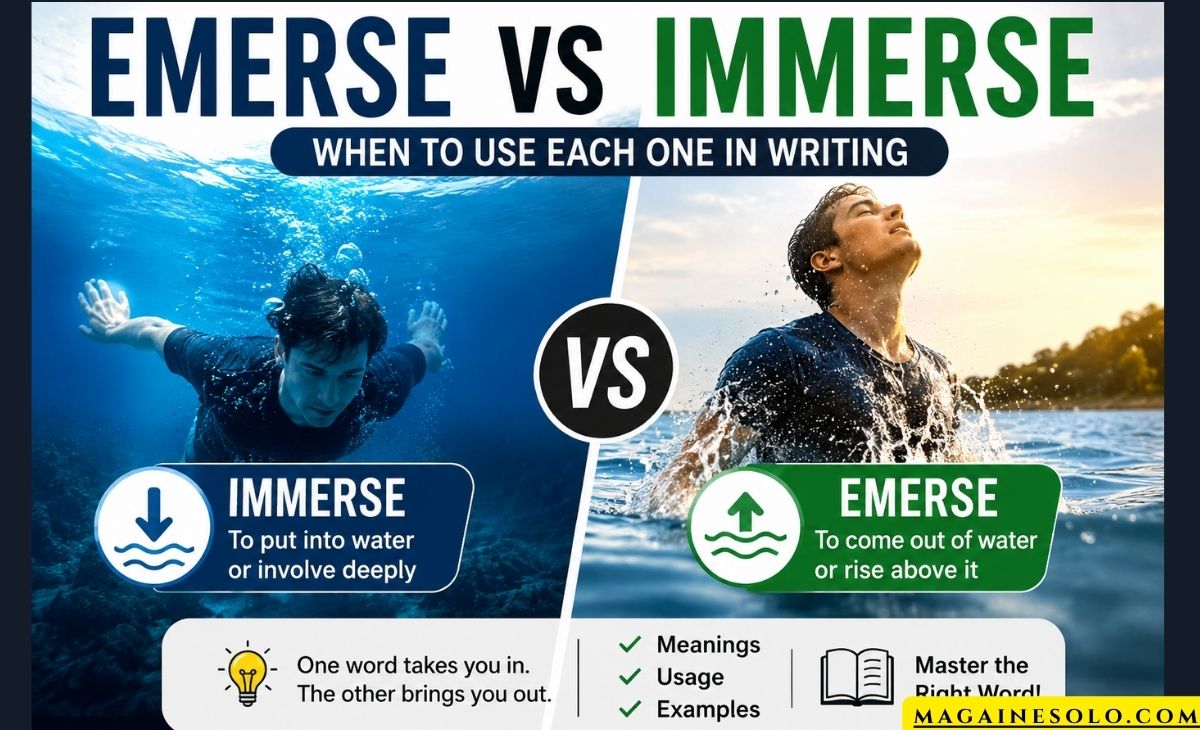
Immerse Vs Emerse — When To Use Each One In Writing (Complete Guide)
If you have ever paused mid-sentence wondering whether to write immerse or emerse, you are absolutely not alone. The emerse vs immerse debate trips up students, bloggers, and professional writers every day and for good reason. These two words look like close relatives, share the same Latin ancestry, and both orbit the concept of liquids and surfaces. Yet they describe completely opposite actions.
Get it wrong, and your sentence quietly loses its meaning. Get it right, and your writing signals confidence and precision. In this guide, we break down the full picture of emerse vs immerse definitions, origins, usage, real-life examples, and the key differences you need to know so you never have to second-guess yourself again.
What Is The Meaning Of The Word “Immerse”?
Immerse is a verb, and its core meaning is straightforward: to put something or someone completely under a liquid, or to become deeply absorbed in an activity or experience.
There are two main ways writers use this word:
1. The Literal Sense In its physical sense, immerse describes complete submersion. When you drop a tea bag into boiling water, the bag is immersed. When a diver plunges beneath the ocean surface, they immerse themselves in the sea. Nothing sticks out above the waterline, the object or person is fully under.
2. The Figurative Sense This is where immerse truly earns its place in everyday language. Over the centuries, the word expanded far beyond swimming pools and science labs. Today, people use it to describe total mental or emotional engagement with something:
- A student who forgets to eat because they are so focused on their thesis is immersed in their work.
- A traveler who adopts local customs, eats local food, and speaks only the local language is immersed in the culture.
- A gamer wearing a VR headset who can no longer tell the virtual from the real world is fully immersed.
When you choose the word immerse or emerse in writing, ask yourself: is something going in or being held under? If yes, immerse is your word.
What Is The Origin Of The Word “Immerse”?
Understanding where immerse comes from helps explain why it carries such a strong sense of total engagement.
The word traces directly to Latin:
| Latin Root | Meaning |
| immergere | to plunge into, to dip under |
| im- (prefix) | into, within |
| mergere (root) | to plunge, to dip |
The Latin immergere evolved into the past participle immersus, and English adopted the verb immerse in the early 17th century. By around 1660, the word had already moved beyond its literal aquatic meaning and was being applied to intellectual and emotional absorption — studying, passion, and focused work.
That shift is what made immerse such a flexible and durable word. Its Latin roots locked in the idea of going into something completely, and that idea proved just as powerful for describing a curious mind as it did for describing a sponge in a bucket of water.
What Is The Meaning Of The Word “Emerse”?
Here is where things get genuinely interesting and where the immersed vs emersed confusion begins.
Emerse (often spelled emersed) describes something that rises or exists above the surface of water. Rather than going under, it is coming up or remaining partially out. Think of the tall stems of a water lily pushing up through the surface of a pond the lily is emerse.
Emerse appears most often in these specific contexts:
- Botany: Aquatic plants with leaves, stems, or flowers that protrude above the waterline are described as having emerse growth. The roots may be submerged, but the upper plant is not.
- General scientific writing: Any object, organism, or structure that rises above a liquid surface can technically be described as emerse.
- Verb use: In less common usage, emerse as a verb means to rise from a liquid or come into view from beneath a surface.
One important note: emerse is not a common everyday word. If you are writing a blog post, an email, an essay, or a story, you almost certainly do not need it. The word belongs to scientific, botanical, and technical writing. In casual writing, the word you are probably reaching for is emerge not emerse.
The Relationship Of The Word “Emerse” With “Emersion”
Emerse and emersion are two sides of the same coin, and understanding their relationship makes both easier to use correctly.
- Emerse describes the state — something that is above the water surface.
- Emersion describes the process — the act of rising above a surface or reappearing after being hidden.
This mirrors the immerse/immersion pairing perfectly:
| Word | Type | Meaning |
| Immerse | Verb | To submerge or deeply absorb |
| Immersion | Noun | The act or state of being submerged/absorbed |
| Emerse | Verb/Adjective | To rise above a surface / existing above water |
| Emersion | Noun | The act of rising or reappearing |
In astronomy, emersion has a precise technical meaning: it refers to the exact moment a celestial body, a star, planet, or moon — reappears after being hidden during an eclipse or occultation. Astronomers track this moment with great precision. Interestingly, immersion also has an astronomical counterpart: it describes the moment that same celestial body disappears behind another object.
This parallel in astronomy is a perfect illustration of the broader principle: immersion is going in or going under, while emersion is coming back out or rising above.
What Is The Origin Of The Word “Emerse”?
Like its counterpart, emerse has Latin roots, though its history in English is shorter and less documented.
| Latin Root | Meaning |
| emersus | risen, having come out |
| e- (prefix) | out of, away from |
| mergere (root) | to plunge, to dip |
The word emerse is believed to have entered English toward the end of the 17th century, drawn directly from the Latin emersus, the past participle of emergere (“to rise out of” or “to come up”). This is also the Latin root behind the more familiar English word emerge.
This shared ancestry between emerge and emerse explains why the two are so often confused. They both describe something coming out of or rising above something else, and they both trace back to emergere. The key distinction is that emerge is a common, general-purpose verb in modern English, while emerse stayed narrow and technical.
The Difference Between “Immersion” Vs “Emersion” (Immerse Vs Emerse)
Let’s put the full emerse vs immerse contrast side by side so the difference is crystal clear.
| Feature | Immerse / Immersion | Emerse / Emersion |
| Direction | Inward — going under | Outward — rising above |
| Literal meaning | Full submersion in liquid | Rising or existing above a surface |
| Figurative meaning | Deep mental/emotional engagement | Emerging into awareness or view |
| Common usage | Everyday language, education, culture | Scientific, botanical, astronomical |
| Word frequency | Very common | Rare; mostly technical |
| Latin prefix | im- (into) | e- (out of) |
| Related noun | Immersion | Emersion |
The simplest memory trick: im sounds like in, and immerse means going in. The e in emerse sounds like exit something coming out or rising above.
In plain terms:
- Immersion = the inward process; to absorb, submerge, or concentrate fully
- Emersion = the outward process; to rise, emerge, or appear above a surface
When deciding between immerse or emerse, this directional logic is all you need.
How Do People Use The Word “Immersion” (Immerse)
The word immerse and its noun form immersion, shows up across a surprisingly wide range of fields. Here are the most common areas where you will encounter it:
Language Learning
Immersion programs place students in environments where only the target language is spoken. The idea is that surrounding yourself completely with a language, no escape, no shortcuts, accelerates learning dramatically. The term language immersion is now standard in education worldwide.
Virtual Reality and Gaming
VR developers talk constantly about creating immersive experiences. The goal is to make users feel they are fully inside a digital world, with no awareness of the physical room around them. Full immersion in this context means the technology has successfully replaced the user’s sensory reality.
Baptism and Religious Practice
Full-immersion baptism, practiced in many Christian traditions, involves submerging the person completely in water. This is the most literal religious use of the word and preserves the original Latin meaning almost unchanged.
Therapy and Psychology
Immersion therapy (also called flooding or exposure therapy) is a psychological technique used to help patients confront and overcome phobias or anxiety disorders. The patient is immersed, either literally or imaginatively, in the fear-inducing situation until the fear response diminishes.
Everyday Figurative Use
This is the most common form. People say they are immersed in a novel, a project, a new relationship, a sport, or a creative challenge. The word signals total focus and the temporary disappearance of everything outside the activity.
How Do People Use The Word “Emersion” (Emerse)
Because emerse is largely a technical and scientific word, its uses are narrower but no less precise. Here is where you will actually encounter it:
Botany Aquatic plants that grow with their roots submerged but their leaves or stems rising above the water are described as having emerse or emersed growth. Common examples include cattails, bulrushes, and certain lily species. This is the single most common context for the word.
Astronomy As mentioned earlier, emersion in astronomy refers to the reappearance of a celestial body after an eclipse or occultation. Professional astronomers use the term regularly in observational reports.
Marine Biology and Environmental Science Researchers describing organisms or structures that exist at the waterline neither fully submerged nor fully above the surface, may use emerse or emersed for precise technical description.
Figurative (Rare) Occasionally, a writer might use emerse figuratively to describe an idea rising to the surface of a discussion, or a feeling becoming conscious awareness. However, this usage is uncommon, and most readers would find it unusual. In everyday figurative writing, emerge is a far more natural and widely understood choice.
Examples Of The Use Of The Word “Immerse” In Everyday Sentences
Seeing immerse in action across a range of sentences makes its flexibility obvious:
Literal / Physical:
- She slowly immersed the fabric in the warm dye bath and watched the color spread.
- The scientist immersed the specimen in a saline solution to preserve it overnight.
- He immersed his sore feet in a bucket of cold water after the long hike.
Figurative / Mental:
- After losing her job, she decided to immerse herself in learning a new skill.
- The documentary completely immersed viewers in the daily lives of the fishermen.
- He was so immersed in the novel that he missed three stops on the train.
- The best way to learn a language is to immerse yourself in it — speak it, dream in it, live in it.
- She arrived in Japan and chose to fully immerse herself in the local culture rather than stay in tourist zones.
Professional / Academic:
- Students in the program are expected to immerse themselves in primary sources before forming an argument.
- The design team immersed themselves in user research before building the first prototype.
Notice how naturally immerse works in all of these sentences. Whether the context is physical, emotional, intellectual, or cultural, the word fits without feeling forced.
FAQ’s
Is “emerse” a real word?
Yes, emerse is a real word, but it is rare and mostly limited to scientific contexts like botany and marine biology. It is not a common everyday English word.
What is the difference between immerse and emerse?
Immerse means to submerge something completely or become deeply involved, while emerse means to rise above a liquid surface. They are essentially antonyms.
Can I use “emerse” instead of “emerge”?
No. Emerse and emerge are related but distinct. Emerge is the common everyday word for coming out or becoming visible. Emerse is a technical term for something rising above a water surface.
Which is more common — immerse or emerse?
Immerse is far more common and appears across everyday language, education, media, and professional writing. Emerse is rare and mostly appears in scientific literature.
What does “immersed vs emersed” mean in plant biology?
In botany, submerged or immersed plants grow entirely underwater, while emersed plants have roots below the water but stems and leaves above the surface.
Is “immersed in” grammatically correct?
Yes. “Immersed in” is a standard and correct English phrase used to describe deep involvement or engagement with something, such as “immersed in her studies.”
What is the opposite of immerse?
The functional opposite of immerse depends on context. For physical submersion, the opposite is emerge (to come out). In scientific writing, emerse describes the state of being above the water surface.
Can emerse be used figuratively?
Technically yes, but it is rarely done in practice. Most writers use emerge when they mean something is coming into awareness or visibility. Using emerse figuratively will likely read as unusual or overly technical.
Conclusion
Understanding emerse vs immerse is easier once you recognize how differently the two words are used in English.
- Immerse is the standard, widely accepted term for deep involvement or submersion.
- Emerse is a rare technical word mostly limited to scientific fields.
For nearly all everyday writing, blogging, business communication, and academic work, immerse is the correct choice. If you are unsure whether to use immersed or emersed, the safer and more natural option is almost always immersed.
Remember this simple rule:
Immerse = go into
Emerse = come out
Keeping this distinction in mind will help you avoid grammar mistakes and improve your writing clarity.
Whether you are discussing language learning, culture, reading, technology, or science, knowing the proper usage of emerse or immerse ensures your writing sounds polished, accurate, and professional.

Shoaib Ahmad is a language-focused content writer and researcher at magazinesolo.com, where he explains the meaning of words, phrases, and text in a clear and reader-friendly way. His work focuses on simplifying language, uncovering context, and helping readers understand text with confidence and clarity.