

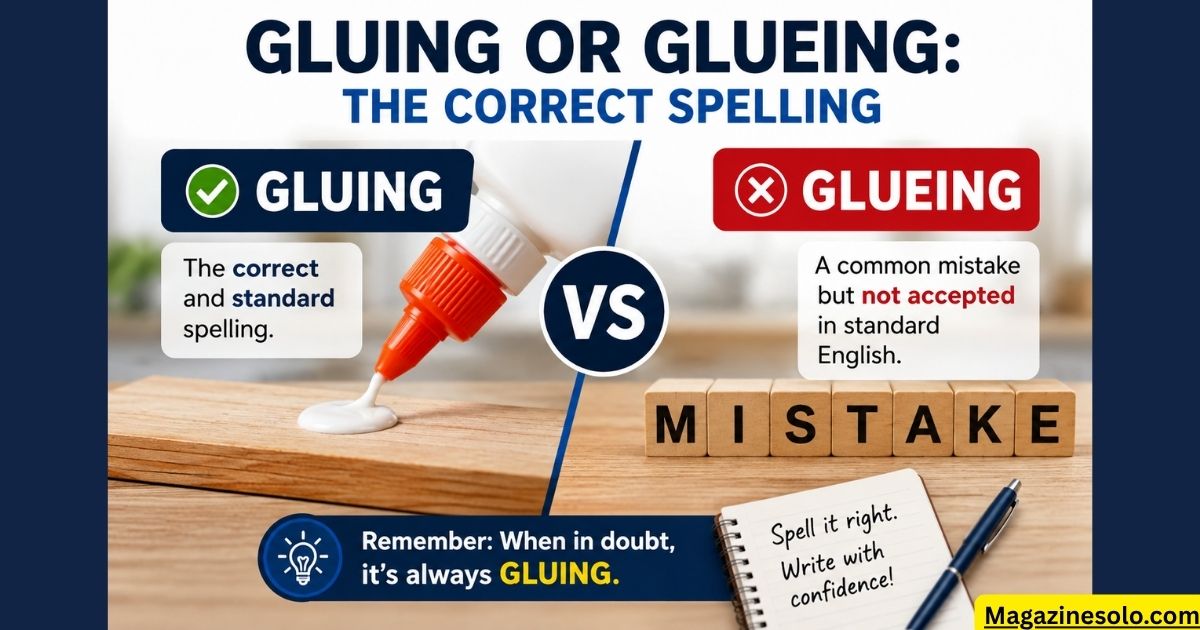
You’re writing a caption, a school assignment, or a work email, and you stop mid-sentence. Is it “gluing the pieces together” or “glueing the pieces together”? Your cursor blinks, spellcheck underlines one of them in red, and suddenly a simple five-letter word feels like a trap.
You’re not the only one who has paused here. This is one of the most searched spelling questions in English, right up there with “traveling vs travelling” and “canceled vs cancelled.” The good news is that the answer is short, settled, and easy to remember once you understand the logic behind it.
This guide breaks down the correct spelling, why the confusion exists, how American and British English treat the word differently, and how to make sure you never second-guess yourself again.
Gluing vs Glueing, The Only Correct Spelling You Need to Know
Let’s clear this up immediately: gluing is the correct spelling.
“Gluing” is the standard present participle (the -ing form) of the verb “glue.” It’s the spelling recognized by every major dictionary, including Merriam-Webster, the Oxford English Dictionary, and Cambridge Dictionary. It’s also the spelling accepted by leading style guides such as the Chicago Manual of Style and the AP Stylebook.
“Glueing,” on the other hand, is a common misspelling. It shows up often enough that people assume it must be an accepted variant somewhere, but it isn’t listed as standard in any current dictionary. If you’re wondering how to spell gluing correctly for an essay, a product label, or a professional document, the answer stays the same everywhere: drop the “e,” add “-ing.”
So next time you’re stuck between “gluing or glueing,” remember there’s really no contest. One is correct English. The other is a spelling slip that happens to look plausible.
Why the Spelling Confusion Still Happens Today
If gluing is so clearly correct, why do so many people still type “glueing” and second-guess themselves?
A few reasons explain the confusion:
- The base word ends in “e.” Most English speakers learn the “silent e” rule as children, but the rule itself feels counterintuitive when you’re typing quickly. Adding “-ing” without thinking often produces “glueing” by habit.
- Autocorrect isn’t always consistent. Some keyboards and apps don’t flag “glueing” as an error, which reinforces the wrong spelling for people who trust their phone more than a dictionary.
- Visual similarity to other words. Words like “seeing,” “agreeing,” and “fleeing” keep a double vowel before “-ing,” so writers sometimes assume “glue” should behave the same way. It doesn’t, because those words end in double vowels for a different phonetic reason, not because of the same spelling pattern as “glue.”
- Regional myths. A persistent rumor claims British English allows “glueing.” As you’ll see in the next section, that’s mostly outdated and not supported by modern British dictionaries.
Understanding why the mistake happens is often the fastest way to stop making it.
Gluing vs Glueing in American and British English
One of the most common questions writers ask is whether regional English changes the answer. It doesn’t, not in any meaningful way for modern writing.
| Region | Accepted Spelling | Notes |
| American English | Gluing | Universally accepted; “glueing” is always flagged as incorrect |
| British English | Gluing | Modern UK dictionaries and style guides prefer gluing |
| Historical British texts | Glueing (rare) | Appeared occasionally in older 19th- and early 20th-century writing, now considered outdated |
| Australian/Canadian English | Gluing | Follows the same modern standard as US and UK English |
Unlike genuine US-UK spelling differences, color versus colour, traveling versus travelling, gluing versus glueing isn’t a real regional split. It’s simply one correct form and one outdated or mistaken form. If you’ve been telling yourself “maybe it’s a British thing,” it’s worth letting that assumption go. Every major English-speaking country now treats gluing as the standard.
Where the Rule Comes From: A Short Etymology of “Gluing”
To understand why gluing wins, it helps to look at where the word comes from and how English handles verbs ending in a silent “e.”
The word “glue” traces back through Middle English “glew,” which itself derives from Old French “glu,” rooted in the Latin word “gluten,” meaning a sticky or adhesive substance. As English spelling gradually standardized over the centuries, dictionaries settled on consistent rules for forming the -ing version of verbs.
That rule is simple: when a verb ends in a silent “e,” you generally drop the “e” before adding “-ing.”
A few familiar examples follow the exact same pattern:
- Make → Making
- Write → Writing
- Bake → Baking
- Care → Caring
- Glue → Gluing
There are a handful of exceptions in English where keeping the “e” changes the meaning or pronunciation, “dye” becomes “dyeing” (to avoid confusion with “dying”), and “singe” becomes “singeing” (to avoid confusion with “singing”). Glue doesn’t fall into that exception category. Removing the “e” doesn’t change how the word sounds or create confusion with another word, so the standard rule applies cleanly, and gluing is the result.
What “Gluing” Actually Means in Real-Life Language
At its core, gluing simply means the act of joining, sticking, or fixing two or more surfaces together using an adhesive substance.
It functions as:
- A gerund – “Gluing requires patience and the right adhesive.”
- A present participle – “She is gluing the frame back together.”
- Part of a continuous verb phrase – “They were gluing tiles onto the wall all afternoon.”
The word applies to both literal, physical contexts (craft projects, furniture repair, construction) and figurative uses, where “gluing something together” can describe holding a plan, team, or relationship intact.
Where You’ll See “Gluing” in Real Life
This word shows up more often than most people realize, across very different settings:
- Arts and crafts – scrapbooking, model-building, and school projects
- Home improvement – repairing furniture, flooring, and fixtures
- Manufacturing and woodworking – bonding materials during production
- Product packaging and instructions – “Allow 24 hours after gluing before use”
- Everyday conversation – describing quick fixes or DIY tasks
- Figurative speech – “He spent the whole meeting gluing the team back together”
Because it appears in instructions, packaging, and professional writing so frequently, getting the spelling wrong in these contexts can look careless, especially on labels, manuals, or client-facing content.
Examples of Correct Usage of “Gluing”
Seeing the word in full sentences makes the correct spelling easier to remember:
- I’m gluing the broken vase back together this afternoon.
- The instructions recommend gluing the edges before sanding.
- She has been gluing sequins onto the costume for hours.
- Gluing wet wood rarely produces a strong bond.
- We’re gluing the shelves in place instead of using screws.
- After gluing the pieces, let them dry for at least an hour.
Notice that in every case, “gluing” fits naturally into the sentence without looking unusual. That’s a strong sign you’re using the correct, dictionary-approved form.
Why “Glueing” Is Not Standard, And Why Using It Hurts Your Writing
“Glueing” isn’t a recognized alternative spelling; it’s simply an error that happens to follow a pattern people expect from other words. Here’s why it doesn’t hold up:
- No major dictionary lists it as correct. Merriam-Webster, Oxford, and Cambridge all list only “gluing.”
- It breaks the standard silent-e rule without any pronunciation reason to justify keeping the extra letter.
- Spellcheckers and style guides flag it. Most professional editing tools, from Microsoft Word to Grammarly, mark “glueing” as incorrect.
- It can undercut credibility. In resumes, instructions, product listings, or academic writing, a spelling error, even a small one, can make readers pause and question your attention to detail.
If you’re writing anything meant to be read by a client, teacher, employer, or customer, sticking with “gluing” protects your professionalism and keeps your writing aligned with what search engines, spellcheckers, and readers all expect.
Memory Tricks to Always Spell “Gluing” Correctly
If you want a foolproof way to remember how to spell gluing every time, try one of these tricks:
- The “drop the e” rule: Just like make → making and write → writing, glue → gluing. If you can picture those familiar words, you can picture this one.
- Say it out loud: “Gluing” and “glueing” sound identical, so the extra “e” adds nothing, a useful reminder that it’s unnecessary.
- Visual anchor: Picture the word “glue” losing its last letter as it “sticks” the “-ing” ending directly onto it, a small mental image that mirrors what the word actually means.
- One-word check: If you’re ever unsure, mentally compare it to “true → truing” or “due → duing”… except due doesn’t drop cleanly, so instead lean on “care → caring,” a much closer match in both sound and structure.
Repetition is often the simplest fix. Once you write “gluing” correctly a few times, the old habit of typing “glueing” tends to fade.
Common Misspellings Related to Gluing
Beyond “glueing,” a few related errors show up in casual writing:
| Incorrect | Correct |
| Glueing | Gluing |
| Glewing | Gluing |
| Gluing’s | Gluing (no apostrophe needed) |
| Glue-ing | Gluing (no hyphen needed) |
| Gluied | Glued |
Keeping these straight matters most in formal writing, packaging copy, and instructional content, where small errors are more noticeable.
Quick Reference Table: Gluing vs Glueing
| Question | Answer |
| How do you spell gluing? | G-L-U-I-N-G |
| Is “glueing” ever correct? | No, not in modern standard English |
| Does British English allow glueing? | No, modern UK dictionaries prefer gluing |
| Does American English allow glueing? | No, never accepted |
| What’s the rule behind it? | Drop the silent “e” before adding “-ing” |
| Similar words with the same rule | Make → Making, Write → Writing, Bake → Baking |
Frequently Asked Questions
Is it gluing or glueing?
It’s gluing. This is the only spelling recognized as correct by major dictionaries and style guides in both American and British English.
How do you spell gluing correctly?
Gluing is spelled G-L-U-I-N-G, drop the silent “e” from “glue” before adding “-ing.”
Is glueing a real word?
No, glueing is considered a spelling error. It isn’t listed as standard in current dictionaries like Merriam-Webster or Oxford.
Why do people spell it glueing?
Many writers instinctively keep the “e” from “glue” out of habit, especially since some other English words don’t drop their final “e” before “-ing.”
Does British English use glueing instead of gluing?
No. While “glueing” appeared occasionally in older British texts, modern British English follows the same rule as American English and uses gluing.
What is the rule for adding “-ing” to words ending in “e”?
In most cases, you drop the silent “e” before adding “-ing,” as in glue → gluing, make → making, and write → writing.
Conclusion
The debate over gluing or glueing has a clear, simple resolution: gluing is correct, and glueing is a misspelling that doesn’t appear in any major modern dictionary. The confusion comes from the natural instinct to keep every letter of the base word, but English’s silent-e rule settles the matter, just like “make” becomes “making” and “write” becomes “writing,” “glue” becomes “gluing.”
Whether you’re writing a school essay, a product label, a work email, or a quick text message, using “gluing” keeps your writing accurate, professional, and aligned with every trusted English-language authority. Once the rule clicks, you’ll never have to pause over this word again.


3 Comments