Have you ever typed “pent” when you meant “pants”, or wondered what “pent” even means in the first place? You’re not alone. These two words look almost identical, and that tiny missing “s” trips up a surprising number of writers every day. Whether you’re a student, a blogger, or just someone who wants to sharpen their English grammar, this guide will clear up the confusion once and for all.
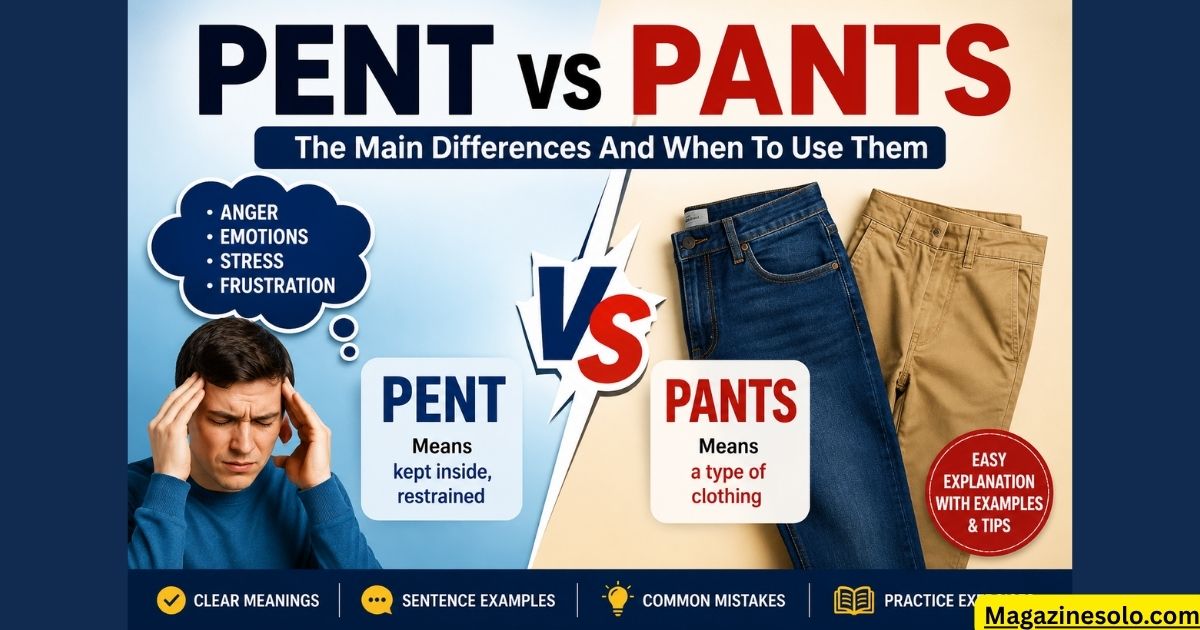
Here’s the quick answer: pent is an old verb form that means confined or restrained, you’ll most often hear it in the phrase “pent-up emotions.” Pants, on the other hand, is the everyday word for the clothing that covers your legs. One word is about feelings locked inside; the other is about what you’re wearing. Simple, right? Let’s dig deeper.
How To Properly Use The Words In A Sentence
Before you can use these words correctly, you need to know exactly what job each one does in a sentence.
What Does “Pent” Mean?
Pent is the past participle of the old verb pen, which means to enclose or confine something. In modern English, you almost never see “pent” standing completely alone. Instead, it almost always appears in the fixed phrase pent-up, which describes emotions, energy, or feelings that have been bottled up and held back for a long time.
Word class: Adjective (past participle used as a modifier)
Pent meaning in everyday use:
- Emotions that are held back and not expressed
- Energy that has built up and needs to be released
- Feelings of being trapped or confined in a space
Correct examples using pent:
- After months of stress, she finally released all her pent-up anxiety at the gym.
- The crowd’s pent-up excitement exploded the moment the singer walked on stage.
- He carried pent frustration for years before he finally talked to a therapist.
- The dog had pent-up energy from being indoors all week.
Quick tip: If you can replace the word with “bottled-up” or “suppressed,” then pent (or pent-up) is the right choice.
What Does “Pants” Mean?
Pants is a noun that refers to a garment worn on the lower half of the body, with a separate section for each leg. In American English, pants covers everything from jeans and chinos to formal trousers. In British English, however, pants usually means undergarments, what Americans would call underwear. British speakers use trousers for the outer leg garment.
Word class: Plural noun (always plural, even when referring to one item)
Grammar rule: You never say “a pant” (unless talking about a single pant leg). Always say a pair of pants.
Correct examples using pants:
- He bought three pairs of pants for his new job.
- She ironed her pants before the interview.
- The pants are hanging in the wardrobe, which pair do you want?
- These pants are too long; I need to get them hemmed.
| Feature | Pent | Pants |
| Word type | Adjective / past participle | Plural noun |
| Meaning | Confined, restrained, held back | Lower-body clothing with two leg sections |
| Common phrase | Pent-up emotions / pent-up energy | A pair of pants |
| American English | Emotional restraint | Trousers / leg garment |
| British English | Same | Usually refers to underwear |
| Can stand alone? | Rarely, almost always “pent-up” | Yes |
More Examples Of Pent & Pants Used In Sentences
Seeing words used in many different ways is one of the fastest ways to truly understand them. Here are expanded examples for both words across different situations.
More Pent Examples
In emotional contexts:
- Years of pent-up grief finally came out when she heard that old song.
- The therapist said his anger had been pent inside for far too long.
- There was a sense of pent-up anticipation in the room before the announcement.
In physical or spatial contexts:
- The animals were pent inside a small enclosure with little room to move.
- His creative energy felt pent, blocked by deadlines and pressure.
In literature and formal writing:
- The poet described love as a pent flame, burning quietly beneath the surface.
- Her voice carried years of pent emotion when she finally spoke.
More Pants Examples
In everyday casual use:
- I spilled coffee on my pants right before the meeting.
- He owns seven pairs of pants but somehow always wears the same ones.
In shopping or fashion contexts:
- These pants come in three colors: black, navy, and gray.
- Wide-leg pants are very popular this season.
In British English (where pants = underwear):
- She packed her pants and socks into the smallest bag.
- “Where are my pants?” meant something very different to the British guest than to the American host.
Common Mistakes To Avoid
Even experienced writers make these errors. Here’s what to watch out for:
Mistake 1: Using “pent” when you mean “pants”
❌ He wore a nice pair of pent to the wedding.
✅ He wore a nice pair of pants to the wedding.
This is the most common mix-up. Remember: pent is never a clothing item in modern English.
Mistake 2: Saying “a pant” instead of “a pair of pants”
❌ I bought a new pant yesterday.
✅ I bought a new pair of pants yesterday.
Pants is always grammatically plural. You wear pants (plural), not a pant (singular).
Mistake 3: Forgetting the hyphen in “pent-up”
❌ She had pent up anger for months.
✅ She had pent-up anger for months.
When used before a noun, pent-up needs a hyphen. It’s a compound adjective.
Mistake 4: Using “pants” in British English for the wrong garment
❌ (To a British audience) He ironed his pants before the ceremony.
✅ (To a British audience) He ironed his trousers before the ceremony.
Mistake 5: Using “pent or pant” when you mean “pent-up”
❌ He felt pent or pant with frustration
✅ He felt pent-up with frustration.
“Pent or pant” is not a set phrase. If you’re describing restrained emotion, always go with pent-up.
Context Matters
The same word can mean completely different things depending on who you’re talking to and where. Context is everything in English grammar.
Emotional or Psychological Context → Use Pent
When you’re talking about feelings, stress, energy, or anything that has been held back over time, pent (almost always as pent-up) is the right word. This is its home territory. You’ll see it in:
- Psychology articles about suppressed emotions
- Literary descriptions of tension or dramatic buildup
- Everyday conversations about stress relief
Example: “After the lockdown, there was a surge of pent-up demand for travel.”
Clothing or Fashion Context → Use Pants
Any time you’re discussing what someone is wearing on their lower half, pants is the word you need. This covers:
- Casual wear (jeans, joggers, chinos)
- Formal wear (dress pants, suit trousers)
- Sports and activewear (track pants, yoga pants)
Example: “She paired her silk blouse with high-waisted pants for the event.”
American vs. British English Context
This is where things get interesting. If your audience is in the United States, pants means leg-covering outerwear. But if your audience is British, pants likely means underwear, and trousers is the correct word for outerwear. Always think about your reader’s location before choosing.
| Context | Best Word Choice |
| Describing suppressed feelings | Pent-up |
| Talking about lower-body clothing (US) | Pants |
| Talking about lower-body clothing (UK) | Trousers |
| Discussing emotional release | Pent-up energy / pent-up emotions |
| Fashion or shopping | Pants / trousers / a pair of pants |
Exceptions To The Rules
English always has a few surprises. Here are the exceptions worth knowing:
“Pant” as a Verb (Breathing Hard)
Pant (without the “s”) is also a completely separate word that means to breathe rapidly and with difficulty, usually after exercise or in extreme heat.
- The dog began to pant after running around the yard.
- She was panting when she reached the top of the stairs.
This pant has nothing to do with either pent (restrained emotions) or pants (clothing). It’s its own word entirely.
“Pant” in Fashion (Singular Form)
In the fashion industry, you’ll sometimes see pant used as a singular modifier before another noun:
- A pant leg (one leg of a pair of pants)
- The pant suit (a suit made of pants-style trousers)
- Pant hem (the hemline of trousers)
This is industry-specific language. In general everyday writing, stick with pants (plural).
Historical Use of “Pent” as Clothing
In older texts and historical writing, you may occasionally come across pent used to describe a type of long, loose garment. This usage traces back to the Hindi word pāījāma, meaning leg clothing, the same root that gave us the word pajama. However, this use is extremely rare and almost never appears in modern English. If you see it, it’s likely an archaic or literary reference.
“Pents”, Is It a Word?
You might wonder about pents (with an “s”). In standard modern English, pents is not a commonly used word. The plural of pent-up is simply not applicable the same way. If you’re searching for pents, you’re likely looking for pants, so double-check your spelling!
Practice Exercises
The best way to lock in what you’ve learned is to practice. Try completing these exercises on your own before checking the answers below.
Exercise 1: Fill in the Blank
Choose the correct word (pent, pent-up, or pants) to complete each sentence.
- He had years of ________ frustration that finally came out during the argument.
- She bought two new pairs of ________ for her business trip.
- The crowd had ________ excitement before the concert started.
- I can’t find my ________, have you seen them anywhere?
- The writer felt ________ by the strict editorial guidelines.
Exercise 2: Spot the Error
Each sentence below contains a mistake. Can you find and fix it?
- She wore a beautiful pent to the gala last night.
- He had a pant with frustration after the meeting.
- I need to buy new pent for my trip next week.
- The children had pent up energy after being inside all day. (Watch the hyphen!)
- In British English, he said he’d iron his pants before the ceremony.
Exercise 3: Write Your Own Sentences
Write one original sentence using each of the following:
- pent-up emotions
- a pair of pants
- pant (as in breathing hard)
Answer Key
Exercise 1:
- Pent-up
- pants
- pent-up
- Pants
- pent
Exercise 2:
- She wore beautiful pants to the gala.
- He felt pent-up frustration after the meeting.
- need to buy new pants for my trip.
- He had pent-up energy (hyphen required)
- He said he’d iron his trousers (British English)
FAQ’s
What is the pent meaning in English?
Pent means confined, restrained, or held back. It almost always appears as “pent-up” to describe suppressed emotions or built-up energy.
Can I use pent or pant to describe clothing?
No. Neither pent nor pant (singular) is the correct word for the garment. The right word is pants (always plural) or a pair of pants.
Is “pents” a real word?
Pents is not a standard word in modern English. If you’re thinking of the clothing item, the correct word is pants.
What is the difference between pent and pants?
Pent describes restrained emotions or confined energy. Pants is a plural noun for lower-body clothing. They have completely different meanings and cannot be swapped.
Do I need a hyphen in “pent-up”?
Yes, when pent-up is used as an adjective before a noun, it requires a hyphen, for example, pent-up anger, pent-up energy.
Why do British people use “pants” differently?
In British English, pants typically means underwear, while trousers refers to the outer leg garment. In American English, pants means trousers.
Is “pant” the same as “pent”?
No. Pant (without the “e”) is a separate verb meaning to breathe rapidly. Pent (with the “e”) means confined or restrained. And pants is the clothing noun, three different words!
When should I write “pent up” vs “pent-up”?
Use pent-up (with a hyphen) when it comes before a noun: pent-up frustration. You may see pent up without a hyphen after a verb: the frustration had been pent up for years.
Conclusion
At the end of the day, the difference between pent and pants is actually quite simple once you see it clearly. Pent (almost always used as pent-up) describes emotions or energy that has been bottled up inside, it’s about feelings under pressure. Pants is the everyday word for the garment you wear on your legs.
The key is to ask yourself one question before you write: Am I talking about feelings or clothing? If it’s feelings that have been held back, reach for pent-up. If it’s something you wear, reach for pants. And if you’re writing for a British audience, swap pants for trousers to avoid any awkward misunderstandings!
Getting these small grammar details right builds trust with your readers, improves the clarity of your writing, and shows real command of the English language. Now that you know the difference, you’ll never mix them up again.