
Courtesy vs Curtesy: When to Opt for One Term Over Another
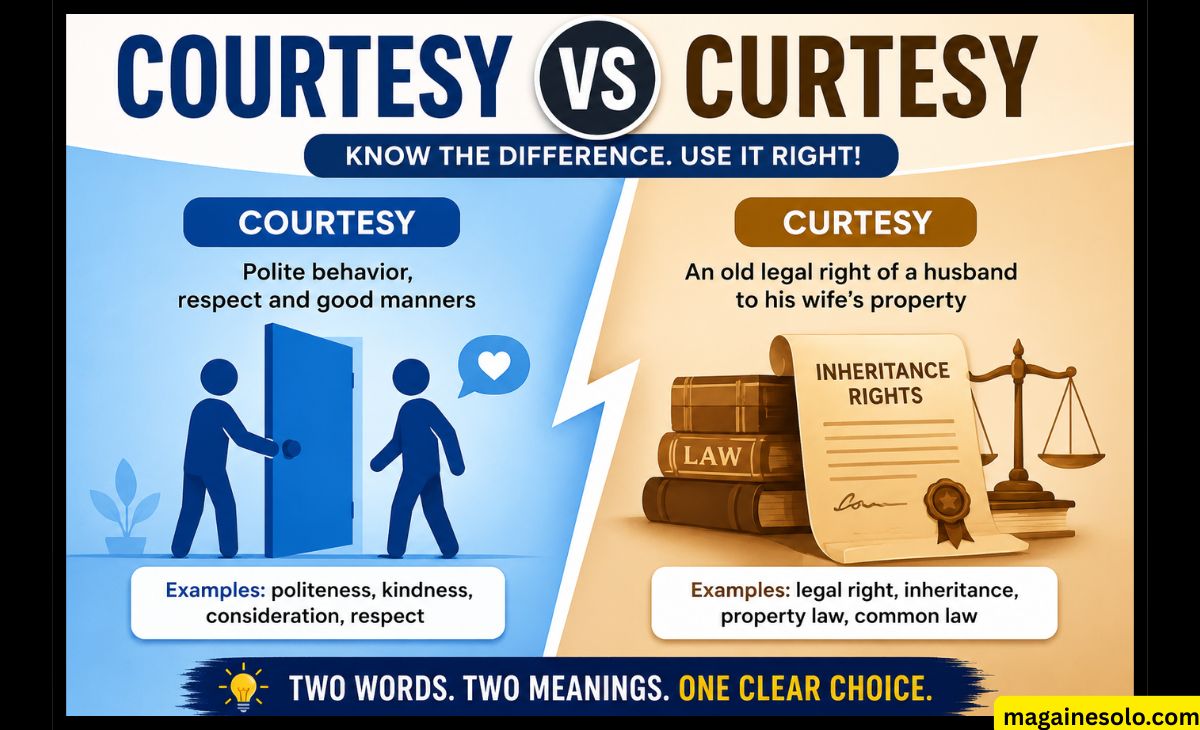
If you’ve ever paused while writing and wondered whether it should be “courtesy vs curtesy”, you’re not alone. These two words are often confused because they look similar, but their meanings are completely different.
One belongs to everyday language and is used to describe polite behavior and respect. The other comes from old legal terminology and has nothing to do with manners at all.
This guide breaks down curtesy vs courtesy in a simple, practical way so you can stop guessing and start using the right word confidently. Whether you’re writing an email, an essay, or just improving your English skills, understanding this difference will instantly make your communication clearer and more professional.
Define Courtesy

Courtesy (noun) refers to polite behavior, respectful treatment, and the considerate acts people show toward one another in everyday life. It is one of the most commonly used words in the English language when discussing etiquette, social norms, and professional conduct.
Origin and Pronunciation
The word comes from the Old French courtoisie, meaning the behavior befitting someone at a royal court. Today, it is pronounced /ˈkɜːr.tə.si/ and is always spelled with a “u” between the “o” and the “r” — c-o-u-r-t-e-s-y.
What Courtesy Covers
Courtesy shows up in virtually every area of life:
- Social settings: Saying “please” and “thank you,” holding a door open, or letting someone merge in traffic
- Professional environments: Writing a polite email, acknowledging a colleague’s contribution, or giving advance notice before canceling a meeting
- Customer service: Offering a full refund as a gesture of goodwill or providing a complimentary upgrade
- Public spaces: Silencing a phone in a theater, waiting your turn in line, or speaking quietly in a library
Common Courtesy Phrases You Already Know
| Phrase | Meaning |
| Common courtesy | Basic politeness that society expects from everyone |
| Courtesy call | A polite, often formal phone call made out of respect |
| Courtesy copy (CC) | A copy of an email sent to keep someone informed |
| As a courtesy | Done voluntarily out of politeness, not obligation |
| Professional courtesy | Special consideration extended among peers in the same field |
Courtesy functions as both a noun (“He showed great courtesy”) and an adjective (“The hotel provided a courtesy shuttle”). It is never used as a verb — more on that mistake later.
Define Curtesy
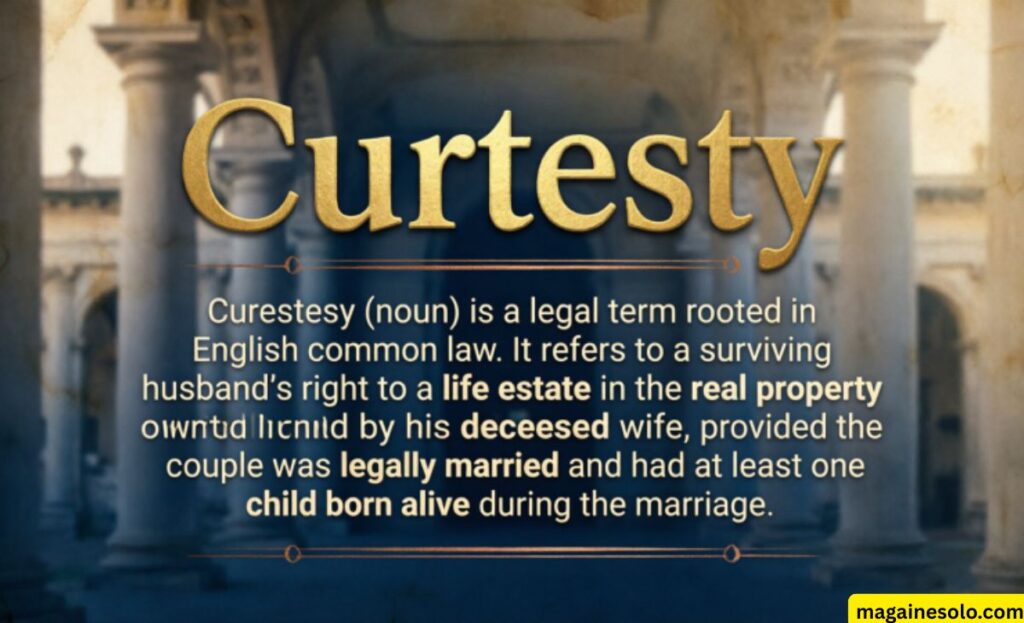
Curtesy (noun) is a legal term rooted in English common law. It refers to a surviving husband’s right to a life estate in the real property owned by his deceased wife, provided the couple was legally married and had at least one child born alive during the marriage.
Origin and Legal Context
Curtesy emerged from medieval English common law as a property protection mechanism for widowers. Historically, when a wife died, her husband could claim a life estate — the right to occupy and benefit from her real property for the remainder of his own lifetime. This right was conditional: the couple had to have produced a child capable of inheriting the estate, even if that child later died.
Curtesy served as the male counterpart to dower rights, which similarly protected widows by granting them a one-third life estate in their deceased husband’s real property.
Two Stages of Curtesy
According to legal history, curtesy had two recognized forms:
- Curtesy initiate — The husband’s inchoate interest that arose upon the birth of a qualifying child during the marriage, even before the wife’s death
- Curtesy consummate — The full life estate that crystallized upon the wife’s death, giving the husband actual possession and enjoyment of the property
Is Curtesy Still Used Today?
For practical purposes, curtesy has been largely abolished across most U.S. states and modern legal systems. Many jurisdictions replaced it with gender-neutral spousal elective share statutes. For example, Florida replaced curtesy with an Elective Share law (Florida Statute 732.201), which grants a surviving spouse the right to claim 30% of the deceased spouse’s elective estate, regardless of gender.
Today, curtesy appears primarily in:
- Historical legal documents and deeds
- Estate law and probate research
- Genealogical records (particularly pre-20th century)
- Academic legal writing and law school curricula
Key takeaway: Unless you are writing a legal brief, researching historical property records, or studying common law, you will almost certainly never need the word curtesy in your daily writing.
How to Properly Use the Words in a Sentence
Understanding the definition of each word is only half the battle. Knowing how to deploy them correctly in context is what separates confident writers from those second-guessing every keystroke.
Using “Courtesy” Correctly
Courtesy is a high-frequency word. Use it whenever you mean politeness, respect, or a thoughtful gesture.
As a noun:
- As a courtesy, please notify your team before taking unplanned leave.
- The receptionist greeted every visitor with remarkable courtesy.
- The airline offered complimentary seats as a courtesy to delayed passengers.
As an adjective (modifying a noun):
- The hotel provided a courtesy van to transport guests from the airport.
- She received a courtesy call from the doctor’s office reminding her of the appointment.
- He was given a courtesy discount for being a long-time customer.
What NOT to do with courtesy:
- “I will courtesy you with a refund.” — Courtesy is not a verb.
- “Thank you for your curtesy.” — This is a misspelling; the word you want is courtesy.
Using “Curtesy” Correctly
Curtesy belongs exclusively to legal and historical contexts. Outside of those domains, it has no place in general writing.
Correct usage in legal/historical contexts:
- Under the old common law doctrine, the widower claimed curtesy in the farmland his wife had owned since before their marriage.
- The estate attorney explained that curtesy rights had been abolished in that jurisdiction decades earlier.
- Researchers studying 19th-century property deeds frequently encounter references to curtesy and dower.
A simple decision rule: If you are writing about manners, respect, or politeness → use courtesy. If you are writing a historical legal document about a husband’s inheritance rights in a deceased wife’s real property → use curtesy.
More Examples of Courtesy & Curtesy Used in Sentences
Seeing multiple examples in context is one of the fastest ways to internalize correct usage. Here is a broader set for both words:
Courtesy : Additional Examples
- Out of professional courtesy, she forwarded the meeting notes to the colleague who had missed the call.
- Common courtesy dictates that you respond to a message within a reasonable amount of time.
- The manager extended the courtesy of a personal apology to every affected customer.
- Courtesy copies of the report were distributed to all department heads.
- His unfailing courtesy made him one of the most respected members of the team.
- Please extend the courtesy of silence to other library patrons.
- The company offered a courtesy inspection before beginning the renovation.
Curtesy : Additional Examples
- The deed recorded in 1842 clearly indicated the widower’s curtesy interest in the property.
- Legal scholars debate whether curtesy consummate was enforceable when no qualifying child survived.
- The probate court had to resolve a curtesy claim before the estate could be distributed.
- Curtesy and dower were abolished together under the state’s modernized probate code.
- A genealogist found the curtesy release document while tracing the family’s land ownership history.
Common Mistakes to Avoid
The curtesy vs courtesy confusion generates several predictable errors. Here are the most frequent mistakes and how to sidestep each one.
Mistake 1: Spelling “Courtesy” as “Curtesy” in Everyday Writing
This is the most common error by far. Writers reaching for the politeness word occasionally produce curtesy perhaps because the “-esy” ending feels vaguely familiar, or typing speed causes a letter swap.
- “Thank you for your curtesy during the negotiation.”
- “Thank you for your courtesy during the negotiation.”
On a resume or professional email, this single-letter swap can make the writing look careless.
Mistake 2: Using “Courtesy” as a Verb
The word courtesy does not function as a verb in standard English.
- “I will courtesy the client with a follow-up call.”
- “I will extend the courtesy of a follow-up call to the client.”
Use verbs like show, extend, demonstrate, or offer when you need to describe the action of being courteous.
Mistake 3: Confusing “Curtesy” with “Curtsy”
There is a third word lurking here that trips up many writers: curtsy. A curtsy (also spelled curtsey) is the physical gesture of respect in which a person, traditionally a woman, bends their knees slightly to show deference to royalty or a person of authority. It is an entirely separate word from both courtesy and curtesy.
| Word | Meaning | Example |
| Courtesy | Polite, respectful behavior | She thanked him with great courtesy. |
| Curtesy | Legal right of a husband to a deceased wife’s property (archaic law) | He held curtesy in her estate. |
| Curtsy | A physical gesture of respect, bending the knees | She performed a deep curtsy before the queen. |
Mistake 4: Using “Curtesy” in Legal Writing When You Mean Modern Inheritance Law
Even in legal contexts, using curtesy when discussing modern spousal inheritance rights is inaccurate, since the doctrine has been abolished in most jurisdictions. Use “elective share,” “spousal share,” or “dower” (if applicable) depending on the jurisdiction.
Mistake 5: Assuming Both Words Are Interchangeable
They are not. One describes human behavior; the other describes a defunct property law doctrine. Using them interchangeably introduces confusion and, in legal documents, potential misinterpretation.
Context Matters
The debate over curtesy or courtesy often comes down entirely to context. Here is a practical guide to reading the situation before you write.
Social and Professional Writing → Always Use “Courtesy”
Any time your writing involves interpersonal dynamics, professional communication, customer relations, or etiquette, courtesy is the correct choice. This includes:
- Emails and business correspondence
- Cover letters and resumes
- Customer service scripts
- Blog posts and articles about manners or culture
- Academic essays about communication and social norms
Legal and Historical Writing → “Curtesy” May Apply
Curtesy is appropriate only in a narrow, specialized context:
- Pre-20th-century property deeds and conveyances
- Legal briefs discussing historical common law doctrines
- Law school exams or academic papers on property law history
- Genealogical research involving land records from earlier centuries
When You Are Not Sure
If there is any doubt in your mind, ask: Am I writing about how someone treats another person? If yes, use courtesy. If you are writing about a husband’s legal inheritance rights in a deceased wife’s real property under pre-modern law, use curtesy. In virtually every other scenario, courtesy is the word you want.
Exceptions to the Rules
Language has its gray zones, and even these two seemingly clear-cut words have a few edge cases worth noting.
Heraldic Usage of “Courtesy”
In the field of heraldry, courtesy carries a specialized meaning: granting a coat of arms or a title to descendants of a noble family who are not strictly entitled to it by birth. This is called a courtesy title, for instance, the children of a duke may carry the title “Lord” or “Lady” as a courtesy, even though they have not inherited the actual peerage. This is still a polite, social use of the word courtesy, just in a formal aristocratic context.
Regional Variations in Curtesy Law
While curtesy has been abolished in most U.S. states and many common law countries, a small number of jurisdictions retain aspects of it or treat it differently under local statute. Legal professionals researching estate matters in unfamiliar jurisdictions should always verify current local law rather than assuming the doctrine is entirely defunct.
Literary and Archaic Usage
In older literature novels, plays, and documents from the 18th and 19th centuries — you may encounter curtesy used in legal-sounding passages about inheritance, land rights, or widowhood. Recognizing the word in that context helps you interpret historical texts accurately without confusing it for a misspelling.
Practice Exercises
The best way to cement the difference between courtesy vs curtesy is to put yourself to the test. Work through these exercises and check your answers at the end.
Exercise 1: Fill in the Blank
Choose the correct word — courtesy or curtesy — for each sentence.
- The hotel staff showed remarkable _______ to every guest who checked in.
- The 19th-century deed referenced the widower’s _______ interest in the disputed farmland.
- As a _______, the manager offered a full refund without requiring further explanation.
- Legal historians note that _______ was the male counterpart to a widow’s dower rights.
- Speaking with _______ in professional emails makes a lasting impression.
Answers: 1. courtesy, 2. curtesy, 3. courtesy, 4. curtesy, 5. courtesy
Exercise 2: Spot the Error
Identify the incorrect word in each sentence and correct it.
- “Thank you for your curtesy and professionalism throughout the project.”
- “The estate attorney explained that courtesy rights had been abolished under modern probate law.”
- “Please extend curtesy to all visitors by greeting them at the door.”
Answers:
- curtesy → should be courtesy (politeness context)
- courtesy → should be curtesy (legal property doctrine)
- curtesy → should be courtesy (social behavior context)
Exercise 3: Write Your Own Sentence
Write one original sentence using courtesy in a professional context, and one sentence using curtesy in a historical legal context. This active practice helps reinforce correct usage more effectively than passive reading.
FAQ’s
Is “curtesy” just a misspelling of “courtesy”?
No. Curtesy is a real word, but it is an archaic legal term not a spelling variant of courtesy.
Which word should I use in a professional email?
Always use courtesy. It means politeness and respectful behavior, which is what professional communication calls for.
Are courtesy and curtesy pronounced the same way?
Yes, both are pronounced /ˈkɜːr.tə.si/, which is one reason they are so easily confused in writing.
Is curtesy still used in modern law?
It has been largely abolished across most U.S. states and modern jurisdictions, replaced by gender-neutral spousal inheritance statutes.
What is the difference between curtesy and curtsy?
Curtesy is a legal term about property inheritance; curtsy is a physical gesture of respect — bending the knees typically performed before royalty.
Can “courtesy” be used as a verb?
No. Courtesy functions only as a noun or adjective. Use verbs like show, extend, or offer instead.
What is “curtesy consummate”?
It is the stage of curtesy that takes full effect upon the wife’s death, giving the widower actual possession of the property for the rest of his life.
How do I remember which spelling to use?
A helpful trick: courtesy contains the word “you” it is about how you treat others. Curtesy sounds like “curse” something old and legally outdated.
Conclusion
To wrap it up, the confusion around curtesy vs courtesy comes mainly from their similar spelling, not their meaning.
Courtesy is the word you’ll use almost every day. It reflects politeness, respect, and good manners in both personal and professional communication. On the other hand, curtesy is a rare legal term tied to historical inheritance laws and is mostly seen in academic or legal history contexts.
So, the rule is simple: if you’re talking about behavior, respect, or etiquette, always choose courtesy. Reserve curtesy only for discussions related to old legal systems. Getting this distinction right not only improves your grammar accuracy but also strengthens your overall writing confidenceespecially when clarity matters most.

Shoaib Ahmad is a language-focused content writer and researcher at magazinesolo.com, where he explains the meaning of words, phrases, and text in a clear and reader-friendly way. His work focuses on simplifying language, uncovering context, and helping readers understand text with confidence and clarity.