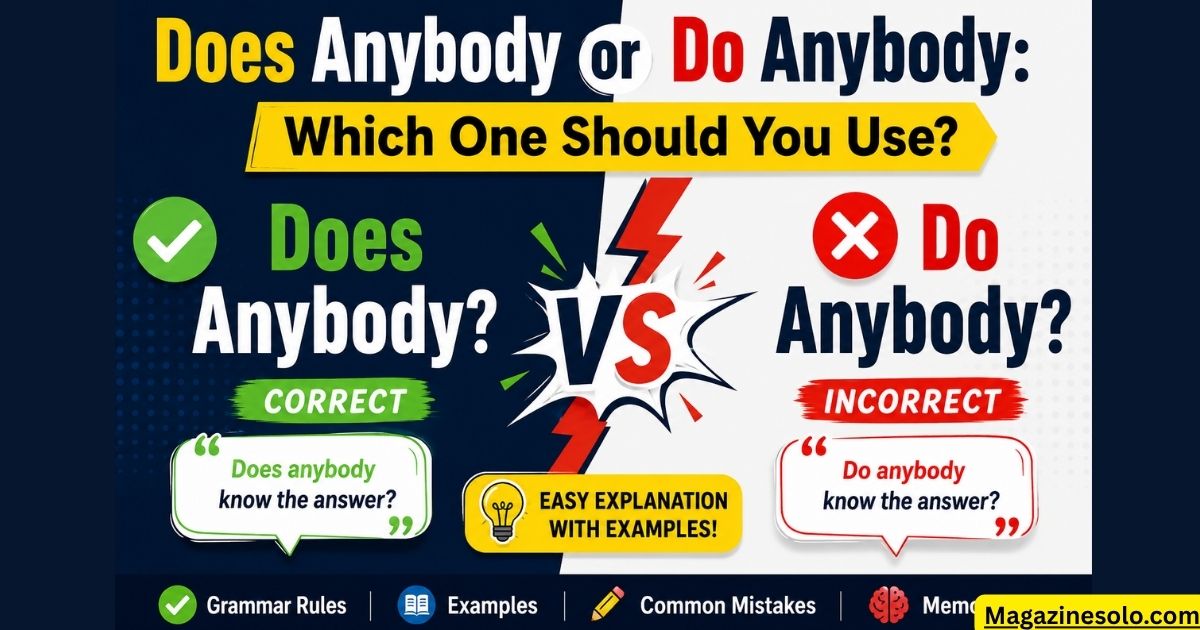
If you have ever wondered whether “does anybody” or “do anybody” is correct, you’re not alone. This is one of the most common grammar questions for English learners and even native speakers. The good news is that the rule is simple once you understand how indefinite pronouns work.
In this guide, you’ll learn the correct grammar, easy explanations, real-life examples, common mistakes, and memory tips. Whether you’re writing emails, assignments, blog posts, or simply trying to improve your English, this article will help you use the correct form with confidence.
Quick takeaway: “Does anybody” is always correct in the present tense. “Do anybody” is grammatically incorrect in standard English because anybody is treated as a singular indefinite pronoun.
Does Anybody or Do Anybody: Which is Correct?

The correct phrase is “does anybody.” Saying “do anybody” is grammatically incorrect in standard English and should be avoided, especially in writing, professional emails, or formal speech.
Here’s a simple way to think about it: “anybody” behaves like “he,” “she,” or “it” in a sentence. And just like you would never say “do she know?” or “do he want?”, you also wouldn’t say “do anybody know?” Instead, you’d say “does she know?” and “does anybody know?”, same rule, every time.
The Quick Answer
| Correct | Incorrect |
| Does anybody know the answer? | Do anybody know the answer? |
| Does anyone have a pen? | Do anyone have a pen? |
| Does anybody want coffee? | Do anybody want coffee? |
Bottom line: Always use “does anybody” in present tense questions. It’s the only grammatically correct form.
Understanding Indefinite Pronouns: The Foundation
To truly understand why “does anybody” is correct, you need to know what an indefinite pronoun is. Don’t worry, it’s simpler than it sounds.
An indefinite pronoun is a word that refers to a person or thing without naming them specifically. These words are “indefinite” because they don’t point to any one particular person.
Common indefinite pronouns include:
- anybody / anyone
- somebody / someone
- nobody / no one
- everybody / everyone
- anything / something / nothing / everything
The key rule in English grammar is this: indefinite pronouns are treated as singular. Even though “everybody” might make you think of many people, grammatically it acts like one, just like “he” or “she.”
This is the entire reason “does anybody” is correct. Since “anybody” is singular, it needs the singular verb form: does, not do.
Common Examples of Indefinite Pronouns
Here’s how indefinite pronouns behave the same way in sentences:
- Does everyone agree with this plan?
- Does somebody want to volunteer?
- Does nobody care about this?
- Is anyone home?
Notice how each one uses a singular verb form. The same pattern applies to “anybody.”
The Role of Auxiliary Verbs: “Do” vs “Does”
Before jumping to “does anybody” vs “do anybody,” it helps to understand what auxiliary verbs are. In English, “do” and “does” are helper verbs (also called auxiliary verbs) used to form questions and negative sentences in the present tense.
Think of them as the engine that powers a question. Without them, the question sounds incomplete.
- Wrong: “Anybody know the answer?”
- Right: “Does anybody know the answer?”
The helper verb “does” makes the question grammatically complete and natural-sounding.
When to Use “Do”
Use “do” with these subject pronouns:
| Subject | Example |
| I | Do I need to sign this? |
| You | Do you understand the instructions? |
| We | Do we have enough time? |
| They | Do they want to join us? |
“Do” is used with the first person (I, we), second person (you), and third person plural (they).
When to Use “Does”
Use “does” with third-person singular subjects:
| Subject | Example |
| He | Does he know the way? |
| She | Does she want to come? |
| It | Does it work properly? |
| Anybody / Anyone | Does anybody have a charger? |
| Somebody / Someone | Does someone need help? |
| Nobody / No one | Does no one care? |
Because “anybody” falls into the singular third-person category, it always pairs with “does.”
Why “Anybody” Takes “Does”
Here’s the grammar logic laid out simply:
- In the present simple tense, singular third-person subjects (he, she, it) add “-s” to verbs.
- He walks. She knows. It works.
- The auxiliary verb “do” follows the same rule: do + s = does.
- Since “anybody” is a singular third-person indefinite pronoun, it follows the same pattern.
- Therefore: Does anybody, always.
This is subject-verb agreement at its most basic level.
The Logic Behind “Does Anybody”
Think of it this way:
- “Does she want coffee?” → Replace “she” with “anybody.”
- “Does anybody want coffee?” → Exact same grammatical structure.
“Anybody” is just a stand-in for an unknown “he” or “she.” Once you see it that way, the rule becomes obvious and easy to remember.
Examples of Using ‘Does Anybody’ in a Sentence
Here are real-life examples showing how “does anybody” naturally appears in questions:
- Does anybody know what time the meeting starts?
- Does anybody have a spare pen I can borrow?
- Does anybody want the last slice of pizza?
- Does anybody need a ride to the station?
- Does anybody understand how to use this software?
- Does anybody care about what’s happening?
- Does anybody remember where we parked?
All of these are grammatically correct. All of them use “does” with “anybody”, no exceptions.
Common Mistakes and How to Avoid Them
Here are the most frequent mistakes people make with “does anybody”, and how to fix them instantly.
Mistake 1: Using “do” instead of “does”
- ❌ Do anybody want more food?
- ✅ Does anybody want more food?
Mistake 2: Adding “-s” to the main verb after “does”
- ❌ Does anybody wants to help?
- ✅ Does anybody want to help?
This is a common double error. Remember: when you use “does,” the main verb stays in its base form (no “-s”). The “-s” has already been used in “does.”
Mistake 3: Mixing past and present forms
- ❌ Does anybody called yesterday?
- ✅ Did anybody call yesterday?
For past events, switch to “did”, and again, keep the main verb in base form.
Similar Grammar Mistakes with Indefinite Pronouns
The “does” rule applies to other indefinite pronouns too. Here are common mistakes people make with similar words:
| Incorrect | Correct |
| Do anyone have a car? | Does anyone have a car? |
| Do somebody know this? | Does somebody know this? |
| Do everyone agree? | Does everyone agree? |
| Do nobody care? | Does nobody care? |
The pattern is consistent: all indefinite singular pronouns take “does” in present tense questions.
Tips for Remembering the Correct Form
Struggling to remember whether to use “does” or “do”? Try these tricks:
- The “he/she” swap trick: Replace “anybody” with “he” or “she.” If it sounds right with “does he” or “does she,” then “does anybody” is correct too.
- Singular = does: Any time your subject is a singular indefinite pronoun (anybody, anyone, somebody, everyone), go with “does.”
- Check the tense: Present tense → does/do. Past tense → did (for everyone).
- No double “-s”: “Does anybody want“, not “wants.” One “-s” per question is the rule.
Does Anyone Have or Do Anyone Have?
The correct phrase is “Does anyone have.”
“Anyone” works exactly like “anybody”, it’s a singular indefinite pronoun. So the same rule applies:
- ✅ Does anyone have a moment to chat?
- ❌ Do anyone have a moment to chat?
Both “anybody” and “anyone” mean the same thing. The choice between them is more about style: “anyone” tends to be used more in formal writing, while “anybody” shows up more in casual speech. But grammatically, both need “does.”
Should I Use ‘Wants’ or ‘Want’ After ‘Does Anyone’?
Always use “want” (base form), not “wants.”
- ✅ Does anyone want to join?
- ❌ Does anyone wants to join?
Here’s why: The auxiliary verb “does” already carries the third-person singular “-s.” Adding it again to the main verb creates a grammatical double error. The main verb stays in its plain base form after any form of “do/does/did.”
Can “Anybody” Ever Be Used with “Do”?
In standard, formal, or written English, no. “Do anybody” is always incorrect in present tense questions.
However, in some informal regional dialects, you might occasionally hear it in casual spoken English. But even then, most native English speakers would recognize it as non-standard. In emails, school assignments, professional conversations, or any written context, always stick to “does anybody.”
What About “Does Anybody Else”?
Adding “else” does not change the grammar rule at all.
- ✅ Does anybody else need help?
- ✅ Does anybody else want to speak?
The word “else” simply adds the meaning of “other than what’s already been mentioned.” It doesn’t affect whether you use “do” or “does.” “Anybody” is still singular, so “does” remains correct.
Past Tense: “Did Anybody”
When you’re talking about something in the past, the rules shift, and actually get simpler. In the past tense, you use “did” for everyone and everything, regardless of singular or plural.
- Did anybody call while I was out? ✅
- Did anyone see what happened? ✅
- Did somebody leave this here? ✅
Notice that the main verb stays in its base form (call, see, leave), not called, saw, or left. This is the same pattern as in the present tense: the auxiliary verb (did) carries the tense, and the main verb stays unchanged.
The confusion between “do” and “does” only exists in the present tense. The past tense is easier, “did” works for everything.
Why Correct Grammar Matters in Professional Settings
You might be thinking: does this really matter in real life? Absolutely, and here’s why.
When you write an email with “Does anybody have the report?” it signals that you’re precise, careful, and professional. Using “do anybody” in the same email, even once, can subtly undermine how others perceive your communication skills.
In job interviews, presentations, and client communication, people notice grammar. It doesn’t mean one mistake ends your career, but consistently correct grammar builds credibility over time. Small details add up to a big impression.
Building Strong Language Skills
Understanding the “does anybody” rule is more than just one grammar fix. It helps you understand a broader principle: subject-verb agreement. Once you understand how singular subjects need singular verbs, you start seeing the pattern everywhere in English.
Every grammar rule you master makes the next one easier. Learning this one unlocks your ability to use “everyone has,” “someone is,” “nobody was,” and dozens of similar phrases correctly, without even thinking about it.
Quick Reference Guide
Use this table as a cheat sheet whenever you’re unsure:
| Scenario | Correct Form | Example |
| Present tense question | Does anybody | Does anybody know? |
| Present tense with “anyone” | Does anyone | Does anyone have a pen? |
| Past tense question | Did anybody / Did anyone | Did anybody call? |
| Adding “else” | Does anybody else | Does anybody else want some? |
| Main verb after “does” | Base form (no “-s”) | Does anybody want (not wants) |
| With “do” (incorrect) | Never with anybody/anyone | ❌ Do anybody know? |
FAQ’s
Is “does anybody” or “do anybody” correct?
“Does anybody” is always correct. “Do anybody” is grammatically wrong because “anybody” is a singular pronoun and needs the singular auxiliary verb “does.”
Why does “anybody” use “does” and not “do”?
Because “anybody” is a third-person singular indefinite pronoun, just like “he” or “she.” The same rule that gives you “does he” and “does she” also gives you “does anybody.”
Can I say “does anyone” instead of “does anybody”?
Yes, completely. “Anyone” and “anybody” are interchangeable in meaning and follow the same grammar rule, both take “does” in present tense questions.
Should I say “does anybody want” or “does anybody wants”?
Say “does anybody want.” The main verb stays in its base form after “does.” Adding “-s” to “want” would create a grammatical double error.
What do I use in past tense, “did anybody” or “does anybody”?
Use “did anybody” for past tense. For example: “Did anybody call while I was away?” The word “did” replaces “does” when talking about the past.
Does “does anybody else” follow the same rule?
Yes. Adding “else” doesn’t change anything. “Does anybody else need help?” is correct, “anybody” is still singular regardless of the extra word.
Is “do anyone” ever acceptable in English?
No, not in formal or standard written English. While you might hear it occasionally in very informal regional speech, it should always be avoided in writing, professional settings, and careful speech.
Conclusion
The answer is straightforward: “Does anybody” is correct, while “do anybody” is not. The reason is that anybody is a singular indefinite pronoun, so it always takes the singular auxiliary verb does in the present tense. Likewise, use did anybody in the past tense and remember that the main verb always stays in its base form after does or did.
By understanding this simple rule and practicing it in everyday conversations and writing, you’ll avoid one of the most common English grammar mistakes and communicate with greater confidence.