Jynx vs Jinx: When To Use Each One In Writing
Have you ever typed “Jynx” and wondered whether it should actually be “Jinx”? You’re not alone. Many English learners and even native speakers confuse these two spellings because they look almost identical and sound exactly the same.
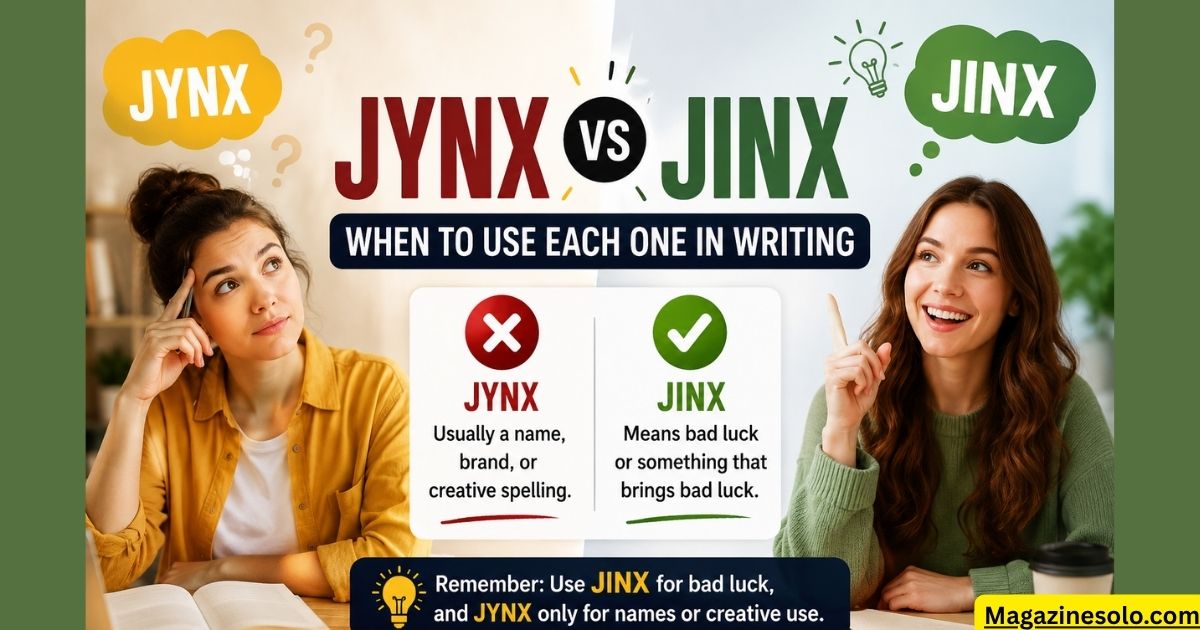
The good news is that the difference is simple once you understand the context. In modern English, jinx is the accepted dictionary spelling. It refers to bad luck, someone who brings bad luck, or the act of causing something unfortunate to happen. On the other hand, jynx is not the standard spelling in everyday writing. You’ll mostly see it used as a character name, brand name, username, or creative variation.
If you’ve ever searched for jinx or jynx, jynx or jinx, or even jinks or jinx, this guide will explain everything in clear and easy language.
Define Jynx
Jynx is, historically, a real word, just not the one most people mean when they type it today. It traces back to the Greek term iynx, referring to the wryneck, a small bird once linked to charms, spells, and love magic in ancient folklore. Because of that history, “jynx” occasionally surfaces in older texts, mythology discussions, or scholarly writing about witchcraft and superstition.
In modern usage, though, jynx has taken on a completely different identity. It’s best known today as:
- The name of a Psychic/Ice-type Pokémon character
- A stylized spelling choice for usernames, brand names, or gaming handles
- An intentional creative twist used in fantasy writing or fiction
So when someone asks whether to use jinks or jinx or reaches for “jynx” instead, the honest answer is that jynx isn’t considered correct in standard, modern English. It’s a proper name or a deliberate stylistic choice, not a general-purpose noun or verb you’d use to describe everyday bad luck.
Define Jinx
Jinx is the word you actually want in almost every situation involving luck, curses, or superstition. Merriam-Webster defines it plainly: as a noun, a jinx is someone or something believed to bring bad luck; as a verb, to jinx means to bring bad luck to someone or something.
Jinx entered English usage in the early 1900s and has stayed firmly rooted in everyday conversation ever since. Think about phrases like:
- “Don’t jinx it!”
- “That stadium has a jinx on it.”
- “I think I just jinxed myself.”
It works as both a noun (“he’s a jinx”) and a verb (“you’ll jinx the game”), and it shows up constantly in sports commentary, casual conversation, and pop culture. If you’re writing about superstition, misfortune, or a run of bad luck, jinx is the word that belongs in your sentence, not jynx.
How To Properly Use The Words In A Sentence
The easiest way to get this right every time is to ask yourself one question: am I talking about bad luck, or am I referring to a name?
Use jinx when:
- You’re describing someone or something believed to cause misfortune
- You’re using it as a verb meaning “to bring bad luck”
- You’re writing casual, conversational, or professional content
Use jynx when:
- You’re referring specifically to the Pokémon character
- You’re naming a brand, business, or username
- You’re discussing the word’s Greek or folklore origins in an academic context
Here’s a quick side-by-side to keep things simple:
| Situation | Correct Word | Example |
| Talking about bad luck in sports | jinx | “The team hasn’t lost since he stopped calling it a jinx.” |
| Referring to the Pokémon character | Jynx | “Jynx learns Ice Punch at level 15.” |
| Casual warning about tempting fate | jinx | “Don’t say we’re winning, you’ll jinx it.” |
| Naming a gaming username or brand | Jynx | “She streams under the name Jynx99.” |
| Discussing word origins/etymology | jynx (historical) | “The word jinx may derive from the older term jynx.” |
Notice the pattern: unless you’re naming something or someone specifically called “Jynx,” you almost always want jinx.
More Examples Of Jynx & Jinx Used In Sentences
Seeing the words in context makes the distinction stick. Here are more real-world style examples covering both jynx or jinx and jinks or jinx confusion:
Jinx examples:
- “I hope I didn’t jinx the interview by talking about it too much.”
- “Every time someone predicts sunny weather, they end up jinxing it.”
- “The old house has had a jinx on it for decades, nothing good happens there.”
- “He broke the jinx after missing three championships in a row.”
- “She knocked on wood so she wouldn’t jinx her good fortune.”
Jynx examples (proper noun usage):
- “Jynx is one of the more unusual-looking Pokémon in the original 151.”
- “The brand rebranded itself as Jynx to stand out online.”
- “In Greek mythology, the jynx bird was tied to enchantment rituals.”
A quick note on a related mix-up: people also confuse jinks or jinx. “Jinks,” as in “high jinks,” refers to playful mischief or lively pranks, a completely different word with its own meaning, unrelated to bad luck. So if you’re describing rowdy, fun behavior, “high jinks” is correct; if you’re describing bad luck, it’s “jinx.”
Common Mistakes To Avoid
Even experienced writers slip up here. These are the errors that show up most often:
- Using “jynx” as a verb. Jynx isn’t standard as a verb at all. “I hope I don’t jynx it” should be “I hope I don’t jinx it.”
- Calling a person “a jinx” when you mean “jinxer.” Technically, jinx describes the misfortune or the act of causing it, the person who does the jinxing is sometimes more accurately called a “jinxer,” though “he’s a jinx” has become so common it’s widely accepted in casual speech.
- Confusing jinx with hex. A jinx is usually minor, temporary bad luck. A hex implies something stronger and more deliberate, like an actual curse. They’re related but not identical.
- Mixing up jinx and jinks. As covered above, “jinks” (as in “high jinks”) means playful mischief, not misfortune.
- Assuming jynx is a casual alternative spelling. It’s not simply a stylistic variant like “grey” vs. “gray.” Dictionaries don’t recognize jynx as an accepted spelling of jinx, so using it in formal writing reads as an error, not a creative choice.
Context Matters
Word choice always depends on your audience and setting, and that’s especially true with jinx vs jynx. A few scenarios worth thinking through:
- Formal or professional writing: Always use jinx. Business emails, reports, essays, and articles should stick to the dictionary-standard spelling.
- Gaming and pop culture content: If you’re specifically discussing the Pokémon character, Jynx is correct and expected, using “jinx” there would actually be the mistake.
- Branding and usernames: Creators often choose Jynx deliberately because it looks sharper and stands out online, even though it’s not “correct” English. That’s a valid stylistic decision, not a grammar error, as long as it’s intentional.
- Superstition and everyday conversation: Jinx is what your reader expects. Using jynx here will just look like a typo.
The key takeaway: context tells you whether you need the dictionary word or the proper noun. When in doubt, jinx is almost always the safer, more recognizable choice.
Exceptions To The Rules
Language is rarely 100% tidy, and there are a few edge cases worth knowing:
- Historical and etymological writing: Some older texts and word-origin discussions genuinely use “jynx” to refer to the wryneck bird or ancient charm practices. In that narrow academic context, jynx is accurate and appropriate.
- Branding exceptions: Companies, characters, and creators are free to name themselves “Jynx” for stylistic reasons. This isn’t wrong, it’s a deliberate identity choice, similar to a brand spelling “Lyft” instead of “lift.”
- Regional or dialectal quirks: Occasionally, informal or regional usage blurs the line between these words, but this doesn’t change the standard rule for formal writing. Dictionaries still recognize only jinx as the correct term for bad luck.
- Fictional storytelling: Fantasy writers sometimes invent their own rules, using “jynx” as a unique magical term distinct from the everyday concept of a jinx. This is a creative liberty, not a grammar standard.
Outside of these specific situations, the rule holds firm: jinx is the correct English word for bad luck, and jynx is a name, not a synonym.
FAQ’s
Is jynx a real word?
Yes, but only in a limited, historical sense tied to Greek mythology and the wryneck bird. In modern everyday English, it’s not the standard spelling for bad luck.
What’s the difference between jinx or jynx?
Jinx means bad luck or to cause bad luck and is standard English. Jynx is mainly a proper noun, like the Pokémon character or a stylized brand name.
Is jynx the same as jinx in Pokémon?
The Pokémon character is spelled “Jynx” and is a unique name, not an alternate spelling of the word “jinx.”
What does jinks or jinx mean when people say “high jinks”?
“High jinks” refers to playful mischief or fun pranks and has nothing to do with luck. It’s a completely different word from “jinx.”
Can I use jynx as a verb?
No. Jynx is not used as a verb in standard English. “To bring bad luck” is always expressed with “jinx,” as in “you’ll jinx it.”
Which spelling should I use in an essay or professional email?
Always use “jinx.” It’s the dictionary-recognized spelling and the one readers expect in formal or everyday writing.
Conclusion
At the end of the day, the jynx or jinx debate has a pretty clean resolution. Jinx is the real, dictionary-recognized word for bad luck, misfortune, or the act of causing it, and it’s the one you should reach for in almost every sentence about superstition or luck. Jynx, meanwhile, survives mainly as a proper name: the Pokémon character, a stylish username, or an occasional nod to the word’s ancient Greek roots.
When you’re unsure which spelling fits, ask yourself if you’re naming something specific called “Jynx”, if not, go with jinx. Keep this simple test in mind, and you’ll never second-guess yourself again.

Shoaib Ahmad is a language-focused content writer and researcher at magazinesolo.com, where he explains the meaning of words, phrases, and text in a clear and reader-friendly way. His work focuses on simplifying language, uncovering context, and helping readers understand text with confidence and clarity.