Of Course or Ofcourse: The Complete Guide to Correct Usage
Have you ever typed “ofcourse” in a text message and then paused, wondering if that’s actually how it’s spelled? You’re not alone. This is one of the most common spelling mix-ups in the English language, and it trips up native speakers and English learners alike.
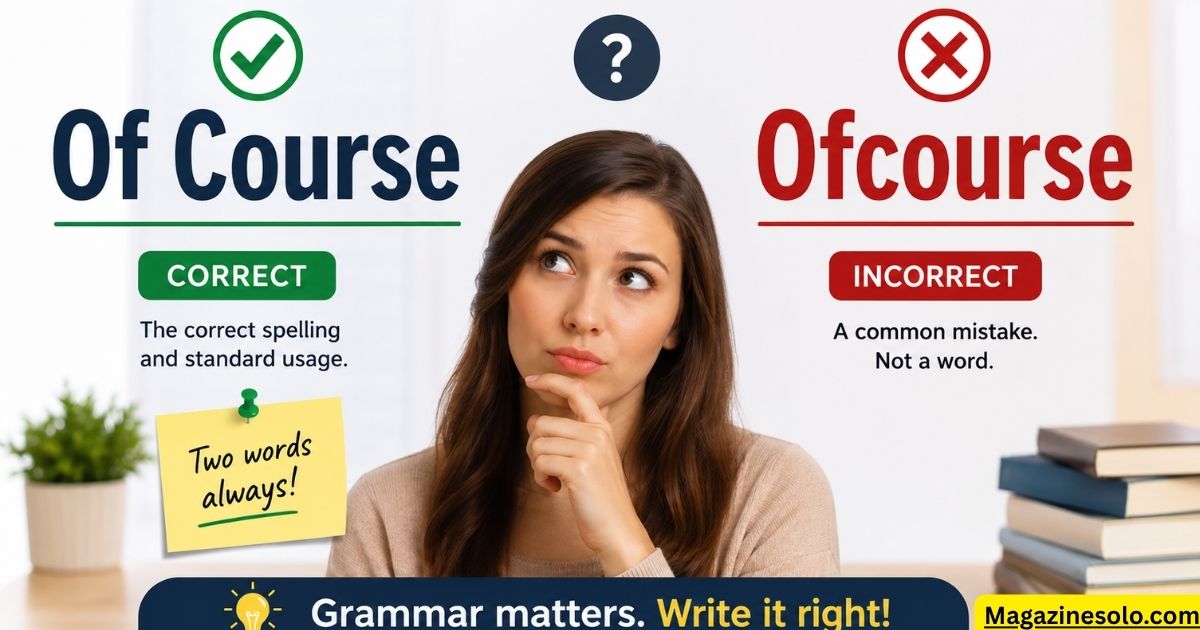
The short answer: “of course” is always correct, and “ofcourse” is always wrong. But knowing why this happens, and how to make sure you never make the mistake again, is worth a few minutes of your time. This guide breaks it all down in plain, simple language, no confusing grammar jargon, just clear answers.
Of Course or Ofcourse: What Writers Should Know
Before we go deeper, here’s the quick version for anyone in a hurry:
- The correct spelling is “of course”, two separate words.
- “Ofcourse” is not a recognized word in any English dictionary.
- “Of course” means something is obvious, expected, or agreed upon.
- The mistake usually happens because of how the phrase sounds when spoken quickly.
- Writing “ofcourse” in emails, resumes, or professional documents can make your work look careless.
If you remember nothing else from this article, remember that rule. Now let’s look at why this small error happens so often, and how you can avoid it for good.
Why People Get Confused About “Of Course”
If “of course” is always wrong when written as one word, why do so many people write “ofcourse” anyway? There are a few simple explanations.
- It sounds like one word when spoken. In everyday conversation, “of course” is said quickly, almost as a single beat of sound, “uh-kors.” Your brain hears one unit, so your fingers sometimes type one unit too.
- English has plenty of real compound words. Words like “everyday,” “notebook,” and “anymore” started as two words and eventually merged into one. It’s natural to assume “ofcourse” followed the same path, it just didn’t.
- Fast typing and texting habits. On phones and social media, people skip spaces without thinking twice, especially with phrases used constantly in casual chat.
- Autocorrect doesn’t always catch it. Some keyboards and apps fail to flag “ofcourse” as an error, which quietly reinforces the wrong habit over time.
- It gets confused with texting shorthand. The abbreviation “ofc” (short for “of course”) is common in informal texting, and this can blur the line between casual shorthand and standard spelling.
None of these reasons make “ofcourse” correct, they just explain why the mistake spreads so easily.
The Correct Spelling: “Of Course”
“Of course” is a fixed phrase made up of two words: the preposition “of” and the noun “course.” Grammatically, it functions as an adverb, meaning it modifies a whole sentence or clause rather than a single noun.
The phrase is used to show:
- Agreement, “Of course, I’ll be there.”
- Certainty, “Of course the sun will rise tomorrow.”
- Permission, “Can I borrow your pen?” “Of course.”
- Something obvious or expected, “Of course it rained on the one day I forgot my umbrella.”
You can place “of course” at the beginning, middle, or end of a sentence, and each position slightly changes the emphasis:
- Start of sentence: “Of course, you can join us.”
- Middle of sentence: “You can, of course, join us.”
- End of sentence: “You can join us, of course.”
No major dictionary, not Oxford, not Merriam-Webster, not Cambridge, lists “ofcourse” as an alternate or accepted spelling. That alone should settle the debate, but let’s look at the incorrect version more closely anyway.
The Incorrect Spelling: “Ofcourse”
“Ofcourse” is a spelling error, plain and simple. It combines a preposition and a noun into a single word without any grammatical basis for doing so. English does allow some prepositional phrases to merge over centuries of use (like “into” or “onto”), but “of course” never went through that transformation, and modern style guides don’t recognize it as one word.
Here’s what makes “ofcourse” stand out as wrong:
- It doesn’t appear in any standard or academic dictionary.
- Grammar checkers and spell-checkers flag it as an error.
- It signals rushed or careless writing, especially in professional settings like emails, resumes, and reports.
- Search engines and readers alike recognize it as a typo, not a stylistic choice.
Correct: “Of course, I’ll send you the report by Friday.” Incorrect: “Ofcourse I’ll send you the report by Friday.”
If you’re writing anything that other people will read, a school assignment, a work email, a blog post, always use the two-word form.
Commonly Confused Variations of “Of Course”
“Of course” isn’t the only phrase people get tangled up in. A few lookalikes and soundalikes cause similar confusion, so it helps to separate them clearly.
- Off course, This is a real, correct phrase, but it means something completely different. It describes something moving away from its intended path or direction. Example: “The ship drifted off course during the storm.”
- Offcourse, Like “ofcourse,” this is never correct. It’s a spelling mistake, not a real word.
- Ofc, This is informal internet and texting shorthand for “of course.” It’s fine in casual chats with friends but should never appear in formal writing.
- Of coarse, A homophone mix-up. “Coarse” means rough in texture, not related to “course” at all, so this combination doesn’t make sense in this phrase.
Keeping these apart is easy once you see them side by side, which is exactly what the table below does.
Side-by-Side Comparison Table
| Phrase | Correct? | Meaning | Example Sentence |
|---|---|---|---|
| Of course | Yes | Naturally, certainly, obviously | “Of course, you’re welcome to stay.” |
| Ofcourse | No | Not a word; misspelling | — |
| Off course | Yes (different meaning) | Deviating from the intended path | “The plane went off course due to strong winds.” |
| Offcourse | No | Not a word; misspelling | — |
| Ofc | Informal only | Texting shorthand for “of course” | “Coming to the party tonight?” “Ofc!” |
| Of coarse | No | Incorrect homophone combination | — |
How to Remember the Correct Spelling
If you’ve made this mistake before, don’t worry, a few simple memory tricks can make it stick for good.
- Break it into its two building blocks. Say it slowly in your head as “of” + “course,” the same way you’d say “as well,” not “aswell.”
- Swap it for a synonym test. If you can replace the phrase with “naturally” or “certainly” and the sentence still makes sense, it should be written as two words.
- Picture the space as part of the meaning. Think of “of course” as “part of the natural course of things”, the space represents that separation between the preposition and the noun.
- Read it out loud during proofreading. Reading slowly, rather than skimming, helps your eyes catch the missing space that your brain glosses over.
- Let your spell-checker help. Most grammar tools will underline “ofcourse” automatically, don’t ignore that red squiggly line.
Writers who use small mnemonic tricks like these tend to retain correct spellings far better than those who simply try to memorize the rule by repetition alone.
Synonyms and Alternatives to “Of Course”
Using “of course” repeatedly in the same piece of writing can start to feel repetitive. Swapping in a synonym now and then keeps your writing fresh while matching the tone you’re going for.
Formal alternatives:
- Certainly
- Naturally
- Undoubtedly
- Indeed
- Needless to say
Casual alternatives:
- Sure
- Totally
- For sure
- Yeah, definitely
- Obviously
Academic or professional alternatives:
- It goes without saying that…
- As expected…
- Unquestionably
Choosing the right synonym depends on your audience. “Certainly” fits a business email, while “totally” fits a text to a friend. Both carry the same core meaning as “of course,” just with a different tone.
Examples of “Of Course” in Real Sentences
Seeing the phrase in context makes it easier to use correctly and confidently in your own writing.
- “Of course, I remember your birthday, how could I forget?”
- “You’re allowed to ask questions during the meeting, of course.”
- “Of course it’s going to be busy on a Friday night.”
- “She agreed, of course, without a moment’s hesitation.”
- “Can you help me move this weekend?” “Of course, no problem at all.”
- “Of course mistakes happen, what matters is fixing them.”
- “He was, of course, the last person to arrive.”
Notice that in every example, “of course” adds a tone of certainty, agreement, or acknowledgment without changing the basic meaning of the sentence around it.
Quick Reference Summary Table
| Rule | Details |
| Correct spelling | Of course (two words) |
| Incorrect spelling | Ofcourse (never correct) |
| Word type | Adverbial phrase (preposition + noun) |
| Common meaning | Naturally, certainly, obviously |
| Where it can appear | Start, middle, or end of a sentence |
| Punctuation | Usually set off with commas |
| Formal use | Fully acceptable in professional and academic writing |
| Informal shorthand | “Ofc” (texting only, not formal writing) |
| Related but different phrase | “Off course” (deviating from a path) |
Frequently Asked Questions
Is “ofcourse” ever correct?
No. “Ofcourse” is not listed in any standard English dictionary and is always considered a spelling error.
What does “of course” mean?
It means something is obvious, expected, or agreed upon, similar to “naturally” or “certainly.”
Can “of course” be used in formal writing?
Yes, it’s fully acceptable in emails, essays, reports, and other professional or academic writing.
Why do people write “ofcourse” by mistake?
Because the phrase sounds like a single word when spoken quickly, and autocorrect doesn’t always catch the error.
Is “ofc” the same as “of course”?
“Ofc” is informal texting shorthand for “of course,” suitable for casual chats but not formal writing.
What’s the difference between “of course” and “off course”?
“Of course” means something is expected or obvious, while “off course” means moving away from an intended direction or path.
Do I need a comma after “of course”?
Usually yes, especially when it starts a sentence, for example, “Of course, I’ll be there.”
Conclusion
The rule behind “of course” versus “ofcourse” is refreshingly simple once it clicks: “of course” is always two words, and “ofcourse” isn’t recognized as a word at all. The confusion mostly comes down to how quickly we say the phrase out loud, not because there’s any real grammatical debate.
Whether you’re writing a school essay, a work email, or a quick text to a friend, sticking with the two-word spelling keeps your writing clear, correct, and professional. A tiny space between “of” and “course” might seem like a small detail, but it’s exactly the kind of small detail that shows readers you know what you’re doing.

Shoaib Ahmad is a language-focused content writer and researcher at magazinesolo.com, where he explains the meaning of words, phrases, and text in a clear and reader-friendly way. His work focuses on simplifying language, uncovering context, and helping readers understand text with confidence and clarity.