The Difference in 10 Seconds
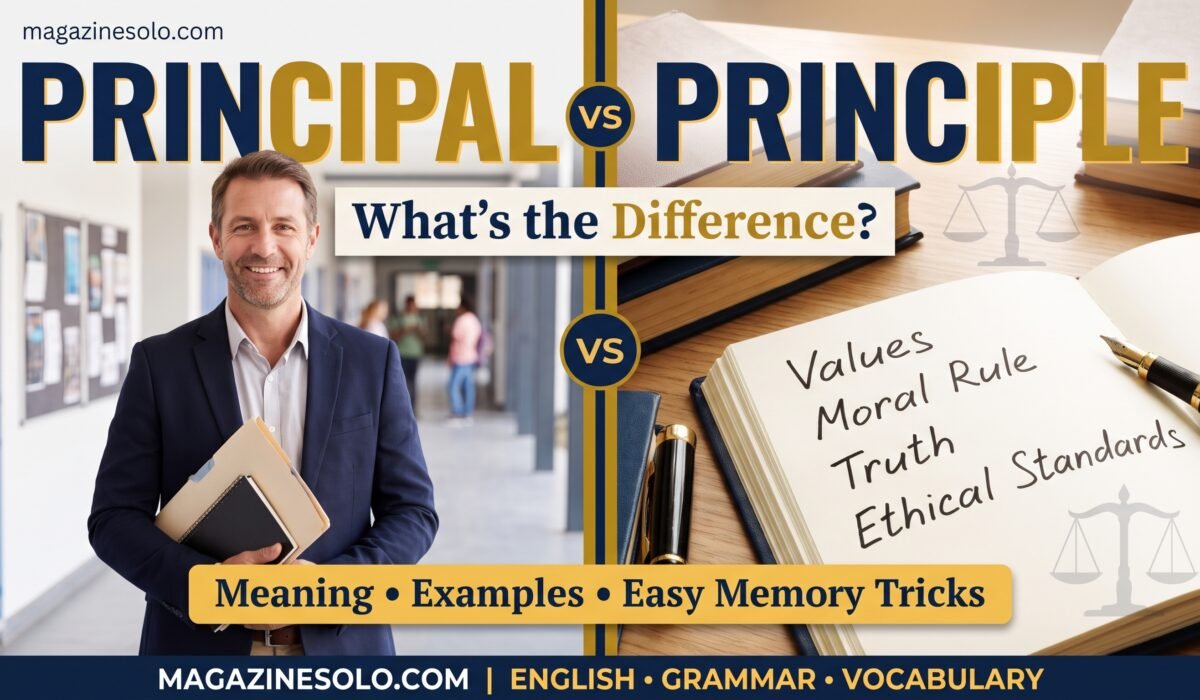
Principal means a person in charge, the main thing, or a sum of money. Principle means a rule, belief, or fundamental truth. Remember: the principal is your pal, and a principle is a rule (both end in -le).
Introduction
Principal vs principle is one of English’s most quietly costly mix-ups. The two words sound identical, differ by two letters at the end, and appear in high-stakes places: school documents, loan papers, cover letters, and essays. Yet their meanings never overlap. This guide gives you the clear rule, maps every sense of principal, explains the finance meaning with real numbers, untangles “in principle” from “on principle,” reveals the senses of principal most guides miss, and ends with a practice quiz so the distinction sticks for good.
What Does Principal Mean?
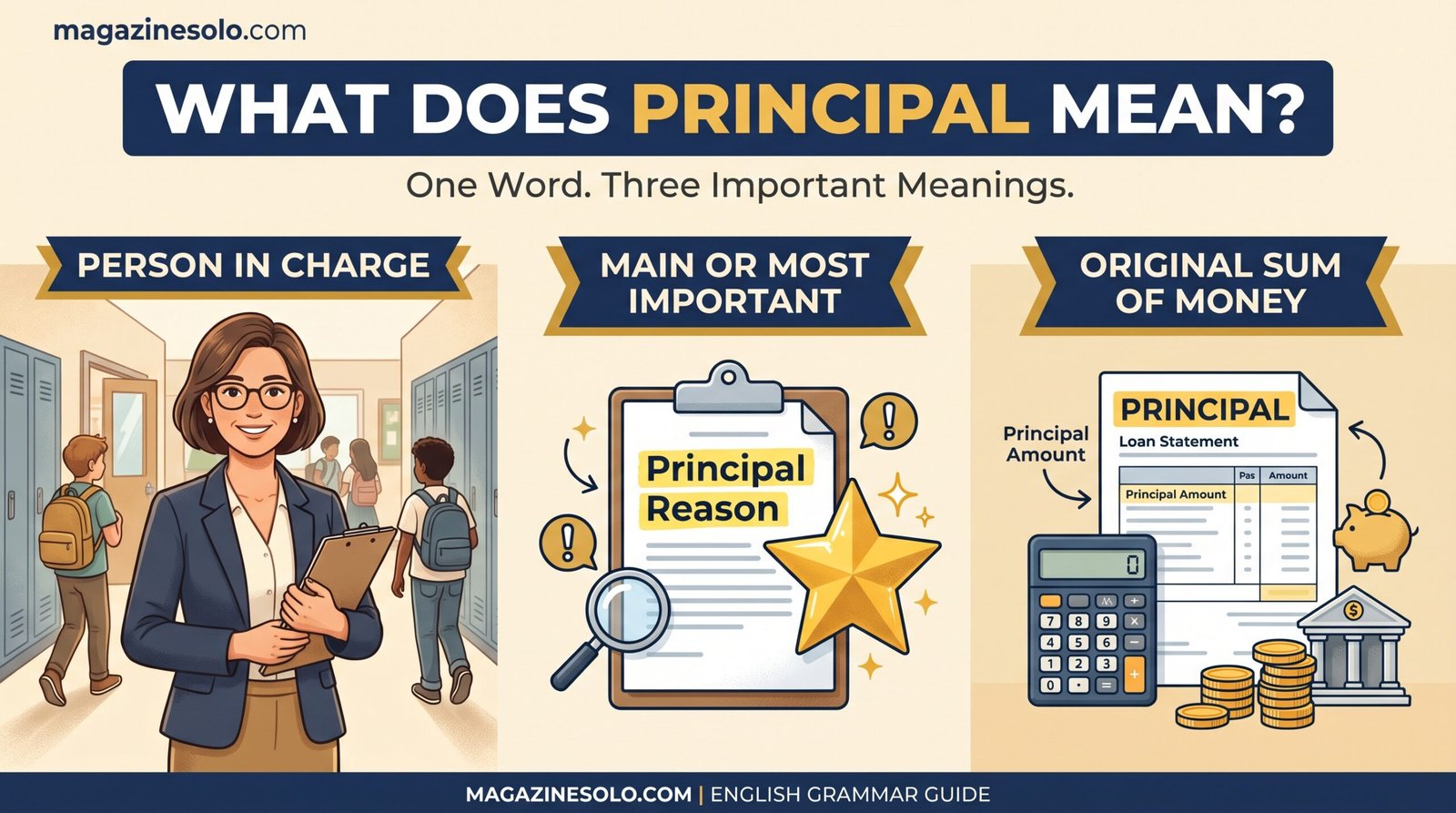
Principal does three jobs, and each one is worth learning separately. As a noun it names a person in a leading position. As an adjective it means main or most important. As a noun in finance it names a sum of money borrowed or invested.
Principal as a Person
The most familiar sense is the head of a school. In American English, the principal runs the school, handles discipline, and meets parents. The classic mnemonic lives here: the principal is your pal.
The person sense extends beyond schools. A principal investigator leads a research project. A company founder can be a principal of the firm. In each case, the word marks the person in charge.
Principal as an Adjective: Main or Most Important
As an adjective, principal means first in importance. The principal reason for the delay was bad weather. Her principal concern is safety. The adjective always modifies something, emphasizing that it comes first.
Here is a bonus mnemonic from Merriam-Webster: principal ends with A-L, and adjective starts with A. Only principal can do the adjective job. Principle never can.
Principal as Money
In finance, principal is the original sum borrowed or invested, separate from interest or returns. When you take a mortgage, the principal is the amount you borrowed. Every payment chips away at it, while interest is the lender’s fee for the loan.
This is the one spelling for money, always. A loan document that says “principle amount” has an error. The Consumer Financial Protection Bureau distinguishes mortgage principal from interest in its consumer guides, and lenders use the A spelling without exception.
What Does Principle Mean?
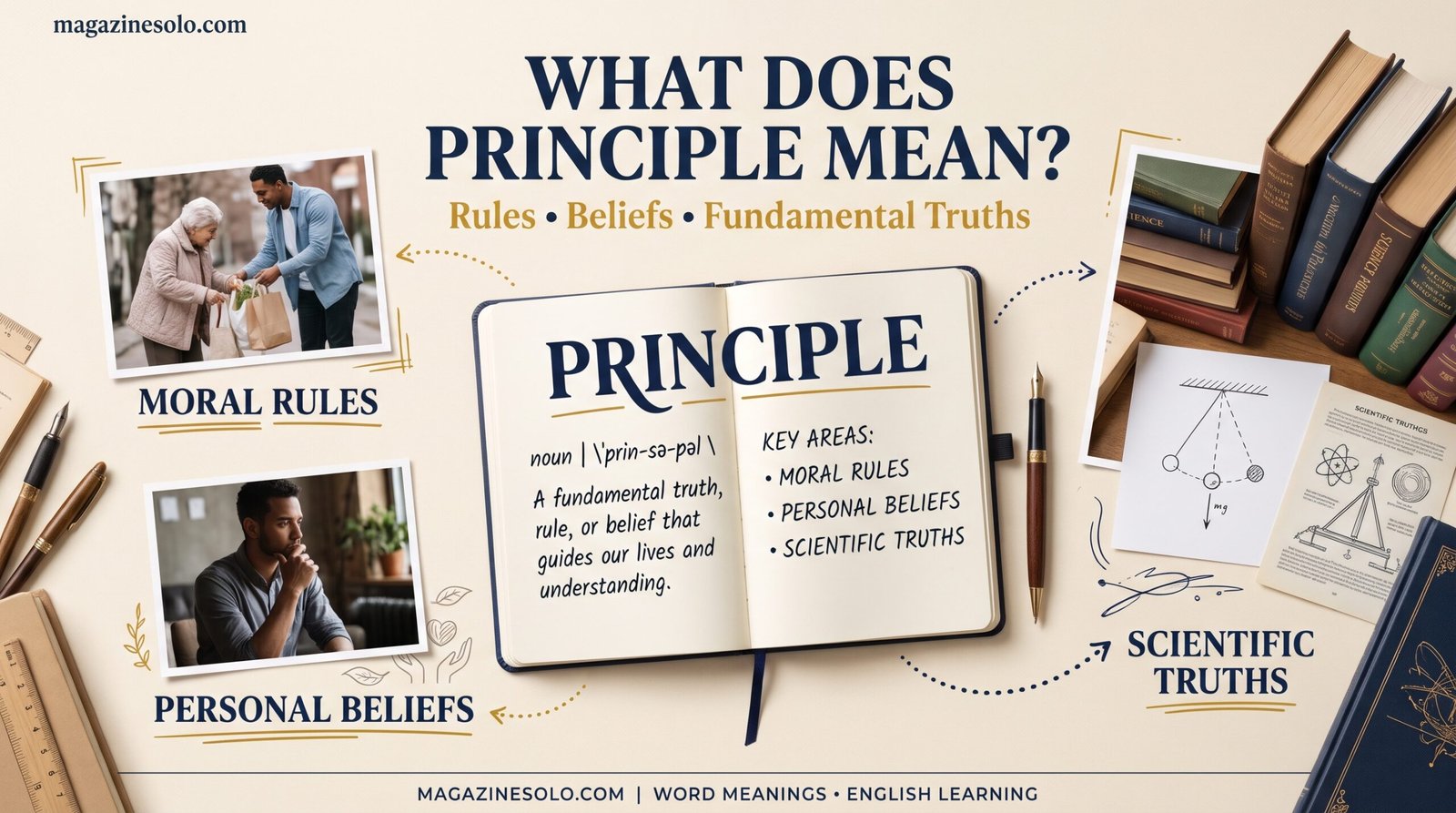
Principle is simpler in grammar and richer in meaning. It is always a noun, and it names a rule, belief, or fundamental truth that guides behavior or explains how things work.
Principle as a Moral Rule
A principle can be a moral standard you live by. Honesty is a guiding principle. She refused the offer on principle. Here the word carries ethical weight: it describes what a person will and will not do.
The mnemonic: principle ends like rule. Both end in -le, and both guide behavior. When you mean a code you follow, the -le spelling is your signal.
Principle as a Fundamental Truth
A principle can also be a law of how things work. The basic principle of gravity is that objects fall toward the Earth. Engineers work from first principles. Scientists name principles after discoverers, as in Archimedes’ principle.
This sense has no moral content. It describes the operating rules of nature, systems, or disciplines. Accounting has principles. Design has principles. Physics is built on them.
Side-by-Side Comparison
| Word | Part of speech | Core meaning | Example |
|---|---|---|---|
| Principal | Noun / adjective | Person in charge; main thing; sum of money | The principal greeted the parents. |
| Principle | Noun only | Rule, belief, or fundamental truth | Honesty is a guiding principle. |
Principal vs Principle in Popular Culture
The pair echoes through phrases everyone knows. “Sent to the principal’s office” is a school-discipline trope across generations of film and television. The principal here is always the person, never the rule.
“A man of principle” is the classic character description for integrity. Screenwriters use it as shorthand: say a character has principles and the audience instantly understands their moral compass. Biographers do the same in profiles of public figures.
Political speeches lean on the word constantly. Candidates promise to govern by principle, opponents accuse them of abandoning their principles, and commentators debate which principles survived contact with power. The -le spelling carries the entire moral vocabulary of public life.
Even comedy plays on the pair. Jokes about “high principals” (tall school heads) versus “high principles” (strict morals) work precisely because the audience hears one word and must supply the right spelling. The humor depends on the confusion this guide resolves.
Principal in Investing: Protecting the Original Sum
Beyond loans, principal matters in investing. Your principal is the money you put in; returns are what it earns. “Never risk the principal” is conservative investing’s first commandment.
Bonds illustrate the distinction cleanly. A bondholder lends the principal and receives interest payments, then gets the principal back at maturity. Certificates of deposit work the same way: the bank guards your principal and pays you interest for the use of it.
This is why financial writers guard the spelling so fiercely. In a prospectus, “principle” where “principal” belongs is not a typo; it is a category error that suggests the writer does not understand the instrument. Money takes the A spelling, in every market, every time.
The Grammar Key: Principal Does Two Jobs, Principle Does One
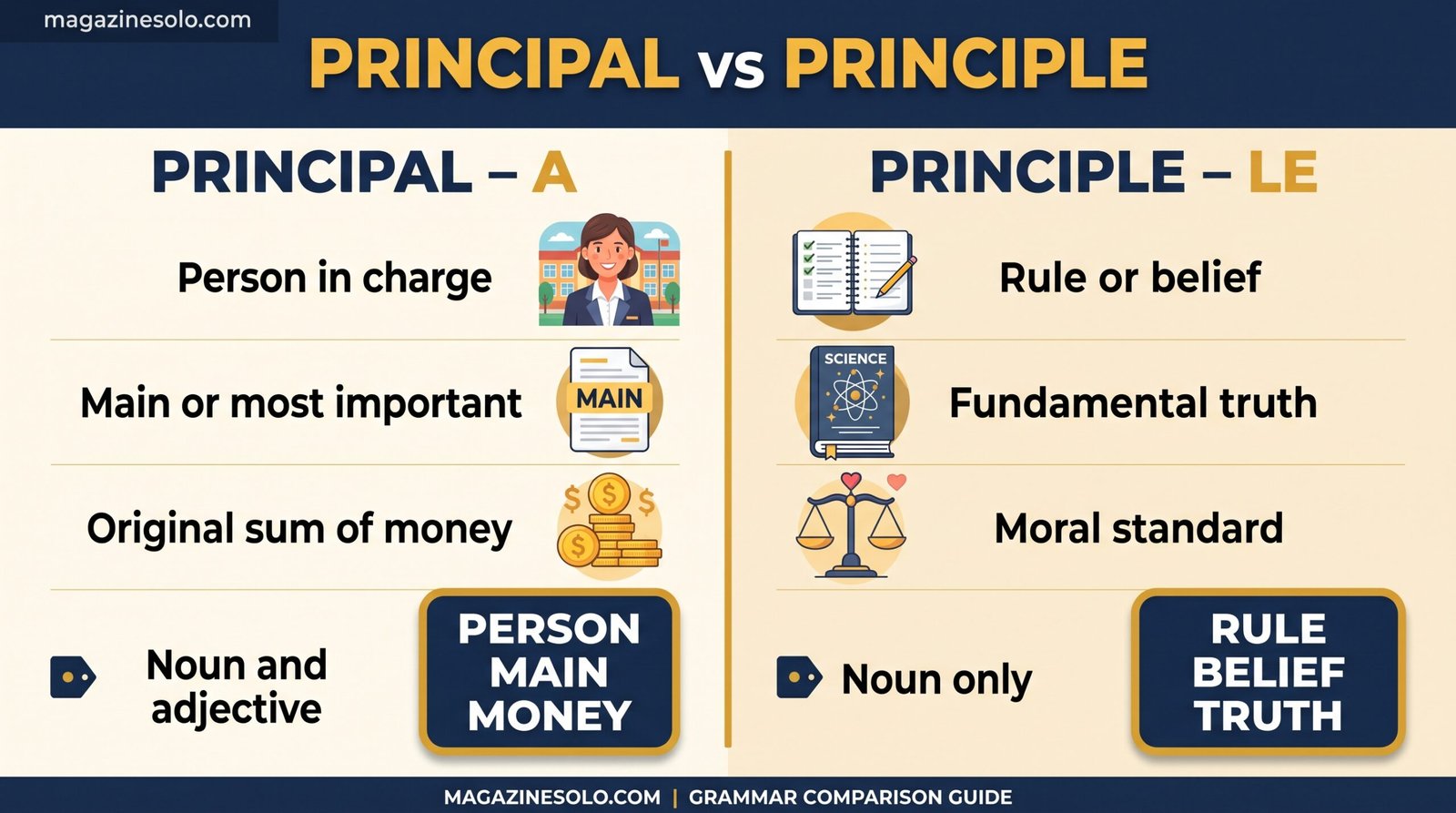
The single most useful grammatical fact: principal works as a noun and an adjective, while principle is noun-only. If your sentence needs an adjective meaning “main,” the answer is automatically principal.
The principal concern was budget approval. “Principal” modifies “concern,” so only the A spelling works. A “principle concern” would mean a rule-shaped worry, which is nonsense.
Principle’s adjective form is a different word: principled. A principled stand is one taken according to beliefs. Its opposite, unprincipled, describes someone without moral standards. When you need the adjective of the rule word, reach for principled, never “principle” as a modifier.
Principal and Money: What “Principal Amount” Really Means
The finance sense deserves its own section because it confuses even careful writers. On any loan, two numbers matter: the principal, which is what you borrowed, and the interest, which is what the lender charges for the privilege.
Consider an illustrative $300,000 mortgage at 6 percent annual interest over 30 years. The monthly payment works out to about $1,799. In the very first month, roughly $1,500 of that payment is interest, and only about $299 reduces the principal. The lender collects its fee first; your debt shrinks slowly.
Over time the split flips. As the principal shrinks, the interest charged each month shrinks with it, so more of each payment attacks the remaining balance. This gradual shift is called amortization, and every amortization schedule is really a story about principal versus interest.
Why does the spelling matter here? Because loan documents, tax forms, and investment statements all use principal, and misspelling it as “principle” in financial writing signals unfamiliarity with the territory. Money takes the A spelling. Always.
In Principle vs On Principle
Two fixed phrases use principle in ways that confuse learners. They look similar and mean very different things.
| Phrase | Meaning | Example |
|---|---|---|
| In principle | In theory; as a general idea, though details may differ | In principle I agree, though the details need work. |
| On principle | Because of one’s moral beliefs | She refused the gift on principle. |
| Matter of principle | An issue of beliefs rather than practicality | He resigned as a matter of principle. |
“In principle” is about ideas. “On principle” is about character. Mixing them changes a philosophical agreement into a moral stand, or vice versa. Both use the -le spelling because both involve rules or beliefs.
The Principal You Didn’t Know: Law and the Arts
Most guides stop at schools and money. But principal does distinguished work in two more fields, and knowing these senses completes your command of the word.
In agency law, a principal is the person who authorizes another, called the agent, to act on their behalf. When you hire a lawyer, you are the principal and the lawyer is your agent. The principal’s instructions define the agent’s authority. This is precise legal vocabulary, and it always uses the A spelling.
In the performing arts, a principal is a leading performer. A principal dancer stars in a ballet company. A principal violinist, also called the first chair or concertmaster, leads the orchestra’s string section. Programs and reviews use this sense constantly.
Notice the pattern: every sense of principal involves being first. First in the school, first in importance, the first money, the first authority, the first chair. The Latin root princip- means “first” or “chief,” and every meaning grows from that seed.
Principal in Everyday Institutions
The school sense of principal deserves a closer look because it generates the most everyday encounters with the word. A principal typically oversees curriculum, staff, student discipline, and the school budget. Assistant principals handle grade levels or operations beneath them.
Above the principal sits the superintendent, who runs the school district. Below sit department heads and teachers. Knowing this hierarchy prevents a common error: calling a superintendent the “principal” of a district, or calling a department head a “principle” of anything.
In higher education the titles shift. American universities have presidents and deans rather than principals. British universities and colleges, however, often do have principals. A “college principal” in the UK is the institutional head, the exact counterpart of an American college president.
When writing about education, match the title to the country. An American profile mentions the high school principal. A British profile mentions the headteacher or the college principal. The spelling stays constant; only the job title changes.
Principle in Science and Philosophy
The “fundamental truth” sense of principle anchors some of the most famous ideas in science. Archimedes’ principle explains buoyancy: a body immersed in fluid is buoyed by a force equal to the displaced fluid’s weight. Bernoulli’s principle explains how air pressure differences create lift.
In philosophy and reasoning, first principles are the foundational truths from which arguments are built. First-principles thinking breaks problems into basic elements instead of reasoning by analogy. Entrepreneurs and engineers invoke it constantly.
Occam’s razor is often called a principle: the simplest explanation is usually the right one. Design fields have their own, from “form follows function” to Dieter Rams’ ten principles of good design.
What unites these uses is foundational status. A principle is not a tip or a suggestion. It is a load-bearing idea: remove it and the structure falls. That weight is why the word carries such authority, and why misspelling it as “principal” in a scientific paper would be embarrassing.
The Trickster’s Gallery: Sentences That Fool Everyone
Some sentences resist the quick test because both readings seem plausible. Decode them slowly.
“The principal actors supported the reform.” The leading actors. “The principle actors supported the reform.” The rule-shaped actors, which is nonsense. Context crowns principal.
“He acted on principle.” His beliefs drove him. “He acted on principal.” He acted on the school head, which is absurd. The idiom “on principle” is fixed with -le.
“The principals agreed to the terms.” The authorizing parties agreed. “The principles agreed to the terms.” The rules agreed, which is nonsense unless personified. Legal writing lives or dies on this distinction.
When a sentence survives both readings, rewrite it. “The lead actors supported the reform” can never be misread. Clarity beats cleverness every time.
How the Pros Keep Them Straight
Professional editors catch principal/principle errors with systems, not memory. Borrow their workflow.
1. Search, don’t skim. Run a find-all for the pair in every document. Your eyes glide over familiar words; the search function does not. Add both spellings to your personal checklist.
2. Read with the synonym swapped in. “The school rule called my parents” sounds wrong out loud in a way it might not on screen. Hearing “rule” where a person belongs exposes the error instantly.
3. Flag the finance sense separately. Money contexts deserve their own check because “principal amount” appears in dense documents where attention fades. Verify each occurrence; the -le spelling is never right for money.
4. Slow down at the end. Most homophone errors survive because proofreading happens when attention is lowest. Check confusion pairs in a dedicated final pass.
Why Are They Spelled So Similarly?
The resemblance is etymological, not accidental. Both words grew from the Latin root princip-, meaning “first” or “chief,” entering English through Old French adaptations.
Principal traces to Latin principalis, meaning “first” or “original.” It kept the first-ness: the first person, the first in importance, the original sum. Etymology references confirm this straight line from “first” to every modern sense.
Principle traces to Latin principium, meaning “source” or “beginning.” The journey went from “source” to “fundamental truth” to “rule of conduct.” A principle is where reasoning starts, which is why the word governs both science and morals.
So the two letters at the end record a real fork in history. The -pal branch stayed with persons and primacy. The -ple branch became the word for rules and foundations. Remembering the fork makes the spelling feel inevitable rather than arbitrary.
5 Memory Tricks That Actually Stick
1. The principal is your pal. The word principal ends with “pal.” Picture the school principal as a friendly face at the front desk. A pal is a person, and the person spelling is principal.
2. Principle ends like rule. Both principle and rule end in -le. Rules guide behavior, and principles guide behavior. Match the endings and the meaning follows.
3. A is for adjective. Principal ends in A-L, and adjective begins with A. Only principal can modify a noun. If you need “main” as a descriptor, the A spelling is automatic.
4. Money has a pal. Your loan’s original sum is the principal. Think of it as the bank’s pal: the amount that was there first, before interest piled on. Finance never uses the -le spelling.
5. One sentence to rule them all. Memorize this: “The principal explained the principle behind the new rule.” The person teaches the rule. Reciting it rebuilds both spellings whenever doubt strikes.
The 1-Second Replacement Test
When you hesitate mid-sentence, run this three-step check. It takes about one second with practice.
Step 1: Cover the word. Read your sentence with a blank. “The ___ reason for the delay was weather.”
Step 2: Try “main.” “The main reason” works perfectly. Main points to principal.
Step 3: Try “rule.” “The rule reason” is nonsense. Rule is out, confirming principal.
Reverse it for the other direction. “She refused as a matter of ___.” “Matter of main” fails; “matter of belief” works. Belief points to principle. The test checks meaning, so it never misfires.
Common Mistakes to Watch For
Mistake 1: The school rule. Wrong: “The school principle called my parents.” Right: “The school principal called my parents.” A person runs the school, not a rule.
Mistake 2: The moral person. Wrong: “She is a woman of strong principals.” Right: “She is a woman of strong principles.” Beliefs take the -le spelling.
Mistake 3: The main rule. Wrong: “The main principle of the project is teamwork.” Right: “The main principal of the project is teamwork.” When you mean “main,” only principal works as the adjective.
Mistake 4: The guiding person. Wrong: “Safety is our guiding principal.” Right: “Safety is our guiding principle.” A guiding idea is a rule, not a person.
Mistake 5: The money rule. Wrong: “The loan’s principle was repaid.” Right: “The loan’s principal was repaid.” Money always takes the A spelling.
Real-World Errors and What They Cost
In school communications, the error undermines authority. A newsletter announcing “a message from our principle” suggests the school is run by a rule. Parents notice, students smirk, and the administration’s credibility takes a small hit.
In finance, the stakes are concrete. A borrower who confuses principal with interest may misread their amortization schedule, not realizing how little of each early payment reduces the debt. The illustrative $300,000 mortgage above shows why: $1,500 of the first $1,799 payment is interest. Understanding the principal is understanding the loan.
In job applications, the adjective error is common. “My principle strength is communication” tells the recruiter your rule-shaped strength, which is nonsense. “My principal strength” says communication comes first. One letter changes the pitch.
In legal writing, precision is non-negotiable. Naming the wrong “principal” in an agency document, or writing “principle” where the authorizing person is meant, creates genuine ambiguity. Lawyers proofread this pair with particular care.
More Example Sentences: Principal at Work
Person: “The principal welcomed new students at the assembly.” “She was appointed principal dancer last season.” “The principal investigator presented the findings.” “As principal of the firm, he signed the agreement.”
Main thing: “The principal cause of the outage was a damaged cable.” “Our principal concern is safety.” “The principal characters drive the story.” “Cost was the principal reason for the change.”
Money: “She finally paid off the loan’s principal.” “The principal balance dropped each month.” “Interest accrues on the remaining principal.” “He invested the principal and lived off the returns.”
More Example Sentences: Principle at Work
Moral rule: “She refused the offer on principle.” “Honesty is a core principle.” “He would not compromise his principles.” “They run the business on strong principles.”
Fundamental truth: “The principle behind the lever is simple.” “She explained the basic principles of design.” “In principle, the plan works.” “The experiment confirmed the principle.”
Notice how principle never describes a person and never modifies a noun. It stands alone as the thing believed, followed, or built upon. That grammatical solitude is part of its identity.
Examples in Real Life
At school: “The principal announced new policies at the assembly.” A person leads. “The school operates on the principle that every child can learn.” A belief guides.
At the bank: “Your principal balance is $284,000.” Money owed. “The advisor explained the principles of compound growth.” Rules explained.
At work: “Her principal duty is client safety.” The main duty. “She acted on principle when she reported the error.” Moral courage.
Writing about people: Biographies and profiles use both words precisely. A writer might note a subject’s principal achievements while describing the principles that guided their choices. Readers browsing celebrity profiles meet this pairing often: the main facts, then the values behind them.
Practice Quiz: Test Yourself
Choose the correct word for each sentence. Answers with explanations follow.
1. The (principal / principle) reason for the delay was bad weather.
2. She refused to lie as a matter of (principal / principle).
3. The school (principal / principle) spoke at graduation.
4. He paid off the loan’s (principal / principle) in five years.
5. Fairness is a guiding (principal / principle).
6. In (principal / principle), I agree with the plan.
7. She is a woman of strong (principals / principles).
8. The (principal / principle) dancer took center stage.
9. A (principled / principaled) stand earned her respect.
10. The (principal / principle) concern is safety.
Quiz Answers
1. principal. “Main reason” needs the adjective. Only principal qualifies.
2. principle. “Matter of belief” points to the rule word. Ends like rule.
3. principal. The person in charge. The principal is your pal.
4. principal. Money always takes the A spelling.
5. principle. A guiding idea, not a guiding person.
6. principle. “In principle” means in theory. Fixed phrase, -le spelling.
7. principles. Strong beliefs. Plural of the rule word.
8. principal. The leading performer. First chair, first dancer.
9. principled. The adjective of principle. “Principaled” is not a word.
10. principal. “Main concern” needs the adjective again.
Extended Challenge: 5 Harder Questions
1. The lawyer acts on behalf of her (principal / principle).
2. He compromised his (principals / principles) for the promotion.
3. The (principal / principle) balance accrues interest daily.
4. She took a (principled / principaled) stand against the policy.
5. “Your (principal / principle) concern should be accuracy,” the editor said.
Answers: 1. principal (agency law: the authorizing person). 2. principles (beliefs compromised). 3. principal (money). 4. principled (adjective of the rule word). 5. principal (main concern, adjective).
Question 1 is the hardest because most learners never meet the legal sense. In agency law, the principal is the person giving authority. File it with the person senses: pal, person, principal.
Putting It All Together: A Worked Example
Watch every sense fire in a single paragraph. “The principal opened the assembly by naming honesty the school’s guiding principle. Her principal concern was the building fund: the principal on the loan stood at $400,000, and she explained the principle of amortization to the board. She closed on principle, refusing donations with strings attached.”
Count them: person, rule, main thing, money, fundamental truth, moral stand. Six uses, two spellings, zero errors. Each choice follows the same one-second test: main or head points to principal, rule or belief points to principle.
Write your own paragraph next. Pick three senses, build one scene, and check each word with the substitution test. Producing the distinction cements it far better than reading about it. Active recall beats rereading, and a self-made paragraph is recall at its best.
Key Takeaways
Principal is the versatile one: a person in charge, the main thing, or a sum of money. It works as a noun and an adjective. Principle is the specialist: a rule, belief, or fundamental truth, noun-only, with principled as its adjective.
The mnemonics do the heavy lifting: the principal is your pal, a principle ends like rule, and the A in principal matches adjective. The replacement test settles the rest: “main” or “head” points to principal, “rule” or “belief” points to principle. Merriam-Webster’s usage guide confirms these distinctions, and etymology references trace principal to principalis (“first”) and principle to principium (“source”).
Quick Reference Card
Pin this master table until the distinction is automatic.
| You mean… | Write… | Remember |
|---|---|---|
| Person in charge | principal | The principal is your pal |
| Main / most important | principal | A is for adjective |
| Sum of money | principal | Money never uses -le |
| Rule or belief | principle | Ends like rule |
| Fundamental truth | principle | Noun only |
| In theory | in principle | Fixed phrase |
| Because of beliefs | on principle | Fixed phrase |
When in doubt, cover and substitute. “Main” or “head” points to principal. “Rule” or “belief” points to principle. The whole system fits on an index card.
Frequently Asked Questions
What is the difference between principal and principle?
Principal means a person in charge, the main thing, or a sum of money. Principle means a rule, belief, or fundamental truth. One names primacy; the other names rules.
Is it principal or principle?
It depends on your meaning. Use principal for a person, the main thing, or money. Use principle for a rule or belief. Try substituting “main” and “rule” to decide.
How do you remember principal vs principle?
Three mnemonics: the principal is your pal (person), principle ends like rule (-le), and the A in principal matches adjective. Together they cover every use.
Are principal and principle homophones?
Yes. Both are pronounced /ˈprɪnsəpəl/ in standard American and British English. Pronunciation cannot guide you; only meaning and spelling can.
Can principle be an adjective?
No. Principle is noun-only. Its adjective form is principled, as in “a principled decision.” Only principal works as an adjective.
What is the adjective form of principle?
Principled, meaning guided by moral rules. Its opposite is unprincipled. Do not use “principle” itself as a modifier.
Can principal be a noun?
Yes. As a noun it names a person in charge (school principal), a leading performer (principal dancer), a sum of money (loan principal), or a legal authorizer (agency law).
Can principal be an adjective?
Yes. As an adjective it means main or most important: “the principal reason,” “her principal concern.” This is the sense principle can never fill.
What does “principal amount” mean?
The original sum borrowed or invested, separate from interest or returns. On a mortgage, it is the amount you borrowed; payments gradually reduce it.
What is the principal on a loan?
The debt itself, before interest. Each payment splits between interest (the lender’s fee) and principal (reducing what you owe). Early payments are mostly interest.
What is the difference between principal and interest?
Principal is the amount borrowed. Interest is the cost of borrowing it. On a $300,000 mortgage at 6 percent, the first monthly payment of about $1,799 includes roughly $1,500 in interest and only $299 against the principal.
What does “in principle” mean?
In theory, or as a general idea. “In principle I agree” means the idea is sound, though details may still need work. It uses the -le spelling.
What does “on principle” mean?
Because of one’s beliefs. “She refused on principle” means her moral code, not practicality, drove the refusal. Do not confuse it with “in principle.”
What is a guiding principle?
A core rule or value that directs decisions. Organizations state guiding principles to define their culture. Always the -le spelling: a guiding idea, not a guiding person.
What is a school principal?
The head of a school in American English, responsible for administration, discipline, and staff. In the UK, schools more often have headteachers, while “principal” heads colleges and universities.
Is a principal the same as a headteacher?
Functionally similar, terminologically different. US schools have principals; UK schools have headteachers. In the UK, “principal” usually heads a college or university instead.
What is a principal investigator?
The lead researcher on a scientific project or grant. The title marks the person in charge, using the person sense of principal.
What is a principal dancer?
The leading dancer in a ballet company, performing starring roles. “Principal” here means first in rank, from the Latin root for “first.”
What is a principal violinist?
The first-chair violinist, also called the concertmaster, who leads the orchestra’s string section. Another “first in rank” use of principal.
What does principal mean in law?
In agency law, the principal is the person who authorizes an agent to act on their behalf. A client is the principal; their lawyer is the agent. The principal’s instructions define the agent’s power.
Do principal and principle have the same origin?
Yes. Both grew from the Latin root princip-, meaning “first” or “chief.” Principal traces to principalis (“first”); principle traces to principium (“source”).
What does “matter of principle” mean?
An issue decided by beliefs rather than practicality. “He resigned as a matter of principle” means values, not convenience, drove the choice.
Is it “principal reason” or “principle reason”?
“Principal reason.” You mean the main reason, which needs the adjective. Only principal can do that job.
Is it “school principle” or “school principal”?
“School principal.” The person in charge. “School principle” would mean the school’s rule, a different and odd claim.
Is it “guiding principal” or “guiding principle”?
“Guiding principle.” A guiding idea or value. “Guiding principal” would mean a guiding person, which is rarely intended.
What is a synonym for principal (main)?
Chief, primary, foremost, paramount, or leading. Each carries a slightly different register, so choose by context.
What is a synonym for principle?
Rule, tenet, doctrine, maxim, or precept. For moral senses, value or standard also work.
What does “unprincipled” mean?
Lacking moral standards. It is the opposite of principled. An unprincipled person is not guided by rules of right conduct.
Can a thing be a principal?
Yes. As an adjective, principal describes things: “the principal ingredient,” “the principal city.” As a noun for money, the principal is a thing: the loan sum itself.
Does principal always refer to a person?
No. Only one of its senses is a person. The adjective sense (main thing) and the finance sense (money) refer to things. Let the sentence decide.
What is the plural of principle?
Principles. It is a regular countable noun: one principle, many principles. “She stood by her principles.”
How do you use both words in one sentence?
Try: “The principal explained the principle behind the new rule.” The person teaches the rule. Memorizing one such sentence rebuilds both spellings on demand.
What is the most common mistake with these words?
Writing “principle” for the school head or the main thing (“the principle reason”). The second most common is writing “principal” for beliefs (“strong principals”).
Do British and American English differ here?
Only in titles. The spelling distinction is identical. The difference is institutional: US schools have principals, while UK schools have headteachers and UK colleges have principals.
How do you teach this to ESL students?
Start with the pal/rule mnemonics, then drill the replacement test with ten sentences. Add the finance sense early, since learners meet “principal amount” in real documents. Finish with the quiz.
What does “first principles” mean?
Reasoning from foundational truths rather than analogy. “First principles thinking” breaks a problem into its basic elements and rebuilds from there. Always the -le spelling.
What other word pairs work like this?
Many homophone pairs reward the same method: affect/effect, complement/compliment, stationary/stationery, and discreet/discrete. Each splits on meaning, and each has a mnemonic.
What is the principal of a school district?
Districts do not have principals; they have superintendents. The principal runs an individual school. Using the right title for the right level shows institutional literacy.
Can “principal” mean first in time?
Occasionally. The Latin root means “first,” and older uses include “first in order.” Modern usage favors “main” or “primary,” but the first-ness survives in titles like principal dancer and first chair.
Is “principle” ever plural?
Constantly. “Principles” is the everyday plural: moral principles, design principles, accounting principles. The singular names one rule; the plural names a code.
What is the difference between a principle and a value?
Values are what you care about; principles are the rules those cares produce. Honesty as a value becomes “tell the truth” as a principle. Values motivate; principles direct.
What does “compromise one’s principles” mean?
To abandon your moral rules for advantage. The phrase always uses the -le spelling. “Compromise one’s principals” would mean abandoning the school heads, which is a different scandal.
Is it “principal photography” or “principle photography”?
“Principal photography.” The film industry’s term for the main shoot, as opposed to reshoots or second-unit work. Main equals principal, the adjective.
What is a “principal office”?
A company’s main office, used in legal filings and registrations. The adjective marks primacy: this office comes first among the company’s locations.
Can “principle” refer to a person?
Never. Principle names rules, beliefs, and truths, not people. If your sentence is about a human being, the answer is principal. The pal mnemonic exists precisely for this test.
Is “principle” countable?
Yes. One principle, two principles, many principles. It behaves like any regular noun, which is why “strong principles” and “basic principles” are so common.
What is the difference between “principal” and “primary”?
Little. As adjectives they overlap heavily: “principal reason” and “primary reason” both mean the main reason. Principal additionally carries the person and money senses that primary lacks.
Conclusion
Principal vs principle stops being confusing the moment each ending carries its meaning. The -pal word handles persons, primacy, and money: the school head, the main reason, the loan sum. The -ple word handles rules: the belief you follow, the truth you build on, the theory you test.
Principal is the versatile one, working as noun and adjective. Principle is the specialist, noun-only, with principled as its adjective. The mnemonics do the heavy lifting, the replacement test settles the rest, and the etymology explains why the fork exists at all.
For more word pairs that reward the same careful attention, explore the grammar guides alongside profiles like Kate Connelly and Arch Kelley III, where precise language does its quiet work. The next time two letters decide your meaning, you will choose them with confidence.
Keep the quick reference card within reach for the first month. After a dozen correct choices, the mnemonics fade into instinct, and the right spelling simply arrives. That is the quiet payoff of mastering a word pair: one less decision, made correctly, every time you write.

Dilawar Mughal is an SEO expert with 8 years of hands-on experience helping websites grow their organic traffic, rankings, and revenue. He specializes in content-driven SEO, local SEO, and Pinterest SEO, and builds practical, results-focused strategies for businesses and publishers.