Difference Between Grammar and Vocabulary: Definitions, a Diagnostic and Which to Study First
Grammar and Vocabulary in 60 Seconds: The Short Answer
The difference between grammar and vocabulary decides where your study time should go, and most learners draw the line in the wrong place. This page draws it with sources shown, then sorts 12 real mistakes so you can sort your own.
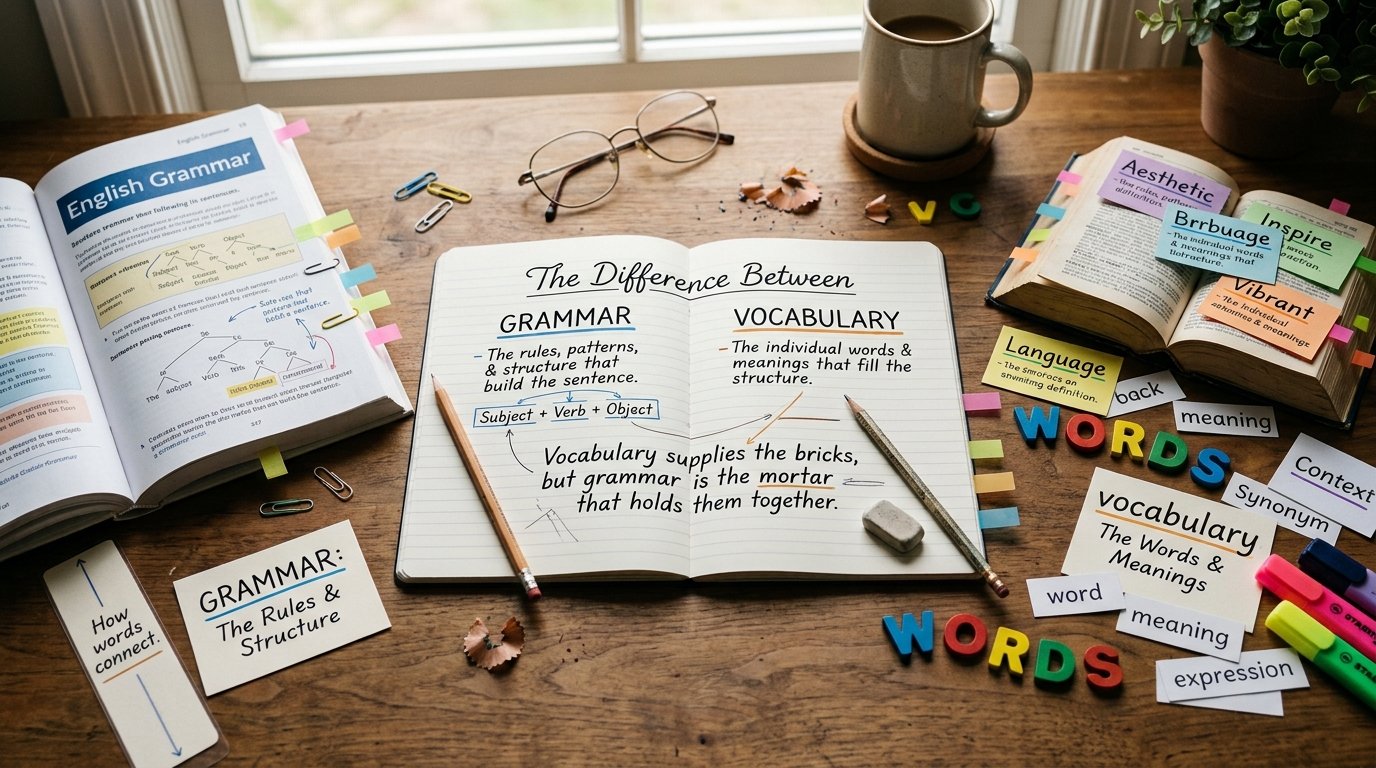
Grammar is the system for changing word forms and combining words into sentences. Vocabulary is the stock of words and items you know. One builds the sentence, the other fills it, and the interesting cases sit on the border between them.
The method here is simple: diagnose the error, then draw the line. Read the two definitions, check the 14-row comparison, then run your own recent mistakes through the diagnostic and the two-question test at its end.
The Two Definitions, With Their Sources Shown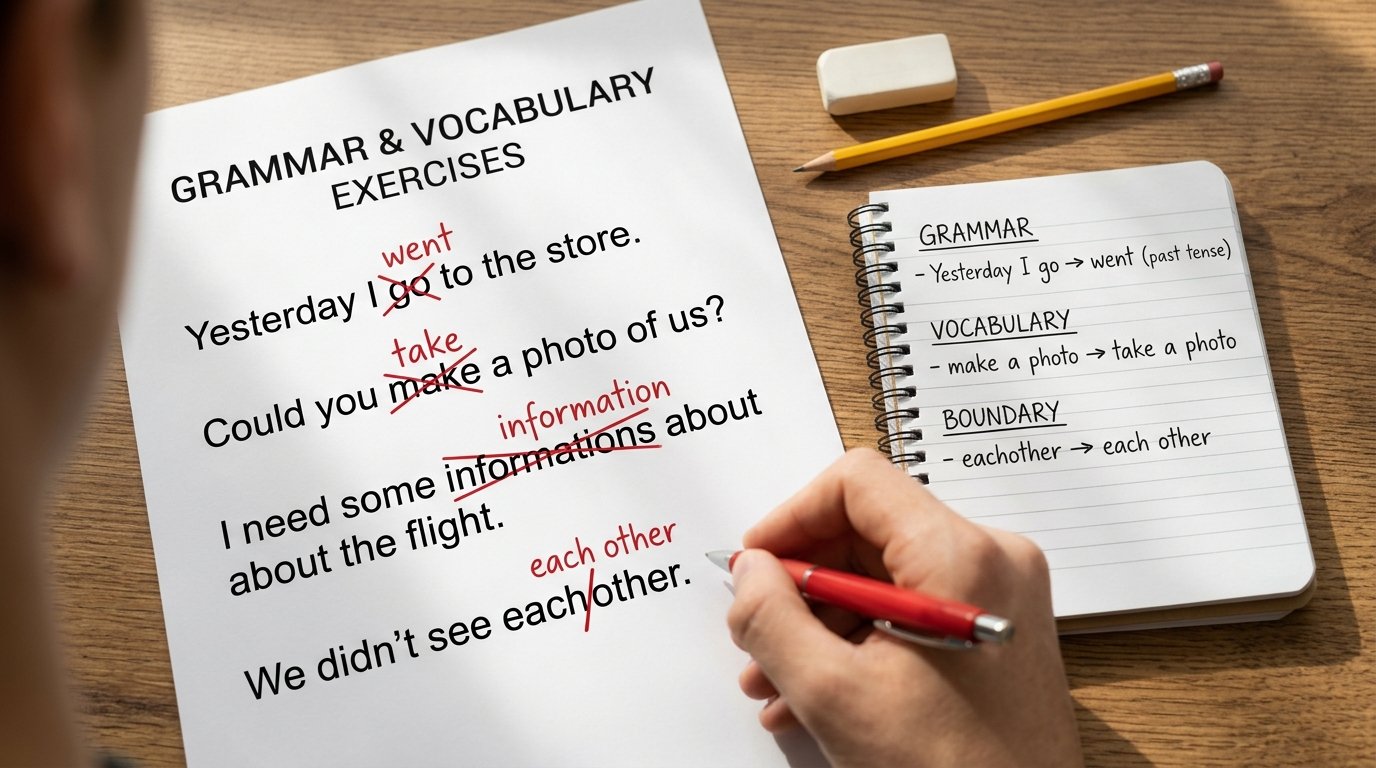
Definitions in this arena are often thinned down until they mislead. This section prints each term with its sources separated, because the authorities agree on grammar and genuinely differ on vocabulary, and that difference changes what you should study.
Grammar: words change form, words combine
The Oxford learner’s definition, quoted in full on the grammar meaning page, calls grammar the rules for changing the form of words and joining them into sentences. Cambridge says the same in its own words, and Merriam-Webster leads with word classes, inflections and relations.
So grammar has two halves that every strand shares. Morphology changes the word itself: walk becomes walked, happy becomes happier. Syntax arranges the result: the words must stand in an order English accepts, with subjects and verbs agreeing.
One split is real and worth naming. Restricted definitions limit grammar to morphology and syntax alone. Broader accounts add sound, meaning and use. This page works with the restricted line, because it is the line the diagnostic below can actually apply.
The full treatment of grammar’s senses and branches lives on the site’s grammar meaning in English page, and this page does not rebuild it. Here, the definition only needs to be sharp enough to sort errors and settle boundary cases.
Vocabulary: a stock of words, or of items?
Merriam-Webster defines vocabulary as a sum or stock of words employed by a language, a group or a person. The definition is quoted verbatim on Om Proofreading’s comparison page, the one arena page that anchors both of its definitions to a named dictionary.
Read strictly, that definition covers single words only. Phrases, partnerships and fixed expressions fall outside it, and many arena pages quietly rely on exactly that narrow reading while teaching phrases everywhere else in the same article.
A wider strand comes from the Cambridge coursebook chapter on teaching vocabulary: it counts items of more than one word, such as post office or call it a day, stored as whole chunks. Its working unit is the vocabulary item, not the word.
The same chapter adds what knowing an item involves: its form, spoken and written, its meaning, and its use, including the grammar it carries and the words it partners with. A word you can define but cannot use is only partly known.
Vocabulary vs lexis: the wider name
The British Council teaching strand resolves the disagreement by renaming the wider set. In that strand, vocabulary means individual words, often taught in lists, while lexis covers the wider stock: collocations, chunks and formulaic expressions. Teachers use lexis for the whole territory.
This page follows the wide answer as its working answer: vocabulary includes multiword items. The narrow dictionary sense stays named beside it wherever the difference matters, because pretending the sources agree would hide the most useful fact in this section.
The Full Comparison: 14 Rows
The table below carries 14 rows. The largest table in the arena, the eight-row grid on WordsCoach’s difference page, stops before the rows that matter most here: how an error looks, what knowing each side means, and how items behave at the boundary.
|
Aspect |
Grammar |
Vocabulary |
|---|---|---|
|
Definition |
The system of rules for changing word forms and combining words into sentences |
The stock of words and items a speaker knows and uses |
|
The unit it works on |
The sentence and the word form |
The word and the vocabulary item |
|
The question it answers |
How do I put it together correctly? |
What can I say it with? |
|
What it is made of |
Morphology and syntax: inflection, word order, agreement, sentence patterns |
Words, phrases, collocations, chunks, idioms and phrasal verbs |
|
Size and openness |
A comparatively closed system of finite patterns |
An open stock that gains new items constantly |
|
How it changes over time |
Slowly, across generations |
Daily, as words are coined and borrowed |
|
How an error looks |
Right words in the wrong order or the wrong form |
The wrong word, or no word at all |
|
What knowing it means |
Producing correct new sentences you have never seen |
Using an item in its form, its meaning and its use |
|
How it is learned |
Noticing patterns, then practicing them until automatic |
Meeting items in context, repeatedly, and using them |
|
Where it is recorded |
Reference grammars and coursebook grammar sections |
Dictionaries and coursebook vocabulary sections |
|
What weakness costs |
Meaning survives but sounds broken and can mislead |
Nothing can be conveyed at all |
|
Beginner priority |
The highest-frequency patterns only |
First, and by a wide margin |
|
Advanced priority |
Rises sharply: accuracy, register, exam range |
Continues through collocations, chunks and precision |
|
The boundary behaviour |
General rules, except where one word dictates a pattern |
Items carry their own grammar: countability, transitivity, patterns |
Rows 1 to 3 draw the basic line. Grammar works on the sentence you are building now; vocabulary is the stock you build it from. If your problem is choosing material, it is vocabulary. If it is assembling material, it is grammar.
Rows 4 to 6 explain why the two feel so different in study. Grammar is a small, closed system: its patterns repeat in every sentence. Vocabulary is open and endless, which is why word learning never finishes while pattern learning largely can.
Rows 7 and 8 are the diagnostic rows. A grammar error keeps the right words and damages their order or form. A vocabulary error picks the wrong word, or finds no word. Knowing each side means producing with it, not recognizing it.
Rows 9 to 11 cover learning and cost. Patterns are noticed and practiced; items are met in context and reused. Weak grammar leaves meaning standing but shaky, while weak vocabulary stops the message before grammar gets a chance to help.
Rows 12 to 14 look forward. Beginners need words first, with only the commonest patterns. Advanced learners meet the boundary in row 14: items that carry their own grammar, which is where the diagnostic’s hardest cases come from.
Diagnose Your Own Errors: 12 Mistakes Sorted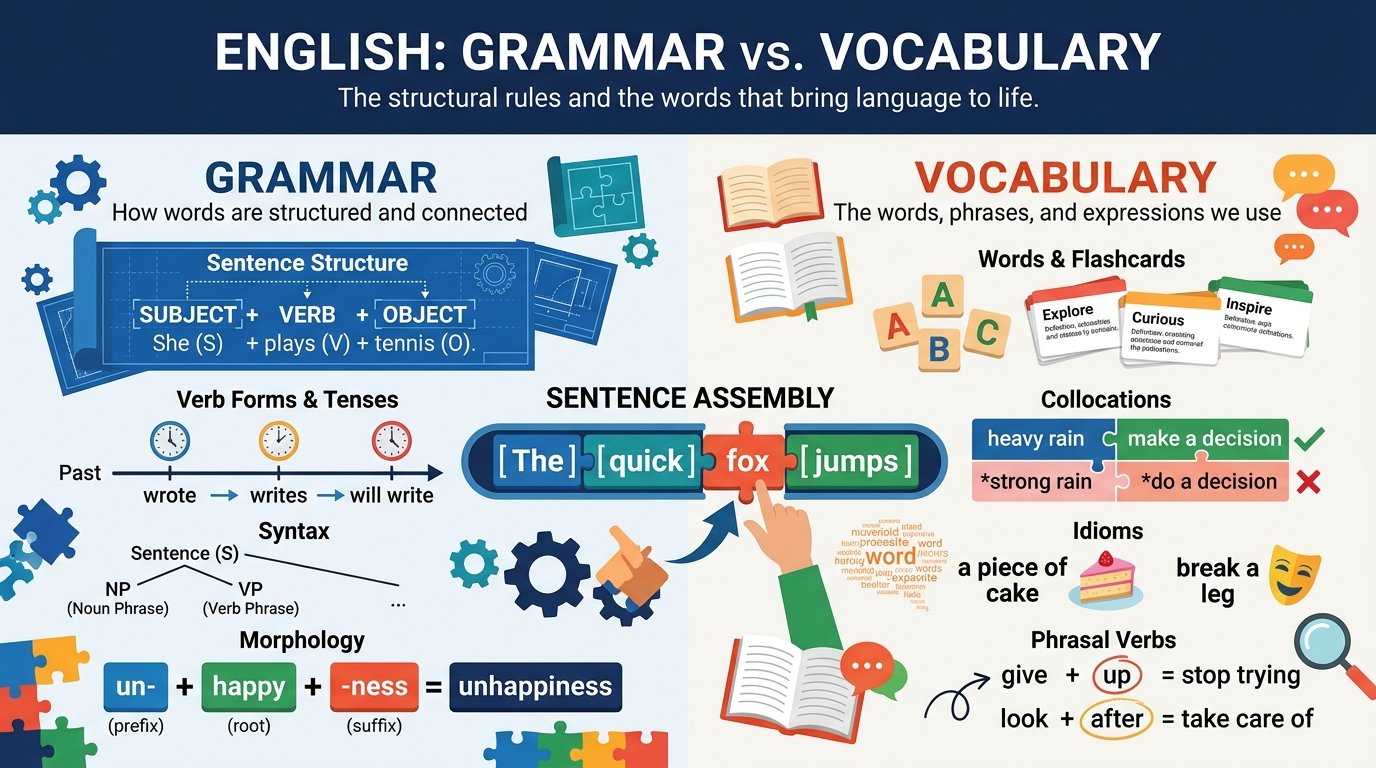
Here is the asset no competitor page offers: 12 real learner errors, each classified as grammar, vocabulary or boundary, with the reasoning and the fix. Sort your own recent mistakes the same way and the study decision later in this page makes itself.
The seed of this method is a two-sentence rule on Grammarist’s grammar versus vocabulary page: the wrong word means study vocabulary; the right word in the wrong order means study grammar. This section works that seed into twelve verdicts.
The five grammar errors
1. Yesterday I go to the market. Verdict: Grammar.
The words are all right, but the verb form ignores the past time the sentence itself announces. Choosing walked over walk is a form rule, not a word gap, so learning more words would leave this error untouched.
The fix is pattern work: drill past forms against time markers such as yesterday and last week, until the form follows the marker without thinking.
2. She is more happier now. Verdict: Grammar.
The comparative is marked twice, once by more and once by the er ending. Forming comparatives is a grammar pattern with a short list of shapes, and this sentence picks two of them at once.
The fix: learn the comparative shapes as one pattern: short adjectives take er, longer ones take more, and the two never combine.
3. I don’t have some money. Verdict: Grammar.
Some and any are chosen by the sentence’s polarity, not by what the speaker prefers. Negatives and questions take any; offers and positives take some. That is a system rule operating above individual word meanings.
The fix: practice some and any inside whole sentences, positive, negative and question, rather than as a vocabulary pair with two translations.
4. He has lived here since five years. Verdict: Grammar.
Since and for divide time by shape: since takes a starting point, for takes a length. The words are common and known; the structural choice between them is wrong, which makes the error grammar.
The fix: sort time expressions into points and periods first, then let the sort choose the preposition for you.
5. Where you went yesterday? Verdict: Grammar.
English questions need an auxiliary and inversion: the helping verb moves ahead of the subject. This sentence keeps statement order and statement forms, so both its word order and its question formation are grammar.
The fix: build questions as a two-step pattern, auxiliary first, then subject, then the base verb, across all the question words.
The three vocabulary errors
6. I need to make a photo of this. Verdict: Vocabulary.
The grammar is flawless and the sentence still fails, because photo partners with take, not make. Word partnerships like this are item knowledge: they are learned with the word, not derived from any rule.
The fix: record new nouns with their partner verbs, take a photo, make progress, do homework, so the partnership is stored with the word itself.
7. I will borrow you my notes. Verdict: Vocabulary.
Borrow and lend name opposite directions of one act: borrow takes in, lend gives out. Both words are known here; choosing the wrong direction is a meaning choice, which is vocabulary’s territory.
The fix: learn direction pairs together with an arrow in your notes, borrow from, lend to, so the direction is part of the word’s meaning.
8. My uncle is a very sensible man; he cries at films. Verdict: Vocabulary.
A false friend: sensible means reasonable and level-headed, while the word wanted is sensitive. The sentence is perfectly grammatical, which proves the failure sits in word meaning alone.
The fix: flag look-alike words from your first language in your word list and learn each with a contrast sentence, not a translation.
The four boundary errors
9. The informations in this book are old. Verdict: Boundary.
Countability is taught in grammar lessons, but it belongs to the individual noun. Information carries its grammar with it: no plural, no a or an. Dictionaries mark this on the word itself, which is word grammar.
The fix: learn each new noun with its countability label attached, and treat uncountable nouns as items to memorize, not rules to apply.
10. I look forward to see you soon. Verdict: Boundary.
The chunk look forward to demands the ing form after it, whatever the general infinitive rule suggests. The pattern is fixed by the phrase itself, so it is learned as vocabulary and behaves as grammar.
The fix: store the whole chunk with its pattern, look forward to plus ing, the way you would store a single long word.
11. She suggested me to take the train. Verdict: Boundary.
Suggest never takes that pattern; English says suggest taking, or suggest that someone take. The individual verb dictates which pattern follows it, so the pattern is part of knowing the verb.
The fix: learn verbs with their patterns as one entry: delay doing, wait to do, suggest doing. The pattern travels with the verb.
12. I am boring when the lesson is long. Verdict: Boundary.
Bored and boring are one word family split by form: the ing form describes the cause, the ed form the feeling. Choosing between them is form work that changes the meaning, so both sides meet here.
The fix: learn ed and ing adjective pairs as a family with two example sentences, one for the feeling and one for its cause.
How to sort your own mistakes (the two-question test)
The diagnostic closes with the two-question test, this page’s own extension of the Grammarist seed. Run any mistake of yours through both questions, in order, before you decide what to study next.
- Was the word wrong, or was the right word used wrongly? A wrong word points to vocabulary. The right word in a wrong form or wrong order points to grammar.
- Does an individual word dictate the pattern? If yes, the error is boundary, whichever side it first looked like: learn the item with its grammar attached.
Sort ten of your own recent errors this way and count them. The counts, not a general rule about learners, decide your study order in the framework further down this page.
The Boundary Cases: Where the Line Blurs
The diagnostic produced four boundary verdicts out of twelve, which is typical of real learner English. This section treats the zones where the line blurs, written for learners; the teacher-facing model is the Collins Dictionary blog essay on the blurry line, credited zone by zone.
Word grammar: labels that live on words
Dictionaries print grammar labels on individual words: countable or uncountable, transitive or intransitive, stative. A stative verb like know resists the continuous form, and that resistance is a fact about know, not about the continuous.
The ruling for this zone: treat the label as part of the word. When you learn a noun, learn its countability; when you learn a verb, learn whether it takes an object. The grammar applies the label; the vocabulary stores it.
Verb patterns belong to verbs
The Collins essay gives the cleanest pair: you delay doing something but wait to do it. No general rule predicts which pattern a verb takes; the verb itself decides, so the pattern belongs to knowing the verb.
The same logic covers phrasal verbs and multiword items: give up, look forward to, post office, call it a day. These are vocabulary items stored whole, which is exactly why the wide definition of vocabulary is this page’s working answer.
Collocations and chunks
Collocations are the partnerships words keep: make progress, heavy rain, take a photo. They are item knowledge, not rule knowledge, and they are where advanced learners’ remaining errors concentrate, long after basic grammar settles.
The British Council strand gathers collocations with chunks and formulaic expressions under lexis. However they are named, the study method is the same: learn the partnership, never the word alone.
Word forms and families
A word family shares one root across forms: succeed, success, successful, successfully. Changing the form is grammar’s machinery, prefixes, suffixes and endings, but each family’s members are learned as vocabulary, one by one.
Word-form mix-ups are the everyday face of this zone: passed and past differ by form and function together, and sorting them is family work, not rule work.
One function, three carriers: the continuum
One job, expressing uncertainty, can be carried three ways: a modal verb like might, an adverb like perhaps, or a fixed expression like it is possible that. The Collins strand calls this a continuum: grammar and vocabulary are its two ends.
The ruling is that some choices have no single box. When a function matters, learn all three carriers and their strengths; the continuum, not the line, is the honest map at this point.
Spelling and punctuation sit outside both boxes in the linguistic strands: they belong to orthography, the writing system. One arena page files punctuation under grammar components; that filing is contested, and this page does not adopt it.
Spelling keeps its own treatment on this site: grammar vs grammer correct spelling settles the word this whole topic is named after.
Pronunciation also refuses a single box. A word’s spoken form is part of knowing the word, form, meaning and use, while sound patterns belong to neither system cleanly. Learn each word’s stress and sounds with the word itself.
Which Should You Study First? The Decision by Your Error Pattern
Every verdict page in this arena lands in the same place: vocabulary first, grammar catches up. That advice is true for a beginner on day one and wrong as a permanent rule. Your sorted error counts give a better answer.
Pattern A: mostly grammar errors
If most of your errors are grammar errors, your words are ahead of your patterns. The study block is pattern practice: take the families your diagnostic exposed, tenses, question forms, agreement, and drill them inside sentences until the forms arrive automatically.
Keep vocabulary ticking over in the background through reading, but do not add word lists as the main effort. Your bottleneck is assembly, and assembly is trainable in weeks, not years.
Pattern B: mostly vocabulary errors
If most errors are vocabulary errors, your patterns are fine and your stock is thin. The block is words in context: reading and listening at your level, with new items recorded as chunks and partnerships, not single translations.
Grammar study shrinks to maintenance. Adding rules you already apply will not move your English; adding usable items will, because every new item is a sentence you can now finish.
Pattern C: boundary-heavy errors
If your errors are boundary-heavy, you are past the basics and your mistakes live on individual items. The block is patterns and chunks: verb patterns, word grammar labels, word families and collocations, learned item by item with their grammar attached.
This is the block no competitor describes, because it needs the diagnostic to exist. It is also where advanced learners gain the most, since boundary errors are the ones listeners notice as almost right.
Pattern D: few errors, narrow range
If your sort produced few errors but a narrow range, accuracy is not your problem; range is. The block is extensive reading and listening, wide and enjoyable, chosen to stretch the stock of items you can actually deploy.
Measure progress by new items used, not errors avoided. A learner who says little, perfectly, stays at the same level as a learner who says more, imperfectly, then sorts the errors.
One worked profile shows the framework operating. A learner sorted her last 20 errors and counted 11 boundary, 6 vocabulary and 3 grammar. Her plan followed the counts: a boundary block first, vocabulary second, grammar left to maintenance.
Weeks of verb patterns and word families then removed most of the 11. The same hours spent on a general grammar course would have polished the 3 errors she rarely made and left the real pattern untouched.
The goal modifier: travel, exams, work
Goal adjusts the pattern verdict at the edges, a split credited to the Grammarist study guide. Travel weights vocabulary further, since survival phrases carry the trip. Professional writing weights grammar earlier, because readers judge accuracy on the page.
Skill pulls the same way, as the level-and-skill verdict on MyEnglishTeacher’s comparison argues: speaking rewards vocabulary range first, while writing exposes grammar to a reader who can reread and judge it.
- Rules first: fast early accuracy and clean sentences; the cost is a thin stock that leaves little to be accurate with.
- Words first: immediate ability to convey meaning; the cost is errors that fossilize while fluency grows around them.
- Pattern first: the order this page recommends, because your own error counts outrank any general sequence.
The Wilkins Line and What the Verdict Pages Get Right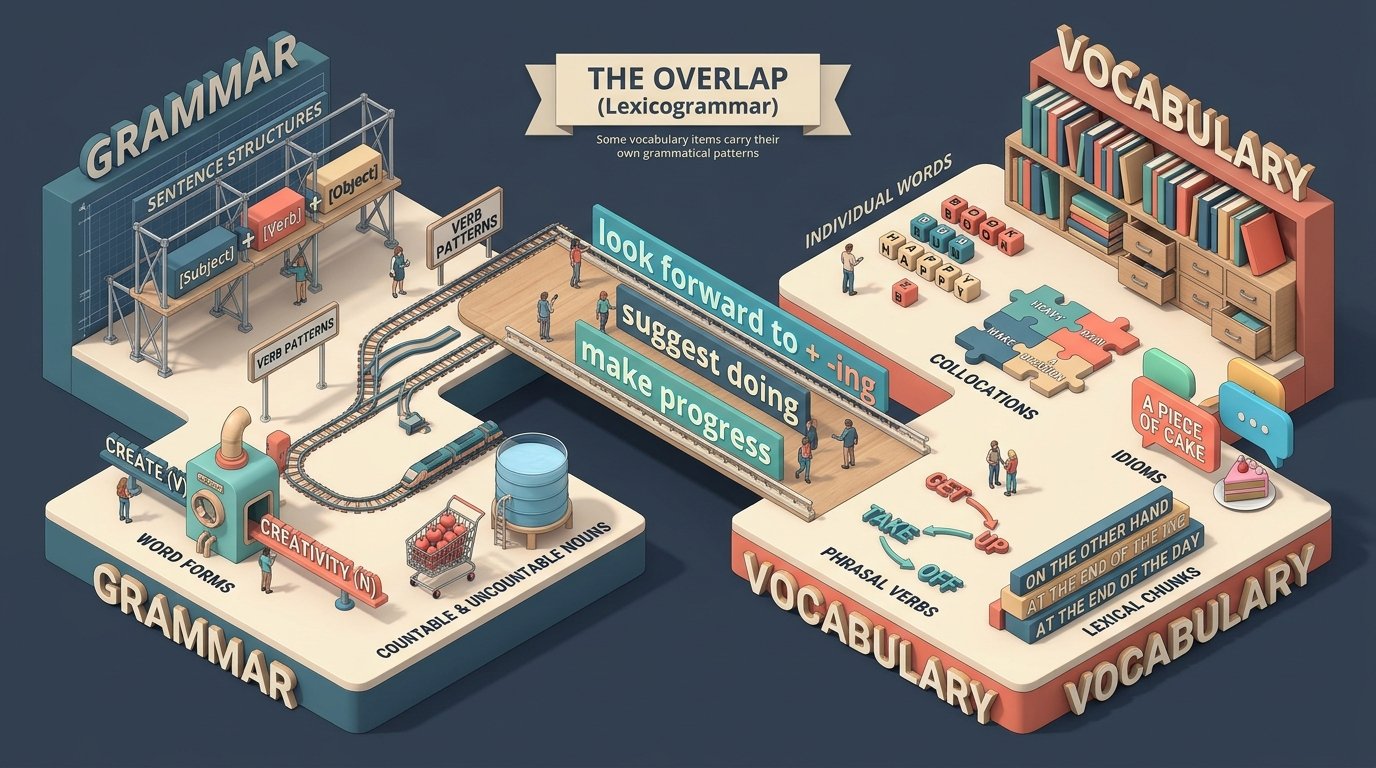
The arena’s most quoted line belongs to the linguist David Wilkins, writing in 1972: without grammar very little can be conveyed, without vocabulary nothing can be conveyed. It is quoted here as a dated quotation, attributed, not as this page’s verdict.
The line is half the truth. It measures what happens with nothing on one side, and beginners rightly hear it as permission to start with words. It says nothing about a learner whose errors are mostly boundary or grammar, two years in.
The verdict pages get real things right, and this page keeps them: level matters and goal matters, and words in context beat word lists, as nearly everyone argues. What they miss is the learner’s own error pattern as the deciding evidence.
Frequently Asked Questions
What is the difference between grammar and vocabulary?
Grammar is the system for changing word forms and combining words into sentences; vocabulary is the stock of words and items you know. Grammar assembles the message, vocabulary supplies its material, and the diagnostic above shows the line working on real errors.
Which is more important, grammar or vocabulary?
Neither, in the abstract; your error pattern decides. Beginners gain most from vocabulary, while a learner whose mistakes are mostly pattern errors gains most from grammar. Sort your recent errors first, then let the counts rank the two for you.
Should I learn grammar or vocabulary first?
Start with vocabulary and the highest-frequency grammar patterns together. Words give you something to say from day one, and a small set of patterns, questions, past forms, word order, keeps those words usable. After that, follow your diagnosed error pattern.
What should beginners focus on, grammar or vocabulary?
Beginners should focus on vocabulary first, by a wide margin. The arena agrees on this much. Add only the commonest patterns at the start, then widen the grammar as your stock of words gives those patterns more to work on.
What is grammar in simple words?
Grammar is how words change their form and join into sentences. Walk becomes walked; words line up in an order English accepts. The full definition, with its senses and branches, is treated on the site’s grammar meaning page.
What is vocabulary in simple words?
Vocabulary is the words and items you know and can use. On the wide definition this page works with, it includes phrases and chunks like post office and call it a day, not only single words standing alone.
Is vocabulary part of grammar?
No; they are two systems that overlap at the edges. Restricted definitions of grammar cover word forms and sentence structure only. The overlap is real, though: individual words carry grammar facts, like countability, which is why this page has a boundary section.
What is the difference between vocabulary and lexis?
Lexis is the wider name for the whole stock. In the British Council strand, vocabulary means individual words, while lexis also covers collocations, chunks and formulaic expressions. Teachers use lexis when they want the wider territory in one word.
Are phrasal verbs grammar or vocabulary?
Phrasal verbs are vocabulary. Give up and look forward to are items learned whole, with their meanings and patterns attached. Their grammar, like the ing form after look forward to, travels with the item rather than following a general rule.
Are collocations grammar or vocabulary?
Collocations are vocabulary. Make progress and heavy rain are partnerships between words, learned as item knowledge. No grammar rule predicts them, which is why advanced learners, whose grammar has settled, still collect most of their errors here.
Are idioms grammar or vocabulary?
Idioms are vocabulary items. A fixed expression like call it a day is stored and learned as one chunk with one meaning. Its internal grammar is frozen, so you learn the whole item rather than building it from rules.
Is spelling grammar or vocabulary?
Neither, strictly: spelling belongs to orthography, the writing system. The linguistic strands place spelling and punctuation outside grammar. It still matters for learners, but it is a third territory, not a point scored for either side of this comparison.
Is pronunciation part of grammar or vocabulary?
Pronunciation sits closest to vocabulary, without belonging cleanly to either. A word’s spoken form is part of knowing that word, alongside its written form, meaning and use. Sound patterns themselves belong to a separate system, phonology.
Can you have good vocabulary but bad grammar?
Yes, and it is a common profile. The meaning survives, because the words are right, but broken order and forms make the message effortful and sometimes misleading. The Pattern A study block above is written for exactly that learner.
Can you speak English with vocabulary but no grammar?
You can convey simple meanings, but very little beyond them. Wilkins’ 1972 line makes the point: without vocabulary nothing can be conveyed, yet words alone cannot show time, questions or who did what. That work belongs to grammar.
Can you learn grammar without vocabulary?
Only as empty patterns. Grammar is learned through words: a tense pattern means nothing until real verbs fill it. In practice the two grow together, and every grammar lesson you have ever taken quietly taught vocabulary at the same time.
What is the difference between active and passive vocabulary?
Active vocabulary is what you can use; passive vocabulary is what you only recognize. Your passive stock is always larger. The gap between them is normal, and speaking and writing practice is what moves items across it.
What is the difference between receptive and expressive vocabulary?
Receptive vocabulary is what you understand when you read or listen; expressive vocabulary is what you can produce. The pair names the same gap as active and passive, from the direction of the skill: taking language in versus sending it out.
Does grammar include tenses?
Yes, tenses sit at the centre of grammar. Choosing and forming past, present and future forms is morphology and syntax working together. A wrong tense with the right words is the first grammar error in this page’s diagnostic.
Are parts of speech grammar or vocabulary?
Parts of speech are grammar’s categories. Noun, verb and adjective are classes in the system, used to state patterns. One arena page files them inside vocabulary; that blurs the line this comparison exists to draw, and this page does not follow it.
Is word order grammar or vocabulary?
Word order is grammar. Arranging words into an order English accepts is syntax, half of grammar’s core work. If the right words stand in the wrong order, the error is grammar, however strong your vocabulary is.
Is countable and uncountable grammar or vocabulary?
It is the boundary case this page calls word grammar. The labels are grammar, but they live on individual nouns and are learned word by word. Information is uncountable because that fact belongs to the word information itself.
Why is my grammar good but my vocabulary weak?
Because the two systems grow at different speeds. Patterns are finite and finish early; the word stock is open and grows for years. If your sentences are accurate but limited, your study block is vocabulary in context, not more rules.
Why do I understand words but cannot make sentences?
Because recognition is passive knowledge, and sentences need productive grammar. You know the words when you meet them, but assembling them under time pressure needs patterns practiced to automatic. Short, daily sentence-building practice closes this exact gap.
How do I know if my mistake is grammar or vocabulary?
Run the two-question test. Was the word itself wrong? That is vocabulary. Was the right word used in the wrong form or order? That is grammar. If one word dictated the pattern, the mistake is boundary.
Is using the wrong preposition a grammar or vocabulary mistake?
Usually boundary. Some preposition choices follow broad patterns, but most belong to the word they follow: depend on, interested in, good at. Learn the preposition as part of the item, and the mistake stops repeating.
Is the wrong word form a grammar or vocabulary mistake?
It depends on where the failure sits. Choosing the wrong form by rule, like a doubled comparative, is grammar. Choosing between family members like bored and boring, where meaning turns on the form, is boundary.
Which matters more for speaking, grammar or vocabulary?
For speaking, vocabulary range usually matters first. Listeners forgive broken grammar when the words carry the meaning, and fluency needs items ready to hand. Grammar still matters: it carries time, questions and politeness that words alone cannot.
Which matters more for writing, grammar or vocabulary?
For writing, grammar’s weight rises. A reader can reread, so errors stay visible and judgeable, and accuracy shapes how your ideas are rated. Vocabulary still sets your ceiling: precise words do work no correct sentence can do without them.
Which matters more for exams, grammar or vocabulary?
Exams score both, under names like range and accuracy. Cambridge and similar exams reward a wide, precise vocabulary and controlled grammar together. The practical answer is to fix whichever side your own error sort shows losing you more marks.
Do native speakers learn grammar or vocabulary first?
Children learn both together, words first in effect. Single words come before sentences, and patterns are absorbed from the items around them. Adult learners can shortcut the order with explicit patterns, which children never use, but the word-led start is natural.
How can I improve grammar and vocabulary at the same time?
Learn words inside sentences and patterns inside texts. Record each new item with an example sentence, and notice one pattern in everything you read. The two habits feed each other, which is how the systems grow in real use anyway.
Should I study grammar rules or learn words in context?
Both, weighted by your error pattern. Rules are efficient for patterns you keep breaking; context is the only reliable source of partnerships and chunks. A learner with mostly vocabulary errors gains little from another rule chapter.
What is a lexical chunk?
A lexical chunk is a group of words stored and used as one item. Post office, in any case and as soon as possible work this way. Chunks are why the wide definition of vocabulary counts items, not just words.
What does Wilkins mean by without vocabulary nothing can be conveyed?
David Wilkins, in 1972, meant that words carry the message itself. Grammar shapes a message, but with no words there is nothing to shape. The line argues vocabulary’s floor, not a complete study order for every learner.
Is vocabulary just single words?
On the narrow dictionary sense, yes; on the working definition, no. Merriam-Webster defines vocabulary as a sum or stock of words. The Cambridge teaching strand counts multiword items too, and this page works with that wider answer.
Does vocabulary include phrases?
Yes, on the wide definition this page uses. Phrases, collocations, idioms and phrasal verbs are vocabulary items, stored whole. The narrower dictionary sense covers single words only, and the difference between the two senses is printed, not hidden.
What is the difference between a word and a vocabulary item?
A word is a single unit; a vocabulary item can be several words acting as one. Knowing an item also runs deeper: its form, its meaning and its use, including its grammar and its partners, on the Cambridge account.
Can grammar change meaning without changing words?
Yes: order and form alone can reverse a message. The dog chased the cat and the cat chased the dog share every word. Questions, negatives and tense changes do the same work with the same stock.
Can vocabulary change meaning without changing grammar?
Yes: swap one word and the sentence’s grammar stands untouched while its meaning moves. He borrowed my notes and he lent my notes keep identical structure. Word choice is meaning’s steering wheel, which is vocabulary’s home ground.
Which is harder to learn, grammar or vocabulary?
Grammar is harder to start and easier to finish; vocabulary is the reverse. The pattern system is finite but abstract, while the word stock is concrete and endless. Most learners find the long vocabulary road the bigger lifetime task.
Does grammar change over time like vocabulary does?
Yes, but far more slowly. New words enter English daily, while core patterns shift across generations. That speed difference is row six of the comparison table, and it is why vocabulary study never ends while grammar study largely can.
Conclusion
The difference between grammar and vocabulary is finally a practical line, not a trivia answer. Grammar is the system that changes word forms and combines words; vocabulary is the stock of words and items the system works on.
Draw the line where it earns its keep: in your own errors. Sort them, count them, and let the pattern choose your next study block, whether that is patterns, items, or the boundary where the two meet.
For the full definition of grammar itself, the site’s grammar meaning in English page is the companion read. For word pairs where one wrong choice changes the meaning, affect vs effect and imply vs infer show the vocabulary side at work.
The MagazineSolo homepage collects the site’s other word and grammar guides, ready for the next question your sort raises.

Dilawar is a content writer at MagazineSolo, covering travel, home improvement, interior design, and everyday lifestyle topics. He enjoys researching practical solutions, exploring travel destinations, and sharing helpful guides that make daily life easier. His writing focuses on clear information, useful advice, and engaging stories for a wide audience.