Occurrence Or Occurence Correct Spelling Which Spelling Is Correct?
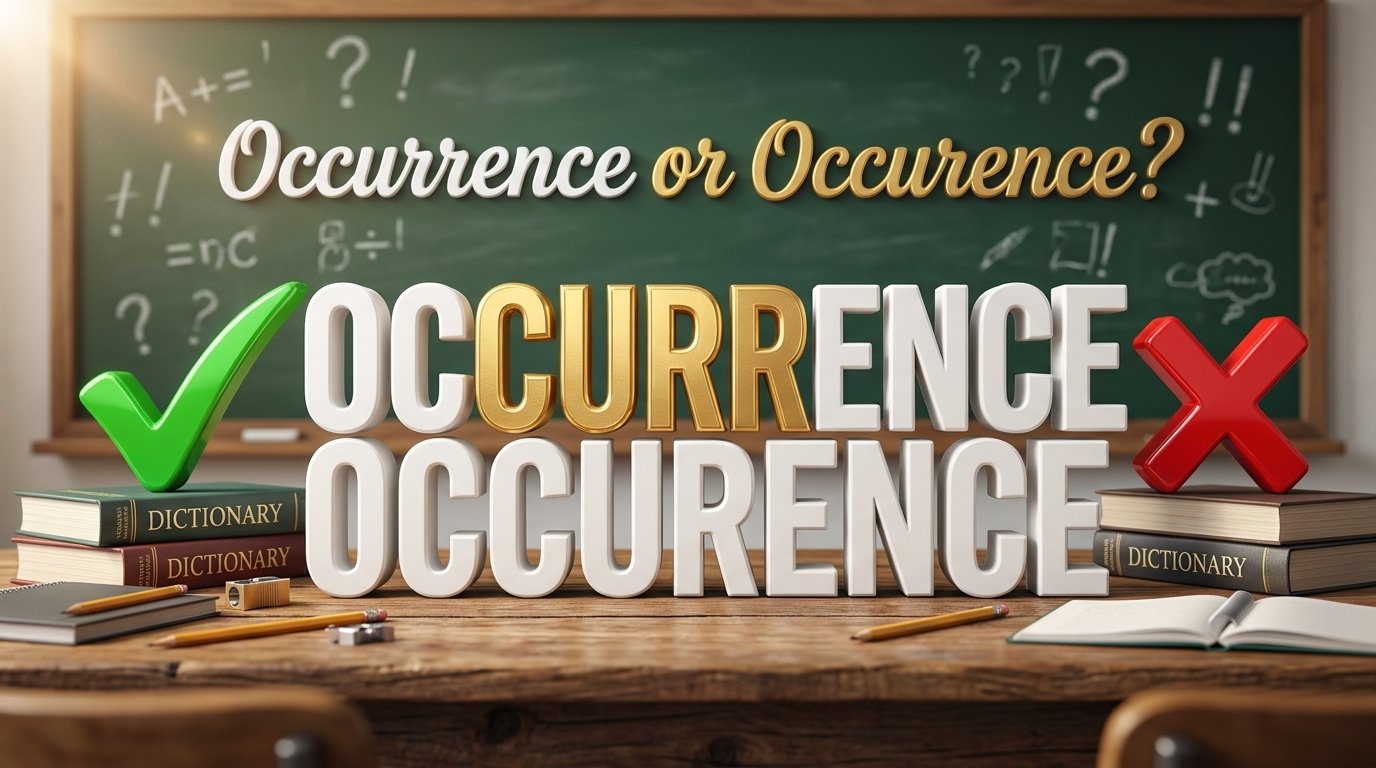
Occurrence or occurence correct spelling is settled by one letter. Occurrence is the correct spelling: o-c-c-u-r-r-e-n-c-e, two c letters and two r letters. Occurence drops the second r, and no dictionary accepts it.
The pair is not a close call between two live spellings. One form is a headword in every dictionary checked for this page. The other is a documented misspelling, recorded on both canonical lists of English errors.
This page gives the verdict and its proof, and nothing else. The count contrast, the documentary record and the family verdicts follow. The full rule, gallery and word family live on our occurrence spelling guide, the companion page.
The Verdict in One Line
Occurrence is correct; occurence is not a spelling at all. It is the same word with its second r missing, one letter short of the only form the dictionaries print.
Four dictionaries checked for this page agree. The Merriam-Webster entry for occurrence, the Oxford Learner’s entry for occurrence, the Cambridge Dictionary entry for occurrence and the Dictionary.com entry for occurrence each record occurrence alone: ten letters, three syllables, identical in American and British English.
The ruling holds in every variety and register. There is no British form, no American form and no formal variant of this word. The string is the string, in London exactly as in New York.
The only dedicated verdict page in the current results agrees. AdeptWrite’s occurrence or occurence page reaches the same ruling in about 250 words, checked against Oxford. This page adds the proof that page leaves out.
What the word means, in one line: occurrence is a noun for something that happens, or for the fact of something happening or existing. Occurence means nothing, because it is not a word.
The word is not new, and neither is its spelling. Merriam-Webster gives a first known use of 1539, and Dictionary.com dates the word to 1530 to 1540. The ten-letter form has been the record for nearly five centuries.
The Count Contrast: Ten Letters Against Nine
The pair differs by exactly one letter. Occurrence runs ten letters with the r doubled. Occurence runs nine, the second r gone and nothing else changed.
|
Form |
Letter string |
Letters |
C letters |
R letters |
|---|---|---|---|---|
|
occurrence |
o-c-c-u-r-r-e-n-c-e |
10 |
Two |
Two |
|
occurence |
o-c-c-u-r-e-n-c-e |
9 |
Two |
One |
The count check takes two seconds. Count the c letters: two in both forms. Count the r letters: two in the correct form, one in the error. A draft that fails the r count is wrong.
The positions matter as much as the totals. The r pair stands fifth and sixth, inside the stressed syllable. An attempt with the right totals in the wrong places is still an error.
Say the word in chunks and the count becomes visible. Oc-cur-rence: three syllables, stress on the middle one. The doubled r sits inside that stressed chunk, which is where the next sections find it.
The spelling and the sound part company in the middle. Said at full speed, the word compresses toward uh-rince, and the stressed syllable hides both r letters inside one sound. The ear cannot audit what it cannot hear separately.
A Documented Error: What the Two Lists Record
Occurence is not an obscure slip; it is a documented one. Wikipedia’s list of commonly misspelled English words records the row in full: occurrence, with occurrance and occurence named as its misspellings.
The second canonical list records the same pair. The Mental Floss presentation of the Oxford English Corpus list prints occurrence with occurance and occurence beside it as errors, drawn from a corpus of more than two billion words.
Wiktionary’s usage note points the same way. Its occurrence entry names occurence first among the word’s common misspellings. Its own occurence entry defines the form as a misspelling of occurrence, not as a word with a meaning.
A correction index gives the error a measured share. In the TextRanch correction index, occurence takes 20.43 percent of recorded misspellings of this word. Occurance leads the same index at 34.72 percent.
Those figures are index data, labeled as such. They come from a spellchecker’s correction record, not from any dictionary. No dictionary ranks misspellings against each other, and this page does not pretend one does.
A poll strand points the same way, and is printed as a poll. An Oxford University Press teaching blog reported occurrence among the most misspelt words in a 2010 survey. A survey is not a corpus, but it agrees with the lists.
Documentary weight is what separates this pair from a guess. The error is attested in reference works, not only in classrooms and quizzes. A spelling recorded as an error on both lists has no standing as an alternative.
Is Occurence Ever a Valid Alternative?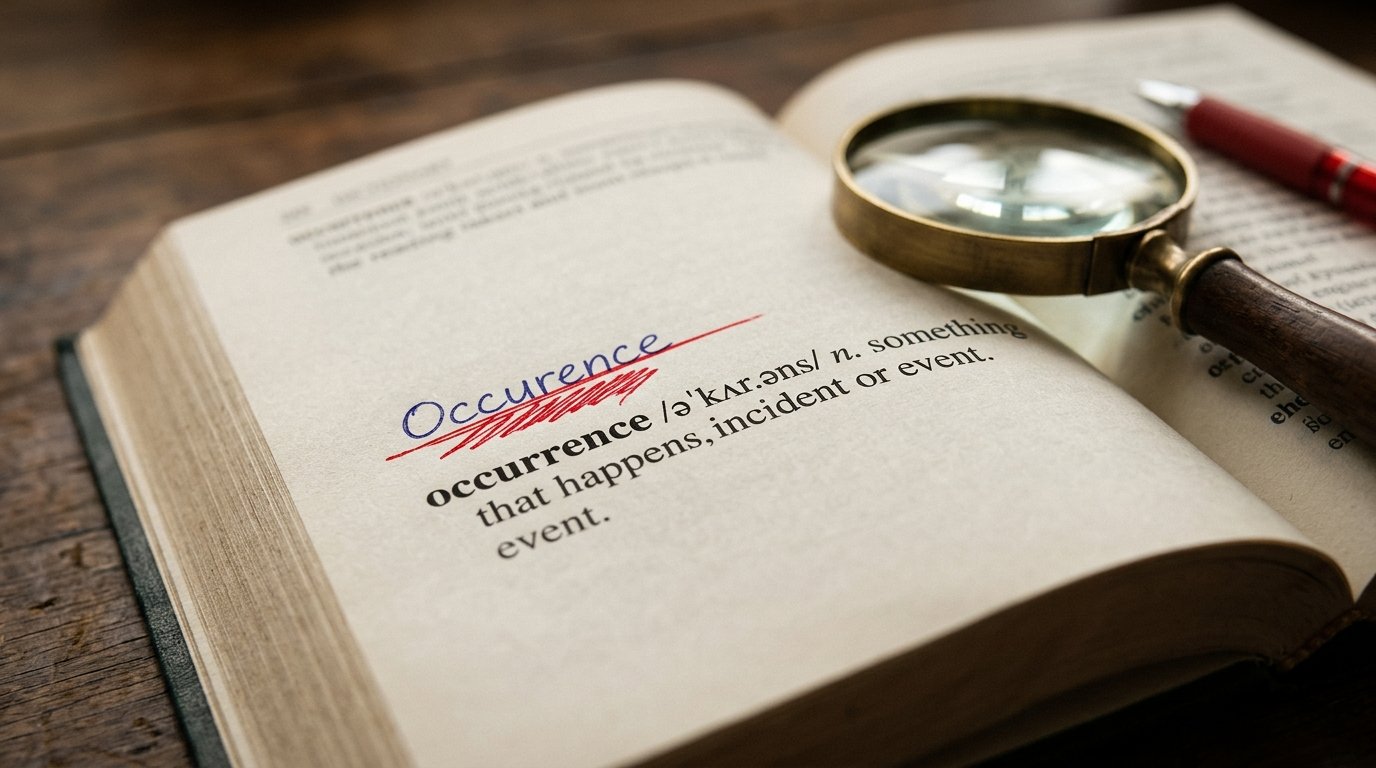
No. Occurence is never a valid alternative spelling. Not in American English, not in British English, not in formal writing, and not in any register a dictionary records.
One ranking page claims otherwise, and the claim fails on its own page. TextRanch calls occurence a valid alternative spelling, then quotes the Wiktionary entry that defines occurence as a misspelling of occurrence.
A source cannot overrule its own quoted evidence. The page’s verdict and its own dictionary quotation say opposite things. The quotation is the one that matches every other reference work checked for this page.
Dictionaries do record genuine alternatives when they exist. Real variants appear as entries of their own, labeled by region, period or register. Occurence appears in reference works only inside lists of errors, which is the opposite of acceptance.
Frequency does not rescue the claim either. A misspelling repeated in millions of drafts stays a misspelling. The documented lists record occurence precisely because it is common, not because it is accepted anywhere.
The exam pages in the current results mark it wrong too. The quiz pages ranking for this phrase use occurence as the incorrect option in their answer keys. Even the weakest pages in the set agree on the verdict.
Why the Second R Drops
The r drops because the doubling is silent. A doubled r sounds exactly like a single one, so the ear reports one r and the hand writes one r. Sound gives the writer no warning at all.
The stress condition in two sentences
Occur ends in a single vowel plus a single consonant, and its final syllable is stressed, oc-CUR. A verb in that shape doubles its final consonant before a vowel suffix: occurred, occurring, occurrence.
Preference and reference prove the stress half matters. Their stress sits on the first syllable, so their r stays single. TwoMinEnglish prints the rule without the stress condition, in a form that would produce visitted.
The full rule treatment lives on the companion page. Our occurrence spelling guide works the stress test in depth, with the visited trap and the words that follow the same rule. This page states the rule only as far as the verdict needs it.
The sentence pair: wrong to right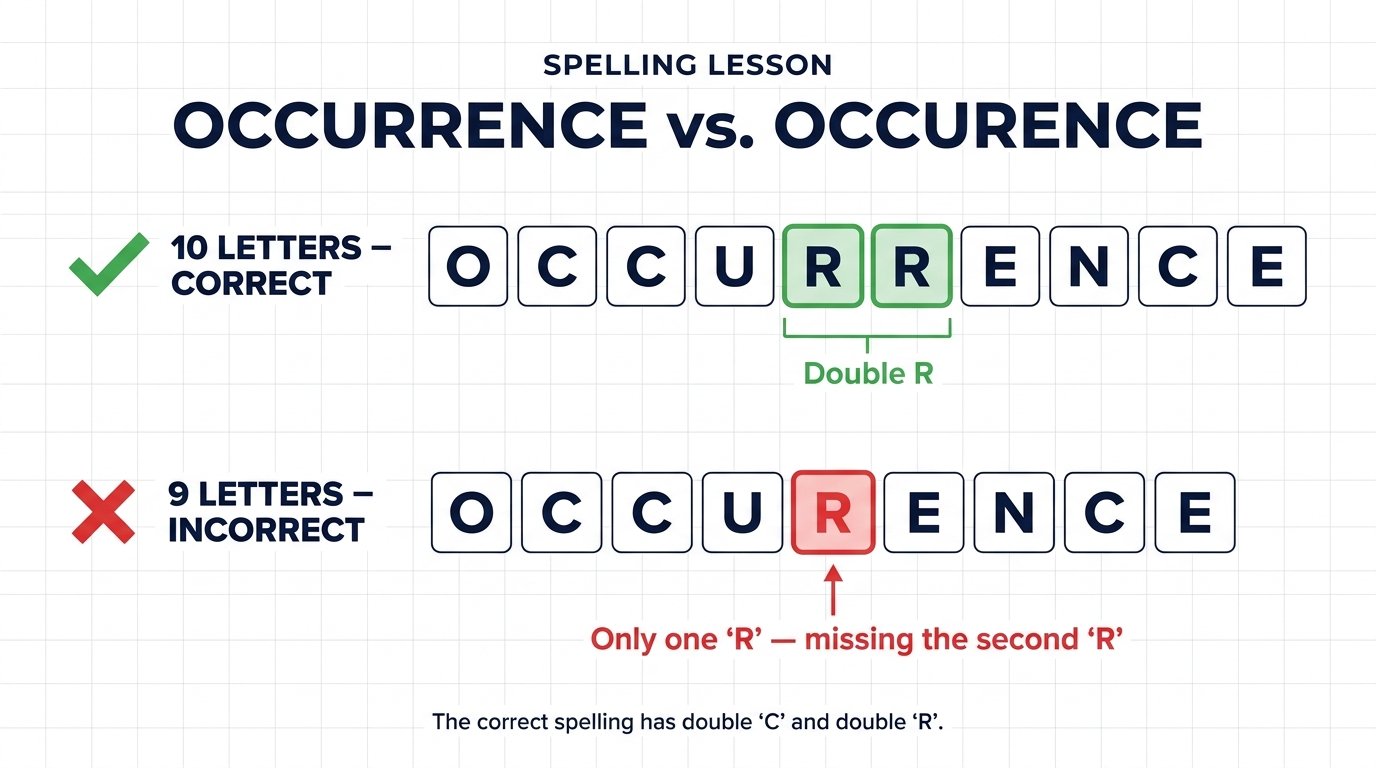
The wrong form fails inside an ordinary sentence. “Power cuts are a regular occurence in this district” carries the dropped r in plain sight. Corrected, it reads: “Power cuts are a regular occurrence in this district.”
The right form holds in the phrases writers actually use. “Such failures are a common occurrence in older systems” keeps both r letters. In every setting, formal or casual, the word is spelled the same way.
The fix is a count, not a closer listen. Before submitting any draft, search it for the one-r string. Every find is corrected by the same two-second count: two c letters, two r letters, then move on.
The Family Verdicts: Occurred and Occurring
The same one-letter question runs through the whole family. Occur doubles its r before every vowel suffix, so each relative of the noun carries the same verdict inside its own pair.
|
Pair |
Correct |
Wrong |
The line |
|---|---|---|---|
|
occurrence or occurence |
occurrence |
occurence |
The noun keeps two r letters |
|
occurred or occured |
occurred |
occured |
The past tense doubles the r |
|
occurring or occuring |
occurring |
occuring |
The participle doubles the r |
|
occurs or occurrs |
occurs |
occurrs |
The -s suffix starts with a consonant, so no doubling |
The participle pair gets its own depth elsewhere. The GrammarMint occurring guide works occurring against occuring across contexts, and its answer matches this table: occurring, two r letters, in both varieties of English.
The past-tense pair has the strongest teaching in the set. The ClarifyRa occurred guide states the stress condition precisely and quotes Cambridge grammar guidance that the past forms of occur have rr. Occured is wrong for the same reason occurence is.
One check settles every row of the table. If a form is built from occur plus a suffix starting with a vowel, double the r. If the suffix is -s, do not. The noun, the past tense and the participle all obey it.
Occurence Against the Other Errors
Occurence is one error among several, and each fails differently. The lines below give each rival form its one-line ruling. The full gallery, sorted by mechanism, lives on the companion spelling page.
- Occurance: the commonest recorded error in the index. It drops the second r and swaps the -ence ending for -ance, two mistakes inside one form.
- Ocurrence: drops one c instead of one r. The c pair is inherited from Latin and never singles in any form of this word.
- Occurrance: keeps both r letters but swaps the ending to -ance. The ending of this word is -ence, as in reference and preference.
- Ocurrance: drops the c and swaps the ending at once. It fails the c count and the ending check together.
Occurence is the only error named on both lists. Occurance appears on the corpus list and occurrance on the documented list, but the one-r form sits on both. That double standing is why this page exists for it.
The exam pages use these forms as distractors. In the quiz pages ranking for this phrase, occurence and occurance appear as the options a candidate must reject. Their answer keys mark occurrence correct every single time.
Every form above fails the same two-second check. Two c letters, two r letters, an -ence ending. Any string that misses one of the three is not this word, whatever a quiz or a template page suggests.
Frequently Asked Questions
1. Occurrence or occurence: which is correct?
Occurrence. O-c-c-u-r-r-e-n-c-e: ten letters, two c letters, two r letters. Occurence drops the second r and is a documented misspelling, recorded on both canonical lists of English errors.
2. Is occurence a word?
Not a standard word. No dictionary carries an entry for occurence as a headword. Wiktionary treats it only as a misspelling of occurrence, and reference works list it among errors, never among words with meanings.
3. Is occurence ever correct?
Never. No dictionary, corpus list or style record accepts occurence in any variety, register or period. The correct form is always occurrence, spelled with two r letters, in every setting where the word is used.
4. Is occurence accepted in British English?
No. British and American English spell the word identically: o-c-c-u-r-r-e-n-c-e. Occurence is an error in London exactly as in New York, and British reference lists record it among misspellings just as American ones do.
5. Is occurence correct in formal writing?
No, and formal writing is where it costs most. Formal registers follow the dictionary record, which lists occurrence alone. A one-r form in a report, application or paper reads as an uncorrected error, not a variant.
6. Is occurence in the dictionary?
Only as an error. Dictionaries carry occurrence as the headword. Occurence appears in reference works inside misspelling lists and usage notes that name it as a mistake, which is documentation of the error, not acceptance of it.
7. Which is correct: occurrence, occurence or occurance?
Occurrence. Occurence drops the second r. Occurance drops the second r and also swaps the -ence ending for -ance, so it fails twice. Both wrong forms are documented errors; only the ten-letter form is a word.
8. Is it occurring or occuring?
Occurring. Occur ends in a single vowel plus a single consonant with the stress on the final syllable, so the r doubles before -ing. Occuring drops the letter the rule adds and is wrong in every variety.
9. Is occuring ever correct?
Never. No dictionary lists occuring as a form of occur. A stressed final syllable plus a vowel suffix always doubles the r in this family, so the participle is occurring wherever it appears.
10. Is occurring correct in American English?
Yes. Occurring, with two r letters, is the only American present participle of occur. The doubling rule works the same way in American spelling, and no American dictionary records a one-r alternative.
11. Is occurring correct in British English?
Yes, identically. British English spells the participle occurring, two r letters, exactly as American English does. This word family never splits by variety: the noun, the past tense and the participle match on both sides of the Atlantic.
12. Is it occurred or occured?
Occurred. The past tense doubles the r for the same reason the noun does: occur is stressed on its final syllable and ends in a single vowel plus consonant. Occured is itself a documented misspelling, recorded on the Wikipedia list under occurred.
13. Why does occurring have two Rs?
Because the stress stays on CUR when -ing is added. Doubling follows the stressed final syllable of occur, and adding -ing does not move that stress. The participle therefore keeps the doubled r the rule produces: o-c-c-u-r-r-i-n-g.
14. Why do people drop the second R in occurrence?
Because the doubling is silent. A doubled r sounds no different from a single one, so writers who spell by ear write what they hear: one r. The fix is mechanical: count two r letters before you move on.
15. Why is occurrence hard to spell?
Two of its letter pairs sound single, and its ending gives no clue. The cc and rr pairs each produce one sound, while the unstressed -ence ending could as easily be -ance to the ear. Sound alone cannot settle any of the three.
16. What is the difference between occur and occurring?
Form, not meaning. Occur is the base verb, used with subjects like it and events. Occurring is its present participle, used after be or in phrases like problems occurring daily. Both describe the same happening; only the grammar changes.
17. What is a trick to remember how to spell occurrence?
Two Cops Run Rapidly. SpellCamp’s pattern lock teaches that device: the two cops give the cc pair, and run rapidly gives the rr pair. It is a memory device, not the word’s origin, and it checks both pairs at once.
18. How can I remember the correct spelling of occurring?
Copy the noun, then swap the ending. Occurrence already carries the doubled r; occurring keeps the same stem, o-c-c-u-r-r, and adds -ing. If the noun in your draft is right, the participle built from it cannot go wrong.
19. What does occurring mean?
Happening or taking place. Occurring is the present participle of occur: an event occurring now is in the act of happening. It can also mean existing or being found, as in a mineral occurring in nature.
20. What is the verb form of occurrence?
Occur. Occurrence is the noun built from the verb occur plus the suffix -ence. The verb’s own forms are occurs, occurred and occurring, and each one keeps the base word’s double c at the front.
21. What percentage of misspellings of occurrence are occurence?
20.43 percent, in the TextRanch correction index. That figure is index data from a spellchecker’s correction record, not a dictionary ranking; no dictionary ranks misspellings. Occurance leads the same index at 34.72 percent.
Conclusion
Occurrence or occurence correct spelling ends where it started: one letter. Occurrence, o-c-c-u-r-r-e-n-c-e, is the only spelling any dictionary records. Occurence is that word one letter short, documented as an error on both canonical lists.
The depth behind the verdict lives one page away. Our occurrence spelling guide teaches the full doubling rule, the twelve-form error gallery and the whole word family. This page settles the pair; that page teaches the word.
The same verdict method settles the cluster’s other famous pairs. Our definitely spelling guide handles the word writers miss most, our necessary spelling guide fixes its counts with the shirt trick, and the separate spelling rule settles a middle letter by its root.
The rail is gathered in one place for the next doubt. The MagazineSolo home page collects the whole spelling cluster. When the next pair raises the same question, run the count check first: two c letters, two r letters, then write.

Dilawar is a content writer at MagazineSolo, covering travel, home improvement, interior design, and everyday lifestyle topics. He enjoys researching practical solutions, exploring travel destinations, and sharing helpful guides that make daily life easier. His writing focuses on clear information, useful advice, and engaging stories for a wide audience.