Occurrence Spelling: Two Cs, Two Rs and the Stress Rule That Proves It
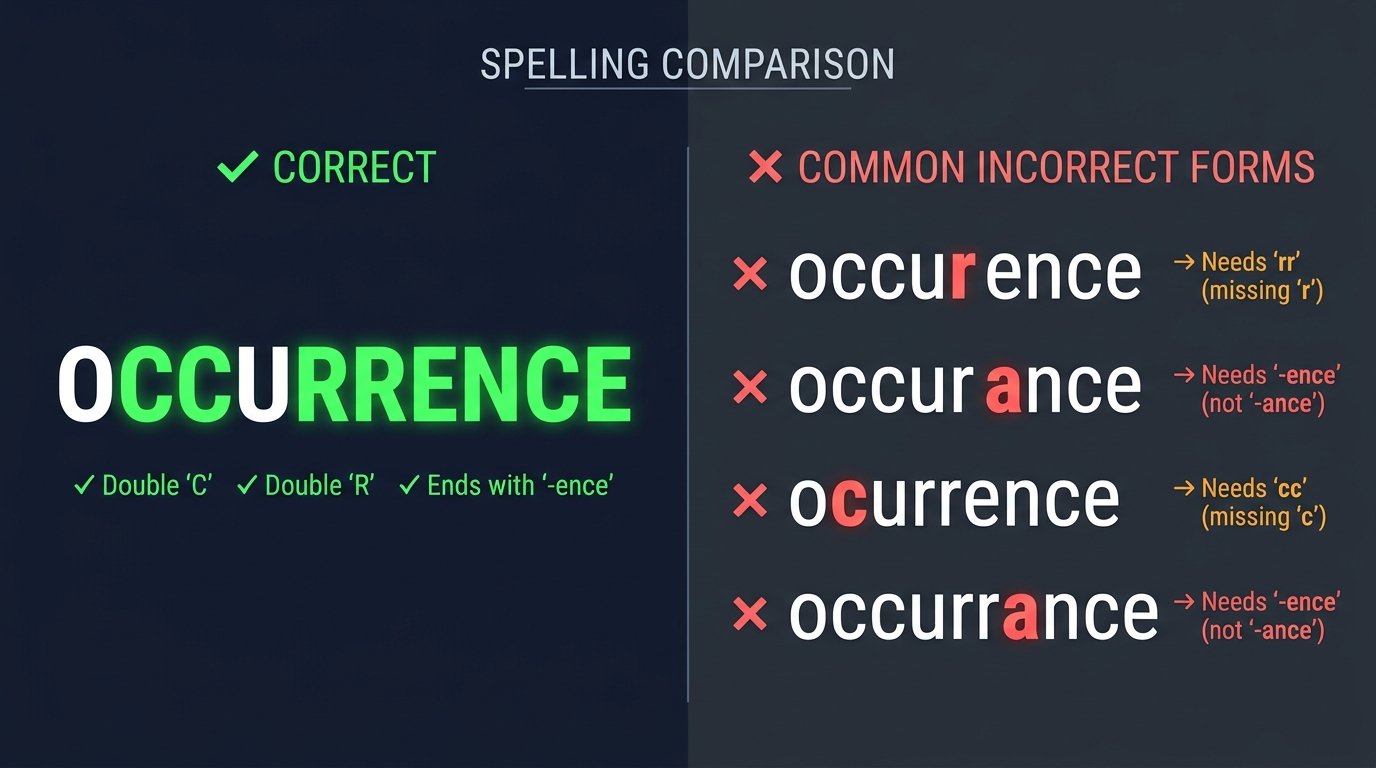
Occurrence spelling is o-c-c-u-r-r-e-n-c-e: ten letters, a double C near the front, a double R in the middle, and an -ence ending. That one line is the whole verdict, and the rest of this page proves it.
The word defeats writers for a simple reason: both letter pairs sound single. You hear one k sound and one r sound, so your ear gives you no reason to write either letter twice.
The fix is more than a memory trick. A stress rule decides the double R, and the same rule settles occurred and occurring, plus why preference breaks the pattern with one R.
Occurrence Spelling in 60 Seconds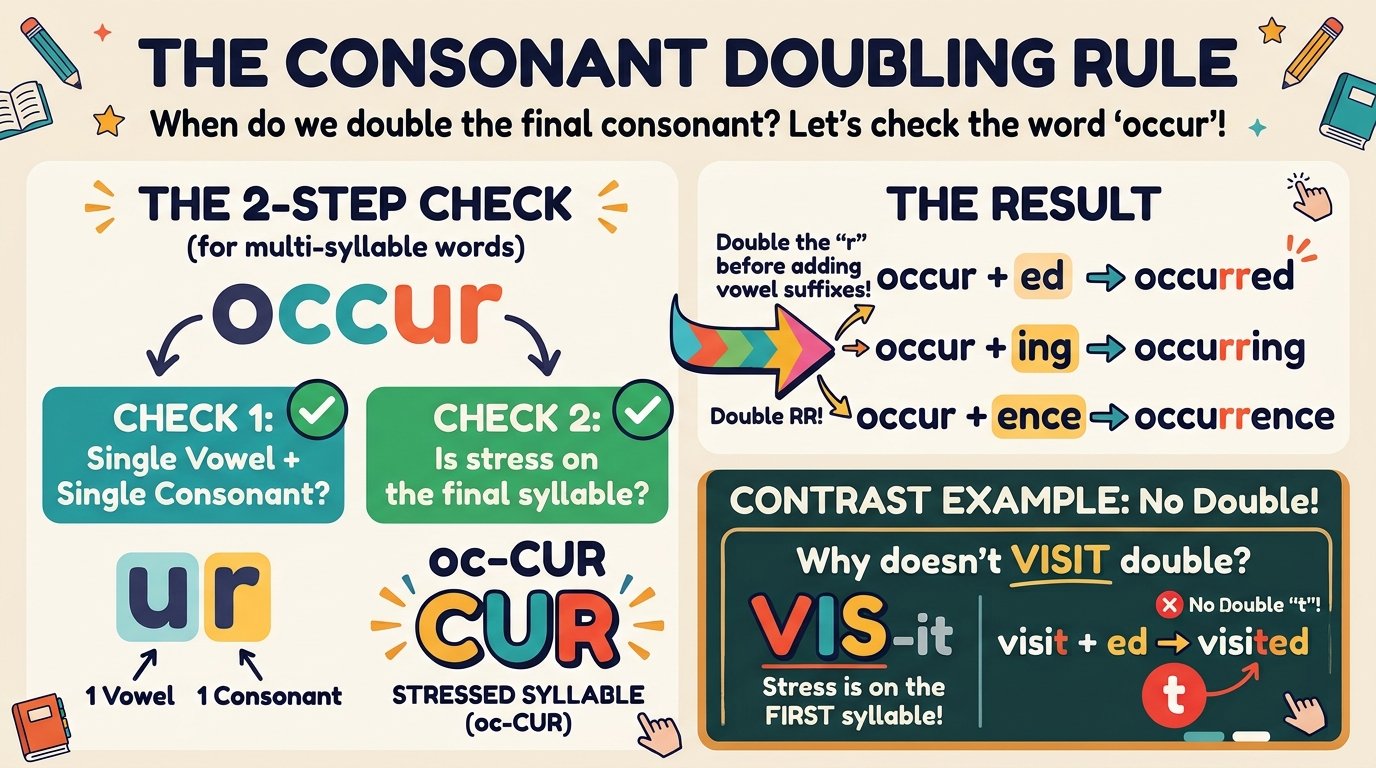
Short answer: occurrence, spelled with two Cs and two Rs, ending in -ence. The R doubles because the stress stays on CUR; the C doubles because Latin handed the word down that way.
- The spelling: occurrence, o-c-c-u-r-r-e-n-c-e, ten letters in three syllables, oc-cur-rence.
- The double R: occur is stressed on its final syllable, oc-CUR, so the R doubles before a vowel suffix.
- The double C: inherited from Latin occurrere; it belongs to the base word and no suffix rule creates it.
- The top errors: occurence drops one R, and occurance swaps the ending and drops one R. Neither is ever correct.
The verdict is not a matter of taste. Five dictionaries print the same headword, and Collins confirms the identical spelling in its own entry and corpus examples.
One circulating claim needs correcting at the start. Some spelling pages call occurence a valid alternative spelling; it is a misspelling, not a variant, and no dictionary lists it as one.
The Doubling Rule: The Stress Is the Switch
Short answer: a verb that ends in a single vowel plus a single consonant doubles that consonant before a vowel suffix, but only when its final syllable is stressed. Occur passes both tests, so its R doubles.
English spelling has a workhorse rule for suffixes like -ed, -ing and -ence. When both conditions hold, the final consonant doubles: stop becomes stopped, begin becomes beginning, and occur becomes occurred.
The stress condition is the half of the rule that does the deciding. The Language Portal of Canada states the outcome for this word family plainly: occurred, occurrence and occurring are all spelled with a double r.
The Two Questions of the Stress Test
Step 1: Does the verb end in a single vowel plus a single consonant? Occur ends in -ur: one vowel, u, and one consonant, r. The answer is yes.
Step 2: Is the final syllable stressed? Say the word out loud: oc-CUR. The beat lands on the last syllable, so the answer is yes again.
Two yes answers mean double the consonant before any suffix that starts with a vowel. That single test produces occurred, occurring and occurrence without memorising any of them separately.
Watch the test refuse a word. Visit ends in a single vowel plus a single consonant too, but its stress sits on the first syllable, VIS-it, so visited keeps one T.
Pages that state the rule without the stress condition teach a version that would wrongly produce visitted and openning. The stress question is not a detail; it is the switch.
One more boundary matters. The suffix -s starts with a consonant, so the rule never fires for it: occurs keeps a single R even though the stress still falls on CUR.
Why the C Doubles for a Different Reason
Short answer: the double C is not the doubling rule at work. It was already sitting inside occur before any suffix arrived, inherited from the Latin verb occurrere.
Say the base word slowly: oc-cur. The CC pair is part of the verb itself, present in every form, including occurs, where no doubling rule fires at all.
That is why the two pairs need two different explanations. The RR pair is manufactured by the stress rule in the derived forms; the CC pair is history, carried down from Latin.
Writers who look for one rule to explain both pairs end up inventing patterns that do not exist. Learn the C pair with the base word, and let the rule handle the R.
When the Doubling Stops: Preference, Reference and the Moving Stress
Short answer: the doubling stops when the stress moves off the final syllable. Preference and reference move their stress in the noun, so they carry one R; occurrence keeps its stress on CUR, so the double R survives.
|
Verb and noun |
Where the stress falls |
The R count |
|---|---|---|
|
occur, occurrence |
oc-CUR, oc-CUR-rence: the stress stays on CUR |
Two Rs in both |
|
prefer, preference |
pre-FER, PREF-er-ence: the stress moves to the first syllable |
preferred has two Rs; preference has one |
|
refer, reference |
re-FER, REF-er-ence: the stress moves to the first syllable |
referred has two Rs; reference has one |
|
recur, recurrence |
re-CUR, re-CUR-rence: the stress stays on CUR |
Two Rs in both |
Read the table as a before and after photograph. While the verb forms keep the stress at the end, the R doubles: preferred, referred, occurred, all identical in shape.
The -ence noun then pulls the stress forward in preference and reference, and the moment the stress leaves, the reason for doubling disappears with it. One R is what remains.
Occurrence escapes that fate because its stress never moves. Say it again: oc-CUR-rence. The beat is still on CUR, so the double R the rule created stays in place.
This contrast is the fastest self-check in English spelling. If you can hear where the stress sits, you can predict the R count before you write the word.
The Error Gallery: Every Wrong Way, by Mechanism
Short answer: every common error in this word is one of three pressures applied once: a silent letter pair dropped, an unstressed ending swapped, or an extra letter added. The gallery below sorts all twelve forms by that mechanism.
A note on honesty first. No dictionary ranks these misspellings by frequency, and any page that orders them by popularity without naming a source is guessing.
One source does order them: a spellchecker correction index puts occurance at 34.72 percent of recorded misspellings of this word and occurence at 20.43 percent. Those are index figures, printed here with their label, not dictionary facts.
Each form below is also labelled attested, meaning it appears in a fetched dictionary note, teaching page or exam item, or constructed, meaning it survives as an exam distractor rather than a living error.
|
# |
Wrong form |
Mechanism |
What is wrong |
Status |
|---|---|---|---|---|
|
1 |
occurence |
Dropped R |
occur plus -ence with the doubling rule never applied |
Attested |
|
2 |
ocurrence |
Dropped C |
One C dropped from the Latin CC pair |
Attested |
|
3 |
occurance |
-ance swap plus dropped R |
The ending swapped to -ance and one R dropped; two errors in one form |
Attested |
|
4 |
occurrance |
-ance swap only |
Both doubles kept, but the ending swapped to -ance |
Attested |
|
5 |
ocurrance |
Dropped C plus -ance swap |
One C dropped and the ending swapped |
Attested |
|
6 |
ocurance |
Dropped C, dropped R, -ance swap |
Three mechanisms stacked in a single form |
Attested |
|
7 |
occurrense |
Wrong final syllable |
-ense written where -ence belongs |
Attested |
|
8 |
occurencece |
Extra syllable |
The -ce ending repeated at the end of the word |
Attested |
|
9 |
occurrencee |
Extra final letter |
The final e doubled |
Constructed, an exam distractor |
|
10 |
occuurance |
Doubled wrong vowel |
The u doubled inside the stem |
Constructed, an exam distractor |
|
11 |
occurrrence |
Tripled R |
The R pushed one letter too far |
Constructed, an exam distractor |
|
12 |
acarranza, accurance |
Index noise |
Typing artifacts in the spellchecker index tail, not spelling variants |
Attested as index entries only |
Dropped Letters: occurence and ocurrence
Occurence is the most instructive error in the set. The writer knows the word, applies no doubling at all, and produces occur plus -ence with a single R.
Wiktionary defines occurence directly as a misspelling of occurrence, which settles the alternative spelling claim from the gallery introduction. It is an error form, full stop.
Ocurrence fails at the other pair. It keeps the stress rule’s double R but drops one of the Latin Cs, a letter pair no rule rebuilds once it is lost.
Both errors share one cause: each pair is heard as a single sound. The ear reports one k and one r, and the hand writes what the ear reports.
The -ance Swap: occurance, occurrance and ocurrance
The ending swap is the most recorded error family in the spellchecker index. English is full of -ance words, and the unstressed ending of occurrence gives the ear no clue at all.
Occurance makes two mistakes at once: it swaps -ence for -ance and drops an R. Exam pages that describe it as a misplaced letter miss half of what is wrong with it.
Occurrance is the near miss. Both doubles survive intact, and only the ending is wrong, which makes it the form most likely to slip past a quick proofread.
Ocurrance stacks the swap on a dropped C. It appears in exam items precisely because it looks plausible at speed while being wrong in two places.
Stacked and Extra-Letter Errors
The remaining forms fail by accumulation. Ocurance stacks three mechanisms, occurrense rewrites the final syllable, and occurencece repeats the ending outright.
The constructed distractors, occurrencee, occuurance and occurrrence, exist to catch overcorrection. A writer who has just learned that letters double here may double the wrong one, or double one too many times.
That is the gallery’s real lesson. The errors are not random: they are the three pressures of this word, a silent C pair, a silent R pair and a soundless ending, applied in every combination.
The Word Family: One Rule, Every Form
Short answer: learn occur and the stress test, and every form in the family spells itself. The verb doubles its R before vowel suffixes, keeps one R before -s, and hands the noun its double R intact.
|
Form |
Part of speech |
Spelling note |
|---|---|---|
|
occur |
Verb, base form |
The double C is already present; the final R is single |
|
occurs |
Verb, third person singular |
No doubling: -s is a consonant suffix, so the rule does not fire |
|
occurred |
Verb, past tense and past participle |
R doubles: stress on CUR, vowel suffix -ed |
|
occurring |
Verb, present participle |
R doubles before -ing |
|
occurrence |
Noun |
R doubles before -ence; the stress stays on CUR |
|
occurrences |
Noun, plural |
A regular -s plural of the noun |
|
occurrent |
Adjective, rare |
The stem the noun was built on |
The Verb Forms: occur, occurs, occurred, occurring
The verb is where the rule earns its keep. Occur and occurs are written with the letters the base word owns: double C, single R, nothing added.
Add a vowel suffix and the stress test fires. Occurred and occurring both double the R, for exactly the reason the noun does: the beat is still on CUR when the suffix lands.
Writers who memorise occurred as a separate fact miss the economy here. One rule, run once, generates the whole row of the table.
The Noun and Its Plural
The noun occurrence is the verb plus -ence, with the doubling carried through. Its meaning splits two ways: something that happens, and the fact or rate of something happening.
The first sense is countable: a rare occurrence, three occurrences. The second is uncountable, usually with of: the occurrence of earthquakes, the occurrence of a word in a text.
The plural is plain work: occurrences, a regular -s ending with no further change. Nobody needs a rule for it beyond knowing the singular cold.
Cousins, Not Twins: recurrence, reoccurrence and occasion
Recurrence looks like family but is built on a different verb, recur, from Latin recurrere. It means a return of something, and it obeys the same stress rule: recurred, recurring, recurrence.
Reoccurrence is a genuine derived word, re- plus occurrence, listed among the derived forms at Dictionary.com. For something happening again, recurrence is usually the more standard choice.
Occasion is the false friend: o-c-c-a-s-i-o-n, double C but a single S and no R at all. It names a particular time or special event, and its spelling problem is entirely its own.
How to Say It: Pronunciation, Syllables and the Schwa Trap
Short answer: occurrence has three syllables, oc-cur-rence, with the stress on the middle one. The unstressed syllables shrink to schwa sounds, which is exactly why spelling this word by ear fails.
The Cambridge Dictionary gives the American pronunciation as /əˈkɝː.əns/ and the British as /əˈkʌrəns/. Merriam-Webster writes the American form as ə-ˈkər-ən(t)s, the (t) marking an optional t sound.
The Oxford Learner’s Dictionary gives the same British form and marks the word as formal, standard in reports and professional writing. Both dictionaries agree the stress never leaves the second syllable.
Now hear the trap. The first and last syllables are unstressed, so their vowels collapse toward the flat schwa sound, and the ending comes out sounding like uh-rince.
That sound carries no spelling information: it could justify -ence, -ance or -ense equally, and it says nothing about single or double letters. Every gallery error starts in that gap between sound and spelling.
The bridge across the gap is the stress itself. The one syllable you hear clearly, CUR, is the syllable that controls the doubling, so the loud part of the word is the part worth listening to.
Where the Word Comes From: Latin occurrere
Short answer: occurrence descends from the Latin verb occurrere, to run to meet, built from ob-, against, plus currere, to run. The three dictionary accounts agree on that root and differ only in the path detail, so each is printed under its own name.
Merriam-Webster parses the word as occurr(ent) plus -ence, perhaps after Middle French occurrence, meaning circumstance. It dates the first known use of occurrence to 1539.
Oxford traces it to the mid 16th century, probably from the plural of the archaic word occurrent, via French, from Latin occurrent-, befalling, from occurrere, go to meet or present itself.
Dictionary.com dates the word 1530 to 1540 and gives the Latin stem directly: occurrent-, stem of occurrens, the present participle of occurrere, plus the -ence ending.
For the verb itself, Merriam-Webster’s occur entry records occur as borrowed from Latin occurrere, to run to meet or present itself to the mind, with a first known use in the 15th century.
Notice where the double C lives in this story. The Latin prefix ob- assimilated to oc- before currere, and that assimilated pair is the CC sitting at the front of the word today.
The etymology strands above follow Merriam-Webster’s occurrence entry and its companion sources as fetched for this page. The root is one; the routes the dictionaries describe are three, and they are kept separate here on purpose.
US and UK: Same Spelling, Slightly Different Sound
Short answer: there is no British spelling of occurrence to learn. The word is spelled identically in American and British English; only the vowel in the stressed syllable sounds slightly different.
Cambridge lists one headword spelling serving both its UK and US entries. Dictionary.com likewise prints one spelling across its American and British pronunciations.
The sound difference is small and lives entirely in the stressed syllable: the American vowel is the r-coloured /ɝː/, the British a shorter /ʌ/ before the r. The letters never change.
So any page selling a UK variant of this word is inventing one. Wherever English is written, the answer is occurrence, with two Cs and two Rs.
Memory Hooks That Actually Encode the Rule
Short answer: the strongest hook is the build: occur, plus the extra R the stress rule adds, plus -ence. It reconstructs the word from parts you already know instead of asking you to photograph it whole.
Hook one: the build. Write occur. The stress test says a vowel suffix is coming, so add one more R. Then add -ence. The result, occurrence, is assembled, not recalled.
Hook two: the chunking. Break the word into its syllables and say them with the beat: oc-CUR-rence. The loud middle chunk is the chunk carrying the double R, so the sound of the word points at its own hard part.
Hook three: the pair lock. This word doubles in pairs, twice: CC at the front from Latin, RR in the middle from the rule. If a draft shows only one pair doubled, it is wrong.
Sentence mnemonics can help, but only when they encode the pairs in order, C pair first and R pair second. A sentence that merely mentions the word teaches nothing.
For paper drills, the look, cover, write, check method pairs well with the build: look at the assembled word, cover it, write it from the rule, then check the two pairs.
Occurrence in Sentences: The Example Bank
Short answer: the word lives in set phrases: a rare occurrence, a common occurrence, an everyday occurrence, and the counting pattern, every occurrence of a word or error in a text.
- Power cuts are a rare occurrence in this building.
- Snow in April is a common occurrence in the mountains.
- The editor counted every occurrence of the error in the report.
- She marked the first occurrence of the word in the text.
- Delays on this route are an everyday occurrence now.
- The occurrence of earthquakes in the region is monitored daily.
- The safety talk became a weekly occurrence on the site.
- Three strange occurrences were logged in a single night.
- Saving twice reduces the occurrence of lost files.
- Frost is a regular occurrence here in January.
Read the bank for the two senses at work. Sentences one, two, five and ten use the countable sense, something that happens; sentences three, six and nine use the rate sense, the occurrence of something.
Practice: Spot the Correct Spelling
Short answer: five quick items, all built from the gallery. Pick the correctly spelled form in each set, then check the answers printed under the drill.
- a) occurence b) occurrence c) occurance
- a) occurrance b) ocurrence c) occurrence
- a) occurrence b) ocurrance c) occurencece
- The past tense of occur: a) occured b) occurred c) ocured
- a) occurring b) occuring c) ocuring
Answers: 1 b, 2 c, 3 a, 4 b, 5 a. Every wrong option above is a real gallery form, so a miss tells you exactly which mechanism to revisit.
For paper practice, this drill and the error gallery above print cleanly together as a one-page practice sheet: the twelve wrong forms on one side of the lesson, the five questions on the other.
The MagazineSolo Spelling Cluster
Short answer: occurrence belongs to a small family of spelling verdicts on this site. Each page owns one word and one mechanism, and the pages link to each other rather than repeating each other.
The definitely spelling page settles the word writers most often mangle into definately. Its problem is a wrong vowel in an unstressed syllable, the same schwa pressure that attacks the end of occurrence.
The separate spelling rule page teaches why separate keeps the A in the middle, because its root is par. It is the cluster’s other rule page, built on a root instead of a stress test.
The necessary spelling page is the cluster’s contrast case: necessary is a pure memory word, because no rule produces its doubles, while occurrence is a rule word through and through. Its page joins this list as a link once it is published.
More verdicts, drills and word family tables live on the MagazineSolo spelling rail, where each new word is added with its mechanism stated and its sources named.
Frequently Asked Questions
How do you spell occurrence?
Occurrence: o-c-c-u-r-r-e-n-c-e. The word carries a double C near the front, a double R in the middle, and the -ence ending, across ten letters and three syllables.
Is it occurrence or occurance?
Occurrence. Occurance makes two mistakes at once: it swaps the -ence ending for -ance and drops one of the two Rs. It is never correct in any variety of English.
Is it occurrence or occurence?
Occurrence. Occurence drops the second R, the letter the stress rule adds. It is a misspelling, not an alternative form, and no dictionary lists it as a variant.
Is occurence a valid alternative spelling?
No. Dictionaries do not list occurence as a variant of the word at all, and Wiktionary defines it directly as a misspelling of occurrence. Claims otherwise, wherever they circulate, are wrong.
Why does occurrence have two Rs?
Because occur is stressed on its final syllable, oc-CUR, and ends in a single vowel plus a single consonant. The final consonant therefore doubles before a vowel suffix: occurred, occurring, occurrence.
Why does occurrence have two Cs?
The CC pair is inherited from Latin occurrere and sits inside the base word occur itself. No English suffix rule creates it, so it is learned as part of the word rather than derived.
Does occurrence end in -ence or -ance?
It ends in -ence. The -ance forms, occurance and occurrance, are misspellings, however plausible they look. The unstressed ending gives no sound clue, so the ending is learned with the word family.
How many letters are in occurrence?
Ten: o, c, c, u, r, r, e, n, c, e. Counting the letters is a fair quick check, because every common error form in the gallery has nine letters or fewer.
How many syllables does occurrence have?
Three: oc-cur-rence. The stress falls on the middle syllable, CUR, and the two outer syllables are unstressed, which is why their vowels shrink and mislead the ear.
How do you pronounce occurrence?
In American English, /əˈkɝː.əns/; in British English, /əˈkʌrəns/. Merriam-Webster writes the American form as ə-ˈkər-ən(t)s. In both, the stress falls on the second syllable, CUR.
Is occurrence spelled the same in the UK and the US?
Yes. The spelling is identical on both sides of the Atlantic, and dictionaries list one headword for both. Only the pronunciation of the stressed vowel differs slightly between the two.
What is the plural of occurrence?
Occurrences, a regular -s plural: three occurrences, several occurrences. The plural adds nothing and changes nothing, because -s is a consonant suffix and the doubling rule never fires for it.
How do you spell the past tense of occur?
Occurred, with a double R. The stress sits on CUR and -ed starts with a vowel, so the stress test doubles the consonant, exactly as it does in the noun.
How do you spell occurring?
Occurring, with a double R; occuring is wrong. The -ing suffix starts with a vowel and the stress stays on the final syllable of occur, so the rule fires in the same way.
Why is preference spelled with one R but occurrence with two?
In preference the stress moves to the first syllable, PREF-er-ence, so the doubling stops and one R remains. In occurrence the stress stays on CUR, so the double R survives into the noun.
What is the rule for doubling the final consonant?
If a verb ends in a single vowel plus a single consonant and its final syllable is stressed, double the consonant before a suffix that starts with a vowel: -ed, -ing or -ence.
Why does visited not double its T?
Because visit is stressed on its first syllable, VIS-it, so the stress test fails and no doubling happens. This is the half of the rule that many teaching pages leave out entirely.
What does occurrence mean?
Something that happens: an incident or event, as in a rare occurrence. It also names the fact or rate of something happening, as in the occurrence of earthquakes in a region.
What is the difference between occurrence and recurrence?
Recurrence is built on recur and means a return of something, a happening again. Occurrence is any happening at all, first or repeated. Different verbs, different words, one shared doubling rule.
Is reoccurrence a real word?
Yes. It is a derived noun, re- plus occurrence, listed among the derived forms at Dictionary.com. For something happening again, though, recurrence is usually the more standard choice in careful writing.
What is the most common misspelling of occurrence?
In one spellchecker correction index, occurance leads with 34.72 percent of recorded misspellings of this word, ahead of occurence at 20.43 percent. No dictionary ranks the misspellings, so treat that order as index data only.
Is ocurrence correct?
No. Ocurrence drops one of the two Cs the word inherited from Latin. The CC pair is part of the base word occur, and losing half of it produces a misspelling.
Is occurrance correct?
No. Occurrance keeps both double pairs intact, which makes it a near miss, but it swaps the ending to -ance. The correct ending is -ence, so the form is still wrong.
Where does occurrence come from?
From Latin occurrere, to run to meet, built from ob-, against, plus currere, to run. The word arrived through the participle stem occurrent- plus -ence; Merriam-Webster dates its first known use to 1539.
What is a good mnemonic for occurrence?
Any sentence that encodes CC then RR in order can work, but the rule-based memory is stronger: say oc-CUR-rence, and let the stressed beat remind you that the R doubles before the ending.
Is occurrence a noun or a verb?
A noun. The verb is occur, which carries the forms occurs, occurred and occurring. Occurrence names the happening itself, or the fact of something happening, never the action of happening.
Can occurrence be uncountable?
Yes. Its second sense, the occurrence of something, is uncountable: the occurrence of errors, the occurrence of a word in a text. The first sense, an event, is countable and takes a plural.
Why do people write occurance so often?
Because -ance is the commoner ending sound in English and the unstressed ending of occurrence gives the ear no clue which one is written. The ending has to be learned with the word, not heard.
Why does the end of occurrence sound like “uh-rince”?
The last two syllables are unstressed, so their vowels reduce to flat schwa sounds. That reduction is exactly why spelling by ear fails on this word: the sound carries no information about the letters.
Does occur double its R in occurs?
No. Occurs keeps one R, because -s is a consonant suffix and the doubling rule only fires before suffixes that start with a vowel. The stress is unchanged; the suffix decides.
What are the forms of occur?
The verb runs occur, occurs, occurred, occurring. The noun is occurrence and its plural is occurrences. Every doubled R in that set comes from the same stress rule applied to the same base.
Is it an occurrence or a occurrence?
An occurrence. The word opens with a vowel sound, the schwa at the start of oc-cur-rence, so the article is an, not a. The spelling of the article follows the sound.
How is occurrence used in a sentence?
Power cuts are a rare occurrence here. Or, in the counting sense: report every occurrence of the error. The word suits both a single notable event and a tally of repeated ones.
What is the difference between occurrence and occasion?
Occasion, o-c-c-a-s-i-o-n, is a particular time or a special event, and it carries a double C with a single S. Occurrence is any happening at all. Different words, different spelling problems.
Which words follow the same doubling rule as occur?
Recur (recurred), prefer (preferred, while the stress stays), admit (admitted) and begin (beginning). Each ends in a stressed syllable built from a single vowel plus a single consonant, so each doubles.
Why does reference have one R?
For the same reason as preference: the stress moves off the final syllable in the noun, REF-er-ence, so the doubling stops. Referred keeps two Rs because there the stress stays at the end.
How do you spell occurrence in British English?
Occurrence, identically. There is no separate British spelling of the word, and British dictionaries print the same headword as American ones. Only the pronunciation of the stressed vowel shifts slightly.
Is occurrence a formal word?
Oxford marks it (formal), and it is standard in reports, academic and professional writing. It also lives comfortably in everyday phrases like a common occurrence and an everyday occurrence, so formality is a tendency, not a ban.
What does “a common occurrence” mean?
Something that happens often or regularly: delays are a common occurrence on this route. The phrase pairs the countable sense of the word with frequency, and it is the word’s most familiar home.
Can a spellchecker be trusted with occurrence?
Partly. It catches the non-word error forms, because they exist in no dictionary. It cannot teach you the rule, and it may miss a real-word error elsewhere in the same sentence, so the stress test stays worth learning.
How is occurrence spelled in exams like the SSC?
The same way: occurrence. The word recurs as a correctly or incorrectly spelt item in competitive exams precisely because occurence and occurance make such tempting distractors for candidates spelling by ear.
What is the quickest check before submitting writing?
Search the document for occurence and occurance. If either appears, replace it with occurrence and check the sentence still reads correctly. The two searches take seconds and catch the index’s two most recorded errors.
Conclusion
Occurrence spelling stops being a guessing game once the word is read as two mechanisms, not one mystery. The double C is Latin history sitting inside occur; the double R is the stress rule firing because the beat stays on CUR.
Run the two-question stress test whenever a suffix approaches a verb like this. It settles occurred and occurring, explains preference and reference in passing, and leaves the error gallery with nothing left to tempt you.

Dilawar is a content writer at MagazineSolo, covering travel, home improvement, interior design, and everyday lifestyle topics. He enjoys researching practical solutions, exploring travel destinations, and sharing helpful guides that make daily life easier. His writing focuses on clear information, useful advice, and engaging stories for a wide audience.