Necessary Spelling: One C, Two S, and the Shirt Trick
Necessary spelling defeats more careful writers than almost any other everyday word. The failure is never carelessness. The word hides its letter counts behind weak sounds, so even strong spellers hesitate over its middle.
The answer fits on one line. Necessary is spelled n-e-c-e-s-s-a-r-y: nine letters, one c, two s letters, and an -ary ending. Everything below makes that line permanent.
Three tools do the work on this page. The shirt trick fixes the counts, the chunking fixes the order, and the Latin root explains the letters. The tricks are memory devices, labeled as devices wherever they appear; no shirt image ever poses as the origin.
The Verdict: Necessary, Spelled N-E-C-E-S-S-A-R-Y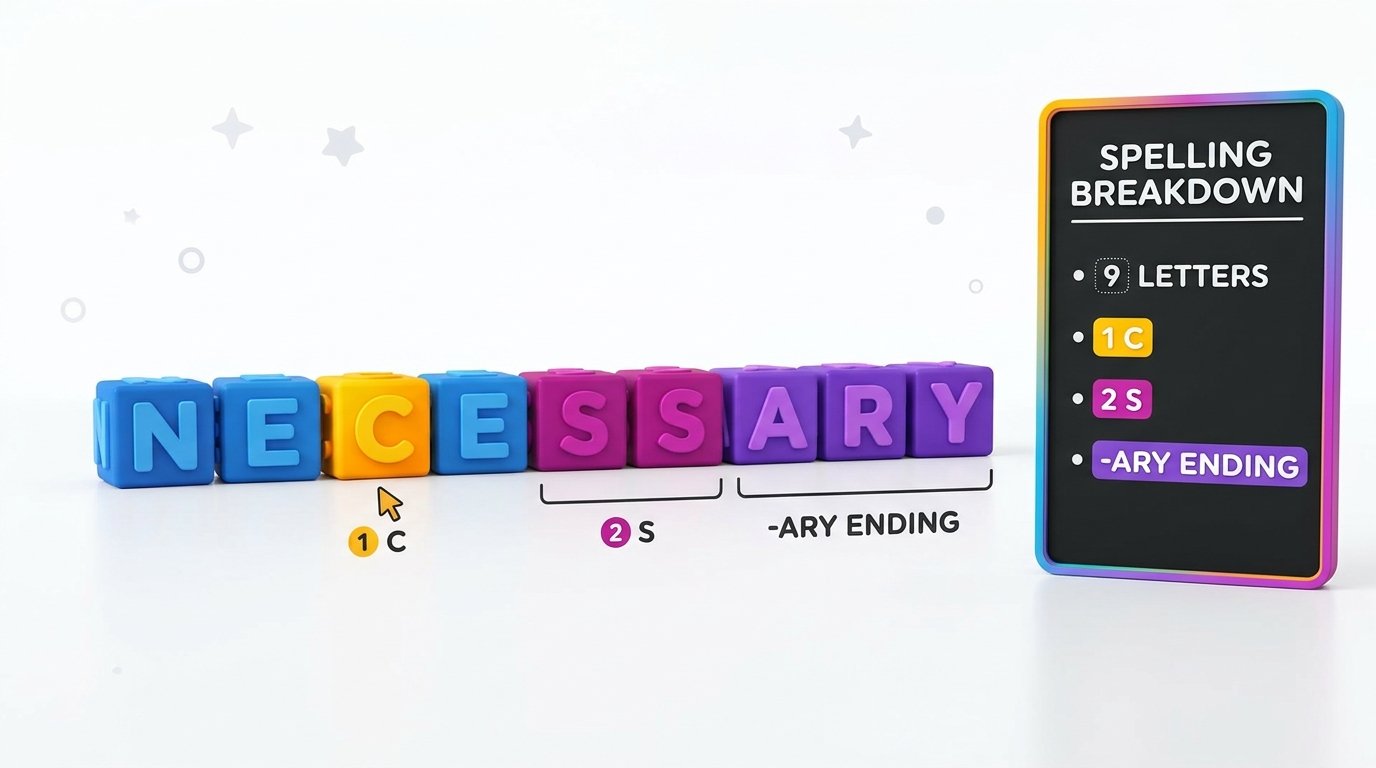
Necessary is the only correct spelling. The four dictionaries checked agree: the Merriam-Webster entry for necessary, the Cambridge Dictionary entry for necessary, the Oxford Learner’s entry for necessary and the Dictionary.com entry for necessary all record the same nine-letter form, in American and British English alike.
Settle the verdict first, because the teaching depends on it. A trick is only worth learning once the target is fixed. The target here is one string of nine letters, and it never changes.
The Letter Count Check: One C, Two S, and the -Ary Ending
The count check takes two seconds and catches nearly every error. Count the c letters: one. Count the s letters: two. Check the ending: -ary. A written attempt that fails any of the three is wrong.
|
Check |
The record |
Where it sits |
|---|---|---|
|
Total letters |
9 |
n-e-c-e-s-s-a-r-y |
|
C letters |
1 |
Third letter |
|
S letters |
2 |
Fifth and sixth letters |
|
Ending |
-ary |
Last three letters |
|
Syllables |
4 |
nec-es-sary |
The positions matter as much as the counts. The single c stands third, and the double s stands fifth and sixth. An attempt with the right totals in the wrong places, like necesarry, is still an error.
This is the page’s first takeaway. One collar’s worth of c, two sleeves’ worth of s, and the ending the Latin root hands down. The next section turns that count into a picture.
The Shirt Trick: One Collar, Two Sleeves
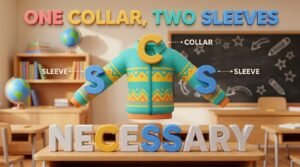
The shirt trick is the dominant memory device for this word. A shirt has one collar and two sleeves. Necessary has one c, for the collar, and two s letters, for the sleeves.
The image carries the order as well as the count. The collar comes before the sleeves on a shirt, and the c comes before the s letters in the word. One picture checks both facts at once.
The device is carried by serious teaching sources: the Open University OpenLearn memory aids page prints it in bold letters, Necessary, one collar, two sleeves, and the Staffordshire University spelling guide teaches the same sentence to university students, attributing it to BBC Bitesize.
Use the trick for what it is: a check, not a cause. The shirt does not explain the spelling. It gives the hand a picture to verify against while the root, below, does the explaining.
The socks variant: one collar, two socks
The socks variant swaps sleeves for footwear and changes nothing else. One collar, two socks: the counts, the order and the check are identical. It circulates through classroom mnemonic collections, including the GCSE.com spelling page. Picture whichever garment you see faster.
One cup, two sugars: the tea and coffee devices
The second device family moves the count to a drink. One cup for the one c, two sugars for the two s letters. Spellzone’s ten mnemonics for tricky words teaches it around a cup of tea, as the first of its ten mnemonics.
The coffee form is the same device in a different cup. Grammarly’s spelling rules blog prints it directly: remember “one coffee, two sugars,” and it reminds you there is one c and two s letters, in that order.
The Scholastic Megabook of Spelling prints the device for teachers. Its line orders a necessary coffee with two sugars, one c for the coffee and two s letters for the sugars. A spoons variant also appears in the Spellzone record.
The sentence mnemonics: Never Eat Cake and its family
Sentence mnemonics spell the whole word, letter by letter. The best known runs “Never Eat Cake, Eat Salad Sandwiches And Remain Young,” and its initials give n-e-c-e-s-s-a-r-y exactly, start to finish.
The family has many printings, and they are variants, not rivals. OpenLearn prints Salmon for the second s word. Other versions run Crisps, Chips or Cold Egg Salad, and one classroom version begins “Not Every Cat Eats Sardines.”
Choose a sentence when the count devices are not enough. The shirt checks two facts; the sentence rebuilds all nine letters. Writers who scramble the middle vowels often find the full string easier.
Every sentence in this family is an invention for the classroom. None of them is old, none of them is an origin, and each page that prints one, this one included, owes the reader that label.
Chunking the Word: Ne-Ces-Sa-Ry and the Cess Middle
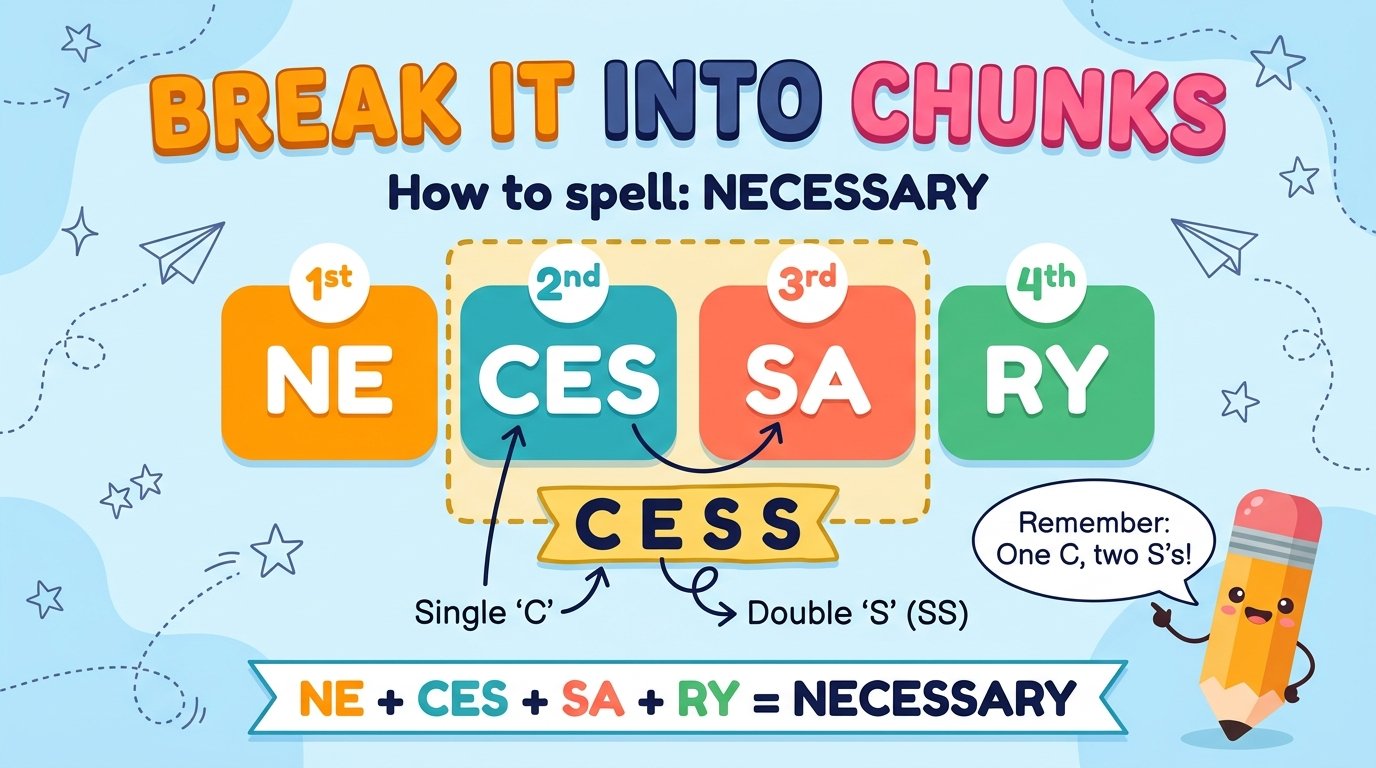
Chunking breaks the word into four speakable pieces. Ne-ces-sa-ry matches the four syllables, and saying the chunks aloud while writing slows the hand enough for the counts to register.
The teaching record chunks it several ways, with one shared point. SmartGrammer prints Nec + ess + ary, PeakGrammar highlights NE + CESS + ARY, and LivePhysics writes ne + ces + sar + y. Every version isolates the same middle chunk.
That middle is the checkable heart of the word. The chunk CESS carries the single c and the double s together. If the middle chunk is right, the rest of the word almost cannot go wrong.
OpenLearn gives the same middle a picture of its own. Its discussion offers “the cesspool in the middle” as another good example for necessary. The image is odd, memorable, and fixed on exactly the right letters.
Why Sound Cannot Settle It: The Schwa Problem
The spoken word destroys the evidence a speller needs. In necessary, several vowels are unstressed, said softly and quickly, as the LivePhysics cheat sheet puts it. Stressed syllables keep their letters audible; unstressed ones do not.
The reduced vowel has a name: the schwa. It is the weak “uh” sound that English unstressed vowels collapse into. The dictionaries’ own transcriptions show it sitting in the second syllable of this word.
A schwa can be written with almost any vowel letter. English spells that weak sound with a, e, i, o and u in different words. Hearing it tells a writer nothing about whether the letter is a or e.
That single fact explains the two classic failures. The a-or-e choice in the middle and ending cannot be heard, so writers guess, and the -ery ending is the guess that sound suggests. The consonant counts fail the same way, as the next point shows.
The c makes no separate sound at all. It stands before e and sounds like s, so the ear hears a run of s sounds with no c in it. Writers then invent the counts, doubling the c or dropping an s.
Sound is therefore demoted from judge to suspect. Pronunciation is the problem the devices exist to solve. The count, the chunks and the root are the evidence; the ear is not.
Where Necessary Comes From: The Latin Root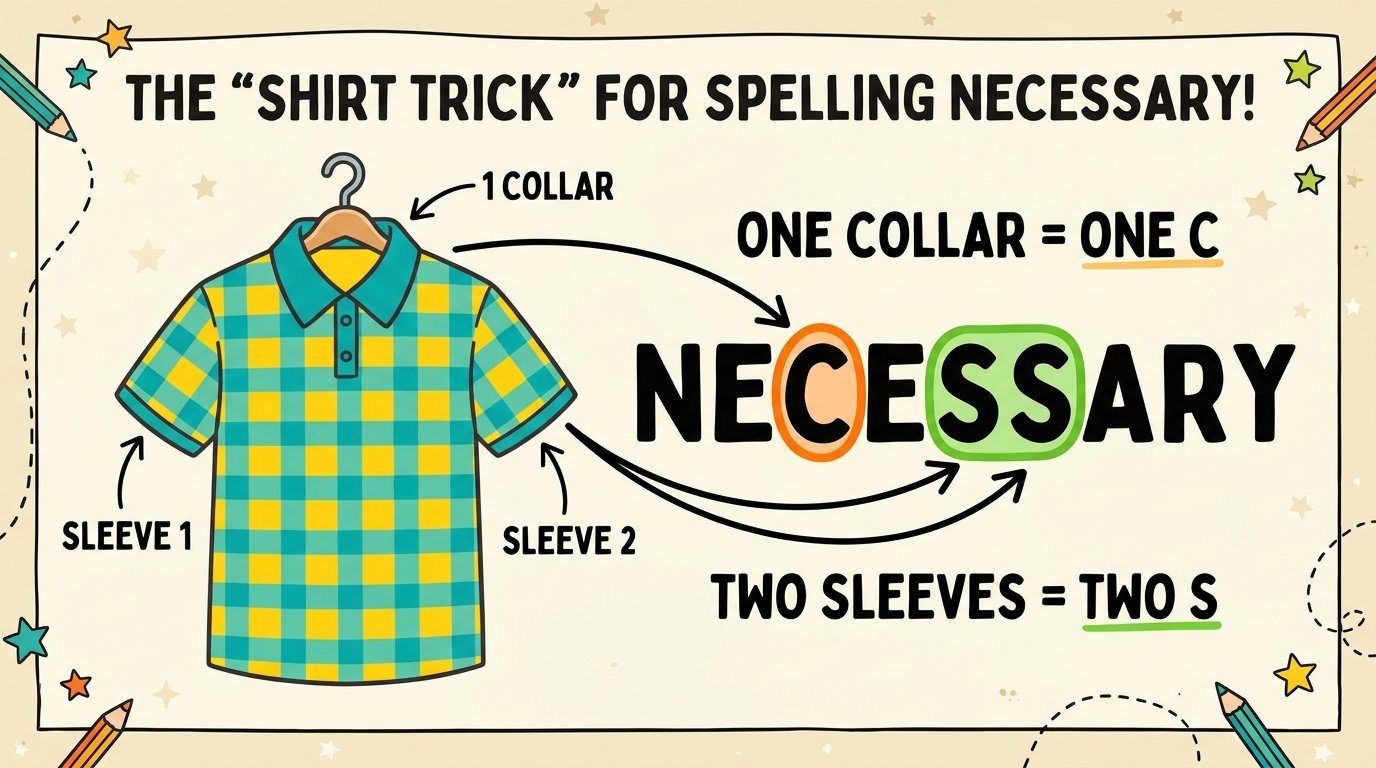
The origin is a chain, and the dictionaries agree on it: the Merriam-Webster entry for necessary records Middle English necessarie, from Latin necessarius, from necesse, meaning necessary, and the Dictionary.com entry for necessary gives the same chain, dating the first recording to 1300 to 1350.
Merriam-Webster carries the analysis one step deeper. Necesse is probably built from ne-, meaning not, plus cedere, meaning to withdraw. The word’s core image is that which does not withdraw, hence what cannot be avoided.
The root explains the ending outright. Necessarius is necesse plus the suffix -arius, and -arius becomes -ary in English. The ending is -ary because the Latin word ends that way, not because any rule prefers a.
First use is a medieval fact with two consistent datings. Merriam-Webster gives the 14th century for the adjective and the noun. Dictionary.com’s 1300 to 1350 recording matches it. The strands are printed with their owners, as this page prints all its strands.
Hold this section apart from the shirt, deliberately. A competitor page in the current results teaches the reverse count inside an etymology passage, claiming a double c from Latin. That is a competitor error, contradicted by the dictionaries and by that page’s own tables.
A second competitor error deserves the same label. A spelling site writes that spellers forget “the double c and double s” in this word. There is no double c to forget. Loose phrasing like that is how the wrong count spreads.
The Error Gallery: Every Wrong Form and What Goes Wrong
The gallery is ordered by mechanism, and the reason is honesty. No fetched source ranks these errors against each other, so no frequency order is printed here. The record supports a grouping by what goes wrong in each form.
|
Wrong form |
What goes wrong |
Documented by |
|---|---|---|
|
neccessary |
A second c is added; the wrong consonant doubles |
Wikipedia list; Oxford Corpus list; teaching pages |
|
necesary |
One s is dropped; the double s becomes single |
PeakGrammar; Wordspry; AdeptWrite; LivePhysics |
|
neccesary |
The c doubles and one s drops at once |
AdeptWrite; WhichIsCorrect; Wordspry |
|
necessery |
The a of -ary is replaced by e, giving -ery |
Wikipedia list; LivePhysics; Wordspry |
|
nessessary |
The c position is filled by s |
Testbook; GrammarDiary table; LivePhysics |
|
nessesary |
The c becomes s and the middle scrambles |
GrammarDiary table |
|
nessacary |
The middle letters transpose around the a |
WhichIsCorrect list |
|
nessecary |
The c becomes s with the ending intact |
WhichIsCorrect list |
|
necassary |
A social quiz strand form, c kept, a doubled early |
Social quiz record |
|
necesarry |
The a and the second s trade places |
Constructed pattern variant |
|
necessarry |
The s pair moves after the a |
Constructed pattern variant |
|
necissary |
The c doubles into an i-shaped scramble |
Constructed pattern variant |
Two lists anchor the gallery in the documented record. Wikipedia’s list of commonly misspelled English words carries exactly two forms for this word, neccessary and necessery. The Oxford English Corpus list carries one, neccessary.
The doubled-c group is the swap error. Writers know one consonant in this word doubles and pick the wrong one, doubling the c and singling the s. Neccessary and neccesary are both that single mistake, in full and in part.
The dropped-s group is the mirror image. Necesary keeps the c single, as it should, but lets one s go. Four teaching sources document it, the gallery’s best-attested single-letter failure after neccessary.
The substitution group replaces the c with s. Nessessary and its cousins nessesary and nessecary fill the third position with s. The ear caused it: the c sounds like s, so the hand writes s.
The ending group is one letter deep. Necessery changes nothing except the a of -ary into e. Its Wikipedia place comes from the unstressed ending, which gives the ear no way to refuse the swap.
The scramble group moves letters instead of changing counts. Necesary’s cousins necesarry and necessarry keep the inventory and lose the order. Where no fetched source carried a form, it is labeled a constructed pattern variant, and the label stays on.
Pronunciation: Four Dictionaries, Printed as Strands
The dictionaries do not print one single transcription, so this page prints four. They agree on what matters for spelling: four syllables, stress on the first. Their middle vowels differ, and the strands stay unmerged with owners attached.
|
Source |
Transcription or respelling |
Syllables |
|---|---|---|
|
Merriam-Webster |
Respelling with a schwa in syllable two |
4 |
|
Cambridge |
UK and US printed identically |
4 |
|
Oxford Learner’s (American) |
/ˈnɛsəˌsɛri/ |
4 |
|
Dictionary.com |
American and British forms differ in the middle vowels |
4 |
The practical point for spellers is narrow. Say the word in chunks, ne-ces-sa-ry, with the first syllable stressed, and the pronunciation supports the spelling. Say it fast and whole, and the schwa swallows the evidence again.
What Necessary Means
The first sense is the everyday one. Merriam-Webster defines the adjective as “absolutely needed: required,” with the model sentence “Food is necessary for life.” Cambridge levels the word B1 and defines it as needed to achieve a particular result.
Oxford adds the second everyday sense. Alongside “needed for a purpose or a reason,” with essential as synonym, it records “that must exist or happen and cannot be avoided,” with inevitable as its synonym.
The word is also a noun, with a plural. Dictionary.com lists the noun with the plural necessaries, the things a person needs. Merriam-Webster dates the noun’s first known use to the 14th century, like the adjective.
One idiom rides on the entry. Oxford carries “a necessary evil”: something unpleasant that must be accepted because it brings a needed result. The phrase doubles as a spelling checkpoint, since its first word is this page’s subject.
The Word Family: Necessarily, Unnecessary, Necessity and the Rest
The family keeps the cess middle in every form. Learn the base string once and each relative becomes a small, named change at an edge: a prefix at the front, a suffix at the back, or the y trading for i.
|
Form |
Spelling |
The change to watch |
|---|---|---|
|
necessary |
n-e-c-e-s-s-a-r-y |
The base string |
|
necessarily |
n-e-c-e-s-s-a-r-i-l-y |
The y stays before -ly |
|
unnecessary |
u-n-n-e-c-e-s-s-a-r-y |
Double n at the prefix join |
|
necessity |
n-e-c-e-s-s-i-t-y |
The -ity ending |
|
necessities |
n-e-c-e-s-s-i-t-i-e-s |
y becomes i, plus -es |
|
necessaries |
n-e-c-e-s-s-a-r-i-e-s |
y becomes i, plus -es |
|
necessitate |
n-e-c-e-s-s-i-t-a-t-e |
The verb, -itate ending |
|
necessariness |
necessary + -ness |
A listed derived form |
Necessarily: the y stays before -ly
Necessarily is the adverb, and its trap is the join. The standard form keeps the y of necessary before -ly, giving n-e-c-e-s-s-a-r-i-l-y across five syllables. Writers who reshape the base at the join produce the constructed error form neceserily.
Unnecessary: the double n at the join
Unnecessary is the prefix un- joined to the untouched base. The join produces a genuine double n, u-n-n, and inside the word nothing changes: one c, two s letters, -ary. The error form unneccessary simply carries the doubled-c mistake through the prefix.
Necessity and necessities: y becomes i
Necessity is the family’s noun of state. It spells n-e-c-e-s-s-i-t-y, descends from Latin necessitas through Anglo-French, and is first recorded in the 14th century. Its plural, necessities, makes the standard change: y becomes i, then -es is added.
Necessaries and necessitate
Necessaries is the plural of the noun necessary. It forms the same way, y to i plus -es, and Dictionary.com lists it as the inflected form. Necessitate is the verb, n-e-c-e-s-s-i-t-a-t-e, to make something necessary.
Necessary in British and American English: One Spelling
There is no British form and American form of this word. The checked teaching record, Wordspry, SmartGrammer and PeakGrammar among it, states the same spelling for both varieties, and no dictionary in the record shows a split.
That sameness is worth a section because writers assume otherwise. English is full of genuine variety pairs, and assuming necessary is another one licenses experiments. It is not one. The string is the string, everywhere.
How to Practice Until It Sticks
Practice works when each step checks a different layer. The count, the chunks, the sentence and the root each guard a different failure, so rotating them fixes the word faster than copying it fifty times.
- Run the count check on every attempt. One c, two s letters, -ary ending, nine letters total. Say the three numbers before you write, and the commonest errors never reach the page.
- Say the chunks as you write. Ne-ces-sa-ry, four chunks, with the cess middle named aloud. The spoken chunking slows the hand at exactly the letters where the errors live.
- Keep one device in reserve for hard moments. The shirt for the counts, the cup for variety, the Never Eat Cake sentence for the full string. One strong image, used consistently, beats five weak ones.
- Write it in real sentences, not in isolation. Use the dictionary models: food is necessary for life; he lacks the necessary skills. Sentences transfer to emails and essays, where the errors actually happen.
- Proofread with a hidden-spot check. Search finished writing for “necc” and “necessery” before sending. The two documented error shapes are easy to find mechanically, and finding one teaches the eye quickly.
- Check the family when you extend the word. Necessarily keeps its y, unnecessary doubles only its join, and necessity changes its ending. Each extension is one named change, checked in one second.
The cluster’s other traps yield to the same discipline: our definitely spelling guide applies the verdict-first method to the word writers miss most, and our separate vs seperate guide shows a middle letter settled by its root, exactly as this page settles an ending by one.
Frequently Asked Questions
1. How do you spell necessary?
N-E-C-E-S-S-A-R-Y. Nine letters, one c, two s letters, ending -ary. All four dictionaries checked for this page record the same form, in American and British English alike.
2. Is it necessary or neccessary?
Necessary. Neccessary, with two c letters, is the best-documented error for this word: it appears on Wikipedia’s documented list of common misspellings and on the Oxford English Corpus list reported by Mental Floss.
3. Is neccessary a word?
No. No dictionary in the checked record lists neccessary as a standard spelling in any variety of English. The same answer covers neccesary and the constructed necissary: the c never doubles in this word.
4. How many C’s and how many S’s are in necessary?
One c and two s letters. The c is the third letter; the two s letters are the fifth and sixth. The counts only make sense as a pair: one collar, two sleeves.
5. What is the easiest trick to remember the spelling of necessary?
The shirt trick. A shirt has one collar and two sleeves, and necessary has one c (collar) and two s letters (sleeves). It is a memory device carried by OpenLearn and the Staffordshire University guide, not the word’s origin.
6. What does “one collar, two sleeves” mean?
It maps the word’s consonant counts onto a shirt. The one collar stands for the single c, the two sleeves for the double s. The letters also come in that order, c before s, which makes the image a complete check.
7. Is there a “one cup, two sugars” trick for necessary?
Yes. It is the second device family: one cup for the one c, two sugars for the two s letters. Spellzone teaches it around tea, and Grammarly’s spelling-rules blog prints the coffee form, one coffee, two sugars.
8. How many letters are in necessary?
Nine: n, e, c, e, s, s, a, r, y. The letter string is the fastest self-check there is: if a written attempt lacks nine letters with s doubled at positions five and six, it is not the word.
9. How many syllables are in necessary?
Four. Merriam-Webster syllabifies it nec-es-sary, and teaching pages chunk it ne-ces-sa-ry. The adverb necessarily has five. Every dictionary strand in the record agrees on four syllables and first-syllable stress, even where their vowel transcriptions differ.
10. How do you pronounce necessary?
The dictionaries print it as strands, not one form. Merriam-Webster gives a respelling with the second syllable reduced to a schwa; Cambridge prints UK and US identically; Oxford and Dictionary.com differ in the middle vowels. All agree on four syllables, first-syllable stress.
11. What does necessary mean?
Needed. Merriam-Webster’s first sense is “absolutely needed: required,” as in “Food is necessary for life.” Cambridge defines it as needed to achieve a particular result and levels it B1; Oxford’s first sense gives essential as the synonym.
12. Is necessary an adjective or a noun?
Both. It is primarily an adjective, and it is also a noun: Dictionary.com lists the noun with the plural necessaries, and Merriam-Webster records first known use in the 14th century for both. The adjective does nearly all the everyday work.
13. Is the spelling the same in British and American English?
Yes. The checked teaching and dictionary record states the same form for both varieties, and no dictionary records a variety split: n-e-c-e-s-s-a-r-y in the US and the UK alike.
14. Why do so many people misspell necessary?
Because sound gives no clue. Several vowels are unstressed and reduced to the schwa, so pronunciation cannot say whether the middle and ending vowels are a or e, or how many c and s letters there are. Writers often double the wrong consonant.
15. What is the most common misspelling of necessary?
No fetched source ranks the errors, and this page does not invent a ranking. What the record shows: neccessary is the only variant on both documented lists, Wikipedia’s and the Oxford English Corpus list, and necessery is the second form on Wikipedia’s list.
16. Is necesary correct with one S?
No. Necesary drops one of the two s letters and is documented as an error by PeakGrammar, Wordspry, AdeptWrite and LivePhysics. The s always doubles in necessary, at positions five and six of the nine-letter string.
17. Is necessery correct?
No. Necessery replaces the a of the -ary ending with e. It is one of only two forms for this word on Wikipedia’s documented misspelling list, and the ending is -ary because the word descends from Latin necessarius, ending -arius.
18. Where does the word necessary come from?
From Latin, through Middle English. Merriam-Webster: Middle English necessarie, from Latin necessarius, from necesse. Dictionary.com records it first in 1300 to 1350 with the same chain, necessarius built from necesse plus -arius, which becomes English -ary. The two datings are consistent strands.
19. What is the Latin root of necessary?
Necesse, inside necessarius. Merriam-Webster adds the deeper analysis: necesse is probably from ne-, meaning not, plus cedere, meaning to withdraw: that which does not withdraw, hence unavoidable. That root, not any mnemonic, is the word’s origin.
20. How do you spell necessarily?
N-E-C-E-S-S-A-R-I-L-Y. Necessary plus -ly, with the y of necessary kept before -ly in the standard form as the dictionaries list it. Five syllables. The kept y is the point writers miss; the constructed error neceserily breaks the base and the ending at once.
21. How do you spell unnecessary?
U-N-N-E-C-E-S-S-A-R-Y. The prefix un- joined to necessary, which produces a genuine double n at the join. Inside the word nothing changes: one c, two s letters, -ary ending. The error form unneccessary carries the doubled-c mistake through the prefix.
22. How do you spell necessity and necessities?
Necessity: n-e-c-e-s-s-i-t-y. The noun, from Latin necessitas through Anglo-French, first known use in the 14th century per Merriam-Webster. Necessities is its plural, n-e-c-e-s-s-i-t-i-e-s, with y becoming i before -es. The cess middle is unchanged in both.
23. What is the plural of necessary (the noun)?
Necessaries: n-e-c-e-s-s-a-r-i-e-s. Dictionary.com lists necessaries as the inflected plural of the noun necessary, formed with y becoming i before -es. It is a real but uncommon form, used for the things a person needs.
24. What does “a necessary evil” mean?
Something unpleasant that must be accepted because it brings a needed result. Oxford Learner’s carries “a necessary evil” as the idiom on its necessary entry. The phrase is also a spelling checkpoint: its first word takes one c and two s letters.
25. How do you spell necessitate?
N-E-C-E-S-S-I-T-A-T-E. It is the verb of the family, meaning to make something necessary, and it keeps the family’s cess middle and single c, exactly like the base word it comes from.
26. Can necessary be used as a noun?
Yes. The dictionaries record a noun use alongside the adjective: Merriam-Webster dates both uses to the 14th century, and Dictionary.com gives the noun a plural, necessaries. In modern writing the noun is formal and uncommon.
27. What are examples of necessary in a sentence?
The dictionaries supply the models. Merriam-Webster: “Food is necessary for life.” Cambridge: “He lacks the necessary skills for the job” and “If necessary, we can always change the dates of our trip.” Each example also models the spelling in place.
28. Why does necessary end in -ary and not -ery?
Because of its Latin shape. Necessary descends from necessarius, whose ending -arius becomes -ary in English. The -ery form is a documented misspelling driven by sound: the final syllables are unstressed, so the ear cannot separate -ary from -ery.
29. What part of the word do people get wrong most?
The middle, by mechanism rather than by counted frequency. No source ranks the errors. The documented failures cluster in the unstressed middle and ending: the c and s counts swap, an s drops, the c position fills with s, or the ending vowel flips.
30. Is it “one C, two S” or “two C, one S”?
One c, two s. That is the dictionary record and the whole point of the shirt device: one collar (c), two sleeves (s). One ranking competitor teaches the reverse inside an etymology passage; that is a competitor error, and its own tables contradict it.
31. How can I teach a child to spell necessary?
Teach the device, then the chunks. Start with the shirt image, add the acrostic sentence if the child likes word games, then practice the chunking ne-ces-sa-ry with the cess middle checked aloud. The classroom record uses exactly this order: image, sentence, chunks, dictation.
32. What is the “Never Eat Cake” sentence for necessary?
An acrostic whose initials spell the word. “Never Eat Cake, Eat Salad Sandwiches And Remain Young” gives N-E-C-E-S-S-A-R-Y. It exists in variants across the record, Salad or Salmon in the OpenLearn printing, Crisps or Chips elsewhere, and none of them is the word’s origin.
33. Does the shirt mnemonic come from the word’s origin?
No, and this page says so wherever the device appears. The shirt, the cup of tea and the acrostic sentences are memory devices invented for teaching. The origin is the Latin chain: necessarius from necesse, probably ne- plus cedere.
34. How do you break necessary into chunks to spell it?
Ne-ces-sa-ry, four chunks for four syllables. The teaching record chunks it several ways, and the checkable point is the same in all of them: the middle chunk CESS carries the one c and the double s. OpenLearn’s image for that middle is the cesspool.
35. What sound does the C make in necessary?
A soft c: an s sound. The c stands before e, and a c before e sounds like s, which is why one c suffices: the letter already sounds doubled because the s letters follow it. Hearing only s sounds, writers guess the counts and guess wrong.
36. Why doesn’t necessary sound the way it is spelled?
Because of the schwa. Several vowels are unstressed and said softly and quickly, and the dictionaries’ transcriptions show the second syllable reduced in Merriam-Webster, Cambridge and Oxford alike. Reduced vowels carry no a-or-e information, so spelling from sound alone is unreliable by design.
37. Is nessessary correct?
No. Nessessary fills the c position with an s, giving s sounds all through the middle. It is attested as an error in the Testbook record, in GrammarDiary’s visual table and in LivePhysics. The third letter is a c; without it, the Latin middle is gone.
38. What is the difference between necessary and necessity?
Word class and ending. Necessary is the adjective, also a noun, ending -ary: n-e-c-e-s-s-a-r-y. Necessity is the noun only, ending -ity: n-e-c-e-s-s-i-t-y, from Latin necessitas. They share the cess middle and the single c; the ending follows the grammar choice.
39. What is the difference between necessary and necessarily?
Necessarily is the adverb. It is formed from necessary plus -ly with the y kept: n-e-c-e-s-s-a-r-i-l-y, five syllables against the adjective’s four. The trap is the join: keep the full base word intact, then add -ly.
40. How do you spell “if necessary”?
I-F, then necessary spelled in full: n-e-c-e-s-s-a-r-y. The phrase is one of Cambridge’s own examples, and it is the commonest place the word is written under time pressure, in emails and forms, which is why the count check matters there.
41. Do I need two S’s in unnecessary as well?
Yes. Unnecessary keeps the whole base word intact: un- plus necessary, one c and two s letters, with the double n appearing only at the prefix join. Changing the s count inside the base is the same error as in the base word itself.
42. Is necessary in the list of commonly misspelled words?
Yes, on both documented lists checked. Wikipedia’s list of commonly misspelled English words carries exactly two forms for this word, neccessary and necessery. The Oxford English Corpus list reported by Mental Floss carries one, neccessary. No list in the record ranks its errors against each other.
Conclusion
Necessary spelling stops being a guessing game the moment the count is fixed. One c, two s letters, the -ary ending from the Latin root, and the shirt image to check it all in two seconds.
The word family follows the same string. Necessarily keeps its y, unnecessary doubles only the n at its join, and necessity trades the ending, while the cess middle never changes in any of them.
The same one-page treatment settles the cluster’s other famous traps: our definitely spelling guide handles the word writers miss most, our separate vs seperate guide owns its own verdict, and the MagazineSolo home page gathers the whole spelling rail in one place.

Dilawar is a content writer at MagazineSolo, covering travel, home improvement, interior design, and everyday lifestyle topics. He enjoys researching practical solutions, exploring travel destinations, and sharing helpful guides that make daily life easier. His writing focuses on clear information, useful advice, and engaging stories for a wide audience.