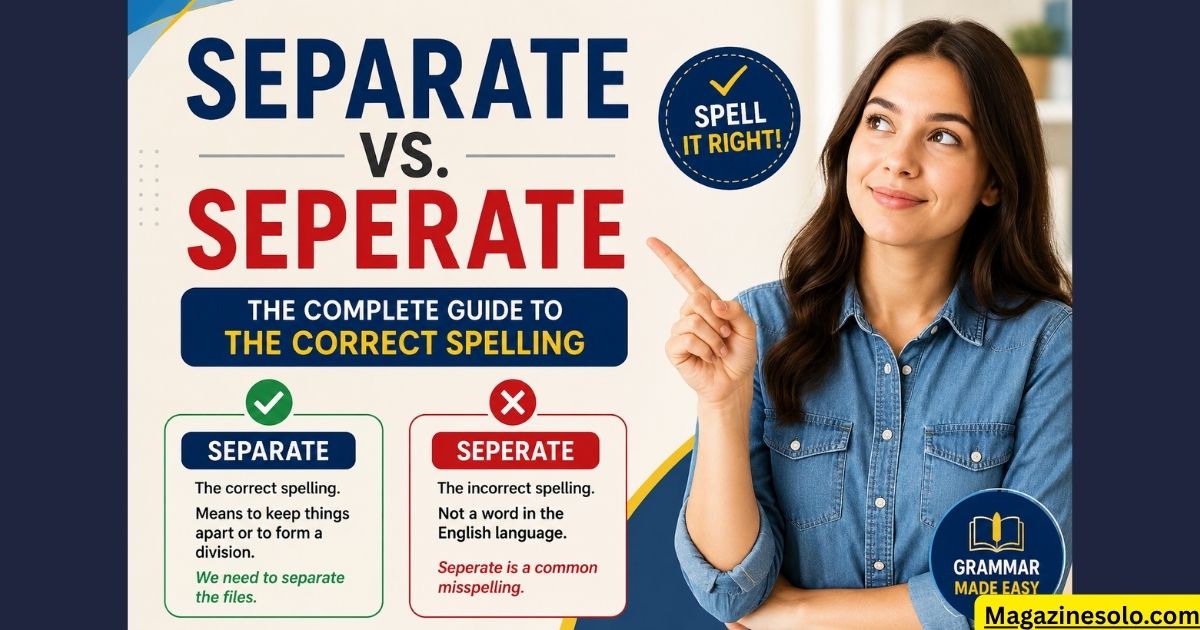
Separate vs. Seperate: The Complete Guide to the Correct Spelling
If you’ve ever typed this word and then stared at it wondering whether it looks “right,” you’re not alone. It’s one of the most Googled spelling questions in English, and there’s a good reason for that: the correct version and the common typo look almost identical. This guide clears up the confusion for good, so you never have to second-guess yourself again.
Separate vs. Seperate, What’s the Correct Spelling?
Let’s settle this right away: “separate” is the correct spelling. “Seperate” is not a real word, it’s simply a misspelling, no matter how often it shows up in emails, texts, and social media posts.
So when people search for “seperate or separate,” “separate vs seperate,” or ask “how do you spell separated,” the answer is always the same. Only one version exists in the dictionary, and it’s the one with two A’s: s-e-p-A-r-A-t-e.
The mix-up happens because of how the word sounds when spoken quickly. In casual speech, that middle “a” often gets swallowed and comes out sounding like “eh,” which nudges people toward writing an “e” instead. It’s an easy trap, but now that you know it, you won’t fall into it again.
Understanding the Core Difference (Separate vs. Seperate)
There isn’t really a “difference” in meaning between these two words, because only one of them actually means anything.
| Word | Status | Meaning |
| Separate | Correct | To divide, set apart, or keep things apart; also describes something distinct or standing on its own |
| Seperate | Incorrect | No meaning, it’s a spelling error, not an alternate form |
Unlike some commonly confused word pairs (like “affect” vs. “effect,” which both exist but mean different things), this one is simpler. “Seperate” isn’t a British spelling, an informal variant, or an old-fashioned form. It’s simply wrong in every version of English, American, British, Canadian, or Australian.
Why “Separate” Is Difficult to Spell
“Separate” regularly shows up on lists of the most misspelled English words, right alongside words like “definitely” and “necessary.” A few reasons explain why it trips people up so often:
- The pronunciation doesn’t match the spelling. The middle vowel sound is often reduced to a quick “uh” sound, making it easy to guess “e” instead of “a.”
- Muscle memory works against you. Once your fingers learn to type “seperate,” autocorrect and repetition can reinforce the wrong pattern.
- It has two identical-looking syllables. “Sep” and “rate” bookend a middle section that’s easy to mistype without noticing.
- Related words inherit the same mistake. People who misspell “separate” usually also misspell “separately,” “separated,” and “separation” the same way.
Once you understand where the confusion comes from, fixing it becomes much easier, it’s really about training your eye to spot that middle “a.”
Correct Meaning and Uses of “Separate”
“Separate” is a flexible word that can function as a verb, an adjective, and occasionally a noun.
As a verb (pronounced SEP-uh-rate), it means to divide, split apart, or keep things or people from being together. Think of separating laundry, separating two arguing kids, or separating facts from opinions.
As an adjective (pronounced SEP-rit), it describes something that is distinct, apart, or standing on its own, like having “separate” bedrooms or “separate” opinions on a topic.
As a noun (less common), “separates” refers to individual clothing pieces, like tops, skirts, or trousers, that can be mixed and matched, often seen in fashion and retail contexts.
Knowing these different roles helps you understand why the word shows up in so many everyday sentences, from casual conversation to legal and business writing.
Examples of “Separate” in Sentences (Verb and Adjective)
Seeing the word in context makes it much easier to remember. Here are some natural examples:
Verb usage:
- Please separate the recyclables from the regular trash.
- The teacher had to separate the two students who kept talking.
- It’s healthy to separate your work life from your home life.
- We need to separate the good apples from the bruised ones.
Adjective usage:
- My sister and I have separate bank accounts.
- They sleep in separate rooms during allergy season.
- This is a completely separate issue from what we discussed earlier.
- The company keeps its finance and marketing teams in separate departments.
Notice how in every one of these, “seperate” would look immediately out of place once you know the correct spelling to compare it against.
“Seperate”, Why It’s Incorrect
There’s no hidden rule that makes “seperate” acceptable in any context, formal, informal, academic, or casual. It doesn’t appear in any recognized English dictionary because it isn’t a word; it’s simply what happens when someone spells “separate” the way it sounds rather than the way it’s written.
If you search “seperate or separate” online, you’ll notice spell-checkers, grammar tools, and dictionaries all point to the same answer. The confusion is common enough that major grammar resources dedicate entire articles just to clarifying it, which tells you how widespread the mistake really is. But widespread doesn’t mean correct. In professional writing, resumes, emails, or school assignments, using “seperate” can come across as a careless error, even if the rest of your writing is strong.
Separation vs. Seperation (Correct vs. Incorrect)
The same rule carries over to the noun form of the word.
| Word | Status | Notes |
| Separation | Correct | Refers to the act or state of being divided or set apart |
| Seperation | Incorrect | Common misspelling with the same “a to e” error |
“Separation” is used in everyday language, legal contexts (like a marital separation), workplace settings (like a “separation of duties”), and even science (like the “separation” of mixtures in chemistry). Just like with “separate,” remembering the two A’s is the key to writing it correctly every time.
Examples of “Separation” in Sentences
- The couple announced their separation after fifteen years of marriage.
- There should be a clear separation between personal and professional emails.
- The company enforces a strict separation of duties to prevent fraud.
- A thin wall creates a separation between the two rooms.
- The chemistry experiment involved the separation of oil and water.
Pronunciation Guide for Separate and Separation
Pronunciation is actually where a lot of the spelling confusion begins, so it helps to break it down:
| Word | Part of Speech | Pronunciation |
| Separate | Verb | seh-puh-rayt |
| Separate | Adjective/Noun | seh-prit |
| Separation | Noun | seh-puh-ray-shun |
| Separately | Adverb | seh-prit-lee or seh-puh-rayt-lee |
| Separated | Past tense verb | seh-puh-ray-tid |
Saying the word slowly and deliberately, emphasizing each “a”, can actually help reinforce the correct spelling in your memory over time.
Memory Tools to Avoid Spelling Errors
If you’ve misspelled this word before, these simple tricks can help make sure you never do it again:
- “There’s ‘a rat’ in separate.” Spot the word “rat” hiding in the middle of “sep-A-RAT-e”, it’s a silly but incredibly effective trick that many teachers use.
- Two A’s, not two E’s. Just remember: separate has A’s on both sides of the “r,” not E’s.
- Think of the Latin root. The word comes from the Latin separare, meaning “to set apart”, and that root always uses an “a,” never an “e.”
- Say it slowly, syllable by syllable. Sep-a-rate. Hearing each part clearly helps override the “eh” sound you hear in fast speech.
- Use spell-check as backup, not a crutch. Tools catch the error, but building the habit means you won’t need them for this word anymore.
Pick whichever trick sticks with you best, even one simple mental cue can permanently fix a spelling habit.
Common Phrases Using “Separate” and “Separation”
Here are some everyday phrases where the correct spelling matters most, especially in professional and academic writing:
- Separate ways / go their separate ways
- Separate but equal
- Keep church and state separate
- Judicial separation
- Legal separation
- Separation anxiety
- Separation of powers
- A separate matter entirely
- Separate checks, please
- Separation agreement
Getting these right instantly makes your writing look more polished, whether it’s a text message, a resume, or a formal report.
Quick Reference Table
| Correct Spelling | Incorrect Spelling |
| Separate | Seperate |
| Separates | Seperates |
| Separated | Seperated |
| Separately | Seperately |
| Separating | Seperating |
| Separation | Seperation |
| Separations | Seperations |
| Separator | Seperator |
Bookmark this table if spelling this word has ever slowed you down, a quick glance is often all you need.
Frequently Asked Questions
Is it “separate” or “seperate”?
“Separate” is the only correct spelling. “Seperate” is a common misspelling and isn’t a recognized English word.
How do you spell “separated”?
It’s spelled “separated,” with two A’s, not “seperated.”
Is “seperate” ever correct in British English?
No. “Seperate” is incorrect in every version of English, including British, American, Canadian, and Australian spelling.
Why do so many people misspell “separate”?
It’s usually because the middle vowel sound gets slurred in speech, making it easy to guess an “e” instead of the correct “a.”
What’s an easy trick to remember the spelling?
Remember that there’s “a rat” hidden inside sep-A-RAT-e, it’s a simple visual cue that sticks in memory.
Is “separation” spelled with an A or an E in the middle?
It’s spelled with an A: “separation,” not “seperation.”
Final Thoughts
At the end of the day, this comes down to one simple fact: “separate” is correct, and “seperate” is not. The confusion is common, understandable, and easy to fix once you know the trick, just remember those two A’s, or picture “a rat” tucked inside the word. Whether you’re writing a text, an email, a school essay, or a professional report, getting this spelling right is a small detail that makes a real difference in how polished your writing looks. Keep this guide handy, and you’ll never have to second-guess “separate” again.

Shoaib Ahmad is a language-focused content writer and researcher at magazinesolo.com, where he explains the meaning of words, phrases, and text in a clear and reader-friendly way. His work focuses on simplifying language, uncovering context, and helping readers understand text with confidence and clarity.