Separate Spelling Rule: The Middle Letter Is A Because the Root Is Par

Separate spelling rule in one line: check the root, not the sound. The middle letter of separate is a because its root syllable is par, and that single fact settles the spelling every time.
Separate is correct, and seperate is not a word. That verdict is stated once here, in the opening, because everything after it is the rule that makes the verdict permanent rather than memorized.
Most spelling advice for this word stops at a trick. The rat helps, and appears below labelled as what it is. A root check keeps working on new words.
What follows is the check itself. Why sound fails, what the root records, how the syllable runs through prepare and repair, and how desperate tries to pull the wrong letter across.
The Rule in One Line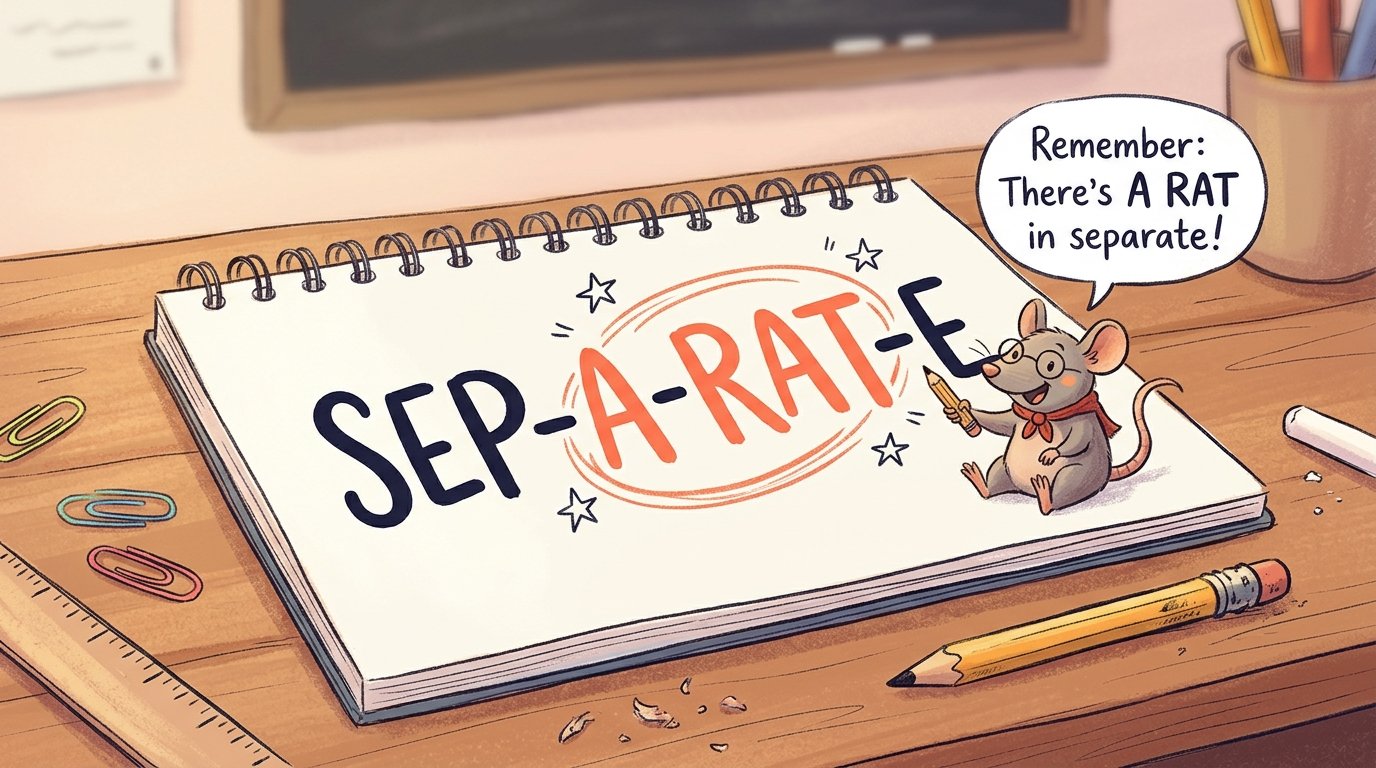
Separate or seperate: the verdict the rule rests on
The verdict: separate, spelled s-e-p-a-r-a-t-e. Two a letters sit in the word, one on each side of the r, and the middle one is the letter writers keep replacing with an e.
Seperate appears in no dictionary consulted for this page: the Merriam-Webster entry for separate, the Cambridge Dictionary US entry for separate and the Dictionary.com entry for separate each carry an entry for separate, and none of them returns any entry for seperate.
The full verdict treatment lives elsewhere on this site. our separate vs seperate verdict carries the complete word family, the error gallery and the deeper verdict record, so this page can stay on the rule itself.
The rule card: check the root, not the sound
The rule card fits on one line. Root syllable: par. Letter the root carries: a. Check: find the root syllable first, then write the quiet vowel the way the root spells it.
The card works because the failure point is predictable. The error never touches the first syllable or the ending. It strikes one unstressed vowel in the middle, and the root is the only evidence that vowel leaves behind.
Why Sound Cannot Tell You the Letter
The schwa in the middle
Say separate at normal speed and the middle vowel vanishes. It comes out as a weak “uh,” the sound linguists call the schwa, because that syllable carries no stress at all.
A reduced vowel can be spelled with almost any vowel letter. English writes the schwa with a, e, i, o and u in different words, so hearing “uh” tells a writer nothing about which letter belongs there.
That is the whole cause of the seperate error. The ear reports a sound with no letter attached, the writer guesses, and the guess lands on e because e feels like the default weak vowel.
Sound is therefore demoted from judge to suspect. Wherever a vowel is unstressed, pronunciation stops being evidence. The rule replaces the ear with the word’s history, which never reduces and never guesses.
Why the adjective sounds even more like an e
The verb and the adjective do not sound the same. The verb ends in a full “rate,” SEP-uh-rayt, while the adjective shrinks toward SEP-rit, with its ending syllable reduced almost to nothing.
The adjective’s rhythm is the rhythm of desperate. QuillBot’s seperate or separate guide notes that the adjective sounds slightly similar to desperate, and that shared weak middle is one feeder of the confusion between the two words.
Reduced sound, full spelling: the letters do not follow the reduction. the Cambridge Learner’s Dictionary entry for separate records the same word for learners with its pronunciations, and the spelling stays separate in every form it lists.
The Rule Is the Root: Se- Plus Parare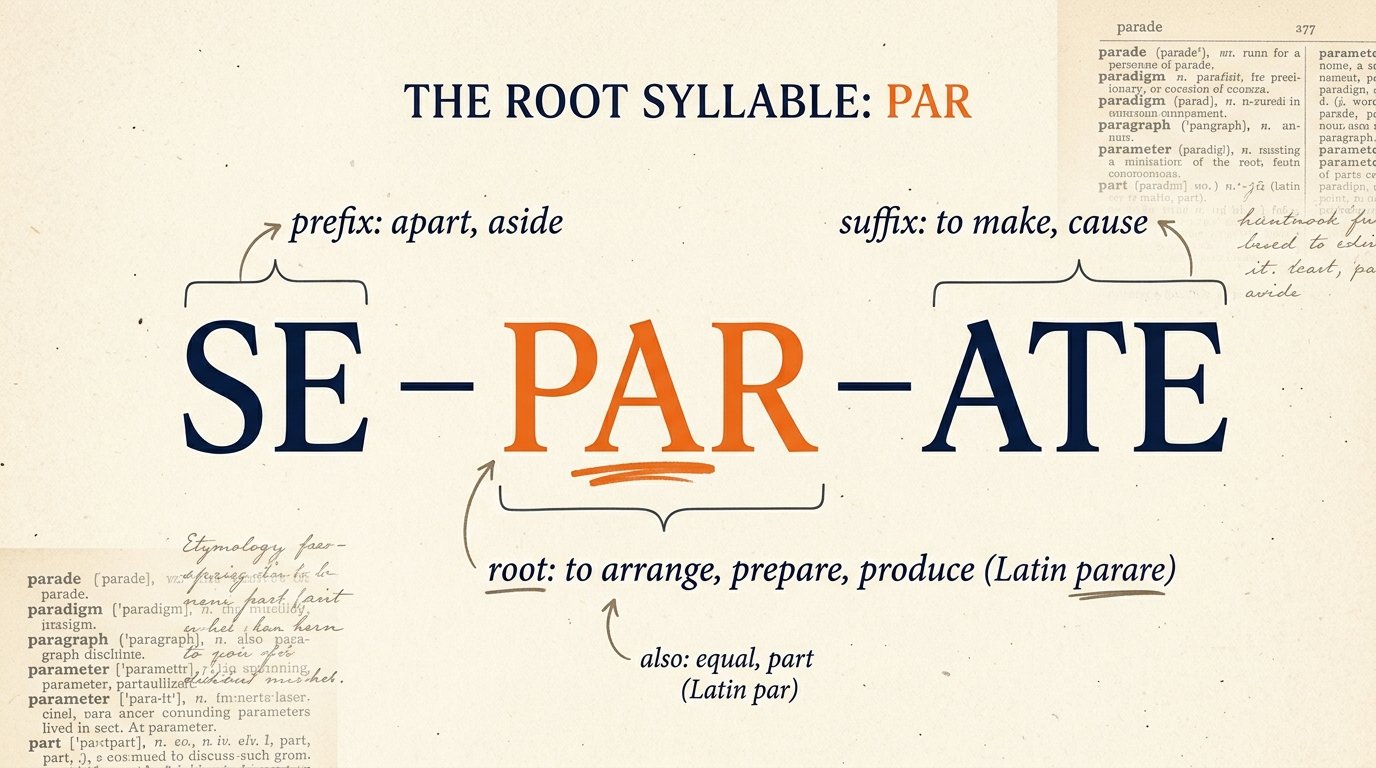
What Merriam-Webster and Oxford record
The dictionary record is short and unanimous. Merriam-Webster gives: Middle English, from Latin separatus, past participle of separare, from se-, apart, plus parare, to prepare, procure. First known use: the 15th century.
Oxford records the same chain in its Word Origin line. the Oxford Advanced Learner’s Dictionary adjective entry for separate gives Latin separat-, “disjoined, divided,” from separare, from se-, “apart,” plus parare, “prepare.” the Oxford Advanced Learner’s Dictionary verb entry for separate carries the verb entry too.
Dictionary.com agrees and adds a warning. the Dictionary.com entry for separate glosses parare as “to furnish, produce, obtain,” cross-refers to prepare, and states in its own usage note that separate is one of the most commonly misspelled words.
Three independent records, one root. No fetched dictionary derives separate from anything else, and none mentions a per root anywhere in the word’s history. The a is not a preference; it is an inheritance.
Par, not per: the syllable that carries the a
Inside separate sits the syllable par, p-a-r. That syllable is the middle of the word and the source of its contested letter. Spell the root syllable correctly and the whole word follows.
There is no per in this word’s past. Writers who produce seperate have not misheard a letter; they have replaced the root syllable with a different one. The correction is therefore a root correction, not a letter swap.
A folk gloss sometimes claims par means “to part.” The dictionaries do not record that gloss; they record prepare, procure, furnish, produce, obtain. The rule rests on the dictionary gloss, not on the tidier story.
The etymology chain: separare, separaten, separate
The chain has three links. Latin separare splits and prepares apart; its past participle separatus enters Middle English; the modern form separate settles with the root syllable intact and audible in the spelling.
Every link keeps the a. Separare, separatus and separate all carry par in the middle. Six centuries of sound change reduced how the vowel is heard and never touched how the root is spelled.
The rat in separate: a memory device, not the reason
There is a rat in separate: sep-A-RAT-e. The letters a-r-a-t genuinely sit inside the word, so picturing the rat fixes the middle letters in memory. Teachers have used the trick for decades.
The rat is a memory device, never an etymology. It explains nothing about where the word came from, and it works for one reason only: the letters happen to be there. Grammarly’s separate vs seperate guide teaches it alongside its own guide.
Use the rat for speed, the root for certainty. The rat answers in a second and covers this one word. The root answers slightly slower and covers the family, the relatives and the mirror trap below.
The other attested tricks
The vowel symmetry check runs e-a-a-e. Grammarly’s separate vs seperate guide also teaches the pattern of the word’s vowels: e, then a, then a, then e. A draft showing e in the middle breaks the symmetry on sight.
The separated-by-r observation spots the same fact differently. Each a in the word is separated by the letter r, a phrasing the Spellzone teaching tradition uses. It is another memory route to the same two letters.
Saying it slowly stretches the schwa back out. SEP-a-rate, said deliberately, lets the middle a be heard as an a. Proofed’s guide to spelling separate collects memory routes like these for exactly this word.
The Mirror Trap: Desperate Runs on a Different Root
Sperare, to hope: why desperate keeps its e
Desperate looks like separate’s twin and is no relation. Merriam-Webster records it from Middle English desperat, borrowed from Latin desperatus, past participle of desperare, “to give up as hopeless, despair of.”
Inside desperare sits sperare, to hope. Desperate therefore carries the syllable sper in its middle, s-p-e-r, and sper is spelled with an e. The word keeps its e for exactly the reason separate keeps its a.
Two roots, two letters, no shared story. Separate is se- plus parare, to prepare apart. Desperate is de- plus sperare, hope given up. Merging the two histories is the single most common way this pair gets taught wrong.
The meanings never meet either. Separate means set apart; desperate means having lost hope. Only the rhythm and weak middle vowel are shared.
The two-root contrast table
|
Word |
Root syllable |
Latin source |
Middle letter |
The check |
|---|---|---|---|---|
|
separate |
par |
separare, from parare, to prepare |
a |
find par, write a |
|
desperate |
sper |
desperare, from sperare, to hope |
e |
find sper, write e |
Read the table as two separate rules, not one pattern. Each word obeys its own root. The moment the rows blur into one habit, errors start crossing over.
The table doubles as a self-test. Cover the middle-letter column and name each root from memory, and both spellings are owned.
The reverse error: desparate
The contamination runs in both directions. Desparate, with an a, is an attested misspelling of desperate, recorded in the linguist Arnold Zwicky’s language log discussion of this pair. Writers pull separate’s a across into desperate.
The mechanism is identical, mirrored. Desperate hides its middle vowel behind the same schwa, so sound gives no evidence there either. A writer armed with “a in the middle” as a habit, not a root, exports the error.
The Check That Travels: The Par Family
Separate, separation, separately: one root, every form
The root does not change when endings attach. Separated, separating, separately, separation and separator all keep par in the middle, so the one check a writer learns for separate silently covers the whole family.
The error family makes the same journey in reverse. Seperated, seperately and seperation are the attested wrong forms, and each one is the single root substitution repeated. Fix the root once and every form is fixed with it.
The complete family record sits with the verdict page. our separate vs seperate verdict pairs every correct form with its common error, row by row. This page needs only the principle: one root, inherited by every form the word takes.
Prepare, repair, apparatus: the same par syllable
Separate is not the only English word built on parare. Prepare and repair carry the same par syllable from the same Latin verb, and apparatus descends from the same root through its own Latin path.
|
Word |
The par syllable |
How the root shows up |
|---|---|---|
|
separate |
se-PAR-ate |
set apart, from separare |
|
prepare |
pre-PAR-e |
make ready beforehand, from parare |
|
repair |
re-PAR-e |
put back in order, from parare |
|
apparatus |
ap-PAR-atus |
equipment made ready, from the same root |
The transfer is the point of the whole rule. Checking the root in separate rehearses the exact move that confirms the a in prepare and repair.
The boundary of the family matters as much as its members. Parade and parent are not parare relatives in the fetched dictionary record, and claiming them would corrupt the method. A root check is only trustworthy when its family is accurate.
The three-step root check, worked on new words
Step one: find the vowel the sound cannot settle. Say the word at natural speed. The syllable that collapses into “uh” is the suspect, and it is the only syllable that needs the check.
Step two: name the root syllable. Use a dictionary etymology when the root is not obvious: par inside separate, sper inside desperate. The root syllable, not the whole word, is what carries the contested letter.
Step three: write the letter from the root, then verify against the family. Par gives a, sper gives e. A quick glance at a relative, separation for separate, confirms the letter survives the family unchanged.
Worked once, the check takes seconds. Separate: root par, letter a, separation agrees. Desperate: root sper, letter e. Same three steps, both correct.
Teaching the Rule (for Teachers and Parents)
A one-minute teaching sequence
First, give the verdict and the letter string. Separate, s-e-p-a-r-a-t-e, said once, written once. A learner who starts from the answer can attach the reason to something solid instead of guessing toward it.
Second, show the rat inside the word. Sep-A-RAT-e gives the learner a picture to keep. It is the fast hook, and it is honestly labelled a trick, so the learner never mistakes it for the explanation.
Third, give the reason the trick works. The middle syllable is par, from the Latin for prepare, and par is spelled with an a. Now the learner owns a check that still works when the picture fades.
Fourth, finish with one dictation line. Production, not recognition, is where the error lives. One written sentence in the learner’s own hand reveals immediately whether the check has actually taken hold.
Dictation and self-test set
Pair the two trap words in a single line. “Keep the desperate measures on a separate list.” One sentence forces both roots to be produced at once, which is exactly where the crossover errors happen.
The errors to listen for
Seperate is the headline error, and it is diagnostic. It tells the teacher the learner is spelling from sound. The remedy is not more copying of the word; it is the root check, aimed at the exact syllable that failed.
Desparate is the transfer error. It appears after separate has been learned as a letter habit. Its presence is useful evidence: the learner has a rule, but the rule is the wrong size, covering two roots with one letter.
Seperation and seperately are the family errors. They show the base word was memorized as a string instead of a root. One family drill, checking each form against par, usually ends the whole set at once.
When the Rule Does Not Apply
Words where the root check cannot help
Not every quiet vowel hides a Latin root a learner can reach. Some spellings rest on Greek roots, borrowed forms or sheer convention, and for those words the dictionary entry, not a root story, is the honest check.
Nor can it rescue a word whose root the writer does not know. Even then it flags the syllable as unsettled, sending the writer to the dictionary before the guess hardens.
The unsupported -arate generalization, flagged
A tidier rule circulates and should not be taught. The claim that words ending in -arate take an a, against an -erate class built from desperate, generate and moderate, sounds systematic and is stated by no fetched dictionary or authority.
The generalization fails because it groups by ending, not by root. Endings are where the schwa hides the evidence; roots are where the evidence lives. Separate and desperate differ in the middle because par and sper differ, not because of their endings.
The defensible rule is per-root, and only per-root. Check the root syllable, because the schwa hides it. That sentence is less elegant than the folk version, and it has the advantage of being true for every word it touches.
Small-difference pairs reward the same slow reading. our precede vs proceed guide separates two verbs by their parts, and our desert vs dessert guide keeps a landscape and a pudding apart by one letter each.
Other pairs turn on one space, letter or syllable. our a lot vs allot difference guide, our adapt vs adopt difference guide, our all ready vs already difference guide and our adverse vs averse difference guide each settle by structure, not by sound.
Single-word verdicts complete the set. our atleast or at least verdict settles a spacing question, while our definitely spelling guide and our correct spelling of definitely guide prove the most missed word in English.
Frequently Asked Questions
1. Is it separate or seperate?
Separate. The word is spelled s-e-p-a-r-a-t-e, with an a in the middle and two a letters in total. Seperate is not a word in any variety of English.
2. Is seperate a word?
No. Seperate is a misspelling, not a variant spelling. Merriam-Webster, Oxford Advanced Learner’s, Cambridge and Dictionary.com each carry an entry for separate, and none returned an entry for seperate.
3. What is the rule for spelling separate?
Check the root, not the sound. The middle syllable is par, from the Latin parare, so the letter is a. That vowel is unstressed and gives no sound evidence, which is why the root decides.
4. Why is separate spelled with an a in the middle?
Because the root syllable is par. Merriam-Webster records the word from Latin separare, built from se-, apart, plus parare, to prepare, procure. There is no per in the word’s history, so the letter is a.
5. How do you remember the spelling of separate?
Use the rat for speed and the root for certainty. There is a rat in separate, sep-A-RAT-e, and the durable check is the root: the syllable is par, so the letter is a.
6. What is the rat trick for separate?
The letters a-r-a-t sit inside the word. “There is a rat in separate” fixes the middle letter, and the trick is attested across Grammarly, Proofed, Spellzone and ThoughtCo. It is a memory device, not an etymology.
7. Does separate have one a or two?
Two. Separate is s-e-p-a-r-a-t-e: an a before the r and an a after it. The same check is often phrased as a mnemonic: two A’s, not two E’s, with A’s on both sides of the r.
8. Why do so many people spell it seperate?
The middle vowel is unstressed and reduces toward the schwa. It sounds like “eh,” so the ear pushes writers toward e, and familiarity with desperate pulls the same way.
9. Is seperate ever correct in British English?
No. The spelling is identical in British, American, Canadian and Australian English: separate is correct and seperate is an error in all four. Only pronunciation moves slightly between varieties; the letters never do.
10. How do you spell separated?
Separated: s-e-p-a-r-a-t-e-d. The root does not change when the ending is added, so the a stays. Seperated is the attested error form, named by both Grammarly and QuillBot in their error families.
11. How do you spell separately?
Separately, with the same par root and the same middle a. Seperately is the attested error, one of the family forms Grammarly and QuillBot both list. If separate is right, separately follows automatically.
12. How do you spell separation?
Separation. Seperation is the attested misspelling, recorded by QuillBot and Grammarist. The whole family inherits the root syllable par, so the a survives every ending the word takes.
13. How is separate pronounced as a verb?
SEP-uh-rayt, with a full “rate” ending. Grammarist, QuillBot and GrammarPaths all record the split: the verb keeps the long ending while the adjective reduces it. The spelling is the same for both.
14. How is separate pronounced as an adjective?
SEP-uh-rit, often shortened toward SEP-rit. The ending syllable is unstressed and reduces, which is one reason the adjective feels e-like and feeds the seperate error.
15. Why does separate sound like seperate?
Because the middle vowel is unstressed. In fast speech it reduces toward the schwa and comes out sounding like “eh,” which is exactly the sound writers then spell with an e.
16. What is a schwa and why does it cause this error?
The schwa is the weak “uh” sound an unstressed vowel reduces to. A reduced vowel can be spelled with almost any vowel letter, so the sound gives no evidence for the middle letter. Where sound cannot decide, the root decides.
17. Where does the word separate come from?
From Latin, through Middle English. Merriam-Webster records: Middle English, from Latin separatus, past participle of separare, from se-, apart, plus parare, to prepare, procure. First known use: 15th century.
18. What Latin words is separate built from?
Separare is the verb, and separatus is its past participle. Separare itself is se-, apart, plus parare, and Oxford Advanced Learner’s gives the same chain in its Word Origin line.
19. What does parare mean?
Merriam-Webster glosses parare as to prepare, procure. Dictionary.com glosses it “to furnish, produce, obtain” and cross-refers to prepare. A looser folk gloss, “par means to part,” appears in one competitor and is not what the dictionaries record.
20. Is the root of separate par or per?
Par, and the question is the whole rule. The root syllable inside separate is par, from parare; there is no per root in this word’s history. Because the syllable is par, the middle letter is a.
21. Does the rat mnemonic explain why the spelling is right?
No, and the distinction matters. The rat is a memory device: the letters a-r-a-t happen to sit inside separate, so the phrase helps recall the spelling. The reason the spelling is right is the root, par, from parare.
22. Is separate related to desperate?
No. They are different words from different roots that happen to sound alike in the middle. Separate runs on parare, to prepare; desperate runs on desperare, to give up as hopeless, from sperare, to hope.
23. Why does desperate have an e but separate has an a?
Because each middle letter follows its own root. Desperate carries sper, from sperare, to hope, so its middle vowel spells e. Separate carries par, from parare, so its middle vowel spells a. Merging the stories is the error.
24. What root does desperate come from?
Latin desperatus, past participle of desperare. Merriam-Webster records desperate from Middle English desperat, borrowed from that form, meaning “to give up as hopeless.” Inside desperare sits sperare, to hope.
25. Is desparate a misspelling of separate?
No. Desparate is the attested reverse error: a misspelling of desperate, not of separate, recorded in the linguist Arnold Zwicky’s language log discussion of the pair. The two words contaminate each other in both directions.
26. Why do people write desparate for desperate?
The same schwa mechanism runs in reverse. Desperate hides its middle vowel the same way separate does, so sound gives no evidence, and a writer who knows separate carries an a can pull that a across into desperate.
27. Do prepare and repair come from the same root as separate?
Yes. Prepare, repair and separate all carry the par syllable of Latin parare. Dictionary.com’s etymology for separate cross-refers to prepare on exactly this root.
28. What other English words come from parare?
On the fetched dictionary record: prepare, repair, apparatus, and separate itself. The boundary matters: parade and parent are not parare relatives in the fetched record and must not be claimed as such.
29. Does the a rule apply to separation and separately too?
Yes. The root never changes across the family, so every form keeps par and its a: separated, separating, separately, separation, separator, separateness.
30. How can I check the spelling of a word when the middle vowel is silent?
Find the root syllable. The vowel is unstressed, so sound cannot settle it; name the root, in a dictionary etymology if needed, then spell the quiet vowel the way the root spells it.
31. What is the three-step root check?
Find the unsettled vowel, name the root, write its letter. Say the word and locate the vowel sound cannot settle, name the root syllable, then write the middle letter from the root and verify it against the word family.
32. How do I teach a child to spell separate?
Give the verdict, the picture, the reason, then one dictation line. State the letter string, show the rat, then explain the root is par, so the child owns a check, not just a trick.
33. What is a good dictation sentence for separate?
One that produces both trap words in a single line. For example: “Keep the desperate measures on a separate list.” Pairing separate with desperate tests both roots at once, which is where the errors actually happen.
34. Why is separate on so many most-misspelled lists?
The claim is real, but it travels with its sources. Dictionary.com states in its usage note that separate is one of the most commonly misspelled words, and Grammarly places it among them alongside loose and definitely.
35. Was seperate ever an accepted spelling in the past?
No accepted seperate appears anywhere in the fetched dictionary record. The dictionaries record separate continuously from Middle English, with a 15th century first known use, and no entry, historical or current, was returned for seperate in this research.
36. Why does seperate look right when I type it?
Familiarity. A form typed and seen many times starts to read as correct, which is why a second look rarely catches it. The practical fix is not a harder look but a different check: the root.
37. Is there a rule that all -arate words take a?
No. That tidy generalization is not stated by any fetched dictionary or authority, and it is flagged here as an unsupported folk rule. The only defensible rule is per-root: check the root syllable, because the schwa hides it.
38. What is the difference between separate and desperate in meaning?
Separate means set or kept apart; desperate means having given up hope. The words share a rhythm and an unstressed middle vowel, and nothing else: different roots, different meanings, different middle letters.
39. Can separate be a noun?
Yes. Merriam-Webster records a noun use of separate from 1886, the use behind clothing “separates.” The spelling does not change with the part of speech: verb, adjective and noun are all separate, all with par in the middle.
40. Does separate have a silent letter?
No letter in separate is silent. The middle a is fully present in the spelling; it is only weakly heard, because the syllable is unstressed and the vowel reduces toward schwa. Weak sound, present letter.
41. Why does the adjective separate sound like SEP-rit?
Because its ending syllable is unstressed and reduces in speech. QuillBot notes the adjective sounds slightly similar to desperate, and that reduced rhythm is one feeder of the confusion.
42. How can I stop misspelling separate for good?
Retrain the check, not the word. When the middle vowel is in doubt, ask for the root, par, confirm it against the family, and use the rat meanwhile. Once the root check runs alone, the error has no route back.
Conclusion
The separate spelling rule holds because the root holds. Separate takes an a in the middle since its root syllable is par, from parare, and no amount of listening will ever change that letter.
For the full verdict treatment, the family forms and the error gallery, one page carries the complete record. our separate vs seperate verdict is that page: this page taught the check, and that page owns the verdict depth behind it.
The same root-first habit pays off across the spelling rail. our definitely spelling guide and our correct spelling of definitely guide settle the word writers miss most, and the MagazineSolo home page collects every guide in one place.

Dilawar is a content writer at MagazineSolo, covering travel, home improvement, interior design, and everyday lifestyle topics. He enjoys researching practical solutions, exploring travel destinations, and sharing helpful guides that make daily life easier. His writing focuses on clear information, useful advice, and engaging stories for a wide audience.