Adapt vs Adopt Difference: The Word Families and the Domains, Explained

Adapt vs adopt difference questions rarely stop at the two verbs, because the same choice returns inside adaptation and adoption, adaptive and adoptive, and adapter and adopter. Learn the two families once, and every form falls into place.
The short rule is simple. Adapt means to change something to fit new conditions, while adopt means to take something as your own by choice, usually as it stands.
The fuller rule is better. Each professional domain has already picked its family: biology only adapts, film credits only adapt, councils only adopt. Name the domain, and the verb chooses itself.
The Short Answer: Change to Fit, or Choose as Your Own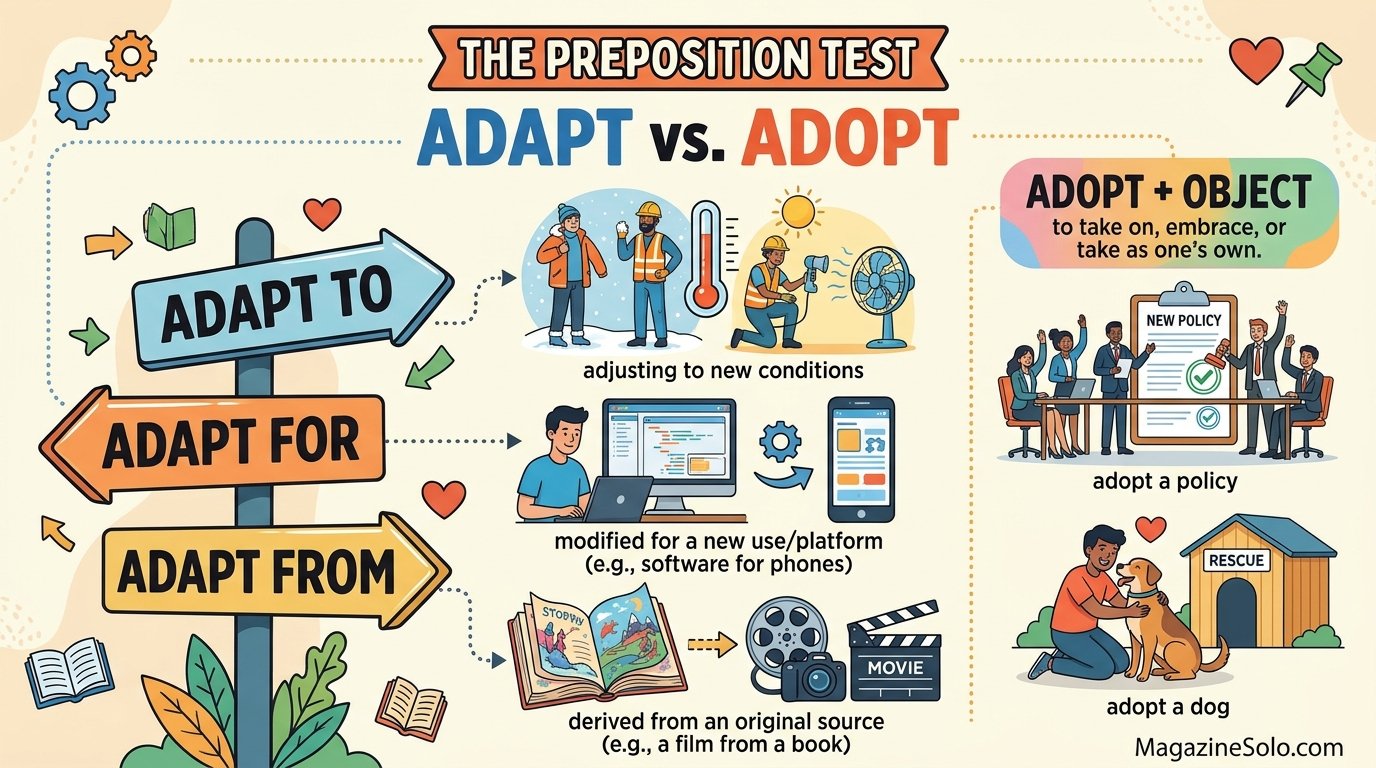
Ask one question about your sentence: is something being changed, or is something being chosen? Changed points to the adapt family, and chosen points to the adopt family, every time.
A species adapts to a desert because its body changes across generations. A council adopts a budget because it chooses a finished text and makes that text its own.
Three quick checks settle most sentences before you write them:
- Swap in the noun: if adaptation fits, the verb is adapt; if adoption fits, the verb is adopt.
- Watch the preposition: adapt pairs with to (adapt to change), while adopt takes its object directly (adopt a method).
- Read the set phrase: adapted from a novel, adopt a resolution, early adopter, never the crossed versions.
The Family Map: Every Form of Adapt and Adopt in One Table
Writers meet this pair away from the verbs: in a job advertisement praising an adoptive platform, in a headline about an early adapter, in a family story naming an adoptive child. Each of those errors lives in a derivative.
Sort any word into its family first, and the meaning follows. The adapt side always carries change and fitting; the adopt side always carries choice and taking on.
|
Word form |
Adapt family (change to fit) |
Adopt family (choose as your own) |
|---|---|---|
|
Verb |
adapt: change to fit new conditions |
adopt: take as your own by choice |
|
Noun |
adaptation: the change, or its result |
adoption: the act of taking on |
|
Able adjective |
adaptable: able to change and fit |
adoptable: able to be adopted |
|
Working adjective |
adaptive: built to adjust |
adoptive: related through adoption |
|
Person or device |
adapter: a device, or one who adapts a work |
adopter: one who adopts |
|
Person receiving |
(no matching form) |
adoptee: the person who was adopted |
The adapt family: adaptation, adaptable, adaptive, adapter
Adaptation names both the process of changing and the finished result: the adaptation of a novel, an adaptation to altitude. One word covers the work and the product, which is why science and film both rely on it.
Adaptable praises flexibility: an adaptable design, an adaptable colleague. Adaptive describes something built to adjust, from an adaptive trait in biology to adaptive technology in a classroom.
Adapter is the family’s working noun. It is usually a device that lets two different things connect, like a travel plug adapter, and it can also name the person who adapts a book for the screen.
The adopt family: adoption, adoptable, adoptive, adopter, adoptee
Adoption names the act of taking on: the adoption of a child, of a resolution, of a new platform. Where adaptation reshapes, adoption accepts and claims, and the thing taken on usually arrives as it is.
Adoptable means able to be adopted, heard most at animal shelters and also used for proposals and standards. Adopter names the person or organization doing the adopting, from a child’s adopter to an early adopter of software.
Adoptee names the person who was adopted, the receiving side of the act. The Canadian adoption glossary at Family Helper, used here for terminology only, defines the adoptee and the adoptive parent side by side in exactly this way.
Adopted vs adoptive: the role split that matters most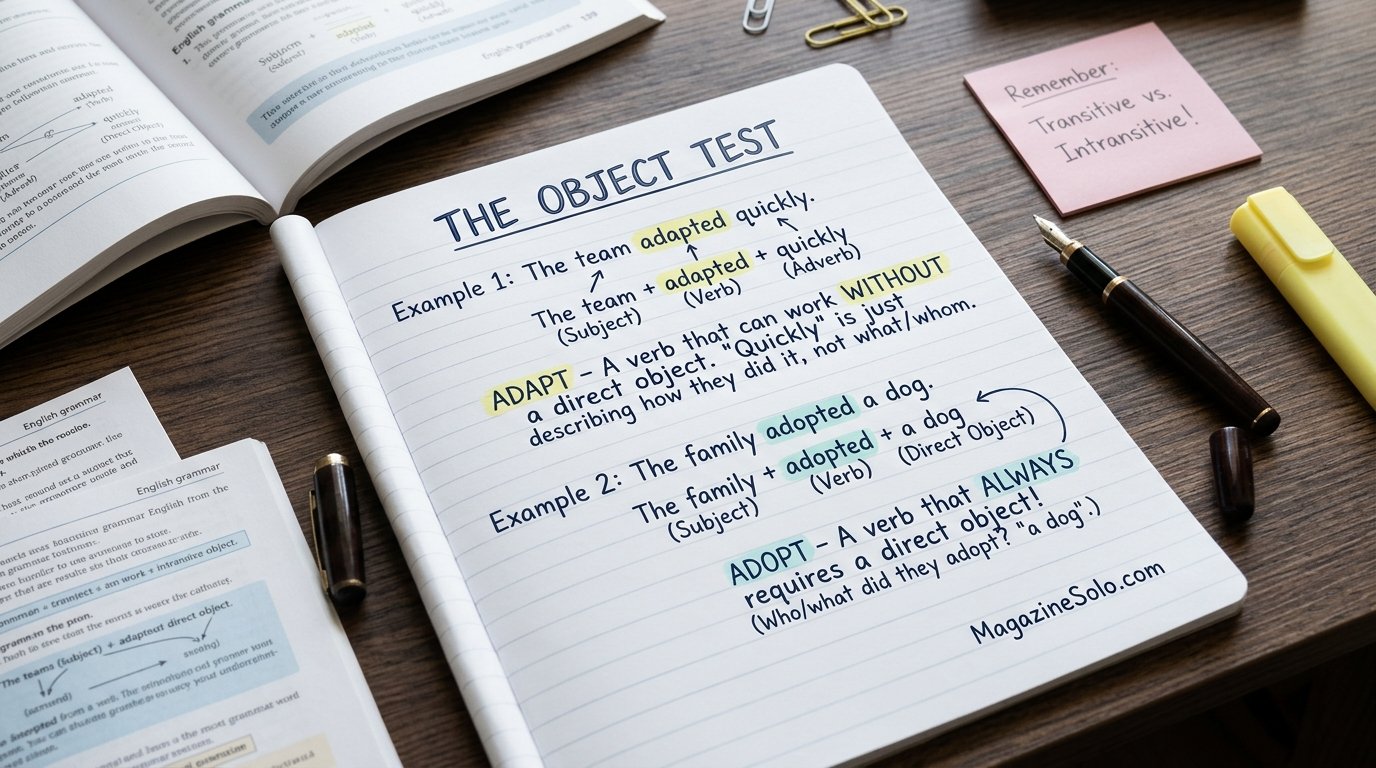
Inside the adopt family sits the pair’s sharpest trap. Adopted describes the person who was adopted, and adoptive describes the people who did the adopting, so the standard phrases are adopted child and adoptive parents.
|
Phrase |
Verdict |
Why |
|---|---|---|
|
adopted child |
Correct |
The child is the one who was adopted |
|
adoptive parents |
Correct |
The parents are the ones who adopted |
|
adoptive child |
Wrong |
It claims the child did the adopting |
|
adopted parents |
Wrong |
It claims the parents were adopted |
The usage guide at Grammar Monster states the same split plainly: children are adopted, and the parents who take them in are adoptive. Washington State University’s Common Errors page, named here in text, flags adoptive child as the classic slip.
The third word: adept, the adjective that is neither verb
Adept completes the confusion set, and it is not a verb at all. Adept is mainly an adjective meaning very skilled, as in adept at negotiation, and it can also serve as a noun meaning an expert.
The learner trio page at WordPandit teaches all three words together for a reason: one middle vowel separates change, choice, and skill. If your sentence praises skill, neither adapt nor adopt belongs in it.
The noun swap, worked once in full
Take a doubtful sentence: the studio announced the adoption of the novel for a streaming series. Swap the verb’s noun and the error shows itself, because a novel is changed, not chosen, so the noun must be adaptation.
Now the mirror case: the shelter posted photos of the adaptation of a puppy. A puppy is taken on, not reshaped, so the noun is adoption and the puppy is adoptable. Two sentences, one test, both fixed.
Domain 1, Biology and Evolution: Adaptation Only
Biology allows one family only, and saying so flatly is the whole lesson. Species adapt to their environment; they never adopt it, and no adoption exists anywhere in this domain.
An adaptation is a heritable trait that helps an organism survive and reproduce in its environment, shaped by natural selection across generations. The biology course text at LibreTexts defines adaptation in exactly those terms.
An adaptive trait is the feature itself: camouflage coloring, webbed feet, a longer neck. The adjective is always adaptive, never adoptive, because nothing in evolution is chosen or claimed.
Three errors mark science writing instantly: species adopted to a climate, an adoptive trait, and adaption in journal prose. Editors print adaptation, and careful writers match them.
Adaptation vs acclimatization: the distinction science keeps
Science separates two kinds of fitting that everyday writing blends. Adaptation is the heritable change across generations, written into a population by natural selection, and no individual animal performs it during its own lifetime.
Acclimatization is the short term adjustment one organism makes: a hiker’s breathing settles at altitude, a gardener hardens seedlings before transplanting. Both words sit inside the adapt family, but only adaptation is inherited, and confusing them misstates the timescale of the change.
Domain 2, Film and Publishing: Adapted From, Never Adopted From
Film credits say adapted from because a screenplay taken from a novel has been changed to fit a new medium. Scenes are cut, dialogue is rewritten, and interior thought becomes visible action.
That reshaping is why the product is an adaptation, why the script is an adapted screenplay, and why awards bodies formalize the work in the category Best Adapted Screenplay, kept separate from Best Original Screenplay.
Publishing holds the family split inside one industry. The work itself adapts: a novel is adapted, a play is adapted. The selection adopts: a school district adopts a textbook when a committee chooses it as the required text.
So a teacher adopts the textbook in September and adapts lessons, worksheets, and pacing to it all year. Both verbs, one classroom, in the order this page keeps returning to: choice first, change second.
The awards split teaches the same boundary from the other side. An original screenplay is written directly for the screen, with no source behind it, while an adapted screenplay begins from material that already exists in another form.
Writers’ contracts, festival entries, and credits all respect that line, because the two jobs differ: one invents the story, the other reshapes it. StudioBinder’s screenplay guides, named here in text, walk through the adapted category in those terms.
Domain 3, Technology and Business: Adopt the Platform, Then Adapt the Work
A company adopts a platform, a system, a tool, or a standard when it chooses it and starts using it as its own. Nothing about the platform changes at that moment; the decision is the adoption.
After adoption, the adapting begins. Teams adapt workflows, training, and documents to the platform, which is why business writing needs both families, each doing its own job in sequence.
The adoption curve and the five adopter categories
Adoption spreads through a population in a pattern mapped by Everett Rogers in his diffusion of innovations research. The TechTarget summary of that theory lists five adopter categories, with shares attributed to Rogers’ model.
|
Adopter category |
Share in Rogers’ model |
Who they are |
|---|---|---|
|
Innovators |
About 2.5 percent |
The first to try the new idea |
|
Early adopters |
About 13.5 percent |
Respected voices who adopt early |
|
Early majority |
About 34 percent |
Deliberate adopters just before the average |
|
Late majority |
About 34 percent |
Skeptical adopters just after the average |
|
Laggards |
About 16 percent |
The last to adopt, tradition first |
Those percentages are model figures, printed as Rogers’ framework rather than measured counts of any real launch. The categories themselves are the vocabulary business writing borrows, and every one of them is built on adopter.
Early adopter, never early adapter
An early adopter is a person or organization among the first to take up a new product, technology, or idea. The phrase belongs to the adopt family because the act is choosing early, not changing anything.
Early adapter is the domain’s signature error: it swaps the person for the plug shaped device. If your sentence is about a customer, a firm, or a market, the word is adopter.
Domain 4, Law and Family: Adoption, Adoptive Parents, Adopted Child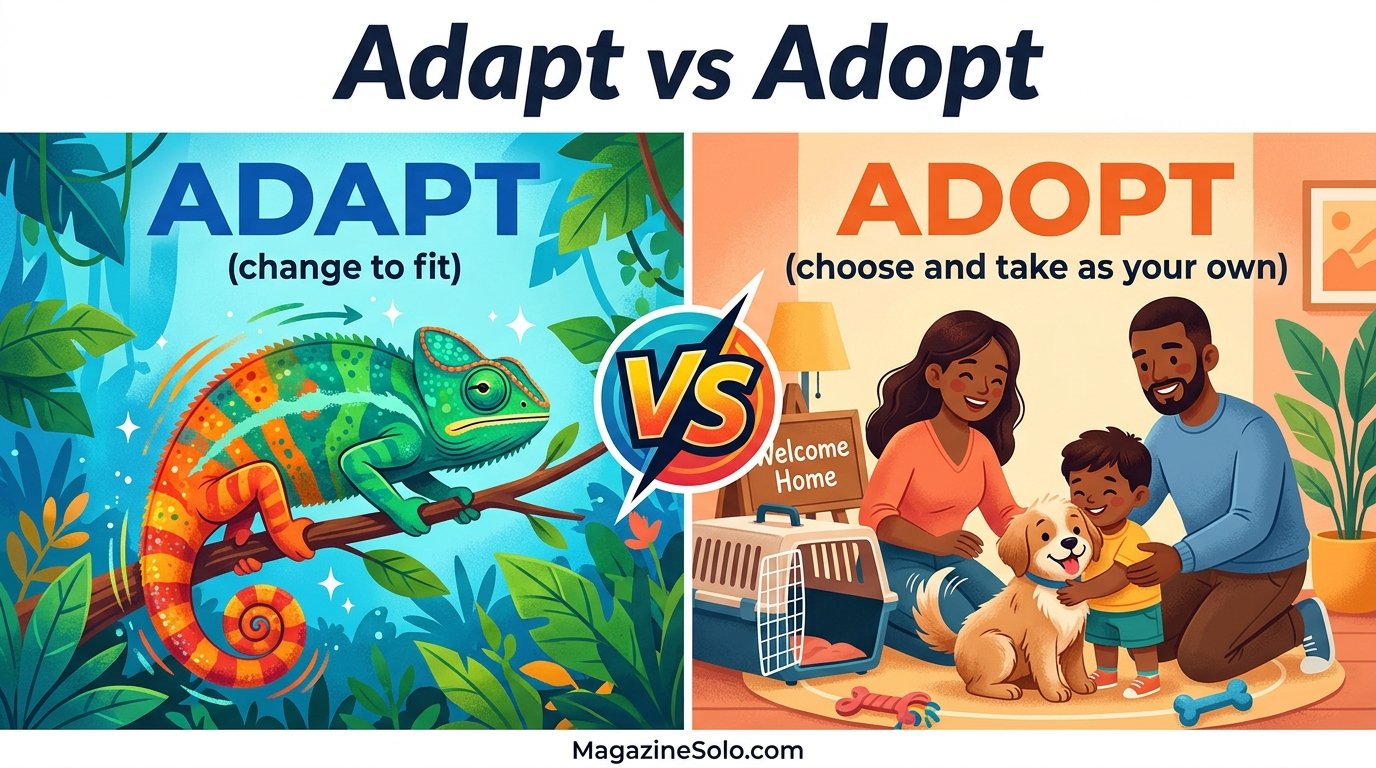
Family law runs on the adopt family end to end: adoption proceedings, an adoption agency, prospective adopters, adoptive parents, an adopted child, and the adult adoptee.
The role split from the family map does legal work here. The parents who adopt are adoptive; the child who is adopted is adopted; and a child is never adapted, a phrase that would claim the child was modified to fit.
Pets follow the same grammar. A shelter transfers an animal to you as your own, usually with paperwork and a fee, and only afterward do you and the pet adapt to the new home and each other.
Adoption language: when the label helps and when plain parents is kinder
Style guidance adds a sensitivity layer on top of the grammar. The Columbia Journalism Review adoption language column explains that the labels help when the distinction matters to the story, and mislead when it does not.
Many families prefer simply parents and child when adoption is not relevant, a preference the Family Helper glossary echoes by advising adoptive only when the distinction is needed. Correct grammar first, then judgement about whether to use it.
Domain 5, Government and Policy: Adopt a Resolution, Adopt a Highway
To adopt a resolution is for a body, a council, a board, an assembly, or the United Nations, to formally approve a text and make it its own official position. The vote takes the text as it stands.
That is why minutes keep the families separate. Changing the text first would be amending or adapting it; passing it unchanged is adopting it, and swapping the verbs misdescribes what the meeting actually did.
The same verb covers budgets, agendas, constitutions, and standards, and it also carries a sponsorship sense. Adopt a Highway, begun in Texas in 1985, is the program the SlashGear explainer describes: a group takes responsibility for cleaning a stretch of road and is named on a roadside sign.
Merriam-Webster, named here in text because its pages block automated checking, captures that sense directly: to sponsor the care and maintenance of something, such as a section of public road.
Domain 6, Everyday Change: Adapt to the New City, Job, and Climate
Everyday life belongs to adapt, and its signature phrase is adapt to. You adapt to a new city, a new climate, a new job, or a new country, because you are changing your habits to fit new conditions.
The same verb works transitively in the kitchen and the classroom. Cooks adapt a recipe to a smaller pan, and teachers adapt a lesson plan to a shorter period, changing the material itself to fit.
Keep the boundary bright: adopt to is not a phrase English uses. Adopt takes its object directly, so the moment your sentence needs to after the verb, the verb you want is adapt.
The Six Domains at a Glance
|
Domain |
Fixed family |
Set phrases to copy |
|---|---|---|
|
Biology and evolution |
Adapt only |
species adapt, adaptive trait, adaptation |
|
Film and publishing |
Adapt for the work, adopt for selection |
adapted from, adapted screenplay, adopt a textbook |
|
Technology and business |
Adopt the decision, adapt the work |
adopt a platform, early adopter, adapt workflows |
|
Law and family |
Adopt, with the role split |
adoptive parents, adopted child, adoptee |
|
Government and policy |
Adopt for approval |
adopt a resolution, adopt a budget, adopt a highway |
|
Everyday change |
Adapt, with to |
adapt to a new city, adapt a recipe |
The Error Patterns: Eight Documented Confusions and Their Fixes
Real errors cluster into eight patterns, each documented in edited or reference text. Learning the patterns beats memorizing the verbs, because your own slips will match one of these rows.
|
Error pattern |
The fix |
Where it is documented |
|---|---|---|
|
adopt to, for adapt to |
Adapt to the new environment |
Exam substitution items and learner drafts |
|
adoptive child |
Adopted child; adoptive belongs to parents |
Washington State University Common Errors, in text |
|
adaptive parents |
Adoptive parents; adaptive means adjusting well |
The same university usage note, in text |
|
adoption of the novel |
Adaptation of the novel |
The noun swap check catches it in drafts |
|
early adapter |
Early adopter, from Rogers’ categories |
Business writing confusing device and person |
|
adaption in edited prose |
Adaptation, the standard editorial form |
Journals and awards categories print adaptation |
|
adapted a method, used unchanged |
Adopted the method; adapted only if changed |
Academic editing guidance on methods writing |
|
adoptive platform, adaptive family |
Sort by family before publishing |
Derivative slips in advertisements and stories |
Two of these deserve emphasis. Adoptive child survives because adoptive sounds more formal, and early adapter survives because adapter is a familiar object. Neither reason survives the family check.
The last row is the quiet one: derivative slips in finished copy, an adoptive platform in a product announcement or an adaptive family in a profile. The families fail quietly there, which is why the check below exists.
Roots and Sounds: Optare, Aptare, and the Middle Vowel
The roots explain the families in four words. Adopt grows from Latin optare, meaning to choose, the same root behind option. Adapt grows from Latin aptare, meaning to fit, from aptus, fitted or suitable, the root behind apt.
Choose maps to adopt; fit maps to adapt. A writer who keeps option beside adopt and apt beside adapt owns a memory hook that works inside every derivative, not just the verbs.
The sounds explain the confusion honestly. Adapt and adopt are near homophones, not homophones: the first syllable is an unstressed schwa in both, the stress falls on the second syllable, and only the middle vowel differs.
In most American transcription, adapt carries the vowel of trap and adopt the vowel of top. British transcription prints the adopt vowel differently, a strand kept separate here rather than blended into one pronunciation.
That single vowel is why sound alike pairs fill this site’s library, from lose vs loose to than vs then. Spelling carries the meaning that speech blurs, and this pair is the clearest case in the set.
For Learners: How the Pair Works in Learner Dictionaries and Exams
Learner dictionaries keep a dedicated page for this trio for a reason. The Britannica learner answer, named here in text because its page blocks automated checking, was written for a learner asking exactly this question from China.
The university library guide at Texas State Technical College reduces the pair to one line each: adapt, make fit or adjust, against adopt, accept as one’s own or choose, with technology examples for both verbs.
Exams exploit the pair’s two traps: the middle vowel and the transitivity split. Adopt takes an object directly, while adapt happily works without one, as in he adapted quickly to the new school.
The learner facing table at Two Minute English drills the role split at reading level, pairing adopted and adoptive sentence by sentence. Anchor sentences beat definitions: species adapt, credits say adapted from, families adopt.
The same discipline sorts the rest of the learner shelf. Pairs like your vs you’re and its vs it’s reward readers who check the word’s job in the sentence, exactly the habit this page teaches.
Three Quick Checks Before You Publish
The older test based approach survives here as a short proofreading pass, useful after the families and domains have done the teaching:
- Name the domain: biology, film, family law, government, and technology each fix one family, so the domain answers first.
- Swap in the noun: rewrite with adaptation or adoption, and whichever noun survives names the verb family you need.
- Read the set phrase aloud: adapted from, adopt a resolution, adapt to; a crossed phrase sounds wrong once the families are familiar.
Run the checks in that order. Domain first, because it is decided for you; noun second, because it tests the actual sentence; phrase last, because it catches the slips your eyes skip.
The Grey Zone: When a Sentence Honestly Needs Both Verbs
Some sentences honestly need both verbs, and the competitor set’s best examples do exactly this. A company adopted a new dress code, and employees adapted their wardrobes to it.
An adopted child adapts to a new home and customs. A district adopts a textbook, then teachers adapt it. Languages adopt words, like smorgasbord from Swedish, and later adapt their spelling to English patterns.
Notice the order in every case: adopt first, adapt second. The choice happens once, at the start; the changing follows, for as long as the fitting takes. When both verbs appear, that sequence is the pattern to copy.
Writers sorting pairs like this one usually have a shelf of them. The same family thinking sorts advise vs advice, where the noun and verb split by one letter, and principal vs principle, where one word carries people and the other carries rules.
It also sorts complement vs compliment, and pairs like affect vs effect, accept vs except, desert vs dessert, and stationary vs stationery punish the same one letter inattention. Build the checking habit once, and the whole shelf gets easier.
MagazineSolo keeps these pairs in one commonly confused words library, and each guide in it applies the same discipline: sort the family, name the context, and let the word choose itself.
Frequently Asked Questions
What is the difference between adapt and adopt?
Adapt means to change something, or yourself, so it fits new conditions. Adopt means to take something as your own by choice, such as a child, a pet, a policy, or a method, usually as it is.
What is the difference between adaptation and adoption?
Adaptation is the act or result of changing to fit: a film adaptation, a biological adaptation. Adoption is the act of taking something on as your own: the adoption of a child, of a resolution, or of a new platform.
What is the difference between adaptable and adoptable?
Adaptable describes someone or something that can change to fit new conditions: an adaptable employee, an adaptable design. Adoptable describes someone or something that can be adopted: an adoptable dog at a shelter, an adoptable policy proposal.
What is the difference between adaptive and adoptive?
Adaptive describes something that helps adjustment or is designed to adjust: an adaptive trait, adaptive technology. Adoptive describes the relationship created by adoption, and in family language it belongs to the parent side: adoptive parents, an adoptive family.
What is the difference between an adapter and an adopter?
An adapter is usually a device that lets two different things work together, like a power adapter, or the person who adapts a work for the screen. An adopter is a person or organization that adopts: of a child, or of a new technology.
What does adoptee mean?
An adoptee is a person who has been adopted. The word names the person on the receiving side of an adoption, just as adopted child does, and many adults who were adopted as children prefer adoptee or adopted person as the adult term.
Is it adopted child or adoptive child?
Adopted child. The child is the one who was adopted, so the child is adopted. The parents who did the adopting are adoptive, and swapping the two adjectives reverses the family relationship in print.
Is it adoptive parents or adopted parents?
Adoptive parents. Adoptive describes the people who have adopted, and adopted describes the person who was adopted. The pair works as one memorized unit: adoptive parents, adopted child, never the crossed versions.
Can you say adapt a child?
No. A child is adopted, never adapted. Adapt a child would claim the child was changed or modified to fit, which is both the wrong meaning and an offensive implication. Family language belongs entirely to the adopt family.
Why do credits say adapted from instead of adopted from?
Because a screenplay taken from a novel has been changed to fit a new medium: scenes are cut, dialogue is rewritten, and interior thought becomes action. That is adaptation, so the credit reads adapted from, and awards formalize it as Best Adapted Screenplay.
Is adaption a word, or should it be adaptation?
Adaptation is the standard noun in edited prose, in science, and in film. Adaption exists as a less common variant in some dictionaries and older texts, but editors, journals, and awards categories use adaptation, so match them.
Do species adopt or adapt to their environment?
Species adapt. In biology, adaptation is the technical term: a heritable trait that helps an organism survive and reproduce in its environment, shaped by natural selection over generations. There is no adoption in this domain.
What is an adaptive trait?
An adaptive trait is a feature of an organism that improves its chance of surviving and reproducing in its environment, such as camouflage coloring or webbed feet for swimming. The adjective is adaptive, from the adapt family.
What does early adopter mean, and is it early adapter?
An early adopter is a person or organization among the first to take up a new product, technology, or idea. The term comes from Everett Rogers’ adopter categories, and it is never early adapter: an adapter is a device.
What is the adoption curve?
The adoption curve shows how a new idea or technology spreads through a population as adopter categories take it up. Rogers’ widely cited model shares are innovators about 2.5 percent, early adopters about 13.5 percent, each majority about 34 percent, and laggards about 16 percent.
Should a company adopt or adapt a new platform?
Adopt. A company adopts a platform, system, tool, or standard when it chooses it and starts using it as its own. After adoption, the company may adapt its workflows, training, and documents to the platform.
What does it mean to adopt a resolution?
For a body, such as a council, board, assembly, or the United Nations, to formally approve a resolution and make it its own official position. The vote takes the text as it stands; changing the text first would be amending or adapting it.
What does adopt a highway mean?
Adopt a Highway is a volunteer sponsorship program, started in Texas in 1985, in which a group, business, or family takes responsibility for cleaning litter from a stretch of road, usually for a set period, and is named on a roadside sign.
Do you adapt to or adopt to a new city?
Adapt to. You adapt to a new city, a new climate, a new job, or a new country, because you are changing your habits and expectations to fit new conditions. The preposition to belongs with adapt.
Is adopt to ever correct?
Not in the pattern learners usually mean. Adopt is transitive and takes its object directly: adopt a method, adopt a child, adopt a name. When the meaning is adjusting yourself to conditions, the verb is adapt and the preposition is to.
What are the Latin roots of adapt and adopt?
Adopt comes from Latin adoptare, built on ad, to, plus optare, to choose, the root behind option. Adapt comes from adaptare, built on ad plus aptare, to fit, from aptus, fitted or suitable, the root behind apt.
Are adapt and adopt homophones?
No. They are near homophones, not homophones. The first syllable is an unstressed schwa in both, but the middle vowel differs: adapt has the vowel of cat and trap, while adopt has the vowel of hot and top in most American speech.
How are adapt and adopt pronounced?
Both words stress the second syllable. Adapt is commonly transcribed with the a vowel of trap in the second syllable, and adopt with the o vowel of top. British transcription prints the adopt vowel differently, a separate strand.
What is the third word, adept, and how does it fit?
Adept is the third member of the confusion set, and it is not a verb at all. Adept is mainly an adjective meaning very skilled, as in adept at negotiation, and it can also be a noun meaning an expert.
Can adapt be used without an object?
Yes. Adapt works both ways. Transitive: she adapted the novel for television. Intransitive: he adapted quickly to the new school, with no object needed, because the subject does the changing. Adopt, by contrast, always takes an object.
What is an adapted screenplay?
An adapted screenplay is a film or television script based on material that already exists in another form: a novel, play, memoir, short story, or earlier film. The writer reshapes that source, which is why awards separate it from Best Original Screenplay.
What is the noun form of adapt and of adopt?
The noun form of adapt is adaptation, and the noun form of adopt is adoption. This is the fastest self check in the pair: rewrite with the noun, and whichever noun survives names the verb family you need.
Which word do researchers use for a method: adopt or adapt?
Both, for different actions, and academic writing separates them strictly. A researcher adopts a method, framework, questionnaire, or protocol when taking it up as it is, and adapts it only when changing it for a new population or purpose.
Do you adopt or adapt a textbook?
Schools and districts adopt textbooks: a committee chooses a book and makes it the required text for a course. A teacher then adapts lessons, worksheets, and pacing to that book and to the class. Choice first, change second.
What does it mean to adopt a word from another language?
Languages adopt words: English adopted smorgasbord from Swedish and many terms from French and Latin, taking each word into common use as its own. The borrowed word may later be adapted in spelling or pronunciation to fit English patterns.
Can a person be described as adaptive?
Yes, but it means something specific: an adaptive person adjusts readily to new conditions. Adaptive is also the standard adjective in set phrases like adaptive technology and adaptive learning. It never describes family relationships formed by adoption.
What is adaptive technology?
Adaptive technology is equipment or software designed or adjusted to help a person do a task, especially in education and accessibility: screen readers, alternative keyboards, adjustable workstations. Some fields prefer assistive technology, and careful writers follow their field’s term.
How do you adapt a book into a film?
By changing it: cutting subplots, turning interior thought into visible action and dialogue, restructuring scenes for screen time, sometimes changing endings or combining characters. That reshaping is why the product is an adaptation and the script an adapted screenplay.
Is it climate adaptation or climate adoption?
Climate adaptation. Governments, cities, and communities adapt to climate impacts by changing infrastructure, water use, building rules, and farming practice, and the policy field’s standard term is climate adaptation. Adoption belongs to plans and resolutions, not to the adjusting itself.
What does adopt a pet involve that adapt does not?
Adopting a pet is a legal and practical taking on of responsibility: the shelter or rescue transfers the animal to you as your own, usually with paperwork and a fee. Afterward, both you and the pet adapt to the new home.
Why do style guides care about adopted versus adoptive?
Because the two adjectives assign opposite roles, and getting them backwards misstates a family relationship in print. Journalism guidance also notes a sensitivity layer: many families prefer simply parents and child when the adoption detail is not relevant to the story.
How can ESL learners keep adapt and adopt apart?
Learn them as families and domains, not as two isolated verbs. Keep three anchor sentences: species adapt to a climate, the film was adapted from a novel, and they adopted a child. Change, change, choice: the anchors carry the rule.
What is the difference between adopt a stance and adapt a stance?
You adopt a stance: you take a position as your own, like a negotiating stance or a public stance on an issue. There is no standard phrase adapt a stance; for modifying one, careful writers say adjust, shift, or soften the stance.
Can both words appear correctly in one sentence?
Yes, and the best example sentences do exactly this. A company adopted a new dress code, and employees adapted their wardrobes to it. An adopted child adapts to a new home and customs. Choice first, change second.
Is there a word adoptable for policies and ideas, not just pets?
Yes. Adoptable means capable of being adopted, and while shelters use it most visibly for animals, it also appears for proposals, standards, and plans a body could take up. Its adapt family counterpart is adaptable, capable of being adapted.
What is the difference between an adoption agency and an adaptation?
An adoption agency is an organization that arranges adoptions, matching children with prospective adopters and handling legal steps. Adaptation has no agency sense at all; it is a process or a product, never an organization in this pair.
How should a writer check the choice before publishing?
Run three quick checks in order. First, name the domain: biology, film, family law, government, and technology each fix a family. Second, swap in the noun: adaptation or adoption. Third, read the set phrase: adapted from, adopt a resolution, adapt to.
Conclusion: Sort the Family, Name the Domain, and the Verb Chooses Itself
The adapt vs adopt difference stops being a spelling worry once it becomes a sorting habit. Every form belongs to a family: adaptation, adaptable, adaptive, and adapter carry change, while adoption, adoptable, adoptive, adopter, and adoptee carry choice.
Every context then fixes the family for you. Biology adapts, credits adapt, councils adopt, families adopt, and people adapt to new cities. The wrong word is rarely a mystery once the domain is named.
Keep the three checks beside your keyboard: name the domain, swap in the noun, and read the set phrase. Run them in order, and the verb, the noun, and the adjective all choose themselves.

Dilawar is a content writer at MagazineSolo, covering travel, home improvement, interior design, and everyday lifestyle topics. He enjoys researching practical solutions, exploring travel destinations, and sharing helpful guides that make daily life easier. His writing focuses on clear information, useful advice, and engaging stories for a wide audience.