All Together vs Altogether Difference: The Three Tests, Trap Pairs and Examples
All together vs altogether difference is a difference of structure before it is a difference of spelling, because one form is a living phrase of two words and the other is a single adverb that fused shut centuries ago.
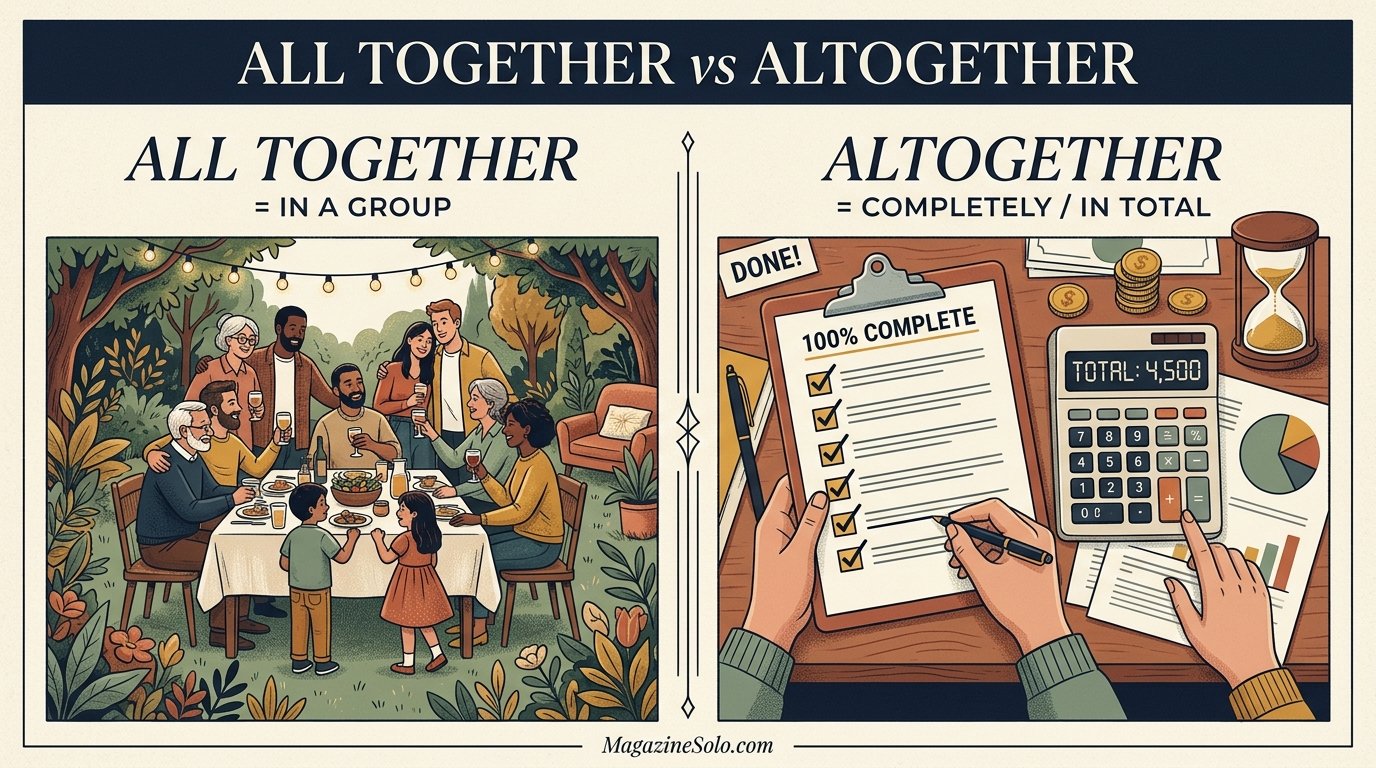
All together means a group in one place, or everyone acting at the same time. Altogether means completely, in total, or on the whole, and the two forms share no sense in any standard dictionary.
This page is the difference treatment, not another quick definition. A master difference table, the difference taken dimension by dimension, three decision tests, and verdicts on sentence pairs where both forms are grammatical.
The tests come from the authorities themselves. The split test is stated by the LanguageTool guide to this pair, the substitution rule by the YourDictionary guide to this pair, and the removal observation sits in the usage note at the Dictionary.com entry.
The neighbouring pairs reward the same patience. The difference treatment in our passed vs past difference guide and the tests-led verdicts in our adverse vs averse difference guide show the family pattern: state the deciding test first, then let examples earn it.
All Together vs Altogether in One Answer: A Living Phrase Against a Fused Adverb
The one answer: all together gathers, altogether completes. If people or things are collected or acting as one, the two-word phrase is correct, and if the meaning is completely, in total or on the whole, the one-word adverb is correct.
The phrase is two words doing two jobs. All is a quantifier and together is an adverb, and because each word keeps its own job, the pair can be split, rearranged and shortened in ways a single word cannot.
The adverb is one word doing three jobs. Completely, in total and on the whole are its dictionary senses, and no seam runs through it, because its parts fused in Middle English and stopped moving independently.
Sound is no guide at all with this pair. The phrase and the adverb are pronounced identically, so both spellings pass a spell checker, and the choice has to be made on meaning and structure instead.
University glossaries teach the same split. In the MIT usage glossary, the phrase is glossed as gathered in one location or all acting in concert, and the Albany State usage glossary gives the phrase as in a group and the adverb as wholly or completely.
The shortest statement of the rule runs the same way. The group versus completely framing in the EnglishGrammar.org page on this pair compresses the distinction into a single line, and everything after this section is that line unfolded into tests and verdicts.
The fused word drifted away from its parts. Merriam-Webster traces altogether to Middle English altogedere, built from al plus togedere, with the adverb in use before the 12th century, and the meaning moved from gathered to completely as the form fused.
Two more strands sit beside that account, labelled rather than blended. One strand, in the Dictionary.com entry, records the word as first recorded in 1125-75, a variant of Middle English altogeder, while the Oxford Learner’s Dictionary gives the shorter line: Old English, composite of all and together.
The Master Difference Table: Form, Grammar, Meaning, Separability, Test, Example
Read the table by dimension, because each row is a separate difference. Form, grammar and meaning differ independently, and a sentence can match one form on one row and the other form on the next, which is why the tests follow the table.
|
Dimension |
All together |
Altogether |
|---|---|---|
|
Form |
Two words, a phrase |
One word, a fused adverb |
|
Grammar |
Quantifier all plus adverb together |
Single adverb, three senses |
|
Core meaning |
In one place, or at the same time |
Completely, in total, on the whole |
|
Separability |
Splits, moves, loses all |
No seam, nothing inserts or deletes |
|
Deciding test |
Split test and removal test |
Completely test |
|
Example |
The family was all together |
The family was altogether different |
The form difference is the visible one. Two words against one word looks like a spelling preference, and it is not, because the two-word form is a phrase with moving parts and the one-word form is a single dictionary entry.
The grammar difference explains the form. A quantifier beside an adverb can rearrange around a verb, while a fused adverb sits in adverb positions only, which is why you should all come together works and nothing like it exists for altogether.
The meaning difference is the decisive one. The phrase always involves a group, a gathering or joint action, and the adverb always involves completeness, a total or a summary judgment, with no overlap in the dictionaries.
Simple comparison tables elsewhere stop at the definitions. The table in the GeeksforGeeks comparison of this pair and the side-by-side in the ESLBuzz guide to this pair both sort the pair by meaning alone, and neither carries the separability row that makes the tests possible.
The Three Tests That Decide Every Sentence
Run the tests in order, because each one catches what the previous one misses. The split test settles most sentences, the completely test settles the rest, and the removal test breaks ties when a sentence seems to pass both.
The Split Test: If Words Fit Between Them, It Is the Phrase
The split test asks one question: can anything go between the two words? If a noun, a verb or a whole phrase can sit between all and together, the sentence needs the phrase, because a fused word has no middle to open.
The test is stated almost word for word by its source. If you can rearrange the sentence to add a noun or verb in the middle, then all together is the word you are looking for, as the LanguageTool guide to this pair puts it.
The same test is taught independently elsewhere. The rearrangement check in the QuillBot guide to this pair runs identically, and two tools arriving at one test from different example banks is the closest thing usage guidance has to a consensus.
- Take the sentence as written and find the all together or altogether slot in it.
- Try inserting the subject or an object between all and together, as in put all the books together.
- If the sentence still reads naturally, write the two-word phrase and stop there.
- If the insertion collapses, the word is fused, and the completely test confirms which adverb you have.
Grammarly’s examples are the test in action. Put all the tickets together in a wallet splits the phrase around its object, and after the reception, you should all come together moves all in front of the verb entirely, as the Grammarly guide to this pair shows.
The moved all has a grammar name: the floated quantifier. All belongs with the subject but floats beside the verb, and spotting that float is the strongest version of the split test, because a fused adverb can never float.
The Completely Test: Swap In Completely, Entirely or On the Whole
The completely test is a substitution: swap in completely, totally or on the whole. If the sentence keeps its meaning, the answer is the one-word adverb, and if the swap produces nonsense, the sentence was carrying the phrase all along.
The rule is stated as a rule by its source. If it can be replaced in the sentence by completely, totally or on the whole, the single word is the one you need, as the YourDictionary guide to this pair states the test.
A mirror version of the swap exists for the phrase. The swap test in the ESLBuzz guide to this pair replaces the phrase with in a group, and running both swaps in sequence decides nearly every real sentence a writer meets.
Watch the swap with totals, because in total is the honest substitute there. The bill came to $85 altogether passes with in total in the slot, and a writer who only tries completely may miss the total sense entirely.
The Removal Test: Drop All and See What Survives
The removal test deletes all and reads what is left. In the phrase, all is an optional modifier, so together alone still carries the sentence, while the al- of altogether is fused and offers nothing to delete.
The observation is printed in a dictionary usage note. The word all can be omitted without seriously affecting the meaning, as the Dictionary.com entry notes in the usage note beside the entry, giving the children were together in the kitchen as the surviving sentence.
Use the removal test as the tiebreak, not the opener. A total sentence like the bill came to $85 survives no deletion at all, which is itself the verdict: nothing removable means nothing separable, and the fused adverb wins.
Altogether, Sense by Sense: Completely, In Total, On the Whole
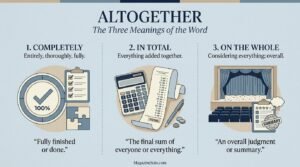
Altogether carries three senses, and blending them is how the errors start. Each sense has its own substitute, its own home ground and its own trap, so the senses are taught one at a time here.
|
Sense |
Substitute |
Example |
Confirming test |
|---|---|---|---|
|
Completely, entirely |
Completely |
An altogether different problem |
Completely test |
|
In total |
In total |
The bill came to $85 altogether |
Completely test, total swap |
|
On the whole |
On the whole |
Altogether, it was a great evening |
Completely test at the front |
Completely: The Degree Sense and Its Collocations
Completely is the first dictionary sense and the commonest. An altogether different problem is the example Merriam-Webster itself prints (word credit), and altogether new, altogether convincing and altogether impractical run in the same pattern.
The degree sense also intensifies adjectives directly. Altogether too difficult and altogether too friendly push a quality past a limit, a use the committee trap pair below puts to work, and the phrase can never do this job.
Not altogether is the degree sense under partial negation. I am not altogether convinced means not completely convinced, a softening construction careful prose uses to grade certainty, and it belongs wholly to the adverb.
In Total: The Money Sense and the Arithmetic Trap
In total is the sense that sums. Spent a hundred dollars altogether is Merriam-Webster’s example (word credit), and the American entry at the Oxford Learner’s Dictionary gives you owe me $68 altogether, the same sense in a debt.
Totals are the adverb’s home ground. Bills, sums, headcounts and repair costs all take the one-word form at the end of the clause, because the word is counting everything in, not gathering anything up.
The arithmetic trap is writing the phrase for a sum. The bill was $50 all together claims the money is physically gathered in one pile, and it is the single most repeated error with this pair in real writing.
On the Whole: The Sentence Adverb and Its Comma
On the whole is the summary sense, and it works at the front of a sentence. Altogether, their efforts were successful comments on the whole statement rather than modifying one verb, which makes the word a sentence adverb in this use.
A comma follows the fronted adverb in standard edited American English. Altogether, it was a great evening prints the comma in Oxford’s own example, and inside a sentence the other senses need no comma at all.
All Together: One Place, Same Time, and the Patterns That Split It
The phrase has two readings, and both are about groups. One reading is spatial, everyone or everything in one place, and the other is temporal, everyone acting at the same time or in unison, and the adverb covers neither.
One Place: The Gathered Reading
The gathered reading answers where. The family was all together for the holidays places the whole family in one location, the reading the MIT glossary calls gathered in one location, and no completeness meaning is present.
Things gather as well as people. Put all the chairs together at the back collects objects in one place, and the visible split in that sentence is the phrase announcing its own structure.
Same Time: The Unison Reading and the Fixed Call
The unison reading answers when and how. On the count of three, sing all together asks for simultaneous action, the reading the MIT glossary calls all acting in concert, and simultaneity always takes the phrase.
All together now is the fixed call for that moment. Oxford’s usage box gives it before a group song, let’s sing Happy Birthday, all together now, and the call only makes sense addressed to a group about to act as one.
A restaurant runs on the same reading. Are you all together asks whether the whole party is present, the seating question in the Cambridge Dictionary grammar page, and no adverb can replace the phrase in that scene.
The Split Patterns: Floated All and Inserted Words
The phrase splits in two regular patterns. Words insert between all and together, as in can you put all the books together, please, and all itself floats away from its noun, as in you should all come together.
The separation trick is what learner sites teach. All of us together keeps the group visible inside the split, a pattern set out in the HeadsUpEnglish page on this pair and in the Definebly page on this pair, and expanding the phrase is a writing check.
Trap Pairs: Sentences Where Both Forms Are Grammatical
A trap pair puts both forms into the same frame and grades each one. Every verdict below is grammatical on both sides, the meanings differ, and the test named in the verdict is the one that delivers it.
|
Frame |
With all together |
With altogether |
Verdict |
|---|---|---|---|
|
The family was ___ |
Gathered for the holidays |
Different from ours |
Both correct, different meanings |
|
The committee members were ___ |
In one room, gathered |
Too friendly for comfort |
Both correct, different meanings |
|
The choir ___ |
Sang in unison |
Stopped entirely |
Both correct, opposite jobs |
|
The bill came to $85 ___ |
Claims the money is gathered |
In total |
Only altogether is correct |
|
He stopped smoking ___ |
A group quitting in unison |
Completely, for good |
Altogether, on the natural reading |
The family pair is the signature trap. The family was all together reports a gathering, the family was altogether different reports a degree, and a writer who hears no difference between them has not yet run either test.
The committee pair comes from a university glossary. The pair printed in the MIT usage glossary sets members gathered in one room against members altogether too friendly for comfort, and it is the cleanest published proof that grammar alone cannot choose.
The choir pair shows one subject taking opposite answers. The choir sang all together is unison, the choir stopped altogether is completeness, and the verb, not the subject, decides which form the sentence earns.
The bill trap is the pair where only one form survives. A total cannot gather, so $85 all together fails on meaning even though every word in it is spelled correctly, which is why totals anchor the error gallery below.
Alltogether: The Misspelling, With a Dictionary Verdict
Alltogether is not a word, and the verdict is dictionary-backed. It has no dictionary entry and no definition, a common misspellings catalog lists it as an error for altogether, and reference sites call it a common misspelling of the adverb.
Grade it as an error every time, never as a variant. Unlike alright, which dictionaries record as a disputed variant, alltogether has no entry, no defenders and no register where it is accepted, so correction needs no judgment call.
The spell checker point needs care. A checker does flag alltogether when it is switched on, because the string is not a word, and the real blind spot is the choice between the two genuine forms, which no checker can grade.
In the Altogether: The Idiom, in One Box
One bounded box holds the idiom, because it is a curiosity, not a sense in daily use. In the altogether means naked, an informal phrase for being nude that survives mostly in older fiction, humor and set phrases.
The dictionary facts are short and dated. Merriam-Webster lists the use as a noun sense of altogether, dates that noun use to 1893 and labels it informal (word credit), and the Dictionary.com entry carries the phrase in its idioms entry.
One origin story circulates, and it stays a labelled strand. A competitor traces the phrase’s wide circulation to George du Maurier’s 1894 novel Trilby, a single-source claim that sits beside the dictionary’s 1893 date without merging with it.
Error Gallery: Wrong Sentences Corrected, With Verdicts
Each gallery item prints the error as written, then the correction, then the verdict. Every error below is one of the traps the tests were built to catch, and the verdict names the test that catches it.
- As written: the bill was $50 all together. Corrected: the bill was $50 altogether. Verdict: a total takes the adverb, and the completely test, with in total swapped in, delivers it.
- As written: the family was altogether for the holidays, meaning gathered. Corrected: the family was all together for the holidays. Verdict: a gathering takes the phrase, and the split test delivers it.
- As written: he gave up sugar alltogether. Corrected: he gave up sugar altogether. Verdict: the spelling is not a word at all, and the sense is completeness, so the fused adverb corrects both faults.
- As written: we were all together exhausted by the climb, meaning completely. Corrected: we were altogether exhausted by the climb. Verdict: exhaustion here is a degree, and degrees belong to the adverb.
- As written: put the files altogether in one folder, meaning collected. Corrected: put all the files together in one folder. Verdict: the split visible in the correction proves the phrase was needed.
- As written: the cousins were altogether on the porch, meaning gathered. Corrected: the cousins were all together on the porch. Verdict: a group in one place takes the phrase, and the removal test confirms it.
The Cousin Pair: All Ready vs Already Runs the Same Fusion Story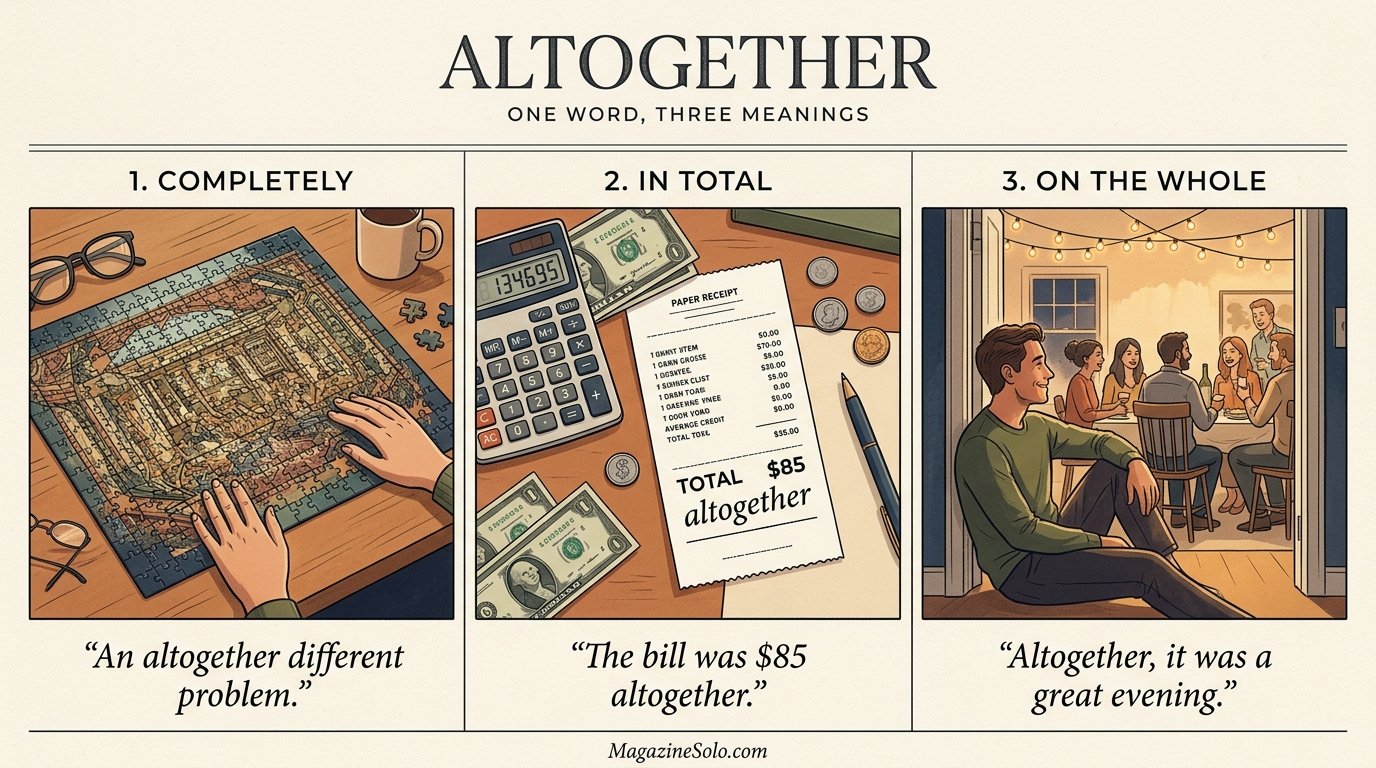
This pair is not the only fused phrase in the family. All ready and already tell the same story: a living phrase whose parts still move, against a fused word whose meaning drifted, readiness becoming by now just as gathered became completely.
The same tests transfer for the same reason. The split test and the removal test both run on the cousin pair, as our all ready vs already guide shows in its placement and scope treatment, and learning one pair audits the other.
One grammar site suggests the adverb can sometimes stand in for the phrase in an all at once sense. That claim, printed by Grammar.com, is recorded here as a strand the dictionaries do not back, and edited or exam writing should not rely on it.
The Difference Family: How the Neighbouring Pairs Decide
Every pair in this cluster owns a deciding system. The direction test in our imply vs infer difference guide and the building test in our capital vs capitol difference guide each settle their pair the way the split test settles this one.
Sequence does the same work in its own pair. The before-and-after test in our precede vs proceed difference guide settles a pair whose whole difference is order, the closest cousin to a test built on word position.
Verb pairs run on form and function. The tense split in our lay vs lie difference guide and the movement split in our emigrate vs immigrate difference guide show the range, while our affect vs effect guide settles its pair on the verb and noun jobs.
The spelling-led pairs close the set. The triple distinction in our allusion vs illusion vs delusion guide and the one-letter trap in our desert vs dessert guide are decided by spelling and sense together, not by any test of position.
The trio and the verb split complete the family. The trio verdicts in our ensure vs insure vs assure guide and the verb split in our adapt vs adopt guide complete the difference family this page belongs to.
Frequently Asked Questions
1. What is the difference between all together and altogether?
The phrase and the fused adverb are different objects. All together means everyone or everything in one place or acting in unison, while altogether means completely, in total, or on the whole.
2. Which one means completely?
Altogether. It is the adverb’s first dictionary sense: an altogether different problem, it stopped raining altogether, and the completely swap is the test that proves it in any sentence.
3. Which one means in a group?
All together. The quantifier all sits beside the adverb together, as in the family was all together for the holidays, and no standard dictionary gives the fused adverb a gathered sense.
4. What does altogether mean?
A single adverb with three senses. Completely or entirely, in total with everything counted, and on the whole as a sentence adverb, a word Merriam-Webster traces to Middle English altogedere.
5. What does all together mean?
All plus together, each word doing its own job. It means everyone or everything in one place, or acting at the same time in unison, and because the words are independent, all can move: you should all come together.
6. Can altogether and all together be used interchangeably?
No. They sound identical but share no sense in the standard dictionaries, the phrase covering groups and joint action, the adverb completeness, totals and summary, so swapping them changes or breaks the sentence.
7. How can I remember the difference between all together and altogether?
Run the split test first, then the completely test. If words fit between all and together it is the phrase, and if completely substitutes cleanly it is the adverb, the word that fused shut in Middle English.
8. What is the split test for all together?
If a noun or verb can sit between all and together, the phrase is correct. LanguageTool states the test directly, QuillBot teaches the same test, and Grammarly’s example, all the tickets together in a wallet, shows it running.
9. What is the completely test for altogether?
Swap in completely, totally or on the whole. If the sentence keeps its meaning the one-word adverb is the answer, the rule YourDictionary states, while ESLBuzz runs the mirror swap, in a group, for the phrase.
10. Can you put words between all and together?
Yes, and that separability is the point of the phrase. Can you put all the books together, please, puts a noun phrase in the middle, and nothing can enter altogether because the fused word has no seam.
11. Can “all” be removed from all together?
Yes, and that removability is the removal test. Dictionary.com notes that all can be omitted without seriously affecting the meaning, as in the children were together in the kitchen, while the fused adverb has no all to delete.
12. Is alltogether a word?
No, alltogether is not a word. It is a common misspelling of altogether with no dictionary entry or definition, listed as an error in misspelling catalogs, and it is never a variant.
13. Is altogether an adverb?
Yes, in all three working senses. It is an adverb of degree, a total adverb in sums and a sentence adverb meaning on the whole, and Merriam-Webster lists a noun use only inside the idiom in the altogether.
14. What part of speech is all together?
Not one part of speech, because it is not one word. All is a quantifier and together is an adverb, the pair working as an adverbial phrase, which is why the words can split, move and lose all.
15. Does altogether mean in total?
Yes, in total is the adverb’s second dictionary sense. Merriam-Webster gives spent a hundred dollars altogether and Oxford gives you owe me $68 altogether, so a bill or a headcount always takes the one-word form.
16. How is altogether used with money and totals?
Place the adverb after the amount, or at the end of the clause. The bill came to $85 altogether and there were forty guests altogether show the pattern, while the phrase claims the money sits gathered in a pile.
17. How do you use altogether in a sentence?
Match the sense first. Completely gives the plan was altogether impractical, in total gives the trip cost $900 altogether, and on the whole gives Altogether, the move went smoothly, each passing the completely test.
18. How do you use all together in a sentence?
Wherever a group gathers or acts as one. The cousins were all together for the first time in years and, on the count of three, sing all together show both readings, and together alone surviving deletion confirms the phrase.
19. Is it “the family was all together” or “altogether”?
All together, when the family is gathered in one place. The adverb in the same frame is also grammatical with a different meaning, the family was altogether different from ours, so context and the tests decide the verdict.
20. Is it “the bill was $50 all together” or “altogether”?
Altogether. A bill is a total and in total is the adverb’s second sense, so the bill was $50 altogether is correct, while the phrase is the classic arithmetic trap, claiming the money is gathered rather than summed.
21. Is it “he stopped smoking all together” or “altogether”?
Altogether: he stopped smoking altogether, completely and for good. Stopping is a degree, not a gathering, so the completely test passes instantly, and the two-word version would need a group quitting in unison.
22. Can both all together and altogether be correct in the same sentence frame?
Yes, and those frames are the teaching core of this page. The committee members were all together in one room, gathered, against the committee members were altogether too friendly, completely, both grammatical, with the tests delivering the verdict.
23. What is the difference between “the choir sang all together” and “the choir stopped altogether”?
The first choir acts in unison, and the second stop is complete. Singing passes the split test because the choir all sang together also works, while stopping passes the completely test, stopped entirely.
24. Does all together mean at the same time?
Yes, that is one of its two readings. Everyone acting at the same time or in unison, as in the call all together now before a group song, while the other reading is spatial and altogether covers neither.
25. What does “all together now” mean?
It is a fixed call for unison. A conductor, teacher or host asks a group to sing, count or speak at the same moment, Oxford uses it as the phrase’s showcase example, and the adverb could never replace it.
26. Why do waiters ask “Are you all together?”
Because the phrase asks whether the whole party is present, seated as one group. Cambridge uses exactly this restaurant dialogue, no adverb can replace it, and Are you altogether would ask a completely different question.
27. Can altogether start a sentence?
Yes, in its sentence adverb sense, on the whole. Altogether, their efforts were successful and Altogether, it was a great evening show the adverb commenting on the whole statement rather than modifying one verb.
28. Do you need a comma after altogether at the start of a sentence?
Yes, in standard edited American English. The comma sets the fronted sentence adverb off from the clause that follows, Altogether, it was a great evening, while the other senses inside a sentence need no comma.
29. Is “altogether different” correct?
Yes, and it is Merriam-Webster’s own example. An altogether different problem illustrates the completely sense, altogether new and altogether convincing are sibling collocations, and the phrase would be wrong because a problem cannot gather.
30. Is “not altogether” correct usage?
Yes, not altogether is standard usage. It is a partial negation meaning not completely, as in I am not altogether convinced, softening a claim instead of denying it outright.
31. What is a synonym for altogether?
By sense: completely, entirely, wholly and totally for degree, in total and all told for sums, on the whole for summary. The synonym set doubles as the completely test’s toolbox, so a clean substitution names the adverb.
32. What is a synonym for all together?
Phrases, not single words: in a group, in one place, at the same time, in unison, collectively. The form has no one-word synonym because it is not one word, and if one of these substitutes, all together is the answer.
33. Are all together and altogether homophones?
Yes, the phrase and the adverb are pronounced identically. That is why the confusion survives spell checkers, since both forms are real and correctly spelled, and the decision has to be made on meaning with the three tests.
34. Do British and American English use all together and altogether differently?
No, and no fetched source states a regional difference in the rule. Oxford publishes the same entries in its British and American editions, Cambridge’s US page states the same rule, and the distinction is identical in both varieties.
35. What is the most common mistake with altogether?
Two errors lead: the phrase for a total, the adverb for a gathering. The bill was $50 all together and the family was altogether for the holidays are the twin traps, with no error rate published anywhere reputable.
36. Why does my spell checker not catch alltogether mistakes every time?
A checker does flag alltogether, since it is not a word, unless a custom dictionary holds it. The blind spot is the choice between the two real forms, both correctly spelled, and that meaning error is what reaches print.
37. Can altogether mean everyone together?
No, not in any dictionary fetched for this research. Merriam-Webster, Oxford, Cambridge and Dictionary.com list completely, in total and on the whole, never a gathered sense, and one grammar site’s contrary claim is not backed by the dictionaries.
38. Is “altogether” ever a noun?
Only inside one idiom. Merriam-Webster lists a noun sense in the phrase in the altogether, meaning naked, dates that use to 1893 and labels it informal, while outside that phrase the word is an adverb only.
39. What does “in the altogether” mean?
It means naked. The informal idiom names being nude, Merriam-Webster dates the noun use to 1893, and it survives mostly in older fiction, humor and set phrases, which is why this page gives it one bounded box.
40. Where does the word altogether come from?
From a phrase that fused. Merriam-Webster gives Middle English altogedere, from al plus togedere, used before the 12th century, while Dictionary.com and Oxford carry compatible strands that this page labels rather than blends.
41. What is the difference between altogether and all in all?
All in all is a fixed summary phrase, and altogether is one adverb with three senses. All in all, it went well matches Altogether, it went well, but all in all cannot carry totals.
42. Is all together similar to all ready in grammar?
Yes, structurally the same story, and this cluster’s own frame. A living phrase keeps two words doing separate jobs, the fused form became one word whose meaning drifted, and the split and removal tests work on both pairs.
Conclusion
All together vs altogether difference stops being a spelling guess once the tests do the deciding. All together is a living phrase whose parts still split, move and shorten, and altogether is a fused adverb meaning completely, in total or on the whole.
Run the split test first. If words fit between all and together, write the phrase; if completely substitutes, write the adverb; and if a sentence still resists, drop all and let the removal test break the tie.
The trap pairs are the proof. Both forms can be grammatical in the same frame with different meanings, so the verdict always comes from meaning, never from sound, and never from a spell checker.
The rest of the difference family works the same way. The guides gathered on the MagazineSolo home page each state their deciding test first, so the next confused pair you meet is a meaning question before it is a spelling one.

Dilawar is a content writer at MagazineSolo, covering travel, home improvement, interior design, and everyday lifestyle topics. He enjoys researching practical solutions, exploring travel destinations, and sharing helpful guides that make daily life easier. His writing focuses on clear information, useful advice, and engaging stories for a wide audience.