What Does Literally Mean? Two Senses, One Test

What does literally mean? It has two recorded answers, and most arguments about the word start when a reader meets the wrong one. In its strict sense, literally means in actual fact: exactly as stated, with no exaggeration.
In informal use, literally is an intensifier: it means in effect or virtually, and it emphasizes a statement that is not literally true, as in I literally died laughing.
Both senses are in the dictionaries, and both are old. What readers need is a decision tool for telling them apart in any sentence: the substitution test, which takes seconds.
What follows: the two senses, the test, a bank of 30 classified sentences, the boundary with figuratively, and the formal writing rules.
Literally in One Answer: In Actual Fact, or Pure Emphasis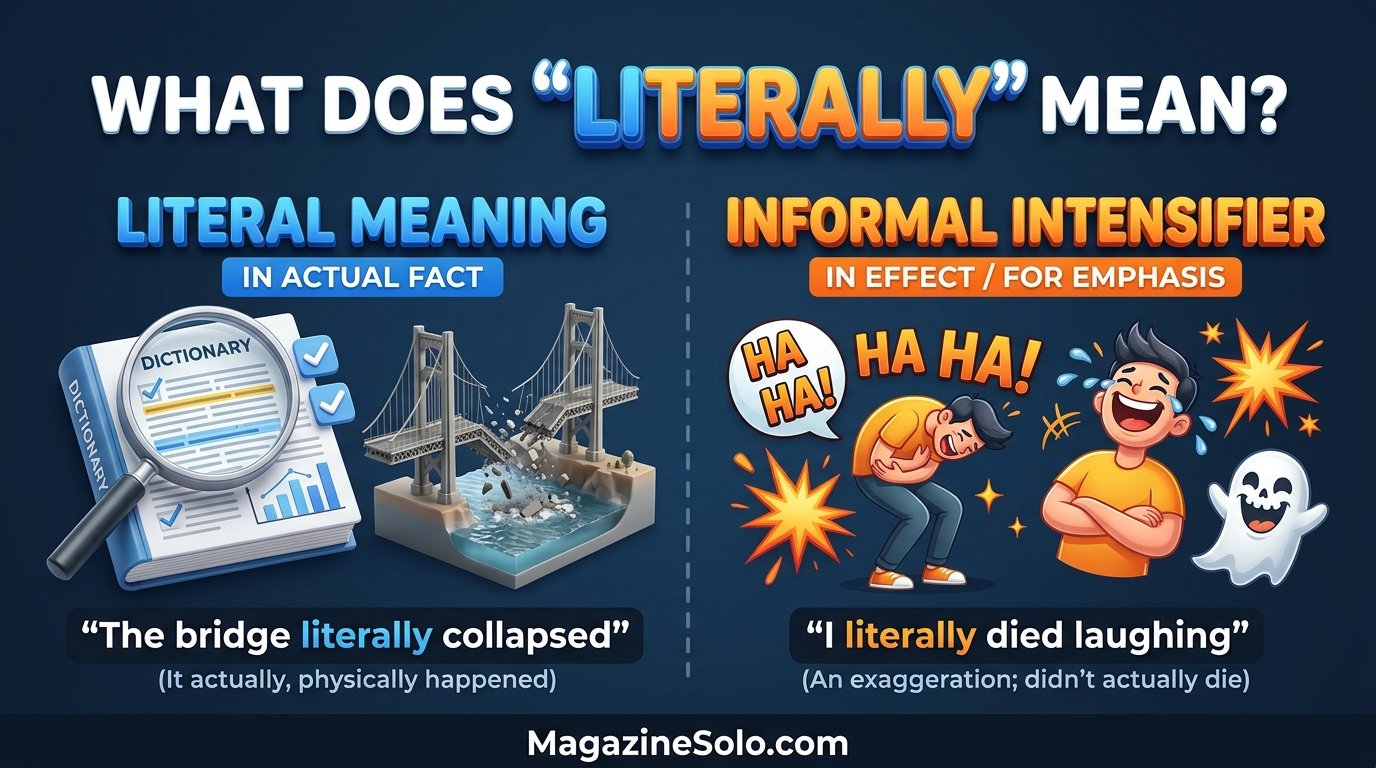
Literally means in a literal sense: in actual fact and exactly as stated. In informal use it also works as an intensifier meaning in effect or virtually, used to emphasize a statement that is not literally true.
Every example here is graded against those two lines: a factual, checkable claim can carry sense 1; an impossible or figurative one leaves the word adding emphasis.
|
Sense |
What it means |
Label in the dictionaries |
Example |
|---|---|---|---|
|
1, strict |
In actual fact, exactly as stated, word for word |
The primary sense everywhere |
The term literally means Fat Tuesday |
|
2, intensifier |
In effect, virtually; emphasis on a claim that is not literally true |
Informal (Merriam-Webster, Cambridge) |
I literally died laughing |
The dictionaries agree on the senses; they differ in how loudly they warn:
|
Dictionary |
Sense 2 label |
Its caution |
|---|---|---|
|
Merriam-Webster |
Informal; in effect, virtually |
Pure hyperbole for emphasis, often unneeded |
|
Cambridge |
Informal emphasis |
Listed at learner level B2, with the strict sense first |
|
Collins |
Intensifier meaning in effect, virtually |
States plainly that the sense contradicts the earlier meaning |
|
Oxford Learner’s |
Informal emphasis |
Notes that some people think it is not correct |
Sense 1: In a Literal Sense, Exactly as Stated
Sense 1 is the sense nobody argues about: it tells the reader to take the words at face value, the claim standing or falling as a fact.
The Four Parts of Sense 1 in Merriam-Webster
Merriam-Webster breaks sense 1 into four parts, and each part is a different job. The first is the ordinary meaning job: the words are used in their primary sense, not as a figure of speech.
The second part is the complete accuracy job, the plain actually: the event happened in fact. The third is the truth emphasis job, and the fourth is the word for word job.
Word for Word: The Translation Sense
In translation and quotation, literally promises exact equivalence. Merriam-Webster’s own example is the cleanest: the term Mardi Gras literally means Fat Tuesday in French. Each word is matched, and the claim can be checked.
The same branch covers records: a name copied literally is copied character by character; a remark taken literally, at its exact wording.
The Truth Emphasis: Literally Hundreds of People
The third branch vouches for a surprising fact. When a speaker says literally hundreds of people attended, the claim sounds like exaggeration, and the word insists it is a count, not a figure of speech.
Merriam-Webster files this under sense 1 (California is literally the last state to report election results), and readers misread it most, because the sentence sounds inflated while claiming a fact.
Sense 2: The Intensifier, In Effect and Virtually
The claim is not factual, everyone involved knows it, and literally is added purely for force: I literally died laughing, he literally flew out of the room.
What the Dictionaries Actually Record
Merriam-Webster records sense 2 as informal, defined as in effect, virtually, used to emphasize a statement that is not literally true. Cambridge lists the same sense as informal emphasis, and Collins calls it an intensifier use.
Recording is not recommending. Merriam-Webster’s usage note calls the use pure hyperbole for emphasis, often appearing where no emphasis is needed at all.
Why It Is Hyperbole, Not a Meaning Flip
The intensifier does not reverse the word. A speaker who says she literally died laughing is not claiming the word now means figuratively; she is borrowing the strongest truth word she owns to say the feeling was overwhelming.
Linguists call that borrowing semantic bleaching: truth words fading into general intensifiers. Very began as a word for truth; really travelled the same road before literally.
The Substitution Test: Tell the Senses Apart in Seconds
Definitions describe the senses; the substitution test grades your sentence, with one replacement phrase, in actual fact, and five seconds of reading.
Step 1: Swap In ‘In Actual Fact’
- Find literally in the sentence and replace it with the phrase in actual fact, changing nothing else.
- Read the new sentence as a factual claim. Ask whether the claim could be true, and whether it is the claim the writer meant.
- If the sentence still makes the same claim, the word was sense 1. The shop literally closed at nine becomes the shop in actual fact closed at nine, unchanged.
- If the sentence collapses into an absurd fact, the word was an intensifier. I in actual fact died laughing reports a death that did not happen.
Step 2: The Deletion Check
Some sentences pass neither way cleanly, and the deletion check settles them. Delete literally and reread: if the sentence loses information, the word was sense 1 and stays; if it loses nothing, the word was decoration.
The training case is he is literally the best player in the league: best is an opinion, so sense 1 has no fact to guarantee, and the deletion verdict is cut it.
Worked Verdicts
Three quick grades: he took the remark literally survives the swap (sense 1); I literally died of embarrassment collapses it (sense 2); the city was literally destroyed survives in a disaster report and collapses in a match report (context decides).
One named test per problem is the method across this site: Adapt vs adopt is settled by asking what is changing, all ready vs already by a proofreading test. Literally needs the sharpest test, because its senses point in opposite directions.
The Example Bank: 30 Sentences, Classified
Every verdict below is produced by the substitution test and the claim type, in that order. Dictionary examples are labelled with their source; the rest are training examples built for this bank.
Clear Sense 1: The Test Survives
1. ‘He took the remark literally.’ Verdict: sense 1, clear. Merriam-Webster’s own first example. The swap survives: he understood the remark in its ordinary sense, which is exactly what the sentence reports. The word guarantees the reading, and deleting it would lose information.
2. ‘The term Mardi Gras literally means Fat Tuesday in French.’ Verdict: sense 1, word for word branch. Also Merriam-Webster’s own example. The claim is about exact equivalence between expressions, the translation sense. The test passes trivially, because the sentence is itself a statement about wording.
3. ‘The story he told was basically true, even if it wasn’t literally true.’ Verdict: sense 1, accuracy branch. The sentence contrasts rough truth with complete accuracy, which only works if literally carries its strict sense. An intensifier reading would destroy the contrast, so context locks the verdict.
4. ‘California is literally the last state to report election results.’ Verdict: sense 1, truth emphasis branch. Quoted by Merriam-Webster under sense 1b. The claim is surprising and factual: the speaker vouches for a checkable fact. This is the branch searchers most often misclassify as the intensifier.
5. ‘The results were literally identical.’ Verdict: sense 1, clear. A training example. The claim is exact sameness, and the word rules out ‘almost’. The swap survives; delete the word and the guarantee weakens, so sense 1 earns its place.
6. ‘Copy the file name literally, character by character.’ Verdict: sense 1, word for word branch. A training example. The instruction is about exact characters; an intensifier reading is nonsense here, because copying has no figurative mode. The sentence is an order about wording itself.
7. ‘The old bridge literally collapsed during the storm.’ Verdict: sense 1, clear. A training example. Bridges do collapse; the claim is factual and checkable against the news record. The swap changes nothing, so the word is doing sense 1 work.
8. ‘She translated the letter literally, line by line.’ Verdict: sense 1, translation branch. A training example. The method is the claim: words matched one by one rather than sense rendered freely. Sense 1 again, on the word for word branch.
9. ‘There were literally no tickets left.’ Verdict: sense 1, truth emphasis branch. A training example. It sounds like exaggeration, but the speaker vouches for a checkable zero. If the box office confirms it, the swap survives and the verdict stands.
10. ‘The sign literally reads: no entry after six.’ Verdict: sense 1, quotation branch. A training example. The words on the sign are the subject, and literally promises the quotation is exact. Where the wording is the evidence, only sense 1 is available.
Clear Intensifier: The Test Collapses
11. ‘I literally died of embarrassment.’ Verdict: sense 2, clear. Merriam-Webster’s own example for the informal sense. The speaker is alive and reporting the sentence, so the swap collapses on contact. The word’s only work is emphasis on a figurative claim.
12. ‘They will literally turn the world upside down to combat cruelty or injustice.’ Verdict: sense 2, clear. Norman Cousins, quoted in Merriam-Webster’s entry. No physical inversion of the planet is proposed; the hyperbole is the point, and the entry files it under the exaggerated use.
13. ‘I literally blazed with wit.’ Verdict: sense 2, dated proof. Thackeray, in Punch, 30 October 1847, from Merriam-Webster’s entry. A canonical writer, in a mainstream magazine, more than 175 years ago. This single entry dismantles the modern invention claim.
14. ‘Lily was literally run off her feet.’ Verdict: sense 2, dated proof. Joyce, Dubliners, 1914, quoted by Merriam-Webster. Lily kept her feet; she was rushed beyond endurance. It is the safest classroom example in the bank, because the source is beyond argument.
15. ‘He literally flew.’ Verdict: sense 2, on the dictionary’s own historical note. Merriam-Webster’s explainer reports that its 1909 unabridged dictionary already described literally as often used hyperbolically, with this example. Dictionary recognition of the intensifier is more than a century old.
16. ‘She was literally tearing her hair out with grief.’ Verdict: sense 2, with a teaching note. A Cambridge corpus example. Hair tearing is an idiom for distress; unless handfuls of hair are evidenced, the word intensifies the idiom. Idioms attract literally because speakers want to insist the feeling is real.
17. ‘He literally feasted his eyes.’ Verdict: sense 2, dated proof. Dickens, in Nicholas Nickleby, via Merriam-Webster’s explainer. Eyes do not eat; the verb is figurative, so literally can only be intensifying it. Literary proof from the strict sense’s own century.
18. ‘He literally glowed.’ Verdict: sense 2, clear. Fitzgerald, via Merriam-Webster’s explainer. The sentence means he radiated happiness, not that he emitted light. A figurative claim carrying an intensifier word: the standard shape of sense 2.
19. ‘Literally to suffocate me with her unrestrained spirits.’ Verdict: sense 2, dated proof. Bronte, via Merriam-Webster’s explainer. No suffocation occurred; the spirits were overwhelming company. Sense 2 in canonical prose, long before it was a texting habit.
20. ‘This song literally lives in my head rent free.’ Verdict: sense 2, modern register. A training example from texting speech. Songs do not rent property; the claim is figurative, and the word works as a stance marker for strong feeling. Sense 2 doing social work.
Genuinely Ambiguous: Context Decides
The ambiguous set is never resolved by phrase. Classify the claim the writer is making, in their situation, and the verdict follows. These ten are the training set for that rule.
21. ‘The city was literally destroyed.’ Verdict: genuinely ambiguous. Collins files this sentence under its sense 3, actually, without exaggeration. In a disaster report the verdict is sense 1. In a match report about a beaten team, the identical string is sense 2.
22. ‘He is literally the best player in the league.’ Verdict: borderline, deletion test decides. Best is an opinion, so sense 1 has no fact to guarantee, yet nothing impossible is claimed either. Delete the word and nothing is lost: the bank’s advice is to cut it.
23. ‘He literally flew across the room.’ Verdict: genuinely ambiguous. Read as a stage effect, a stunt or a crash report, sense 1 is available. Read as praise for a fast runner, it is sense 2 hyperbole, the same fork as the 1909 example in verdict 15.
24. ‘There were literally hundreds of people at the party.’ Verdict: genuinely ambiguous. If the host counted, it is sense 1 truth emphasis, the shape of Merriam-Webster’s sense 1b. If ‘hundreds’ means ‘a lot, I think’, the word is decorating an estimate. Ask which claim the speaker is making.
25. ‘Cold weather literally gives me hives.’ Verdict: genuinely ambiguous, fact decides. It sounds like exaggeration; for a speaker with cold urticaria it is a medical fact, as one usage writer notes of her own case. Check the claim before grading the word.
26. ‘The store was literally mobbed on opening day.’ Verdict: genuinely ambiguous. A crowd crush at the doors is a factual, reportable event: sense 1. A busy Saturday with long queues is sense 2. The word cannot tell you which; the scene does.
27. ‘The fans literally shook the stadium.’ Verdict: genuinely ambiguous. Stadium crowds can register measurable vibration, so sense 1 is physically possible. As praise for noise alone, it is sense 2. Context, and evidence, decide between them.
28. ‘She was literally starving.’ Verdict: genuinely ambiguous. At a dinner table after a skipped lunch, it is hyperbole: sense 2. In a famine report or a clinical note, the same words are sense 1. Register and setting carry the verdict.
29. ‘He literally wrote the book on negotiation.’ Verdict: genuinely ambiguous, the trap case. The idiom says he is the authority. If he also authored an actual book on negotiation, the sentence is sense 1 and checkable. Idiom shape, factual possibility: grade the fact, not the phrase.
30. ‘The queue literally stretched for a mile.’ Verdict: genuinely ambiguous. Measured or paced by the speaker: sense 1. Offered as a feeling about a long wait: sense 2. Distance claims are verdicts about evidence, not about wording.
Literally vs Figuratively: The Boundary
Literally and figuratively are opposite instructions. Literally, in sense 1, says take the words at their ordinary meaning. Figuratively says take them as a figure of speech, carried by comparison, not by fact.
The cleanest pair in the comparison literature: you can literally open a package, but you can only figuratively open your heart. Dictionary.com’s figuratively vs literally comparison builds its explainer on swaps of exactly this kind.
The boundary matters because sense 2 blurs it: add literally to a figurative claim and careful readers hear a factual promise made about a metaphor. In writing, choose figuratively or almost.
|
You mean |
Write |
Example |
|---|---|---|
|
A fact the reader might doubt |
Literally |
The results were literally identical |
|
A figure of speech, flagged honestly |
Figuratively |
He figuratively opened his heart |
|
An exaggeration, softened |
Almost, practically |
I almost died laughing |
Is Literally a Contronym? The Label and the Correction
Literally is often called a contronym, or auto-antonym: a word that means its own opposite, like cleave or sanction. LanguageTool’s guide states the label outright, and social media repeats it whenever the argument restarts.
The correction matters more than the label. Wikipedia’s article on literally summarizes the record: the intensifier does not make literally a synonym of figuratively. It works as a generic intensifier, the job really and very do, and neither is called the opposite of itself.
So: literally is labelled a contronym in popular usage; more precisely, a strict sense adverb that grew an intensifier use, the way truth words do.
The History: 1769, Dickens, Bronte, Joyce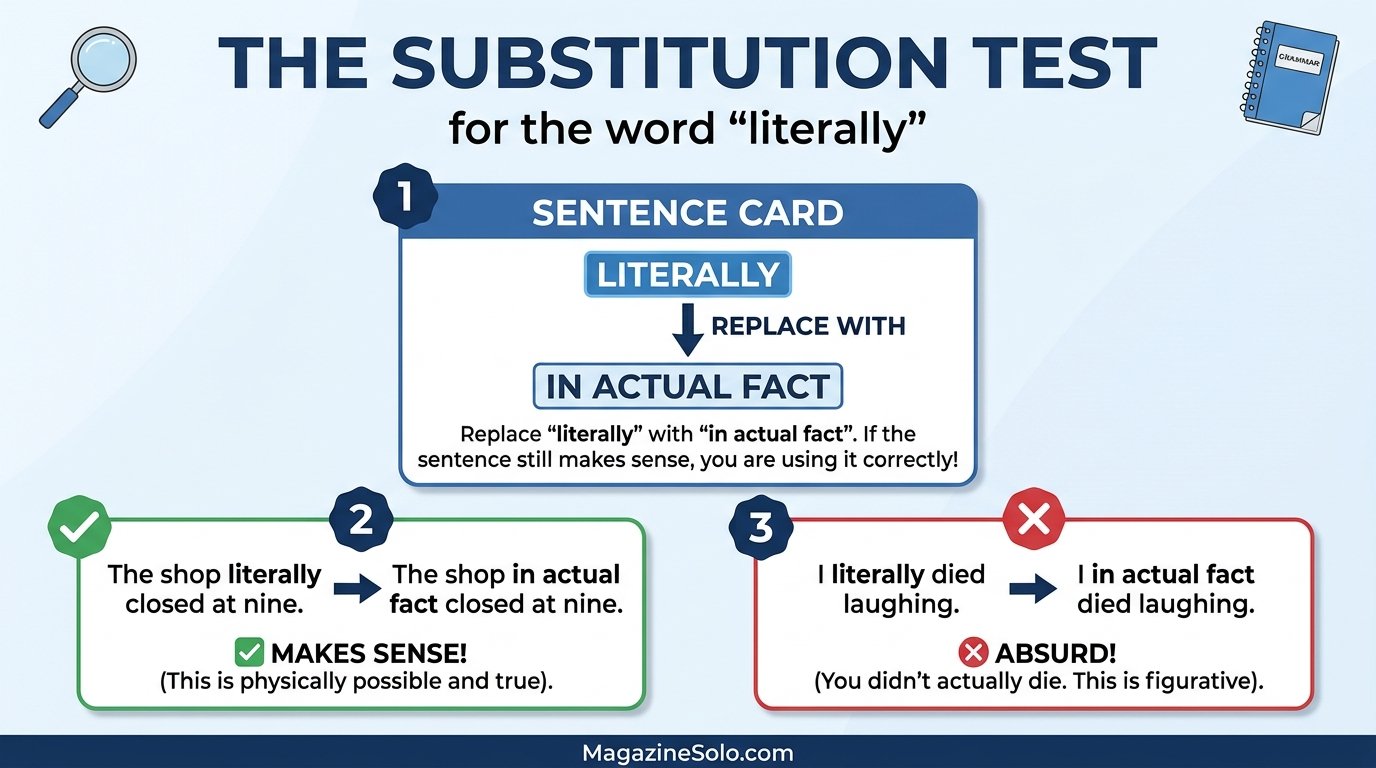
The strict sense is medieval: Merriam-Webster gives the first known use as the 15th century, in sense 1. A separate Collins strand dates the adverb to 1525 to 1535, built from literal plus ly. The two datings stay separate strands, never merged.
The word descends from the letter: Late Latin litteralis, of or relating to letters, from Latin littera, a letter. To take something literally is to hold to its letters, its exact wording.
The intensifier is not a modern accident. Merriam-Webster’s usage guide dates evidence of it to the mid 18th century, and its explainer gives 1769: Wikipedia, summarizing the Oxford English Dictionary record, names Frances Brooke’s 1769 novel The History of Emily Montague as the earliest OED citation.
The next century and a half is crowded with canonical names, all on Merriam-Webster’s own pages: Thackeray in 1847, Dickens in Nicholas Nickleby, Bronte, Fitzgerald, and Joyce’s Lily, run off her feet in 1914. The use was literary before it was ever slang.
Did the Dictionaries Change the Definition? No, and the 1909 Proof
The popular story says dictionaries recently gave in and changed literally to mean figuratively. Merriam-Webster answers it directly in ‘Did we change the definition of literally?’: the intensifier sense is old, and its inclusion is old too.
The proof is dated. Merriam-Webster reports that its 1909 unabridged dictionary already noted that literally is often used hyperbolically, giving ‘he literally flew’ as the example. A sense recorded that early was not invented for social media.
Formal Writing Rules: Essays, Email, Journalism
The register rules here are practical guidance, and simple: sense 1 is welcome everywhere; sense 2 is a speech form that formal readers are trained to mark wrong.
|
Context |
Sense 2 verdict |
What to do instead |
|---|---|---|
|
Casual speech and texting |
Fine |
Nothing; tone carries it |
|
Social media posts |
Fine |
Nothing; it works as a stance marker |
|
Fiction dialogue |
Fine |
Use it as characterization |
|
School essay |
Avoid |
Figuratively, almost, or delete the word |
|
Academic writing |
Avoid |
Sense 1 only, where it earns its place |
|
Business email and resumes |
Avoid |
Delete; the claim stands cleaner without it |
|
Journalism |
Avoid |
Follow the house guide; see below |
The big guides agree, in their own words. The Associated Press Stylebook: literally means in an exact sense; ‘do not use it figuratively.’ The Chicago Manual of Style says it ‘should not be used loosely in figurative senses,’ and adds that wherever other guides have accepted the usage, they should be disregarded.
The American Heritage usage panel, surveyed in the usage literature, objected to metaphorical uses such as ‘literally out of his mind with worry,’ and Oxford’s learner guidance warns the intensifier is not acceptable in formal contexts.
While you are in editing mode, the neighbouring pairs submit to the same discipline: passed vs past is decided by the verb test, and affect vs effect by the RAVEN rule.
The Neighbours: Literary, Virtually, Actually, and the Spellings
Literary is the neighbour that changes the topic: the adjective about literature, as in literary fiction. Literally, the adverb of literal, concerns facts. Same Latin root, different departments.
Virtually means for all practical purposes, nearly: the careful writer’s substitute when sense 2 tempts, since Merriam-Webster defines the intensifier as in effect, virtually. Actually is sense 1’s closest synonym; really completed the same journey earlier.
Pronunciation is four syllables, lit-er-al-ly, stressed on the first. Cambridge’s US entry for literally gives the American form roughly as LIT-er-uh-lee; the British form keeps a clearer t.
Spelling is literal plus ly: build the adjective first, then add the suffix. The two common misspellings attack the build in opposite places: litterally doubles the t, and litrally drops the e.
Fused spellings fail the same way: alot is a lot with the space wrongly closed, and all together vs altogether shows one small join changing the meaning entirely.
Frequently Asked Questions
1. What does literally mean?
Literally has two recorded senses. Sense 1 means in a literal sense: in actual fact, exactly as stated, word for word. Sense 2, labelled informal by Merriam-Webster, means in effect or virtually, used to emphasize a statement that is not literally true. The substitution test tells them apart.
2. What is the strict, original meaning of literally?
The strict sense is the dictionary’s sense 1: using the ordinary or primary meaning of a word, with exact accuracy and no exaggeration. Merriam-Webster breaks it into four parts, including word for word equivalence in translation and the truth emphasis of literally hundreds of people.
3. What does literally mean when people say ‘I literally died laughing’?
That is sense 2, the intensifier. The speaker did not die; the word adds emotional force to a figurative claim. Merriam-Webster records the use as informal and exaggerated, Cambridge labels it informal emphasis, and Collins calls it an intensifier use. It is understood, and it is the use purists object to.
4. Is it wrong to use literally as an intensifier?
Dictionaries record it, so it is not an error against the dictionary; usage guides still advise care. Merriam-Webster’s usage note calls the use pure hyperbole intended to gain emphasis, often where no emphasis is needed. The safe rule: fine in speech and informal writing, risky in formal writing.
5. Did dictionaries change the definition of literally to mean figuratively?
No. Merriam-Webster answers this directly in its explainer ‘Did we change the definition of literally?’: the intensifier sense is old, its inclusion is old, and its 1909 unabridged dictionary already noted that literally is often used hyperbolically, with the example ‘he literally flew.’ Dictionaries record use; they did not recently invent this sense.
6. Does literally actually mean figuratively now?
Not exactly, and Merriam-Webster’s FAQ makes the distinction. Its sense 2 means in effect or virtually, used to emphasize a statement that is not literally true. That is not identical to figuratively, which means with a metaphorical rather than literal meaning. Swapping the two words changes the sentence.
7. How old is the intensifier use of literally?
Old. Merriam-Webster’s usage guide dates evidence of the exaggerated use to the mid 18th century, and its explainer gives 1769. Wikipedia, summarizing the Oxford English Dictionary record, names Frances Brooke’s 1769 novel The History of Emily Montague as the earliest OED citation for the figurative sense.
8. Which famous writers used literally as an intensifier?
Merriam-Webster’s own pages name them. Its entry quotes James Joyce (Dubliners, 1914, ‘literally run off her feet’) and William Makepeace Thackeray (Punch, 1847, ‘I literally blazed with wit’). Its explainer adds F. Scott Fitzgerald, Charlotte Bronte, Charles Dickens in Nicholas Nickleby, and Mark Twain.
9. What is the difference between literally and figuratively?
Literally, in sense 1, says the words are to be taken in their ordinary, factual sense. Figuratively says the words carry a metaphorical, non literal meaning. Dictionary.com’s comparison puts it plainly: you can literally open a package, but you can only figuratively open your heart.
10. When should I use figuratively instead of literally?
Use figuratively when you want to flag a figure of speech and have the flag itself be correct in careful writing. The Language Portal of Canada gives the model correction: not ‘I literally died laughing’ but ‘I almost died laughing.’ In formal text, figuratively or almost is the safe choice.
11. What is the substitution test for literally?
Replace literally with the phrase in actual fact and reread. If the sentence still makes the same claim, the word is sense 1: ‘the shop literally closed at nine’ survives the swap. If it collapses into an absurd fact, as in ‘I in actual fact died laughing,’ the word was an intensifier.
12. Is literally a contronym or auto-antonym?
It is often labelled one: LanguageTool’s guide states that literally can technically be considered a contronym. The careful version, from Wikipedia’s summary of the linguistic record, is that the intensifier works as a generic intensifier, like really or very, rather than making the word a true synonym of figuratively.
13. How do you pronounce literally?
The word has four syllables, lit-er-al-ly, stressed on the first. Cambridge gives the US pronunciation roughly as LIT-er-uh-lee, with the middle consonant softened, and the UK form with a clearer t. Oxford Learner’s gives a similar four syllable pattern for both varieties.
14. How do you spell literally?
L-i-t-e-r-a-l-l-y. The common misspellings are litterally, with a doubled t, and litrally, missing the e. The memory hook used by spelling guides: the word is built from literal plus ly, so spell the adjective first, then add the suffix.
15. What is the difference between literally and literary?
They are different words from the same Latin root. Literally is the adverb of literal and concerns factual accuracy. Literary is an adjective about literature and writing, as in literary fiction or a literary magazine. One grades facts; the other describes books.
16. What is the difference between literal and literally?
Literal is the adjective: a literal translation, the literal meaning. Literally is its adverb: translated literally, taken literally. Collins builds literally as literal plus the suffix ly, first recorded, on the Collins strand, in 1525 to 1535. Same family, different jobs in the sentence.
17. What is the difference between literally and virtually?
In strict use, literally asserts exact fact, while virtually means for all practical purposes, nearly, as the Language Portal of Canada defines it. The twist: Merriam-Webster’s sense 2 of literally is itself defined as in effect, virtually, so the two overlap in the intensifier use. In careful writing, choose virtually for nearly.
18. Is literally the same as actually or really?
In sense 1, nearly: Merriam-Webster glosses sense 1 as actually, and its truth emphasis example could swap in actually without changing the claim. Really and very travelled the same road earlier, from truth words into general intensifiers, which is the comparison linguists use to explain how literally changed.
19. Can I use literally in formal writing?
You can use sense 1 freely: a literal translation, a literally true statement. Avoid sense 2. Oxford’s learner guidance, as quoted in the usage literature, warns the intensifier use can produce unintentional humorous effects and is not acceptable in formal contexts, though it is widespread in speech.
20. Can I use literally in an academic essay?
Only in sense 1, and only where it earns its place, for example when discussing translation or interpretation. The American Heritage usage panel, reported in the usage literature, objected to metaphorical uses such as ‘literally out of his mind with worry.’ In assessed writing, the intensifier invites a marker’s correction.
21. Is literally acceptable in a resume or a business email?
Sense 1 is safe, though it usually adds nothing: ‘led a team of literally twelve engineers’ is cleaner as ‘led a team of twelve engineers.’ Sense 2 reads as casual speech and weakens a professional claim. In business writing, delete the word and the sentence keeps its meaning.
22. What does ‘take it literally’ mean?
It means interpret the words in their strict, ordinary sense, with no allowance for metaphor, irony or exaggeration. Merriam-Webster’s first example for sense 1 is exactly this: ‘He took the remark literally.’ Its opposite is taking something figuratively, as a figure of speech.
23. What does ‘literally’ mean in translation?
It names word for word equivalence. Merriam-Webster’s sense 1c defines it as with the meaning of each individual word given exactly, and gives the example: the term Mardi Gras literally means Fat Tuesday in French. A literal translation keeps the words; a natural translation keeps the meaning, and the two often differ.
24. Verdict: ‘The party was attended by literally hundreds of people.’ Which sense?
Sense 1, the truth emphasis branch, sense 1b in Merriam-Webster, which uses this exact sentence shape. The claim is surprising but factual: the speaker insists the number is real, not a figure of speech. Swap in in actual fact and the sentence survives the test.
25. Verdict: ‘I literally died of embarrassment.’ Which sense?
Sense 2. This is Merriam-Webster’s own example sentence for the informal intensifier sense. The speaker is alive and exaggerating for effect; the substitution test collapses, because the speaker did not in actual fact die. Understood in speech, avoided in formal writing.
26. Verdict: ‘Lily was literally run off her feet.’ Which sense?
Sense 2, in a respected literary source: James Joyce, Dubliners, 1914, quoted in Merriam-Webster’s entry. Lily’s feet stayed attached; she was rushed and exhausted. The example matters because it shows the intensifier in canonical prose more than a century ago, not in modern slang.
27. Verdict: ‘The city was literally destroyed.’ Which sense?
Sense 1 on the Collins strand: Collins lists ‘actually; without exaggeration or inaccuracy’ as a sense and uses this sentence as its example. Context decides: after a disaster report it is a factual claim. The same words in a sports report about a defeated team would be intensifier use.
28. Verdict: ‘He literally flew across the room.’ Which sense?
Ambiguous until context arrives, and used in this page’s bank as a training case. Read as a stage effect, a stunt or a crash report, it can be sense 1. Read as praise for a fast runner, it is sense 2 hyperbole, the same shape as the ‘he literally flew’ example in the 1909 dictionary note.
29. Why do so many people object to the intensifier use?
Because sense 2 appears to reverse sense 1, and readers who prize the strict sense hear a factual claim being made carelessly. Merriam-Webster’s usage note acknowledges the criticism directly: the sense has been frequently criticized as a misuse. H. W. Fowler was already quoting offending examples in 1926.
30. Is the intensifier use of literally slang?
No. Merriam-Webster’s FAQ answers this directly: the disfavoured in effect use does not qualify as slang, because slang is markedly informal group language that outsiders may not understand. The intensifier use is standard informal English understood by everyone, which is a different category.
31. When was literally first used?
Merriam-Webster gives the first known use as the 15th century, in the meaning defined at sense 1. A separate Collins strand dates the adverb’s first recording to 1525 to 1535, formed from literal plus ly. The two strands are printed separately on this page and never merged into one date.
32. Where does the word literally come from?
From the letter. Dictionary etymologies trace literal to Late Latin litteralis, of or relating to letters or literature, from Latin littera, a letter. That is why the strict sense is about the letter of the text: to take something literally is to hold to its letters, its exact wording.
33. What is the opposite of literally?
Figuratively. The pair is the standard antonym set in the comparison pages: literally marks the factual reading, figuratively marks the metaphorical one. Virtually is not the opposite; on the Merriam-Webster record it is a near neighbour of the intensifier sense.
34. What are synonyms for literally?
By sense. For sense 1: actually, exactly, word for word, precisely, in actual fact, to the letter; Oxford Learner’s gives exactly as the synonym for its first sense. For the intensifier sense, the working substitutes are really, truly, virtually, almost and in effect, chosen by how strong the exaggeration is.
35. Can I just delete literally from my sentence?
Often, yes, and the deletion test is this page’s second check. If the sentence loses no information when literally is removed, the word was decoration. If it loses a factual guarantee, as in ‘the results were literally identical,’ the word was sense 1 and should stay.
36. Is literally used the same way in British and American English?
The two senses and the same argument exist in both. Cambridge lists the word with an original meaning sense and an informal emphasizing sense for both varieties; the difference is pronunciation detail, not meaning. Oxford publishes parallel UK and US learner entries with the same three part structure.
37. What does literally mean in texting and online speech?
Online, literally is most often the intensifier plus a stance marker: it signals strong feeling about a figurative claim, as in ‘this song literally lives in my head rent free.’ The claim is not factual and no reader takes it as fact. It is sense 2 doing social work, and it stays out of formal writing.
38. How do I use literally correctly in a sentence?
Follow three rules. One, use it where a factual claim might be doubted and you are vouching for it. Two, use it for word for word meaning in translation and quotation. Three, keep the intensifier for speech and informal writing, and expect some readers to dislike it even there. The substitution test checks any doubtful case.
39. What are the most common mistakes with literally?
Four recur across the usage guides. Using the intensifier in formal writing. Using literally where figuratively or almost is the accurate word. Adding literally to a claim that needed no emphasis, which Merriam-Webster’s note flags. And spelling it litterally or litrally. A fifth is calling a word for word translation accurate when only the words were kept.
40. What is the literal meaning of a word?
It is the word’s denotation: its ordinary, primary, dictionary meaning, independent of metaphor or context. Wikipedia’s literal and figurative language article defines literal usage as words used exactly according to their direct, conventionally accepted meanings. Literally is the adverb that asserts this reading.
41. Should I correct someone who uses literally as an intensifier?
Almost never in conversation: the meaning is understood, the use is centuries old, and the correction usually costs more goodwill than the error costs clarity. In editing, teaching or assessed writing, yes, flag it, because there the register rules apply. Correct the context, not the person.
42. What can I say instead of literally?
Match the substitute to the job. For a factual guarantee: actually, in fact, truly. For word for word: exactly, verbatim. For an exaggeration you want to keep but soften: almost, practically, figuratively. For pure emphasis in speech: really. Choosing the substitute is the practical half of the substitution test.
Conclusion
What does literally mean is, in the end, a question with a test attached. The word carries a strict sense, in actual fact and exactly as stated, and an informal intensifier sense recorded since the 18th century. Neither sense is going away.
Run the substitution test before you judge any sentence, including your own: swap in in actual fact, and keep the word only where the sentence survives. Where it collapses, emphasis is doing the work, and your register decides.
The neighbouring verdicts live across MagazineSolo: the comparison pages settle pairs like adverse vs averse the same way. Learn the test once, and the argued about words get quieter.

Dilawar is a content writer at MagazineSolo, covering travel, home improvement, interior design, and everyday lifestyle topics. He enjoys researching practical solutions, exploring travel destinations, and sharing helpful guides that make daily life easier. His writing focuses on clear information, useful advice, and engaging stories for a wide audience.