Passed vs Past: The Verb Test, the Four Jobs of Past, and the Trap Phrases
The passed vs past choice defeats good writers daily, because the two words sound identical and both spellings are real English.
Your spellchecker cannot save you. It sees two valid words and stays silent, while the sentence’s grammar already knows the answer.
The rule, once seen, is almost unfairly simple. Passed is only ever a verb, and past is never a verb at all.
Everything else is application: four tests that decide any sentence in seconds, a shelf of trap phrases with verdicts, and one honest disagreement.
That disagreement is included, not hidden. Most pages state the rule absolutely; one major source qualifies it, and this page shows you both.
Passed vs Past in 20 Seconds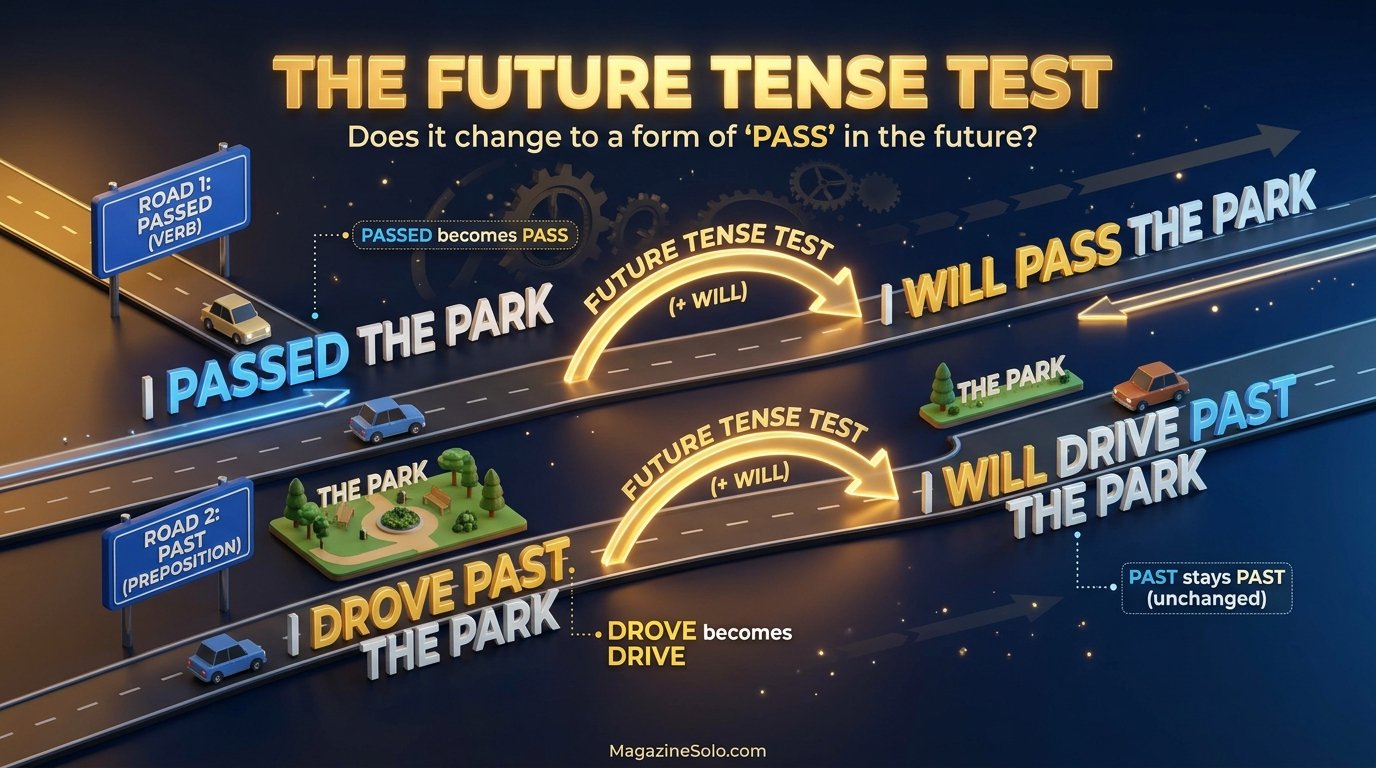
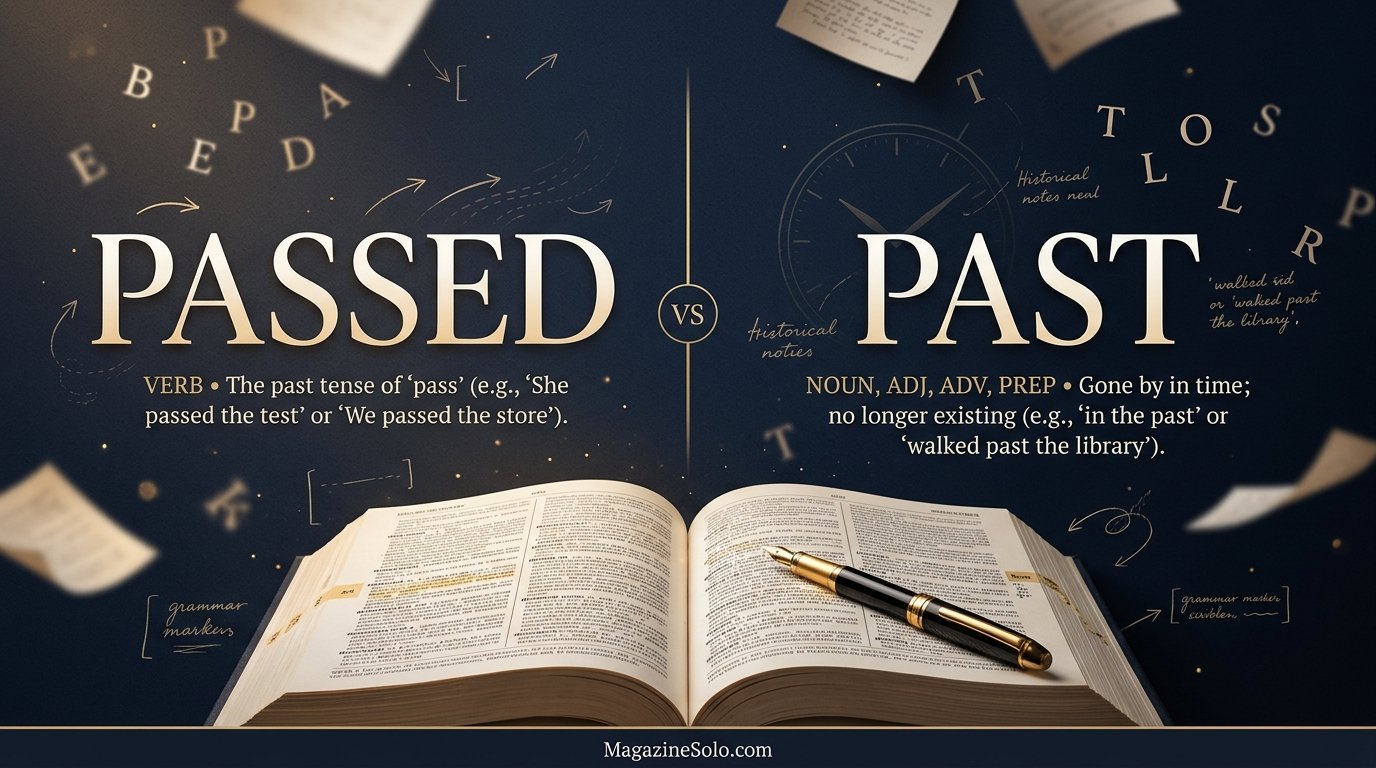
Passed is a form of the verb pass. Its past tense and past participle: she passed the exam, time has passed, the law was passed.
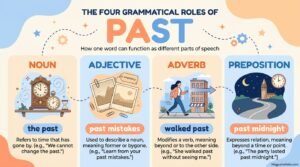
Past does four other jobs. Noun (the past), adjective (past mistakes), adverb (walked past), and preposition (past midnight), and never a verb’s job.
The one test to keep: rebuild the sentence in the future tense. If the word becomes will pass, it was passed; if it does not change, it is past.
Memorize those three lines and most sentences you will ever write are settled. The rest of this page exists for the stubborn remainder.
The Core Rule: One Word With One Job, One Word With Four
Merriam-Webster frames it best. Past is a very busy word, the dictionary says, while passed is busy too, but its role is much more limited.
That framing deserves to lead every treatment. One word is a specialist, the other is the busiest small word in the neighborhood.
The specialist first. A detailed statement of the same rule runs in the Grammarly past vs passed guide, whose distinguishing trick is exactly this: passed is always a verb.
Passed: Only Ever a Verb (and the One Disagreement)
Passed is the past tense and past participle of pass. Pass, passed, passed: a regular verb with one form doing both jobs.
That single identity covers every correct use. Moving (we passed the library), enacting (the bill was passed), dying (she passed away), handing (passed the ball).
A strong statement of the absolutist version appears in the LanguageTool passed or past guide: passed can only ever function as a verb, nothing else.
Now the disagreement, honestly. Thesaurus.com breaks ranks in the Thesaurus.com passed vs past article, saying passed is mostly a verb but can also be used as an adjective.
An ESL forum tradition agrees at the edge, allowing rare adjective and noun uses. No ranking page prints both strands; this one does.
The practical ruling: for school, exams, and edited writing, follow the majority. The strand exists, and you now know it exists, which is the honest position.
Past: Noun, Adjective, Adverb, Preposition
Past is the busy word. Four parts of speech share one spelling, and recognizing which job is present settles the spelling.
The entry structure at the Cambridge Dictionary past entry is itself the lesson: preposition and adverb entries, a noun entry, and no verb entry anywhere.
|
Job |
What it does |
Example |
|---|---|---|
|
Noun |
Names earlier time |
Learn from the past. |
|
Adjective |
Describes a noun as former |
Past generations knew hunger. |
|
Adverb |
Follows a movement verb |
The bus drove past. |
|
Preposition |
Means beyond |
Just past the post office. |
The adjective has one reversed pattern. In years past and in times past, the adjective follows its noun, an old fashioned arrangement called postposed.
The preposition is the beyondness word. Beyond in place (past the station), beyond in time (past midnight), beyond in degree (past caring).
Hold the table and the rule together: if your word is doing any row of this table, the spelling is past, full stop.
Passed in Its Many Senses: What the Verb Is Doing
One verb, a crowd of meanings. The inventory at LanguageTool counts ten senses of pass, and every one of them takes passed in the past.
Movement: to go by or beyond a point. We passed the library on our way here, in Merriam-Webster’s own example sentence.
Handing: to give something across. She passed the salt, he passed me the keys, the guard passed the documents through the window.
Succeeding: to clear a test or a threshold. She passed the exam, the car passed inspection, the proposal passed the committee stage.
Enacting: to make a measure law. The senate passed the bill, and the passive form follows: the law was passed.
Sport: to throw, kick, or hit to a teammate. Chanel passed the ball is the reference example for the sense, and match reports repeat it nightly.
Time elapsing: to go by. Two years passed, the hours passed slowly, not a minute passed without news.
Dying, gently: the phrasal family. He passed away in his sleep, she passed on last spring, and both take the verb’s form.
Fainting and declining: two more phrasal senses. The kids passed out in front of the television; she passed up the promotion, and passed on the dessert.
Approving and clearing: to give a pass mark or permission. The committee passed the design; the censor passed the film without cuts.
Going unnoticed: to pass without remark. The remark passed without comment, the anniversary passed quietly, the moment passed.
Read the list as one identity. Ten jobs, one word class: every sense is something a subject does, which is why every past form is passed.
The Test Stack: Four Ways to Decide in Seconds
Tests outrank memory. Each test below is named, credited, and given its failure mode, because a test you trust beats a rule you half remember.
Run them in order. The first test settles most sentences; the later ones exist for the constructions where the first one strains.
Test 1: The Future Tense Swap (Merriam-Webster)
Rebuild the sentence in the future. Merriam-Webster’s signature test: put the same sentence in the future tense and watch the word.
I passed the park becomes I will pass the park. The word changed into pass, proving it was the verb all along.
I drove past the park becomes I will drive past the park. Past did not move, because past was never the verb.
The same test is taught to learners in the Oxford International passed vs past guide, with the cafe example: we passed the cafe, we will pass the cafe.
Test 2: The Went Past Substitution (Grammar-Monster)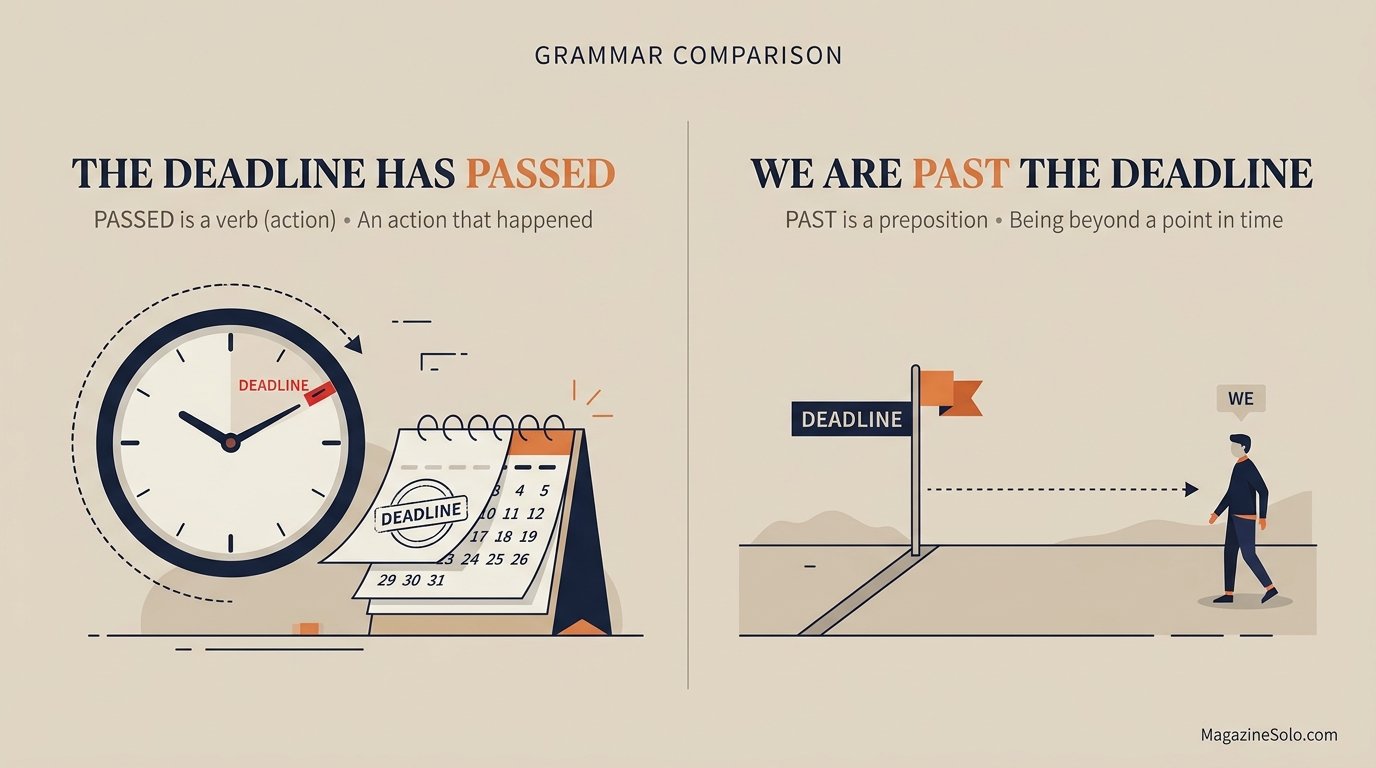
For movement sentences, substitute went past. The teaching page at the Grammar-Monster past and passed page names this its Top Tip, and it earns the name.
If went past fits where your word sits, your word is doing movement work: he ran past, they walked past, the car sped past.
Use the participle twin where needed. Where passed would follow has or have, test with gone past in the same slot.
Its limit is scope. The test speaks to movement only; it says nothing about bedtimes, due dates, or history, which the other tests cover.
Test 3: Look for the Verb Already in the Sentence
Every clause needs its verb, and usually has one. The guide at the ProWritingAid passed vs past guide teaches two tests, and this is the more mechanical one.
Find the sentence’s action word first. In she walked past the shop, walked is the verb, so the second word cannot be a past tense verb form.
The warning sign is visible: two ed forms together. Ran passed, walked passed, drove passed: one of the pair is nearly always wrong.
Its companion test swaps to the present. Passed becomes pass or passes cleanly (I pass the ball); past refuses the swap (I drove pass the shop is broken).
Test 4: When, or What Happened
Ask what the phrase answers. The checker guide at Linguix phrases it crisply: if the phrase answers when, use past; if it answers what happened, use passed.
In the past answers when. Time has passed answers what happened, which is why the same word time takes both spellings in different sentences.
Use this test as the tiebreaker. It is the least mechanical of the four, and the fastest once the habit forms.
Minimal Pairs: The Same Road, Both Words
Contrast teaches faster than definition. The table format at the YourDictionary passed vs past article builds its whole page on this, with one pair worth memorizing.
|
Sentence |
Why |
|---|---|
|
I drove past the exit. |
Drove is the verb; past is the adverb of movement. |
|
I passed the exit. |
Passed is the verb; nothing else does the action. |
|
The deadline has passed. |
Passing is the event; has takes the participle. |
|
We are past the deadline. |
Past is the preposition: beyond the deadline. |
|
She passed the salt. |
Handing over is the verb pass. |
|
She walked past the salt cellar. |
Walked is the verb; past marks the path. |
Read each pair aloud. The grammar is identical in sound, which is the whole problem, and opposite in structure, which is the whole solution.
The deadline pair is the one to keep. The same noun takes both words in different constructions, proving the job, not the topic, decides.
The Trap Shelf: Set Phrases With Verdicts
Set phrases bypass the tests. They are learned whole, like vocabulary, and the table below is the shelf readers actually arrive for.
|
Phrase |
Verdict |
The one line reason |
|---|---|---|
|
passed away / passed on |
Passed |
Phrasal verbs of pass (to die) |
|
passed down |
Passed |
The handing down verb |
|
passed out / passed up |
Passed |
Phrasal verbs again |
|
past due |
Past |
Beyond the due date |
|
past your bedtime |
Past |
Beyond, preposition |
|
past tense |
Past |
Named for the past, the noun |
|
in the past |
Past |
The noun with its article |
|
in years past |
Past |
Postposed adjective |
|
past master |
Past |
Adjective in a fixed phrase: an expert |
|
past caring / past it |
Past |
Beyondness, preposition |
Notice the pattern inside the table. Every passed row is a verb doing work; every past row names, describes, or points beyond something.
Passed Away, Passed Down, Passed Out: Always Passed
The phrasal verbs are unanimous. Pass away, pass on, pass down, pass out, pass up: each is the verb pass wearing a particle.
Their past forms therefore take passed, always. A university errors page at the Washington State University common errors page makes the time version famous: you have passed the time, never past it.
Passed down carries a classroom pedigree. The wrong version, past down through the family, is literally a school exercise item in a major practice platform.
Past Due, Past Your Bedtime, Past Tense: Always Past
The billing phrase is past due. Sources split on which part of speech past is there, adjective or preposition, and agree completely on the spelling.
Bedtime is the preposition’s home turf. Past your bedtime means beyond the hour, and question sites keep standing pages answering exactly this.
Past tense is the famous slip. The explainer at the Reader’s Digest passed vs past explainer calls passed tense one of the most common mix ups in the whole topic.
The tense is named for the past, the noun. Nothing is being passed when you conjugate a verb, however tempting the ed looks.
Get Past vs Get Passed: Both Correct, Different Meanings
This pair is the shelf’s jewel. Both spellings are correct English, in different sentences, and meaning alone chooses.
Get past means resolve or move beyond: get past the problem, get past the gate, get past the first round.
Get passed means be approved: only one bill will get passed, the motion got passed at noon.
The quiz at the QuillBot past vs passed guide builds a question on exactly this, answering BOTH in capitals, and it is right to shout.
Pastime, Pass Time, Past Time: The Three Way Trap
Three lookalikes, three different objects. A pastime (one word) is a hobby, something that makes time pass agreeably.
Pass the time is the verb phrase for spending time. Its past tense is passed the time, the only elapsed time verb form, per the university page.
Past time is the disputed third. One guide allows it as adjective plus noun for an earlier period; another calls it often a mistake for the other two.
One use is not disputed: it is past time to act, meaning overdue, where past is the preposition before the noun time. Learn that idiom whole.
Telling the Time: Half Past, and the British American Split
Clock time is past’s daily shift. Half past ten is 10:30, a quarter past twelve is 12:15, ten past three is 3:10, always with past.
Cambridge grades the pattern as beginner level English: five, ten, a quarter, twenty, twenty five, half past the hour.
British English splits the hour. Past serves the first half hour only; after half past, British speakers switch to to: twenty to eight is 7:40.
American English mostly skips both. Digital style (ten twenty five) or after (ten after three) and of (a quarter of four) do the work.
One learner trap rides along: informal British half ten means 10:30, not 9:30, a misunderstanding with real missed trains behind it.
Twenty Verdicts in a Row: A Sentence Bank
Volume builds the reflex. Twenty real constructions, each with its verdict and its one line reason, grouped by the job being done.
Movement sentences:
- The train passed the station without stopping. (Verb: the train did it.)
- We walked past the station twice. (Walked is the verb; past marks the path.)
- He ran past the door and kept going. (Ran holds the verb slot.)
- The parade has gone past the square. (Gone is the participle; past is the adverb.)
Time sentences:
- Three weeks have passed since the letter. (Elapsing is the verb.)
- It is past midnight already. (Preposition: beyond the hour.)
- In the past, letters took weeks. (The noun, with its article.)
- The danger has passed. (The event is the verb’s work.)
Formal and work sentences:
- Your account is past due. (Set phrase: beyond the due date.)
- The bill was passed on Tuesday. (Passive of enact.)
- She passed the bar exam in June. (Succeeding is the verb.)
- His past experience impressed the panel. (Adjective before the noun.)
Home and feeling sentences:
- It is past your bedtime. (Beyond, preposition.)
- Grandmother passed away in March. (Phrasal verb.)
- Do not let it get past you. (Movement beyond, fixed phrase.)
- Only one motion got passed. (Approval, the verb in the passive.)
Beyondness sentences:
- She is past caring about the gossip. (Beyond in degree.)
- The shop sits just past the bridge. (Beyond in place.)
- In years past, the harbor froze. (Postposed adjective.)
- The milk is past its sell by date. (Fixed phrase, preposition.)
Scan the bank for the pattern. Wherever something happens, the spelling is passed; wherever something is located in time or space, the spelling is past.
The Wrong Sentence Clinic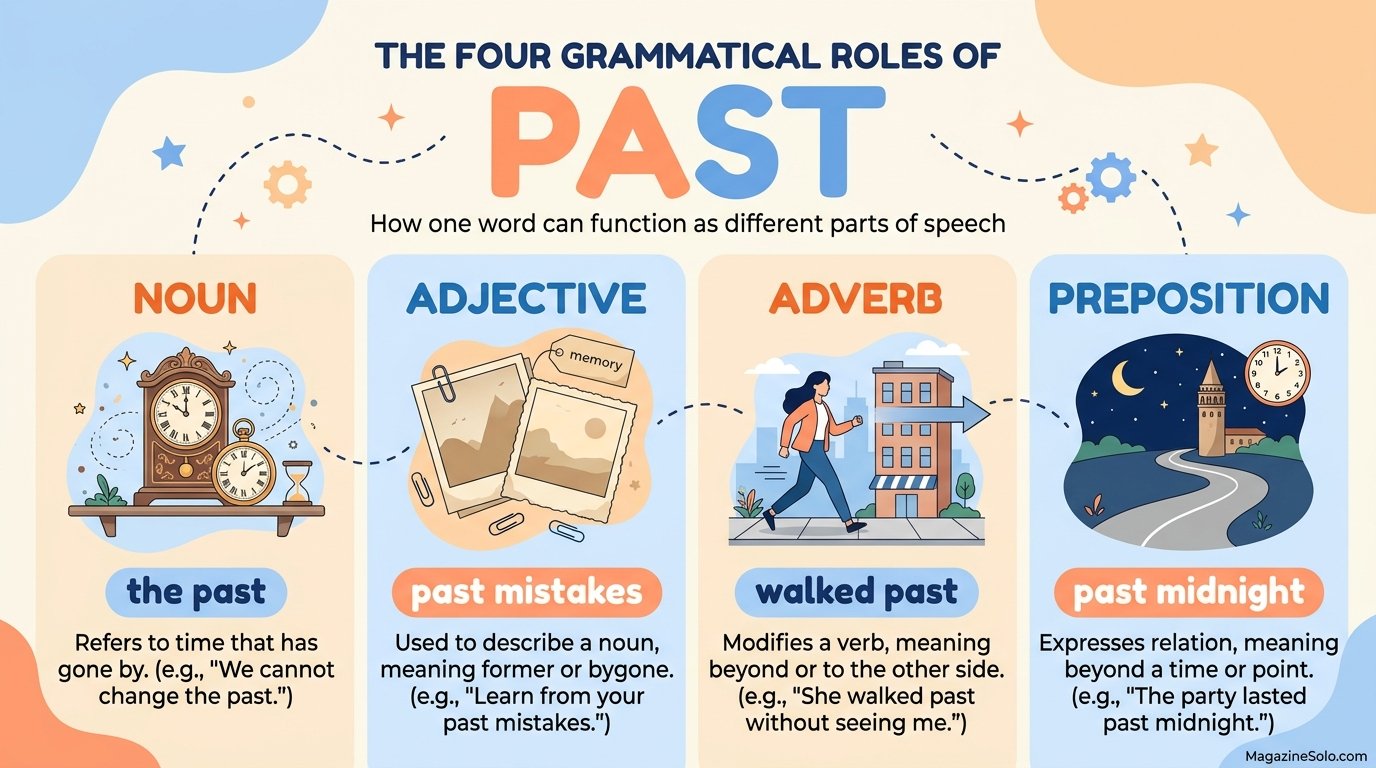
Errors teach the rule backwards. Every sentence below is a documented, searchable mistake, corrected with its test attached.
|
Wrong |
Right |
The test that catches it |
|---|---|---|
|
In the passed, things were simpler. |
In the past |
When, or what happened: it answers when |
|
The watch was past down for generations. |
Passed down |
Phrasal verb: pass down takes passed |
|
Your invoice is passed due. |
Past due |
Set phrase: beyond the due date |
|
Use the passed tense for this verb. |
Past tense |
Named for the noun, the past |
|
He ran passed the house. |
Ran past |
Two ed forms: ran already holds the verb slot |
|
Too much time has past. |
Has passed |
Future swap: time will pass |
Keep your own clinic list. The errors you personally repeat are the highest value study material in the topic, a point every teacher in the set makes.
Direction errors like this pair have cousins across the cluster. The movement logic in our emigrate vs immigrate guide works on the same principle: the word’s job in the sentence decides.
Passed and Past in Formal Writing: Exams, Work, and Notices
Formal contexts punish the slip hardest. A past due invoice misspelled, or a death notice with past away, reads as carelessness before it reads as content.
Death notices take passed away. It is the standard gentle phrasing, a phrasal verb, and the form every style conscious writer uses.
Billing takes past due. Accounts language is fixed: past due balance, days past due, past due notice, and the spelling is part of the professionalism.
Exams take the majority rule. Whatever the strand debate, school and edited English mark passed as a verb only; the absolutist sources are the safe syllabus.
An honesty note belongs here: claims that this pair is tested by named exam boards circulate loosely online, and no verified board level link appears in the sources. Curricula and school platforms, yes; named boards, unverified.
Meaning distinctions in formal prose are a cluster habit. The same care runs through our imply vs infer guide, where direction decides, and our lay vs lie guide, where the object decides.
Why Two Words Exist at All: A Short History
The pair is one word that split. Understanding the split explains why the confusion is centuries old and not a modern carelessness.
In Middle English, past was originally a form of passed: the past participle of the verb passen, worn down in everyday speech.
Over centuries the worn form specialized. Past drifted away from the verb and settled into the noun, adjective, adverb, and preposition jobs it holds today.
Meanwhile the full form, passed, kept the verb’s work: the action senses, the participles, the passives, and the phrasal verbs.
That history is why the boundary sits where it does. The language itself separated the doing (passed) from the done and the beyond (past).
It also explains the stubborn strand in the sources. Where Thesaurus.com allows passed an adjective use, it is hearing an echo of the era before the split finished.
The practical moral is not antiquarian. You are not failing a spelling rule; you are standing at a seam in the language, and seams need a test, not a memory.
Modern authorities police the seam as it now stands. The dictionaries’ entries are the map of the finished split: verb forms under pass, everything else under past.
Writers who know the story stop blaming themselves. The confusion is structural, the fix is procedural, and the procedure is the test stack above.
Both Words in One Sentence: The Final Boss
Some sentences need both words at once. They look like traps and read perfectly once the jobs are separated.
As we passed the courthouse, we talked about the past. Passed does the moving; the past names the era under discussion.
The years passed, and the town put the past behind it. First the verb elapses time; then the noun is what gets left behind.
She passed the gate and walked past the garden. The same motion, split: passing the gate is her action, walking past the garden is her path.
Read them with the swap. Each passed becomes will pass in the future version; each past sits still, exactly as the test predicts.
How to Remember It for Good
Two mnemonics circulate because they work. They are memory hooks, not rules, and they pair best with the verb test as the referee.
Past ends with a T, and past usually refers to time, which begins with T. The trick is credited across the guide set, including the ProWritingAid treatment.
Passed ends with ed, like most verbs in the past tense. If the word is doing a verb’s work, its spelling wears the verb’s uniform.
The classroom version compresses both: passed tells what she did; past tells where or when. Teachers print it because ten year olds retain it.
Build the habit in three moves. Learn the trap shelf whole, run the future swap on anything doubtful, and keep your personal clinic list updated.
Within a week of real writing, the test becomes reflex. The pair then behaves like the cluster’s other solved pairs, such as the time and place logic in our capital vs capitol guide and the three way split in our ensure vs insure vs assure guide.
Learning the Pair: A One Week Practice Plan
The pair yields to a week of small reps. Teachers build it into curriculum units for a reason: short, daily contrast beats one long lesson.
Day one: the rule and the table. Read the 20 second box and the part of speech map, then write four sentences of your own, one per job of past.
Day two: the future swap. Take ten sentences from your own recent writing, real ones, and run the swap on every past sounding word in them.
Day three: the trap shelf. Cover the verdict column and call each phrase aloud before checking. Misses go onto your personal clinic list.
Day four: the sentence bank. Work the twenty verdicts the same way, verdict first, reason after, and add two sentences from your own work emails.
Day five: the clinic. Write the six classic errors from memory, correct them, and name the test that catches each one.
Day six: live fire. Draft a page of anything (a notice, an invoice note, a match report) and proofread it with the stack only, no checker.
Day seven: the checker audit. Run the same page through a grammar checker and compare its calls with yours. Where you disagree, the trap shelf arbitrates.
Keep the clinic list permanently. Every future slip gets logged with its test, and within a month the list stops growing, which is the measurable end of the lesson.
More of the cluster’s standing guidance starts from our MagazineSolo home page, where the confused pairs are shelved together.
Frequently Asked Questions
1. What is the difference between passed and past?
Passed is the verb; past is everything else. Passed is only a form of the verb pass.
Past is never a verb: it works as a noun, adjective, adverb, or preposition.
2. How do I know whether to use passed or past?
Run the future swap. Rewrite the sentence in the future tense.
If the word changes to will pass, it was passed; if it stays unchanged, it is past.
3. Is passed a verb only?
The majority says verb only. Merriam-Webster, Grammarly, LanguageTool, and QuillBot state it absolutely.
One strand, Thesaurus.com, allows rare adjective uses of passed; edited writing follows the majority.
4. Can past be used as a verb?
Never. Past has no verb form in any dictionary entry: Cambridge lists it as preposition, adverb, and noun only.
The verb is pass, and its past forms are passed.
5. Is it past your bedtime or passed your bedtime?
Past your bedtime. Past is the preposition of beyondness here: the hour is beyond your bedtime.
Passed would need a verb’s job, and the phrase gives it none.
6. When someone dies, is it passed or past?
Passed, in passed away. Dying takes the phrasal verb pass away, so the form is passed.
Passed on means the same; past away is never correct.
7. Is it time has passed or time has past?
Time has passed. Passing time is the verb at work, so has takes the participle passed.
Time has past is one of the pair’s commonest written errors.
8. Is it past due or passed due?
Past due. Beyond the due date takes past, and every authority checked, quiz pages included, gives past due for unpaid bills and overdue items.
9. Is it passed down or past down?
Passed down. Handing down is the phrasal verb pass down.
The watch has been passed down, never past down; the wrong version is a school test item.
10. What is the difference between get past and get passed?
Both, with different meanings. Get past means resolve or move beyond.
Get passed means be approved, as a bill is.
Meaning, not spelling instinct, chooses between them.
11. Is it walked past or walked passed?
Walked past. Walked already fills the verb slot, so the movement word is the adverb past.
Two past tense verb forms cannot share that job.
12. He ran past or ran passed the house?
He ran past the house. Ran is the verb; ran passed puts two ed forms in one job and is the classic warning sign.
Keep ran, write past.
13. Is it in the past or in the passed?
In the past. The past is the noun for earlier time, with its article.
In the passed is a documented error common enough to have its own correction page.
14. Is it past tense or passed tense?
Past tense. The tense is named for the past, not for a verb form.
Reader’s Digest calls passed tense one of the most common mix ups with this pair.
15. What does half past ten mean?
Ten thirty. Past is the time preposition: half past ten is thirty minutes after ten, a quarter past twelve is 12:15, and ten past three is 3:10.
16. Is it well past or well passed?
Well past, in the common uses. Well past midnight, well past the deadline, well past caring: the beyondness word.
A rare verb reading exists for bills well passed by a house.
17. Is it gone past or gone passed?
Gone past. For movement and deadlines, the bus has gone past and the deadline has gone past.
Gone passed is not standard English.
18. Is passed experience correct?
No: past experience. The word describes the noun, so it is the adjective past, as in past performance and past generations.
Experience cannot pass anything.
19. Do you run something past someone or passed someone?
Run it past someone. The idiom meaning show it for a reaction takes the preposition past.
Its own past tense is a verb form: yesterday I ran it past him.
20. What is the past tense of pass?
Passed. Pass is a regular verb: pass, passed, passed.
She passes today, she passed yesterday, she has passed already.
Past appears nowhere in its conjugation.
21. What is the past participle of pass?
Passed again. Regular verbs use one form for both jobs, so has passed and was passed are both built from passed: time has passed, the law was passed.
22. Why do people confuse passed and past?
They are homophones. Identical sound, different spelling and job, and both are real words, so a spellchecker stays silent.
Only the sentence’s grammar decides, which is why tests beat memory.
23. What is a pastime, and is it past time or pass time?
Pastime is the hobby, one word. Spending time is the verb phrase pass the time, whose past tense is passed the time.
Past time is a rarer, disputed phrase outside one idiom.
24. Is past time ever correct?
In one idiom, yes. It is past time to act means it is overdue, past as preposition before the noun time.
Elsewhere, sources split on past time and usually advise a clearer phrase.
25. What does past master mean?
An expert. A past master is someone very skilled through long experience.
Dictionaries also list an older sense, a former master of a guild or lodge.
26. What does past caring mean?
Beyond caring. Past caring means no longer able to care.
It belongs to the beyondness family: past it, past your prime, past the point of no return.
27. How do you use past as a preposition?
Beyond, in place, time, or degree. The shop just past the station, past midnight, past caring, ten past three.
It answers where or when beyond, and never changes form.
28. How do you use past as an adverb?
After a movement verb. They walked past, the bus drove past, she ran past without stopping.
For movement sentences, the went past substitution settles the form.
29. How do you use past as an adjective?
Before a noun, usually. Past generations, past mistakes, the past few days.
In one pattern it follows the noun instead: in years past, in times past.
30. How do you use passed in the passive voice?
Was or were plus passed. The bill was passed, the law has not been passed yet.
Enacting is the verb pass in the passive, and Merriam-Webster’s own example is the unpassed law.
31. Can passed be an adjective?
The pair’s one open argument. Dictionary aligned sources say never.
Thesaurus.com and a forum tradition allow rare adjective uses.
School, exam, and edited writing follow the majority rule.
32. Is there a British and American difference with past?
In telling time, yes. British English uses past for the first half hour, then to.
American English prefers the digital form or after and of.
The grammar rule itself does not change.
33. What is the mnemonic for passed vs past?
Two circulate widely. Past ends with a T and refers to time; passed ends with ed, like most past tense verbs.
A classroom version: passed tells what she did, past tells where or when.
34. How do you test a sentence with the future tense?
Rewrite it in the future. We passed the cafe becomes we will pass: the word changed, so it was the verb.
We walked past keeps past unchanged, because it never was the verb.
35. What does passed away mean, and is passed on the same?
Both mean died, gently. Passed away is the standard phrase in notices; passed on means the same in many varieties.
Both are phrasal verbs, so both take passed.
36. Is it the deadline has passed or past?
The deadline has passed. A deadline passing is an event, the verb in the perfect tense.
Compare past the deadline, where past is the preposition: we are past the deadline.
37. How is passed used in sports?
As the ball verb. Chanel passed the ball is a reference guide’s own example: throwing, kicking, or hitting to a teammate is pass, so its past tense is passed.
38. How is passed used in law and news?
For enactment. The bill was passed, the motion passed, the law has not been passed yet.
Journalists use passed for the vote and past for the history: in past sessions, it failed.
39. Two years have passed or two years have past?
Two years have passed. Years passing is the verb in the perfect tense with have.
The question fills forums, and the consensus answer is passed; have past is the error being asked about.
40. Can a grammar checker fix passed vs past for me?
Mostly, yes. Checkers read sentence grammar, which is what decides this pair, and the ranking brands are checker companies for that reason.
Learn the trap phrases yourself as the backstop.
41. What are the most common passed vs past mistakes?
The documented shelf. In the passed, past down, passed due, passed tense, ran passed, and time has past.
Each wrong form is a real, searchable error with correction pages of its own.
42. How can I practice passed vs past?
Drill minimal pairs. I drove past the exit against I passed the exit teaches more than a restated rule.
Add a spot quiz, interactive tests, and a personal list of your own past errors.
Conclusion
Passed vs past resolves to one habit: ask what job the word is doing. If it is the verb, or part of the verb, write passed; if it names, describes, or points beyond, write past.
The trap phrases reward learning whole, and the one scholarly disagreement rewards honesty: the majority rule is safe for every exam, editor, and employer you will meet.
Run the future swap when in doubt, keep the clinic list near your keyboard, and the pair stops being a coin toss by the end of the week.
Start from our MagazineSolo home page for the wider confused words cluster, and let your passed and past be chosen by the test, never by the sound.

Dilawar is a content writer at MagazineSolo, covering travel, home improvement, interior design, and everyday lifestyle topics. He enjoys researching practical solutions, exploring travel destinations, and sharing helpful guides that make daily life easier. His writing focuses on clear information, useful advice, and engaging stories for a wide audience.