Lay vs Lie Difference: The Table, the Test, and the Traps
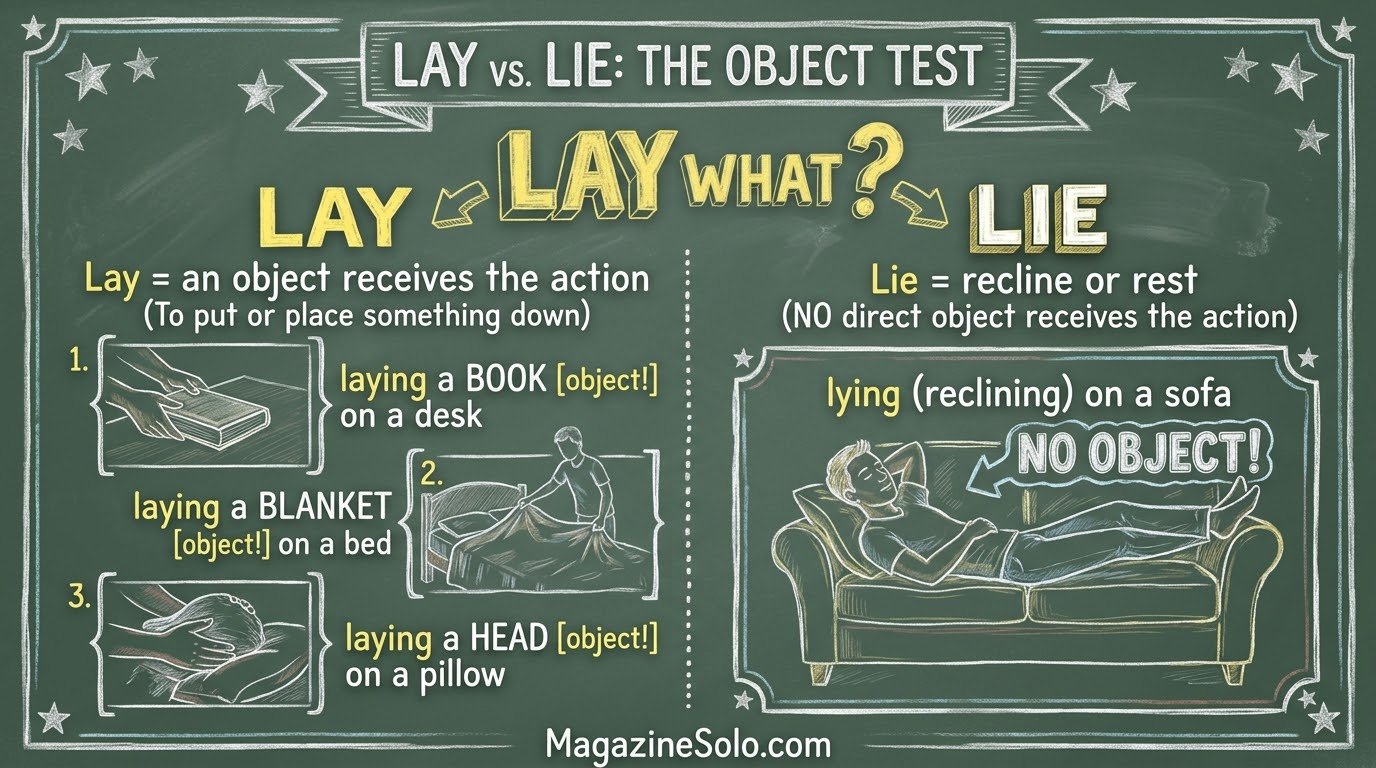
The lay vs lie difference fits in one line, and this page starts with it. One of these verbs places something, and the other one simply rests.
Lay places. It needs an object every time: lay the book, lay the baby, lay your head on the pillow.
Lie rests. It takes no object at all: lie down, the dog lies in the sun, the answer lies in the data.
Everything else about this pair is detail around that single contrast. The forms, the tenses, the songs, and the phrases all hang on the object column.
So this page works like a difference page should. The table comes first, then the trap cell inside it, then ruled sentences instead of more definitions.
The Difference in One Table
|
Verb |
Meaning |
Object needed |
Present |
Past |
Past participle |
Ing form |
One example |
|---|---|---|---|---|---|---|---|
|
Lay |
Put or place something |
Yes |
lay |
laid |
laid |
laying |
Lay the book on the desk |
|
Lie |
Recline, rest, be situated |
No |
lie |
lay |
lain |
lying |
Lie on the sofa |
|
Lie |
Tell an untruth |
No direct object in the usual use |
lie |
lied |
lied |
lying |
He lied about his age |
Read the object column before every other column. It is the only column that never changes its answer across tenses, dialects, or registers.
The present row is where the difference feels easy. Laying places and lying rests, and no honest sentence confuses the two for long.
The past row is where the difference hides, and the next chapters live there. The participle row is where the difference becomes safe to test, because laid and lain never collide.
One competitor, The ClarifyWords quick answer table, builds its whole page on a quick answer table like this one. It adds rows for lay as the past of lie and for lied, which this table folds into the lie rows.
One major explainer prints this difference with an error inside it. The Reader’s Digest difference guide gives the past participle of lie as lay in its own chart, which is the collision swallowing the table.
Read difference charts the way editors read them: check the participle row first. If a chart gets lain wrong, its confidence elsewhere deserves a second look too.
Lay: The Placing Side of the Difference
On the lay side, the difference is a delivery. Something is always being carried from the verb to a resting place, and the sentence names it.
The objects are ordinary: books, blankets, babies, bricks, blame. She lays the towels out, he laid the foundation, the road crew lays asphalt before noon.
Lay behaves regularly, which is part of its danger. Lay, laid, laid, laying never surprise anyone, so the hand borrows laid for every past job in the neighborhood.
Its phrases carry their objects openly. Lay the table, lay an egg, lay the groundwork: strip the object out and each phrase collapses, which proves the column.
Historically, lay is the difference with a blueprint. Old English built it from lie to mean cause to lie, the way set was built to mean cause to sit.
That is why the object is not an arbitrary rule. The verb was manufactured transitive, and a thousand years of use have not worn the requirement off.
Lie: The Resting Side of the Difference
On the lie side, the difference is a posture. The subject does the resting itself, and nothing receives the action because there is nothing to receive.
People lie down, dogs lie in the sun, villages lie in valleys. The verb completes itself the moment the subject settles, with no delivery involved.
Situated subjects: books, villages, answers
Lie reaches far beyond sleepy bodies. The book lies on the table, the road lies ahead, and the answer lies in the data, all situated, none placing.
This figurative shelf is where careful writers slip. A report that the answer lays in the data has crossed the difference, and editors catch it precisely because data places nothing.
The third verb: lie, lied, lied
The difference has a silent third party. Lie meaning tell an untruth runs lie, lied, lied, lying, regular in every cell and unrelated to both neighbors.
It never borrows laid or lain, and it never lends lied to them. Nobody has ever lay about their age, and nobody has ever lied in the sun as a grammar form.
The LanguageTool difference explainer, the checker brand’s explainer, closes its lesson by restating all three verbs in one recap. That recap is the right instinct: the difference is only clean once the third verb leaves the room.
The Difference in the Past Tense: The Trap Cell
Ask where the difference breaks down and every honest guide points at the same cell. The past tense of lie is lay, identical to the present tense of lay.
So one spelling does opposite jobs across time. Yesterday he lay down (rested). Today I lay the book down (placing). The word did not change; the verb underneath it did.
This is why difference charts disappoint in the past row. They print the forms correctly and still leave the reader unable to rule the sentence in front of them.
The repair is to rule past sentences as pairs. He lay down at noon, rested. He laid down his rifle at noon, surrendered it. One letter, opposite sides of the difference.
Context does the resolving in real prose. Tense markers (yesterday, last night, every day) plus the object question together identify which verb a bare lay belongs to.
The participles never collide: laid vs lain
After has, have, or had, the difference becomes mechanical again. Laid always belongs to placing and lain always belongs to resting, with no shared spelling anywhere.
She has laid the towels out. He has lain awake for hours. The hen has laid an egg. The letter has lain unopened for a week.
That makes the participle row the safest diagnostic on the page. When a bare past form confuses you, rewrite it mentally with has and watch the difference reappear.
Cambridge adds the register note that explains the wobble. The Cambridge grammar entry marks lain as very formal and rarely used, so speakers dodge it, and the dodge blurs the whole row.
The Lay What Test: The Difference as a Question
The difference survives longest when it is carried as a question. Ask the verb: lay what? The sentence either answers with a thing or it does not.
Step 1: find the verb. Ignore the rest of the sentence until the candidate stands alone.
Step 2: ask lay what, out loud. The ear often answers before the eye does, especially in long sentences.
Step 3: if a thing answers, take the lay row. Book, baby, blame, groundwork: any placed noun sends you to lay, laid, laying.
Step 4: if silence answers, take the lie row. Resting, situated, and existing somewhere all live on the lie side of the difference.
Step 5: take the tense form from that row only. Forms never travel between rows, however similar they look in the trap cell.
Try it on the classic borderline: I want to lay down. Lay what? Nothing answers, so the difference rules lie down, whatever habit says in the moment.
The GrammarBook entry, the style guide entry, teaches the same border with corrected wrong sentences. Its entry lists I’m going to lay on the couch among the errors and fixes it to lie, which is the test in action.
The Difference in Phrases: Two Frozen Shelves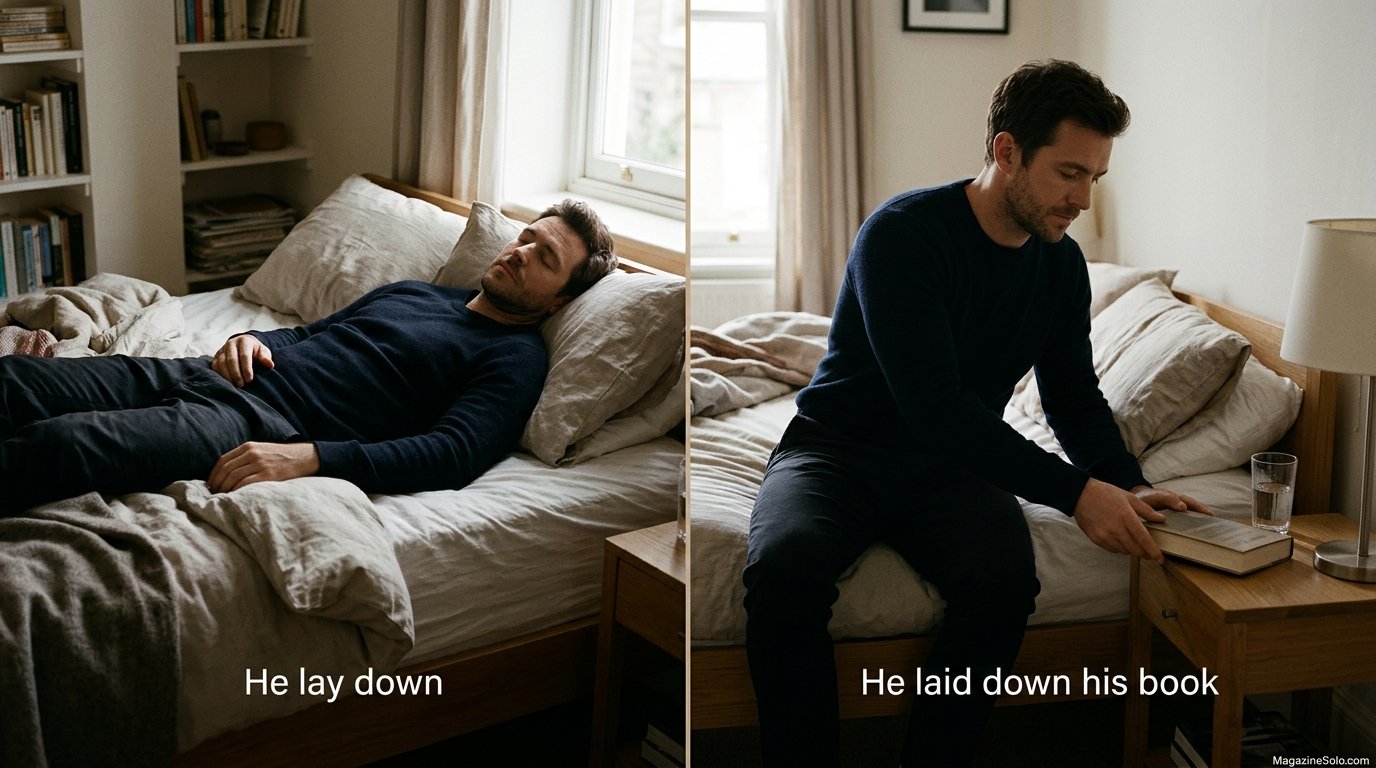
Set phrases file themselves on one side of the difference and stay there. Learn the shelves as vocabulary and whole families of sentences stop wobbling.
|
Shelf |
Phrases |
Why they sit there |
|---|---|---|
|
Lay phrases |
lay the table, lay an egg, lay the groundwork, lay blame, lay claim, lay down arms |
Each one places something, named or understood |
|
Lie phrases |
lie low, lie ahead, lie in wait, lie dormant, let sleeping dogs lie, the answer lies in |
None of them places anything at all |
The shelves are the difference in storage form. A phrase keeps the verb it froze with, and fresh logic applied to a frozen phrase manufactures errors out of correct lines.
Let sleeping dogs lie is the shelf’s proverb. The dogs are resting, the phrase is centuries settled, and modernizing it to lay breaks a correct sentence.
The land idiom: an American lay, a British lie
One idiom straddles the difference by dialect. American English says the lay of the land, while British English traditionally says the lie of the land.
Neither side is wrong on its own shore. The difference here is geography, not grammar, and editors keep each version in its own dialect’s documents.
Figurative writing follows the shelves too. Success lies in preparation, credit is laid at a door, and the future lies ahead, each on its correct side.
The Difference in Songs: Verdicts by Object
The difference gets its public lessons from choruses, and the choruses are split. Ruling them by object turns famous lines into the clearest teaching set available.
Lay Lady Lay (Dylan, 1969): wrong side. The lady is invited to rest across the bed, nothing is placed, so the difference files the line under lie.
Lay Down Your Weary Tune (Dylan again): right side. Tune is a genuine object being set down, so the same singer lands on the lay side, correctly.
The two Dylan lines are the difference in miniature. One noun’s presence flips the verdict, which is exactly the behavior the object column predicts.
Lay Down Sally (Clapton): wrong side. Sally is asked to rest, not placed, so edited prose moves the line to lie down Sally.
Lay You Down (Bon Jovi): right side. You is the object being placed, so the line sits on the lay side with the test’s full approval.
Now I lay me down to sleep: right side. Me is the object, quietly doing the work, and the prayer’s lay is the placing verb properly used.
A popular suggestion for Dylan’s famous miss is the third verb. Lie, lady, lie risks sounding like an accusation, and lay simply sings cleaner across a bed of brass.
The Same Difference Three Times: Sit Set, Rise Raise
Lay and lie are one instance of an old English pattern. The language built several pairs on the same plan: a base verb that acts alone, and a causative twin that acts on something.
Sit and set repeat the difference exactly. You sit with no object; you set the vase down with one. Set historically means cause to sit, matching lay’s blueprint.
Rise and raise repeat it in the other direction. The sun rises alone; workers raise a flag with an object in their hands.
Only the lay pair turned treacherous, because its causative twin is spelled like the base verb’s past. The difference is the same; the collision is extra.
Learning the family pays compound interest. The question that rules lay what also rules set what and raise what, and one habit covers three error shelves.
Why the Difference Keeps Blurring: Four Causes
The difference is simple, famous, and centuries old, yet it blurs for every new generation of writers. Four causes keep the blur supplied.
Cause one: the trap cell itself. A language that spells resting’s past like placing’s present has built the confusion into its own machinery.
Cause two: the regular verb lends its forms. Laid feels like the universal past because lay behaves so well, and the hand reaches for it everywhere.
Cause three: the fading participle. As lain retreats into formality, the resting row loses its most distinctive member and blurs toward the placing row.
Cause four: the songs teach it wrong. Choruses reach more ears than classrooms, and the most famous chorus of all sits on the wrong side of the difference.
None of the four is carelessness. Each is the language’s history pressing on the writer, which is why this page teaches a question instead of a scolding.
Five Hard Cases at the Border of the Difference
Case 1: Lay your head on my shoulder. Verdict: lay side. Head is a real object being placed by the speaker, however tender the sentence sounds.
Case 2: The land lies fallow this year. Verdict: lie side. Fallow land rests situated in its field, placing nothing, so the third person form is lies.
Case 3: She laid down for a nap after lunch. Verdict: wrong in edited prose. Nothing is placed, so the past of resting is lay: she lay down for a nap.
Case 4: They have laid the matter to rest. Verdict: lay side. The matter is an object set down figuratively by the speakers, and laid is its participle.
Case 5: The future lays ahead of us. Verdict: wrong. Ahead belongs to lie’s frozen shelf, so the future lies ahead, in headlines and essays alike.
Two of the five turn on objects hiding in plain sight (head, matter). The test catches them because it asks mechanically, without consulting the sentence’s mood.
A Twelve Sentence Difference Drill
Rule each sentence to a side before reading its verdict. The side matters less than the reason, and every reason is the object question in work clothes.
Sentence 1: Please ___ the files on my desk. Lay side: files are placed, object present.
Sentence 2: I am going to ___ down for twenty minutes. Lie side: nothing is placed, habit overruled.
Sentence 3: Yesterday she ___ the baby in the crib. Lay side, past: laid, with baby as the object.
Sentence 4: Yesterday he ___ in the hammock all afternoon. Lie side, past: lay, the trap cell form.
Sentence 5: The dog has ___ by the fire since lunch. Lie side, participle: lain, formal but correct.
Sentence 6: The hen has ___ six eggs this week. Lay side, participle: laid, with eggs answering the question.
Sentence 7: Do not ___ the blame on me. Lay side: blame is placed figuratively.
Sentence 8: The village ___ between two rivers. Lie side: situated subject, third person lies.
Sentence 9: He ___ awake half the night. Lie side, past: lay again, with awake as a state, not an object.
Sentence 10: ___ the table, dinner is at seven. Lay side: the frozen phrase, table as standing object.
Sentence 11: Success ___ in preparation. Lie side: the figurative situated use, lies.
Sentence 12: She ___ her head on the pillow and slept. Lay side, past: laid, closing the dozen where the difference began.
Teaching the Difference in Five Minutes
The difference can be taught in one short lesson because it compresses into a question. Five steps carry a learner from the table to independence.
Step 1: place a book and name the object. I lay the book down; the class answers book, and the lay row earns its object column.
Step 2: rest a volunteer and name the silence. She lies down; asked what was placed, the class hears nothing, and the lie row defines itself.
Step 3: travel in time together. I laid the book down; she lay down. The trap cell appears inside the learners’ own sentences, where it sticks.
Step 4: rule a famous song. The class votes on Dylan’s lady and defends the verdict by object, which is the difference operating unaided.
Step 5: freeze the two phrases. Lay the table and let sleeping dogs lie close the lesson as shelf vocabulary, stored rather than derived.
Parents run the same lesson at a kitchen table with a book and a cushion. The deliverable is not the chart; it is a question the learner can ask alone.
Sibling Difference Pages on This Site
This site keeps a shelf of difference pages, and each one settles its pair with a single test the way this page does.
The closest sibling is the imply vs infer difference page. On the imply vs infer guide the pair is settled by direction: the speaker implies, the listener infers, and asking who acts does the work the object question does here.
Direction decides a viewpoint pair at the emigrate vs immigrate guide. One person emigrates from a country and immigrates to it, and the reference point selects the word.
An object test of a different kind lives at the ensure, insure and assure trio guide. Ensure, insure, and assure divide by what follows them, cousins of the question asked on this page.
Even the building pair at the capital vs capitol difference page follows the pattern. One word is the building, the other is everything else, and a single test settles it.
The confused words shelf at MagazineSolo runs on the same discipline throughout. Find the deciding feature, ask its question, and the pair chooses itself.
Mistakes to Avoid on Both Sides of the Difference
Mistake one: layed. The past of lay is laid on both sides of the Atlantic, and layed belongs to no verb in English.
Mistake two: has laid in bed. After has, resting takes the lain row. Promoting laid across the difference is the participle error editors flag first.
Mistake three: the laying dog. A dog in the sun rests on the lie side, and its ing form is lying, however natural laying sounds.
Mistake four: the answer lays in the data. Figurative situated subjects sit on the lie side, and their third person form is lies, never lays.
Mistake five: correcting the frozen phrases. Lay the table and let sleeping dogs lie are the difference stored correctly; fresh logic applied to them manufactures errors.
Mistake six: trusting a difference chart blindly. One top explainer prints the wrong participle inside its own table, so check the lain row before trusting any chart, including this one.
The Difference at Work and in Exams
The difference earns its keep where writing is judged. Three arenas grade it in three different currencies, and the rulings are the same in all of them.
In exams, the difference is a designed trap. Item writers plant laid in bed and the laying dog because the trap cell confuses prepared students on schedule.
In publishing, it is a copyediting checkpoint. Manuscripts arrive with intransitive lay daily, and authors who hold the difference themselves earn a reputation for clean copy.
In the workplace, it hides in plain sentences. Lay out the plan (plan is an object, lay side) and the answer lies in the data (situated, lie side) appear in the same report.
The swap never collapses meaning, which is exactly why it reads as polish. Readers understand both sides instantly; the difference signals care, not comprehension.
That signal compounds over a document. A page that holds the difference everywhere reads as edited, and a page that drops it twice reads as drafted, fairly or not.
Holding it is therefore a professional uniform. Boardrooms, examination halls, and editorial desks all read the same column of the same table.
The Difference in One Glance
For the note app, the whole contrast compresses into a pocket card. Copy it once and the next hundred rulings take seconds each.
Lay side: places something, object required, lay laid laid laying, books and babies and blame.
Lie side (rest): rests or is situated, no object, lie lay lain lying, beds and dogs and villages.
Third verb: deceives, regular, lie lied lied lying, ages and alibis, never near the difference.
Test: ask lay what. Trap: the past of lie is lay. Safe cells: laid and lain never collide. Never: layed.
Songs: Dylan’s lady wrong side, Dylan’s tune right side, Clapton wrong, Bon Jovi right. Land: American lay, British lie.
Carry the card into your next editing pass. Sentences sort themselves into its two sides faster than any definition paragraph can sort them for you.
One more distinction belongs on the record. The difference is not an intelligence test. Every fluent speaker commands placing and resting perfectly; only the labels collide, in a paradigm the language itself broke.
Treat the blur as weather, not failure. Hold the difference where it is graded, on the page, and let conversation carry whatever it carries.
File the pocket card where you edit most, and run the one minute circle pass on your next finished draft. Circle every lay, laid, lain, and lying, and ask the question at each one.
By the third draft the circles thin out. The question starts asking itself before the hand can type the wrong form, which is the difference fully installed.
Worth one plain sentence before the questions begin. Nobody confuses the actions. Hands place and bodies rest in every fluent speaker alive; the difference is only ever lost in the spelling of the forms.
That is why the question outperforms the chart here. Charts get copied wrong, even by famous explainers, while a question asked at the verb keeps answering correctly on its own.
Ask it once, out loud, at the sentence that brought you here today, slowly if the sentence runs long, and then let the FAQs below take the rest of the remaining weight.
Carry one picture out of this page if the card gets lost.
A hand lowering a book is the lay side in every tense. A body settling onto a bed is the lie side in every tense, and the tenses are just the table read aloud in order, one row at a time, from the present down to the participles.
Frequently Asked Questions
1. What is the difference between lay and lie in one line?
Object versus no object. Lay places something and needs an object (lay, laid, laid).
Lie reclines or is situated and takes none (lie, lay, lain).
2. What is the difference between lay and lie in the past tense?
The difference survives, with a trap. Present forms split cleanly, but the past of lie is lay, so yesterday he lay down means he rested, not he placed.
3. Lay vs lie difference: which verb needs an object?
Lay needs the object. Lay is transitive and unfinished without one.
Lie is intransitive, complete the moment its subject rests or sits situated.
4. What is the difference between laid and lain?
Laid places, lain rests. She has laid the towels out (placed).
He has lain awake for hours (rested).
After has, the difference never blurs.
5. What is the difference between lying and laying?
Laying places, lying rests. She is laying the table (placing).
The dog is lying in the sun (resting).
The ing forms split as cleanly as the present.
6. What is the difference between lies and lays?
Lies rests, lays places. She lies in the sun every afternoon.
She lays the book down every night.
The third person keeps the same object difference.
7. What is the difference between lay down and lie down?
Lie down rests a person. Nothing is placed, so resting takes lie.
Lay down needs a thing after it: lay down your arms, lay down the book.
8. What is the difference between lay, lie, and lied?
Three verbs, two spellings. Lay places (laid).
Lie reclines (lay, lain).
Lie deceives (lied).
The third verb is regular and never borrows forms from either neighbor.
9. Why is the difference between lay and lie so confusing?
Because the paradigms collide. The past of lie is spelled lay, the participle lain is fading into formality, and famous songs model the wrong side daily.
10. Is the lay vs lie difference the same in British and American English?
Yes, identical for the verbs. Both dialects split lay and lie the same way.
They differ on the land idiom: American lay of the land, British lie of the land.
11. What is the difference between lay of the land and lie of the land?
Dialect, not grammar. Lay of the land is the American idiom.
Lie of the land is the traditional British one.
Each is correct on its own shore.
12. Difference between lay and lie: what does transitive mean here?
It names the carrying. A transitive verb passes its action to an object, so lay must name what it places.
An intransitive verb like lie completes itself.
13. What is the quickest test for the lay vs lie difference?
Ask lay what. Say the question at the verb.
If the sentence answers with a thing being placed, take the lay row.
If silence answers, take the lie row.
14. Lay vs lie difference chart: what are the four forms of each verb?
Four forms each. Lay runs lay, laid, laid, laying.
Lie to recline runs lie, lay, lain, lying.
Lie to deceive runs lie, lied, lied, lying.
15. What is the difference between he lay down and he laid down?
Rest versus surrender. He lay down means he rested (past of lie).
He laid down his rifle means he placed it (past of lay).
The object decides.
16. What is the difference between has laid and has lain?
Has laid places, has lain rests. Has laid the groundwork (object placed).
Has lain unopened for a week (rested).
The participles are the safest test on the page.
17. Lay vs lie difference for the dog: laying or lying in the sun?
Lying, on the lie side. The dog places nothing in the sun, so the resting participle is lying.
Laying would need something the dog is putting down.
18. Lay vs lie difference for chickens: why do hens lay but people lie?
Because the egg is an object. Hens lay eggs, and the egg is what gets placed.
People resting place nothing, so people lie down.
19. What is the difference when the subject is a thing, like a book?
Things rest with lie too. A book lies on the table and a village lies in a valley: situated, placing nothing, so the lie side takes them.
20. What is the difference between the answer lies and the answer lays in the data?
Lies, on the lie side. The answer is situated in the data, not placing anything, so the figurative use takes lies, a standard editing checkpoint.
21. Lay vs lie difference: is layed part of it?
No, layed is outside the difference. The past of lay is spelled laid in every dialect and register.
Layed is not a form of any English verb.
22. What difference does the third verb (lied) make?
It removes a false suspect. Lied belongs only to the untruth verb, so it never competes with laid or lain.
The difference is strictly between placing and resting.
23. Lay vs lie difference in songs: why is Lay Lady Lay on the wrong side?
No object is placed in the line. Dylan invites the lady to rest across the big brass bed.
Resting is the lie side, so edited prose wants lie, lady, lie.
24. What is the difference between Dylan’s two lay down songs?
One noun flips the verdict. Lay lady lay has no object and is wrong by the rule.
Lay down your weary tune has tune as its object and is correct.
25. Lay vs lie difference: why do people keep saying lay down?
Because speech simplifies. The paradigm is broken, lain is fading, and lay down is understood everywhere.
Habit spreads in conversation faster than the rule does.
26. Does the lay vs lie difference still matter if everyone understands lay down?
On the page, yes. Exams, editors, and clients still grade by the table.
In speech the swap costs nothing; in edited prose it reads as carelessness.
27. What is the difference between lie low and lay low?
Lie low, in edited prose. Hiding places nothing, so the phrase sits on the lie shelf.
Lay low survives in speech and in its separate sense, to defeat.
28. Let sleeping dogs lie: which side of the difference is it on?
The lie side, frozen. The dogs are resting and placing nothing, and the proverb is a set form that is never modernized to lay.
29. Lay the table vs lie low: how do set phrases show the difference?
Each phrase keeps its object status. Lay the table places the table, so it sits on the lay shelf.
Lie low places nothing, so it sits on the lie shelf.
30. What is the difference between lay and lie for exams?
Exams test the trap cell. Expect laid in bed, the laying dog, and past tense items where the answer is lay for resting.
Rule each by the object question.
31. How is the lay vs lie difference like sit vs set?
The same causative design. You sit with no object and set the vase down with one.
Set means cause to sit, exactly as lay means cause to lie.
32. How is the lay vs lie difference like rise vs raise?
Also the same design. The sun rises alone and workers raise a flag with an object in hand.
Raise means cause to rise, the third twin in the family.
33. What is the historical reason for the lay vs lie difference?
Lay was built from lie. Old English formed lecgan from licgan to mean cause to lie.
The object is not a pasted rule; it is the verb’s original design.
34. Lay vs lie difference: which forms never collide?
The participles. Laid and lain never share a spelling, and neither do laid and lied.
Only the bare past of lie collides, with the present of lay.
35. How do you spot the lay vs lie difference in a finished sentence?
Ask the object question at the verb. If a thing in the sentence is being placed, the verb is a lay form.
If only a subject rests, it is a lie form.
36. What is the difference between I lay awake and I lie awake last night?
Lay awake, for last night. Last night makes it past resting, and the past of lie is lay: I lay awake for hours.
Lie awake fits tonight, not last night.
37. Lay vs lie difference: can lay ever be used without an object in edited prose?
Not in edited prose. Edited English keeps lay transitive in every register of print.
Object free lay belongs to speech, lyrics, and quoted dialogue.
38. What is the difference between lay your head and lie down, when both are about rest?
The head is the hidden object. Lay your head places the head, so it takes lay.
Lie down places nothing, so it takes lie.
Both rest, one carries.
39. How do you explain the lay vs lie difference to a child?
With a book and a dog. Place the book (lay, the book answers) and rest like the dog (lie, nothing answers).
Then rule the Dylan song together.
40. What is the difference between lay vs lie in the present participle?
Laying places, lying rests, in progress. The participles run parallel to the present: laying the table, lying in bed.
Same object difference, ongoing action.
41. Lay vs lie difference: which verb is regular and which is irregular?
Lay is regular, lie is irregular. Lay runs laid in both past cells with no surprises.
Lie borrows lay for its past and ends in the formal participle lain.
42. What is the one difference to remember if you forget everything else?
Remember the object. If one line survives, keep this: lay needs a thing, lie needs nothing.
Every form, tense, phrase, and song on the page follows from it.
Conclusion
The lay vs lie difference is one column wide. Lay needs a thing, lie needs nothing, and every tense, phrase, and chorus on this page is that column read aloud.
Respect the trap cell without fearing it. The past of lie wears lay’s spelling, but the participles never collide, and the object question resolves the bare past in seconds.
Keep the shelves and the dialect straight. Lay the table, lie low, let sleeping dogs lie, and the land idiom on your own side of the Atlantic.
Take the sentence that brought you here and ask it the only question this difference ever asks: lay what? If a thing answers, place it. If silence answers, rest.

Dilawar is a content writer at MagazineSolo, covering travel, home improvement, interior design, and everyday lifestyle topics. He enjoys researching practical solutions, exploring travel destinations, and sharing helpful guides that make daily life easier. His writing focuses on clear information, useful advice, and engaging stories for a wide audience.