What Does Literally Mean in English? Senses, Labels and the Test

‘What does literally mean in English?’ is the question behind one of the longest arguments in the language, because the honest answer has two senses and a warning label attached to one of them.
Every major dictionary records both senses. Literally means exactly, word for word, and it also works as an emphasis word on statements that are not literally true at all.
What the dictionaries do not agree on is the label. One calls the emphasis sense informal, another calls it colloquial, one leaves it unlabeled, and the careful writing guides tell you to delete it.
That label disagreement is the subject here. The standard definition treatment, senses and basic examples, lives on our what does literally mean guide, and this page works the layer underneath it: the labels, the test and the learner rules.
Three tools carry the whole page. A label table compares the dictionaries side by side, a four move substitution test judges any sentence, and four example banks sort real uses by the standard that judges them.
Quick Answer: Two Senses, and the Label Decides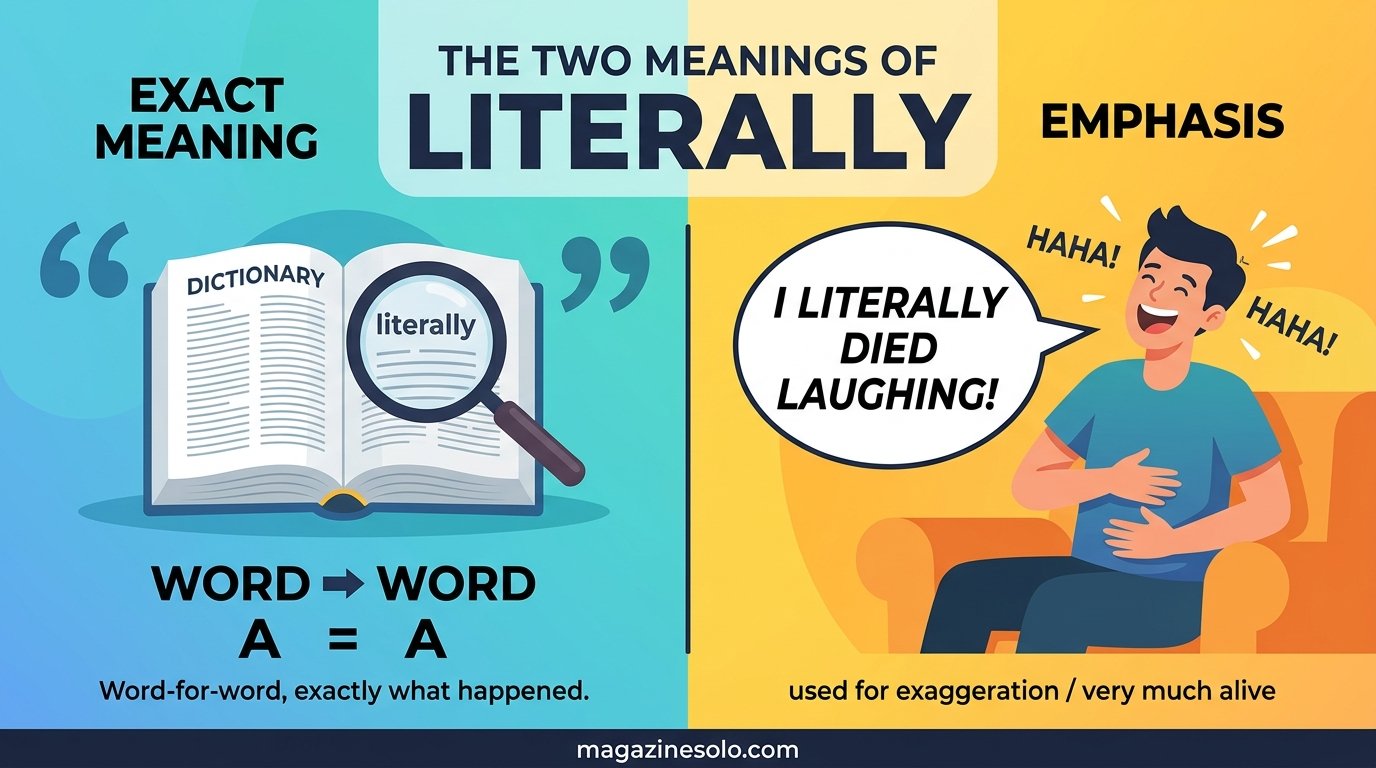
Literally has two recorded senses in English. Sense 1 means in a literal sense or manner: exactly, word for word, as when a term literally means something in another language.
Sense 2 is the emphasis use: in effect, virtually. It strengthens a statement that is not literally true or possible, as in the classic example, I literally died of embarrassment.
Both senses are real, recorded and centuries old. No fetched dictionary treats sense 2 as a recent error, and Merriam-Webster dates evidence of the exaggerated use to the mid 18th century.
The live question is never whether sense 2 exists. The live question is what your dictionary calls it, because that label, informal, colloquial, unlabeled or proscribed, tells you where the use is safe.
The Label Table: What Each Dictionary Calls the Emphasis Sense
The table below is the centerpiece of this page. Every authority in it records both senses of literally; read down the label column and the agreement on senses turns into open disagreement on verdicts.
|
Authority |
Senses as printed |
Label on the emphasis sense |
Usage note stance |
|---|---|---|---|
|
Merriam-Webster |
Sense 1 with four sub-senses; sense 2: in effect, virtually |
informal, on sense 2 only |
The exaggerated use is common and old; sense 2 is not quite identical to figuratively |
|
Oxford English Dictionary, as quoted by Merriam-Webster |
Sense 1c, the strongest admissible sense |
colloq. |
A secondhand quotation from the 2011 edition, attributed as such wherever it is used |
|
Oxford Advanced Learner’s and American |
Three senses: literal way, truth emphasis, intensifier |
informal on sense 3 only; sense 2 unlabeled |
The American edition adds: some people think it is not correct |
|
Cambridge |
Two blocks: ORIGINAL MEANING and EMPHASIZING, at CEFR B2 |
informal, on the EMPHASIZING block |
Organized by function rather than by sense number |
|
Collins, American entry |
Four senses; the in effect sense is sense 4 |
unlabeled |
Criticized, yet it appears in all but the most carefully edited writing |
|
Collins, British entry, via Dictionary.com |
The intensifier listed as sense 2 |
intensifier |
Often results in absurdity; best avoided in formal contexts |
|
Language Portal of Canada |
A guide entry covering literally, figuratively and virtually |
avoid in careful writing |
Incorrect: literally died laughing; Correct: almost died laughing |
|
Garner, via LawProse |
Two accepted senses only |
slipshod extension; delete it |
Used for figuratively, the word is distorted beyond recognition |
|
Wiktionary |
The fullest map, including a downtoner sense |
colloquial; one sub-sense sometimes proscribed |
The intensifier predates the proscriptions around it by several centuries |
No competitor prints this comparison. The dictionaries compress their verdicts into usage notes a reader rarely opens side by side, and the guides quote only the label that supports their own position.
Merriam-Webster: Informal on Sense 2 Only
Merriam-Webster splits its own entry with unusual care. Sense 1 holds four sub-senses, and only sense 2, the exaggerated emphasis use, carries the informal label in its entry.
Its usage guide asks the controversy question directly. Should literally be used for emphasis? The guide answers that the exaggerated use is common and surprisingly old, and that it greatly irks many people.
Its FAQ then refuses the easy headline. Asked whether literally can mean figuratively, the entry provides sense 2 but states that its meaning is not quite identical to that of figuratively.
Oxford: Informal on Sense 3, Sense 2 Unlabeled
Oxford’s learner entries separate what other dictionaries merge: the Oxford Advanced Learner’s Dictionary entry for literally gives three senses: in a literal way, truth emphasis with no label at all, and the intensifier labelled informal.
The American edition adds one sentence the British lacks: the Oxford Advanced American Dictionary entry for literally carries the same three senses, plus the warning that although this is a common use of literally, some people think it is not correct.
That single sentence is the learner layer in miniature. It tells a learner the use exists, that it is common, and that a correctness argument follows it, all before the learner risks it in assessed writing.
Cambridge: Informal, Split by Function
Cambridge organizes the word by job instead of by number: the Cambridge Learner’s Dictionary entry for literally splits the entry into two headed blocks, literally in its ORIGINAL MEANING and literally EMPHASIZING, and marks the word at CEFR level B2.
The emphasizing block carries the informal label. Its examples run from he missed that kick literally by miles to I was literally bowled over by the news, emphasis doing visible work in each one.
The function split is a teaching decision. A learner meets the two jobs as two blocks with two behaviors, instead of absorbing both senses as one blurred meaning and discovering the label only after an examiner objects.
Collins: Unlabeled, With the Longest Usage Note
Collins American is the outlier in the table. Its fourth sense, in effect, in substance, very nearly, virtually, carries no informal label at all, the quietest verdict any major dictionary prints.
Its British strand, carried on the Dictionary.com entry for literally, labels the same use intensifier. The British usage note warns that the use often results in absurdity and is therefore best avoided in formal contexts.
One dictionary family, two different verdicts. The Collins site also dates wide intensifier use to the early 20th century, while its own syndicated mirror on Dictionary.com says early 19th, a conflict printed unmerged here.
The Canada Portal and Garner: The Careful Writing Verdicts
The Language Portal of Canada gives the strictest mainstream verdict. In casual speech the word serves for emphasis, the guide allows, but this usage should be avoided in careful speech or writing.
Garner goes further than any dictionary dares. On the LawProse page carrying Garner’s usage tip on literally, the truly or completely sense is a slipshod extension, and used for figuratively the word is distorted beyond recognition, with deletion as the modeled fix.
These two are verdicts, not records. The dictionaries describe what English does; the Canada Portal and Garner prescribe what careful writers should do, and a reader needs both kinds of authority to judge a sentence.
The Two Senses in Plain English
The senses themselves take one short section, stated once. Everything after this section is about the labels, the test and the register rules that decide whether a given use survives editing.
Sense 1: Exactly, Word for Word
Sense 1 is the strict sense, and it is safe everywhere. It covers using a term in its ordinary meaning, exact equivalence in translation, and statements that are completely accurate as written.
Its home examples are the dictionaries’ own. The term Mardi Gras literally means Fat Tuesday in French, and he took the remark literally, both from Merriam-Webster’s sense 1 in its entry.
The Middle Sense: Truth Emphasis on a True Statement
Between the two headline senses sits a third working zone. This is literally emphasizing the truth of a statement that is actually true, as in the party was attended by literally hundreds of people.
Merriam-Webster files this use inside sense 1, unlabeled. It is sub-sense 1b, used to emphasize the truth and accuracy of a statement, and no caution label touches it anywhere in the entry.
Oxford gives the same use its own unlabeled sense 2. There are literally hundreds of prizes to win is its example, recorded between the strict sense and the labelled informal sense in the Oxford Advanced Learner’s Dictionary entry for literally.
No competitor teaches this split, and it changes verdicts. Truth emphasis on a true statement is not the use the guides proscribe; the intensifier on a non-literal statement is, and confusing the two produces most bad advice about this word.
Sense 2: The Intensifier on a Non-Literal Statement
Sense 2 strengthens a statement that cannot be literally true. I literally died of embarrassment, I literally jumped out of my skin: the events are figures, and the word’s job is pure emphasis.
Every dictionary records this sense; the labels do the arguing. Informal at Merriam-Webster, Oxford and Cambridge, colloquial at the OED as quoted, unlabeled at Collins American, and proscribed by the careful writing guides.
The Substitution Test: Four Moves on Any Sentence
Rules tell you about the word; a test tells you about your sentence. The four moves below are assembled from the sources’ own moves, and together they place any use of literally into its zone in under a minute.
- Swap in exactly as the words say. If the sentence stays true, the use is sense 1, strict and safe in every register, from a text message to a legal brief.
- Swap in figuratively. If the sentence keeps its meaning, a metaphor was doing the work, and careful guides say to write figuratively instead or rewrite the sentence without either word.
- Swap in virtually or almost. If the sentence keeps its meaning, the use is the in effect sense: recorded everywhere, labelled by most dictionaries, and the first thing careful editors cut.
- Delete the word entirely. If nothing is lost, literally was emphasis filler, which is why Merriam-Webster notes it often appears where no additional emphasis is necessary, and why Garner models deletion.
The test carries one documented limit, printed with it. The linguistics strand holds that the intensifier cannot be lexically substituted for figuratively without changing meaning, because it intensifies rather than labels the figure.
So move 2 diagnoses register risk, not meaning identity. A sentence can fail the figuratively swap as a meaning match and still be flagged by the test as a sentence careful writing should rebuild.
Example Banks: Judged by the Standard That Judges Them
Examples teach this word faster than definitions do. The four banks below sort sentences by zone, and each bank is headed by the standard that judges it, because the same sentence passes one standard and fails another.
Bank A: Strict Sense, Correct Under Every Standard
Dictionary examples, verbatim and attributed. The word planet literally means wandering body, from Oxford. The term Mardi Gras literally means Fat Tuesday in French, from Merriam-Webster. He took the remark literally, also Merriam-Webster.
One constructed example, in this page’s own voice. The instructions say to literally copy the file name, character by character. It is marked constructed because no dictionary printed it, and the marking itself is the honesty habit this page teaches.
Bank B: Truth Emphasis, Unlabeled and Accepted
True statements wearing emphasis, judged safe by every source. The party was attended by literally hundreds of people, Merriam-Webster’s 1b example. There are literally hundreds of prizes to win, Oxford’s sense 2 example.
Cambridge’s example belongs to this bank too. They were responsible for literally millions of deaths is a true statement under emphasis, which is why it sits in the middle zone rather than with the intensifier examples.
Bank C: The Intensifier, Recorded and Labelled
Non-literal statements under emphasis, judged by the label column. I literally died of embarrassment, Merriam-Webster’s sense 2 example. I literally jumped out of my skin, Oxford’s sense 3 example. He missed that kick literally by miles, from Cambridge.
The documented writers live in this bank. Thackeray in 1847 wrote I literally blazed with wit, and Joyce in 1914 wrote that Lily was literally run off her feet, both as Merriam-Webster’s entry cites them.
Bank D: Judged Wrong in Careful Writing
The guides’ own corrected examples, with their fixes attached. I literally died laughing is the Canada Portal’s Incorrect line, corrected to I almost died laughing. The news was literally an eye-opener is the Collins British note’s absurdity example.
Bierce supplies the oldest entries in this bank. The stream was literally alive with fish and his eloquence literally swept the audience from its feet are his 1909 blacklist examples of literally used for figuratively.
Literally vs Figuratively, Virtually and Actually
Four words share this word’s territory, and the boundaries are testable. The table below keeps the sources’ own glosses separate, because each neighbor fails a different move of the substitution test.
|
Word |
What it claims |
The test that exposes it |
|---|---|---|
|
literally |
The words stand exactly as written, or emphasis on them |
Swap in exactly as the words say; truth decides |
|
figuratively |
The meaning is metaphorical rather than literal |
Swap it in; if meaning survives, a figure was working |
|
virtually |
In effect, practically, for all practical purposes |
Swap it in; if meaning survives, the use was in effect |
|
actually |
This is true, without exaggeration or inaccuracy |
The truth emphasis neighbor; it never carries the translation sense |
Figuratively is the organizing opposite, not a synonym. Merriam-Webster glosses it as meaning that is metaphorical rather than literal, and its FAQ insists sense 2 of literally is not quite identical to it.
Virtually is the honest replacement for the in effect sense. The Canada Portal glosses it as practically, for all practical purposes, and its own correction of died laughing reaches for almost, the same neighborhood.
Actually is the safe truth word. Collins defines one sense of literally itself as actually, without exaggeration or inaccuracy, which shows the overlap, and actually carries no controversy into a formal document.
The Controversy in the Record: 1769 to a Courtroom
The argument over this word is documented, not folklore. The record runs from an 18th century novel to a blacklist and a dictionary note in the same year, and ends, for now, in an American courtroom.
Bierce 1909 Against the 1909 Dictionary Note
In 1909 the two positions were already fully formed. Ambrose Bierce’s Write It Right blacklisted literally for figuratively: it is bad enough to exaggerate, but to affirm the truth of the exaggeration is intolerable.
The same year, the dictionary was describing, not condemning. Merriam-Webster’s 1909 unabridged entry already noted that the word is often used hyperbolically, as in he literally flew, a record the modern usage article still cites.
Neither strand wins on this page. The blacklist and the descriptive note are the same age, and together they are the controversy in miniature: prescription and record, printed side by side ever since.
The Auto-Antonym Argument and the Linguist Rebuttal
The popular charge is that literally means its own opposite: the Reader’s Digest guide to using literally the right way puts it plainly: with the second definition, literally joins the collection of words that mean their opposite, the auto-antonym or contronym family.
The linguist rebuttal answers that the charge misfires. As the Wikipedia article on literally documents from a linguistics textbook, the intensifier does not mean figuratively and cannot substitute for it, so the word works like very and really instead.
Merriam-Webster lands between the two strands. Its FAQ records sense 2, refuses to equate it with figuratively, and calls the use pure hyperbole intended to gain emphasis, a middle position the label table already showed.
The Maddow Case: When a Court Applied Sense 2
The stakes stopped being theoretical in 2020: the Reader’s Digest guide to using literally the right way documents the Herring Networks v. Rachel Maddow defamation proceedings, in which the court asked whether Maddow had used literally hyperbolically in a broadcast statement.
The court answered with the dictionary. It cited Merriam-Webster’s sense 2 definition, in effect: virtually, used in an exaggerated way, and concluded the statement was not to be taken at face value.
A defamation question turned on an adverb’s label. Reader’s Digest attributes its account to the Fordham intellectual property journal’s article, and the strand is printed here with that attribution, as the record’s proof that labels decide real outcomes.
Literally for English Learners
The in English in the search is the learner’s phrasing. Three of the top results for this exact question are Oxford learner entries, and the layer those entries compress into single sentences deserves a section of its own.
The Translation Sense and the Idiom Warning
Many learners meet literally first as a translation word. To translate literally is to carry each word across in its primary meaning, Collins sense 2 and part of Oxford sense 1, whose given synonym is exactly.
Oxford’s own example states the limit in one line. Idioms usually cannot be translated literally into another language, because an idiom’s meaning belongs to the whole phrase and not to the sum of its words.
The reverse error completes the learner picture. When I told you to get lost I did not expect to be taken literally is Oxford’s other sense 1 example, teaching that figurative speech breaks when a listener reads it strictly.
The Formal Writing Rule
One rule covers essays, exams and work documents. The intensifier sense of literally is recorded, labelled, and out of place in careful writing, so keep it in speech and informal messages and leave it out of assessed prose.
Four authorities converge on that single rule. The Collins British note says best avoided in formal contexts, the Canada Portal says avoided in careful writing, and the Oxford Advanced American Dictionary entry for literally warns that some people think it is not correct.
What to write instead depends on the zone. The replacements below are the guides’ own moves, matched to the sense you actually meant when literally came to mind.
|
What you meant |
Write instead |
Source of the move |
|---|---|---|
|
This is exactly true |
actually, really, in fact |
The truth emphasis zone, Collins sense 3 |
|
In effect, practically |
virtually, almost, practically, nearly |
The Canada Portal’s correction pattern |
|
Pure emphasis, nothing more |
delete the word |
Garner’s modeled editorial instruction |
|
A metaphor, honestly labelled |
figuratively, or rewrite the sentence |
Garner’s figuratively test |
One sense sits outside the commercial dictionaries: the Wiktionary entry for literally records a colloquial downtoner use, just or merely, labelled colloquial with one sub-sense sometimes proscribed, the fullest sense map in the record.
First Uses and Word Origin: The Dates Conflict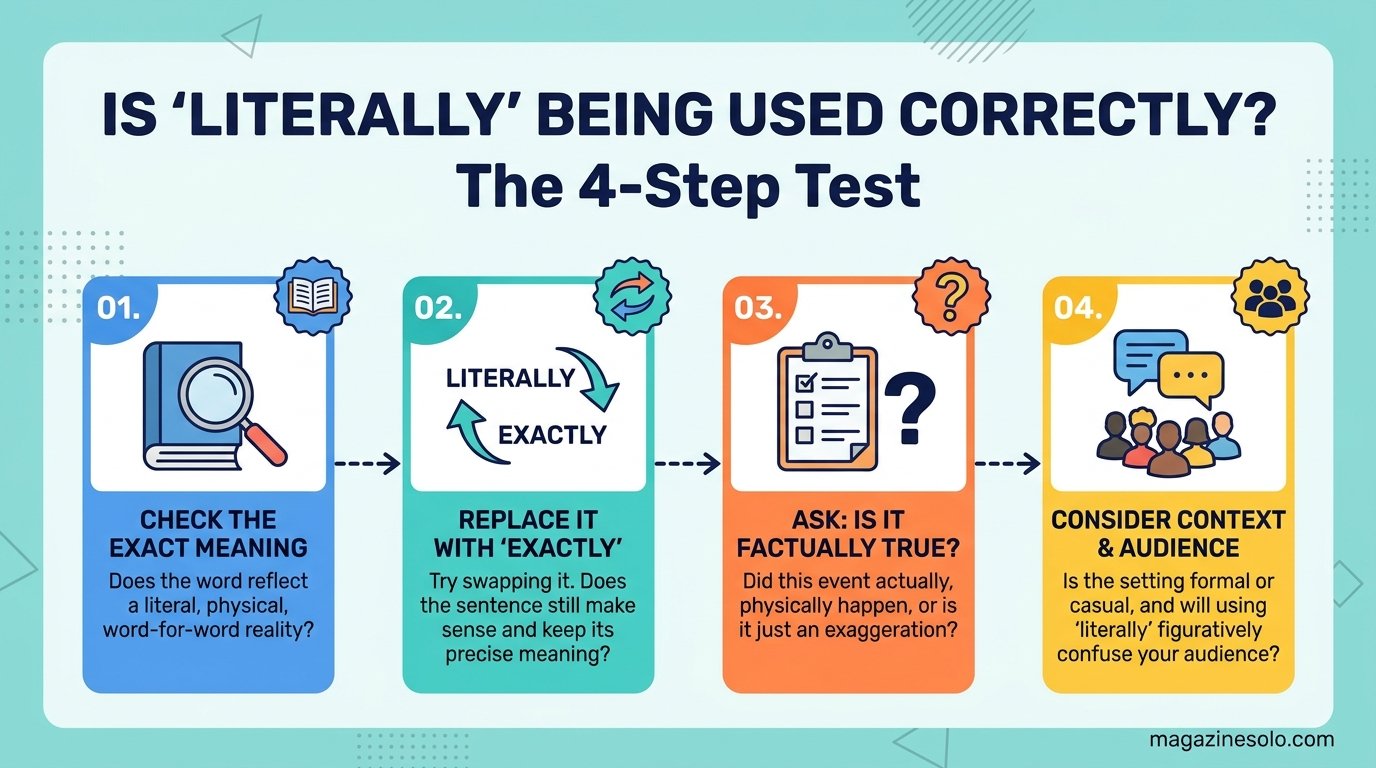
Literally is built from literal plus -ly, and literal is a letter word. It descends from Latin littera, letter, through Late Latin litteralis, which is why the oldest meaning is to the letter: word for word, exactly as written.
The first use dates conflict, and they print unmerged. No source in the record supports one clean invention date, so the table below gives each dating beside the authority that prints it.
|
Dating |
Source |
What it dates |
|---|---|---|
|
15th century |
Merriam-Webster, Word History |
First known use, sense 1 |
|
1429 |
Reader’s Digest, citing the OED |
First recording, in Mirour of Mans Saluacioune |
|
1525 to 35 |
Collins, etymology line |
The word’s formation, literal plus -ly |
|
1530s |
Wikipedia |
First known use |
The emphasis use has its own evidence date. Merriam-Webster dates the hyperbolic evidence to 1769, and the example attached to that year is Frances Brooke’s it is literally to feed among the lilies, from her 1769 novel.
Dated citations then run in a clean line. Thackeray blazed with wit in 1847, and Dickens feasted his eyes in Nicholas Nickleby, as the Reader’s Digest guide to using literally the right way attributes it.
The line continues into the modern record. Joyce ran Lily off her feet in 1914, and Jean Stafford counted literally millions of kittens in 1954.
Two famous names are named, never quoted, on this page. Merriam-Webster’s FAQ lists Charlotte Brontë and Mark Twain among writers in whose work the extended use appears, but the fetched sources quote no sentence from either, so none is printed.
Where This Page Sits in the Word Cluster
This page is the verdict layer of a growing shelf. The base what does literally mean guide owns the standard definition treatment, and our what does irony mean guide owns the figure of speech whose name learners most often pair with this one.
The confused pair guides apply the same discipline: our a lot vs allot vs alot guide and our a lot vs allot difference guide settle their pair by grammar class alone.
Placement settles the neighboring pair: our all ready vs already guide and our all ready vs already difference guide decide theirs by placement and scope, the same test first habit in different dress.
Register and attitude pairs complete the shelf: our adverse vs averse difference guide turns on the writer’s stance toward an event, our adapt vs adopt difference guide turns on word families and domains, and our all together vs altogether difference guide turns on grouping versus completeness.
Every guide on the shelf states its deciding system first. Labels here, class there, placement elsewhere: the habit of naming the test before the examples is what the cluster is built on, and it starts from the MagazineSolo home page.
Frequently Asked Questions
1. What does literally mean in English?
Literally has two recorded senses in English: exactly, and an emphasis use. The emphasis sense means in effect or virtually, on statements that are not literally true, and every major dictionary records it.
What differs is the label each dictionary puts on it.
2. What are the two meanings of literally?
The strict meaning says exactly as the words say. The emphasis meaning is an intensifier on a statement that is not literally true.
Between them sits truth emphasis on a true statement, which Merriam-Webster places inside sense 1 and Oxford records unlabeled.
3. Can literally mean figuratively?
Not exactly, and Merriam-Webster’s own FAQ says so. Sense 2 is recorded, but its meaning is not quite identical to that of figuratively.
The intensifier strengthens a figure rather than labelling it, so swapping the two words changes the sentence.
4. Is it correct to use literally for emphasis?
It depends on which emphasis you mean. Emphasis on a true statement is recorded without a caution label.
Emphasis on a non-literal statement is labelled informal or colloquial by most dictionaries, and careful guides advise against it in formal writing.
5. Is saying “I literally died laughing” wrong?
The Canada Portal prints this exact sentence as its Incorrect example. Its correction is: I almost died laughing when I heard that joke.
Merriam-Webster records the pattern as informal sense 2, so the verdict splits by register.
6. Is literally an auto-antonym?
That is the popular framing, and Reader’s Digest uses it. The linguist rebuttal, documented on Wikipedia from a linguistics textbook, is that the intensifier works like very and really and is not an auto-antonym.
This page prints both strands without a winner.
7. What is the difference between literally and figuratively?
Literally says the words stand exactly as written; figuratively says the meaning is metaphorical. That is Merriam-Webster’s own gloss of figuratively.
If swapping in figuratively keeps your sentence’s meaning, you meant a metaphor, and careful guides say to write it that way.
8. What is the difference between literally and virtually?
Virtually means in effect, practically, for all practical purposes. Merriam-Webster uses in effect to define literally sense 2 itself.
If replacing literally with virtually or almost keeps your meaning, you are in the labelled in-effect sense editors cut first.
9. What is the difference between literally and actually?
They overlap where both assert truth. Collins defines one sense of literally as actually, without exaggeration or inaccuracy.
Actually only ever asserts truth, while literally also carries the word-for-word sense and the labelled intensifier, so actually is safer in careful writing.
10. How can I test whether my use of literally is correct?
Run the four-move substitution test on the sentence. Swap in exactly as the words say, then figuratively, then virtually or almost, then delete the word.
Each surviving swap names the zone your use sits in, and the test diagnoses register risk.
11. What should I use instead of literally in formal writing?
Match the replacement to the sense you meant. For truth emphasis, write actually, really or in fact.
For the in-effect sense, write virtually, almost or practically, and for pure emphasis filler, delete the word, as Garner instructs.
12. Can I use literally in an essay or exam?
Use sense 1 freely and avoid the intensifier sense. Four authorities converge: the Collins British note, the Canada Portal, the Oxford American note and Reader’s Digest.
An examiner can mark the intensifier wrong even though every dictionary records it.
13. Is literally informal or formal?
The word is neutral; one of its senses is labelled. Sense 1 carries no label in any fetched dictionary and suits formal writing.
The intensifier is labelled informal by Merriam-Webster, Oxford and Cambridge, while Collins American leaves its in-effect sense unlabeled.
14. Which dictionaries include the emphasis meaning of literally?
All of them in the fetched record. Merriam-Webster’s usage article states that literally every modern dictionary includes the intensifying sense.
The difference is only the label: informal, colloquial, intensifier, unlabeled, or proscribed by the careful-writing guides.
15. Why did dictionaries add a second meaning to literally?
Because writers used it for centuries before anyone proscribed it. Merriam-Webster dates evidence of the hyperbolic use to 1769 and notes its own 1909 entry already described it.
Dictionaries documented the sense from writers; they did not invent it.
16. Did Merriam-Webster change the definition of literally?
Its own usage article answers by pointing at the record. The intensifying sense appears in literally every modern dictionary, and Merriam-Webster’s 1909 unabridged entry already noted the hyperbolic use.
What changed over time is the label debate, not the sense.
17. When did people start using literally for emphasis?
The record dates evidence, not a single birthday. Merriam-Webster gives 1769 for the exaggerated use, with dated citations after it: Thackeray 1847, Joyce 1914, Stafford 1954.
Collins dates wide intensifier use to the early 20th century; its own mirror says early 19th.
18. Which famous writers used literally for emphasis?
The writers the authority sources themselves cite. Frances Brooke in 1769, Thackeray in 1847, Dickens via Reader’s Digest, Joyce in 1914 and Jean Stafford in 1954.
Merriam-Webster’s FAQ also names Charlotte Brontë and Mark Twain, without quoting any sentence from either.
19. What is the oldest recorded use of literally?
The sources conflict, so no single date is printed as fact. Merriam-Webster gives a 15th century first known use.
Reader’s Digest, citing the OED, gives a first recording in 1429, Collins dates the formation 1525 to 35, and Wikipedia gives the 1530s.
20. Where does the word literally come from?
It comes from literal plus the adverb suffix -ly. Literal descends from Latin littera, letter, through Late Latin litteralis.
That origin is why the oldest meaning of literally is to the letter: word for word, exactly as written.
21. Is literally slang?
No, and Merriam-Webster’s FAQ answers this directly. The labels dictionaries actually use are informal and colloquial, which describe register, not slang status.
The word appears in edited prose, and its strict sense belongs in the most formal writing there is.
22. Is literally a contronym or Janus word?
It is widely listed as one in popular coverage. The linguistics strand disputes the classification, because an intensifier that cannot swap for figuratively is not functioning as its own opposite.
The record supports a disputed case, not a settled label.
23. Why do people get annoyed by literally?
Because sense 2 seems to affirm the truth of an exaggeration. Bierce wrote in 1909 that exaggerating is bad enough, but affirming the truth of the exaggeration is intolerable.
Merriam-Webster adds that the use often appears where no emphasis was necessary.
24. What does “taken literally” mean?
To take something literally is to read it in its ordinary, primary sense. Oxford teaches the phrase by its failure: when I told you to get lost, I did not expect to be taken literally.
Idioms and jokes break under that reading.
25. What does “translate literally” mean?
It means translating word for word, carrying each word across. That is Collins sense 2 and part of Oxford sense 1, whose synonym is exactly.
Oxford also gives the limit: idioms usually cannot be translated literally into another language.
26. Can a word be used both literally and figuratively?
Yes, and literally itself is the standing example. The same adverb works in the strict sense, in truth emphasis and as an intensifier on a figure, as in Joyce’s run off her feet.
The open question is which label your register allows.
27. What part of speech is literally?
Literally is an adverb, built from the adjective literal plus -ly. It can scope over a single word, a quantity or an entire claim, which is why its senses spread so far.
Cambridge marks the word at CEFR level B2.
28. What are synonyms for literally?
Synonyms split by sense, because the word has three working zones. Strict sense: exactly, word for word, verbatim.
Truth emphasis: actually, really, truly.
In-effect sense: virtually, in substance, practically.
A single list without the split teaches the confusion.
29. What is the opposite of literally?
Figuratively, in Merriam-Webster’s gloss: metaphorical rather than literal. The Canada Portal treats literally, figuratively and virtually as one three-way distinction.
In looser speech, loosely or in a manner of speaking also flag that words are not at face value.
30. Is “literally hundreds of people” correct?
Yes, under every fetched standard. It is Merriam-Webster’s own sense 1b example, the party attended by literally hundreds of people, emphasizing a statement that is true.
Oxford records the same pattern unlabeled.
Truth emphasis is not the use the guides proscribe.
31. What is a literal meaning of a word?
A word’s literal meaning is its ordinary or primary meaning. It is what the word denotes before metaphor, idiom or context stretches it.
Merriam-Webster adds exact equivalence, each word’s meaning given exactly, which is the translation sense.
32. Does literally mean actually or almost?
Both, in different uses, which is why the question has no one-word answer. Collins records literally as actually, without exaggeration.
The Canada Portal corrects literally died laughing to almost died laughing, placing the in-effect use where almost belongs.
Test your sentence.
33. Can literally be used in a job interview or work email?
Sense 1 yes; the intensifier no. Reader’s Digest holds that in serious or professional contexts literally should keep its original meaning.
The labelled sense buys emphasis at the price of a correctness argument you did not need to have.
34. Did a court case really turn on the meaning of literally?
Yes, on the fetched record. Reader’s Digest documents the Maddow defamation proceedings of May 2020, where the court cited Merriam-Webster’s sense 2 and held the use was not to be taken at face value.
The strand is attributed to Reader’s Digest.
35. What happened in the Rachel Maddow literally case?
As Reader’s Digest documents it, the court applied the dictionary. Herring Networks sued over a broadcast statement; the court quoted the sense 2 definition and defeated the claim’s premise.
The two senses of one adverb decided a real legal question.
36. How do English learners use literally correctly?
Learn the three zones in order. Exactly first, then truth emphasis, which is safe and unlabeled, then the intensifier, which stays in speech and out of essays.
Never carry first-language idioms across word for word; Oxford warns they cannot be translated literally.
37. What CEFR level is literally?
B2, per Cambridge’s Learner’s Dictionary. Cambridge splits its entry into two headed blocks, ORIGINAL MEANING and EMPHASIZING, and labels the second informal.
The level is a teaching fact: mid-level vocabulary carrying an advanced usage controversy.
38. Can idioms be translated literally?
No, and the authority is a dictionary’s own example sentence. Oxford states that idioms usually cannot be translated literally into another language.
An idiom’s meaning belongs to the whole phrase, so translate the meaning, not the words.
39. What is the difference between literal and literally?
Literal is the adjective; literally is the adverb built from it. A literal translation is adjectival, while translated literally and literally hundreds are adverbial.
The controversy attaches to the adverb, whose intensifier sense is the one dictionaries label informal.
40. What does literally mean in British vs American English?
The senses are the same; the labelling emphasis differs by edition. Collins American leaves the in-effect sense unlabeled, while its British entry labels it intensifier and warns against formal use.
Oxford American adds a correctness sentence its British counterpart does not carry.
41. If I delete literally and the sentence still works, was it wrong?
Not wrong, but exposed as filler. Deletion is Garner’s modeled editorial test, and Merriam-Webster notes the intensifier often appears where no emphasis was necessary.
Collins adds that the use probably neither distorts nor enhances the intended meaning.
42. Should teachers mark the emphasis use of literally wrong?
The authorities support a register answer, not a blanket one. In formal assessed writing, the careful-writing standard gives a teacher grounds to mark the intensifier.
As a claim about English itself, wrong is unsupportable, because every modern dictionary records the sense.
Conclusion
What does literally mean in English is settled; what each dictionary calls the emphasis sense is not. The senses agree everywhere, the labels do not, and the label matched against your register is the verdict that decides your sentence.
Run the four moves before you publish the word. Swap in exactly, swap in figuratively, swap in virtually or almost, then try deleting it, and the sentence will tell you which zone it lives in.
The full definition treatment lives with its owner: our what does literally mean guide carries the standard senses and examples, and the wider word shelf gathered on the MagazineSolo home page applies the same label first habit to every confused pair it covers.

Dilawar is a content writer at MagazineSolo, covering travel, home improvement, interior design, and everyday lifestyle topics. He enjoys researching practical solutions, exploring travel destinations, and sharing helpful guides that make daily life easier. His writing focuses on clear information, useful advice, and engaging stories for a wide audience.