
What Does Irony Mean? Three Types, One Reversal

What does irony mean? Irony is a gap between what is expected or appears to be true and what actually is or happens. The reality reverses the expectation, and that reversal is the whole device.
The gap sits in three places. Verbal irony puts it between words and meaning, situational irony between expectation and outcome, and dramatic irony between a character’s knowledge and the audience’s. Most pages stop at the definitions; the reversal test is the decision tool.
Irony in One Answer: A Reversal You Can Point To
Irony means an expectation or appearance reversed by reality: in words, in outcomes, or in who knows what. Name what was expected, show the reality running against it, and the label holds. Cambridge Dictionary’s US entry for irony gives the pattern: the irony is that a system burdens the people it was built to help. Verbal irony reverses words against meaning, situational irony reverses outcomes against expectation, and dramatic irony reverses what a character knows against what the audience knows.
The Reversal Test: Name the Expectation, Name the Reality
Definitions describe irony; the reversal test grades a case.
Step 1: Name What Was Expected
- State the expectation plainly. What did the words, the plan, the role, or the situation lead a reasonable person to expect?
- Check it is earned. A fire station earns an expectation of fire safety; a wedding earns no expectation about weather.
Step 2: Name What Actually Is or Happened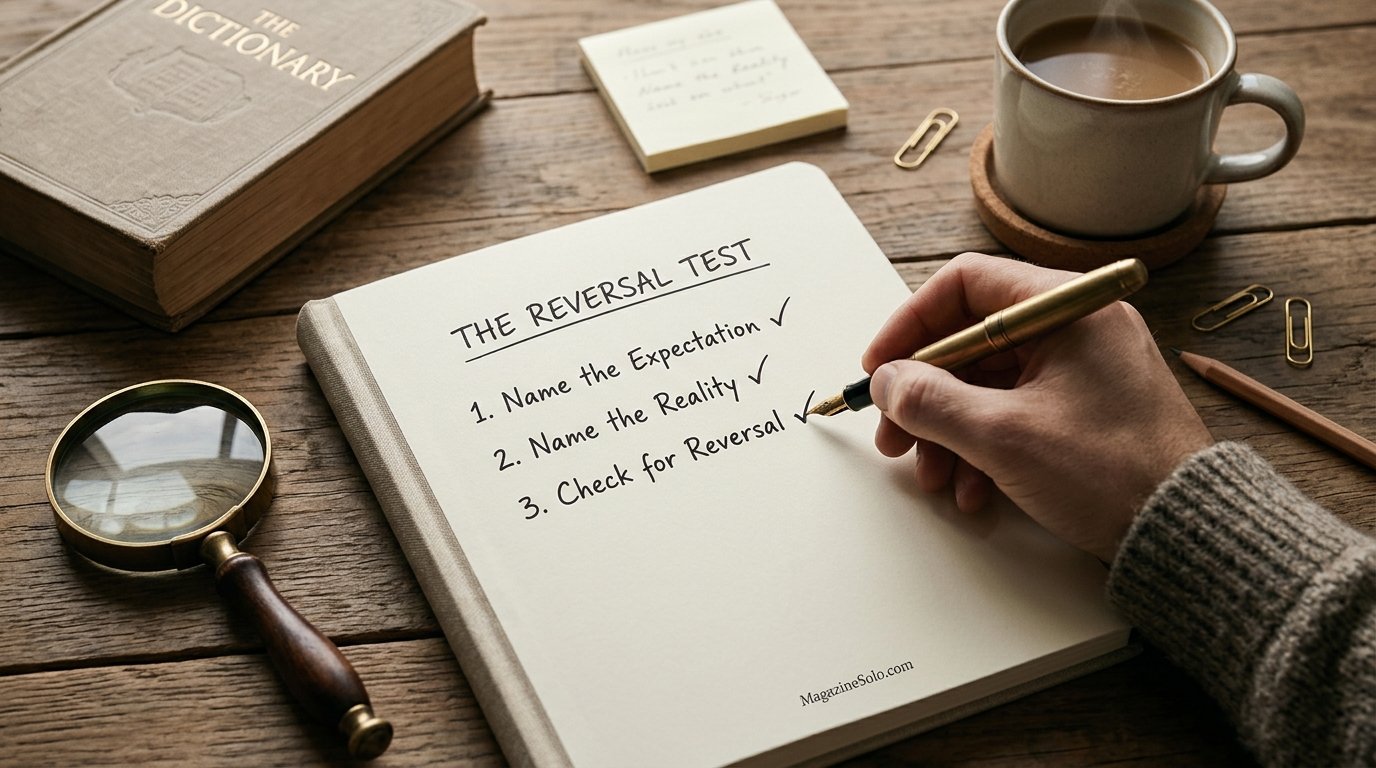
State the reality in the same plain style: what is actually meant, what actually happened, or what the audience actually knows. Keep the sides separate; most failed claims blur them together.
Step 3: Check for Reversal, Then Name the Type
Ask whether the reality reverses the expectation. Merely surprising, sad, or unlikely does not count. No reversal means coincidence, bad luck, misfortune, or paradox, each graded in the bank below. With a reversal, locate the gap: in the words, verbal; in the outcome, situational; in who knows, dramatic.
Pass: a fire station burns down; the outcome reverses the building’s purpose, so situational irony. Fail: an old friend calls just as you were about to call her; nothing is defeated, and Merriam-Webster rules this shape coincidence. One named test per problem is the method across this site: adapt vs adopt by asking what is changing, all ready vs already by a proofreading test.
Type 1: Verbal Irony, Words Against Meaning
Verbal irony is a statement where the intended meaning is sharply different from, usually opposite to, the meaning the words literally express. Britannica, named in text, calls it the literal meaning contradicting the actual meaning. The classroom case is praising a storm as beautiful weather: the words praise, the sky refutes them, and the listener who shares the situation hears the real meaning.
It fails when the listener is not looking for a double meaning, the recognition problem the University of Chicago’s glossary names in text. And not every verbal irony bites: perfect timing, sighed over a ruined picnic, attacks nobody.
Type 2: Situational Irony, Outcomes Against Expectation
Situational irony is an outcome that reverses what was reasonably expected or intended. Merriam-Webster’s own example: a person sidesteps a pothole to avoid injury and steps into another, injuring themselves. The action taken to prevent the outcome produces it, and that self defeating turn is the signature.
The strongest cases defeat a purpose built into a role or a place, like the fire station; a merely unlikely or sad result belongs in the bank’s not irony class.
The Literary Anchor: The Gift of the Magi
Della sells her hair to buy Jim a chain for his prized watch; Jim sells the watch to buy Della combs for her hair, as LitCharts’ irony page summarises O. Henry’s story. Each gift is defeated by the sacrifice that paid for it, so the test passes it without argument.
Type 3: Dramatic Irony, The Audience Knows More
Dramatic irony is a knowledge gap: the audience knows something a character does not, and watches the character act on the wrong picture.
Romeo and Juliet: The Ending
The audience knows Juliet is alive in a drugged sleep; Romeo does not, and acts on the belief that she is dead. Merriam-Webster uses exactly this anchor: the audience realises the lovers’ plans will go awry.
Oedipus and the Tragic Form
In Sophocles’ Oedipus Rex, the king vows to find and punish the former king’s killer, and the audience understand he is cursing himself; the Macmillan glossary, named in text, puts it plainly: he is hunting himself. Scholars call this catastrophe bound form tragic irony.
The Example Bank: 30 Cases, Classified
Every verdict below names the expectation and the reality before it rules. Cases from dictionaries and study sources are labelled; the rest are training cases built for this bank.
Clear Verbal Irony
1. ‘Beautiful weather,’ said into a storm. Verdict: verbal irony, clear. The words praise the sky; the speaker means the reverse, and the shared situation delivers the real meaning. The expectation sits inside the words themselves, which is the verbal signature.
2. ‘Brilliant planning,’ to the friend who forgot the tickets. Verdict: verbal irony, tipping into sarcasm. A study source uses this shape for the sarcasm boundary: the praise is false, the blame is real. Because the remark aims to make someone feel foolish, it crosses the line graded later.
3. The opening claim of Pride and Prejudice. Verdict: verbal irony, literary. Austen’s narrator announces as a universal truth that a rich single man must be in want of a wife. The novel that follows shows the wanting running the other way, and study guides file the line as irony.
4. ‘Just what I needed,’ surveying a flat tyre in the rain. Verdict: verbal irony, clear. A training case. The sentence claims gratitude; the speaker means its opposite, and any listener standing in the same rain catches it. No target is mocked, so it stays irony, not sarcasm.
5. ‘Glad you could join us,’ to a colleague an hour late. Verdict: verbal irony, clear. A training case. The welcome is the surface; the rebuke is the meaning, carried entirely by the lateness everyone in the room can see. Words against meaning, the textbook shape.
6. ‘A bit of a problem,’ about a flooded office. Verdict: verbal irony, understatement form. The statement shrinks a catastrophe into a nuisance. It earns the label because the real meaning reverses the surface calm, not merely because it understates; understatement is the tool, reversal is the test.
Clear Situational Irony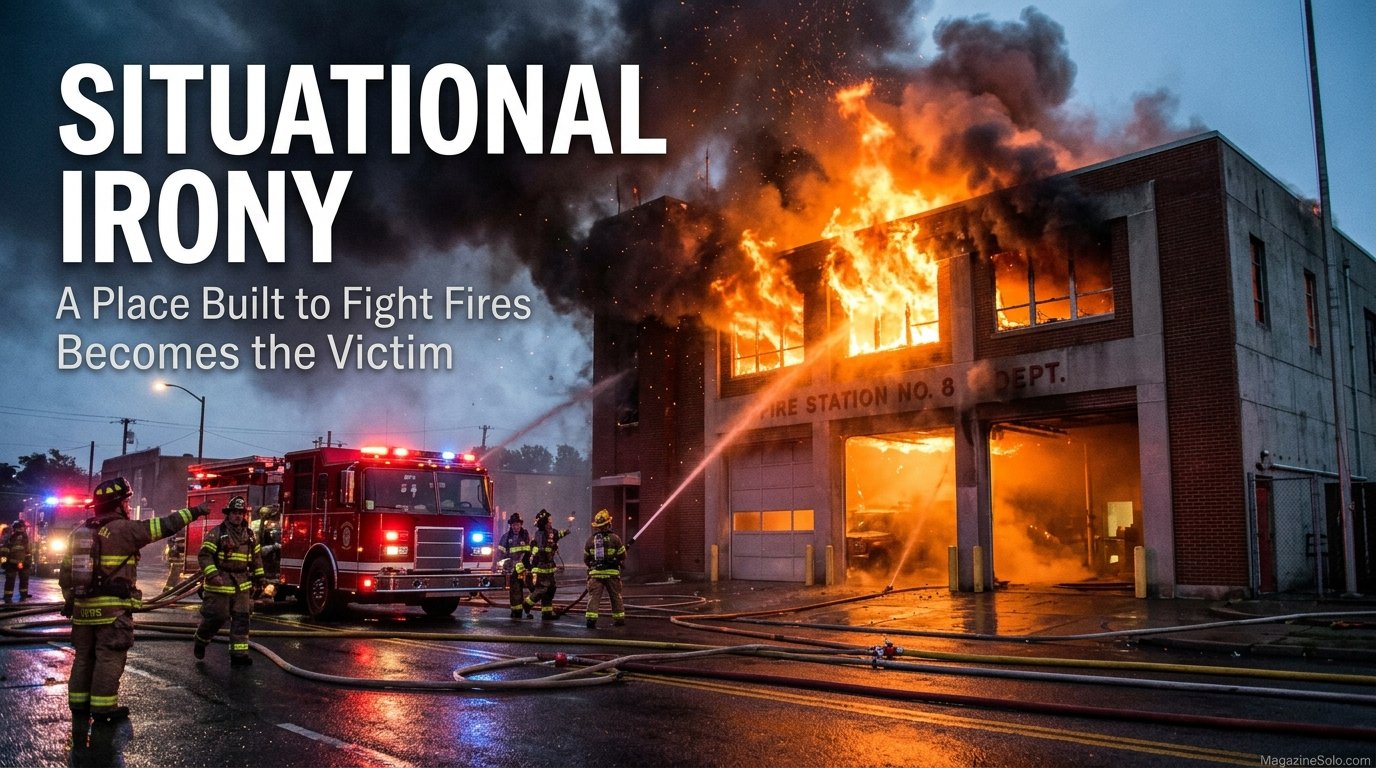
7. A fire station burns down. Verdict: situational irony, the textbook case. The Macmillan glossary uses exactly this shape. Expectation: the building whose purpose and equipment exist to fight fires resists fire. Reality reverses the purpose itself, which is why the case never gets argued.
8. The pothole sidestep. Verdict: situational irony, the dictionary’s own case. Merriam-Webster’s example: a person steps aside to avoid one pothole and is injured by another. The preventive action produces the prevented outcome, the strongest situational pattern there is.
9. The Gift of the Magi. Verdict: situational irony, clear. Della’s sold hair buys a chain for a watch Jim no longer owns; Jim’s sold watch buys combs for hair Della no longer has. Each sacrifice defeats the gift it funded, as the LitCharts summary shows.
10. A marriage counsellor files for divorce. Verdict: situational irony, clear. A training case from the everyday set. The role creates a specific expectation, expertise in holding marriages together, and the outcome reverses it in the counsellor’s own life. Role against result is the situational shape.
11. Rain on a meteorologist’s wedding day. Verdict: situational irony, clear. Merriam-Webster’s own contrast case. The bride predicted sun for her professional living; the rain reverses a specific, earned, expert expectation. Compare case 26, where the same rain fails for want of that expectation.
12. A police station is burglarized. Verdict: situational irony, clear. The Macmillan glossary pairs it with the firehouse. The place charged with preventing crime becomes its victim, so the outcome defeats the institution’s stated purpose rather than merely surprising anyone.
Clear Dramatic Irony
13. Romeo over Juliet’s body. Verdict: dramatic irony, clear. The audience knows the sleep is drugged and temporary; Romeo believes the death is real and acts on it. Two versions of the truth run at once, and the audience holds the true one.
14. Oedipus hunting the killer. Verdict: dramatic irony, tragic form. The king’s vow to find and punish the murderer is, unknown to him, a vow against himself. The audience’s knowledge turns every step of his investigation into a step toward his own exposure.
15. Othello trusting Iago. Verdict: dramatic irony, clear. The audience watches Iago announce his deceptions and then watches Othello call him honest. The gap between what the audience knows and what Othello believes drives every scene the two men share.
16. The horror film door. Verdict: dramatic irony, clear. A training case. The audience has seen the threat waiting in the basement; the character has not, and descends whistling. The tension viewers feel is the byproduct; the knowledge gap is the device.
17. The bear behind the camper. Verdict: dramatic irony, teaching case. Khan Academy teaches the type through an invented scene in which the audience sees the danger the character cannot. Uneven awareness is made visible in its simplest form, which is why teachers reach for it.
18. A boast recorded before the fall. Verdict: dramatic irony, unintentional form. Study sources note that sincere speech can become dramatically ironic when the audience knows more than the speaker. A public figure’s old promise, replayed after events reversed it, carries a gap nobody designed.
Borderline Cases, Argued
19. The 1939 Fitzgerald quotation. Verdict: borderline, the dictionary says so. Merriam-Webster quotes a 1939 Fitzgerald use of the situational sense and grades it debatable itself. The reversal is arguably present but arguably only misfortune, which makes it the model teaching case for this class.
20. Ten thousand spoons, when all you need is a knife. Verdict: borderline, the song’s strongest case. Book Riot calls it probably the most solid irony in the lyrics, because abundance of the wrong tool against absence of the right one has an opposition shape. It still lacks a defeated plan, so the bank argues it rather than passing it.
21. ‘The irony is that when he finally got the job, he discovered he didn’t like it.’ Verdict: borderline. Oxford’s learner example, named in text. An expectation, that the wanted job would satisfy, is genuinely reversed; the reversal is mild and private, which is why graders split on it.
22. Captain Renault pockets his winnings. Verdict: borderline, ironic hypocrisy. In Casablanca, Renault condemns gambling and then collects his own winnings, as a study source files it. The hypocrisy is his; the irony is in the gap between his words and his act exposing itself on screen.
23. A plot twist that reverses the hero’s plan. Verdict: borderline until the expectation is named. A twist alone is only surprise. When the hero’s own plan produces the outcome he feared, the reversal is real and the case upgrades to situational irony; without that chain, it stays a twist.
24. Rain on a weather forecaster’s day off picnic. Verdict: borderline, weaker than case 11. A training case. Professional knowledge creates some expectation of a well chosen day, but a picnic makes no public prediction, so the defeated expectation is thinner than the wedding case Merriam-Webster endorses.
Not Irony: Coincidence, Bad Luck, Misfortune
25. ‘You called just as I was planning to call you.’ Verdict: coincidence, not irony. Merriam-Webster’s own example of the misuse. Two intentions meet neatly; nothing is reversed, defeated, or exposed. The timing pleases, and pleasing timing is the whole event.
26. Rain on your wedding day. Verdict: bad luck, not irony. The most debated non-example in the song, graded fully in the Morissette section. A wedding creates expectations about vows, guests, and photographs; it creates none about the weather, so the rain reverses nothing.
27. A traffic jam when you are already late. Verdict: misfortune, not irony. Lateness plus delay is one misfortune stacked on another, in the same direction. Irony needs the outcome to run against the expectation, not to deepen it, and critics grading the song make exactly this point.
28. A black fly in your Chardonnay. Verdict: disgust, not irony. A training grade on a famous song image. Contamination is unpleasant and unlikely at a good table, but no plan, role, or prediction is defeated by it. Unwelcome is not the same as reversed.
29. Meeting an old friend by chance in a foreign city. Verdict: coincidence, not irony. A training case. The meeting is improbable and delightful, and improbability is all it has. No expectation existed that the meeting defeats, so the reversal test stops at step three.
30. A preacher caught cheating, still unexposed. Verdict: hypocrisy, not irony yet. A training case on the boundary graded later. The gap between professed standards and conduct is real, but until events or words expose it, no reversal has occurred for any audience. Hypocrisy alone is a failing, not a device.
The Morissette Verdicts: Grading Ironic Line by Line
Alanis Morissette’s 1995 song Ironic is the largest single reason this keyword carries a correctness argument. The verdicts below are this page’s analysis, run through the reversal test; the critics’ positions are attributed as published. Book Riot grades the scenarios line by line and fails most; Copyblogger records the debate.
|
Famous example, described |
Expectation |
Reality |
This page’s verdict |
|---|---|---|---|
|
Rain on a wedding day |
None about weather |
Rain |
Not irony, bad luck |
|
Ten thousand spoons, needing a knife |
The right tool among plenty |
Only the wrong tools |
Borderline, strongest case |
|
A pardon arriving minutes too late |
Mercy takes effect |
Too late |
Argued both ways |
|
Winning the lottery, dying the next day |
A long enjoyment |
Death |
Not irony, tragedy |
The pardon case divides graders because a specific expectation, that the pardon will work, is created and then defeated by minutes; this page calls it argued both ways. The spoons case survives longest on its opposition shape, and Copyblogger sharpens it: spoons in a cutlery factory break room would pass, because the setting creates the expectation defeated.
Irony vs Sarcasm: The Mocking Target
The narrow strand: sarcasm is verbal irony with a target and a sting; a scholarly abstract on PubMed, named in text, defines it as irony directed at a person, with the intent to criticise. The broader strand: everyday usage also counts cutting remarks that mean what they say, and Dictionary.com’s irony entry describes sarcasm as harsh, often contemptuous ridicule. So verbal irony means the opposite of its words and needs no target and no wound; sarcasm adds both, as when brilliant planning is aimed at the friend who forgot the tickets. Find the mocking target, and you have found the line.
Irony vs Coincidence: The Line the Dictionary Draws
Merriam-Webster draws this line explicitly. Uses of irony for cases lacking a striking reversal are, in its words, more properly called coincidence; its example is the phone call that arrives just as you were planning to make it. The loose use has been common for almost a hundred years: understood everywhere, graded as coincidence by the test, because a coincidence creates no specific expectation for reality to reverse. LitDevices’ irony guide gives the matching classroom test: merely surprising, with no meaningful reversal, means coincidence.
Irony vs Paradox and Irony vs Hypocrisy
Paradox lives inside a statement; irony lives between a statement or plan and the world. A paradox seems self contradictory yet may hold a truth: the more choices she gained, the less free she felt. A fire station burning down is irony, never paradox. Hypocrisy is a person’s failing, professing standards they do not follow; a hypocrite caught by his own words produces irony, as bank case 22 showed, while unexposed it stays a failing, not a device.
The Wider Family: Socratic, Cosmic, Tragic and Romantic Irony
Beyond the school three sits an older family, presented as separate labelled strands: Wikipedia’s irony article records that the taxonomy itself is disputed.
Socratic irony is the classical rhetorical sense: feigning ignorance to expose an opponent’s ignorance. Cosmic irony, the irony of fate, hands the reversal to the universe. Tragic irony is dramatic irony inside a tragedy, and Romantic irony is a work exposing its own constructedness.
The History: Eiron, Socrates, and a Word for Dissembling
The word descends from Greek eironeia, dissimulation, sarcasm, understatement, in Dictionary.com’s etymology: first recorded 1495 to 1505, through Latin ironia, built on eiron, a dissembler.
Behind it stands the eiron of Greek comedy, the clever underdog who, Britannica recounts, triumphs by wit over the boastful alazon. Socrates made the character a method, professing ignorance until others’ ignorance showed. Wikipedia dates the concept to 5th century BCE Greece, kept separate from the word’s arrival.
Using Irony Well: Speech, Essays, and Exams
In everyday speech, the loose use is understood everywhere; save strict grading for assessed or published writing. In essays and exams, name both sides of the gap, using the frame: I expected, or heard, one thing; the text shows another. If both halves will not fill, coincidence or paradox is the honest word. The neighbouring pairs submit to the same discipline: passed vs past by the verb test, affect vs effect by the RAVEN rule.
The Neighbours: Ironic the Adjective, Pronunciation, Synonyms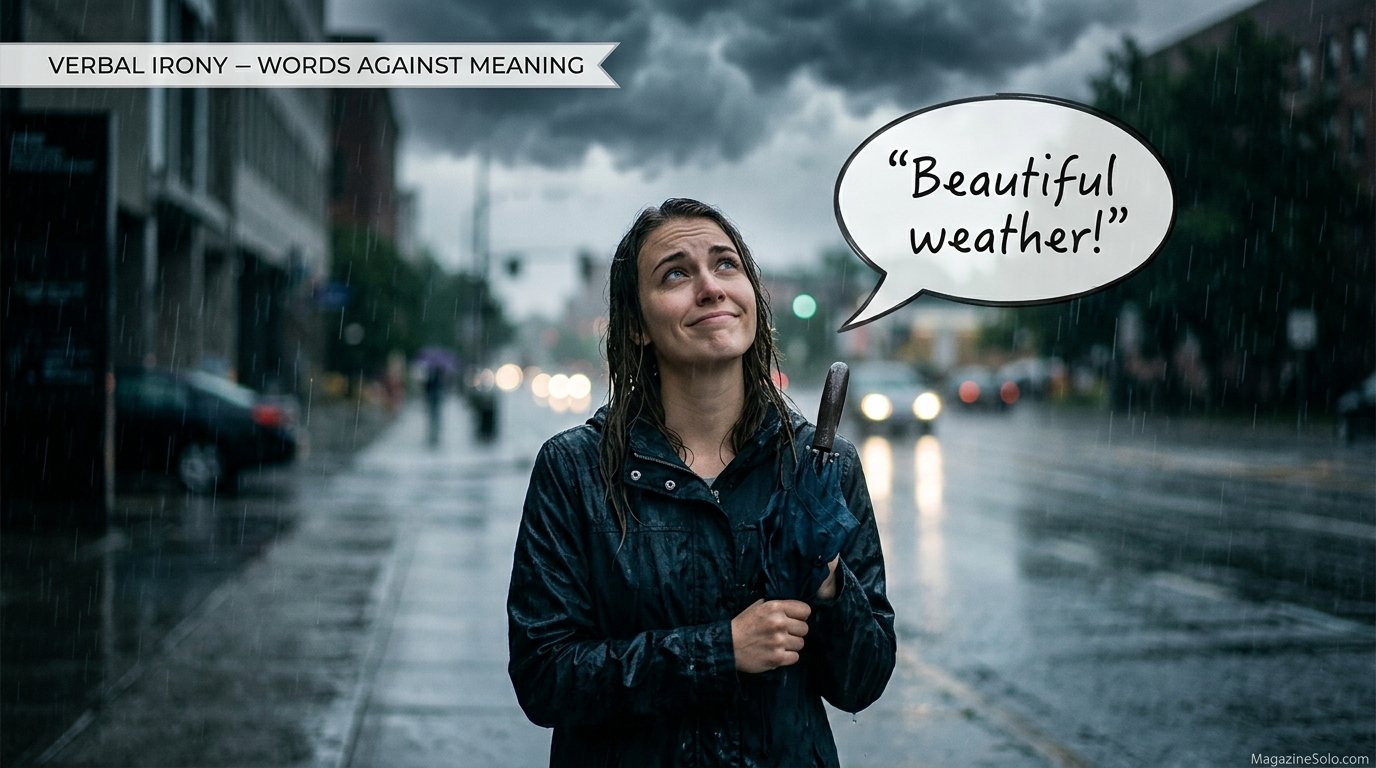
Irony is the noun, the device or the situation; ironic is the adjective, describing a remark, an outcome, or a style. Same family, different jobs, like the fused spellings graded on a lot vs allot vs alot.
Pronunciation splits the pair: irony is three syllables, EYE-ruh-nee, stressed on the first; ironic moves the stress, eye-RON-ik, the detail learners most often miss.
Frequently Asked Questions
1. What does irony mean?
Irony is a gap between what is expected or appears and what actually is or happens. Merriam-Webster’s usage note frames its forms around reversal and incongruity, and Wikipedia defines it as a juxtaposition of what appears to be the case with what actually is. The gap takes three standard forms: words, outcomes, and knowledge.
2. What are the three types of irony?
Verbal, situational, and dramatic. Verbal irony is saying the opposite of what is meant. Situational irony is an outcome opposite to what was reasonably expected. Dramatic irony is the audience knowing what a character does not. LitCharts, LitDevices, Khan Academy, and the Macmillan glossary all teach this same three type frame.
3. What is verbal irony?
Verbal irony is a statement in which the meaning the speaker intends is sharply different from, usually opposite to, the meaning the words literally express. Britannica describes the literal, ostensible meaning of words contradicting their actual meaning. The classic classroom case is praising a storm as beautiful weather.
4. What is situational irony?
Situational irony is an outcome that reverses what was reasonably expected or intended. Merriam-Webster’s own example is a person who sidesteps a pothole to avoid injury and steps into another pothole, injuring themselves: the action taken to prevent the outcome produces it. The reversal, not the surprise, earns the label.
5. What is dramatic irony?
Dramatic irony is a knowledge gap: the audience knows something a character does not, and watches the character act on the wrong picture. Britannica stresses that it depends on the structure of a work rather than its words. Merriam-Webster’s example is Romeo and Juliet: the audience realises the lovers’ plans will go awry.
6. What is the difference between irony and coincidence?
A coincidence is two events meeting unexpectedly, with no expectation reversed. Merriam-Webster states the boundary directly: uses of irony for cases lacking a striking reversal, such as the call that comes just as you planned to make it, are more properly called coincidence. LitDevices gives the matching test: merely surprising, with no meaningful reversal, means coincidence.
7. Is bad luck irony?
Not by itself. Bad luck is an unwanted outcome; irony needs an outcome that reverses a reasonable expectation or an intention. Rain on a wedding day is the standard non-example in the Morissette debate: nothing about a wedding creates an expectation of dry weather that the rain reverses. The reversal test grades any claimed case.
8. What is the difference between irony and sarcasm?
Sarcasm is verbal irony with a target and a sting. A scholarly abstract states the narrow version: verbal irony communicates the opposite of what is said, while sarcasm is irony directed at a person, with the intent to criticise. Dictionary.com’s synonym note agrees from the other side: sarcasm uses ridicule harshly, often for destructive purposes.
9. Is sarcasm a type of irony?
On the narrow definition, yes: sarcasm is the mocking branch of verbal irony. The Macmillan glossary calls sarcasm a strong form of verbal irony calculated to hurt, for example through false praise. LitDevices adds the honest caveat that broader usage also counts cutting remarks that mean what they say, so this page keeps the two strands separate.
10. What is the difference between irony and paradox?
A paradox is a statement that seems self contradictory yet may hold a truth; irony is a gap between expectation or appearance and reality. LitDevices separates them with a test: is an apparently contradictory idea being explored, rather than a surface meaning overturned? The more choices she gained, the less free she felt is paradox. A fire station burning down is irony.
11. What is the difference between irony and hypocrisy?
Hypocrisy is a person professing standards they do not follow; irony is a reversal or gap that nobody has to intend. LitDevices files its Casablanca example under ironic hypocrisy: Captain Renault condemns gambling, then pockets his winnings. A hypocrite caught by his own words produces irony; hypocrisy alone, unexposed, is not yet irony.
12. What is Socratic irony?
Socratic irony is the classical, rhetorical sense: feigning ignorance and asking probing questions to expose an opponent’s ignorance. Merriam-Webster lists it as one of irony’s two formal uses, a tool used in debating. Britannica traces it to the Platonic dialogues and to the Greek comic character Eiron, the clever underdog who triumphs over the boastful Alazon.
13. Are there more than three types of irony?
Yes, in the scholarly record, and the strands must not be merged into a fake single taxonomy. Wikipedia notes that academic reference volumes standardly include at least verbal, dramatic, cosmic, and Romantic irony as major types. School and study sites teach three. This page teaches the three as the working system and labels the rest as the extended classical set.
14. What is cosmic irony?
Cosmic irony, also called the irony of fate, is the extended type in which fate, the gods, or the universe itself appears to defeat human hopes and plans. The Macmillan glossary defines it as a writer using God, destiny, or fate to dash the hopes and expectations of a character or of humankind in general. It belongs to the extended taxonomy, not the core three.
15. What is tragic irony?
Tragic irony is dramatic irony inside a tragedy, where the audience’s extra knowledge points at a catastrophe the character cannot see. The Macmillan glossary gives Oedipus the King: Oedipus searches for the person responsible for the plague on his city and is, without knowing it, hunting himself. Merriam-Webster pairs the terms directly, calling the dramatic form dramatic irony or tragic irony.
16. What is an example of dramatic irony in Romeo and Juliet?
The ending. The audience knows Juliet is alive in a drugged sleep; Romeo does not, and acts on the belief that she is dead. Merriam-Webster uses exactly this anchor: dramatic irony is what happens when the audience realises that Romeo and Juliet’s plans will go awry. Study guides teach the same case.
17. What is an example of dramatic irony in Oedipus Rex?
Oedipus vows to find and punish the killer of the former king, and the audience, who know the myth, understand that he is cursing himself. The Macmillan glossary states it plainly: Oedipus searches for the person responsible for the plague and ironically ends up hunting himself. Every step toward the truth is a step toward his own exposure.
18. Why is The Gift of the Magi an example of situational irony?
Because each gift defeats itself. Della sells her hair to buy Jim a chain for his prized watch; Jim sells the watch to buy Della combs for her hair, as LitCharts summarises the story. Khan Academy teaches the same reading: the lengths each went to for the other ruined each other’s gifts, and everyone in the story is aware of the discrepancy.
19. Is a fire station burning down ironic?
Yes, on the standard test, and it is the textbook example. A fire station is the place whose whole purpose and equipment exist to prevent and fight fires, so its burning reverses a reasonable, specific expectation rather than merely surprising us. The Macmillan glossary uses exactly this shape: it is ironic for a firehouse to burn down, or for a police station to be burglarized.
20. Is Alanis Morissette’s song Ironic actually ironic?
Mostly not, on the reversal test, and the debate itself is the cultural record. Critics since 1995 have argued the scenarios are coincidence and misfortune rather than irony; Book Riot grades them line by line and fails most of them. Morissette later performed an updated version with James Corden in 2015 whose new lyric concedes the point, as Entertainment Tonight reported. This page grades each example separately.
21. Is rain on your wedding day ironic?
No, not without more. It is the most debated line in the Morissette song, and the critics’ verdict is consistent: bad luck, not irony, because a wedding sets no expectation about weather that rain reverses. Merriam-Webster’s own social explainer draws the contrast: rain on a meteorologist’s wedding day, after she predicted sun, is ironic, because a specific professional expectation is reversed.
22. Is ten thousand spoons when all you need is a knife ironic?
It is the strongest candidate in the song, and still borderline. Book Riot calls it probably the most solid irony in the lyrics, because abundance of the wrong tool against absence of the right one has an opposition shape. Copyblogger sharpens it: ten thousand spoons in the break room of a cutlery factory would be ironic, because the setting creates the expectation the outcome defeats.
23. How can you tell if something is really ironic?
Run the reversal test. Name the expectation: what did the words, the plan, or the situation lead a reasonable person to expect? Name the reality: what actually is or happened? If the reality reverses the expectation, it is irony, and the type follows from where the gap sits. If you cannot name a reversed expectation, it is coincidence, misfortune, or paradox instead.
24. What is an example of irony in everyday life?
A marriage counsellor filing for divorce, a pilot with a fear of flying, or the cobbler’s children having no shoes: in each, a person’s role or effort creates a specific expectation that the outcome reverses. Everyday claims fail the test more often than they pass it, which is why Merriam-Webster notes irony has been used imprecisely, often for coincidence, for almost a hundred years.
25. How do you use irony in a sentence?
Name the gap; do not just attach the word. The Cambridge pattern runs: the irony is that the new tax system will burden those it was intended to help, stating the intention and the reversed result. Weak use says how ironic about a coincidence; strong use shows the expectation and its reversal in the same breath.
26. How do you pronounce irony?
EYE-ruh-nee, three syllables, stress on the first. Dictionary.com gives the American pronunciation in its own respelling, and LitDevices prints the learner form EYE-ruh-nee. Merriam-Webster supplies a pronunciation audio file for the entry, named in its page data.
27. How do you pronounce ironic?
Eye-RON-ik, with the stress moving to the second syllable, unlike irony itself. The stress shift between irony and ironic is the part learners most often miss, and it is worth learning explicitly: the noun leans on its first syllable, the adjective on its second.
28. What is the difference between irony and ironic?
Word class. Irony is the noun, the device or the situation: the irony is that. Ironic is the adjective, describing a remark, a situation, or a style: an ironic comment, an ironic outcome. Merriam-Webster’s thesaurus defines ironic as marked by wit in which words express something different from their literal meaning, while the noun entry carries the full taxonomy.
29. Where does the word irony come from?
From Greek eironeia, dissimulation, sarcasm, understatement, through Latin ironia. Dictionary.com’s etymology records it as first recorded in 1495 to 1505, built on eiron, a dissembler. Wikipedia dates the concept to 5th century BCE Greece, and Britannica adds the theatrical root: the Eiron, a clever underdog who by wit triumphs over the boastful Alazon.
30. What does ‘the irony is that’ mean in conversation?
It is a flag phrase: the speaker announces that an expectation is about to be reversed. Used well, the clause that follows names both sides, as in the tax example above. Used loosely, it introduces a mere coincidence, which is the imprecise use Merriam-Webster documents. The phrase is a promise; the sentence after it has to keep it.
31. What is the difference between irony and satire?
Satire is a purpose, irony is a mechanism. Satire criticises folly, vice, or institutions, often by using irony as its tool. LitDevices puts it as a test: is the larger purpose to expose a social or institutional fault? Then satire is at work. Britannica closes on the same note: irony is among the most powerful devices used in satire.
32. What is the difference between irony and a lie?
A lie intends the hearer to believe the false surface; verbal irony intends the hearer to see through the surface to the opposite meaning. If the audience is meant to be deceived, it is lying; if the audience is meant to catch the reversal, it is irony. The University of Chicago glossary adds the caution: irony only works when the reader is looking for the double meaning.
33. Can irony be unintentional?
Yes, in the situational and dramatic forms, where nobody designs the gap. A statement can also become dramatically ironic against the speaker’s intention: study sources note that sincere speech becomes dramatically ironic when the audience knows more than the speaker. Deliberate verbal irony, by contrast, requires a speaker who means the opposite of the words.
34. Is a plot twist the same as irony?
No. A twist is any surprising turn; irony is a turn that reverses a specific expectation the work has built. A surprise alone earns no marks as irony; show what the text led you to expect. A twist that merely shocks is surprise. A twist that makes the hero’s own plan produce the outcome he feared is situational irony.
35. Why do writers use irony?
For scrutiny, character, tension, and feeling, in the study account this page adapts. Irony makes readers test a confident voice against the evidence, exposes pretence faster than description can, lets readers fear a danger a character cannot see, and can make a reversal tender rather than cruel, as in O. Henry’s gifts. Britannica adds that irony emphasises the multilayered, contradictory nature of experience.
36. How do you identify irony in a text for an exam?
Name both sides of the gap in writing. The three question method asks: what does the passage first invite you to believe, what evidence cuts against that belief, and what does the gap do? The quick check is a sentence frame: I expect or hear one thing, but the text shows another. If you cannot name both sides, the label is not earned yet.
37. What is verbal irony in everyday speech?
It is the daily form of the device: saying great weather into a storm, or brilliant planning to the friend who forgot the tickets. The words praise; the situation and tone reverse them. When the remark is aimed to make someone feel foolish, everyday speech crosses from verbal irony into sarcasm, which is the boundary the comparison section teaches.
38. Is ‘isn’t it ironic that we met here’ correct usage?
On the strict record, no: it is the textbook misuse. Merriam-Webster uses almost this exact sentence shape, the call that comes just as you planned to make it, as its example of a use lacking a striking reversal, more properly called coincidence. The dictionary also records that the loose use is now common, so the position here is precise: understood everywhere, graded as coincidence by the test.
39. What is the difference between dramatic irony and situational irony?
Who holds the gap. In situational irony, an outcome reverses an expectation, and everyone, characters included, can see it once it happens. In dramatic irony, the awareness is unevenly distributed: the audience knows what the character does not, and the effect is tension while the character walks toward the truth.
40. What are synonyms for irony and ironic?
Merriam-Webster’s thesaurus lists humor, repartee, sarcasm, satire, and wit as synonyms of the noun, while noting that irony specifically applies to expression whose intended meaning is opposite to what is seemingly expressed. For the adjective it lists sarcastic, sardonic, and satiric. The synonyms overlap; none covers the situational and dramatic senses.
41. Is irony the same in British and American English?
The definitions match; the stereotype differs. The dictionaries on both sides record the same senses, and Dictionary.com prints parallel American and British entries for the word. What varies is reputation: dry, understated verbal irony is culturally associated with British humour in popular discussion. This page flags that as a cultural strand from commentary, not a dictionary sense.
42. What is the difference between irony and understatement?
Understatement is one tool inside verbal irony’s kit, not a synonym for the whole device. Greek eironeia itself is glossed by Dictionary.com as dissimulation, sarcasm, understatement, which shows how old the overlap is. Saying a bit of a problem about a catastrophe understates; irony begins when the statement’s real meaning reverses its surface, which understatement alone does not require.
Conclusion
What does irony mean is a question with a test attached. The word names a reversal: an expectation or appearance turned back by reality, in words, in outcomes, or in who knows what. Run the reversal test before you label any case: name the expectation, name the reality, and keep the word only where the second reverses the first. Where nothing is reversed, coincidence and bad luck are the honest words.
The neighbouring verdicts live across MagazineSolo: the sibling page what does literally mean settles its two senses with a substitution test, and pairs like adverse vs averse and all together vs altogether are decided the same way.

Dilawar is a content writer at MagazineSolo, covering travel, home improvement, interior design, and everyday lifestyle topics. He enjoys researching practical solutions, exploring travel destinations, and sharing helpful guides that make daily life easier. His writing focuses on clear information, useful advice, and engaging stories for a wide audience.


