
What Does Affect Mean? One Spelling, Four Jobs

What does affect mean is a question with four answers, because one spelling does four different jobs in English, and only one of them is the meaning most people are looking for.
The main job is the influence verb. To affect something is to act on it, change it or influence it, as when weather affects a harvest or evidence affects a verdict.
Three more jobs hide behind the same letters. Affect also names the verb that moves feelings, the verb that means pretend or put on, and a psychology noun for visible emotion.
The stress tells you which job is working. The three verbs are all pronounced uh-FEKT, while the noun moves the stress forward to AFF-ekt, a memory hook this page uses throughout.
A famous neighbor explains the confusion. Effect sits one letter away, and the pair rule is stated once here, in a short boundary section, because the decision system belongs to another page.
Quick Answer: One Spelling, Four Jobs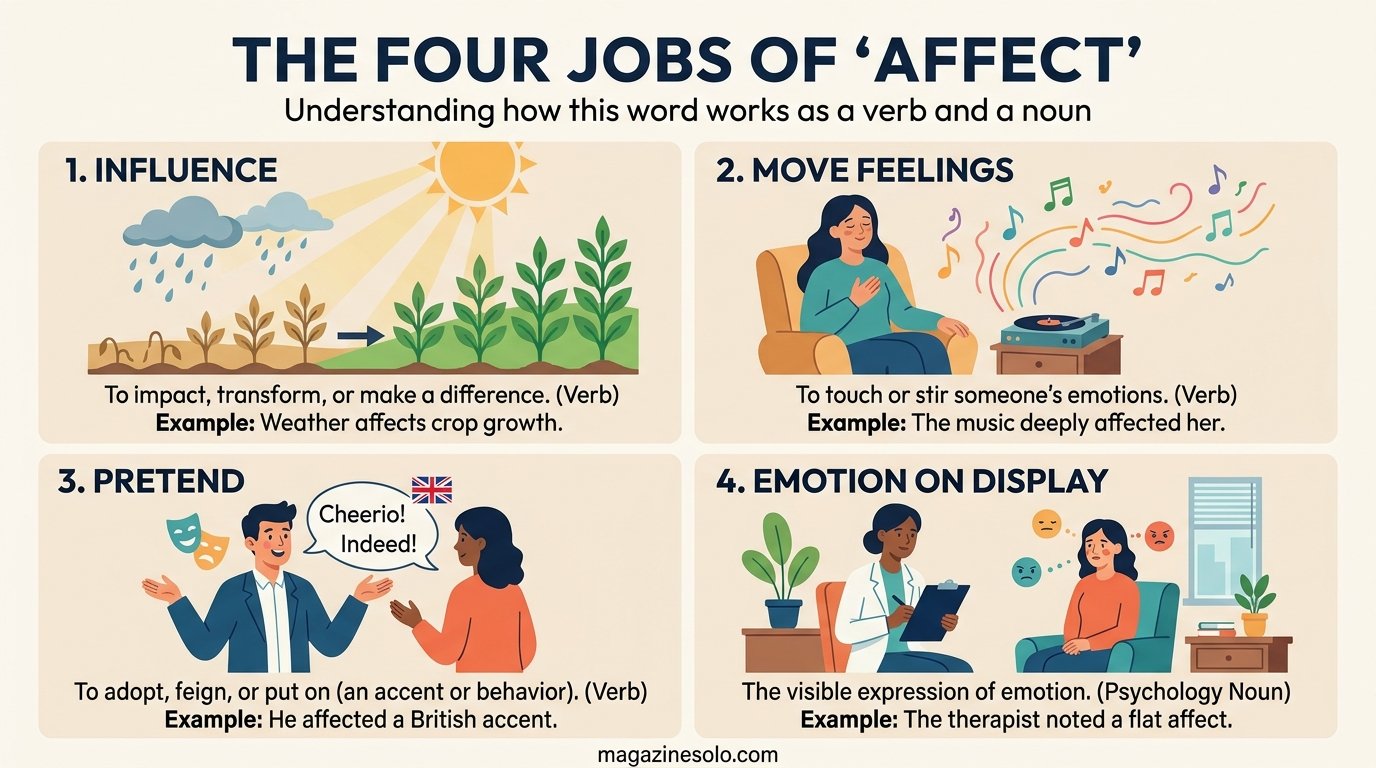
Affect is mostly a verb meaning to influence or cause a change. Merriam-Webster’s headword gloss for the main verb is to produce an effect upon someone or something.
The four jobs fit in one small table. Read down it once and the rest of this page is detail: sub-senses, pronunciations, word history and an example bank for each job.
|
Job |
Part of speech |
Core meaning |
Sound |
|---|---|---|---|
|
Influence |
Verb |
To act on, change or influence something |
uh-FEKT |
|
Move feelings |
Verb |
To produce an emotional response in someone |
uh-FEKT |
|
Pretend or adopt |
Verb |
To put on, feign or cultivate by preference |
uh-FEKT |
|
Emotion on display |
Noun, psychology |
The observable showing of an experienced emotion |
AFF-ekt |
Which job you met depends on the sentence around it. A disease affecting joints is job one, a film deeply affecting viewers is job two, an affected accent is job three.
The noun appears almost only in clinical writing. Outside psychology and psychiatry notes, a noun slot after the or an nearly always belongs to effect, not affect.
Job One: The Influence Verb
The influence verb is the word’s home ground. Merriam-Webster files it as verb (1), a transitive verb that takes a direct object: you affect the outcome, the price, the decision, the result.
Its first sub-sense is acting on something and changing it. Ocean currents affect the weather is the dictionary’s own example, and the pattern holds for traffic, crops, sleep and concentration.
Its fourth sub-sense is influence in the softer sense. Merriam-Webster’s example has people trying not to let emotions affect their decision, where nothing physical changes but a choice is steered.
The passive form does much of the everyday work. To be affected by something is to have it act on you, and Oxford notes the verb appears often in exactly that passive frame.
Its partners are predictable, which helps learners: the Oxford Learner’s Dictionary of Academic English entry for affect lists the collocations affect the outcome, the rate, the quality, the ability and the performance, with adverbs like adversely, significantly, severely, directly and indirectly.
Example bank A: the influence verb at work. Each sentence below is quoted from a fetched dictionary or guide, with its source named, except the last one, which is constructed here.
- “Ocean currents affect the weather.” Merriam-Webster.
- “The new evidence will affect the outcome of the trial.” Merriam-Webster usage guide.
- “Both buildings were badly affected by the fire.” Cambridge.
- “The divorce affected every aspect of her life.” Cambridge.
- “Many countries were severely affected by the financial crisis.” Oxford.
- “Cold weather affected the crops.” Collins.
- “The rain affected their camping plans.” Britannica.
- “Lack of sleep affects my concentration the next day.” Constructed for this page.
The Disease Sub-Sense: When Affect Means Attack
One sub-sense deserves its own heading because explainers skip it. Merriam-Webster’s sub-sense 1b is to cause illness or symptoms in, as in a disease that affects millions of patients each year.
Oxford gives the same job its own numbered sense. Its example is clinical: rheumatoid arthritis is a chronic disease that predominantly affects synovial joints, a sentence no influence paraphrase quite replaces.
Collins files it as its third verb sense. The wording there is to attack or lay hold of, said of pain or disease, which is stronger language than influence and deliberately so.
Example bank B: the disease sub-sense. The pattern is a condition in the subject slot and a body, organ or population in the object slot.
- “A disease that affects millions of patients each year.” Merriam-Webster.
- “It is a disease that affects mainly older people.” Cambridge.
- “Rheumatoid arthritis is a chronic disease that predominantly affects synovial joints.” Oxford.
- “She has a disease that affects her muscles.” Britannica.
- “The infection affects only the outer layer of skin.” Constructed for this page.
Job Two: The Verb That Moves Feelings
The second job is producing an emotional response. An experience that affected him powerfully is Merriam-Webster’s example, and being deeply affected by news, music or a film is this verb at work.
The dictionaries agree the job exists and disagree where to file it. That filing disagreement is itself worth printing, because it explains why short definitions of affect feel incomplete.
|
Dictionary |
Where the emotional sense is filed |
How wide it runs |
|---|---|---|
|
Merriam-Webster |
Sub-sense 1c of the influence verb |
Any emotional response |
|
Oxford |
Its own sense 3 |
Narrowed to sadness: makes you feel very sad |
|
Cambridge |
Folded inside the INFLUENCE sense |
Shown by example, not split out |
|
Collins |
Verb sense 2 of affect 1 |
To impress the mind or move the feelings |
Merriam-Webster splits it out as sub-sense 1c. Its citations include Elsa Dixler’s line about traveling to Cuba and being deeply affected by what she saw there.
Oxford narrows the same sense to sadness. Its example is Kennedy was deeply affected by the death of his third child, a grief context the sadness wording fits exactly.
Cambridge folds it into influence instead. I was deeply affected by the film sits inside the INFLUENCE block, glossed in parentheses as it caused strong feelings in me.
This page teaches it as its own job anyway. Readers meet deeply affected as a distinct meaning, whatever the filing, and the example bank below treats it separately for that reason.
Example bank C: the emotionally move verb. Notice how often deeply, greatly and powerfully travel with this sense; the adverbs are part of its fingerprint.
- “An experience that affected him powerfully.” Merriam-Webster.
- “She traveled to Cuba and was deeply affected by what she saw.” Merriam-Webster, citing Elsa Dixler.
- “Kennedy was deeply affected by the death of his third child.” Oxford.
- “I was deeply affected by the film.” Cambridge.
- “The music affected him deeply.” Collins.
- “The townspeople were greatly affected by the terrible news.” Britannica.
- “The letter affected her more than she expected.” Constructed for this page.
Job Three: The Pretend and Adopt Verb
The third job is a separate verb wearing the same spelling. Merriam-Webster’s verb (2) means to put on a false appearance of something: to pretend to feel, have or do it, to feign it.
Its textbook examples are performances. He affected a French accent is the dictionary’s own sentence, and affect indifference and affect surprise show the verb taking feelings as its stage props.
Britannica teaches the same sense with a bracketed gloss. He affected concern for his coworkers, the entry explains, means he pretended to be concerned after the pay cuts were announced.
Example bank D, part one: the pretend verb. The giveaway is the object: an accent, an air, an indifference, something a person could put on like clothing.
- “He affected a French accent.” Merriam-Webster.
- “Affect indifference; affect surprise.” Merriam-Webster.
- “He affected concern for his coworkers.” Britannica.
- “To affect knowledge of the situation.” Collins.
- “To affect a Southern accent.” Collins.
- “She affected a calm she did not feel.” Constructed for this page.
The Adopt Sub-Sense: Preference, Not Pretense
A softer branch of this verb is about preference. Merriam-Webster’s sub-sense 2a covers what someone often or usually wears or has: to be given to a preferred style of dress or speech.
Its examples are wardrobe and manner, not deception. Affect brightly colored clothing, affect a precise way of speaking, and the citation about Chang affecting the beard and long robe of an ancient scholar.
Sub-sense 2b adds display to the preference. To make a display of liking or using something, to ostentatiously cultivate a quality, as in affect a worldly manner, is the showier end of the same verb.
Collins spreads this verb across six senses. Its affect 2 runs from pretend and assume artificially to use or adopt by preference and to assume the character of, as in affect the freethinker.
The adjective from this verb is a small insult. An affected accent or manner is artificial and put on for show, while an affecting story is the opposite compliment: one that moves the feelings.
The Archaic Tail: Love, Tend, Frequent, Aspire
Merriam-Webster keeps four older senses of this verb, labeled archaic. They are to have affection for, to tend to have a quality, to frequent a place or company, and to aspire to something.
The citations are a small literary museum. Newton wrote of drops of fluid that affect a round figure, Hardy and Hazlitt supply the frequenting sense, and Dryden supplies the aspiring sense.
Collins British adds two nature senses of its own. Of plants or animals, to live or grow in a place, as in penguins affect an arctic climate, and to incline naturally toward a form.
Modern readers meet these only in older texts. The tail matters for reading, not for writing: nobody composing today should reach for affect meaning love or frequent, and the dictionaries label it accordingly.
Job Four: The Psychology Noun, AFF-ekt
The fourth job changes both grammar and sound. As a noun, affect is a technical term in psychology and psychiatry, and the stress moves to the first syllable: AFF-ekt, never uh-FEKT.
Merriam-Webster gives the noun two linked senses. The first is a set of observable manifestations of an experienced emotion: the facial expressions, gestures, postures and vocal intonations that typically accompany an emotion.
The second sense is the emotion as consciously felt. Positive affect encompasses all good emotions, such as joy, bliss, love and contentment, is the entry’s example of the noun naming the inner state itself.
Collins adds the psychiatry framing in plain words. Its noun senses run from feeling or emotion to an expressed or observed emotional response, with restricted, flat or blunted affect named as clinical vocabulary.
The noun names display, not private feeling alone. That is why clinicians record it: a patient’s affect is what can be observed and written down during an examination, as WebMD’s flat affect explainer and Healthline’s blunted affect explainer describe in their clinical coverage.
The Display Scale: Flat, Blunted, Constricted, Labile, Inappropriate
Clinicians grade the display on a rough scale. The terms below come from the health sources that teach this layer, WebMD and Healthline, and they describe expression only, never a diagnosis of any reader.
|
Term |
What the display looks like |
Source strand |
|---|---|---|
|
Flat affect |
Total or near absence of appropriate emotional responses |
WebMD |
|
Blunted affect |
Emotions are felt but only some show, at reduced intensity |
Healthline |
|
Constricted affect |
A narrowed range of expression, a lesser degree than blunted |
Healthline |
|
Labile affect |
Sudden, exaggerated, unpredictable shifts of expression |
Health sources |
|
Inappropriate affect |
A reaction that does not fit the situation, like smiling at bad news |
Health sources |
Flat and blunted are degrees, not synonyms. Healthline prints the continuum in severity order, flat, blunted, constricted, and WebMD notes a person with flat affect may feel an emotion strongly and show nothing.
Affect is not the same as mood. Helpful Professor’s types of affect survey draws the standard line: affect is the emotion shown in the moment, while mood is the longer lasting state underneath it.
Reduced display is not missing feeling. The Wikipedia article on reduced affect display separates reduced affect display from apathy and anhedonia: the noun is about expression, and expression can fall quiet while sensation continues.
This section is vocabulary, not medical guidance. It explains what clinicians mean by the word affect so readers can follow health writing; it offers no diagnosis, no assessment and no advice about any person.
Example bank E: the noun in its natural habitat. Every example sits in a clinical or academic frame, which is exactly the point: outside those frames the noun barely appears.
- “The patient had a flat affect.” Merriam-Webster, inside its entry FAQ.
- “Notes detailing the patient’s affect.” Merriam-Webster usage guide.
- “Restricted, flat, or blunted affect may be a symptom of mental illness.” Collins usage material.
- “Positive affect encompasses all good emotions, such as joy, bliss, love, and contentment.” Merriam-Webster.
- “The clinician noted a blunted affect throughout the interview.” Constructed for this page.
Pronunciation: The Stress Moves With the Job
One pronunciation rule covers the whole word. Every verb job is uh-FEKT, with the stress on the second syllable and a schwa in the first, recorded the same way by Collins and by the Cambridge Dictionary entry for affect.
The noun is the single exception in sound. AFF-ekt puts the stress on the first syllable, and Merriam-Webster’s usage guide flags exactly that: the noun is pronounced with stress on the first syllable.
|
Form |
Pronunciation |
Stress |
|---|---|---|
|
affect, all verb senses |
uh-FEKT, /uh-fekt/ |
Second syllable |
|
affect, psychology noun |
AFF-ekt, /af-ekt/ |
First syllable |
|
effect, noun and verb |
ih-FEKT in Grammar Girl’s rendering |
Second syllable |
One entry prints both pronunciations on a single headword: the Dictionary.com entry for affect, carrying the Collins American text lists uh-fekt and af-ekt side by side, because one spelling is carrying two parts of speech with two different sounds.
One recorded variant softens the noun rule. Collins British prints the noun with the verb style pronunciation as a variant, so AFF-ekt is the standard clinical sound, not an absolute law of speech.
Whether affect and effect sound different is disputed. Grammar Girl’s affect versus effect guide holds the pair is pronounced differently, affect opening with an A sound and effect with an I sound in her rendering.
A journalism strand disagrees in practice. The CUNY journalism guide to affect or effect says the two words sound exactly alike in normal speech, unless a teacher exaggerates the difference to make a point, and both strands stand here unmerged.
Teach the stress shift as the hard fact. Every dictionary agrees the noun moves its stress; the vowel difference between affect and effect is a tendency some speakers hear and others never do.
Word History: Two Latin Compounds, One Shared Piece
Affect and effect are near twins with different birth certificates. Both are built on Latin facere, to do or make, but they arrive through different compounds, and the difference still predicts their modern jobs.
The influence verb comes through afficere. Merriam-Webster traces it from Latin affectus, past participle of afficere, to produce an effect on or exert influence on, built from ad-, toward, plus facere.
The pretend verb is a third borrowing, not a branch. It comes through affectare, to try to accomplish, strive after or pretend to have, the frequentative of afficere, which is why Collins treats affect 2 as its own headword.
The noun has a German chapter in its story. Merriam-Webster’s headnote for the modern psychology sense records German Affekt, borrowed from Latin affectus, because the technical term re-entered English through German psychological writing.
Effect arrives through the opposite prefix. Its line runs from effectus, from efficere, to make, construct, bring about or carry out, built from ex-, out, plus the same facere, a result worked out.
Any simpler story misstates the record. The two words are not one word split in two, and they are not strangers either; shared ancestry on facere, different compounds, different borrowings, different first jobs.
The first use dates differ by word and by dictionary. They are printed here unmerged, each beside the authority that gives it, because no single invention date survives checking.
|
Dating |
Authority |
What it dates |
|---|---|---|
|
15th century |
Merriam-Webster |
First known use of affect, verb |
|
1350 to 1400 |
Collins |
Formation of affect 1 |
|
15th century |
Collins |
Affect 2, the pretend verb, from affectare |
|
17th century |
Collins British |
The noun’s psychology sense, from affectus |
|
14th century |
Merriam-Webster |
First known use of effect, noun |
|
1533 |
Merriam-Webster |
First known use of effect, verb |
The Famous Neighbor: Affect and Effect, Stated Once
Here is the pair rule, stated once, in full. Affect is usually the verb, to influence or change; effect is usually the noun, a result or consequence, and thinking of it that way covers most sentences.
The mnemonic the field teaches is RAVEN. Remember, Affect Verb, Effect Noun: the device is taught by Grammar Girl’s affect versus effect guide and repeated by Dictionary.com, and it resolves the great majority of everyday choices.
Two exceptions exist, and both are narrow. Effect works as a formal verb meaning to bring about, and affect works as the psychology noun this page has already mapped in its own section above.
The sharpest framing of the verb exception is the MLA’s. The MLA Style Center’s affect or effect essay, quoting Garner, puts it this way: to effect something is to bring it into existence; to affect something is to influence something that already exists.
Collins adds the refinement nobody else states. Its usage note warns that affect 2, the pretend verb, is never a noun, so the noun exception belongs to the psychology word alone and to nothing else in this spelling.
How absolute the rule is depends on the authority. Garner’s strand, quoted by the MLA, says in ordinary usage affect is always a verb, while Merriam-Webster and Britannica hedge with most often, usually and typically.
The sentence level decision system lives on the pair page. Tests, drills, corrected sentence pairs and phrase by phrase exception handling are the work of our affect vs effect guide, and this page hands off there rather than rebuilding them.
Example bank F: the pair in miniature. Three items only, because the full pair bank belongs to the pair page; these show the chain, one corrected error and the one famous exception phrase.
- “Something that affects a person has an effect on them.” Merriam-Webster, the causal chain in one line.
- “I think that had a big affect on my ability,” corrected to effect in the CUNY guide’s student writing examples.
- “Policies that can effect change.” Merriam-Webster, the verb exception in its canonical phrase.
False Friends and Loose Ends
Affected the adjective is a different word in practice. An affected accent is a put on one, from the pretend verb, while an affected community in a news report is an influenced one, from the first verb.
Affection and affectation split the family in two. Affection is genuine fondness, from the old feeling side of the word, while affectation is a deliberate display put on to impress, from the pretending side.
Disaffected belongs to the influence family. A disaffected voter is one whose loyalty has been acted on and lost, and affectability and affectable are Merriam-Webster’s derived forms for the main verb’s capacity.
Impact is not a safe hiding place. Grammar Girl warns that writers who cannot decide reach for impact instead, which besides having problems of its own is also vague, a strand worth heeding before dodging the choice.
There is no slang sense of affect. None of the fetched dictionaries records one, so pages claiming a slang meaning are inventing it; the word’s registers run from clinical and academic to ordinary, never slang.
Affect is a B2 word in its main sense. Cambridge marks the influence sense at CEFR level B2, which makes it mid level vocabulary carrying an unusually tangled set of extra jobs for learners to meet later.
Where This Page Sits in the Word Cluster
This page owns the definition layer for affect. The pair decision lives with its owner, and the wider shelf of meaning guides applies the same discipline: name the deciding system first, then show the examples.
The definition siblings set the pattern: our what does literally mean guide owns its word’s senses and labels, and our what does irony mean guide owns the figure of speech learners most often meet beside this one in class.
The spelling pair guides work the same way: our a lot vs allot vs alot guide and our a lot vs allot difference guide settle their set by grammar class, the same part of speech first habit this page teaches for affect.
Placement and scope settle the next shelf: our all ready vs already guide and our all ready vs already difference guide decide theirs by where the words sit and what they cover in the sentence.
Attitude and family pairs complete the shelf: our adverse vs averse difference guide turns on the writer’s stance, our adapt vs adopt difference guide turns on word families, and our all together vs altogether difference guide turns on grouping versus completeness.
Frequently Asked Questions
1. What does affect mean?
Affect mainly means to influence or cause a change in something. It also means to move someone emotionally, to pretend or put on a manner, and, as a psychology noun pronounced AFF-ekt, the observable display of an emotion.
2. Is affect a verb or a noun?
Affect is both, but the verb is far more common. That is Merriam-Webster’s own FAQ answer inside the entry. The noun exists almost only in psychology and psychiatry, where it names an observed emotional response.
3. What is the difference between affect and effect?
Affect is usually the verb and effect is usually the noun. Affect influences or changes something; effect names the result that follows. The full decision system, tests and exceptions live on the pair page in this cluster.
4. How do you pronounce affect?
The verb is pronounced uh-FEKT, with stress on the second syllable. Collins, Cambridge and Dictionary.com all record that sound. The psychology noun is the exception, pronounced AFF-ekt with the stress moved to the first syllable.
5. Why is the noun affect pronounced differently?
Because it is a separate technical borrowing, not the verb reused. The psychology noun re-entered English through German Affekt, from Latin affectus, per Merriam-Webster’s headnote, and its first syllable stress marks it as the clinical term.
6. When is effect a verb?
Effect is a verb when it means to bring about or accomplish. The MLA strand gives the test: to effect something is to bring it into existence, while to affect something is to influence something that already exists.
7. Can affect be a noun?
Yes, in psychology and psychiatry only. There it names an observable emotional response, as in a flat affect, and it is pronounced AFF-ekt. Collins adds that affect 2, the pretend verb, is never used as a noun.
8. What does affect mean in psychology?
In psychology, affect is the observable display of an experienced emotion. Merriam-Webster lists the facial expressions, gestures, postures and vocal intonations that accompany an emotion, plus the conscious emotion itself reacting to a thought or experience.
9. What is flat affect?
Flat affect is a total or near absence of appropriate emotional responses. WebMD’s clinical explainer uses that wording. It describes expression only: a person may feel an emotion strongly and show nothing on the surface.
10. What is the difference between flat affect and blunted affect?
They are degrees on one display scale. Flat affect is the near absence of expression; blunted affect, per Healthline, is feeling emotions but showing only some of them, at reduced intensity. Constricted affect is a still lesser narrowing.
11. What does affect an accent mean?
It means to put the accent on, to pretend or adopt it. This is the separate pretend verb: Merriam-Webster’s example is he affected a French accent, and Collins gives to affect a Southern accent the same way.
12. What does the RAVEN rule mean?
RAVEN stands for Remember, Affect Verb, Effect Noun. It is the field’s standard mnemonic for the pair, taught by Grammar Girl and repeated by Dictionary.com. It covers the usual cases; the two documented exceptions sit outside it.
13. How can I remember affect vs effect?
Use RAVEN first, then the existence test for hard cases. Affect influences something that already exists; effect as a verb creates something new. For sentence by sentence drills and tests, the pair page in this cluster owns that practice.
14. Is it affect change or effect change?
Both exist, and they report different events. Effect change means bring change into existence, the formal verb exception. Affect change means influence a change already under way. Writers who mean make it happen usually need effect change.
15. Does affect mean influence?
Yes, influence is its core meaning. Merriam-Webster’s sub-sense 1d is simply to influence, and its example is trying not to let emotions affect their decision. Influence, act on and cause a change are the same job described three ways.
16. What does it mean when a disease affects an organ?
It means the disease attacks or acts on that part of the body. This is Merriam-Webster’s sub-sense 1b, to cause illness or symptoms in. Oxford’s example is rheumatoid arthritis predominantly affecting synovial joints.
17. What does deeply affected mean?
It means strongly moved emotionally by something. This is the emotional sub-sense of the verb: Kennedy was deeply affected by the death of his third child is Oxford’s example. Oxford files this sense narrowed to sadness.
18. Is affect positive or negative?
Neither; the verb is neutral about direction. Oxford’s collocation list includes adversely, negatively and positively affect side by side. Sleep, stress, medicine and good news can all affect someone, for better or worse.
19. Can a person be affected by something good?
Yes, because the verb names the acting on, not the harm. A raise can affect a budget and a compliment can affect a mood, both positively, and Oxford lists positively affect among the verb’s standard collocations.
20. What does affect mean in simple words?
In simple words, affect means to change something or make a difference to it. Rain affects plants is the plainest pattern: one thing acts, another thing changes. As a noun in psychology it means the emotion a person shows.
21. How do you use affect in a sentence?
Put a thing that acts in front and a thing that changes behind it. Ocean currents affect the weather is Merriam-Webster’s model. The verb is transitive, so it needs a direct object: something always gets affected.
22. What are synonyms for affect?
Synonyms split by sense, so one list misleads. For influence: influence, act on, alter, sway, shape. For the emotional sense: move, touch, stir. For the pretend sense: feign, simulate, put on, assume. Match the synonym to the job.
23. What is the past tense of affect?
Affected, a regular past tense. It affects, it affected, it is affecting follow ordinary verb patterns. Do not confuse the past tense affected with the adjective affected, which means artificial or put on, from the pretend verb.
24. What does affected mean as an adjective?
As an adjective, affected means artificial and put on for show. An affected accent or an affected manner is cultivated to impress. It comes from the pretend verb, which is why it carries a mildly disapproving tone.
25. What is the difference between affection and affectation?
Affection is genuine fondness; affectation is a display put on to impress. Both grow from this word’s family, but they split along its oldest divide: real feeling on one side, performed feeling on the other.
26. Where does the word affect come from?
From Latin affectus, past participle of afficere, to act on or exert influence on. Afficere is built from ad-, toward, plus facere, to do or make. The pretend verb arrives separately, through affectare, to strive after or pretend.
27. Are affect and effect from the same Latin root?
They share one root piece but arrive through different compounds. Both rest on facere, to do or make. Affect comes through ad- plus facere, effect through ex- plus facere, so they are cousins, not one word split in two.
28. Why are affect and effect so often confused?
Because they sound alike, look alike and live in the same sentences. One thing affects another and produces an effect, so both words appear in a single breath, and their Latin compounds were near twins from the start.
29. Do affect and effect sound the same?
The sources disagree, so both strands stand. Grammar Girl holds they are pronounced differently, affect with an A sound opening, effect with an I sound. The CUNY journalism guide says they sound exactly alike in normal speech.
30. What does affect vs mood mean in psychology?
Affect is the emotion shown in the moment; mood is the longer lasting state beneath it. That is the Helpful Professor strand’s standard line. A clinician records affect from observation during a session and asks about mood across days.
31. What is positive affect?
Positive affect is the range of good emotions a person experiences and shows. Merriam-Webster’s noun example says positive affect encompasses all good emotions, such as joy, bliss, love and contentment. It is a psychology term, noun sense 1b.
32. What does side effect have to do with affect?
Side effect takes the noun effect, because it names a result. A side effect is an unintended result of a medicine or treatment. The spelling follows the pair rule: results are effects, and the acting on is the affecting.
33. Is impact a safe substitute when I cannot decide?
No, and Grammar Girl warns against exactly that dodge. Her strand says writers who cannot decide reach for impact, which besides having problems of its own is also vague. Choosing affect or effect precisely beats avoiding the choice.
34. What does affect mean in academic writing?
The same influence verb, working on outcomes, rates and performance. Oxford’s academic entry lists affect the outcome, affect the rate and affect the quality among its collocations. Academic prose also uses the passive heavily: results were affected by several factors.
35. Is affect formal or informal?
The word is neutral; its jobs carry different registers. The influence verb suits every register, the pretend verb is marked formal and mainly disapproving at Cambridge, and the noun is a technical term. No fetched dictionary labels any sense slang.
36. What does affect mean in medical terms?
Two jobs appear in medical writing. The disease sub-sense means a condition attacks or acts on the body, and the psychology noun names a patient’s emotional display during examination. Context, and the noun’s AFF-ekt pronunciation, separate them.
37. What does constricted affect mean?
A narrowed range of emotional expression, milder than blunted affect. Healthline’s continuum prints flat, blunted and constricted in that severity order. It is also called restricted affect in Collins’s clinical wording. The term describes display, not inner feeling.
38. What does labile affect mean?
Emotional expression that shifts suddenly and unpredictably. Labile affect names rapid, exaggerated changes in what a person shows, from laughter to tears without a matching change in situation. It sits on the display scale as instability rather than reduction.
39. What does inappropriate affect mean?
An emotional reaction that does not fit the situation. Smiling while reporting bad news is the standard illustration in the health sources. Like the other scale terms, it describes observed expression only and is general vocabulary, not a diagnosis.
40. Can affect be used for things, or only people?
For anything that can be acted on or changed. Weather affects crops, evidence affects verdicts, prices affect demand. The verb needs a target, not a person, although the emotional sub-sense does take people as its object.
41. What does affect the outcome mean?
It means to influence how something turns out. The outcome exists as a process under way, and the subject steers it. Oxford lists affect the outcome among the verb’s core collocations, with adverbs like significantly and directly.
42. How many meanings does affect have?
Four living jobs, plus an archaic tail. The influence verb with its disease sub-sense, the emotionally move verb, the pretend and adopt verb, and the psychology noun. Merriam-Webster additionally keeps four archaic senses of the pretend verb.
Conclusion
What does affect mean depends on which of its four jobs the sentence is running. The influence verb, the feeling verb and the pretend verb all sound like uh-FEKT, and the psychology noun alone moves its stress to AFF-ekt.
The stress is the fastest check you own. Hear the stress on the second syllable and a verb is working; hear it on the first and a clinician is naming an emotional display.
The pair decision itself belongs to its own page. Our affect vs effect guide carries the tests, the drills and the exception handling, while the wider word shelf gathered from the MagazineSolo home page applies the same system first habit to every confused pair it covers.

Dilawar is a content writer at MagazineSolo, covering travel, home improvement, interior design, and everyday lifestyle topics. He enjoys researching practical solutions, exploring travel destinations, and sharing helpful guides that make daily life easier. His writing focuses on clear information, useful advice, and engaging stories for a wide audience.


